




Abstract
This research examined the contagion of interpersonal goals through mock social media posts among Facebook users recruited from Prolific. Two pilot studies were conducted to create Facebook posts that reflected different combinations of self-image and compassionate goals. Then, in the main experiment, 775 participants were randomly assigned to view one of four posts in a 2 (self-image content) × 2 (compassionate content) between-subjects design. After viewing one of the posts, participants completed measures of prosocial and self-promoting posting intentions and inferred goals. Moderated mediation analyses revealed that perceivers inferred the relevant goals (especially in the absence of a competing goal), which in turn, predicted greater adoption of those goals. Specifically, perceivers inferred compassionate goals from compassionate content (even more so when self-image content was low), and inferring stronger compassionate goals predicted greater prosocial sharing intentions. Similarly, perceivers inferred self-image goals from self-image content (even more so when compassionate content was low), and inferring stronger self-image goals predicted greater self-promoting sharing intentions. This research suggests that interpersonal goal contagion can occur while using social media, revealing new pathways through which social media content can affect users.
Introduction
With 5 billion users spending over 2 hours a day on social media, 1 it is important to understand how people influence each other through the content they share. What people share on social media depends in part on their interpersonal goals. 2 People who want to convey a desirable image of themselves to others (a self-image goal) are more likely to share self-promoting content, whereas those who want support other people’s well-being (a compassionate goal) are more likely to share prosocial content. 2 Goals also relate to different social media experiences: people holding self-image goals report greater social comparison and envy 3 and those holding compassionate goals report more social connectedness. 4 In the current research, we examined a heretofore untested aspect of online goals: whether people adopt the goals they see others pursuing on social media.
Research on goal contagion reveals that people can catch goals from other people by viewing their goal-directed behavior.5–7 The underlying process can occur automatically and involves a) inferring the relevant goal and b) adopting and pursuing the goal. Evidence supports the idea that viewing text or video stimuli that depict behavior relevant to various goals can increase goal activation and pursuit.5,8–12 However, some studies have failed to find evidence for goal contagion13,14 and a recent meta-analysis found the overall goal contagion effect to be small and subject to publication bias. 7 It is important to consider the role of moderating variables that can affect the extent to which perceivers infer or adopt the target goal. 14 Shared group membership,8,10,11 goal appropriateness and value, 5 observed effort, 12 and gratitude 8 can increase goal contagion whereas social power 9 and goal unacceptability 5 can reduce it.
Interpersonal goal contagion has been examined in the context of close, dyadic relationships. In a longitudinal study of college roommates, people’s self-image and compassionate goals toward their roommates predicted corresponding changes in their roommates’ goals over time. 15 The contagion effect of compassionate goals was mediated through reciprocal responsiveness between roommates. This supports the idea that interpersonal goal contagion can occur between two people through multiple interactions over an extended period. However, it is unclear whether written communications directed toward a broader audience would have a similar effect. Goal contagion has not yet been tested in a social media context, but behavior16,17 and emotion 18 contagion have been found to occur in this context.
The current research aimed to examine whether interpersonal goal contagion could occur through viewing social media posts. We conducted pilot experiments to 1) generate stimuli that reflected what and how people post on social media when holding different goals and 2) ensure that perceivers could infer the relevant goals. Then, in the main experiment, we examined whether viewing these stimuli would lead people to adopt and pursue similar goals, to the extent that they inferred the relevant goals.
To disentangle the effects of self-image and compassionate goals, we used factorial designs that crossed these two goals. Past research has found that the goals can interact to predict outcomes, such that the effects of one goal are typically stronger at low levels of the other goal.15,19
Pilot 1
To develop authentic, goal-relevant social media content, we assessed how and whether people would post about different events on Facebook when holding specific interpersonal goals.
Method
All experiments were approved by Queensland University of Technology’s Human Research Ethics Committee (approval number 5367).
Participants
Four hundred participants living in the United States or Australia were recruited through Prolific. 1 Fluent English and Facebook use were set as inclusion criteria. We excluded the data from 35 participants for the following reasons: failing one or more attention checks (n = 26), not having a Facebook account (n = 5), or opting to withdraw their data (n = 4). The remaining 365 participants were balanced in terms of location (51% United States and 49% Australia) and gender (50% male, 49% female, and 1% nonbinary), and ranged in age from 18 to 84 years (M = 35.08, SD = 12.50). A power analysis indicated that our sample size of 365 participants gave us 0.80 power to detect effects as small as f = 0.15, relatively small effects. 20
Design
Participants were randomly assigned to conditions in this 2 × 2 × 2 × 2 mixed model design, with self-image and compassionate goals as between-subjects factors and event valence and domain as within-subjects factors. The dependent variables were likelihood of posting and use of linguistic categories that we thought would be related to interpersonal goals (i.e., positive tone, social referents, and prosocial behavior).21,22
Procedure
Participants were asked to imagine posting Facebook status updates about four different events (in randomized order) while holding the assigned goals. Goals were manipulated by having participants imagine they either were or were not motivated to a) support other people’s well-being (compassionate), and b) convey a desirable image of themselves to other people (self-image). For each event, participants were asked to type an actual post into Qualtrics, as they would post it on Facebook. After composing posts for all events, participants responded to manipulation checks and posting likelihood questions.
Stimuli
The events varied in valence and domain: feeling excited about winning an award at work, having a great time at a party with friends, feeling exhausted and unproductive at work, and missing a friend who passed away last year. 2
Measures
Manipulation checks assessed the extent to which (1 = not at all, 5 = to a great extent) participants were trying to support other people’s well-being (compassionate goal) and convey a desirable image of themselves to other people (self-image goal) through their posts. The likelihood questions assessed how likely participants were to post about each event when holding their assigned goals (1 = not at all likely, 5 = very likely).
Data analysis
To examine whether participants adopted the intended goals, we conducted 2 (self-image goal) × 2 (compassionate goal) Analysis of Variance (ANOVA)s on the two manipulation check items. To examine how goals affected posting behavior, we conducted 2 (self-image goal) × 2 (compassionate goal) × 2 (valence) × 2 (domain) mixed model ANOVAs on likelihood ratings and linguistic categories. When interactions involving goals emerged, we examined simple effects of goals, as the interpretation of goal main effects would be qualified by the interaction. 23
Results and Discussion
Manipulation checks
The 2 × 2 ANOVAs on the manipulation checks revealed that, as intended, participants in the high relative to low compassionate goal condition tried harder to support other people’s well-being, F(1,361) = 606.18, p < 0.001, ηp2 = 0.63, and those in the high relative to low self-image goal condition tried harder to convey a desirable image of themselves to other people through their posts, F(1,361) = 429.71, p < 0.001, ηp2 = 0.54. There were no other significant effects, all p values >0.12.
Likelihood of posting
A 2 × 2 × 2 × 2 mixed model ANOVA on likelihood ratings revealed significant valence (p < 0.001), domain, (p < 0.001), self-image goal, (p < 0.001), valence × compassionate goal (p = 0.006), valence × self-image goal, (p < 0.001), valence × domain (p < 0.001), and valence × domain × compassionate goal × self-image goal (p = 0.020) effects. To probe the four-way interaction, we examined the simple effect of each goal within levels of the other goal and event. These analyses revealed that participants with high relative to low self-image goals were more likely to post about positive events, all p values <0.01. Accordingly, we used event valence as our self-image content manipulation in subsequent studies.
Linguistic analysis
Open-ended responses were cleaned and then analyzed in Linguistic Inquiry and Word Count (2022) (LIWC-22) 24 for the use of positive tone, social referents, and prosocial behavior. The percentage of words in each category was analyzed using a 2 × 2 × 2 × 2 mixed model ANOVA. Data from 10 participants who did not write a post for one or more events were excluded.
Positive tone
Analyses revealed significant compassionate goal (p = 0.047), valence (p < 0.001), valence × compassionate goal (p = 0.006), domain × compassionate goal (p = 0.006), valence × domain (p = 0.004), valence × domain × compassionate goal (p = 0.038), and valence × domain × self-image goal (p = 0.046) effects. Simple effect analyses revealed that participants high relative to low in compassionate goals used less positive tone when posting about the positive work event and more positive tone when posting about the negative work and negative social events. Participants high relative to low in self-image goals also used a more positive tone when posting about the negative work event. Because the use of positive tone was sometimes the same for compassionate and self-image goals, and varied across events, we aimed to hold it constant within event valence when designing our stimuli for subsequent studies.
Social referents
Analyses revealed significant compassionate goal (p < 0.001), valence (p < 0.001), domain (p < 0.001), and valence × domain (p < 0.001) effects on use of social referents. Participants high relative to low in compassionate goals used more social referents.
Prosocial behavior
Analyses revealed significant compassionate goal (p < 0.001), valence (p < 0.001), domain (p < 0.001), valence × domain (p < 0.001), and valence × domain × compassionate goal (p = 0.032) effects on prosocial behavior. Simple effect analyses revealed that participants high relative to low in compassionate goals used more prosocial behavior when posting about the positive work, negative work, and negative social events.
Because those with compassionate goals used more social referents and prosocial behavior in their posts, we focused on these categories for our compassionate content manipulation in subsequent studies. The compassionate goal effects were more consistent for work events (i.e., there was no effect of compassionate goals on prosocial behavior for the positive social event), so we focused on them. We based our stimuli (see Table 1) on posts written by participants. 3
Social Media Posts with Content Related to Self-Image and Compassionate Goals
Pilot 2
Pilot 2 examined whether perceivers could infer the intended goals from our posts.
Method
Participants
As in Pilot 1, participants (N = 200) were recruited through Prolific using the same inclusion criteria, with the addition that those who had participated in Pilot 1 were not eligible. We excluded the data from 5 participants for failing one or more attention checks. For the remaining 195 participants, 51% lived in the United States and 49% in Australia; 60% were female, 37% male, and 2% nonbinary, and ages ranged from 20 to 65 years (M = 35.37, SD = 10.76). A power analysis indicated that our sample size of 195 participants gave us 0.80 power to detect small effects (f = 0.10). 20
Design
Participants were randomly assigned to conditions in this 2 × 2 mixed model design, with compassionate content as a between-subjects factor and self-image content as a within-subjects factor.
Procedure
Participants were asked to imagine seeing two posts from friends they interact with occasionally when looking through their Facebook News Feed. For each post, participants rated the author’s goals.
Stimuli
The posts from Table 1 were entered and screen-captured in Facebook, and then the author’s details were blurred out.
Measures
Participants were asked to rate (in counterbalanced order) the extent to which the person who made the post was trying to a) convey a desirable image of themselves to other people, and b) support other people’s well-being (1 = not at all, 5 = to a great extent).
Results
Perceived goals
A 2 × 2 mixed model ANOVA on perceived self-image goals revealed significant self-image content, F(1, 193) = 361.47, p < 0.001, ηp2 = 0.65, compassionate content, F(1, 193) = 4.74, p = 0.031, ηp2 = 0.02, and interaction, F(1, 193) = 32.05, p < 0.001, ηp2 = 0.14, effects. As seen in Figure 1, friends posting with high relative to low self-image content were seen holding stronger self-image goals across both levels of compassionate content (all p values <0.001), although the effect was stronger when compassionate content was low.

Effects of self-image and compassionate content on perceived self-image and compassionate goals in Pilot 2. Note: Error bars represent the standard error of the mean. There was a larger effect of high versus low self-image content on perceived self-image goals when compassionate content was low versus high, and a larger effect of high versus low compassionate content on perceived compassionate goals when self-image content was low versus high.
A 2 × 2 mixed model ANOVA on perceived compassionate goals revealed significant self-image content, F(1, 193) = 23.10, p < 0.001, ηp2 = 0.11, compassionate content, F(1, 193) = 157.87, p < 0.001, ηp2 = 0.45, and interaction, F(1, 193) = 43.81, p < 0.001, ηp2 = 0.19, effects. As seen in Figure 1, friends posting with high relative to low compassionate content were seen holding stronger compassionate goals across both levels of self-image goals (all p values <0.001), although the effect was stronger when self-image content was low. Thus, participants inferred self-image and compassionate goals from relevant content, although effects were stronger when only one goal was signaled.
Main Experiment
The main experiment examined whether perceivers adopt the inferred goal after observing relevant behavior. We use the terms compassionate content and self-image content to refer to content related to those goals in the pilot studies. We predicted that participants would infer a self-image goal when viewing a post with self-image content, especially when compassionate content was low. Inferring a self-image goal, in turn, should increase intentions to share self-promoting content. Furthermore, we predicted that participants would infer a compassionate goal when viewing a post with compassionate content, especially when self-image content was low. Inferring a compassionate goal, in turn, should increase intentions to share prosocial content. Testing this kind of moderated mediation model is consistent with current practice in the goal contagion literature.13,14
Method
Participants
We recruited 823 participants through Prolific using the same inclusion criteria as the pilot studies and excluding those who had participated in the pilot studies. We excluded 48 responses for the following reasons: missing data (n = 15), opening the study more than once (n = 13 responses from 6 participants), not having a Facebook account (n = 9), opting to withdraw their data (n = 7), and failing the attention check (n = 4). For the remaining 775 participants, 90.5% lived in the United States and 9.5% in Australia; 52% were male, 47% female, and 1% nonbinary; and ages ranged from 18 to 83 years (M = 38.21, SD = 12.74). A power analysis revealed that our sample size of 775 participants gave us 0.80 power to detect small effects (f = 0.10). 20
Design
Participants were randomly assigned to conditions in this 2 (self-image content) × 2 (compassionate content) between-subjects factorial design.
Procedure
Participants were asked to imagine seeing a post from a close friend when looking through their Facebook News Feed. We specified close friend, as past research has found that closeness (e.g., shared group membership) can increase goal contagion.8,10,11,15 Participants were told to read the post carefully as they would be asked some questions about it later in the study. After viewing the post, they were asked to complete a content sharing intentions measure and answer questions about the post they saw earlier.
Stimuli
The posts were identical to those used in Pilot 2.
Measures
We adapted a content sharing intentions measure that has previously been found to relate to interpersonal goals. 2 It includes eight scenarios in which participants imagine deciding whether to post about specific events on “Instagram” and we changed this to “Facebook.” Four of the scenarios were self-promoting: they noted that posting could benefit the self at the possible expense of others. Four of the scenarios were prosocial: they noted that posting could benefit others at the possible expense of the self. For each scenario, participants rated how likely they were to share this post on Facebook and how much they would like to share this post on Facebook (1 = not at all, 5 = very much). Reliability was high for the self-promoting (α = 0.89) and prosocial (α = 0.86) scenarios.
Participants were asked to recall the post they saw at the beginning of the study and rate the extent to which (1 = not at all, 5 = to a great extent) they thought the person who made it was trying to convey a desirable image of themselves to other people (self-image goal) and support other people’s well-being (compassionate goal). Participants were also asked multiple choice questions about where they had seen the post and who made the post.
Results
Most participants correctly recalled that the post was from a close friend (94.3%) and almost all recalled that it had appeared on Facebook (99.9%).
We conducted two moderated mediation models using Hayes’ Process procedure for SPSS (SPSS Version 27, Process Version 4.0, Process Model 7). 25 The first model tested the impact of self-image content on the likelihood of sharing self-promoting content with compassionate content as a moderator and perceived self-image goal as the mediator (see Figure 2). The overall moderated mediation was significant, index = −0.07, SE = 0.02, 95% CI [−0.12, −0.04]. There were significant indirect effects of self-image content on self-promoting sharing through perceived self-image goals when compassionate content was high, effect = 0.07, SE = 0.02, 95% CI [0.04, 0.11], and low, effect = 0.15, SE = 0.04, 95% CI [0.07, 0.22], with a stronger effect when compassionate content was low.
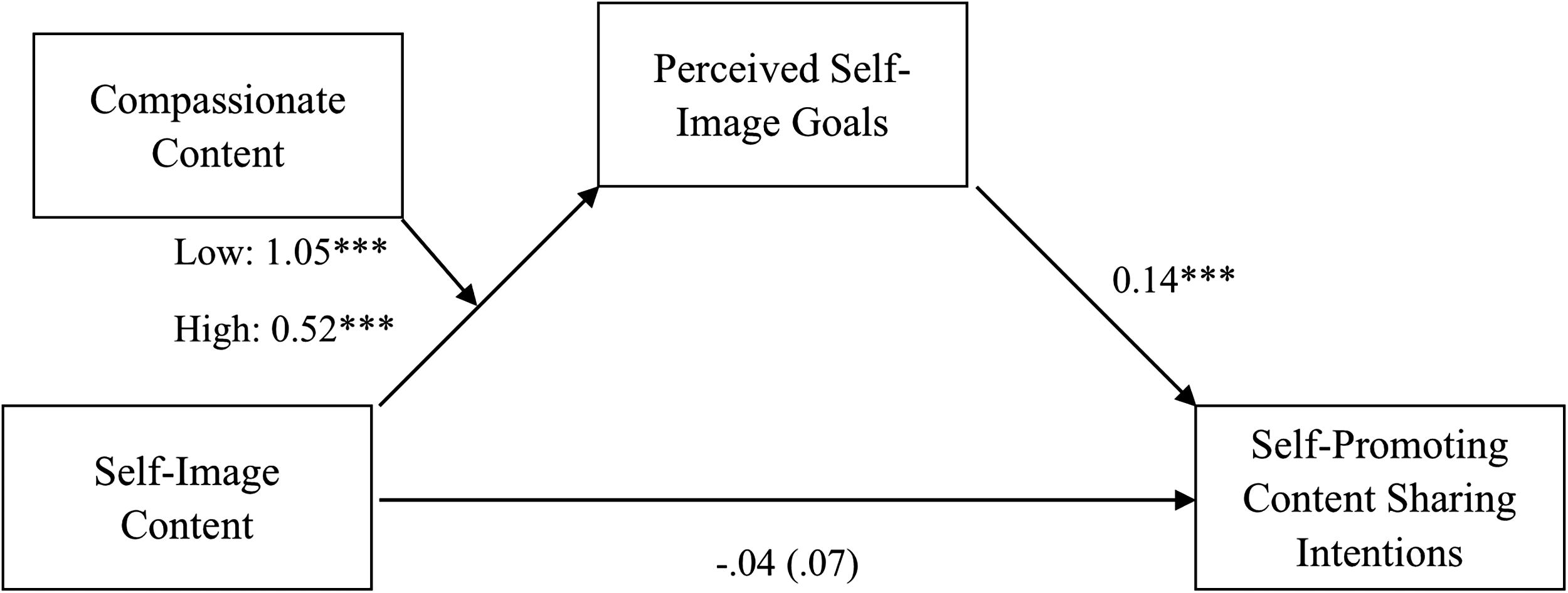
Effect of self-image content on self-promoting content sharing intentions through perceived self-image goals. Note: *** indicates p < 0.001. Numbers represent the unstandardized regression coefficients. The indirect effect of self-image content on self-promoting content sharing intentions via perceived self-image goals was stronger when compassionate content was low versus high. The total effect of self-image content on self-promoting content sharing intentions is presented in brackets.
The second model tested the impact of compassionate content on the likelihood of sharing prosocial content with self-image content as a moderator and perceived compassionate goals as a mediator (see Figure 3). The overall moderated mediation was significant, index = −0.07, SE = 0.02, 95% CI [−0.11, −0.03]. There were significant indirect effects of compassionate content on prosocial content sharing through perceived compassionate goals when self-image content was high, effect = 0.07, SE = 0.02, 95% CI [0.03, 0.10], and low, effect = 0.14, SE = 0.04, 95% CI [0.06, 0.21], with a stronger effect when self-image content was low.
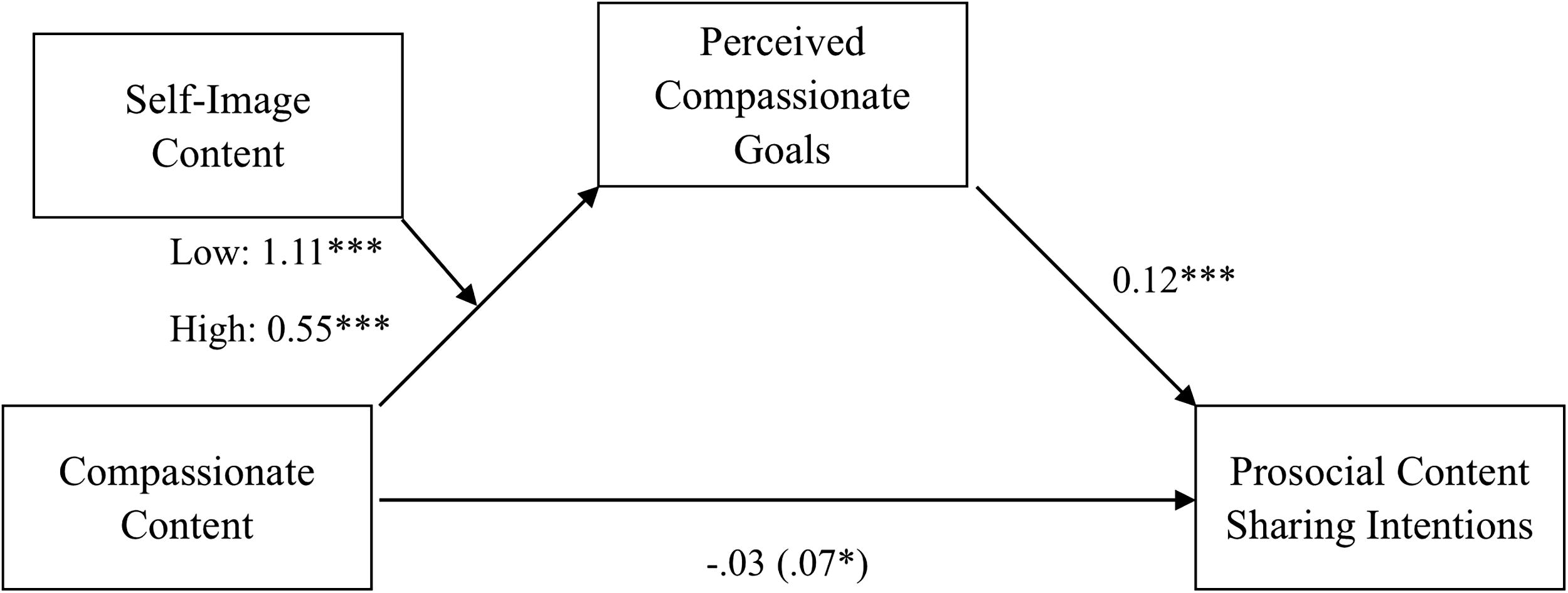
Effect of compassionate content on prosocial content sharing intentions through perceived compassionate goals. Note: * indicates p < 0.05, *** indicates p < 0.001. Numbers represent the unstandardized regression coefficients. The indirect effect of compassionate content on prosocial content sharing intentions via perceived compassionate goals was stronger when self-image content was low versus high. The total effect of compassionate content on prosocial sharing intentions is presented in brackets.
Discussion
Both hypotheses were supported. A moderated mediation analysis revealed that participants inferred a self-image goal from viewing a post with high self-image content, particularly when compassionate content was low, and these perceptions, in turn, predicted greater intentions to share self-promoting content. Another moderated mediation analysis revealed that participants inferred a compassionate goal from viewing a post with high compassionate content, particularly when self-image content was low, and these perceptions, in turn, predicted greater intentions to share prosocial content. Mediation by inferred goals supports goal contagion as the likely process rather than other forms of contagion. These findings contribute to the goal contagion literature6,7 by identifying new moderators, testing new goals, and examining goal contagion through a novel medium.
The findings extend past research, which found that the interpersonal goals of college roommates influenced each other over time. 15 Our findings demonstrate that the mere observation of someone’s behavior can trigger interpersonal goal contagion. However, we did have participants imagine that the post was written by a close friend to maximize the chances of goal contagion. Thus, we cannot generalize our findings to weaker ties. We also cannot generalize beyond individualistic cultures, having recruited participants from the United States and Australia. Although there are similarities in self-image and compassionate goals when comparing across cultures, 26 people may pursue their goals in culturally appropriate ways.
Future research could build upon our findings by examining additional characteristics of stimuli and perceivers. It could also examine the automaticity of interpersonal goal contagion. Other goal contagion research has assessed goals implicitly (e.g., through word completion and lexical decision tasks) and found evidence for automatic goal activation.8,12
The potential implications of interpersonal goal contagion on social media are significant, given frequent and widespread use of social media, and the affective and social outcomes of interpersonal goals. From the perspectives of social comparison and emotional contagion, past research shows that viewing strangers’ positive posts decreases positive affect for individuals prone to social comparison but increases positive affect through emotional contagion for those less inclined to compare themselves to others. 27 Our findings indicate that viewing close friends’ posts about positive events can activate self-image goals and increase intentions to share self-promoting content. A proliferation of self-image goals and positive posts would likely harm perceivers’ well-being, as self-image goals are associated with greater social comparison and envy. 3 Thus, self-image goal contagion could trigger social comparison processes, which typically have a negative impact on perceivers in a social media context due to the upward nature of the stimuli.28,29 However, certain types of self-promoting posts could be viewed positively 30 and lead to professional benefits, 31 and under certain conditions, exposure to self-promoting content can increase positive affect and motivation (e.g., when an admired, higher-ranked person shares their relevant and achievable successes). 32 Our findings also suggest that viewing posts that show consideration for others can activate compassionate goals and increase intentions to share prosocial content. This could have a positive impact on well-being, as past research has found that compassionate goals are associated with greater social connectedness. 4
Taking into account the interactions, the post most likely to maximize compassionate goals and prosocial sharing while minimizing self-image goals and self-promoting sharing was the one that positively related to others when sharing a negative event. Conversely, the post most likely to maximize self-image goals and self-promoting sharing and minimize compassionate goals and prosocial sharing was the one that celebrated one’s own success without acknowledging others. Social media users seeking an online environment that is more likely to foster social connectedness and less likely to elicit upward social comparison and envy may wish to curate their networks and feeds to increase the prevalence of posts that convey compassionate goals and decrease the prevalence of posts that convey self-image goals. Similarly, social media platforms could offer users the option to adjust their algorithms 33 accordingly to promote user well-being.
Footnotes
Authors’ Contributions
Conceptualization: S.J.T., J.C., and T.J.; Funding acquisition: S.J.T.; Methodology: S.J.T., J.C., and T.J.; Investigation: S.J.T.; Formal analysis: S.J.T.; Writing—original draft: S.J.T.; Writing—reviewing and editing: J.C. and T.J.
Author Disclosure Statement
No competing financial interests exist.
Funding Information
The School of Psychology and Counselling at Queensland University of Technology provided funding for the participant payments.

References
Supplementary Material
Please find the following supplemental material available below.
For Open Access articles published under a Creative Commons License, all supplemental material carries the same license as the article it is associated with.
For non-Open Access articles published, all supplemental material carries a non-exclusive license, and permission requests for re-use of supplemental material or any part of supplemental material shall be sent directly to the copyright owner as specified in the copyright notice associated with the article.
