




Abstract
This study explores the potential of generative artificial intelligence (GAI) versus traditional whiteboards in supporting group brainstorming. Sixteen groups of five members each used Miro (a conventional whiteboard) and DALL-E (an image-based GAI tool), either online or offline, in a 2 × 2 experimental design (online vs. offline; Miro vs. DALL-E). Researchers measured participants’ affect (Positive and Negative Affect Schedule), emotions (Aesthetic Emotions Questionnaire), creative self-efficacy, technological readiness (Technology Readiness Survey), user experience (User Experience Questionnaire), flow (Flow State Scale–Short Version), and creativity (fluidity, elaboration, flexibility, and originality). Two independent raters evaluated the groups’ ideas for each member. Results showed that DALL-E generated more positive affect, richer esthetic experiences, and higher attractiveness and novelty than Miro, particularly online. A significant interaction effect was found for “efficiency” (UX dimension) and “union action-consciousness” (flow dimension). Participants felt more creative and preferred working with DALL-E. Moreover, online sessions with DALL-E led to greater idea elaboration. These findings suggest that GAI tools such as DALL-E could reshape and enhance traditional group creativity methods, making them core assets in group collaboration, especially in online settings.
Introduction
Defining creativity with a single definition is nearly impossible, as it has been studied from multiple perspectives over time. Initially, creativity was seen as a reflection of divine inspiration, 1 with no recognition of individual contribution. 2 During the Renaissance, however, it became associated with the solitary creative genius,3–5 an inspired figure linked to free imagination. 6 In the 20th century, Guilford 7 expanded this view, introducing a psychological and social dimension beyond the purely individual perspective.
Creativity has been analyzed not only as a distinctive quality of exceptional people but also as a capability accessible to all. 8 Models, such as divergent thinking7,9 and integrative approaches, framed creativity as the result of interactions between individuals, environment, and culture. 10 Over time, this perspective has evolved into a view of creativity as a complex system, 11 emphasizing “distributed creativity,” 12 where it emerges from networks of people, cultural artifacts, materials, and their interaction. Therefore, group creativity emerges as a collective process built on individual contributions continuously influenced by peer input and shared environments. This shift laid the foundation for today’s multidisciplinary understanding of creativity, where social context and digital technologies play a key role in idea production. 13
These way emerging technologies such as artificial intelligence (AI) are redefining creative processes. AI has recently accelerated innovation across fields such as art, 14 music,15,16 business, 17 and creative domains.18,19
Creativity often seen as an intrinsic human trait, 20 a human strength,21–23 and cognitive ability24–26 to generate original, useful, and influential ideas, 27 can be now impacted by generative artificial intelligence (GAI), which can rapidly produce multiple ideas, mimicking humanlike creativity,18,28 especially by remixing existing content.30,31 This evolution has sparked debate about GAI’s potential to go beyond ideation and be considered fully creative. Studies comparing human and AI performance19,33 often emphasize competition, using Guilford and Torrance’s creativity dimensions: fluidity, flexibility, originality, and elaboration. 7
Joosten et al. 18 found that in corporate settings, ChatGPT outperformed humans in novelty, customer benefit, and quality. However, Lavrič and Škraba 28 observed that human ideas had greater diversity (entropy), while AI was faster. Despite GAI’s advantages, its role as a competitor or complement remains debated.
While solitude supports creativity,34,35 group dynamics also play a role. Osborn 36 promoted brainstorming as a technique for generating innovative ideas, and subsequent studies examined how group factors stimulate creativity. 37 How GAI affects such dynamics as interaction, engagement, and output is still unclear. Balancing tradition and innovation means viewing GAI not just as a tool but as a collaborator. Our study investigates this integration and how GAI might enhance human creativity.
The rise of large language models (LLMs) has enhanced human–AI collaboration in creative activities, 38 often through prompting techniques. 39 This raises new questions on co-creativity.40,41 Some researchers label AI output as “pseudo-creativity,”42,43 while others 44 argue for a clear distinction between human and artificial creativity.
Emerging perspectives 45 predicted four possible scenarios of human–AI collaboration: (a) a “collaborative” scenario, where human and AI contributions would be equally valued, creating a hybrid context; (b) an “organic” scenario, where human-made creations gain greater authenticity and value; (c) a “Plagiarism 3.0” scenario, where individuals can rely solely on AI content without attribution; and (d) a “shutdown” scenario, where AI’s perceived superiority discourages human creativity.
Our study explores human–AI collaboration, examining the emergence of a hybrid creative context. 46 GAI tools such as ChatGPT can enhance creative output in idea generation, 47 improving originality and solution quality in creative problem solving. 48 While brainstorming is a classical group creativity method, 36 digital versions such as brainwriting and electronic brainstorming now incorporate new tools. Research suggested that in-person brainstorming fosters spontaneous interaction, while online brainstorming may reduce social pressure but increase cognitive dispersion. 49
GAI is now used in brainstorming, 50 aiding ideation despite limits such as dependence on historical data. 51 Still, it can support creativity,52,53 as a partner.54,55 However, group collaboration is complex, and GAI’s role in managing cognitive load remains uncertain. Overreliance may lead to reduced individual input, the “free-riding” effect 56 as some rely too much on GAI, 57 lowering group performance. 58
Since ChatGPT only provides text, it may increase effort during ideation. However, visualizing ideas has been shown to stimulate creativity and divergent thinking. 59 In traditional brainstorming, participants document all generated ideas during the divergent phase, aiding selection in the convergence phase while managing cognitive complexity.
Visual digital tools such as Miro 1 support idea generation, with digital post-its, providing effective support for creativity and feedback. 60 DALL-E 2 , an image-based GAI, lets users quickly externalize mental images, vividly enhancing the creative process. Addressing the gap in research on visual and digital GAI tools in creative collaboration, this study explores how hybrid contexts can enhance idea generation and user experience. Specifically, this study explores the role of GAI in group brainstorming by comparing DALL-E with Miro, across online and in-person settings. It examines (a) What is GAI’s role during online and offline brainstorming sessions? (b) How do the UX, flow, esthetic emotions, and affect change using DALL-E and Miro? (c) How do these tools affect the creative output, in fluidity, flexibility, elaboration, and originality?
Materials and Methods
This study followed the following experimental design with “condition” as a between-subjects variable (i.e., online vs. in-presence) and “platform” as a within-subjects variable (i.e., DALL-E vs. Miro) (see Figure 1). All methods were carried out following the Helsinki Declaration, and the Ethical Commission of the Catholic University of the Sacred Heart of Milan approved the study.

Graphical representation of the experiment.
Sample
Eighty participants (45 females and 35 males) were involved, with a mean age of 33.8 (SD = 10.4). Most reported a master’s degree. The sample’s Technological Readiness Index was 14.1. Specifically, the mean for the optimism scale was 4.33 (SD = 0.82), for the innovation scale was 3.52 (SD = 1.15), while for technological discomfort was 2.70 (SD = 0.88), and for technological insecurity scale was 3.53 (SD = 0.98).
Seventy-three participants had never used DALL-E and Miro before the experiment, while 7 had. Specifically, three participants had already used Miro, but not DALL-E, while another three had used the opposite.
Recruitment
Participants were recruited via snowball sampling, starting from the researchers’ contacts. Invitations were sent through personal networks, email, and social media. To avoid dependency relationships, a researcher selected each participant they had no prior acquaintance.
Inclusion criteria
>18 years old.
Native Italian speakers.
High skills in using social online platforms such as Microsoft Teams.
Measures and instruments
The instruments were the following:
Sociodemographic questions. Technology Readiness Survey (TRI 2.0)
61
measures people’s readiness to adopt new technologies on four scales (i.e., Optimism, Innovation, Discomfort, and Insecurity). Positive and Negative Affect Schedule (PANAS),
62
which measures the intensity of positive and negative affective states. Flow State Scale–Short Version (FSS),
63
which measures the state of flow for the experience with the nine scales (i.e., Balance Challenges-Skills, Union Action-Consciousness, Clear Goals, Immediate Feedback, Focus on Task, Sense of Control, Loss of Self-Consciousness, Transformation of Time, and Autotelic Experience). User Experience Questionnaire (UEQ),
64
to evaluate the overall users’ experience according to six dimensions (i.e., attractiveness, perspicuity, efficiency, dependability, stimulation, and novelty). Aesthetic Emotions Questionnaire (AESTHEMOS),
65
which measures esthetic emotions with 21 subscales (i.e., feeling of beauty/liking, fascination, being moved, awe, enchantment, nostalgia, joy, humor, vitality, energy, relaxation, surprise, interest, intellectual challenge, insight, feeling of ugliness, boredom, confusion, anger, uneasiness, and sadness). Post-Experience Questionnaire with ad hoc questions measuring participants’ preferred platform (i.e., what did you prefer: DALL-E vs. Miro? And why?) and their creative self-efficacy (i.e., did you feel more creative in Miro vs. DALL-E?). Brainstorming technique, to stimulate and then analyze creativity, applying a typical scoring of divergent thinking tests.
7
Procedure
Participants completed a pre-experimental online survey including informed consent, sociodemographic questions, and TRI 2.0.
Then, participants were randomly assigned either to the in-presence or the online condition. In both cases, they were invited to take part in groups of five members in two different 15-minute brainstorming sessions, following a counterbalanced order, using two different instruments (a) Miro or (b) DALL-E (see Figures 2 and 3). They were asked to generate as many ideas as possible about either (a) the future airplane or (b) the future car, again in counterbalanced order. Participants were randomly assigned to groups to minimize bias from prior knowledge or relationships. They used Microsoft Teams online for real-time idea sharing and commenting, with all participants viewing the tools on their screens. In the in-presence condition, the setup was similar but without Microsoft Teams; instead, a shared screen allowed interaction with the tools. Instructions were given to the participants before each session. Two tutorials were given on how to use the tools, regardless of whether they had used them before or not, and the basic rules of brainstorming. The decision to limit each brainstorming session to 15 minutes was based on previous research,66,67 showing that limited brainstorming sessions are more likely to stimulate creativity and minimize mental fatigue and cognitive load. At the end of each session, participants completed the PANAS, UEQ, AESTHEMOS, and FSS. Finally, at the end of both brainstorming sessions, they were asked to indicate their favorite condition and the one in which they perceived themselves to be highly creative (ad hoc questions), also explaining the reasons for their preferences. All sessions were audio-recorded for later analysis of creativity by means of two independent raters.

A screenshot of DALL-E dashboard.

A screenshot of Miro dashboard.
Scoring criteria
The idea scoring was carried out by two independent raters who were experts in Guilford’s scoring criteria, which were the following:
Fluidity: total number of ideas generated by each participant. Elaboration: number of details for each idea. Here, we computed the means of elaboration for each participant. Flexibility: number of semantic categories. Originality: frequency of occurrence of each idea out of the total number of unique ideas.
Raters resolved disagreements through comparison; if unresolved, a third independent expert made the final decision.
Data Analyses
First, we computed the descriptives to test whether variables approximated a normal distribution, checking for skewness and kurtosis. At the individual level, we computed mixed analyses of variance (ANOVAs) with “platform” and “condition” as independent variables, with the following measures: Balance Challenges-Skills, Union Action-Consciousness, Clear Goals, Immediate Feedback, Concentration, Sense of Control, Loss of Self-awareness, Deconstruction of Time and Autotelic Experience, Attractiveness, Perspicuity, Efficiency, Dependability, Stimulation and Novelty, Feeling of Beauty/Liking, Fascination, Being Moved, Awe, Enchantment, Nostalgia, Joy, Humor, Vitality, Energy, Relaxation, Surprise, Interest, Intellectual Challenge, Insight, Feeling of Ugliness, Boredom, Confusion, Anger, Uneasiness, and Sadness.
First, we discussed the interaction effects and then the main ones. Second, we compared the creativity scores (fluidity, elaboration, flexibility, and originality) for each instrument, Miro and DALL-E, in both online and in-presence conditions, again at the individual level.
To establish interrater reliability for the creativity scores, we computed Pearson’s r coefficients between ratings by the two independent judges for each of the four dimensions (fluency, flexibility, elaboration, and originality). Then, since the correlations were medium to high (r = 0.50–0.90), indicating satisfactory raters’ agreement, we calculated the mean score of each dimension across the two raters to get a more stable and representative measure. Furthermore, we computed four mixed ANOVAs for the creativity dimensions. Finally, we computed the frequency of response for preferred experience and creative self-efficacy.
Results
Regarding user experience dimensions, between-subjects variable “condition” (online vs. offline), a significant main effect of mode of performance on novelty was found, F(1) = 3.89; p = 0.052; η2p = 0.047. Furthermore, a significant interaction effect was found between “condition” (online vs. offline) × “platform” (DALL-E vs. Miro) for Efficiency, F(1) = 5.507; p = 0.021; η2p = 0.066 (see Figure 4).
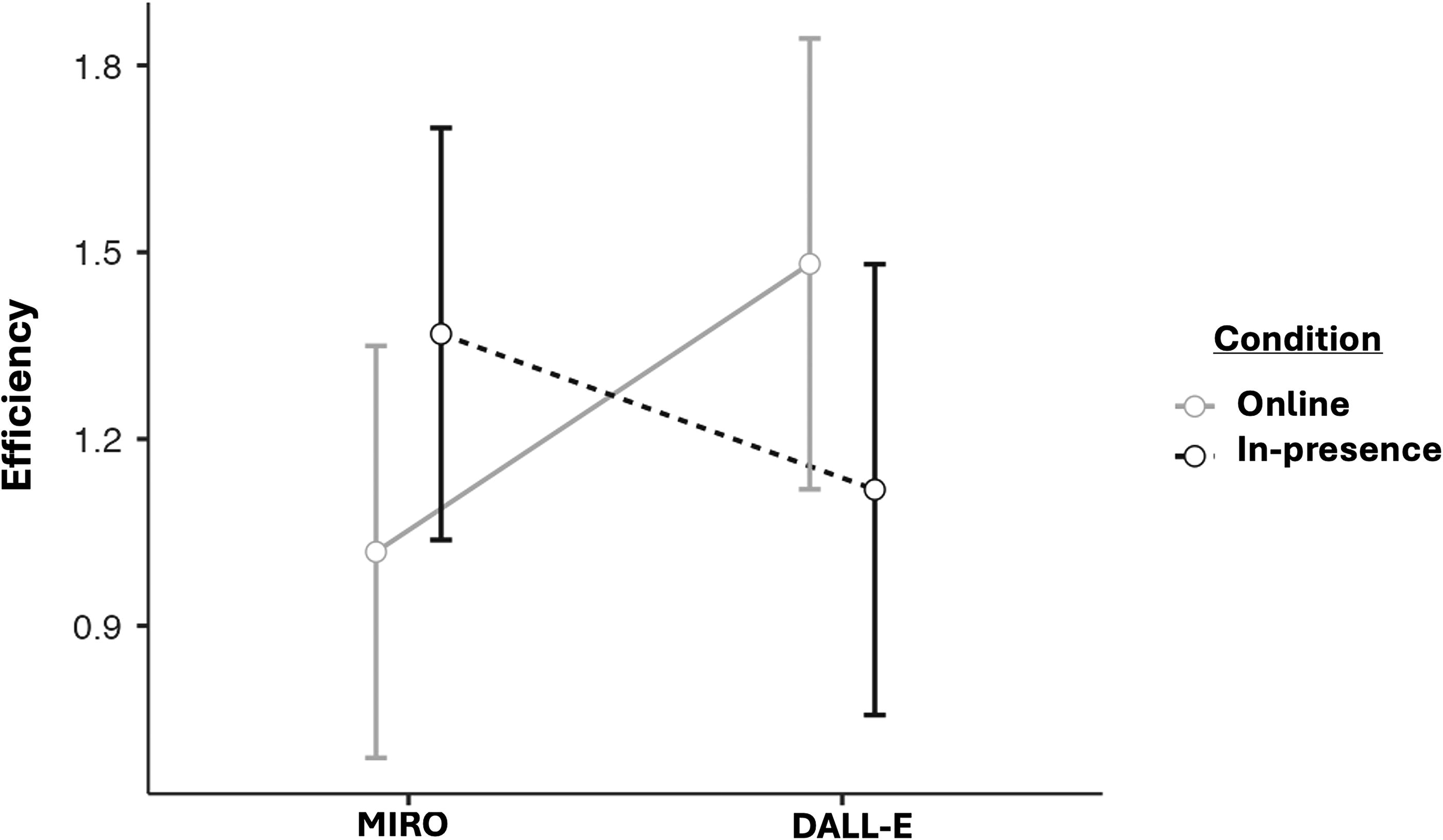
Interaction graph between platform (Miro and DALL-E) and condition (online and in-presence) with efficiency as a measure.
Figure 4 shows how the average efficiency varies between platforms (Miro and DALL-E) and conditions (online and in-presence). The results showed that the efficiency of participants is influenced by the interaction between the platform used and the condition in which the task was performed. In particular, the data suggest that DALL-E is most effective when used online, while Miro is more effective when used in-presence.
Concerning flow, a significant interaction effect was found between “condition” (online vs. offline) × “platform” (DALL-E vs. MiroRO) for Union Action-Consciousness variables, F(1) = 5.35; p = 0.023; η2p = .064 (see Figure 5).

Interaction graph between platform (Miro and DALL-E) and condition (online and in-presence) with union action-consciousness as a measure.
Figure 5 shows how the average action-consciousness union varies between platforms (Miro and DALL-E) and conditions (online and in-person). The results indicated that the action-consciousness union is influenced by the interaction between the platform and the task conditions. Specifically, DALL-E provides a higher action-consciousness union online, while Miro performs better in the in-presence condition.
On an individual level, 83% of participants preferred the DALL-E experience, and 76% felt more creative with DALL-E.
Regarding creativity, a significant main effect of “condition” (online vs. offline) on elaboration’s creativity dimensions was found, F(1) = 4.12; p = 0.046; η2p = 0.050.
Discussion
At the affective level, this study showed that brainstorming with DALL-E elicited significantly more positive affect than Miro. DALL-E experience significantly increased the intensity of the following esthetic dimensions: Beauty, Fascination, Being Moved, Awe, Enchantment, Joy, Humor, Vitality, Energy, Surprise, Interest, Intellectual Challenge, and Insight (see Table 1). In line with this, and conversely, brainstorming with Miro conveyed a significantly higher feeling of ugliness than with DALL-E. It had been shown that brainstorming with DALL-E evoked not just a more intense basic positive affect but especially more intense esthetic positive emotions than Miro. These results may suggest a potential capacity of the tool to enrich the overall quality of user interaction. 68 On the contrary, they could be influenced by the novelty of DALL-E, though this was methodologically controlled by counterbalancing the conditions. Novelty effects can temporarily enhance user experiences, especially when interacting with innovative or visually stimulating technologies. The unfamiliarity with DALL-E may have amplified users’ affective and esthetic responses, potentially influencing evaluations of stimulation and attractiveness. However, this effect was mitigated by providing participants with a brief tutorial on each tool before the brainstorming sessions.
Summary of Significant Main Effects of Mixed Analyses of Variance, Within-Subjects Variables “Platform”
ANOVA, analysis of variance.
Theoretical models of group creativity highlighted the critical role of the environment in shaping creative processes. Digital tools and artifacts used in brainstorming can either enhance or hinder creativity by influencing cognitive load and focus. DALL-E, offering vivid visual feedback, may accelerate creative associations, with research showing that exposure to diverse perspectives and unexpected stimuli can disrupt habitual thinking and deepen idea exploration. 69
Indeed, a significant interaction effect emerged about efficiency, as a UX dimension. In online settings, DALL-E was perceived as significantly more efficient than Miro, whereas Miro outperformed DALL-E in in-person sessions. Moreover, brainstorming with DALL-E was also perceived as more attractive, stimulating, and novel than brainstorming with Miro. These findings were in line with the recent introduction of DALL-E, as a new and not yet fully explored instrument, while Miro has been in use since 2011. Participants also favored DALL-E, possibly due to its novelty and complexity, which enhances arousal and curiosity 70 —a hypothesis supported by self-reported data. Previous studies suggest that perceived visual attractiveness can impact a tool’s usefulness, enjoyment, and ease of use, 71 which may have been a factor here.
Effective group brainstorming relies on balancing divergent and convergent thinking. 72 DALL-E’s ability to produce vivid, unexpected visuals likely stimulated creative exploration, while Miro’s structured, text-based format aided idea refinement during convergence. This interplay between exploration and refinement is a key element of successful group creativity.
Miro was perceived as less novel and surprising than DALL-E. Moreover, considering that positive affect has often been associated with an increase in divergent thinking73–75 and in flow (e.g., 76 ), it was not surprising to find that brainstorming with DALL-E was also associated with a more intense experience of flow given its inherently emotionally positive nature. DALL-E induced a significantly higher sense of Union of Action-Consciousness, Deconstruction of Time, and Autotelic Experience, as dimensions of flow. Specifically, participants felt more blended with the task (Union Action-Consciousness) in the online brainstorming with DALL-E and in the in-presence brainstorming with Miro. Overall, DALL-E tended to elicit stronger task immersion during brainstorming sessions.
This aligns with Zhang et al. 77 who suggested that intrinsic motivation enhances cognitive effort in online creativity rather than direct group interaction. This may explain why DALL-E’s novelty and surprise fostered flow and engagement: its emotionally stimulating nature likely sustained participants’ motivation. The unpredictability of visual outcomes triggered curiosity and persistence, key elements of intrinsic motivation, further increasing engagement.
The DALL-E experience was perceived as more intrinsically motivating and pleasurable, likely due to the novel skills required for its use. Regarding perceived novelty, a main effect emerged favoring DALL-E, as well as a difference between online and in-person conditions, though without a significant interaction. This may be explained by the unique engagement of DALL-E: its novelty and the unpredictability of outcomes made the experience more surprising. The images generated by the AI vividly reflected participants’ inner ideas, functioning like a “mental projector”—a quality not matched by Miro, as supported by participants’ qualitative reports. The main effect of the condition on novelty may also stem from the increasing familiarity with online collaboration platforms such as Microsoft Teams, which have become widespread since the 2020 pandemic. The strong preference for DALL-E and participants’ reports of feeling that it accurately visualized their ideas highlight a perceived alignment between user intention and AI output. This may boost engagement and flow but also blur the line between human input and machine suggestion, raising concerns about creative authenticity. In group contexts, this challenges authorship and ownership, making individual contributions harder to trace. It also raises ethical questions about agency and overreliance on GAI. Future studies should explore how perceptions of “true authenticity”78,79 shape engagement and creative self-efficacy.
Regarding creativity, participants produced significantly more detailed ideas with Miro than DALL-E (see Table 2 and Figure 6). Online sessions, regardless of tool, led to more detailed ideas than in-person ones. Using GAI in brainstorming may encourage free-riding behaviors, especially online and among adults. Interestingly, this contrasts with the greater elaboration seen in online sessions, where ideas were more detailed and refined. This paradox suggests that while online environments may foster some disengagement, they also provide conditions, such as asynchronous interactions and reduced social pressure, that enhance idea depth and complexity. While some participants may have reduced their effort, others may have felt freer to explore and expand ideas without social pressure. These differences may stem from the fact that group ideation relies not only on participants but also on artifacts 80 and the surrounding environment. 81 In this case, online brainstorming served as both an impactful artifact and environment, highlighting the importance of brainstorming modality. This might be due to the potential of online platforms to enhance creativity by overcoming creative blocks, 82 although online brainstorming could also risk decreasing engagement and satisfaction, compared with offline brainstorming. 83 Furthermore, Miro’s lack of strong visual stimulation may have redirected participants’ cognitive resources toward deepening ideas rather than generating novel but less developed outputs. However, it is important to note that free-riding was not systematically measured in this study, and observations are based on qualitative impressions. Further research is needed to explore how combining these tools could balance novelty-driven exploration with detailed elaboration and the free-riding phenomenon.
Descriptive Statistics of Creativity’s Dimensions
M, mean; SD, standard deviation.

Graphical visualization of creativity scores.
These findings reflect a broader shift from competitive to collaborative perspectives on human–AI creativity. Rather than viewing GAI as a competitor, participants appeared to engage with it as a cognitive partner that supported idea development. The preference for DALL-E and higher flow suggests an active human–AI co-construction process. This aligns with recent frameworks 46 where creativity emerges from the interplay between human cognition, social dynamics, and digital tools, with GAI contributing as an active agent in the creative flow.
Though some effects (e.g., η2p < 0.07) were modest, the differences still indicate meaningful patterns, even if their practical impact is limited. Still, the study highlights the potential of image-based GAI like DALL-E in education and business. In creative disciplines, GAI can help students visualize ideas, increase engagement, and build confidence (e.g., architecture students visualizing concepts before refining them). In business, it can support early-stage projects, particularly in product design and advertising, by offering rapid visual input and helping teams overcome creative blocks. As a “creativity catalyst” in remote collaboration, GAI can stimulate divergent thinking without replacing human input, enabling facilitators to enrich group ideation and foster dynamic, engaging environments. GAI could also benefit health care and well-being. In art therapy, for example, DALL-E could transform children’s verbal expressions into pictures, helping therapists to stimulate dialogue and explore emotions.
Limitations and future directions
This exploratory study has several limitations that inform future research. First, only two tools, Miro and DALL-E, were tested, limiting generalizability to other AI-assisted brainstorming platforms. The focus on visual stimuli was intentional, and tool use was counterbalanced to reduce ordering effects. Nonetheless, future studies should include text-based tools such as ChatGPT or hybrid platforms such as Canva, which may affect creativity differently depending on the task.
Snowball sampling led to a relatively homogeneous sample, particularly in digital competence and openness to innovation. Although most participants were unfamiliar with the tools, their high technological readiness may have influenced engagement. Future studies should use more stratified sampling to include varied ages, professions, and digital skills.
A maturity gap between tools also emerged: DALL-E, being newer and visually rich, may have benefited from a novelty effect relative to Miro. While counterbalancing and tutorials were used to mitigate this, longitudinal research could explore how familiarity shapes creative output over time and across experience levels.
Each brainstorming session lasted 15 minutes to sustain engagement and reduce cognitive fatigue, but this may have constrained idea development. Future work should compare different session lengths under similar cognitive conditions to identify optimal durations.
Although many findings were statistically significant, effect sizes were often modest (e.g., η2p < 0.07), potentially limiting practical implications. Replication with larger and more diverse samples is needed to strengthen generalizability.
Finally, free-riding appeared more frequently among adults (fr 51%) than young adults (fr 49%), especially with DALL-E, suggesting some overreliance on AI. While engagement was monitored during sessions, future systems could implement real-time feedback, turn-taking prompts, or contribution tracking to foster active collaboration.
Despite these limitations, which may affect the external validity of the study, several measures were implemented to mitigate potential biases, and the study provided valuable initial insights into human–AI interaction. Further research is needed to validate these findings across different settings, populations, and creative domains.
Conclusions
This study explored the impact of visual GAI tools versus traditional digital whiteboards in online and in-person brainstorming sessions. DALL-E enhanced positive affect, flow, and user experience, especially online, where it also improved perceived efficiency. Miro was more effective in in-person settings, suggesting that tool-context alignment is key in collaborative creativity. Creativity outcomes were generally similar, but online sessions led to more elaborated ideas across platforms.
Interaction effects reinforced these findings: DALL-E was perceived as more efficient and immersive online, while Miro performed better in-presence. This highlights that the effectiveness of each tool depends on the specific environment.
These findings indicated that GAI tools can serve as valuable allies in collaborative creativity. Their application may be particularly useful in digital environments, offering new opportunities for innovation in different contexts. Furthermore, they highlighted the importance of selecting tools that align with the specific brainstorming context and provided a foundation for future studies on human–AI co-creation. In this light, the results offered preliminary support for the emergence of a hybrid creative context, where human cognition, group dynamics, and generative AI collaboratively could shape the creative process. Future research could compare individual and group creative productivity using GAI tools, potentially exploring the effectiveness of nominal groups versus teams,85,86 with a mixed-method design study.
Footnotes
Acknowledgment
The authors wish to thank Alessandro Roventi, who contributed to data collection.
Authors’ Contributions
K.G.: Conceptualization (supporting), first draft (lead), formal analysis (supporting), and final version (lead). E.D.S.: Revision (supporting). F.B.: Formal analysis (lead). A.P.: Revision (supporting). A.G.: Revision (supporting) and supervision (supporting). A.C.: Conceptualization (lead), rational (lead), supervision (lead), and revision (lead).
Author Disclosure Statement
The authors have no competing interests to declare that are relevant to the content of this article.
Funding Information
The present work was supported by the Italian Ministry of University and Research under the program “PNRR per i dottorati industriali e innovativi che rispondono ai fabbisogni delle imprese” DM 117/2023 and by the Grants PRIN 2022 PNRR P2022PXAZW funded by European Union NextGeneration EU.
