




Abstract
Problematic gaming is becoming increasingly prevalent among young people, often leading to negative developmental consequences. As an essential protective factor against problematic gaming, self-control is the capacity to manage emotions, thoughts, and actions when confronted with temptations and impulses. Previous studies have reported mixed findings regarding the association between problematic gaming and self-control. The current systematic review and meta-analysis synthesized the existing literature on this relationship among adolescents and emerging adults. A systematic search from eight electronic databases (PsycArticles, PsycINFO, EBSCOhost, Web of Science, PubMed, Embase, ProQuest Dissertations & Theses A&I, and China Academic Journal Network Publishing Database) and two additional sources (Google Scholar and reference lists) identified 957 published studies. Of these, 46 articles involving 64,681 participants were included in the review, and 40 provided sample size and Pearson’s r for the meta-analysis. The narrative review findings indicated that problematic gaming was negatively correlated with self-control with only two studies suggesting an insignificant relationship. The meta-analytic findings, conducted using a random-effects model in Comprehensive Meta-Analysis Software Version 4.0, revealed a medium effect (r = −0.287, 95% CI = [−0.33, −0.25], p < 0.001), with high heterogeneity (I2 = 96.5%). Publication bias analysis showed a symmetric funnel plot and a nonsignificant Egger’s test (p = 0.861), indicating no evidence of publication bias. No significant subgroup difference was found between adolescents and emerging adults. The results reveal that self-control is a critical factor in preventing and intervening problematic gaming.
Trial registration:
International Prospective Register of Systematic Reviews (PROSPERO); CRD42023451656; registered on 25 September, 2023.
Introduction
Given that the availability of technology has dramatically changed the world of leisure activities, gaming is currently a hot spot in society and has become increasingly popular among young people as an entertainment activity. However, excessive gaming has been found to be associated with negative outcomes, including impaired social relationships and daily functioning. 1 Research indicates that problematic gaming is characterized by increased social isolation, loneliness, and depression, and it has been linked to academic difficulties, with students exhibiting lower grade point averages being more prone to game addiction compared with their higher-achieving peers. 1 Despite the increasing number of published studies, there is a lack of agreement on whether problematic gaming should be considered an “addiction.” For the purposes of this review, problematic gaming is defined as a pattern of gaming behavior characterized by excessive and compulsive use, resulting in significant impairment or distress in different aspects of one’s life. Prior studies have depended on inconsistent and non-standardized frameworks to define problematic gaming behavior. 2 Problematic gaming serves as an umbrella terminology in this review for various conceptualizations that describe the same phenomenon in previous research, such as video game addiction, 3 pathological video game use, 4 online gaming addiction, 5 and problematic online game use. 6 Given the ongoing controversy about the concept of problematic gaming, in 2013, the fifth edition of the Diagnostic and Statistical Manual of Mental Disorders (DSM-5) proposed Internet gaming disorder (IGD) as a classification for further study. 7 DSM-5 defined IGD with nine criteria, which include: (a) a persistent and excessive focus on gaming activities, (b) withdrawal symptoms when unable to play, (c) a need to spend increasing amounts of time gaming to achieve satisfaction, (d) repeated unsuccessful attempts to reduce or stop gaming, (e) diminished engagement in other activities or interests due to gaming, (f) persistent gaming despite awareness of its negative consequences, (g) deception of others about the extent of gaming involvement, (h) use of gaming to escape or relieve negative emotions, and (i) significant impairment or disruption in personal, academic, or professional life caused by gaming. These symptoms can lead to substantial impairment or distress in various aspects of an individual’s life.7,8
The transition from adolescence to emerging adulthood can be a positive experience, but it also comes with significant developmental changes and challenges that can be particularly difficult for some young people. 9 These age groups are more likely to engage in problematic behaviors compared with other life stages. 10 In a critical period of development, adolescents aged 10–18 years are highly vulnerable to addictive behaviors like problematic gaming. The prevalence of gaming addiction among adolescents in mainland China varied between 3.5 percent and 17 percent in a systematic review. 11 Research in Taiwan and Hong Kong found that 46 percent and 15.6 percent of adolescent online gamers were addicted to online games, respectively.12,13 A meta-analysis reported a high prevalence of IGD among adolescents (8.8 percent) and young adults (10.4 percent). 14 Increased risk may be derived from cognitive, social, hormonal, and neurobiological immaturity. 15 Similarly, emerging adults aged 18–25 are in a crucial developmental stage marked by shifting roles and increased responsibilities. These challenges may make them vulnerable to addiction. 16 Zhou and Li 17 reported a high prevalence of 17 percent of IGD among Chinese university students. Given the urgent need to establish effective strategies and interventions for the prevention of problematic gaming, it is essential to examine a comprehensive theoretical framework that encompasses risk and protective factors.
The role of self-control has been a focal point in recent research, significantly advancing our understanding of the factors that influence IGD. A meta-analysis by Ji et al. 18 reviewed 153 studies targeting Chinese samples and found that individual-related factors, including self-control, have a more substantial influence on IGD than environmental factors such as family and school contexts. Notably, self-control, defined as the ability to resist immediate gratification that may have adverse effects, in favor of long-term goals, 19 emerged as the strongest protective factor against IGD, showing a significant negative correlation with a medium effect size. 18 Self-determination theory (SDT) posits that psychological wellness is rooted in the fulfillment of three basic psychological needs: autonomy (feeling in control of one’s actions), competence (achieving desired results and feeling skilled), and relatedness (feeling connected to others), which serve as the primary drivers of the appeal of games. 20 SDT distinguishes between intrinsic motivation linked to adaptive consequences and extrinsic motivation or amotivation associated with maladaptive outcomes, including problematic behaviors.20–22 When basic psychological needs are not met, continued experiences of need frustration can lead to a reduction in individuals’ self-control. 23 This aligns with the strength model of self-control, which suggests that the strain individuals experience from daily need frustration can deplete the resources needed for self-control, resulting in a diminished ability to regulate oneself. 24 The expected adverse impacts of daily need frustration on self-control are suggested to lead to the adoption of detrimental motivations for video gaming, subsequently leading to a higher severity of problematic gaming. 25 Nigg 26 further supports this finding, highlighting that self-control, influenced by executive functions and self-discipline, helps individuals manage impulsiveness and adhere to what they ought to do, and refrain from what they should not. Research suggests that the prefrontal cortex undergoes a gradual maturation process that spans from adolescence into early adulthood. 27 Adolescents, therefore, may lack self-control to evaluate the future outcomes of their behaviors due to the underdeveloped prefrontal cortex, resulting in less effective regulation of behavior. This diminished self-control may render individuals particularly susceptible during adolescence, a period marked by heightened sensitivity to emotional and environmental cues, further impeding their ability to exert self-control.
Evidence has shown that various addictive and problematic behaviors, such as alcohol addiction and Internet addiction, were related to a lower level of self-control.28,29 The existing reviews primarily focused on Internet and smartphone addiction,30,31 with limited attention given to gaming addiction. Furthermore, while most empirical studies have found a link between problematic gaming and low self-control,31–33 there were conflicting results regarding the association between self-control and game addiction. For example, findings have suggested that self-control had no significant effect on online gaming addiction, 34 and online self-control was not found to be related to problematic video gaming. 35 Another study revealed contradictory results that self-control positively correlated with IGD. 36 Notably, the vulnerability to problematic gaming may differ between adolescents and emerging adults. Research has shown that as individuals transition from adolescence to emerging adulthood, changes in brain development, particularly the thinning of the anterior insula, lead to decreased impulsivity and improved planning abilities, reducing susceptibility to short-term gaming temptations.37–39 Despite research indicating this difference, limited reviews compared the relationship between self-control and problematic gaming in these two populations at critical life stages.
Current study
Given the lack of synthesized results and comparisons across age groups, the current study specifically focused on adolescents and emerging adults, who have a high prevalence of problematic gaming and are in a critical transitional period. It aimed to perform a systematic review and meta-analysis of existing literature to: (a) investigate the relationship between problematic gaming and self-control among young populations, and (b) examine whether there exist differences in the strength of the relationship between problematic gaming and self-control among adolescents and emerging adults. Through systematic review and meta-analysis, we aim to provide more insights into the development of prevention and intervention strategies for problematic gaming.
Methods
We conducted this review in compliance with the Preferred Reporting Items for Systematic Reviews and Meta-Analyses (PRISMA) guidelines. 40 We pre-registered all procedures on the International Prospective Register of Systematic Reviews (PROSPERO; Registration number: CRD42023451656).
Search strategy
We conducted systematic searches in eight electronic databases: PsycArticles, PsycINFO, EBSCOhost, Web of Science, PubMed, Embase, ProQuest Dissertations & Theses A&I, and China Academic Journal Network Publishing Database (CNKI) in November 2023. Two additional sources were included by searching Google Scholar and reviewing the reference lists of relevant studies, ensuring a comprehensive searching of the literature. The publications in English were retrieved from the seven databases except CNKI. The search string was generated with Boolean operators, with restrictions to ensure that the keywords were presented in the title or abstract for the initial screening. This decision was made because attempts to include keywords from the full text resulted in a high number of irrelevant articles due to the commonality of terms related to self-control and problematic gaming across various fields. Therefore, focusing on the title and abstract was deemed to provide more accurate and relevant results. The following search string was used: abstract, title (youth OR “young people” OR teen* OR adolescen* OR student* OR “young adult*” OR “emerging adult*” OR “early adult*” OR child*) AND abstract, title (self-control OR self-regulat* OR self-disciplin* OR “impulse control”) AND abstract, title (gaming OR “gaming disorder*” OR “game addict*” OR “problematic gam*” OR “excessive gam*” OR “internet gam*” OR “pathological gam*” OR “maladaptive gam*”) NOT title (gambl*).
We retrieved the articles in Chinese from the CNKI, using the keywords “adolescent (青少年),” “child (儿童),” “student (学生),” “middle school student (初中生),” “high school student (高中生),” and “minor (未成年人)” to locate target population. For the two variables, we used the search terms “self-control (自我控制),” “self-regulation (自我调节),” “impulse control (冲动控制),” “problematic gaming behavior (问题性游戏行为),” “problematic gaming use (问题性游戏使用),” “gaming addiction (游戏成瘾),” “excessive gaming (过度游戏),” “internet gaming addiction (网游成瘾),” “maladaptive gaming behavior (不良游戏行为),” “gaming disorder (游戏障碍),” “pathological gaming (病态游戏),” and “gaming obsession (游戏沉迷/游戏迷恋).”
Eligibility criteria
The PRISMA flow diagram (Figure 1) shows the screening process of the studies according to the inclusion and exclusion criteria. The inclusion criteria included: (a) adolescents and emerging adults aged 10–25, or those described as middle/high school/university students if their age was not reported (populations slightly under 10 or over 25 were also considered eligible if their mean age fell within the range of 10 to 25); (b) peer-reviewed empirical studies or thesis, which have reported the relationships between self-control and problematic gaming; and (c) sample size and Pearson’s r having been reported (for meta-analysis). Exclusion criteria were: (a) minority groups or samples with developmental disorders or severe illness; (b) intervention studies, review, protocol, conference papers, and case studies that typically focus on individual or small-group analyses, which lack the generalizability and the required quantitative data; (c) full text not available; and (d) studies not written in English or Chinese.

The Preferred Reporting Items for Systematic Reviews and Meta-Analyses (PRISMA) flow diagram. After screening and exclusion, 46 full-text records were assessed for eligibility in the systematic review and 40 articles were included in meta-analysis.
Screening and data extraction
All citations searched through the database search strategy were imported into the reference management software EndNote. We manually searched for additional records through Google Scholar and reference lists of related studies from the principal investigator and removed duplicates using EndNote and manual checks. Following the initial screening based on abstracts and titles, which was conducted by the first author, the screening process and results were independently reviewed and verified by two additional co-authors. Any discrepancies were resolved through discussion and consensus. Given that the verification was based on this collaborative approach rather than fully independent dual screening, a kappa index for interrater agreement was not calculated. We then conducted a detailed screening of full texts, retaining articles that met the eligibility criteria for systematic review and meta-analyses. The data extraction table gathered information on the characteristics of the studies, including (a) country, (b) study design, (c) sample size, (d) gender ratio, (e) mean age of the sample, (f) sample characteristics, (g) measures of self-control and gaming, and (h) key findings related to the objective of the review. Additional tables were yielded for quality assessment and meta-analyses.
Quality assessment
Two independent reviewers (the first and second authors) assessed the quality of the included studies using an adapted version of the Quality Assessment Tool for Systematic Reviews of Observational Studies, 41 which consists of 10 items focusing on four aspects: introduction (objective), method (study design, representativeness, response rate, attrition rate, bias in measurement, and confounders), analysis (data analysis plan), and results (effect size and significance). Reviewers evaluated whether: (a) objectives or hypotheses were clearly stated, (b) study design was appropriate for the research questions, (c) sampling method was representative of the population, (d) response rate and attrition rate were reported, (e) measurements were reliable and valid, (f) confounding factors were controlled, (g) data analysis plan was appropriate for study design, and (h) effect sizes and significance were clearly reported. Reviewers scored each item as either zero or one, with the highest score being 10. The final grade was determined by dividing the total score by the total number of all applicable items and then categorized as “Good (67%−100%),” “Satisfactory (33%−66%),” or “Inadequate (0%−33%)”. Interrater agreement between the two reviewers was assessed using Cohen’s kappa statistics. Any discrepancies were discussed and resolved through consensus.
Data analysis
We employed a descriptive synthesis to summarize the characteristics and findings of the studies. Additionally, we complemented the quantitative synthesis by conducting a meta-analysis using Comprehensive Meta-Analysis Software Version 4.0 to summarize the relationship between self-control and problematic gaming. Given the variations in samples, designs, and measures across studies, random-effects models were utilized to account for the heterogeneity of the studies when pooling the correlational effect sizes (i.e., r). Additionally, this review assessed publication bias through visual inspection of the funnel plot and Egger’s regression test. We also conducted subgroup analysis to examine the differences in the relationship between self-control and problematic gaming among adolescents (<18 years old or described as elementary/middle/high school students) and emerging adults (≥18 or described as university students).
Results
Overview of included articles
The systematic screening process depicted in Figure 1 identified a total of 955 articles from the database search, with an additional 2 records found through Google Scholar and reference lists. After removing 340 system-identified and manually-identified duplicates, 617 articles were retained. Of these, 363 articles were screened out based on the abstracts and titles, leaving 254 records for the full-text screening phase. According to the eligibility criteria, 208 of these 254 studies were excluded. Specifically, 17 records focused on non-gaming addictive behaviors (e.g., Internet addiction, smartphone addiction), 20 records did not pertain to the target age group, 149 studies were review, intervention study, case study, protocol, pilot study, or conference paper, 4 records lacked full texts, and 18 studies examined the association among minority groups or population with mental health disorders (e.g., attention deficit hyperactivity disorder population). Thus, 46 studies were included in the systematic review. For those six studies that did not report correlation coefficients, we contacted the authors for information but did not get replies. Thus, a total of 40 articles were retained for the meta-analysis.
Study characteristics
Table 1 depicts the characteristics of the included studies. Of the 46 articles, most studies were conducted in Asian countries (28 in China, 1 in Singapore, 1 in India, and 8 in South Korea), and only 5 were conducted in Western countries (2 in the Unites States, 1 in Slovenia, 1 in the United Kingdom, and 1 in Australia). The other three were from the Middle East, involving two Turkish studies and one Iranian study. There were 15 longitudinal studies, which involved data collection at multiple time points, ranging from 2 to 10, over a period of 3 months to 2 years, while 31 studies utilized a cross-sectional study design. A total of 64,681 independent participants were included across the studies, with sample sizes ranging from 123 to 9,755. The mean and median sample sizes were 1,618.6 and 789, respectively, reflecting the variability in study sizes. The gender ratio of the final sample was reported or could be calculated in all studies, with 31,622 (49 percent) being females, and two studies exclusively recruiting male participants.42,43 The mean age was reported in 30 studies, ranging from 11.29 to 22.01. As for key findings, the majority of the studies (44 out of 46) have indicated that a higher level of problematic gaming was significantly associated with lower self-control. This consistent pattern suggests that individuals with poorer self-control may be more vulnerable to developing problematic gaming behaviors, likely due to difficulties in managing impulses and regulating emotions. Two studies, Mehroof and Griffiths 34 and Kim et al., 35 reported nonsignificant findings. These exceptions may be attributed to differences in sample characteristics, such as cultural context or variations in the measurement tools used to assess problematic gaming and self-control. Notably, Coyne et al. 36 found a significant positive relationship between IGD symptoms and self-control, contrasting with the more commonly observed negative association. This unexpected finding could also reflect unique aspects of their sample or methodology, such as the inclusion of participants with specific gaming motivations (e.g., escapism-driven or social interaction) or measurement heterogeneity across studies. Such factors may influence how self-control interacts with gaming behavior.
Characteristics and Main Findings of Included Articles
Gender is percentage of female.
aPercentage of female at baseline in the study if not specified.
bMean age and standard deviation at baseline if not specified.
BSCS, Brief Self-Control Scale; Cross, cross-sectional design; DGAS-7, Digital Game Addiction Scale developed by Lemmens et al. (2009); DMSC-S, Dual-Mode of Self-Control Scale developed by Xie et al. (2014); F, female; GAS, Game Addiction Scale developed by Lemmens et al. (2009); IGDQ, Internet Gaming Disorder Questionnaire developed by Yu et al. (2017); IGDS9-SF, Internet Gaming Disorder Scale Short Form developed by Pontes and Griffiths (2015); IGDT-10, Internet Gaming Disorder Test developed by Király et al. (2017); IGD-20 Test, Internet Gaming Disorder Test developed by Pontes et al. (2014); IGUESS, Internet Game Use-Elicited Symptom Screen developed by Jo et al. (2017); ISQ, Intentional Self-Regulation Questionnaire developed by Gestsdottir and Lerner (2007); KS-scale, Korean Self-reporting Internet Addiction Scale Short Form developed by Kim et al. (2008); M, male; N, number of participants; Long, longitudinal design; POGU, Pathological Online Game Use Questionnaire developed by Gentile (2009); SCAQ, Self-Control Ability Questionnaire developed by Wang and Lu (2004); SCS, Self-Control Scale developed by Tangney et al. (2004); SSCCS, Chinese revision of State Self-Control Capacity Scale developed by Fei et al. (2020).
Quality assessment
Table 2 shows the results of the quality assessment. Twenty-three studies were evaluated as “Good,” 22 as “Satisfactory,” and only 1 was rated as “Inadequate.” As the interrater reliability was low (kappa = 0.271, p < 0.001), two independent reviewers discussed the inconsistencies and reached agreement on the final grading. Specifically, 40 out of 46 studies clearly stated study objectives or hypotheses, and 45 were deemed to have an appropriate study design for the research questions. About 52 percent (k = 24) of the articles used representative sampling methods. The response rate was reported by 15 studies, and 6 out of 15 longitudinal studies reported the attrition rate. Most articles utilized reliable and valid measurements, with only 32.6 percent (k = 15) reported validity. Twenty-one studies controlled for confounders in the analyses or design. An appropriate data analysis plan (k = 43) and clear effect size and significance reporting (k = 39) were also considered in the assessment.
Quality Assessment of Included Articles
AR, attrition rate; CON, confounder; DAP, data analysis plan; ES, effect size; MR, measurement reliability; MV, measurement validity; OB, objective; REP, representativeness; RR, response rate; SD, study design.
Meta-analysis of the relationship between problematic gaming and self-control
A total of 40 studies, with 10 of them featuring multiple outcomes, including 58,239 participants, were included in the meta-analysis. Table 3 displays the pooled effect size, the results of the heterogeneity test, and the publication bias test. A random-effects meta-analysis revealed a statistically significant medium effect between problematic gaming and self-control (r = −0.287, 95% CI = [−0.33, −0.25], p < 0.001). The heterogeneity analysis indicated high statistical inconsistency toward study results as the I2 value was higher than 75 percent (Q (39) = 1,105.077, I2 = 96.5%, p < 0.001).
Effect Size and Its Heterogeneity Test and Publication Bias Test
p < 0.001.
N, number of participants; k, number of studies; CI, confidence interval; SE, standard error.
A funnel plot and Egger’s linear regression test were used to identify publication bias. First, evidence from the funnel plot (Figure 2) suggested a symmetric distribution on both sides of the means, indicating a small risk of publication bias in this review. Besides, the nonsignificant results in Egger’s regression test (regression intercept = −0.33, SE = 1.89, 95% CI = [−4.17, 3.50], p = 0.861) implied no statistical evidence of funnel plot asymmetry, indicating no evidence of publication bias. However, the Trim-and-Fill analysis showed that after correcting for publication bias, it yielded a larger pooled effect size (r = −0.333, 95% CI = [−0.38, −0.29]).
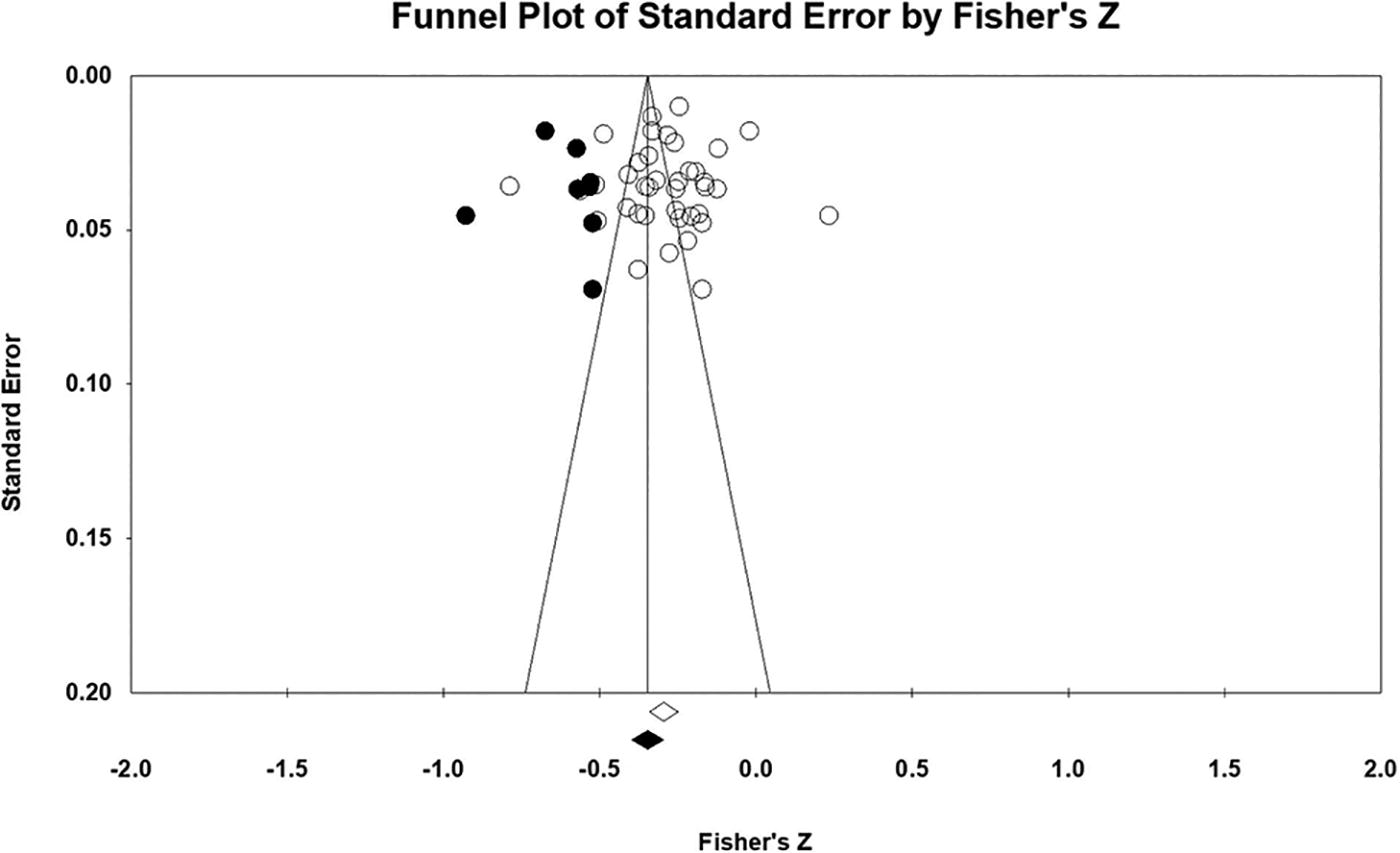
Funnel plot of the correlation between problematic gaming and self-control. The plot displays the relationship between the effect size (Fisher's z) and the standard error, with individual studies represented as data points. The symmetric, funnel-shaped distribution of the data points suggests a lack of significant publication bias.
Subgroup analysis
This review conducted a subgroup analysis due to the high observed heterogeneity to compare the effects of studies targeting different age groups. The age groups were categorized as “adolescents” (k = 32) who were under 18 years old or labeled as primary/middle/high school students in the study, and “emerging adults” (k = 8) who mainly consisted of university students in the included articles. The results showed that the pooled effect size was larger among emerging adults (r = −0.335, 95% CI = [−0.39, −0.28], p < 0.001) than among adolescents (r = −0.276, 95% CI = [−0.33, −0.23], p < 0.001). However, subgroup analysis revealed no significant difference in the magnitude of the relationship between self-control and problematic gaming among adolescent samples versus emerging adult samples (p = 0.133; see Table 4).
Subgroup Analysis of Correlation Between Problematic Gaming and Self-Control
N, number of participants; k, number of studies; CI, confidence interval.
Discussion
This systematic review synthesizes the results of published studies to address the inconsistent findings regarding the relationship between self-control and problematic gaming. Our analysis, incorporating a random-effects meta-analysis, showed that a medium-strength negative correlation between self-control and problematic gaming, indicating that lower self-control is associated with higher levels of problematic gaming. Notably, this association did not vary significantly between adolescents and emerging adults.
The finding of the negative relationship between self-control and problematic gaming is consistent with the common results of published studies, which support SDT. 44 According to SDT, needs for competence, autonomy, and relatedness are the primary driving factors of gaming attractiveness. Research has shown that when these needs are thwarted in daily life, individuals may experience psychological distress, which in turn could lead to more severe symptoms of IGD.45,46 While the thwarting of psychological needs may not directly cause IGD, it likely contributes to broader psychological distress, creating a vulnerability that exacerbates problematic gaming behaviors. The changes in self-control could account for the adverse effects of daily need frustration, potentially leading to an escalation in the severity of IGD symptoms. 23 Besides, previous studies have found that a lack of self-control was found to contribute to an increase in the severity of IGD symptoms by fostering stronger maladaptive motivations toward gaming, which is consistent with the findings in this review. 25 Results could also be explained through the lens of a general theory of crime, 47 emphasizing that the primary cause of criminal and other behavioral problems is a deficiency in self-control ability. Hence, individuals with low self-control are more likely to experience behavioral problems, including problematic gaming behaviors.
Additionally, the findings suggested that there was no notable distinction in the strength of the relationship between problematic gaming and self-control among adolescents and emerging adults. One possible explanation for this could be that although emerging adults may have developed less vulnerability and impulsiveness toward problematic gaming as their brains matured after adolescence, they mostly are the population of university students transitioning into new environments, where feelings of loneliness could trigger impulsivity of university students, encouraging addictive behaviors such as problematic gaming.31,37,48 When students leave for college, significant efforts may be required toward forming new friendships, in addition to the decreased interaction time with parents and friends. 49 Lonely college students who typically experience homesickness and friend sickness tend to be impulsive. 50 Without the monitoring of their parents or friends, they are particularly susceptible to the allure of readily available and instantly gratifying gaming entertainment, resulting in problematic gaming. 51
Notably, the majority of the studies on problematic gaming and self-control searched in this review were conducted in Asian countries. As a result, the subgroup analysis based on different cultural contexts was not feasible due to the limited number of studies from Western countries. Such findings suggested that research on gaming and self-control is more prevalent in Asian countries such as China and South Korea. First, Asian culture values self-discipline as an important attribute. 52 It is generally believed that if one is self-disciplined, one will have fewer problem behaviors. Another potential reason for this trend could be the unique cultural features of Asian countries, where more intense and fiercer competition in education makes students under higher pressure, rendering them more easily to turn to gaming to relieve the academic pressure and thus more susceptible to problematic gaming.53–55
Findings from this review have three important implications. First, this study serves as a valuable reference for future research by synthesizing the negative correlation between self-control and problematic gaming, which could be instrumental in the prevention and intervention of young people’s gaming-related problems. It emphasizes the importance of enhancing self-control to mitigate problematic gaming behaviors. Furthermore, the nonsignificant difference in the relationship between self-control and problematic gaming among adolescents and emerging adults suggests that future interventions can encompass a broad range of young individuals across different age groups. Third, the synthesized results of the review indicate that the lack of consensus on the conceptualization of problematic gaming across studies has led to diverse and complex assessment and measurement tools. Griffiths and colleagues have highlighted the need for age-appropriate screening tools as many studies on problematic gaming among children and adolescents used the adapted measures for adults. 56 Future research could explore the nuanced categorization of measurement tools for gaming and investigate whether using measures with different categorizations would affect the relationship between self-control and problematic gaming. With a more refined categorization, the measurement tools for gaming may be further improved, also leading to greater consensus on its conceptualization. 56
However, several limitations to this review are noted. First, there was an obvious disparity in the number of studies in age subgroups, which may influence the robustness of the subgroup analysis. Furthermore, given that the eligible articles did not further subdivide the recruited adolescents into older and younger age groups but treated them as a single cohort, our subgroup analysis was unable to separate the upper and lower ends of the adolescent period under 18 years old for more specific comparisons. Thus, the results should be interpreted cautiously, and future research should include a more extensive range of relevant studies. Second, this study did not achieve comparisons between cultural groups and sexes, as most included studies did not separate the sexes when conducting correlation analyses. Future research can broaden the scope of the search and conduct subgroup analyses to explore cultural differences (e.g., Eastern vs. Western) and further address sex differences or similarities. More specifically, studies could explore the cultural differences both across countries and within countries (e.g., Chinese Americans vs. German Americans). Third, only one-third of the studies were longitudinal studies in this review, so future research could collect more longitudinal data to address the limitation of the cross-sectional data in determining causation. Furthermore, the measurements used in the reviewed studies were all self-reported, which limited the ability to provide objective and corroborated conclusions. Future research could incorporate behavioral measures, such as direct observations (e.g., tracking gaming time through software or device usage logs), to provide more objective data. Utilizing multiple informants (e.g., parents, teachers, or peers) and physiological measures (e.g., eye-tracking during gaming sessions) could also offer a more comprehensive and objective understanding of the constructs being studied. Last but not least, the current study only tested differences between age groups. Future studies could examine the moderating effects of other variables such as gender, measurements, personality traits (e.g., impulsivity, anxiety, sensation-seeking), and gaming-related factors (e.g., type of gaming).
Conclusions
In conclusion, the current systematic review and meta-analysis synthesized published studies and identified a medium correlation between self-control and problematic gaming. The findings suggest that young individuals with low levels of self-control tend to develop problematic gaming behaviors. Notably, there was no significant statistical difference observed in the magnitude of this relationship among adolescents and emerging adults. These findings have important applications for prevention and intervention strategies. Specifically, interventions aimed at reducing problematic gaming should prioritize young individuals with diminished self-control, incorporating techniques to enhance self-control skills. Additionally, recognizing that this relationship holds across different age groups suggests that prevention programs can be designed to be comprehensive and inclusive. This could reduce the costs associated with personalizing interventions for different age tiers. By fostering self-control in these populations, relevant stakeholders, such as educators, social workers, parents, and policymakers, can potentially mitigate the risks associated with problematic gaming and develop more cost-effective interventions that are easier to implement and promote.
Footnotes
Authors’ Contributions
Y.H. contributed to the conceptualization of the study, conducted the search, reviewed and screened the articles, extracted data, assessed quality of the articles, conducted meta-analysis, and drafted the article. S.C. assisted in assessing the quality of the articles. S.Z. conceptualized the study idea, participated in interpretation of the data, and supervised the project. S.C., D.Q., and S.Z. assisted in checking the extracted data and provided comments for article revision. All authors have read and approved the final article.
Availability of Data and Materials
Data can be requested from the corresponding author.
Author Disclosure Statement
The authors declare no competing interests.
Funding Information
No funds, grant, or other financial support was received.