




Abstract
This study investigated the complex relationship between the Dark Triad (DT) and anonymity levels in the context of cyber aggression on social media. By employing an experimental design, the study aimed to bridge the gap between traditional survey-based experiments and real-time online interactions among social media users. Participants (N = 115) from Taiwan took part a 2 × 2 experimental design, which varied along two factors: anonymity (high vs. low) and DT (high vs. low). Over the course of a four-day simulated exclusionary cyber aggression event, participants’ attitudes were measured via surveys, while their aggressive behaviors were assessed using the polling function on social media. The findings revealed that participants with high DT exhibited significantly higher levels of cyber aggression under the low-anonymity condition compared to those with low DT. However, there was no difference between groups under the high-anonymity condition. Notably, no significant differences were found in attitudes towards cyber aggression. This study makes a significant contribution by employing a simulated cyber aggression scenario that captures participants’ real-time attitudes and behaviors, rather than relying solely on self-report measures, as is common in previous research.
Introduction
Exclusionary cyber aggression (ECA), a pervasive yet underexplored form of online hostility, involves behaviors like social exclusion and group ostracism.1–3 A particularly concerning aspect of ECA is its potential to transform victims into perpetrators.4,5 Research indicates that exposure to exclusion can increase the likelihood of interpreting neutral information as hostile, which may lead to aggressive behaviors. 4 Given these profound negative consequences, identifying the personal and situational factors that contribute to ECA is essential.
The General Aggression Model (GAM) provides a framework for explaining how personal factors (e.g., personality, gender, beliefs) and situational factors (e.g., aggressive cues, external sanctions, incentives) influence aggressive behaviours. 6 According to GAM, personal factors shape an individual’s baseline propensity for aggressive behaviors, while situational factors can trigger or intensify aggressive responses. GAM clarifies why some individuals are more prone to cyber aggression and why certain online environments foster such behaviors. 7 Meta-analyses have identified eight personal and four situational factors associated with cyber aggression, including dark personality traits and online anonymity.7,8
Among personal factors, the Dark Triad (DT)—comprising narcissism, Machiavellianism, and psychopathy—emerges as a key predictor of antisocial behaviors. 9 Evidence from multiple studies, including a meta-analysis, indicates that individuals with higher DT levels are more likely to engage in exclusionary aggression.10,11 Consequently, those with elevated DT levels are at greater risk of perpetrating ECA.
Among situational factors, anonymity plays a critical role in shaping online interactions. 7 Anonymity reduces users’ perceptions of identifiability and accountability.12,13 This diminished sense of responsibility can intensify the relationship between DT and ECA, ultimately fostering an environment in which such hostile behaviors are more readily enacted.
Research on cyber aggression has identified various risk factors. However, the predominant reliance on correlational studies, as highlighted by a meta-analysis of 131 empirical studies 7 —limits our ability to draw causal conclusions due to the nature of these studies. 14 This underscores the need for experimental designs that can establish direct causal relationships between cyber aggression and its associated risk factors.
The present study
Following the GAM, which proposes that both personal (e.g., DT traits) and situational (e.g., anonymity) factors influence cyber aggression, we conceptualized the anonymity condition as a moderator in the relationship between DT traits and cyber aggression. To examine these relationships, we utilized an experimental design that simulated an exclusionary cyber aggression event on a real social media platform. Anonymity was manipulated by assigning participants to one of two conditions: In the low-anonymity condition, participants were asked to display their real names in the social media group; in the high-anonymity condition, participants were identified only by randomly generated ID numbers.
We examined how individuals with high or low levels of DT traits responded to these anonymity conditions in terms of cyber aggression attitudes and behaviors. To ensure the effectiveness of the manipulation, we also measured perceived anonymity as a manipulation check. This step was essential to confirm that participants experienced differing levels of perceived anonymity across conditions, thereby validating the anonymity manipulation. This approach is consistent with established practices in social psychology, where manipulation checks are routinely used to verify whether participants accurately interpreted the experimental context. 15 Importantly, perceived anonymity was not treated as a primary outcome variable, but was used exclusively to verify the success of the anonymity manipulation.
Accordingly, our research question is: How do individuals with high or low DT traits differ in cyber aggression attitudes, and behaviors under high- and low-anonymity conditions? Based on this question, we proposed the following hypotheses: Individuals with high DT traits will report higher levels of cyber aggression attitudes than those with low DT traits. Individuals with high DT traits will report higher levels of cyber aggression behaviors than those with low DT traits. Individuals in the high-anonymity condition will report higher levels of cyber aggression attitudes than those in the low-anonymity condition. Individuals in the high-anonymity condition will report higher levels of cyber aggression behaviors than those in the low-anonymity condition. The anonymity condition will moderate the relationship between DT traits and cyber aggression attitudes. Given the limited empirical evidence currently available, we do not propose a specific directional hypothesis. The anonymity condition will moderate the relationship between DT traits and cyber aggression behaviors. Given the limited empirical evidence currently available, we do not propose a specific directional hypothesis.
In line with the design of prior bullying experiments,16,17 we also included participants’ self-reported experiences of cyber aggression—as both perpetrators and victims—as control variables. This allowed us to account for individual differences in prior exposure to cyber aggression, which may otherwise confound the observed effects of DT traits and anonymity.
Method
Online experimental news articles and platform
LINE OpenChat, a public chat room feature within the LINE messaging app, allows users to engage with various communities while customizing their profile names. This platform supports discussions and interactions among users. 18 We utilized LINE OpenChat to disseminate news and collect users’ opinions by posting content in these chat rooms, allowing participants to comment and participate in discussions. We conducted a four-day discussion, with each day dedicated to a distinct news event concerning the use of ChatGPT in educational settings. Participants were invited to share their opinions on whether such bans were justified or detrimental.
Participants
Participants were recruited through popular social media platforms in Taiwan, such as Facebook and Dcard. We selected participants who were enthusiastic about using ChatGPT for learning. This approach ensured that their responses reflected genuine reactions to simulated cyber aggression incidents, rather than being influenced by preconceived biases against ChatGPT as a learning tool. A total of 115 adults were included in the data analysis (Meanage = 27.97, SDage = 5.76; Nmale = 48, Nfemale = 67). Regarding educational level, 64 participants were undergraduate students, and 51 were graduate students. This study received approval from the University Research Ethics Committee for Human Subject Protection.
Experimental design
This study employs a 2 (low vs. high DT) × 2 (low vs. high anonymity) between-subjects experimental design (see Figure 1). Participants were first categorized into high-DT or low-DT groups based on whether their DT scores were above or below the median score of 15. Within each DT group, participants were then randomly assigned to one of two anonymity conditions: high anonymity (identified only by ID numbers) or low anonymity (using real names). To ensure balance across experimental conditions, a computer-generated randomization process was used within each DT group, providing participants with an equal probability of being assigned to either anonymity condition.
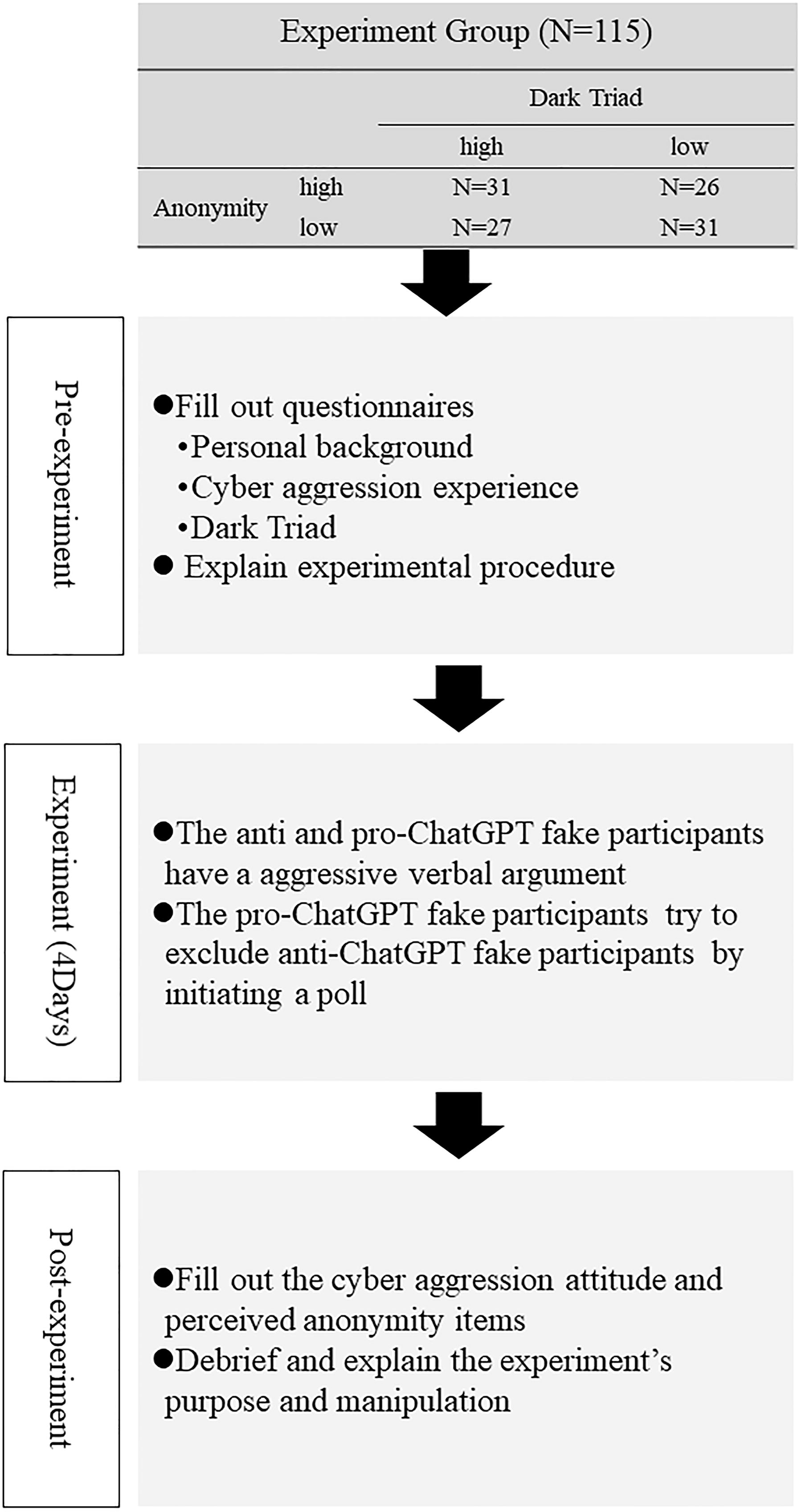
Experimental procedure.
During the experiment, the researcher created confederate accounts that acted as fake participants within each experimental group. These confederates were categorized into three types based on their attitudes toward using ChatGPT for learning: enthusiasts, who strongly supported its use; opponents, who strongly opposed it; and neutral participants, who maintained a neutral stance. Each group included two confederates.
To ensure consistency in their roles, a detailed script was developed specifying what each confederate should say at key time points during the interaction. Before the experiment, training sessions were conducted to familiarize the confederates with the script and their assigned roles. During these sessions, confederates provided feedback, leading to refinements such as the incorporation of emojis and popular internet slang to enhance authenticity.
Additionally, to ensure procedural familiarity, confederates conducted a full practice session on a social media platform before the actual experiment. This rehearsal allowed them to simulate real interactions, reinforce their roles, and ensure uniformity across conditions.
Experimental procedure
Figure 1 outlines the experimental stages: pre-experiment, experiment, and post-experiment. Participants were required to allocate 30 minutes each for both the pre- and post-experiment assessments. Additionally, they spent 20 minutes daily during the experiment engaging with and discussing news, for a total commitment of two hours.
Before the study, participants completed a pre-test questionnaire that assessed their DT, background information, and cyber aggression experiences. The background information included gender, age, and attitudes toward using ChatGPT for learning. Only those who supported the educational use of ChatGPT were eligible to participate. Qualified participants were evenly distributed across four experimental groups. To prevent message overload, each participant was limited to posting only one ChatGPT-related message per day.
The four-day experiment, presented as a discussion on ChatGPT-related news, was actually a simulation of a cyber aggression incident involving exclusionary tactics. Participants were led to believe that the focus was on their views regarding the use of ChatGPT for learning. However, the actual objective was to observe how tensions escalated between ChatGPT opponents and enthusiasts. This conflict peaked on the final day, when ChatGPT enthusiasts initiated an online vote to ostracize ChatGPT opponents and invited actual participants to join in the exclusion. Throughout the experiment, scripted interactions from confederates maintained consistent dynamics across all four groups. The events of each day are summarized in Table 1.
Daily Events during the Experiment
Cyber aggression behaviors were assessed on the fourth day of the experiment through an online voting mechanism initiated by ChatGPT enthusiast. After the experiment, participants completed questionnaires measuring their attitudes toward cyber aggression and perceived anonymity. They were subsequently debriefed and informed that all contentious interactions had been staged using fake accounts and that the cyber aggression was simulated. Each participant received a NT$100 gift card as compensation.
Instrument
Cyber aggression experience
Participants were provided with Schoffstall and Cohen’s 19 definition of cyber aggression and were subsequently asked to report their experiences as either perpetrators or victims over the past six months. Specifically, two questions assessed the frequency of their involvement in cyber aggression: (1) “How often have you been a victim of cyber aggression in the past six months?” and (2) “How often have you perpetrated cyber aggression in the past six months?” Responses were recorded on a 4-point scale (1 = never; 4 = always).
Dark triad
The traditional Chinese version of the Dirty Dozen—derived from the Dirty Dozen 20 —measures narcissism, Machiavellianism, and psychopathy, with each item rated on a 5-point scale ranging from 1 (strongly disagree) to 5 (strongly agree). The scale comprises 3 items for Narcissism, 4 for Psychopathy, and 4 for Machiavellianism. Example items include “I tend to want others to admire me” (Narcissism), “I tend to be cynical” (Psychopathy), and “I tend to manipulate others to get my way” (Machiavellianism). Given the increasing recognition that Likert-scale items should be treated as ordinal variables, we adopted Diagonally Weighted Least Squares (DWLS) estimation with robust correction, which is recommended for ordinal data—particularly when fewer than five ordered categories are present. 21 The CFA model demonstrated good fit indices, with χ2 (41) = 67.810, p = 0.005, CFI = 0.995, TLI = 0.993, RMSEA = 0.068 (90% CI: 0.037, 0.096), and SRMR = 0.076.
To ensure robust reliability assessment, we examined Omega coefficients and Average Variance Extracted (AVE). The results indicated that all dimensions demonstrated acceptable reliability, with Machiavellianism (AVE = 0.725, Omega = 0.912), narcissism (AVE = 0.725, Omega = 0.888), and psychopathy (AVE = 0.701, Omega = 0.902). The overall scale also exhibited high reliability, with AVE = 0.716 and Omega = 0.965. Furthermore, factor correlations were strong: Machiavellianism and narcissism (r = 0.695, p < 0.001), Machiavellianism and psychopathy (r = 0.704, p < 0.001), and narcissism and psychopathy (r = 0.667, p < 0.001).
Cyber aggression attitudes
Participants’ attitudes toward cyber aggression against opponents were measured using a single item on a 6-point scale. The item inquired: “During the experiment, have you wanted to (but not necessarily done) teach the opponents a lesson, such as posting aggressive posts or participating in a poll to exclude them?” Higher scores indicated a greater tendency to engage in cyber aggression towards opponents.
Cyber aggression behaviors
Cyber aggression behaviors were measured using an online poll initiated by the ChatGPT enthusiasts during the experiment. Figure 2 displays the actual voting interface shown to participants. In this poll, participants were asked whether they agreed to block the opponents from the study group—an action consistent with Willard’s (2007) definition of exclusionary cyber aggression. The poll interface was designed to resemble the LINE platform, thereby enhancing the realism of the simulated online environment. Participants rated their agreement with the statement, “Do you agree to add the opponents to the blocklist of the study group, thereby excluding them?” on a 6-point Likert scale (1 = strongly disagree, 6 = strongly agree). Higher scores indicated a stronger tendency to engage in cyber aggression behaviors.

Screenshot of the online voting interface.
Perceived anonymity
Perceived anonymity within the experimental group was measured as a manipulation check to verify whether the anonymity manipulation was subjectively effective. Participants rated their perception of anonymity by responding to the question, “How anonymous do you think the discussion group was during the experiment?” Responses were recorded on a 4-point scale (1 = very unanonymous, 4 = very anonymous).
Analytic strategy
To examine the influence of the DT and anonymity on cyber aggression attitudes and behaviors, a two-way ANCOVA was conducted with previous cyber aggression experience—either as a perpetrator or a victim—included as covariates. According to Blanca et al. (2018) and Hair et al. (2009), this design mitigates the effect of violating assumption of equal variance, equal regression slopes, and normality of distributions, particularly when groups are of approximately equal size. In this study, “approximately equal group size” was defined as the ratio of the largest to the smallest group not exceeding 1.5.22,23
We employed Harman’s One-Factor Test to assess the potential impact of common method variance (CMV). Based on the commonly cited threshold—that a single factor explaining 70% or more of the total variance may indicate problematic levels of CMV 24 —our finding that the extracted factor accounts for only 26% of the variance suggests that CMV is unlikely to pose a significant threat to this study’s validity.
To mitigate social desirability bias, we assured participants that their responses would remain anonymous and confidential, reducing the likelihood of socially desirable responding. Additionally, we incorporated an online poll as a behavioral measure to further minimize social desirability effects. By framing the poll as a natural part of participant interactions rather than an explicit behavioral assessment, we reduced the likelihood that participants would modify their responses due to evaluation awareness. These methodological strategies enhanced the validity of our findings by addressing potential biases inherent in self-report measures.
Result
According to Curran, West, and Finch (1996), skewness values below 2.0 and kurtosis values below 7.0 indicate no substantial deviation from normality. In our dataset, none of the variables exceeded these thresholds. 25 Specifically, the skewness and kurtosis values for perceived anonymity (0.018, –2.035), cyber aggression attitudes (0.414, –0.973), and cyber aggression behaviors (1.557, 1.448) all fell within acceptable ranges, suggesting approximate normality.
Perceived anonymity
As indicated in Table 2, the results of the two-way ANCOVA revealed a significant main effect of anonymity on perceived anonymity (F (1, 109) = 29.394, p < 0.001), confirming that participants experienced differing levels of perceived anonymity across conditions and thereby validating the effectiveness of the anonymity manipulation. Additionally, a significant interaction between DT traits and anonymity was observed (F (1, 109) = 4.038, p = 0.047,
Perceived Anonymity Scores by Anonymity and Dark Triad
Cyber aggression attitudes
The descriptive statistics are presented in Table 3. The results of the two-way ANCOVA indicated no significant main effects for DT (F (1, 109) = 0.010, p = 0.921) or anonymity (F (1, 109) = 0.313, p = 0.577) on cyber aggression attitudes. Additionally, there was no significant interaction effect (F (1, 109) = 0.065, p = 0.800).
Cyber Aggression Attuite Scores by Anonymity Condition and Dark Triad
Cyber aggression behaviors
The descriptive statistics for cyber aggression behaviors are shown in Table 4. The results of the two-way ANCOVA indicated that a significant interaction was observed (F (1, 109) = 4.174, p = 0. 043,
Cyber Aggression Behaviors Scores by Anonymity Condition and Dark Triad
Discussion
This study investigated how DT traits and anonymity conditions jointly influence both attitudes toward and actual engagement in cyber aggression. In this context, attitudes refer to participants’ aggressive perceptions and inclinations toward ChatGPT opponents, while behaviors reflect their observable actions during a simulated online poll. This conceptual distinction is crucial, as prior research in the domain of cyber aggression has rarely differentiated between attitudinal dispositions and behavioral manifestation. The findings revealed that participants with high levels of DT exhibited significantly greater cyber aggression under low-anonymity condition compared to their low-DT counterparts. However, no group differences were observed under high-anonymity condition. The implications and interpretations of these results are discussed in detail below.
Cyber aggression attitudes
The ANCOVA results revealed no significant main effects or interaction effect for cyber aggression attitudes, providing no empirical support for Hypotheses H1a, H2a, or H3a. The lack of significant findings for cyber aggression attitudes was unexpected. Although descriptive statistics (see Table 3) suggested that individuals high in DT traits reported more favorable attitudes toward cyber aggression than their low-DT counterparts—and that participants in the high-anonymity condition reported higher levels of such attitudes than those in the low-anonymity condition—these differences did not reach statistical significance in the ANCOVA analyses.
A plausible explanation involves the influence of social desirability bias, especially since attitudinal data were collected via self-report questionnaires. Social desirability bias operates through two mechanisms: self-deception and other-deception. 26 The latter is particularly relevant in this context, as it involves the deliberate suppression of socially undesirable attitudes to present oneself in a favorable light. In experimental settings, participants may engage in impression management to avoid appearing hostile, particularly when responding to sensitive questions related to aggression. This tendency is well established in aggression research. 27 As aggressive or vengeful attitudes are generally viewed as socially inappropriate, participants—regardless of DT levels or anonymity condition—may have underreported such inclinations, thereby obscuring true group differences.
Cyber aggression behaviors
This section addresses Hypotheses H1b–H3b. While H1b and H2b predicted main effects of DT traits and anonymity on cyber aggression behaviors, these hypotheses were not supported. However, a significant interaction between DT traits and anonymity was found, supporting H3b.
This result indicates a moderation effect, wherein the impact of DT traits on cyber aggression behaviors varies depending on anonymity level—highlighting the importance of person × situation dynamics in cyber aggression. This pattern aligns with the GAM, which posits that both situational and dispositional factors jointly shape aggressive behavior.6,7
Follow-up analyses of the interaction effect revealed that under low-anonymity conditions, individuals high in DT traits engaged in significantly more exclusionary behaviors than their low-DT counterparts. One plausible explanation is that individuals low in DT may inhibit aggressive impulses due to fear of social censure. In contrast, individuals high in DT—characterized by impulsivity, callousness, and risk-seeking tendencies 9 —may be less restrained, making them more likely to act on aggressive impulses. Although direct experimental evidence for this mechanism is limited, related findings from the domains of gambling and risk-taking support this interpretation. Studies show that high-DT individuals are more prone to focus on potential rewards and discount possible risks, often resulting in more impulsive and often reckless decision-making.28,29
Additionally, perceived anonymity offers a complementary explanation. In the low-anonymity condition, individuals high in DT traits reported significantly higher perceived anonymity than those low in DT, even though all participants used their real names. This suggests that perceived anonymity is shaped not only by situational cues but also by individual differences. High-DT individuals may ignore or downplay identity cues—such as real names—due to their reduced risk aversion and heightened sensation-seeking.30,31 This may lead them to overestimate their anonymity and engage more readily in aggressive behavior. Conversely, under high-anonymity conditions, where identity cues were uniformly removed, perceived anonymity was consistent across groups, which may explain the absence of group differences in that condition.
Taken together, these findings highlight a notable divergence between attitudes and behaviors in cyber aggression. While self-reported attitudes—collected through direct questionnaires—did not yield significant effects, likely due to social desirability concerns, behavioral data collected through the simulated exclusionary scenario revealed meaningful patterns. Notably, participants were unaware that the online poll was being used to measure cyber aggression, thereby enhancing ecological validity. The finding that high-DT individuals were more likely to engage in exclusionary behavior under low-anonymity conditions suggests that they may act aggressively even when their identity is visible—possibly because they are less sensitive to risk factors. These findings underscore the importance of distinguishing between attitudinal self-reports and actual behavior, particularly when examining morally sensitive phenomena like cyber aggression.
Limitations and future directions
This study has several limitations. First, it focused exclusively on ECA and used an online poll as the sole behavioral indicator, potentially overlooking other forms of ECA such as passive ignoring or indirect ostracism. Future research should incorporate a broader range of behavioral indicators to strengthen construct validity. Second, the sample primarily comprised individuals familiar with generative AI, particularly ChatGPT, which may limit the generalizability of the findings to broader online populations. Future studies should recruit more diverse participant pools to enhance external validity. Third, several constructs in this study were assessed using single-item measures. This design choice aimed to prevent participants from inferring the true purpose of the study, which was not disclosed at the outset. However, single-item measures typically do not permit the same reliability and validity testing as multi-item scales. Future research is encouraged to adopt validated multi-item instruments with a limited number of items to enhance psychometric quality while still maintaining the concealment of the study’s purposes.
Fourth, although the study followed Nederhof’s (1985) recommendations for reducing social desirability bias—such as ensuring data confidentiality and administering the survey online—these strategies may not have fully eliminated bias in self-reported data. This limitation is particularly relevant to the measurement of cyber aggression attitudes, as attitudes—unlike behaviors—are not directly observable and are more susceptible to impression management. As suggested by Nederhof (1985), future research may benefit from methodological refinements such as indirect questioning (e.g., asking about others’ attitudes), neutral framing (e.g., using less evaluative language), or statistical controls using instruments like the Marlowe-Crowne Social Desirability Scale. These approaches can enhance the validity of self-reported data and help mitigate the influence of socially desirable responding.
Conclusion
This study makes two key contributions. First, by using a simulated cyber aggression scenario, it captures participants’ real-time behaviors rather than relying solely on self-report measures, as is common in previous research. Second, grounded in the General Aggression Model, the study offers a detailed account of how the DT and anonymity jointly influence cyber aggression, thereby addressing a notable gap in the existing literature. Together, these methodological and theoretical contributions provide valuable insights for future research, underscoring the importance of moving beyond traditional self-report approaches to explore how personal and situational factors shape cyber aggression.
Footnotes
Acknowledgments
The authors are extremely grateful to all the participants in this study.
Authors’ Contributions
C.-Y.W.: Conceptualization, methodology, data curation, writing—original, draft preparation. Y.-L.L.: Conceptualization, methodology, writing—reviewing and editing. C.-Y.C.: Writing—reviewing and editing.
Declaration of Publication Ethics
Informed consent was obtained from all individual participants included in the study. All procedures performed in studies involving human participants were in accordance with the ethical standards of Research Ethics Committee for Human Subject Protection, National Yang Ming Chiao Tung University (NYCU112022BF).
Author Disclosure Statement
No competing financial interests exist.
Disclaimer
The study was conducted with no financial or personal relationships that could inappropriately influence or bias the authors’ work. All sources of funding and support for this research are disclosed in the Funding Information section.
Funding Information
This work was supported by the National Science and Technology of the Republic of China under Contract No. MOST109-2511-H009-003-MY3.