




Abstract
Background:
In the development of glucose control algorithms, mathematical models of glucose metabolism are useful for conducting simulation studies and making real-time predictions upon which control calculations can be based. To obtain type 1 diabetes (T1D) data for the modeling of glucose metabolism, we designed and conducted a clinical study.
Methods:
Patients with insulin pump–treated T1D were recruited to perform everyday life events on two separate days. During the study, patients wore their insulin pumps and, in addition, a continuous glucose monitor and an activity monitor to estimate energy expenditure. The sequence of everyday life events was predetermined and included carbohydrate intake, insulin boluses, and bouts of exercise; the events were introduced, temporally separated, in different orders and in different quantities. Throughout the study day, 10-min plasma glucose measurements were taken, and samples for plasma insulin and glucagon analyses were obtained every 10 min for the first 30 min after an event and subsequently every 30 min.
Results:
We included 12 patients with T1D (75% female, 34.3±9.1 years old [mean±SD], hemoglobin A1c 6.7±0.4%). During the 24 study days we collected information-rich, high-quality data during fast and slow changes in plasma glucose following carbohydrate intake, exercise, and insulin boluses.
Conclusions:
This study has generated T1D data suitable for glucose modeling, which will be used in the development of glucose control strategies. Furthermore, the study has given new physiologic insight into the metabolic effects of carbohydrate intake, insulin boluses, and exercise in continuous subcutaneous insulin infusion–treated patients with T1D.
Background
Subjects and Methods
Participants
We recruited 12 patients with T1D from the outpatient diabetes clinic at Hvidovre University Hospital, Hvidovre, Denmark. Patient characteristics were as follows: female sex, 75%; age, 34.3±9.1 years (mean±SD); body mass index, 25.1±4.3 kg/m2; diabetes duration, 16.5±10.2 years; C-peptide, 0.097±0.078 nmol/L (C-peptide was measured 2 h after meal simulation); hemoglobin A1c, 6.7±0.4%; and total daily insulin, 0.63±0.11 U/kg/day. For a minimum of 6 months, patients had been treated with insulin aspart (Novo Nordisk, Bagsværd, Denmark) using the Paradigm® 522/722 insulin pump (Medtronic, Northridge, CA). During the study, patients also used a CGM device (Paradigm Real-Time) from Medtronic and an Actiheart® (CamNtech Ltd., Cambridge, UK), which estimates activity energy expenditure based on heart rate (HR) and accelerometer measurements. Insulin was infused, and CGM devices were inserted into the subcutaneous tissue on the lower abdomen or the lower back. Patients who reported uncertainty about the accuracy of their insulin pump settings performed basal rate and bolus guide testing and optimized pump settings accordingly the first in-clinic study day. 6
The study protocol was approved by the regional ethics committee, and the patients gave informed consent to participation. No remuneration was given.
Experimental design
We devised a modified factorial design study with 24 different study days with predetermined daily life events influencing blood glucose (BG). Each study day consisted of three different events. The event types and sequences of events are described in Tables 1 and 2. Patients were randomly assigned to complete two different study days separated by at least 3 weeks. Except for the duration of the events, the patients spent the day reclining in bed. Study days started at 8:00 a.m. The first 2 h were free of events, designed to stabilize the BG and the effects of transportation to the hospital. The first event of the day was at 10:00 a.m. and was always a meal. The second event was at 12:30 p.m. and was either an insulin bolus or a 20-min bout of exercise, and the third event was at 3:00 p.m. and was an insulin bolus, an exercise bout, or a snack. The events at 12:30 p.m. and 3:00 p.m. were never of the same type on the same study day. At 5:00 p.m. patients' BG was stabilized, and they were subsequently discharged.
CHO, carbohydrate; HR, heart rate; ICR, insulin to carbohydrate ratio; ISF, insulin sensitivity factor; NA, not applicable; PG, plasma glucose.
Large insulin bolus.
Small insulin bolus.
The subject should have had a large insulin bolus (2.6 U) according to the randomization; however, as this amount of insulin would likely have caused severe hypoglycemia, it was decided to overrule the planned sequence and administer a small insulin bolus instead.
CHO, carbohydrate; HbA1c, hemoglobin A1c.
The meal, insulin bolus, and exercise events had two levels as described in Table 1. The meal came either with no insulin or with an insulin bolus corresponding to 50% of the bolus needed to cover the carbohydrate (CHO) content of the meal estimated from the patient's insulin to CHO ratio. The meal bolus was given when the patient started eating. The size of the meal was determined by the weight of the patient (1 g of CHO/kg of body weight) with a composition by energy of 52% CHO, 18% protein, and 30% fat. The CHOs were simple, and the meal included white bread, ham and cheese, margarine, marmalade, milk, and juice. The snack was a juice drink (ProvideXtra, Fresenius Kabi, Bad Homburg, Germany) with 89% of the energy coming from CHO and 11% from fat. The snack size was determined by the patient's weight (0.4 g of CHO/kg of body weight). Meals were ingested over approximately 15 min, and snacks over 5 min.
The exercise event was running, performed on a treadmill. Mild and moderate exercise was quantified by HR and defined as 50% and 75% of the HR reserve, respectively. HR levels were calculated using the formula of Karvonen et al.:
7
The patient's HR was measured online, and the speed of the treadmill was adjusted to achieve the prescribed HR. As a safety precaution, we measured blood ketones before exercise if the plasma glucose (PG) was >252 mg/dL.
The “small” and “large” insulin boluses were estimated to lower PG by 54 and 108 mg/dL, respectively, based on the patient's insulin sensitivity factor.
We instructed patients not to exercise or consume alcohol on the day before the in-clinic study and to fast starting at 10:00 p.m. On the morning of the study day, patients calibrated their CGM devices at home with capillary blood. Upon arrival at the hospital a sampling cannula was placed in an antecubital vein. If PG was <54 mg/dL at any time, another cannula was placed in the other arm, and intravenous glucose was give to raise PG to 94 mg/dL.
We performed 10-min PG measurements throughout the experiment (YSI2300 STAT Plus, Yellow Springs Instruments, Yellow Springs, OH). Blood samples for insulin and glucagon analysis were obtained every 10 min for the first 30 min after an event and subsequently every 30 min. Sensor glucose (SG) values (i.e., CGM measurements) were obtained at 5-min intervals and automatically stored in the insulin pump. After the end of the study day, insulin infusion data, CGM data, and activity and HR data were downloaded from the respective devices. To further improve the physiological understanding of glucose dynamics during CSII treatment, samples for growth hormone, cortisol, epinephrine, and norepinephrine analysis were drawn at the same intervals as insulin and glucagon; however, these data will be reported separately elsewhere.
Changes in concentrations are reported instead of specific values because the baseline values of each event differed markedly as a result of subject-to-subject physiological variability as well as the different sequences of events on different study days. If not otherwise specified, results in the text are mean±SD values. A 5% level is used for significance testing. These significance tests are assuming mutually independent data points; however, future modeling studies should contain parametric descriptions of the autocorrelation structure of data. 8 Area under the curve (AUC) was calculated using the trapezoid rule to quantify the effects of the events.
Results
We present mean changes in PG, SG, plasma insulin, and glucagon concentrations for the three event types: CHO intake, exercise, and insulin bolus. These data are shown in Figures 1 –3.
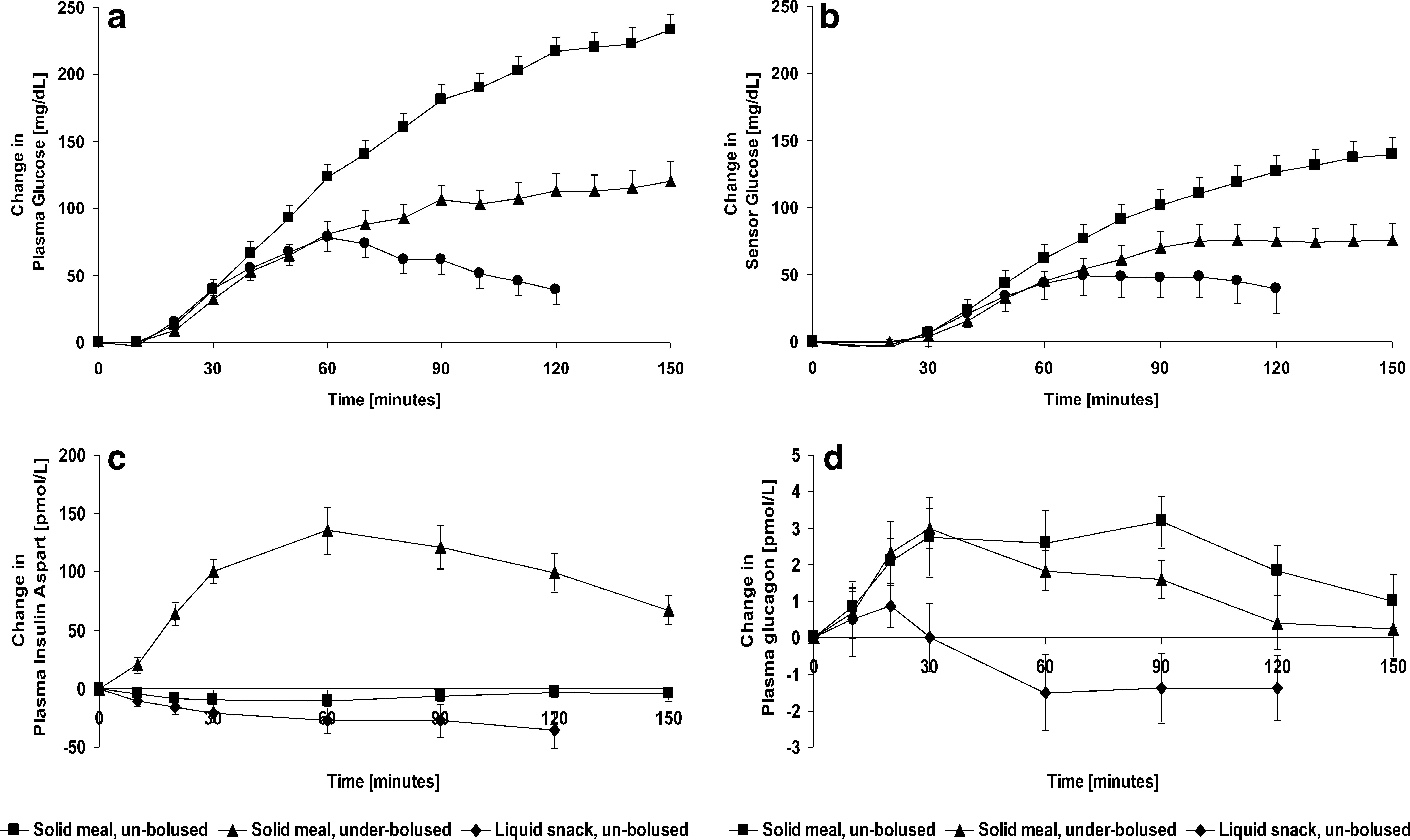
Changes in (
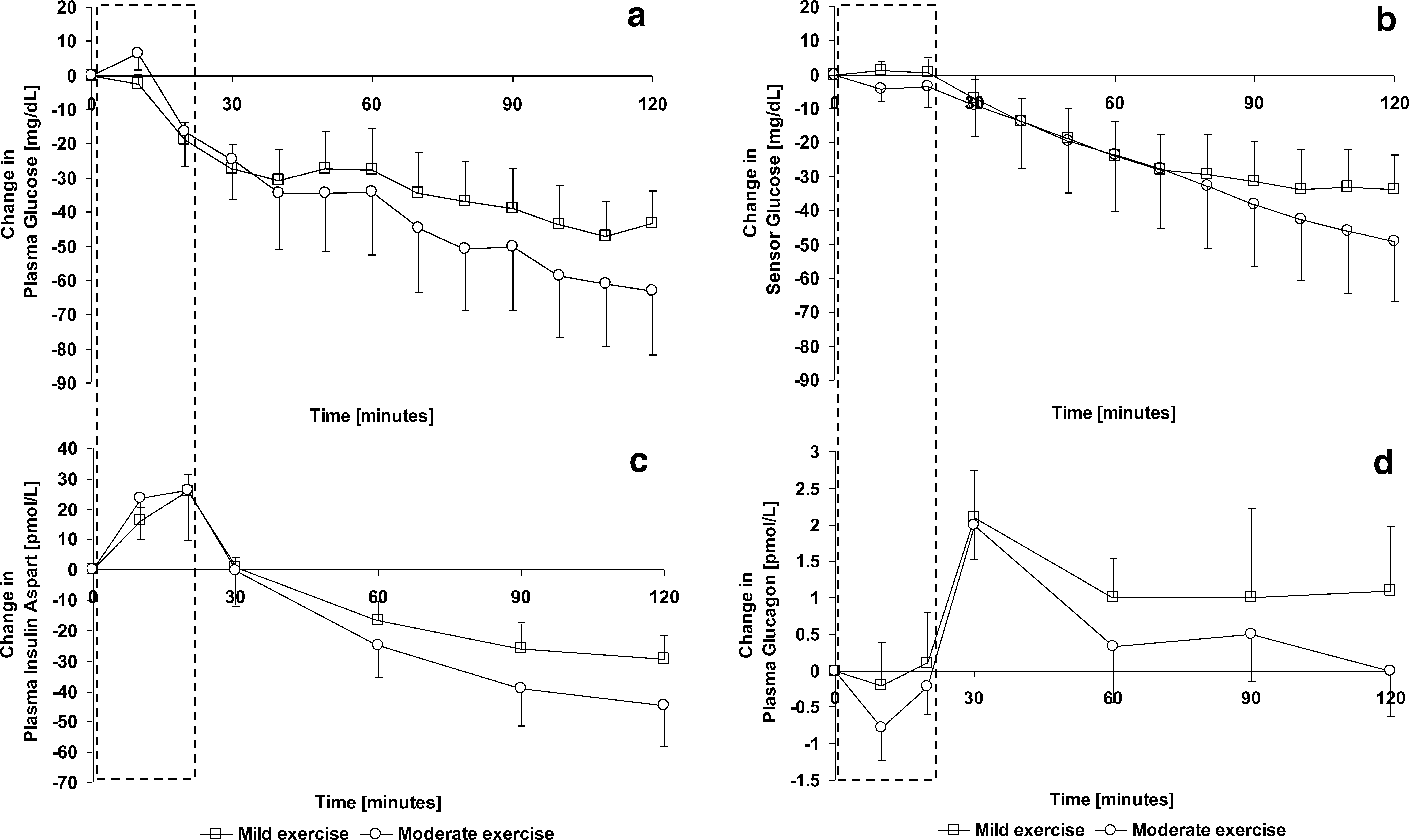
Changes in (
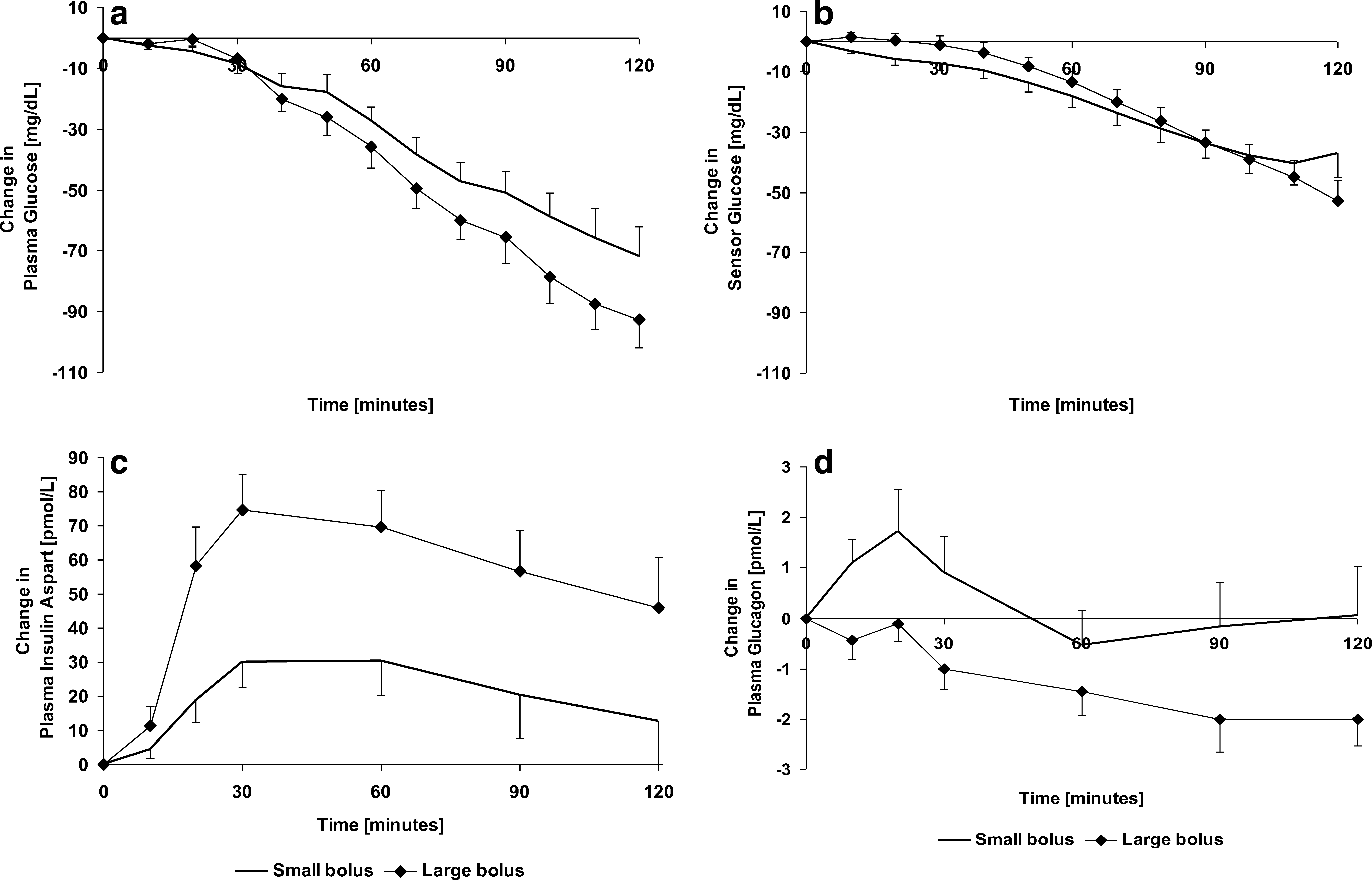
Changes in (
CHO intake
Three event types included CHO intake: the unbolused meal, the underbolused meal (50% meal bolus), and the unbolused snack. The unbolused meal was served on 12 study days, and the underbolused meal was served on another 12 study days. Eight patients were randomized to have the same type of meal on both study days; four patients had the unbolused meal on one study day and the underbolused meal on the other. Six subjects had one of the eight snack events, and one subject completed two study days including a snack event (Tables 1 and 2).
After the meals, PG increased throughout the observation period (Fig. 1). Peak values at 150 min were 232.8±43.4 mg/dL and 120.2±53.1 mg/dL (P=10−5) above baseline for the unbolused and the underbolused meals, respectively. After 60 min, mean PG and AUC for the two meal event types were significantly different; SG values did not statistically differ until 110 min, and SG AUC differed only the last 20 min of the observation period. PG after the snack peaked at 60 min (78.3±33.5 mg/dL) and then decreased again. In the first 60 min after the underbolused meal, plasma insulin rose to 135.5±70.2 pmol/L above baseline and then fell again. After the unbolused meal, plasma insulin remained stable, but after the snack event there was a slight decrease in plasma insulin to 35.4±42.9 pmol/L at 120 min. Glucagon concentrations and AUC after the meals were not significantly different.
Exercise
Nine subjects performed mild exercise on 10 study days. Eight subjects performed moderate exercise on 10 study days (Tables 1 and 2). One moderate exercise event was excluded from the analysis because the subject received intravenous glucose at the beginning of the event. There were no significant differences in mean concentrations or AUC for PG, SG, plasma insulin, or glucagon following mild and moderate exercise. PG levels decreased by 43.4±27.4 mg/dL and 63.2±52.5 mg/dL after mild and moderate exercise, respectively (Fig. 2). Plasma insulin displayed a biphasic pattern: peak values after 20 min of mild and moderate exercise were 26.0±17.1 pmol/L and 26.3±51.6 pmol/L above baseline, respectively, followed by a decline to 29.5±25.3 pmol/L and 44.5±42.8 pmol/L below baseline values at 120 min. A slight decrease in glucagon concentrations was observed after initiation of exercise followed by an increase and peak at the 30-min mark of 2.1±2.0 pmol/L for mild exercise and 2.0±1.5 pmol/L for moderate exercise. Mean energy expenditure was 64±33 kcal and 117±42 kcal during mild and moderate exercise, respectively (P=0.01). There was no correlation between the decrease in BG concentration and activity energy expenditure.
Insulin bolus
A small insulin bolus was given to nine patients and a large bolus to seven patients (Tables 1 and 2). Following the injection of small (1.3±0.2 U) and large (2.8±1.4 U) insulin boluses, PG decreased by 71.8±31.9 mg/dL and 92.6±27.5 mg/dL, respectively, after 120 min (P=0.14) (Fig. 3). PG AUCs did not significantly differ. Plasma insulin peak times were 30 min for both small and large boluses, and the respective peak values were 29.9±24.0 pmol/L and 74.6±30.7 pmol/L above baseline (P=0.002). Glucagon concentrations were lower at all times after the large insulin bolus event compared with the small, but the difference was statistically significant only at 10 and 30 min.
CGM accuracy
The mean absolute difference between paired SG and PG for all study days in total was 28.9 mg/dL (95% confidence interval, 17.6–42.0 mg/dL), and the mean absolute relative difference was 21.6% (17.9–25.2%). When patients were fasting, reclining in bed, and only receiving their basal insulin infusion (8:00–10:00 a.m.), mean absolute difference for all study days in total was 8.9 mg/dL (5.3–12.5 mg/dL), and mean absolute relative difference was 11% (6.5–15.5 %). CGM accuracy decreased during rapid changes in PG. On all study days, CGM values were lower than the actual PG values when PG was increasing but also when PG was stable in the hyperglycemic ranges (<198 mg/dL). Only during sharp decreases in PG and when PG was stable in the normoglycemic range did CGM values correspond to or exceed YSI measurements.
Discussion
We devised a new in-clinic protocol based on daily life events including meals, snacks, insulin boluses, and exercise to obtain T1D data for glucose modeling. CHO intake and changes in insulin delivery are the two most important variables in glucose control in T1D. We designed the study such that these two variables on 12 of the 24 study days were introduced simultaneously, as they often are in real life. On other study days we separated CHO intake and insulin bolus temporally to be able to observe the responses to each system input. Practical T1D measurement heruristics involve a simultaneity between CHO intake and insulin boluses. Unfortunately, this simultaneity disadvantages some useful dynamic modeling strategies that cannot satisfactorially distinguish the very different effects of these two system inputs. It has been shown quantitatively in simulation studies that there is a substantial positive correlation between the prediction accuracy of models and the degree of separation of the inputs from which they were identified. 9
Different levels of CHO intake and insulin boluses were also applied to the protocol. The levels were chosen to gain both fast and slow changes in PG and to challenge the system as much as possible while maintaining realistic values.
Exercise can induce decreases in PG with risk of hypoglycemia during, immediately after, or hours after finishing the activity. However, exercise can also induce hyperglycemia depending on insulin concentration and the type and intensity of exercise. 10 We incorporated into our study protocol both mild and moderate exercise to study these effects.
Each of the 12 subjects was studied on two separate days performing two different sequences of events. In some cases the two study days contained identical events, but in different order; in other cases the events were different. This makes it possible to test the inter-individual performance of the models under identical and dissimilar experimental conditions and to some extent also the intra-individual performance, although a 2-day study does not fully reflect the intra-individual variability. From a clinical perspective, the effects of the different study events are not fully separated; nevertheless, with advanced statistics, such as mixed effects modeling, 11 it is possible to further separate the events and obtain more information across the study population.
One of the DiaCon Study Group's aims is to develop a closed-loop system to improve glucose regulation in T1D. We have based our closed-loop system on the subcutaneous–subcutaneous approach, which has the greatest potential for commercialization in the near future. 12 High-quality insulin pumps are readily available, and sensor performance is steadily improving. The Actiheart used in this study records data for energy expenditure estimations that have to be performed retrospectively. Devices providing the information in real-time are, however, available, which makes it possible to integrate activity in a control algorithm.
We prioritized to perform glucagon analyses to gain insight into the glucagon dynamics in patients with T1D treated with CSII, but also to collect data for potential modeling purposes. Although we intend to develop an algorithm controlling glucose solely by insulin delivery, other groups are working on bihormonal closed-loop solutions based on dual pumps delivering both insulin and glucagon. 13,14 It remains to be determined how the strategies will ultimately perform in an integrated system.
Plasma insulin increased, as anticipated, following the infusion of a half-size meal bolus and remained stable during the unbolused meal. The slight, unexpected decrease in plasma insulin after the unbolused meal was most likely a result of the preceding exercise and insulin bolus events and not an effect of the meal itself. The greater increase in glucagon concentration after the meals compared with after the snack reflects the foods' differing protein content.
During the 20-min bouts of mild and moderate exercise plasma insulin increased. This observation is consistent with the results of one study of exercise in T1D insulin pump users. 15 In contrast, other studies concluded that exercise did not induce increases of insulin concentrations in CSII-treated patients. 16 –18 The observed increase in plasma insulin could be explained physiologically by increases in skin blood flow during exercise for thermoregulatory purposes. 19
The difference in mean energy expenditure during mild and moderate exercise was statistically significant. Nevertheless, changes in PG, SG, plasma insulin, and glucagon during and after exercise did not significantly differ during the 2-h observation period. A tendency toward a greater decrease in PG following moderate exercise was, however, observed, and statistical significance may have been achieved with a larger patient sample. Glucose control in relation to exercise in T1D is complex, and the results of our study should not be extrapolated to other intensities or durations of exercise or exercise performed under different conditions, at different hours of the day, at different time intervals from meals, or with different levels of plasma glucose, insulin, and glucagon. Although there was no simple linear association between activity energy expenditure and decrease in PG during exercise, data analysis might reveal a more complex relation including the counterregulatory hormones that can be modeled and used in a control algorithm.
The decrease in PG after infusion of the large insulin bolus was less than estimated; however, if the observation period had been of the same length as the insulin action time the estimated value might have been achieved. The decrease in PG after infusion of the small bolus, on the other hand, was even larger at 120 min than the estimated total decrease. One explanation for this could be a carryover effect from previous events (e.g., exercise or the meal with the half-size meal bolus).
Accuracy of the CGM was also studied. Mean absolute relative difference for all study days was higher than reported data (21.6% vs. 15.2%). 20 The reason for this divergence could be that these previous studies were performed during eu- and hypoglycemia, whereas most subjects in our study spent a considerable amount of time in the hyperglycemic ranges. Furthermore, the study subjects experienced rapid changes in BG, and CGM values are known to differ from YSI values in these situations.
A limitation of multi-event study days is that PG will vary from the beginning of one event to the next. In our study the different sequences of events further resulted in different baseline values within the same event type, which is why only changes in baseline values are reported in the text and figures. From a strict physiologic point of view it is impossible to draw firm conclusions based on this type of data. On the other hand, these data are highly suited for the intended modeling purposes using advanced pharmacokinetic/pharmacodynamic modeling methods. 21 –23 The patients spent the study day reclining in bed, which may not be representative of outpatient life. The reason for choosing this setup and introducing the events temporally separated was to eliminate the confounding effects of other activities (e.g., the catecholamine response elicited from physical activity).
In conclusion, we have conducted a clinical study based on a novel protocol whereby we have gathered information-rich T1D data for glucose modeling. The next steps will be to develop models of glucose metabolism to be implemented in a virtual T1D clinic. The virtual clinic will be used for simulations of different glucose control strategies including a closed-loop glucose control system.
Footnotes
Acknowledgments
The DiaCon Study Group is financially supported by The Danish Strategic Research Council (NABIIT project 2106-07-0034) and Novo Nordisk A/S.
Author Disclosure Statement
S.S., D.A.F., A.K.D.-H., J.B.J, H.M., H.B., J.J.H., and S.M. have no competing financial interests to declare. K.N. reports receiving consulting and lecture fees from Medtronic.