




Abstract
Background:
The objective of this Canadian observational study was to assess the safety and patient satisfaction with the ClikSTAR® (sanofi-aventis, Frankfurt am Main, Germany) reusable insulin pen in clinical practice.
Subjects and Methods:
Patients with diabetes (n=2,517) were recruited from 103 sites, provided with the ClikSTAR pen, and instructed to report product technical complaints (PTCs), product technical failures (PTFs), and adverse events (AEs) over 6–12 weeks of use. A patient subgroup (n=301) completed a pen use questionnaire at 12 weeks. The risk acceptance criterion was that no validated PTF led to a serious AE (SAE). PTFs were PTCs having a confirmed technical deficiency.
Results:
Patients (68.5% with type 2 diabetes) had a mean age of 56.2 years, and 92.5% were insulin pen users. In total, 84 PTCs were reported by 79 (3.1%) patients. Most PTCs were due to pen handling errors. PTCs from 12 patients were possibly related to AEs, three of which were SAEs; none was confirmed to be due to a PTF. The single reported PTF was not related to an AE/SAE. In the substudy, 97.0% and 95.3% of patients rated “ease of learning” and “ease of use” of the ClikSTAR pen as excellent or good, respectively. Mean scores for patient satisfaction, convenience, flexibility, and recommendations of current treatment on the Diabetes Treatment Satisfaction Questionnaire (change version) had positive changes ranging from 1.0 to 1.8.
Conclusions:
With ClikSTAR, PTCs were infrequent, and there were no PTFs associated with AEs, demonstrating that the pen is reliable and safe with high levels of patient acceptance and satisfaction.
Introduction
Insulin pens are available as reusable or disposable injection devices. In the former, a disposable insulin cartridge is inserted into the pen body, whereas disposable pens are discarded after the insulin has been used. 9 Technological advances in the design of pens mean that routine use of either pen has become more user-friendly through large dose displays, easy dose correction, improved dose accuracy, and reduced injection force. 13 Reflecting this evolving technology, sanofi-aventis (Frankfurt am Main, Germany) has developed a new reusable pen (ClikSTAR®) for use with sanofi-aventis insulins such as insulin glargine and insulin glulisine. 14,15 The features of this pen include an easy-to-change cartridge with a low injection force and the ability to administer from 1 to 80 units of insulin, in 1-unit increments, in one injection, with the possibility of dialing back the selected dose at any time. A preliminary user study has assessed the ease of use and performance of the ClikSTAR pen in a population of diabetes patients (n=654; 23% with type 1 diabetes) from the United States, Canada, the United Kingdom, France, and Germany. 15 Based on questionnaire responses, patients significantly (P<0.05 to <0.001) preferred ClikSTAR to the Lilly (Indianapolis, IN) Luxura® and the NovoPen® (Novo Nordisk, Bagsværd, Denmark) 3 and 4 pens in terms of ease of use, cartridge replacement, and feeling clicks during dose adjustment.
The present study was designed to assess the safety and patient preference for the ClikSTAR pen in clinical practice in Canada. The primary objective was to assess the safety of the pen, based on a risk acceptance criterion of the number of pen product technical failures (PTFs) leading to adverse events (AEs) of very serious, serious, and significant severity of harm. A PTF was defined as a technical deficiency in the pen related to the quality, durability, reliability, safety, efficacy, or performance of the pen. Other aspects of this study included overall safety and patient and healthcare professional acceptance of the new pen device.
Subjects and Methods
Study description
This was a multicenter, open-label, non-randomized, uncontrolled, observational, prospective study, carried out between April 2009 and March 2010. Patients were recruited at 103 sites across Canada and were followed for 6–8 weeks in the main study and for an additional 4–6 weeks (a total of 12 weeks) in a substudy. The latter consisted of a subpopulation of the main study patients who agreed to additional evaluations and longer participation in the study. The study complied with recommendations of the 18th World Health Congress, Helsinki, in 1964 and all applicable amendments, and the study protocol was approved by relevant independent and institutional ethics committees. All participating patients provided written informed consent.
Study inclusion criteria included male and female patients ≥18 years of age with type 1 or type 2 diabetes who were already receiving insulin glargine (Lantus®; sanofi-aventis) or for whom investigators had elected to initiate insulin glargine. In addition, to be eligible for the substudy, patients should have been using only reusable insulin pens for at least 3 months prior to study inclusion. Patients currently participating in a diabetes trial, those with drug or alcohol addiction, diagnosis of dementia, or severe visual or dexterity impairment, or those unable to self-inject (substudy only) were excluded.
The study involved one and two office visits for the main and substudy patients, respectively. At the baseline visit (Visit 1), following confirmation of eligibility, clinical and demographic information was recorded. Patients were then given the ClikSTAR pen and provided with an instructional leaflet and comprehensive training on pen use by a healthcare professional. For participants using insulin glargine prior to the study there was no change in their dosing regimen with the switch to ClikSTAR, and any subsequent dose changes reflected normal clinical practice at each site. Similarly, patients continued using their usual bolus insulins or oral antidiabetes drug medication regimens. Patients initiating glargine and/or other diabetes therapies were treated according to normal clinical practice at each site. Glargine and all other insulins were obtained through standard procedures.
For all patients there was a follow-up visit (either by telephone or face-to-face) at 6–8 weeks (Visit 2) following the baseline visit during which main study patients returned the ClikSTAR pen and completed an ease-of-learning questionnaire. Participants in the substudy had a final face-to-face visit 12 weeks after the baseline visit (Visit 3) when additional pen use and satisfaction questionnaires were completed and the ClikSTAR pen was returned.
Assessment of product technical complaints and PTFs
At Visit 1 all patients were instructed to call the site, or contact the Study Technical Support Call Center, should a product technical complaint (PTC) occur during the course of the study. At Visit 2 for all patients, and again at Visit 3 for substudy patients, the occurrence of PTCs reported during the study period was reviewed by the investigator. When a PTC was reported, the investigator was asked to record details of the complaint. If the problem with the pen was not immediately resolved after troubleshooting, the investigator was asked to collect the pen from the patient, provide a replacement, and send the pen to sanofi-aventis where it was examined by the Product Technical Complaint Centre (Frankfurt), and an attempt made to replicate the PTC reported by the patient through visual and functional inspection of the pen and, when possible, simulation of the complaint. A PTF was defined as a PTC that was confirmed by the Product Technical Complaint Centre, reflecting a technical deficiency in the pen.
Safety assessment
Investigators were asked to record all AEs, their severity, the possible relationship of the event to a PTC, and the event's possible relationship to the ClikSTAR pen or insulin glargine. Healthcare professionals solicited from the patient the occurrence of any AEs or serious AEs (SAEs) occurring from the date the patient received the ClikSTAR pen until the day after the return of the pen. If, according to the investigator, there was a change in the frequency or intensity of symptomatic hyper- or hypoglycemia, this was to be reported as an AE. The relationship between an AE and a PTC was based solely on investigator judgment and was not challenged by an independent adjudication committee.
Patient questionnaires
ClikSTAR: ease of learning
An ease-of-learning questionnaire was completed by all patients at Visit 2. This questionnaire requested information on the patients' primary trainer, their confidence in using the pen, and how easy it was to learn to use the pen. The latter was assessed using a 5-point Likert scale with responses ranging from 1 (strongly agree) to 5 (strongly disagree) that it was easy to learn to use the pen.
The patients participating in the substudy completed several additional questionnaires designed to quantify overall satisfaction with the ClikSTAR pen and comparison with their prior pen. The content of these questionnaires and how patient responses were quantified are summarized in Table 1. All questionnaires were completed at Visit 3, with the exception of the ease-of-use questionnaire, which was also completed at the baseline visit, providing an assessment of prior pen ease of use before switching to ClikSTAR.
Healthcare professional questionnaire
Healthcare professionals completed a questionnaire after the 6–8-week site visit assessing basic demographic information and how easy it was to teach patients to use the ClikSTAR pen. The latter was based on a 5-point Likert scale with responses ranging from strongly disagree (1) to strongly agree (5) that it was easy to teach patients to use the pen.
Diabetes Treatment Satisfaction Questionnaire
The Diabetes Treatment Satisfaction Questionnaire (DTSQ) status version (DTSQs), consisting of eight items relating to diabetes therapy, was completed by substudy patients at baseline, basing their response on a 7-point Likert scale, ranging from 0 to 6. 16,17 The DTSQ change version (DTSQc), consisting of eight items relating to patient perception of change in diabetes therapy, was completed at Visit 3, basing responses on a 7-point Likert scale, ranging from −3 to +3 with 0 indicating no change. 16,17 Overall satisfaction scores on the DTSQs can range from 0 (very dissatisfied) to 36 (very satisfied) and on the DTSQc from −18 (much less satisfied now) to 18 (much more satisfied now). Perceived hyper- and hypoglycemia on the DTSQs can range from 0 (none of the time) to 6 (most of the time) and on the DTSQc from −3 (much less of the time now) to +3 (much more of the time now).
Statistical analysis
Based on the Risk Management Plan, the primary end point of the main study was the number of validated PTFs leading to AEs of very serious harm (resulting in death), serious harm (serious deterioration in state of health), or harm (temporary reversible injury requiring help from others or additional drugs, but without medical intervention), and this formed the basis of sample size calculations. With 2,500 patients and an assumption that no such events would occur, the upper limit of a 95% confidence interval (CI) for the number of PTFs associated with an AE occurring in patients using the ClikSTAR pen would be 3/2,500 or 0.12%, based on criteria (the “rule of three”) defining the probability of rare events occurring in clinical trials. 18 –20 With the occurrence of at least one PTF leading to an AE, the 95% CI was calculated using the Clopper–Pearson procedure. 21 For the substudy population, an estimated sample size of 250 would result in a 95% CI of±0.15 for the mean overall evaluation score for the ClikSTAR pen (pen use questionnaire) based on an assumed SD of 1.0 for the total score.
PTCs and PTFs were grouped according to the specific component of the injection process impacted and summarized using descriptive statistics for frequency. The primary analysis population was an intent-to-treat population who (a) were provided with a ClikSTAR pen and completed Visit 2 (main study population) or (b) completed the overall pen evaluation on the pen use questionnaire (substudy population). Descriptive statistics were used to summarize baseline patient demographics and all survey responses. For the latter, Likert scale responses were expressed in terms of percentages of patients and as mean scores for each specific assessment. Analysis of variance and logistic regression analyses (analysis of covariance in the case of the DTSQc) were performed for all questionnaires to determine if mean scores were consistent across subgroups defined by patient demographic and baseline characteristics. Because these statistical tests were exploratory, the significance level was set to 0.85 (α=0.15) to provide a greater likelihood of identifying possible subgroup effects. Because of a protocol violation in substudy patient recruitment at one site relating to inclusion of patients who were using a disposable insulin pen, 84% of whom were using the Lantus SoloSTAR® (sanofi-aventis) pen, all statistical analyses were carried out with and without these patients.
Results
A total of 103 sites participated in the study and enrolled 2,549 patients, 32 of whom were screening failures. The remaining patients (n=2,517) constituted the intent-to-treat population and formed the basis of the main study evaluations. As shown in Table 2, this population had a mean age of 56.2 years and was 56% male, the majority had type 2 diabetes (68.5%), and the mean duration of diabetes was 17.56 years. Almost all patients had used insulin (94.4%), 92.5% were currently using an insulin pen at the initiation of the study, and nearly half of them (44.4%) had been using a pen for more than 5 years. Only 9.4% and 7.7% of recruited patients were classified as having visual or manual dexterity problems, respectively (Table 2), but only 1.2% of the population (n=30) did not self-inject.
Patients with mild, moderate, or severe visual impairment despite wearing glasses or contact lens.
Patients with mild, moderate, or severe manual dexterity problems such as arthritis or neuropathy.
Total satisfaction score is the mean score for Diabetes Treatment Satisfaction Questionnaire status version (DTSQs) questions 1 and 4–8; the two questions relating to perceptions of blood glucose were not included (questions 2 and 3).
HbA1c, glycosylated hemoglobin; OAD, oral antidiabetes drug.
The substudy population (n=301) was similar to the main study population with the exception of type 1 diabetes, which was more prevalent in this patient group (43.2% vs. 31.4% in the main study population) (Table 2). Although patients using a disposable basal insulin pen should have been excluded from the substudy, 95 (31.6%) of the 301 patients recruited were in fact using a disposable pen at initiation of ClikSTAR; 80 of these patients were using the Lantus SoloSTAR pen. However, consistency of effect analyses and analyses excluding these patients did not identify any subgroup effects due to use of a disposable pen.
PTCs and PTFs
As shown in Table 3, 79 patients (3.1%) reported 84 PTCs over 409.8 patient-years of ClikSTAR use. The most common PTCs were related to insulin delivery (40.5% of total PTCs) and the operation of the plunger (26.2%). Only one of the PTCs was classified as a PTF, and this event was not associated with an AE (Table 3). The PTF was related to a problem with the pen's cartridge holder. Once the Product Technical Complaint Centre received the pen they were able to reproduce the event described by the patient. For all other PTCs, the Product Technical Complaint Centre could not duplicate the problem described by the patient, and all the pens were fully functional. Therefore, as there were no PTFs associated with an SAE, the expected AE rate from use of the ClikSTAR pen in real clinical practice is less than 0.0012 or 12 events in 10,000 experiences with the pen. Logistic regression analysis of the PTC data indicated that statistically significant differences in the likelihood of reporting a PTC were observed in two patient groups: patients with dexterity problems (P=0.0128) and those who found it difficult to learn to use ClikSTAR (P=0.012) (data not shown). These patients were twice as likely to report a PTC as patients with no dexterity problems (2.22; 95% CI, 1.19, 4.17) or who had no difficulty learning to use the pen (2.25; 95% CI, 1.32, 3.85).
Percentages are based on the intention-to-treat population of 2,517.
PTC, product technical complaint; PTF, product technical failure; SAE, serious adverse event.
Safety of the ClikSTAR pen
Safety assessment was based on patient reports to the investigator of AEs, which included changes in the frequency or intensity of symptomatic hyper- and hypoglycemia. In total, 78 patients (3.1%) had AEs over the study period. The most common events were hyperglycemia (n=8 [0.3%]), suspected influenza/viral respiratory illness (n=7 [0.3%]), and hypoglycemia (n=6 [0.2%]). Twenty patients (0.8%) had SAEs, with the most common being diabetic ketoacidosis (n=4 [0.2%]), and all other events were reported by fewer than three patients. There were four unrelated AEs resulting in death: stroke (a 76-year-old man), myocardial infarction (a 71-year-old man), intracranial hemorrhage (a 91-year-old man), and metastatic lung cancer (a 64-year-old man). In total, 19 (0.8%) patients permanently discontinued use of the ClikSTAR pen because of AEs, with the most common being hyperglycemia (n=4 [0.2%]) and hypoglycemia (n=3 [0.1%]).
Based on investigator judgment, AEs in 12 patients were possibly related to a PTC, three of which were SAEs. Two of the latter were episodes of diabetic ketoacidosis: the probable cause for one diabetic ketoacidosis episode in a 42-year-old man was pneumonia, and the probable cause for the second diabetic ketoacidosis episode in a 60-year-old woman was poor compliance to treatment. For the third possibly related SAE, nocturnal hypoglycemia in a 76-year-old man with type 2 diabetes, the investigator could not rule out an association with the pen. Investigation of all pens associated with these events by the Product Technical Complaint Centre did not identify any type of pen failure.
Patient assessments
To evaluate how easy it was to learn to use ClikSTAR, all patients completed a questionnaire after 6–8 weeks of pen use. As shown in Table 4, 96.5% of patients were confident in using the pen immediately after training. For those 86 patients who were not immediately confident in use of the pen, the mean number of days to become confident was 3 days. Moreover, 98.6% (2,423/2,459) of patients “strongly agreed” or “agreed” that it was easy to learn to use the ClikSTAR pen (Table 4); ratings were similar in patients using only insulin glargine (n=735; ease of learning score=97.7%) or a basal/bolus insulin regimen (n=1,782; 99.0%) (data not shown). Training in use of the pen was carried out mostly by nurses (57.6% of patients) and physicians (25.7% of patients), and among the healthcare professionals directly involved in training, 89% agreed, or strongly agreed, that it was easy to teach patients how to use the pen (data not shown). Logistic regression analysis indicated that patients who strongly agreed that it was easy to learn to use ClikSTAR were younger (<45 years of age), had type 1 diabetes, a post-secondary education, never used oral antidiabetes drugs, had no visual or dexterity problems, were educated in pen use by a nurse, and whose healthcare professional had the least difficulty teaching how to use the pen (Table 4). All these parameters were significantly associated with ease of learning to use ClikSTAR (Table 4).
Analysis was based on the population (n=2,459) who completed the ease-of-learning questionnaire and whose site completed the healthcare professional ease-of-teaching questionnaire.
Consistency of effect analysis based on the percentage of subgroup patients who strongly agreed that it was easy to use the pen.
Based on healthcare professional responses to ease-of-teaching assessment and corresponding patient rating of ease of learning.
DEC, Diabetes Education Centre; OAD, oral antidiabetes drug.
The substudy patients further evaluated ClikSTAR after continued use of the pen for a total of 12 weeks. As shown in Figure 1, patient ratings of ease of use of the pen functions during preparation of the pen for injection and the actual injection were very high: 97.0% (292/301) and 95.3% (287/301) of patients rated “ease of learning” and “ease of use” of the ClikSTAR pen as “excellent or good,” respectively. In particular, 89–96% of patients rated different items of the ease-of-use questionnaire relating to preparation of the pen for injection as excellent or good (Fig. 1), and the mean ease of use score was 1.37±0.513. In an overall evaluation, 89.1% of patients rated the pen as excellent or good, 80.6% planned to continue using the pen, and nearly 90% would recommend the pen to others, and the overall evaluation score was 1.4±0.75 on a scale of 1 (excellent) to 5 (very poor) (Fig. 1). Although the consistency of effect analysis in the substudy was limited by the small number of patients in some of the defined subgroups, data indicated that patients who found it easy to learn to use the pen had significantly improved overall ease of use and evaluation scores, emphasizing the importance of effective patient training in pen use.

Rating of the ClikSTAR pen in substudy patients (n=301), as assessed using the ease-of-use and overall evaluation questionnaires. For each question, participants were asked to respond on a scale of 1 (excellent) to 5 (very poor). Data shown are the percentages of patients responding with an excellent/good assessment (scores of 1.0 and 2.0, respectively). Mean assessment scores for each question are shown at the end of each bar. Questions relating to continuation of use and recommendation of the pen to others were assessed with a yes/no response; values shown are the percentages of patients responding yes.
Furthermore, there was a clear preference for ClikSTAR in comparison with the pen used at baseline. As shown in Table 5, compared with their previous pen, 75.1% of substudy participants thought the ClikSTAR pen was much easier/easier to use, 68.4% thought it much easier/easier to inject with, and 75.7% preferred the ClikSTAR pen. The percentages remained approximately the same after removing the 95 patients who had previously used a disposable pen, with 79.5% of the remaining population preferring the ClikSTAR pen.
Ease of use and ease of injection were assessed on a 5-point Likert scale with responses ranging from much easier (1) to much more difficult (5).
Patient satisfaction with the ClikSTAR pen and the positive impact of the pen on perceptions of diabetes control were also apparent in the DTSQc data. As shown in Figure 2, mean scores for this questionnaire on items relating to satisfaction, convenience, flexibility, and recommendations of current treatment had a positive change, indicating an overall greater satisfaction with current therapy. The total satisfaction score was 1.37, suggesting a moderate overall degree of satisfaction with the current treatment. When patients who had used a disposable pen (n=95) were analyzed separately, the total DTSQc satisfaction score was 1.270, compared with 1.434 for the remaining patients (n=204) (P=0.2657), indicating that the inclusion of the former group did not impact the overall DTSQ analysis. Scores for the two items relating to perceptions of low or high blood sugars (scores of −0.1 and 0.2, respectively) indicated no major change in blood control from this perspective. Logistic regression analysis indicated that total DTSQc satisfaction score was significantly higher in female patients (P=0.1382), those with type 2 diabetes (P=0.0191), patients with visual (P=0.0136) or dexterity (P=0.1416) problems, and those who found the pen easiest to learn to use (P=0.0384) (data not shown).
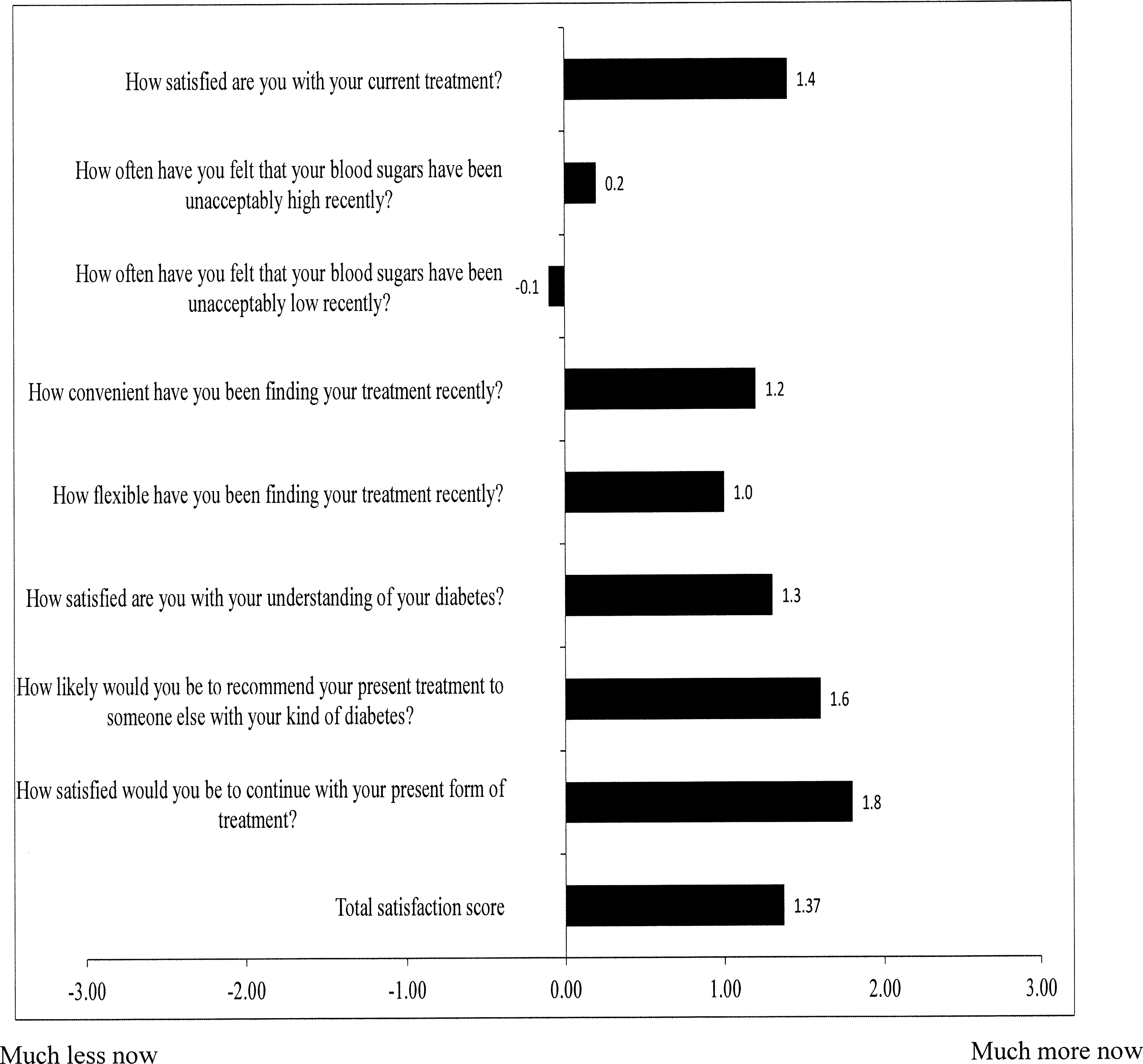
Mean Diabetes Treatment Satisfaction Questionnaire change version scores assessed in substudy patients (n=301) after 12 weeks of ClikSTAR use. Note that a close to zero response for questions relating to patient perceptions on whether blood sugars have been unacceptably higher or lower recently reflects no change. The total satisfaction score is the mean score for all questions, except the two relating to patient perceptions of blood sugar levels.
Discussion
The current study was designed to assess the safety of the ClikSTAR reusable insulin pen device and patient-reported outcomes relating to use of the pen in clinical practice in Canada. The primary outcome was the number of validated PTFs associated with an SAE. In this study, with a safety population of 2,517 patients, no such event was reported. As a consequence the estimated event rate was less than 0.0012.
The PTC assessment reflected patient complaints relating to everyday use of the ClikSTAR pen, and these occurred at a very low rate; only 84 PTCs were reported, and the annualized event rate was 0.205 PTCs per patient-year. In fact, the study design may have increased the number of apparent PTCs because patients were encouraged to contact the investigator if they had any complaint or comments. However, only one event was validated as a PTF, giving an annualized PTF rate of 0.0024 per patient-year; in the remaining cases the Product Technical Complaint Centre did not identify any malfunction of the pen and concluded that the PTCs were due to patient handling errors. The single PTF, which was not associated with an AE, was caused by a welding error that led to incorrect positioning of the cartridge in the pen. As a result an additional 100% quality control procedure has been implemented in the production line directly after the welding station; no further occurrence of this failure was observed.
Consistency of effect analysis showed that patients with dexterity problems and those who had trouble learning to use ClikSTAR had significantly higher rates of reporting PTCs. Elderly patients with visual impairment and patients with impaired manual dexterity have been shown to have increased problems handling insulin injection devices. 9,22,23 Hence, it is not unexpected that these patients would report more PTCs. However, compared with vial-and-syringe systems, prior studies have shown that insulin pens make injections easier and simpler for the majority of patients with visual impairment or manual dexterity problems. 9,22,23 Clearly in the current study, in a population of experienced pen users, the ClikSTAR pen was associated with a small number of PTCs, and the majority of users, including those with visual or manual dexterity issues, were very satisfied with the pen functions.
Few studies have reported on the rates of PTCs associated with the use of insulin pens in clinical practice. In a population of type 1 and type 2 diabetes patients using a reusable pen (HumaPen® Memoir™ [Lilly]) for 6–10 weeks, Venekamp et al. 12 reported a PTC rate of 18.1%: of these complaints, 42.1% were considered to be functional (complaints relating to ability of the pen to deliver a set dose of insulin), approximately one-third of which were related to pen malfunction; the remainder (67%) were judged to be due to patients failing to operate the pen correctly. This study therefore showed much higher rates of PTCs and PTFs in a similar type of patient population.
Three of the patients reporting PTCs also had SAEs, including one patient who experienced two episodes of ketoacidosis. However, the possible relationship between the PTC and the SAE was based on the investigator's opinion at the initial report, and none of the events was due to pen failure. Overall there were no safety issues with the use of the pen, and only 12 patients (0.5%) had AEs (including three SAEs) considered possibly related to the ClikSTAR. The overall rate of AEs was similar to or lower than rates reported for reusable and disposable insulin pens, in studies with a similar treatment period. 12,24,25 In diabetes patients using an electronic reusable pen for 6–10 weeks, Venekamp et al. 12 reported 24% of participants (n=300) had AEs and three (1%) had an SAE, none of which was assumed to be related to the pen. Similarly, in a 5–7-week study of the reusable HumaPen Ergo® (Lilly) insulin pen, three patients (4% of total) had pen-related AEs, two of which (hyperglycemia and ketosis) were considered to be severe. 24
All patient assessments in the current study were highly favorable for the ClikSTAR pen. The majority of patients (98.6%) found it easy to learn to use the pen and were immediately confident after training (96.5%). In the same way, the majority of healthcare providers (89%) found it easy to teach patients to use the pen. In the substudy group, 89.1% rated the ClikSTAR as excellent or good, and 80.6% planned to continue using the pen, which represents a high positive response from a patient population with extensive experience using reusable and disposable insulin pens. In addition, completion of an ease-of-use questionnaire at baseline and again after 12 weeks of ClikSTAR use demonstrated a change in patient preference compared with their prior pen, reflected in a mean ease-of-use score change from 2.29±0.9 at baseline to 1.37±0.513. These results confirm preliminary data reported by Penfornis 15 on the ease of use and performance of ClikSTAR compared with other insulin pens in a population of diabetes patients, where there was a strong preference for ClikSTAR compared with NovoPen 4, NovoPen 3, and Lilly Luxura pens. A preference for current diabetes therapy with ClikSTAR was also apparent in the satisfaction questionnaire evaluation. Because the majority of patients were already using insulin glargine and insulin pens at baseline, initiation of ClikSTAR was the only major change in their diabetes therapy, and hence the increased satisfaction was likely due to the switch to the new pen.
The consistency of effect analyses identified ease of learning as a major factor in almost all patient assessments. Scores for ease of use, overall evaluation, and patient satisfaction using the DTSQc were all significantly higher in patients who found it easy to learn to use the pen. This indicates that teaching patients how to use the pen correctly is an important step in enhancing pen uptake and effective use. The logistic regression analyses also demonstrated that ClikSTAR may offer particular benefits to patients with visual or dexterity problems, a particularly problematic population in diabetes care. 7,9,22 Although these patients had difficulty learning to use the ClikSTAR, the DTSQc evaluation indicated that they had significantly higher levels of overall satisfaction than patients without visual or dexterity problems. This suggests that the features added to the pen, such as larger numbers on the dial and a clear dialing click, appeared to meet their needs, once they had learned to use the pen correctly. Because the only parameter changing during the study was use of the ClikSTAR pen, this suggests that the positive change in these parameters was due to use of the pen. This was supported by the observation that there was no significant change in HbA1c (mean HbA1c was 7.86% at baseline and 7.91% at 12 weeks).
There are several limitations associated with the present study. This was a single-arm study with no direct comparison with other pen devices. However, use of the same questionnaire (ease-of-use questionnaire) at baseline and after 12 weeks of pen use did allow a comparison of patient rating of the pre-study pen with the ClikSTAR. In addition, the data obtained in this single treatment arm study were supported by comparative data from Penfornis, 15 which not only indicated that ClikSTAR was preferred over other pens, but also showed levels of ease of use of ClikSTAR similar to those obtained in the present study. There may also be a potential limitation in applying outcomes assessed only in the subpopulation to the main study population. However, the clinical and demographic baseline characteristics of the main and the subgroup populations were virtually identical, and there was no apparent bias in selection of patients for the latter, nor were there any subgroup effects identified in logistic regression analyses. Finally, apart from the DTSQ, the questionnaires used in this study were not formally validated. However, the same or similar questionnaires have been used in several prior studies by sanofi-aventis, and questionnaires with similar structure have been used to quantify patient satisfaction with insulin pens. 10 –12,25 In addition, the DTSQc did provide validation of the data because it showed significant satisfaction with the ClikSTAR pen, confirming the results obtained from the other questionnaires.
Conclusions
ClikSTAR is a new, easy-to-use reusable pen developed for the administration of sanofi-aventis insulins. In this large Canadian study, patients who were switched to ClikSTAR found it easy to learn to use the pen, >89% rated it as excellent or good for ease of use and recognized an overall improvement over their prior therapy in several key diabetes-related parameters, and there was only a single PTF, which was not associated with an AE. Patients with visual impairment or manual dexterity had particularly high levels of satisfaction with the pen. Only 0.5% of patients (n=12) had AEs that were possibly related to ClikSTAR, and none was confirmed to be related to a pen failure. The study demonstrates that ClikSTAR is an effective, reliable, and safe reusable insulin pen device with high levels of patient acceptance and satisfaction in everyday use.
Footnotes
Acknowledgments
The authors wish to thank all the investigators who participated in this study. The study was supported by a grant from sanofi-aventis.
Author Disclosure Statement
I.G. was a Principal Investigator (PI) in the study. He received grants from sanofi-aventis for his participation in the study and consulting fees for acting as the chairman of the study's Steering Committee. He has participated as a PI in other sanofi-aventis trials. P.P. was a PI in the study. He received grants and consulting fees from sanofi-aventis for acting as a member of the Steering Committee. L.B. was a Study Coordinator at one of the participating sites. She received consulting fees from sanofi-aventis for acting as a member of the Committee. She also received a grant for an Investigator Sponsored Study with diabetes patients. She is often solicited by sanofi-aventis as an expert in the treatment of diabetes. J.S. is an employee of sanofi-aventis and acts as Senior Biostastician. N.B. is an employee of sanofi-aventis and acts as Global Device Leader Reusable Pens. K.M. received consulting fees from sanofi-aventis for acting as a member of the Committee. T.E. was a PI in the study. He received grants from sanofi-aventis for his participation in the study and consulting fees for acting as a member of the Steering Committee.