




Abstract
Introduction:
Glycemic control in critically ill patients has been the topic of an interesting debate during the last decade. An accurate continuous glucose monitoring system is essential to better understand this field. This prospective study thus evaluates the accuracy and technical feasibility of a continuous glucose monitoring system using intravascular microdialysis.
Patients and Methods:
Thirty patients undergoing cardiac surgery were monitored using a triple-lumen central venous catheter (Eirus™ TLC; Eirus Medical AB, Solna, Sweden) with an integrated microdialysis function. The catheter functions as a central venous catheter, enabling blood sampling and administration of infusions and medication while simultaneously providing continuous glucose monitoring. The patients were monitored for up to 48 h postoperatively. As reference, arterial blood gas samples were taken every hour and analyzed in a blood gas analyzer.
Results:
Six hundred seven paired samples were obtained for analysis. Using Clarke Error Grid analysis, 100% of the paired samples were in Zones A+B, and 97% were in Zone A. Mean difference (bias) was −0.12 mmol/L, and mean absolute relative difference was 5.6%. Of the paired samples, 97.5% were correct according to International Organization for Standardization criteria. Bland–Altman analysis showed bias±limits of agreement were −0.12±0.7 mmol/L. No hypoglycemic episodes were observed.
Conclusions:
Central venous microdialysis is an accurate and reliable method for continuous blood glucose monitoring up to 48 h in patients undergoing cardiac surgery. With the microdialysis function integrated in a central venous catheter, no extra device for the continuous glucose monitoring is required. The system may be useful in critically ill patients.
Introduction
Glucose monitoring is essential to better understand the complex metabolic events in critically ill patients. Continuous glucose monitoring (CGM) has been studied in critically ill patients with promising results. 27 In theory, it is plausible that CGM allows for better glycemic control and if implemented correctly may reduce hypoglycemia, hyperglycemia, and glucose variability. 28 To what extent this is beneficial in the clinical setting remains to be further studied.
We have previously described intravascular microdialysis as a method for CGM in critically ill patients and shown this method to be accurate. 29 This study introduces a new triple-lumen catheter (TLC) that allows the same functions as a normal central venous catheter (CVC) with the microdialysis function integrated. The aim of the study was to evaluate the accuracy of this method in patients undergoing cardiac surgery.
Patients and Methods
Of a total of 190 patients undergoing elective cardiac surgery between May and August 2011, 30 patients were randomly included based on availability of monitoring equipment, inclusion criteria, and patients' consent. Each patient gave written consent for participating. Routine cardiac surgery patients (using cardiopulmonary bypass with cardiac arrest for valve replacement or coronary artery bypass surgery) were eligible for enrollment in the study. The inclusion criterion was informed written consent from patients above 18 years of age. Exclusion criteria were ongoing infection, high risk of embolism, or unsuitable anatomy for a central venous catheter. The Regional Ethics Committee of Stockholm approved the study. The Eirus™ microdialysis system (Eirus Medical AB, Solna, Sweden) was used to continuously measure blood glucose with a TLC. The TLC is a radiopaque CVC with a microdialysis membrane proximal to the infusion holes (Fig. 1); hence the catheter functions as a regular CVC while integrating the microdialysis function. The effective length of the catheter is 16 cm, and its diameter is 7 French. The catheter is connected to a sensor and monitor system that continuously (every second) measure and display blood glucose values using the glucose oxidase method (Fig. 2). The microdialysis function is approved for use for up to 48 h with a CVC function equivalent to a regular central line.
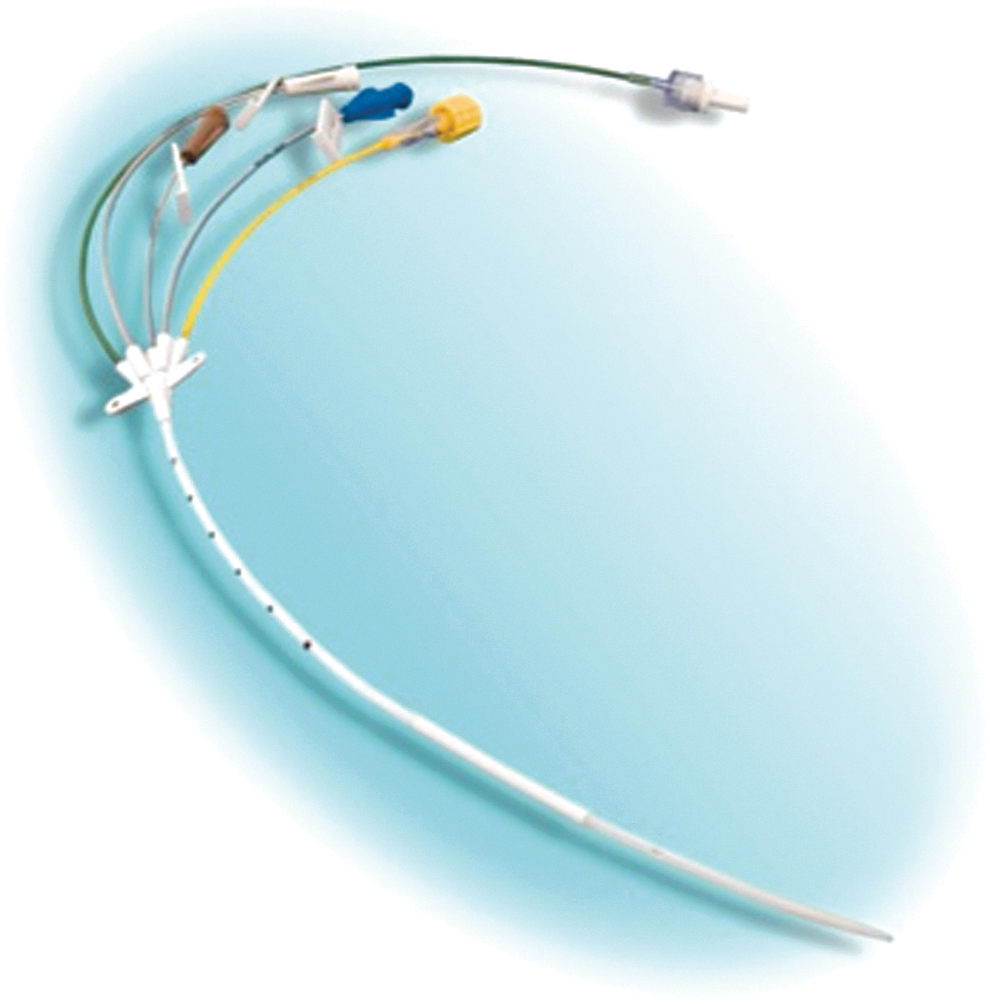
The Eirus triple-lumen catheter with microdialysis function. Color images available online at
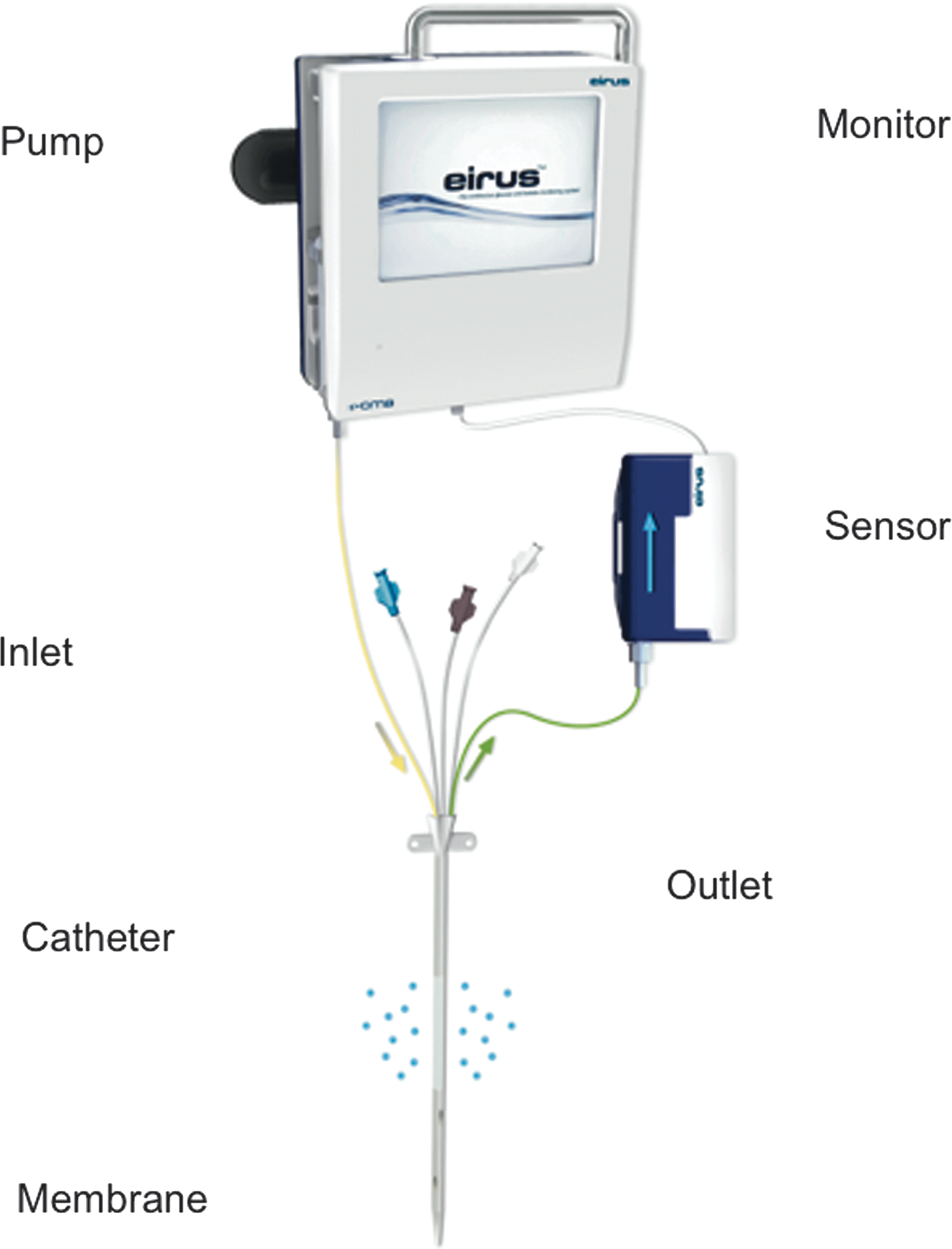
The Eirus microdialysis system. Color images available online at
The microdialysis TLC was preoperatively placed after the patient underwent general anesthesia and was inserted in the vena cava superior/right atrium. After insertion, the TLC was connected to the monitor and the sensor, and perfusion of the system with sodium chloride was initiated. The initial blood glucose value was displayed on the monitor after approximately 30 min. After system start-up the values displayed on the monitor have a delay of approximately 5 min, which is the time it takes to perfuse the system.
The microdialysis glucose values were compared with reference glucose values by an arterial blood gas, analyzed in a blood gas analyzer (ABL800 FLEX®; Radiometer Medical, Copenhagen, Denmark). We have in a previous study described the accuracy of arterial blood gas as a reference method compared with plasma glucose values with good correlation. 29 The reference glucose values were analyzed once every hour, beginning after calibration of the microdialysis system. The ICU nurse performed calibration of the microdialysis system every 8 h; the monitor will signal for time for calibration as a reminder. The calibration process consists of manually entering the arterial blood gas glucose value into the microdialysis system. If calibration is not performed, a warning box will appear in the monitor notifying the user that the displayed values are not calibrated.
The paired glucose values were corrected for the time lag (5 min) to better show the technical accuracy of the microdialysis system. No postoperative anticoagulation was initiated the first 24 h after surgery. If the patient stayed in the ICU after 24 h, he or she received standard antithrombotic prophylactic medication with low-molecular-weight heparin. Patients with warfarin indication were started on low-molecular-weight heparin until the therapeutic international normalized ratio was reached. The TLC was used for medical infusions and drug administration in the postoperative period; by standard routine all patients received 5% glucose infusion (1 mL/kg/h) postoperatively. Patients received insulin infusions or injections as needed aiming for a glucose target range of 5–10 mmol/L during and after cardiac surgery. Vasopressors were given if needed.
Statistical analysis
Clarke Error Grid analysis (EGA) was done to evaluate the clinical relevance of microdialysis glucose values. The EGA plots paired samples in five distinct zones of different significance. 30 Values in Zone A are within 20% of the reference value and have no clinical implications. Values in Zone B exceed 20% difference from the reference value but lead to appropriate clinical decisions. Values in Zone C may lead to unnecessary but harmless corrections. Values in Zones D and E represent overestimation of hypoglycemia (failure to detect) or underestimation of hyperglycemia that may lead to incorrect clinical actions. In brief, the more values in Zones A and B, the more clinical accuracy of the method. Glucose values were also evaluated according to the International Organization for Standardization (ISO) criteria, 31 in which test glucose values have to be within±20% of reference values if the reference value is >4.1 mmol/L (74 mg/dL). If the reference value is less than 4.1 mmol/L (74 mg/dL), the test values have to be within±0.8 mmol/L (14 mg/dL) 95% of the time. Bland–Altman analysis was also used to compare the bias (mean of differences) and limits of agreement (bias±SD).
Results
Patient characteristics are displayed in Table 1. Eighteen patients received insulin during surgery, and 23 patients did so postoperatively. Mean glucose and glucose variability (as range) are shown for each patient in Table 2. Twenty-seven patients received vasopressors. The TLC was in place as long as the patients needed a central venous access (up to 10 days).
Data are mean±SD values.
CABG, coronary artery bypass graft; ICU, intensive care unit.
Data were available from all 30 patients, and the total number of paired samples was 607. Mean follow-up time was 28 h (range, 1–97 h; median, 23 h), and on average 20 samples (range, one to 43; median, 20) were obtained from each patient. The TLC was removed when central venous access was no longer necessary. The monitoring was ended prematurely in one patient because of catheter dislocation resulting in false values. This was detected after the system gave a warning signal for uncertain values, due to a high variation in glucose level (i.e., from 8 to 15 mmol/L within 2 min). All glucose values prior to dislocation were included for analysis. In three patients the system indicated sensor malfunction and was restarted after change of sensor without further faults. Glucose values obtained during sensor malfunction (n=16) were accompanied with a warning signal and thus excluded from further analysis.
The microdialysis glucose values were compared with arterial blood gas values. Using Clarke EGA, 100% of the paired samples were in Zones A+B and 97% in Zone A (Fig. 3). Mean microdialysis glucose value was 8.52±1.74 mmol/L, and mean arterial blood gas glucose value was 8.64±1.59 mmol/L. Mean relative difference was −1.5%, and mean absolute relative difference was 5.6%. Bland–Altman analysis showed bias±limits of agreement were −0.12±0.7 mmol/L (Fig. 4). Of the paired samples, 97.2% were correct according to ISO criteria. No hypoglycemia was seen among the patients. In the hyperglycemic range there was increased bias as seen in the Bland–Altman analysis. After removal of the TLC no blood clotting of the microdialysis membrane was observed, and no complications caused by the TLC were detected. No consistent systematic drift between calibrations was observed.

Clarke Error Grid analysis. Art-BG, arterial blood glucose.

Bland–Altman analysis. Art-BG, arterial blood glucose.
Discussion
In this study we have evaluated intravascular microdialysis for CGM using a TLC, functioning as a regular CVC with an integrated microdialysis function. Microdialysis glucose values were compared with reference glucose values analyzed by an arterial blood gas analyzer and were found to be accurate with low bias and all paired samples within Zones A+B of the Clarke EGA.
Most studies on CGM published today use subcutaneous systems, 27,32,33 but a few have described other intravascular systems 34,35 with results similar to those of the microdialysis system described in our study, although with the need of complementary, possibly hazardous, devices. We believe that intravascular microdialysis to be advantageous in patients requiring a CVC because the microdialysis TLC combines the glucose monitoring function in a CVC.
The sensor in the microdialysis system was dislocated in one patient, resulting in a warning signal for uncertain values, and the monitoring was thus ceased. Three other patients had sensor malfunctions indicated by the system, but the monitoring was recommenced and accurate after replacement of sensor. Glucose values obtained during the sensor failures were accompanied by a warning signal, and thus we conclude that it is unlikely that the ICU nurse would administer insulin and/or glucose based on these values.
It is important to state that the microdialysis system in this study was used on a specific patient category: patients undergoing cardiac surgery. All these patients receive antithrombotic prophylaxis (low-molecular weight heparin) postoperatively. To what extent this may explain the lack of clotting at removal of the TLC is unclear. We did not observe any interference during administration of drugs or glucose infusions. The microdialysis membrane is located proximal to the infusion opening of the TLC, which is thus placed “downstream,” an important technical feature to avoid interference. Furthermore, the system is programmed to warn for rapid and high variations in glucose values, which precludes interference with glucose and/or drug administration.
Glucose monitoring in the ICU is important. Most point-of-care glucose monitoring systems were not developed for use in critically ill patients, and various studies have compared these systems and found them lacking in accuracy. 36 –39 CGM in critically ill patients may facilitate improved glycemic control and simplify the detection of both hyperglycemia and hypoglycemia. 28 Glucose variability could also be decreased with improved glycemic control. In addition, CGM may also help reduce nurse workload. 40
Whether the use of CGM is clinically beneficial remains to be further studied. In a prospective randomized trial published in 2010, glycemic control was not significantly improved with CGM, although the incidence of hypoglycemic events was reduced. 32 It would therefore be possible to conduct studies with CGM investigating intensive insulin therapy while safely avoiding hypoglycemia. This would contribute to a better understanding of glycemic control in critically ill patients. A recently published study used CGM in patients undergoing cardiac surgery concluded that CGM enables close monitoring and optimal control of blood glucose in this patient category. 41
The major limitation of this study is that no hypoglycemic episodes were observed. However, the system has been extensively tested in animal studies (data on file) and found to provide accurate hypoglycemic data. Further studies using intravascular microdialysis are needed to confirm these results and especially to evaluate the hypoglycemic accuracy. We conclude that the microdialysis glucose monitoring function is not affected when the TLC is used for drug administration and infusions.
Conclusions
This study shows that intravascular microdialysis using a TLC is an accurate, useful, and safe method for CGM in patients undergoing cardiac surgery. The system may be used to improve glycemic control, including hyperglycemia, hypoglycemia, and glucose variability. No hypoglycemic episodes were observed, which is a major limitation of this study. With the microdialysis function integrated in a CVC, no extra device for the CGM is required.
Footnotes
Acknowledgments
We thank the Mats Kleberg Foundation and the Signe and Olof Wallenius Foundation for financially supporting this study.
Author Disclosure Statement
J.L. and A.F.-C. are stockholders in Eirus™ Medical AB. F.S. and A.Ö. declare no competing financial interests exist.