




Abstract
Background:
Vascular inflammation associated with mannose-binding lectin (MBL) may be implicated in the pathogenesis of vascular complications in diabetes. The purpose of this study is to evaluate the association of MBL expression with vascular complications in diabetes.
Materials and Methods:
Data from published case-control studies on MBL expression and vascular complications of diabetes were collected up to September 30, 2014. Medline, Embase, and Chinese National Knowledge Infrastructure (CNKI) were searched using the key words “MBL or mannose-binding lectin or mannan-binding lectin,” “diabetes or diabetic,” and “vascular complication, vascular disease or angiopathy” to identify the articles published in English or Chinese.
Results:
The combined odds ratio (OR) and 95% confidence interval (CI) for the cumulative rate of vascular complications in the cases of high-expression MBL versus that in cases of low-expression MBL were estimated using a fixed-effects model and a random-effects model. In total, 2,714 cases from 12 articles including 2,256 cases with high-expression MBL (≥400 μg/L) and 458 cases with low-expression MBL (<400 μg/L) were reviewed. The cumulative vascular complication rates were 52.9% (1,194/2,256) in the cases with high expression and 38.4% (176/458) in those with low expression. The combined ORs were 1.6, with a 95% CI ranging from 1.24 to 2.08, in the fixed-effects model and 1.94, with a 95% CI from 1.00 to 3.76, in the random-effects model.
Conclusions:
High expression of MBL may be correlated with a significantly increased risk of vascular complications in diabetes. Thus MBL detection in diabetes is an effective and feasible method to predict vascular complications.
Introduction
D
Recent research supports the concept that the immune system is involved in these vascular inflammatory processes. The complement system has evolved as a central part of the immune system activation, especially the innate immune initiation. According to our previous study, which was described in detail elsewhere, 6 and other evidence, overzealous responses of the complement system may lead to the development of vascular complications in diabetes. 1,6 Three different pathways, named the mannose-binding lectin (MBL), the classical, and the alternative pathways, can activated the complement system. MBL is the major recognition and initiation molecule of the lectin pathway of complement activation. 1 As a member of the Ca2+-dependent lectin family, MBL can recognize pathogen-associated molecular patterns and initiate the complement system. It has recently been suggested that the MBL concentration in serum may be associated with the pathogenesis of vascular complications in diabetes. MBL levels were significantly increased in diabetes patients with vascular diseases, such as cardiovascular complications or nephropathy, compared with patients without these vascular diseases. 1,7 –9 However, others have raised doubts about this opinion because they found an association between low MBL levels and diabetes-related vascular complications. 10,11 Naturally, the true clinical significance of MBL in the prognosis of diabetes-related vascular diseases remains to be determined.
Because a single study with small sample size is not powerful enough to resolve this issue, we increased the sample size by collecting data from independent studies on MBL expression in diabetes patients with vascular diseases by searching the medical scientific information databases and conducting a meta-analysis based on the published data to determine whether MBL was involved in the clinical progression of diabetes-related vascular complications. We hypothesized that the cumulative published evidence supports the proposal that high expression of MBL is involved in the development of diabetes-related vascular complication and thus is one of the potential prognostic factors of diabetes.
Materials and Methods
Literature search strategy for study identification
Embase, Medline, and Chinese National Knowledge Infrastructure (CNKI) (without a language limitation) were searched, covering the period from January 1, 1980 to September 30, 2014. The medical subject headings “MBL or mannose-binding lectin or mannan-binding lectin,” “diabetes or diabetic,” and “vascular complication or vascular disease or angiopathy” were used as the search key words. The search yielded a total of 25 articles. Four additional qualified articles on this topic were identified by a hand search of the references from the retrieved articles. Studies testing the association of MBL expression and diabetes-related vascular diseases were included if the following criteria were met: (1) the article was published with a randomized case-control design and with a sample size larger ≥15; (2) the study reported the odds ratio (OR) and its 95% confidence interval (CI), or the data on MBL expression necessary to calculate OR and 95% CI; (3) included patients with clinically proven diabetes; and (4) the vascular complications included micro- and macrovascular complications. The exclusion criteria included uncontrolled studies and a sample size of <15. If the studies from the same authors or the same institute had overlapping data, we contacted the authors and discussed what data should be collected and what data should be removed, or we selected the ones with the largest number of clinical cases. After the initial search, we reviewed the title, abstract, and text of all 29 articles carefully in accordance with the inclusion criteria above and finally selected 12 articles for further analysis.
Article evaluation and data extraction
This research was based on the steps of consensus on quality control requirements of meta-analysis reports that were put forward by Moher et al. 12 The selected articles were put into a bibliography using EndNote X2 and evaluated by three of the authors (Y.Z., W.L., and Z.L.) independently. The following information of each study was extracted and recorded from the articles: the first author's last name, publication year, study location, author address, length of follow-up, ethnicity, number of observed cases and controls, statistical methods, randomness and reliability of study, and publication bias. If any disagreement took place among the three reviewers, a discussion was held to reach an agreement among all authors.
Statistical analysis
In our study, we chose 400 μg/L as the cutoff that was used to discriminate between high and low expression levels of MBL. The Review Manager 5.2 program provided by the Cochrane Library was used to perform all the statistical analysis, and all the P values were two-sided. Both a fixed-effects model and a random-effects model were used to calculate OR and 95% CI for the association of MBL high expression and vascular complications in diabetes. The association was determined by a comparison between the vascular complication rates in the high-expression MBL cases and the low-expression MBL cases. The OR and 95% CI were calculated for each study, and the combined OR and 95% CI were calculated for the 12 studies. If the OR was larger than 1, it indicated that the vascular complication rates in the high-expression MBL cases were higher than those in low-expression MBL cases, and vice versa. The statistical significance was considered when the 95% CI did not include 1.
A χ2-based Q-test and I 2 statistics were performed to assess the statistical heterogeneity among studies. If the P value was >0.10, the heterogeneity among studies was insignificant, indicating that the Mantel–Haenszel method (the fixed-effects model) could be used to calculate the combined OR; otherwise, the DerSimonian–Laird method (the random-effects model) was used. A Z test was used to compare the cumulative vascular complication rate in high-expression MBL cases with that in low-expression MBL cases in diabetes. The statistical significance was considered when P<0.05. Publication bias was evaluated with Egger's funnel plot.
Results
Study characteristics
According to the inclusion and exclusion criteria, 12 articles were available for the analysis. All articles provided clear data for MBL expression and vascular complications in diabetes patients. There were four articles published in Chinese. 9,11,13,14 Although these Chinese articles can only be partially searched in English databases such as Medline, they were included because their data were complete and the data represented the largest population frequently experiencing diabetes in the world. Mainly two kinds of experimental methods were used by the studies to detect serum MBL expression level: enzyme-linked immunosorbent assay and/or polymerase chain reaction.
The case characteristics are summarized in Table 1. The 12 studies were published between 2004 and 2014. There were, in total, 2,714 cases, among which 1,370 cases had vascular complications and 1,344 cases had no vascular complications. Of these, 2,256 cases had high levels of MBL expression, and 458 cases had low levels of MBL, according to the cutoff criterion.
MBL, mannose-binding lectin; VD+, vascular complication–positive.
The cumulative incidence of vascular complications and the high MBL expression rate in diabetes were 50.5% (1,370/2,714) and 83.1% (2,256/2,714), respectively. Diabetes subjects with high MBL expression had a cumulative vascular complication rate of 52.9% (1,194/2,256), which was higher than the 38.4% (176/458) in cases with low MBL expression.
Among the 2714 cases, 1,274 were Danish, 191 were Finish, 99 were Dutch, 134 were Indian, and 1,016 were Chinese. The Chinese patients accounted for 37% of the overall population. The age distribution for the patients at diagnosis was 11–77 years, and the mean age was 51 years. Of the 12 studies, there were four articles involving 466 cases related to the duration of diabetes. 13 –16 The duration of diabetes ranged from 3 to 38 years, and the mean duration was 13 years.
OR for association of high MBL expression with vascular complications in diabetes
The OR and 95% CI for association of vascular complications of diabetes with high MBL expression calculated in this analysis are given in Figure 1 (with the fixed-effects model) and Figure 2 (with the random-effects model).

Forest plot for high mannose-binding lectin (MBL) expression and vascular complications in diabetes (VD) under the fixed-effects model. 7 –9,11,13 –16,21,24,28,29 Data analysis was performed by the Review Manager version 5.2 program. The odds ratio and 95% confidence interval (CI) are given for association of high MBL expression with vascular complications in diabetes based on a fixed-effects model: overall 1.60 (1.24, 2.08). M-H, Mantel–Haenszel.
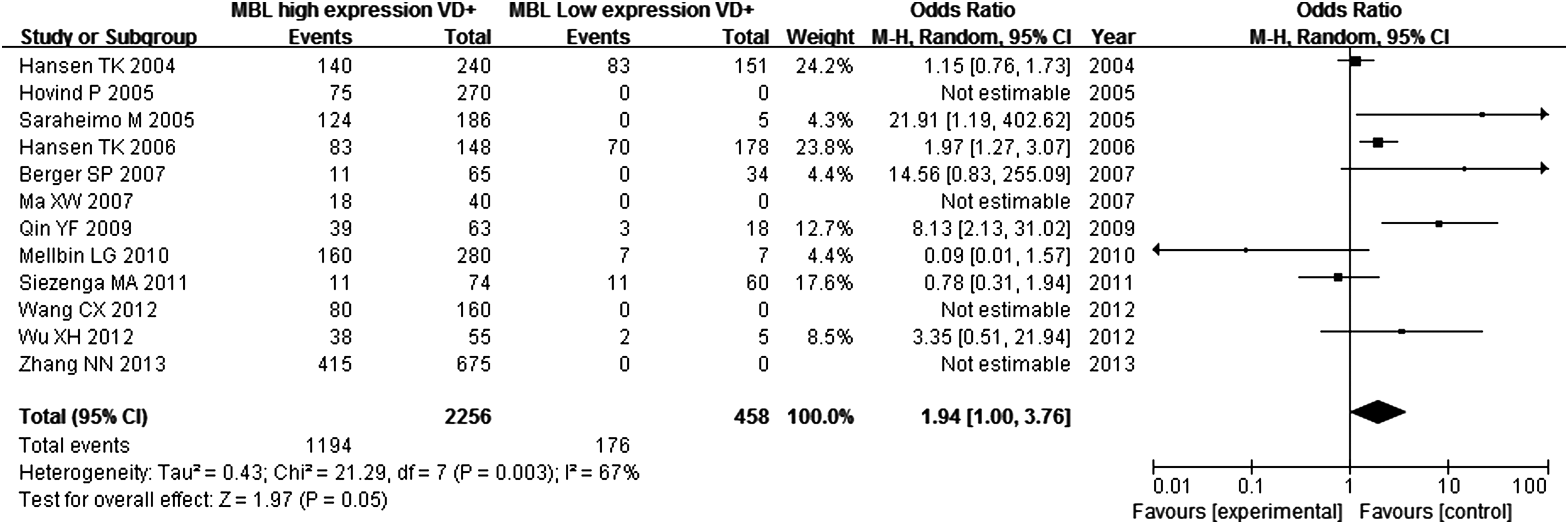
Forest plot for high mannose-binding lectin (MBL) expression and vascular complications of diabetes (VD) under the random-effects model. 7 –9,11,13 –16,21,24,28,29 The combined odds ratios (95% confidence interval [CI]) for the association of high MBL expression with vascular complications in diabetes was 1.94 (1.00, 3.76) calculated by the random-effects model. M-H, Mantel–Haenszel.
Of the individual studies, six of the 12 articles gave an OR of >1, four articles could not estimate the OR, and the remaining two articles gave an OR of <1. In this analysis, if the OR was >1, there was a greater tendency for vascular complications to occur in diabetes subjects with high MBL expression, whereas when the OR was <1, there was a lower tendency for vascular complications to occur in diabetes subjects with high MBL expression. Three of the six studies with an OR of >1 gave a 95% CI that did not include 1 (statistically significant), whereas both studies with an OR of <1 gave a 95% CI that included 1 (statistically significant).
The combined ORs (95% CI) for the association of high MBL expression with vascular complications in diabetes were 1.60 (1.24, 2.08) calculated by the fixed-effects model and 1.94 (1.00, 3.76) calculated by the random-effects model, suggesting that those diabetes subjects with high MBL expression had a 1.60 or 1.94 times greater likelihood of vascular complications than those diabetes subjects with low MBL expression. The two combined ORs were statistically significant because their 95% CIs did not include 1.
Test of heterogeneity
The heterogeneity accompanying the fixed-effects model among studies was tested. As seen in Figure 3, the χ2 was 21.29 with 7 degrees of freedom, P<0.10, and I 2=67%.

Heterogeneity among studies accompanying the fixed-effects model. 7 –9,11,13 –16,21,24,28,29 A forest plot shows the proportions of mannose-binding lectin expression of diabetes patients with vascular complications. The test demonstrated a significant heterogeneity (I 2=67%) that accompanied the fixed effects model between studies. CI, confidence interval; M-H, Mantel–Haenszel.
Because the test demonstrated a significant heterogeneity that accompanied the fixed-effects model between studies, the random-effects model was preferable to account for the extra variation by giving a relatively larger weight to the less precise studies.
Sensitivity and stability analysis
In order to investigate the stability of the analysis, one study was omitted at a time. The omission of any study made no significant difference, indicating that the result was statistically reliable. At the same time, it suggested the stability and sensitivity of this analysis given that the result from the fixed-effects model was similar to the result from the random-effects model.
Test of publication bias
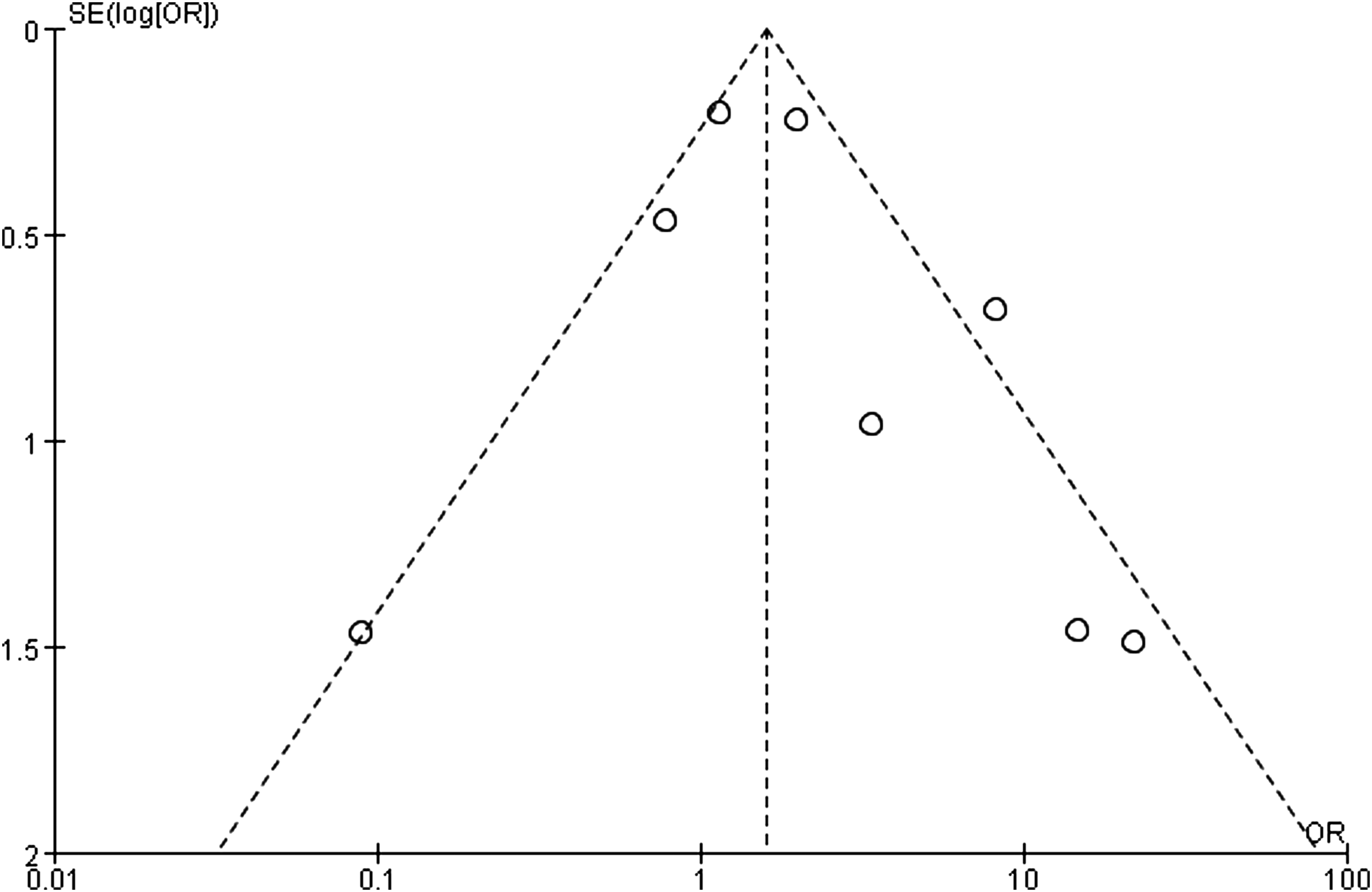
To assess the possible publication biases, Egger's funnel plots were used. As shown in Figure 4, a slightly asymmetric funnel plot was displayed, suggesting that there was slight publication bias in this meta-analysis.
Discussion
To the best of our knowledge, broad agreement on the association between high MBL expression with vascular complications in diabetes has not been reached yet. This is largely because of the limited sample size in the individual studies. Some studies reported that high MBL expression was associated with vascular complications in diabetes, 8,9,16 whereas others reported that MBL does not affect vascular complications. 11,14,15 To overcome the sample size limitation, we performed a meta-analysis on the association between high MBL expression and the risk of diabetes-related vascular complications based on a systematic review of 12 case-control studies, including 2,714 cases. The cumulative ORs were 1.60 in the fixed-effects model and 1.94 in the random-effects model, which were both statistically significant, with 95% CIs of 1.24–2.08 and 1.00–3.76, respectively. Because the heterogeneity among the studies was statistically significant (P<0.10), the result from the random-effects model would be preferable to account for the extra between-study variation by giving relatively larger weight to the less precise studies, which indicated that the probability of vascular complications in high MBL expression diabetes is 1.94 times larger than that in low MBL expression diabetes. When we completed the meta-analysis, both the fixed-effects model and the random-effects model provided evidence that high MBL expression is positively associated with an increased risk of diabetes-related vascular complications. This suggests that MBL could provide prognostic information on the advanced progression of diabetes. 7 It is the first meta-analysis, with a large sample size, on the association of high MBL expression with vascular complications in diabetes.
As an acute-phase reactive protein, the serum concentration of MBL varies from levels that are undetectable up to 10,000 μg/L. 17 Approximately one-third of the population have MBL concentrations below 500 μg/L, whereas more than 10% have concentrations below 50 μg/L. 18 Some articles reported that the median serum level of MBL in the adult population was around 1,000 μg/L in whites, but there is very large variations. 7,19 Others did not agree and mentioned that the cutoff of 400 μg/L that was used to discriminate between high and low MBL expression levels was feasible. 20,21 Of the 12 articles in our study, more than 10 studies showed that the latter cutoff was better. Therefore, we defined 400 μg/L as the cutoff to discriminate between high and low MBL expression levels.
Vascular complications are the most serious complications associated with diabetes. 22 These include micro- and macrovascular complications that are associated with cardiovascular diseases, neuropathy, retinopathy, and nephropathy. 22 About 50% of people with diabetes die because of cardiovascular disease. 23 Diabetes with retinopathy can cause blindness. Diabetic kidney disease influenced the prognosis and outcome of patients with type 2 and type 1 diabetes. 22 In this analysis, seven of the 12 articles reported that diabetes patients had nephropathy and related diseases, and five studies described diabetes with macrovascular complications, such as cardiovascular disease and neuropathy. The study on the correlation between diabetic ophthalmopathy and MBL could not be retrieved. 24 It suggested that serum MBL levels may be involved in the pathogenesis of micro- and macrovascular complications in diabetes. It also suggested that high MBL expression levels were common in diabetes patients with microvascular complications and patients with macrovascular complications.
As described in detail previously, 6 high concentrations of MBL in type 2 diabetes patients might participate in the down-regulation of proliferation and function in monocytes. It implied that high MBL expression in serum might play a negative regulatory role in the chronic inflammation mediated by monocytes. 6 It might be similar to the effect of pentraxin 3 in myocardial infarction. 25 Thus, we presume further investigations with large sample sizes are still needed that could provide evidence of the effect of high concentrations of MBL in serum on immune regulation in peripheral, local, and even extravascular tissues during inflammation.
Studies have shown that generalized chronic low-grade inflammation correlates with the common vascular complications of diabetes. 18 In particular, some markers of chronic low-grade inflammation were associated with markers of endothelial dysfunction in diabetes patients without clinical manifestations of vascular complications. 22 This suggests that diabetes-related vascular complications may have an inflammatory pathogenesis. Mounting evidence suggests that there may be a link among complement activation, the development of chronic inflammation, and the process of endothelial dysfunction. 26,27 MBL-mediated complement activation is also involved in the process. High expression of MBL can activate more components of complement. This suggests that more membrane-attack complex (C5b–9) and inflammatory markers will be produced. All of these factors may be the molecular basis for a link between complement and the vascular complications of diabetes. 26
In our study, 10 of the 12 articles reported that diabetes patients with vascular complications had significantly high circulating levels of MBL. The positive percentage of high MBL expression (83.1%) was much higher than the positive ratio of vascular complications (50.5%) in diabetes. Several studies conjectured that this could be due to genetic mutation. 8,15,24 However, genetic mutation alone cannot fully explain this phenomenon.
Although the serum MBL level is affected by many factors, it has long-term stability and consistent levels in healthy individuals. 17,20 On the other hand, MBL levels were significantly elevated in patients with micro- and macrovascular complications compared with diabetes patients without vascular diseases regardless of the foundation status of vascular diseases. 7 There could be a mechanism that could regulate the expression of MBL in vascular complications in diabetes. Some clinical studies reported that about 50–70% of diabetes patients with high MBL expression (≥400 μg/L) experience vascular complications in the course of the disease. 7 –9,13,14,16,24,28 They speculated that it is associated with the chronic inflammation that correlates with MBL-mediated complement activation. However, other studies showed that there was no clear correlation between the high expression of MBL and vascular complications in diabetes, which confused the association of high MBL expression with vascular complications in diabetes. 11,15,21,29 Surfactant protein D, a member of the lectin family, is highly expressed in asthma and allergy. However, it plays an anti-inflammatory role in a negative feedback loop of sensitive T-cell activation in the progression/regulation of asthma and allergy. 30 These findings have led us to assume that MBL might also have a protective function in the vascular complications of diabetes.
Therefore, further multicenter studies with large sample sizes have long been awaited in this field. The findings in this meta-analysis, which has the largest sample size to date, clearly confirm that high MBL expression is positively associated with vascular complications of diabetes. It surely provides a strong clue for the laboratory research needed to further the study of MBL as a potential target of vascular complications in diabetes and for the establishment of a clinical awareness system of diabetes development. We highly recommend that those diabetes patients with high MBL expression should be given adequate attention from doctors, as well as special therapies that can prevent and control vascular complications, such as the combination of insulin injection and oral antidiabetes drugs. A more careful and longer follow-up of the patients after treatment should also be conducted.
The results of this meta-analysis indicated that the findings were statistically reliable because the omission of any single study made no significant difference to the results from the overall study. However, there may be a small risk of publication bias according to the funnel plot assessment (Fig. 4), in which the slight asymmetry of the funnel plot was displayed. The publication bias may come from the following areas, such as geography, ethnicity, and culture of the patients, race, sex, and some negative articles (with disassociation of high MBL expression with vascular complications in diabetes) that were not published. In this analysis, articles published in Chinese or English were all included, but articles published in other languages were not included. This may also increase the publication bias. The publication bias due to these factors can be considered as the heterogeneity among studies. Because of the stability and reliability of the result in this meta-analysis study according to the Egger's funnel plot assessment, the publication bias could be accepted.
Conclusions
This meta-analysis presented evidence that was sufficient to support the proposal that the high MBL expression (≥400 μg/L) may be highly correlated with a significantly increased risk of vascular complications in diabetes mellitus. Detection of MBL expression at diagnosis of diabetes may help to determine the vascular complications trend in diabetes. It is an effective and feasible means of determining the patient's prognosis and one of the ways to guide the treatment of diabetes.
Footnotes
Acknowledgments
This study was funded by the Science & Technology Innovation Funds of Guangdong Medical College (B2012017 and B2013009) and the Medical Science and Technology Research Fund of Guangdong Province (B2013291 and A2014471).
Author Disclosure Statement
No competing financial interests exist.
Y.W. initiated and supervised the study and revised the final manuscript. Y.Z., W.L., and Z.L. performed the analysis and wrote the manuscript together. J.L. and S.W. helped collect the published articles and contributed to the design of the study. C.Z. and J.N. helped search the articles. All of the authors have read and approved the final manuscript.