




Abstract
Use of insulin pump and glucose sensor in children with diabetes has been shown to cause skin problems such as eczema, wounds, and itching. The mechanisms for development of skin problems are unknown as well as the influence on the everyday life of the patient. The aim of this study was through focus groups to get more perspective on perception of skin problems as well as the patients' view on causes of skin problems. The two focus groups gave new insight into the consequences of skin problems to both patient and parents in terms of itching, concentration, self-esteem, guilt, etc. The focus group gave as well new perspectives on causes of skin problems, and especially three concepts must be further investigated: material (plastic, patch and vacuum effect), time, and skin characteristics.
Introduction
U
Causes of skin problems are unknown and may be influenced by immunological, genetic, and behavioral factors along with age and anthropometric measures. Knowledge on causes of skin problems could possibly guide the development of new improved infusion sets and sensors avoiding skin problems. Consequences of skin problems are not known, but highly relevant since skin problems contribute to the total burden of living with diabetes. The patients' and parents' views are thereby extremely valuable, and their individual experience of causes of skin problems and perception of them could guide future research.
Qualitative methods give many perspectives on skin problems, which are crucial in this complex area. When using qualitative methods with focus groups consisting of patients, relatives, and professionals, an insight through the interaction in everyday life of patients with skin problems can be achieved, and unconsidered possible causal relations can generate new theories. Therefore, the aim of this study was to reveal new perspectives on the perception and causes of skin problems in children and adolescents.
Methods
Participants were recruited from the diabetes clinic at the pediatric department, Herlev Hospital, where the interviews were conducted as well. Patients reporting skin problems due to their insulin pump and/or glucose sensor in the survey described elsewhere 7 were invited. A total of 109 patients were invited by e-mail two times (March and May 2017), one for each focus group meeting. Patients >13 years were encouraged to participate in focus group meeting, but their participation was ultimately the family's decision.
The focus group meetings were designed in accordance with Morgan.
8,9
The focus groups were conducted by a moderator (A.K.B.) and two professionals: a dermatologist (A.B.S.) and a pediatrician (J.S.). The moderator used an interview guide as available on request to guide the flow during the focus group. The professionals had the interview guide as well and participated in the discussion with their specialist knowledge. The moderator and dermatologist were not in a treatment relationship with any of the participants, but the pediatrician was to five out of the eight participants. The participants were encouraged to be honest and were told that all answers were correct and had no influence on their future treatment. The key questions in the interview guide divided into two main categories were: Perception of skin problems How do skin problems influence the child? What is the worst of skin problems? How do skin problems influence the parents? Why do you participate in this study? Causes of skin problems Why do you think skin problems evolve? Which factors/parts of the insulin pump can contribute to skin problems? Which factors/parts of the glucose sensor can contribute to skin problems?
The focus group meetings were recorded and afterward transcribed verbatim. The analysis was done in concordance with Morgan 9 and Krueger's Framework Analysis consisting of familiarization, identifying themes, indexing, charting, and interpretation with inspiration from Rabiee. 10 Phenomenological approach was used for interpretation of the perception category, 11 and Grounded Theory for generating theories on evolvement of skin problems based on the causes category. 12 For the process of indexing and charting, Microsoft Word and Excel were used. All authors did the first three steps of Framework Analysis independently, and A.K.B. compared indexes, looked for discrepancy, deleted duplicates, and did the charting and interpretation. Basic characteristics including age, duration of diabetes, duration of pump and sensor use, HbA1c, and BMI were collected from the survey data described elsewhere. 7 All participants were aware of and gave oral informed consent to the recording and to participate in the focus group. The project was approved by the national research ethical committee.
Results
Two focus group meetings with, respectively, three and five families took place. The participants in each group including age for patient are shown in Figure 1. Basic characteristics for all eight participants are presented in Table 1. Perception and possible causes of skin problems will be described separately.
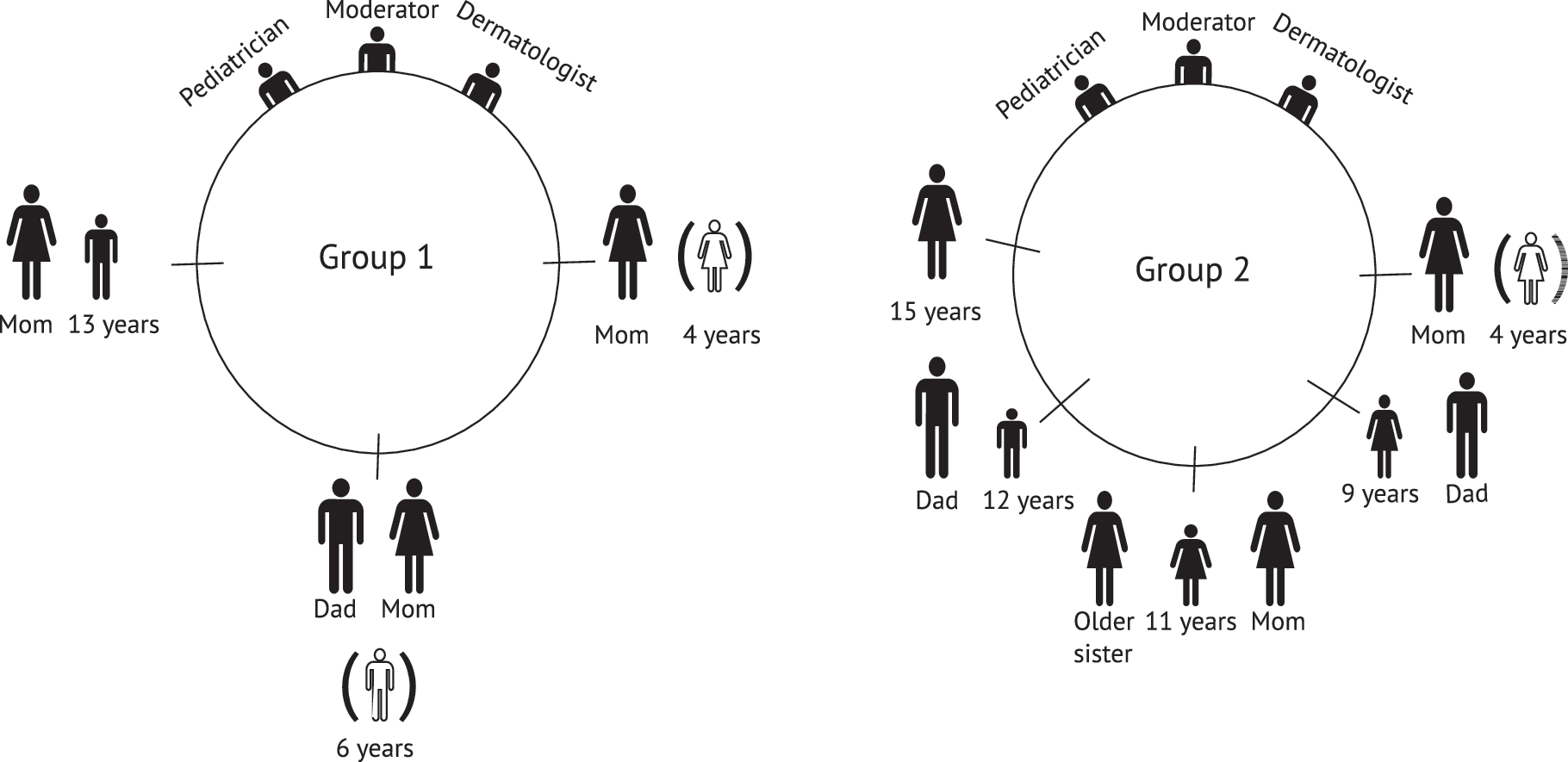
The participants in each focus group including age. Patients in brackets were not present, but one or two parents did represent them.
BMI, body mass index; DM, diabetes mellitus; FG, focus group; HbA1c, hemoglobin A1c; N/A, not applicable.
Perception of skin problems
According to the participants, skin problems had a great influence on the everyday life. For the patients, frequently described themes were pain, irritation, and itching, influencing sleep, distraction, and disturbed concentration. Some even suspected fluctuations in insulin usage when having skin problems or needed to use antiallergic medicine to reduce the skin problems and help sleeping. The comments and questions from others because of the visible skin problems were described as another consequence. The more frequent insertion and the following pain were another complaint. One had chosen to discontinue the glucose sensor because of itching, pain, and irritation. Itching, disfiguring skin, concentration difficulties, and pain were perceived the worst consequences of skin problems according to the patients.
The worst is that it hurts sometimes because he gets some wounds and then he gets unhappy, and I feel awfully sorry for him.
The parents mentioned guilt of exposing their children to this device, well-aware of the following itching, eczema, and wounds. Others described it as an extra stress factor with influence on meeting time at work because of prescheduled infusion set change. Most perceived it as an extra burden on them and described consequences such as reduced possibilities of childcare, need of giving antiallergic medicine to their child, family conflicts concerning use of CGM, and worries about future skin appearance. The skin problems were a visible reminder of the disease of their child too:
For us as parents I think, it is just not nice to see scars at her body reminding us that she is sick.
When asked why they participated in both survey and focus groups, one single aspect was mentioned: Frustration. The frustration caused by skin problems due to treatment was described by a mother:
I think it is a huge problem that something that should be so simple can give so much inconvenience.
Causes of skin problems
Both patients and parents had several theories about why the skin problems evolve based on their personal experience. The themes mentioned by the participants concerned both the insulin pump and the sensor with only few exceptions that will be described. In general, three categories were mentioned: material, time, and skin characteristics. Reactions to the patches, tapes, or directly the adhesive glue were suspected to be the primary cause of skin problems. Many had success with changing the use of patch to a milder one to reduce the skin problems. For the sensor patches, the participants felt that the adhesive was too strong:
You may use this if it is something that should last forever which is not for humans, and when you rip it off, you tear the skin as well.
So, the red circle you get afterwards is actually only where the tape has been.
The hard material or plastic nearest the skin was described having sharp edges as told by a participant:
The inner ring here is hard, and when it really gets knocked into the skin it makes a hole.
The hard plastic itself was by others thought to contribute because of the increased tension to the skin. Some suspected the airtight, enclosed, and wet milieu under the infusion set and the following vacuum effect to contribute in evolvement of skin problems:
It looks like a wet hickey-like reaction when you take it off (the infusion set).
A father suspected that the insulin on the skin was causing the itching. Especially this itching was described as a huge problem, causing wounds in the children. Some suspected the vacuum effect to cause the itching. A mother experienced that it helped using different infusion sets, thereby avoiding the exact same material touching the skin repetitively. The same has been described by others when using different types of patches to fasten the sensor. Besides the material, most participants experienced the skin problems getting worse over time, but one adolescent described her skin getting used to the influence of the devices, causing fewer problems with time. Summer season and heat, especially on holidays, reduced the skin problem. Of skin characteristics, both dry and sensitive skins have been described to cause more skin problems, but the participants thought as well that the location and frequency of change of the sensor or infusion set mattered.
Discussion
The present qualitative study showed that the patients presented valuable theories and opinions toward perception and causes of skin problems due to insulin pump and/or glucose sensor. For children and adolescents, many consequences of skin problems were presented. The worst and most frequent consequence was the itching, which caused problems in school with concentration, distraction, and sleepiness because of itching during nights. The incidence of itching due to both insulin pump and sensor has been found in a Danish population to be >70%. 7 Some patients even had to use antiallergic medicine to relieve the skin symptoms with the potential of getting adverse sedating effects. All of this could affect the patient's quality of life together with loss of sleep, pain, and itching from skin symptoms. Another important aspect was that some patients perceived their skin as disfigured. This could affect their body esteem and social life in relation to wearing swim wear, shower with others in school, etc, which have been shown for atopic dermatitis and acne. 13 The parents worried about their children having ugly skin when going on beach in future. Skin problems posed an extra stress factor for parents, gave the feeling of guilt, and influenced the relationship between parents. The consequences of skin problems on parenting stress, self-esteem, and quality of life must be investigated further.
The participants' views on causes of skin problems had identified certain aspects possibly influencing evolvement of skin problems: The material (the hard material, the patch, and the vacuum) Time (season and duration of treatment) Skin characteristics (dry and sensitive skin)
When looking at the infusion set and the sensor, the inner surface (touching the skin) is surprisingly made of hard plastic with sharp edges, whereas the outer surface is more round edged. The reasons why the material should be so hard could be that it must stay in position even during movement, but experiments with a more rubber or silicone-like material could be warranted. Eczema is a commonly described complication with use of insulin pump and glucose sensor. 3,5 Our Danish quantitative study shows that 25% of the children suffer from eczema due to the insulin pump and 35% due to the glucose sensor. 7 The eczema has been described as contact dermatitis, which is traditionally divided into irritant and allergic contact dermatitis. 14 Although rarely differentiated in the literature, the eczema in these cases may be either irritant or allergic contact dermatitis. 3,5,15,16 Clinically, the two are impossible to distinguish and the diagnosis, therefore, relies on individual patch testing.
Several patients in the focus group did use alternative adhesive material, a paper-based tape such as Micropore™. This have been suggested by Levandoski as well, 17 but the tape needs to be reapplied more frequently because of insufficient adhesion. The adhesive is therefore crucial for the balance between adhesion of patch and prevention of skin problems. 18,19 Experiments with different adhesive and patch fabric would be helpful to increase the supply of different adhesives and prevent skin problems in future. The patients described a certain vacuum or traction in the skin from the infusion set that resulted in a hickey-like reaction or round wet swelling after removal of the infusion set. This traction should be investigated since traction and vacuum could influence the insulin absorption as well. Seasonal variation and relief during vacation are well known in other skin diseases as psoriasis, so this relief is not completely obscure. Most participants described the skin problems getting worse over time, which is in concordance with findings from the quantitative study. 7 In other populations, this relation has not been found. 2 –5 Participants described a certain sensitive and dry type of skin, which have not been investigated, but association of atopy with skin problems has been found. 5,7
Our recommendations for other clinicians based on both our experience and this study are that they be aware of the potential of skin problems especially in patients with atopic disposition, dry or sensitive skin, and thereby act as early as possible. Some of the possible actions to reduce skin problem are to use more different skin sites for insertion, to use different patches underneath the infusion set or glucose sensor, and to keep a healthy skin by using ointment and let the used sites heal before inserting a new set. These recommendations must be further investigated.
One strength of this study was the design of the study: the focus group setting provides the unique possibility of a discussion about consequences and causes of skin problems between different patients, relatives, and professionals. Another strength was that it was the patients and relatives, the daily experts of the treatment regime, who were presenting their perspectives. One limitation was that only eight families participated, and more focus group meetings could possibly provide us with more valuable information, but from these eight participants, we had already collected valuable information on which larger prospective or interventional studies can be based. Another limitation was that the participants in treatment relationships with the pediatrician may have been less honest.
In conclusion, these focus group meetings resulted in new knowledge on the consequences of skin problems on patients and parents as well as three possible influencing theories for evolvement of skin problems: material, time, and skin characteristics, which must all be further investigated to reduce the burden of disease for patients using insulin pump and/or glucose sensor.
Footnotes
Acknowledgments
We would like to thank the participating families for their time and for giving us valuable insight into the lives with skin problems. Financial support for this research was provided by Conva-tec Unomedical, The Aage Bangs Foundation, The Aase and Ejnar Danielsen Foundation, and The Else and Mogens Wedell-Wedellsborg's Foundation.
Author Disclosure Statement
No competing financial interests exist for A.K.B. and A.B.S. J.S. serves as an adviser to Medtronic, Janssen, and Novo Nordisk. She owns shares in Novo Nordisk, and has received fees for speaking on behalf of Medtronic, Sanofi, Novo Nordisk, and Bayer AG.