




Abstract
Increasing proportions of patients with diabetes use continuous subcutaneous insulin infusion (CSII) therapy mostly due to its clinical efficacy and flexibility for insulin dosing and adjustments. Some challenges are nevertheless associated with this technology. A key and underlooked component of CSII technical difficulties is the subcutaneous catheter used to infuse insulin. Several adverse events (AEs) have been experienced by patients in relation to catheters, such as blockage, kinking, and insertion site reactions, including irritation, infections, lipohypertrophies etc., all of which could compromise the metabolic control. With the objective of minimizing these AEs, recommendations for changing catheters every 2–3 days have historically been provided by manufacturers based on reports derived from small studies and anecdotal data. The aim of this review was to provide an updated analysis of current recommendations and patients' practices in relation to frequency of catheter change. Our main findings are: (1) adequately designed and powered studies investigating optimal catheter wearing time are still lacking; (2) increasing catheter wearing time is generally associated with increased frequency of catheter AEs; (3) however, interpatient variability is large, with some individuals needing to change their catheters every 2–3 days, whereas others probably being able to keep them in place for longer periods without problems. Further research is thus warranted to provide more solid and evidence-based recommendations while exploring personalized approaches at the same time. Increasing catheter wear life without significant side effects is an important goal to simplify CSII therapy and reduce its associated costs and burdens.
Introduction
C
Moreover, the insulin pump is an important component of the external artificial pancreas, which combines CSII with a glucose sensor and a dosing algorithm. Such closed-loop insulin delivery system automatically and dynamically adjusts insulin infusion according to changing needs of the patient during the day thereby reducing both time in hypo and hyperglycemia. 9 A hybrid closed-loop system, which still necessitates interventions from the patient around meals and exercise, was commercially launched in the United States in 2017. 10
Currently, two types of CSII are on the market: conventional pumps and patch pumps (Fig. 1). Conventional pumps hold an insulin reservoir that connect to the patient through a flexible and thin plastic tube ending up in a catheter (also named cannula) inserted into the subcutaneous tissue. However, patch pumps connect wirelessly with a pod that holds a tubeless insulin reservoir with an underneath catheter and is applied directly onto the skin. Multiple catheters are available with differences in extremity material (steel needle or soft Teflon), length (ranging from 4.5 to 19 mm), and angle of insertion (from 20° to 90° angle). Catheter selection depends on the compatibility with the pump system (most are pump specific), SCAT thickness, or patients' preferences based on their trial and error experiences with catheter types (comfort, glycemic results, etc.).
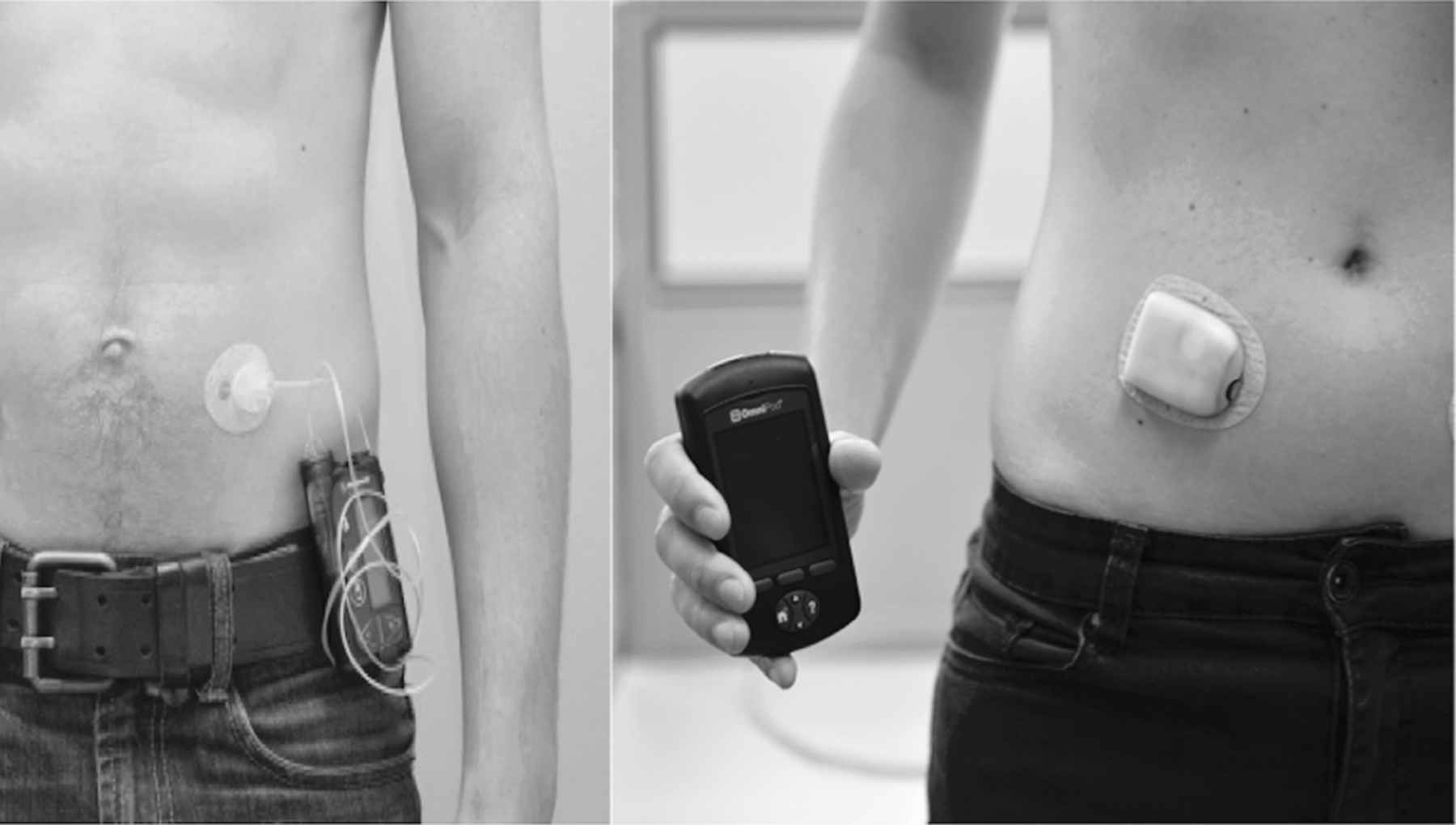
Examples of the two types of pumps currently available for CSII. (left) Conventional Pump with a tubule connecting to the subcutaneous catheter. (Right) Patch Pump without tubule but with a skin pod having an underneath subcutaneous catheter. In the patient hand, a device called PDM controls insulin infusion wirelessly through safe radio frequency. CSII, continuous subcutaneous insulin infusion; PDM, personal diabetes manager.
There are no significant differences in glycated hemoglobin A1c lowering when comparing pumps by different manufacturers or when specifically contrasting patch with conventional pumps. 11 However, CSII therapy imposes its own technical challenges, one of which is related to the adverse events (AEs) associated with CSII catheters. These technical and metabolic AEs as detailed in the following section could influence the length of catheter wear time.
Any pump catheter, or patch pump pod, should be changed every 2–3 days according to current manufacturers' guidelines. This recommendation has never changed since insulin pump therapy had been introduced for clinical use in the early 80's. 12 The brief catheter wear life and the frequency of AEs could negatively affect the quality of life of patients on CSII. Moreover, they result in economic burdens for patients: estimates range from 2500 CAN$ (≈1600 Euros) per year on average for infusion set/catheter material to 3600 CAN$ (≈2300 Euros) when reservoir cost is added. These are often two important determinants of CSII initiation or discontinuation. 13,14
This report aimed to provide an updated review on catheter-related AEs and to analyze current recommendations and studies regarding catheter wear time in patients using CSII, with a focus on the reasons limiting longer use. Potential avenues to improve catheter technology are also discussed.
Methods
A literature search was conducted through two databases (PubMed and Medline), including publications appearing online up to February 2018. The following keywords were used for the search: catheter, wear time, duration, CSII, insulin pump, T1D, insulin-dependent diabetes, infusion, site, frequency of change, and AEs. References in key articles were also explored. A total of 134 articles were identified. Each title and abstract were screened, 49 articles meeting eligibility criteria were included in the present review, which encompasses original articles in either English or French assessing adults or children with diabetes using CSII therapy.
This narrative review starts with a short section on infusion sets and pumps pre- and postmarketing regulations, followed by a detailed description of catheter-related AEs discussed under three sections: cutaneous and subcutaneous complications, technical issues, and subsequent metabolic effects. Then, the central part of this review analyzes studies justifying current wear time recommendations as well as patients' practices. Finally, potential avenues in catheter technology are addressed.
Results
Regulation of insulin infusion sets/catheters marketing
The Food and Drug Administration (FDA) categorizes insulin infusion sets/catheters as medical devices that should be submitted for premarketing clearence through the 510K program (evaluating substantial equivalence in premarket notification). They are listed as class II (moderate risk) medical devices. 15,16 Accordingly, manufacturers are required to submit safety and effectiveness data about adequate insulin delivery. This evidence is usually limited to bench studies. Sometimes, extended studies assess some human factor to compare a new device to predicate devices already on the market. 15,17 Nonetheless, clinical trials are not required for class II devices. The European Medicines Agency (EMD), the regulation system of the European Union is less stringent than the FDA. 16,18
After approval, infusion sets/catheters or insulin pumps hit the market and postmarketing surveillance begins. AEs can be reported either to the manufacturers or to the regulators through the Manufacturer and User Facility Device Experience (MAUDE) by FDA or through the European Databank on Medical Devices (EUDAMED) in Europe. In principle, postmarketing surveillance can be demanded by FDA at any time.
However, in 2015, a joint statement of the European Association for the Study of Diabetes (EASD) and the American Diabetes Association (ADA) Diabetes Technology Working Group on CSII devices highlighted several shortcomings of the abovementioned reporting systems. 17 The panel concluded that most postmarketing information held by manufacturers about CSII is not shared with ample transparency, and that regulators' role in urging manufacturers to evaluate the interactions of patients with their used devices is neither clear nor sufficient. On the other hand, the panel pointed to the difficulty to extract information from the MAUDE databases, partly because the reporting of CSII technology-related AEs is not standardized, and from the EUDAMED database because it is not even publicly available. 17
Catheter-related AEs
Catheter-related AEs can be classified as cutaneous and subcutaneous complications, technical issues, and metabolic effects.
Cutaneous and subcutaneous complications
Cutaneous complications include allergic reactions such as irritation and itching, but also bruising, pain, and infections, whereas subcutaneous alterations result in lipodystrophy at the sites of catheter insertion. Catheters induce an inflammatory state at the injection site, 19 related to insertion trauma to the tissues. 20 Increased levels of proinflammatory cytokines (e.g., IL-1β, IL-6, and CXCL8) in the interstitial fluid of the SCAT have been shown immediately after catheter insertion and up to 8 days. 19 Inflammation can affect local blood flow and metabolism, which in turn could affect insulin absorption from SCAT leading to metabolic AEs. 21,22 The vast majority of clinically apparent inflammatory reaction cases are mild and rapidly resolve without any treatment besides catheter removal.
Leaving the catheter in the skin promotes colonization by the skin flora, which may lead to infection, 13 particularly in cases of atopic skin inflammation, poor metabolic control, nasal carrier state of Staphylococcus aureus, profuse perspiration, and hairy skin. 13,19 The local milieu created beneath the adhesive, 23 combined with micromovements of the catheter in the SCAT, lead to impairment in the skin barrier and may allow microorganisms to penetrate into the subcutaneous tissue. 24 Adhesives may provoke skin irritations or allergic reactions. Patients allergic to adhesives are advised to use hypoallergenic adhesive or skin-protective agents. 1 Giving appropriate instructions to patients (body hygiene, antiseptic preparation of the skin, hand washing, topical disinfection of the insertion site, and sterile covering of the needle), regularly changing catheters and avoiding catheter reuse are important actions to prevent cutaneous complications.
Another common problem related to the infusion site is lipohypertrophy, an abnormal accumulation of fat underneath the surface of the skin. 25 Lipohypertrophy tissue can impair insulin absorption leading to suboptimal glucose control in CSII. 26 The pathophysiology of lipohypertrophy is not well understood, but several local factors appear to be at play: anabolic effect of the insulin per se and repeated catheter insertion at the same site, which can lead to inflammation and local tissue modifications. 25,27 As for insulin injections, rotating catheter insertion sites prevents lipohypertrophies. 28
Technical issues
Technical issues include kinking, bending, crimping, leaking, occlusions, or loss of adhesion of the catheter. Occlusion may be the consequence of kinking of the Teflon cannula, insulin fibrillation, or fibrin formation at the cannula tip. 29 However, a recent survey in 115 patients with T1D using CSII did not show correlation between the frequency of reporting technical problems with catheter use in general and wear time. 30
Effects on metabolic control
Deleterious effects on metabolic control mostly occur consequently to the above-described technical and cutaneous AEs. Diabetic ketoacidosis (DKA) can result from prolonged blockage, kinking, loss of adhesion and accidental pull-out, or skin inflammation, all of which are conditions that affect insulin perfusion and absorption. 31 Milder episodes (e.g., uncompleted or transient blockage) would not lead to DKA but, when repeated, could compromise the overall glycemic control. Contrarily, hypoglycemia remains possible, although the incidence of severe hypoglycemia is reduced in CSII users compared with MDI. 32 –36 Cases of “pump runaway” (overdelivery of insulin) sound historical as no case was reported in recent literature. 13,37 Some cases (n = 2/50) of severe hypoglycemia, requiring hospitalization, were associated with a bedtime catheter change alongside insulin correction bolus without subsequent monitoring. 38 These observations reinforce the importance of appropriate timing of catheter change allowing glucose monitoring during hours following catheter changes.
Studies investigating current recommendations on catheter wear time
The recommendation to change the catheter every 2–3 days dates back to the early 80's. The goals were primarily to provide an optimal glycemic control while minimizing the risks of potential catheter-related AEs. Since then, some efforts have been made to investigate these recommendations and support them with solid clinical data, but few reports involving small numbers of patients are available. 39 –41 In the following sections, we analyze studies that offer information about catheter wear time issues and we provide the readers with a detailed summary of these reports listed by chronological order of publication in Table 1.
AE, adverse event; ATBF, subcutaneous adipose tissue blood flow; AUC, area under the curve; BMI, body mass index; CGM, continuous glucose monitoring; CSII, continuous subcutaneous insulin infusion; LH, lipohypertrophied; NL, normal tissue; T1D, type 1 diabetes.
A study conducted by Thethi et al. (n = 20 patients with T1D CSII users) aimed to determine the optimal duration of insulin infusion set use without compromising glycemic control. 41 Participants used their own insulin pump during the study and continuous glucose monitoring (CGM) sensors to measure glucose levels. A progressive increase in all glucose parameters (daily mean, fasting, peaks, 2h postprandial, time spent with glucose levels exceeding 10 mmol/L) was observed from days 2 to 5 (Table 1). This was accompanied by a continuous increase in total daily insulin requirements from day 3 onward that was mainly due to correction boluses for hyperglycemia, as patients were instructed to do. These results suggest that glycemic control decline starts 48 h after insertion, although the small sample size may limit the conclusions of this study. 41
Pfützner et al. investigated the tolerability of 2 day use compared with 4 day use in 22 patients with T1D using CSII. They designed a crossover study, including two 2-month observation periods. 40 An increased number of issues related to tolerability (e.g., altered glycemic control, device-related and procedure-related AEs, patient discomfort) was reported with periods longer than 2–3 days. For instance, the number of catheter-related AEs (e.g., skin irritation, occlusion, leaking, kinking, detachment, etc.) increased from 290 events with 2 day use to 495 events with 4 day use (P < 0.05). No difference in hypoglycemia (capillary blood glucose [CBG] <3.5 mmol/L) was reported, but more hyperglycemic events (CBG >13.8 mmol/L) occurred with the 4 day use and a slightly lower HbA1c values with the 2 day period (baseline: 62 mmol/mol versus 2 days: 57 mmol/mol [P < 0.05]; versus 4 days: 60 mmol/mol [P = NS]) was observed.
It should be noted that the exact timing of AEs or occurrence of problems was not reported making it impossible to differentiate those that specifically increased after 48h use. 40
A pilot study explored in 12 patients with T1D the potential problems associated with catheter wearing for increasing periods of 1, 2, 3, 4, and 5 days. 39 Mean daily blood glucose levels were positively correlated with the number of days of catheter usage. 39 Catheter-related and site-related AEs (itching, bruising, swelling, and pain) started by the third day of catheter wearing, whereas about 40% of patients had significant issues at day 5 (pulling out, kinking, bruising, leakage). These results were in line with previous studies showing that catheter use beyond 2–3 days increases skin complications. 41,42 However, skin infections are usually mild and abscesses necessitating extensive antibiotics are rare. 2,19 Studies looking specifically into increased rates of skin infections with extended catheter use were not conclusive.
Reports from earlier studies of CSII use in the 80's had high rates of skin infections (29% of patients had 6 episodes/month) without clear correlation with longer catheter wear time. 43 Jarosz-Chobot et al. showed no statistically significant relation between catheter bacterial colonization and time of catheter replacements. However, their study included 40 children who replaced catheters every 3–4 days, limiting the interpretation about possible infections with longer use. 19 In two recent surveys, patients with T1D reported a 17% rate of skin infections at any time point during CSII use in the first survey and an occurrence rate of 18% over the last year of CSII usage in the second. 26,30 In the latter survey, no difference in infection rates was observed in relation to mean time of catheter replacement frequency. Thus, despite the remaining too high rates of skin infections, a progressive decrease in frequency seems to occur over time since the introduction of CSII therapy.
Studies whose main objective was to compare different types of catheter materials or insulin, also revealed interesting information on the consequences of extended catheter use. Bode et al. compared the efficacy, safety, and pump compatibility of insulin analog aspart versus regular human insulin (both manufactured by Novo Nordisk) over 7 weeks. 44 Patients (n = 29) were instructed to change infusion sets every 48 h for the first 6 weeks and to keep it for 7 days in the last week of the trial. Mean daily CBG levels remained stable over the 48h change frequency. With the 7 days' catheter wear time, authors reported no major negative impact on glycemic control or compatibility with infusion sets for either insulin. However, they mentioned that mean CBG started to increase with longer use (by ∼1.0–2.2 mmol/L). Unfortunately, the exact timing of this increase or individual differences during the 7 days' wear time of catheters were not reported in this article. 44 Nonetheless, this study suggests that catheters could be worn up to 7 days in some patients. A prospective trial with a crossover design compared the three insulin analogs, glulisine, aspart, and lispro in 256 patients (13 weeks use of each insulin type). No differences were detected among the three insulins and no correlation between time to infusion set change and occurrence of at least one unexplained hyperglycemia and/or infusion set occlusion was found. It is worth noting, however that, as per protocol, patients were required to change the set every 48 h, but they changed it on average every 3 days despite trial recommendation. 45
Another study by Patel et al. compared Teflon versus steel catheters used for up to 7 days in 19 subjects. 46 The failure rate at 7 days was 68% for both types of catheters and reasons for change included hyperglycemia with failed correction dose, pain, erythema, induration, infection, and accidental pull-out, or loss of adhesion (Table 1). The results of this study indicate a significant interindividual variability in wear time; interestingly 32% of the subjects were able to keep their catheters for 6–7 days without either local problems or reported deterioration in glucose control. 46 Authors observed that the strongest predictor of prolonged catheter use was the individual subject himself, not the type of catheter. A comparable observation of individual variability was made by Karlin et al. who conducted a study with the main objective of comparing Teflon infusion set survival in lipohypertrophied (LH) versus normal tissue in 20 patients with T1D. 27 Keeping the infusion set/catheter for 7 days was possible in 43% of cases with insertion into normal tissue and 33% of cases inserted into LH tissue. Mean daily glucose, analyzed only in sets that survived the 7 days, significantly and gradually increased with longer catheter wear as of the fourth day onward, independently of tissue type (approximately by 1 mmol/L at day 7). The authors concluded that their findings support the recommendation of changing the infusion site every 3 days to prevent degradation of glucose control, but equally noted the significant variability between subjects suggesting that some subjects might be able to extend catheter wear time without AEs. It is worth noting that the absence of statistically significant differences between LH and normal tissue on insulin absorption in the latter study contrast with other studies showing variability and blunting of insulin absorption when infused in LH tissue. 47
Other articles pointed to a shorter time-to-peak insulin concentration after an insulin bolus with extended catheter use, beyond 3 days. Insulin pharmacodynamics were studied in 15 adult patients with T1D comparing plasma insulin and glucose profiles after a bolus (0.11 U/kg of body weight) at day 1 and 4. 48 The mean area under the curve (AUC) for insulin during the first hour after the bolus tended to increase on the fourth day (25 ± 2.2 mU/[L·min] vs. 21 ± 2.1 mU/[L·min], P = 0.12). Interestingly the decremental area of blood glucose on the fourth day was far larger than on the first day (405 ± 111 mmol/[L·min] vs. 82 ± 160 mmol/[L·min], P < 0.05). 48 In another study using a comparable insulin bolus (0.1 U/kg of body weight), time-to-peak plasma insulin aspart concentration decreased with catheter wear time from 55 ± 3 min on day 0 to 45 ± 4 min on day 4 (P = 0.019), although neither peak plasma concentration nor AUC of insulin changed significantly. 49 Similarly, using euglycemic clamps in 17 adolescents with T1D comparing two insulin analogs lispro and aspart at day 1 and 4 after infusion set installation, the observed data support some differences of insulin pharmacodynamic with longer catheter wear 50 : following insulin boluses (0.2 U/kg), time to discontinuation of glucose infusion (254 ± 9 min vs. 211 ± 12 min, P = 0.004), time to half-maximal onset (51 ± 4 min vs. 38 ± 3 min, P = 0.004), and offset (195 ± 8 min vs. 153 ± 9 min, P = 0.0004) of insulin action were observed significantly earlier at day 4 compared with day 1. Overall insulin AUC was, however, unchanged and there was no difference between the two insulins. Observations along the same line were made by Muchmore et al. using insulin aspart and comparing 2 h with 74 h after insulin infusion set insertion regarding time to half-maximal insulin onset (60 min vs. 29.9 min [P < 0.00001]). Interestingly, authors have demonstrated that pretreatment of the infusion set with recombinant human hyaluronidase could eliminate this difference across the lifespan of an infusion set with faster action, and thus decreased variability, even at 2 h after use (34.1 min vs. 31.5 min [P = 0.73]). 51
Thus, not all studies support lower insulin absorption and action with longer catheter wear. Assuming that longer wearing time correlates with inflammation, one could postulate that inflammation stimulates subcutaneous adipose tissue blood flow (ATBF), allowing faster insulin absorption. A study assessed subcutaneous ATBF (measured by [133] Xenon clearance) following catheter insertion at days 0, 1, 2, and 4. ATBF increased from day 0 to 2 after catheter insertion (2.6 ± 0.6–4.5 ± 0.8 mL/[100 g·min]; P = 0.030), but had returned to day 0 level by day 4. 49 Several factors might affect the infusion site microenvironment, such as the inflammatory state, tissue fibrosis, vascularization, etc., all of which could result in changes in insulin absorption and pharmacodynamics with longer catheter wear time.
Two findings apparently contradictory can be highlighted from these studies: the overall progressive increase in mean glucose levels (by an average of 1 mmol/L) contrasts with post bolus greater decremental AUC of glucose, earlier time-to-peak for insulin, and similar peak concentration and insulin AUC. We postulate that contributing factors that are harder to assess in vivo, such as episodes of insulin precipitation and partial silent occlusions by inflammation or insulin fibrillation impact basal insulin delivery, making it less effective with increased wear time. This aspect, however, could be compensated by increased blood flow, which may improve insulin absorption after boluses. Accurate data are lacking about postprandial excursions in most studies while only mean glucose levels, mostly from self-blood glucose monitoring, are reported. Based on these observations, it could be speculated that with prolongation of catheter wear time, some increase in basal insulin rates would be needed and that meal boluses should be less affected. Insulin pharmacodynamics and possible basal rate adjustments warrant research attention, preferably in combination with CGM. Moreover, it is unknown if new ultrafast insulin analogs, such as FiASP, could impact such phenomenon. 52
Altogether, the validity and the applicability of current recommendations to change catheter each 2–3 days have been critically investigated in only few clinical studies of small cohorts (ranging from 10 to 40 patients) (Table 1). Available data suggest that longer catheter wearing time is associated with deterioration of glucose control, favorable pharmacokinetic changes for insulin boluses (e.g., faster absorption), but higher rate of insertion site AEs. On top of these uncertainties, there is considerable interindividual variability in catheter wear time, with a subgroup of patients capable of keeping catheters for a long time, without significant deterioration in metabolic control or insertion site AEs. This suggests a place for individualized care in catheter replacement frequency.
Patients' current practice
Assessing patients' compliance to catheter wear time guidelines is another way to evaluate whether recommendations are appropriate and applicable. In a Swedish survey of 90 patients using CSII, Johansson et al. found that patients changed their infusion set less frequently than recommended. 53 Soft cannula catheters were changed after 4.8 days (range: 2–10 days) and metal needles after 3.8 days (range: 1.5–7.5 days). Among 235 surveyed young patients with T1D (reporting by caregivers or adolescents themselves), 19% kept their catheters for average durations exceeding 3 days, whereas 35% reported having reached long intervals of catheter change ≥5 days. 54 An international survey 55 (structured questionnaires) including 14,015 patients in Europe and North America also reported differences in catheter wear time between Teflon (3.1 days; range: 1–30 days) and metal catheters (2.7 days; range: 1–20 days). 56 Overall, 76% of T1D patients changed their catheters every 2–3 days as recommended, 5% changed it daily, whereas 19% reported extended use.
Thus, ∼20% of patients keep their catheter longer than advised. In addition to factors, such as glycemic control and local complications, convenience and financial considerations probably play a contributory role.
Potential future directions
The main objective of research should be to improve glycemic control while at the same time enhancing the quality of life and reducing economic burden of patients with diabetes using CSII. 14 A side-ported catheter design has been suggested to decrease the frequency of silent occlusions; preliminary result of such a system show promise in comparison with regular marketed catheters. 57 However, at this stage available data are based on bench testing rather than human data. Nowadays, research is also underway to combine insulin CSII with glucose sensors in a single device. One challenge is therefore to refine technology to measure glucose without interference from the insulin infused close to it. 58,59 Another challenge is to match the catheter wear time with that of CGM (typically a week and up to two with newer generations). 60 Such single devices worn 7 or even 14 days would be a real progress, resulting most likely in enhancing patients' compliance and satisfaction. 61 –64
Prevention of local AEs is also investigated although infections could be simply reduced with proper aseptic techniques and good care of materials. Different strategies have been described to prolong catheter life beyond the actual 2–3 days' recommendation. Gendine, a combination of gentian violet and chlorhexidine, has a proven antimicrobial effect against the main pathogens that colonize the skin. 65 A Gendine-coated cannula was developed. It inhibited the biofilm of multidrug-resistant pathogens for up to 2 weeks. Another possible preventive option is represented by catheters coated with Lysostaphin, an endopeptidase with staphylolytic activity maintained for at least 4 days. 66
Another avenue to address is the ongoing inflammatory process. 67 Reducing the inflammatory reactions at the catheter insertion sites could alleviate many of the catheter-related AEs and extend catheters' wear time. Finally, wider use of CGM devices would allow detailed glucose profiles that could be used to individualize the timing of catheter change, for example, based on increasing glucose trends.
Conclusion
Only few small studies have addressed the important aspect of catheter wear time length in CSII. This review showed that longer catheter wear is generally associated with a higher AEs risk, but also points to a large variability in real life, with some patients keeping their catheter for much longer time than recommended without clear evidence that such practices compromised glucose control or increased other AEs frequency. Our main conclusion is that catheter wear time should be individualized but without compromising the main goal of maintaining healthy glycemic control with minimal local side effects.
Potential avenues for extending catheter wear life needs to be explored to improve insulin pump therapy, and any improvement will also benefit the emerging extremely promising artificial pancreas closed-loop systems. Both technologies are known to offer better metabolic control in many patients. Even slight advances toward longer catheter usage could represent a significant improvement in diabetes care, patient convenience, and quality of life while reducing associated costs.
Footnotes
Acknowledgments
This work was supported by a JDRF operating grant (1-SRA-2016-231-Q-R, PI: J.L.A.), the J-A DeSève chair for diabetes research and a CIHR foundation grant to R.R.L. V.G. is a research scholar of FRQS (Fonds de Recherche du Québec en Santé) and N.T. is a research scholar of FRQS and the Canadian Institutes of Health Research CIHR.
Author Contributions
L.B., N.T., V.G., and R.R.L. designed and drafted the review; all authors revised the literature, edited, and approved the final version of the submitted article.
Author Disclosure Statement
L.B., N.T., V.G. and V.M. declared no potential conflicts of interest with respect to the research, authorship, and/or publication of this article.
R.R.L. has received consultant/speaker honorariums and/or his institution received grants from Astra-Zeneca, Becton Dickinson, Bohringer, Eli Lilly, Janssen, Insulet, Lifescan, Medtronic, Merck, Novartis, Neomed, Novo-Nordisk, Roche, Sanofi-Aventis, Takeda, and Valeant. No other competing financial interests were reported. J.-L.A., J.M., F.G., and R.R.L. hold an intellectual property for an invention relevant to the subject of the article (provisional application serial no. 62/555,932).