




Abstract
Background:
The average wear time of continuous glucose monitoring (CGM) systems steadily increased over the last years. Increased wear times are likely achieved by using adhesives with a longer adherence time, which may have a more pronounced effect on the skin than adhesives with shorter adherence time.
Methods:
In this project, a structured literature search was performed to assess how potential skin-related issues with CGM usage have been reported in scientific literature in the last 5 years. The literature search was performed with four search terms in the PubMed database.
Results:
In sum, 279 articles were analyzed. Skin-related issues were mentioned in 19.0% of articles (53 out of 279). With respect to articles mentioning skin-related issues, CGM performance or efficacy was the study's main topic of most of these studies, whereas the minority used CGM as “add-on” to assess other objectives. There was a varying degree in how detailed skin-related issues were described and no uniform structured documentation was given. While some articles only described findings, other articles already documented final diagnoses, such as contact dermatitis. Furthermore, inconsistent wordings for comparable issues were used. The most frequent issues were pain, itching, erythema, bleeding, bruising, and allergic reactions.
Conclusion:
To draw possible conclusions about the occurrence of skin-related issues during CGM use, more reports about skin-related issues in scientific literature are needed. A more detailed and uniformly structured documentation, possibly facilitated by a generally accepted guideline for structured descriptions, of skin-related issues could be helpful to enable clear differentiations between the described skin reactions.
Introduction
For people with diabetes (PwD), continuous glucose monitoring (CGM) represents an established technology to control and regulate their glucose levels.
The medical devices have to be applied to the user's skin to assess the interstitial glucose concentration continuously. 1
In contrast to self-monitoring of blood glucose (BG) with a BG meter, CGM systems provide a more comprehensive picture of the user's glucose concentrations by measuring tissue glucose concentrations automatically and frequently. 1
Various articles demonstrated improved glycemic outcome and treatment satisfaction due to CGM use. 2 Furthermore, some CGM systems are part of sensor-integrated pump systems and represent a cornerstone of closed-loop systems. 3 Currently, there is a trend toward extending CGM wearing time. 4 The average wear time of CGM systems was steadily increased by CGM manufacturers over the last years. An increase in CGM wear time reduces the frequency of sensor changes and thus can lead to fewer sensor needle insertions through the skin and lower health care costs for CGM sensors. 4 However, increased wear times are likely achieved by using stronger sticking adhesives, which may have a more pronounced effect on the skin than adhesives with less adherence time. 4 –6 In addition, the same skin area is in contact with these likely stronger adhesives for a longer time, provided that application sites are rotated following standard practice rules.
Studies already described that some of the substances contained in the adhesive parts and components of the CGM sensor itself, especially acrylates, are recognized to sensitize the skin. 7 –10 However, detailed information about the adhesive components used in medical systems is rare, and frequently the adhesives of CGM systems consist of a mixture of different material components. Thus, without knowing the exact composition, for affected CGM user, it is hard to avoid systems containing the triggering factors.
These factors may contribute to the increasing number of skin reactions, such as allergic reactions, itching, or rashes observed in patients using CGM. 7,10,11
Skin-related complications often are reported as a reason for device discontinuation. 4,11,12 Furthermore, CGM user also using an insulin pump have higher frequencies of specific types of skin complications. 11 Thus, the increase in the number of skin reactions is relevant especially for patients who use CGM chronically. A reduction in skin reactions could improve treatment satisfaction, but currently systematic methods of preventing and treating skin problems are missing. 11 This might be due to users switching to another CGM system and do not report their issues to the manufacturer. 4 Furthermore, clinical studies with CGM often focus on clinical efficacy or scientific aspects such as glycemic outcomes or CGM performance and life time. Occurring issues of daily life that PwD and medical staff have to deal with, such as safety issues, are rare and, if reported, the focus usually is on hypoglycemic events. 4,13,14
Moreover, generally accepted guidelines on how to describe skin issues in scientific literature are missing to our knowledge.
Although the Medical Dictionary for Regulatory Activities (MedDRA) includes a standard medical terminology for the system organ class “skin and subcutaneous tissue disorders”, fee-based licenses may hinder a more universal usage of MedDRA in scientific literature. Furthermore, the dictionary is mainly used by regulatory authorities and pharmaceutical industry. 15,16
The purpose of this article was to review current literature regarding the scope, type, and frequency of reports of skin-related issues associated with CGM use.
Materials and Methods
Literature search
A literature search was performed with four search terms in the PubMed database. The first literature search was performed on June 22, 2018 and updated on August 6, 2018. The PubMed database was searched for articles about continuous or flash glucose monitoring in association with the term “adverse” and tagged with the MeSH (Medical subject headings) term “human”, published within the last 5 years in English language (Fig. 1). The literature search yielded 211 results. Of these results, 41 were excluded, because the article type was not suitable (25 reviews, 5 study protocols without results, 3 editorials, 3 guidance documents, 2 meeting reports, 1 case report, 1 commentary, and 1 survey). Sixteen more articles were excluded because the content was not suitable (9 articles were not about transdermal CGM sensors, 4 were in silico studies, 1 was an in vitro study, and 1 article did not make any statements regarding CGM). Another study, which was performed specifically to investigate potential skin issues, was excluded because it might skew this study's findings toward higher numbers of skin issues than can reasonably be expected in a general population. 9
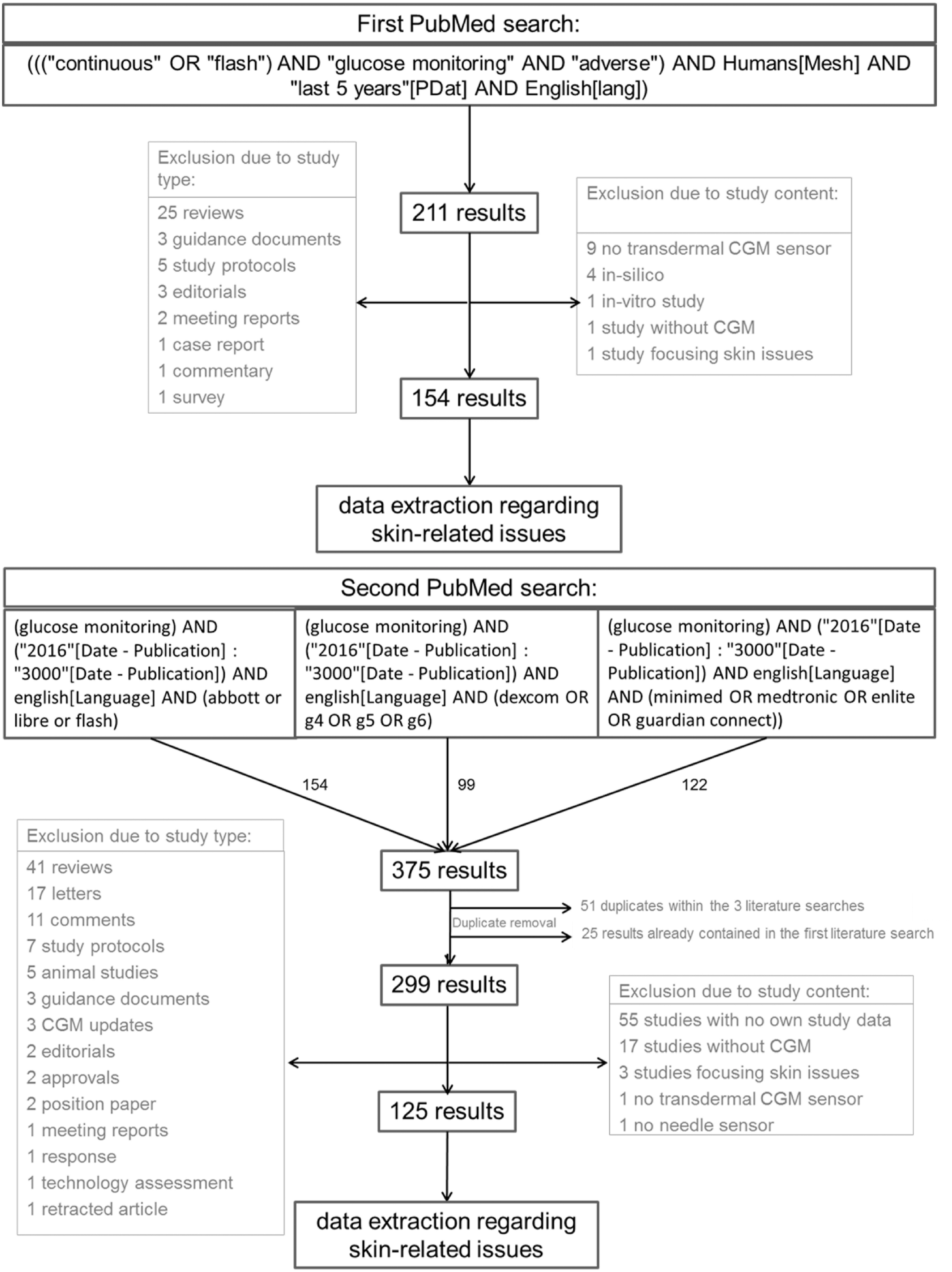
Methods of the first and second literature search.
Since some relevant studies were not included in the first literature search, a second literature search with three terms was performed on October 17, 2018 (Fig. 1). The term “adverse” was not used in this search, to include a broader range of articles with CGM systems, because skin issues were not always categorized as adverse events and/or adverse device effects. To keep the results manageable, the search focused on articles with current-generation CGM systems manufactured by Abbott, Dexcom, and Medtronic, published 2016 or later in English language.
The search yielded 154 (Abbott), 99 (Dexcom), and 122 (Medtronic) results. After deletion of duplicates within the 3 search terms results (51 articles) and after deletion of results already contained in the first literature search (25 articles), 299 articles remained. Of these results, 174 articles were excluded due to article type (41 reviews, 17 letter, 11 comments, 7 study protocols without results, 5 animal studies, 3 guidance documents, 3 CGM updates, 2 editorials, 2 approvals, 2 position articles, 1 meeting report, 1 response, 1 technology assessment, and 1 retracted article) or study content (55 studies had no own study data, 17 did not use a CGM, 3 studies were performed to focus on skin issues, one study had no transdermal CGM sensor, and another did not use a needle sensor), resulting in 125 viable articles (Fig. 1).
In sum, 279 articles (154 of the first and 125 of the second literature search) were analyzed (Supplementary Data S1).
Literature analysis
Data were extracted from the results of the literature searches to further assess the occurrence of skin-related issues associated with CGM use. The device, number of occurrence, seriousness and severity of skin-related issues, and number of patients afflicted by the respective issue were documented.
For data analysis, articles were assigned into one of two study objective categories. Articles handling with CGM accuracy or therapeutic efficacy of CGM systems, sensor-augmented pumps, or closed-loop systems were assigned to the objective category “CGM performance/efficacy”. Articles using CGM as “add-on” to assess other objectives such as the effects of drugs on glucose levels were assigned to the objective category “other”.
Literature analysis was performed by one physician and two scientific researchers.
Results
In 53 of 279 (19.0%) articles (Table 1 and Fig. 2), the topic skin-related issues was mentioned; this includes 10 articles explicitly reporting that no skin-related issue occurred and 43 (81.1%) articles in which the occurrence of skin-related issues is described.
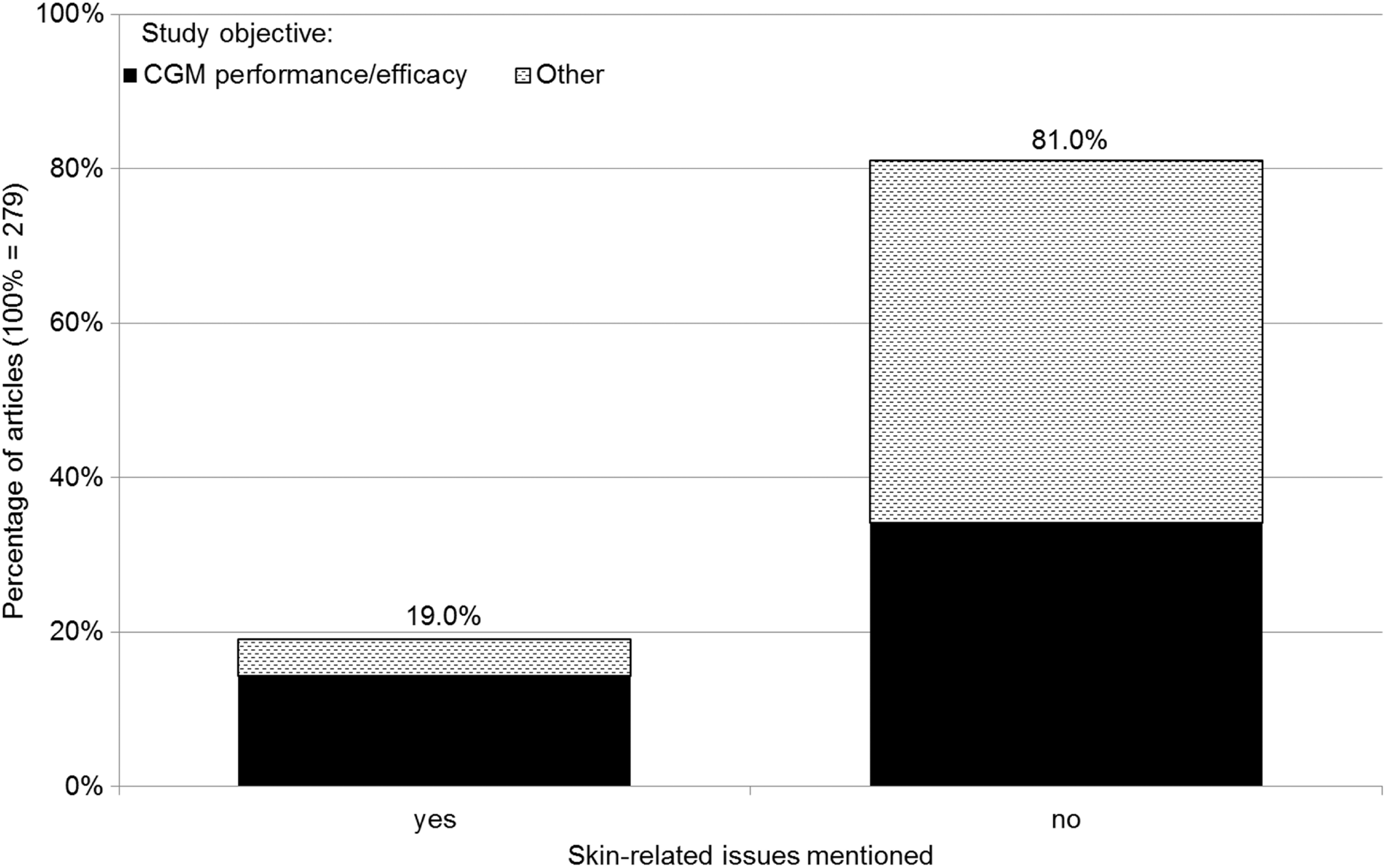
Percentage of articles mentioning (left) or not mentioning (right) skin-related issues. Differentiated by study objective (black: CGM performance/efficacy; black/white dotted: other). CGM, continuous glucose monitoring.
Number of Articles Mentioning Skin-Related Issues; Differentiated by Study Objective
With respect to these 53 articles mentioning skin-related issues, CGM performance/efficacy was the study's main topic in 40 articles (75.5% of this subgroup), whereas in the other 13 articles (24.5% of this subgroup), CGM was used as “add-on” to assess other objectives. In the 43 articles, 49 different event descriptions were documented 160 times in total. Mainly skin-related issues such as pain, itching, erythema, bleeding, bruising, and allergic reactions were mentioned. Pain was documented in 16 articles; itching and erythema were mentioned each in 15 articles, and bleeding was reported in 14 articles (Fig. 3).

Number of articles mentioning skin-related issues. Terms of skin-related issues were taken directly from the articles.
Often, different wordings for comparable findings, such as “erythema”, “redness” and “red dot” or “bleeding” and “blood”, were used (Fig. 3).
General terms such as “skin reaction” (mentioned 3 × ), “insertion site symptoms” (mentioned 2 × ), “device-related adverse events” (mentioned 1 × ), “sensor wear reactions” (mentioned 1 × ), “signs and symptoms observed on the skin” (mentioned 1 × ), and “skin assessments” (mentioned 1 × ) were used in nine articles, without providing further details.
In 4 articles, 13 diagnoses of contact dermatitis were documented. 17 –20 In 9 cases of in total 71 subjects, the CGM system FreeStyle Libre was used, 20 2 cases out of 24 subjects occurred due to an unknown system, 18 and in articles using Dexcom G4® (in total 142 subjects) or the Medtronic Enlite™ sensor (in total 145 subjects) one contact dermatitis in each was described. 17,19
In one article, two subjects stopped CGM use due to contact dermatitis. 20 In five other articles, subjects stopped or interrupted CGM use due to skin-related issues as well (1 × “allergic reaction” 17 , 1 × “moderate erythema” 21 , 2 × “skin irritation from the adhesive tape” 22 , 5 × “repeated sensor issues or failure” 19 , and 7 × because of “cutaneous reactions”. 23 None of these skin-related issues was categorized as serious adverse event or serious adverse device effect.
In 24 articles mentioning skin-related issues, the intensity/severity of the issue (73 issues) was not reported. In 2 articles, 14 severe skin-related issues were reported. 24,25
Severe issues were “device-related adverse events” (4 × ), “edema” (2 × ), “erythema” (2 × ), “sensor wear reactions” (2 × ), “allergy events” (1 × ), “itching” (1 × ), nondescript “insertion-site symptom” (1 × ), and “pain” (1 × ). In one article, the observed skin-related issues of “itching” (72 × ) were generally rated as “moderate to severe”. 26
The number of occurrence was not described in 18 articles, and in 4 articles the occurrence was only reported in sum with all occurred issues, without details for every kind of issue. A documentation of the number or percent of subjects who experienced an issue was not given in 19 articles as well.
In none of the assessed articles mentioning skin-related issues, information about the use of an additional tape or extra glue to maintain the expected CGM wear time was given. In two articles not reporting skin-related issues, extra glues or additional tapes may have been used (indicated by a photo in one article and a statement that instructions how to avoid the self-removal were given in another article). In Table 2, the number and percentage of articles, mentioning skin-related issues differentiated by the CGM manufacturer systems by Dexcom, Abbott, Medtronic, and other are presented.
Number and Percentage of Articles; Differentiated by Continuous Glucose Monitoring Manufacturer/System
Sum of all articles (300) exceeds 279 because some articles used multiple CGM systems.
Table 3 presents the number of articles mentioning skin-related issues categorized by the CGM wear time during the study. The highest percentage (46.9%) of articles mentioning an issue was in articles with a CGM wear time between >10 and ≤14 or more than 14 days.
Number and Percentage of Articles Mentioning Skin-Related Issues; Differentiated by Continuous Glucose Monitoring Wear Time
Discussion
The purpose of this article was to review current literature regarding the scope and type of reports of skin-related issues associated with CGM use. In the literature search, 19.0% of articles (53 out of 279) mentioned skin-related issues, that is, they explicitly reported whether skin-related issues occurred or not. For articles focusing on CGM as study's main topic, approximately, a third of articles mentioned skin-related issues. The most frequently reported issues of this literature analysis were pain, itching, erythema, bleeding, bruising, and allergic reactions. These events were similar to those reported in the FDA approved Summary of Safety and Effectiveness Data (SSED) documents of current CGM systems 27 –30 and the Manufacturer and User Facility Device Experience (MAUDE) database. 31
A limitation of this literature search refers to the search methodology. Due to its focus on skin reactions defined as adverse events, the first literature search may have been too specific. The search terms of the second literature search were chosen to focus on three current-generation CGM systems of the most relevant manufacturers of needle-type CGM systems Abbott, Dexcom, and Medtronic. Thus, other manufacturers of current CGM systems were not included in this literature search. In addition, the second search was limited to articles published 2016 or later, because of the focus on current-generation systems and because the first literature search only provided very few articles published earlier than 2016. Both aspects were mainly selected to keep the number of possible articles manageable. However, it cannot be excluded that studies about other or older CGM system were not found in the second search despite describing skin-related issues.
Furthermore, it has to be noted that subjects with skin problems due to sensor use often are excluded from studies with CGM systems or are likely unwilling to participate in such studies. Therefore, the information about prevalence, severity, and score of skin-related issues given in the assessed articles is likely limited by a restricted subject group.
Another important topic is the use of barrier films under the sensors to prevent that allergens get in contact with the skin or additional adhesives to maintain the expected CGM wear time. Although in practice many patients use these products, 6,32 –34 no specific information was found in this literature search. Thus, the impact of such additional tools is not clear and studies focusing on this topic are needed.
In the assessed articles, the manner in which skin-related issues were reported differed substantially and no uniform structured reporting procedures were given. Comprehensive descriptions were rare: some articles did not provide detailed information regarding the occurrence, severity of issue, or number of afflicted subjects. The skin-related issues themselves were occasionally not described in detail. While some articles only described findings such as “redness” or “itching”, other articles already documented the final diagnoses such as “contact dermatitis”. Furthermore, inconsistent terms for comparable issues or only general wordings were used. Often, a term of an issue was only used by one article. Thus, it is difficult to compare different articles regarding statements on skin-related issues.
Safety issues are rare in studies with CGM and, if reported, there is no unified report. The limited information might be due to the fact that the documentation of each issue requires a lot of time for clinicians. 4 In addition, clear evaluation criteria for skin-related issues are missing and inconsistent terms for comparable issues may result. Furthermore due to a long occlusion effect, sweating, injuries after tearing off the adhesive, and a long sensitization period in type IV allergies, reactions often only progress after prolonged use. Thus, detection in relatively short studies may fail.
A structured and validated plan to guide a comprehensive and uniform assessment and report of skin-related issues may be helpful to explore and compare the prevalence of occurred skin-related issues. In this context, an allocation of comparable issues into five main categories of skin-related issues, to enable a systematic report of the assessed skin issues due to CGM use, was done (Table 4). The main categories comprise “irritations”, defined by findings of superficial skin changes such as redness or abrasion that are not caused by an allergic reaction, “dysesthesia” for findings such as itching, pressure feeling, or pain (which could possibly also be part of skin irritations or allergic reactions), “trauma”, including injuries of the skin or the subcutaneous tissue, “infections” such as an abscess or pustule as consequence of an injury due to sensor insertion and “allergic reactions”. While skin irritations are caused mechanically or physically, for example, due to pulling of an adhesive, prolonged skin occlusion or sweating, an allergic skin reaction is triggered by a contact allergen which should be avoided. In case of an allergic reaction, symptoms similar to symptoms of the category “irritations” tend to occur after a certain sensitization phase. General wordings for skin issues were not included into the main categories. Summarizing the number of assessed skin-related issue into the five main categories showed that the category “irritation” was most frequently reported in the assessed articles.
Categorization and Summarized Number (n) of Assessed Skin-Related Issues into Five Main Categories for Systematic Skin Issue
Bold marked issues were mentioned in more than three of the assessed articles.
Assuming the occurrence of allergic contact dermatitis, the issue contact dermatitis was assigned to allergic reactions.
Although CGM systems, manufactured by Abbott, were not the most frequently used systems of all assessed articles (56), compared to studies with other CGM systems more often studies with CGM systems manufactured by Abbott (24, 42.9%) reported about skin-related issues. It cannot be excluded that different authors report about skin-related issues with different detail level. Thus, this could influence the view about the number of articles mentioning skin-related issues differentiated by the CGM manufacturer systems. However, the number of reported issues in articles using different CGM systems may also vary because of different substances the manufacturer use for their system. 4
Unfortunately, there is often no detailed information about the components used in medical systems, and the adhesives of CGM systems frequently consist of a mixture of different material components. Furthermore, there is an indication that not the adhesive itself, but components of the layer glue fixing the sensor components together may cause skin reactions. 7 –9 Due to the prolonged sensor wear time the components spread and may get in contact with the skin. Furthermore, components of the CGM sensor itself can possibly solve and diffuse to the skin adhesive. 7
The analysis showed that articles with needle-based CGM systems with a longer wearing time (10–14 or more than 14 days) more often reported skin-related issues than articles with a shorter wear time. However, it has to be noted that the time at which the skin-related issue occurred was not given. Thus, the theory that increased wear times and thereby stronger sticking adhesives may have a more pronounced effect on the skin 5,7 cannot be fully confirmed in our analysis due to missing information about the time of occurrence. Another explanation for the increase of skin-reactions might be the steady increase in subjects using CGM systems. 35
Furthermore, for subjects having skin reactions, the increasing benefit of CGM use may outweigh minor skin issues such as redness, dry skin, or scarring, thus subjects might be willing to resolve them rather than stopping using CGM.
In case of contact dermatitis, a distinction has to be made between allergic and irritant forms. 36 An allergic contact dermatitis constitutes a permanent impairment of a body structure or body function, because it is expected to reoccur under similar conditions. The sensitization to an allergen usually lasts a whole life and cross-reactivity toward related substances may occur as well. Currently, there is no therapy to treat contact allergy; if someone is once sensitized, a reaction will occur within a few days of reexposition. Thus, the avoidance or a substantial reduction of exposure of the allergen is the only meaningful action. 7
The current analysis yielded 13 cases of contact dermatitis in 4 articles; in most cases (9 × ), the intermittent scanning CGM (iscCGM) system FreeStyle Libre was used. It remains unclear whether contact dermatitis led to study discontinuation for the affected subjects, because only one article explicitly states that two subjects stopped using the investigational device.
Thus, subjects either had pre-existing contact dermatitis and were included into those studies, which raises questions about subject selection, or their contact dermatitis developed during the studies and were not categorized as serious device-related effect in case of allergic contact dermatitis. If the latter was the case, the adverse events should have been categorized as “serious adverse events” in at least three of the four articles according to ISO 14155.
Conclusion
The average wear time of CGM systems steadily increased over the last years. Increased wear times are likely achieved by using adhesives with a longer adherence time, which may have a more pronounced effect on the skin than adhesives with shorter adherence time. This structured literature search showed that up to now, ∼20% of all articles mentioned skin-related issues. In articles with CGM as main topic, almost 30% reported about skin-related issues. If such issues are reported, there is currently a varying degree in how detailed skin-related issues are described. More reports about skin-related issues in scientific literature may be helpful to draw possible conclusions about the occurrence of skin-related issues during CGM use. Furthermore, a guideline for structured descriptions of skin-related issues occurring during CGM use would help allow uniform wordings and differentiate between temporary issues and long-lasting effects of skin-related issues.
Footnotes
Acknowledgments
The authors thank Roche Diabetes Care GmbH for the financial support of this literature search. The authors also thank the IDT staff who contributed to data collection or assisted in preparation of this article. Funding: This investigator-initiated study was supported by Roche Diabetes Care GmbH, Germany.
Disclosure Statement
G.F. is general manager of the IDT (Institut für Diabetes-Technologie Forschungs- und Entwicklungsgesellschaft mbH an der Universität Ulm, Ulm, Germany), which carries out clinical studies on the evaluation of BG meters and medical devices for diabetes therapy on its own initiative and on behalf of various companies. G.F./IDT has received speakers' honoraria or consulting fees from Abbott, Ascensia, Bayer, Dexcom, LifeScan, Menarini Diagnostics, Metronom Health, Novo Nordisk, Roche, Sanofi, Sensile and Ypsomed. S.P., S.U., E.Z., and C.H. are employees of IDT. S.K. has nothing to disclose.
Supplementary Material
Supplementary Data S1
References
Supplementary Material
Please find the following supplemental material available below.
For Open Access articles published under a Creative Commons License, all supplemental material carries the same license as the article it is associated with.
For non-Open Access articles published, all supplemental material carries a non-exclusive license, and permission requests for re-use of supplemental material or any part of supplemental material shall be sent directly to the copyright owner as specified in the copyright notice associated with the article.
