




Abstract
Background:
FreeStyle Libre is a factory-calibrated continuous 14-day glucose sensor. Little is known about the accuracy of FreeStyle Libre as a function of sensor age.
Methods:
We assessed the accuracy of FreeStyle Libre in 14 adults with type 1 diabetes. Each study participant attended our research facility for two or three 24-h visits, during which they wore a FreeStyle Libre aged 0–1 day, 5–7 days, or 13–14 days. Plasma glucose levels were measured every 10–30 min using YSI2300 STAT Plus Analyser. Participants also wore Dexcom G5® glucose sensor aged 1–2 days. We assessed sensors' accuracy using mean absolute relative difference (MARD) between FreeStyle Libre, the Dexcom G5 sensor, and plasma glucose.
Results:
We had 1930 pairs of FreeStyle Libre sensor-plasma glucose measurements, collected from 36 FreeStyle Libre sensors, 18 of which were sensors aged 0–1 day, 9 were sensors aged 5–7 days, and 9 were sensors aged 13–14 days. The mean and median MARD for FreeStyle Libre sensors aged 0–1 days were 14.5% and 11.2%, respectively, and for sensors aged 13–14 days were 14.7% and 11.2%, respectively, but for sensors aged 5–7 days were 7.8% and 6.6%, respectively (P = 0.03 vs. sensors aged 0–1 days, and P = 0.06 vs. sensors aged 13–14 days). The percentage of points falling in the potentially dangerous zones C, D, or E in Clarke's error grid analysis were 1.9% for FreeStyle Libre sensors aged 0–1 day, 0.2% for sensors aged 5–7 days, and 0.4% for sensors aged 13–14 days. The overall accuracy of FreeStyle Libre and Dexcom G5 sensor was the same (mean MARD 12.8% and 12.5%, respectively; P = 0.57).
Conclusions:
FreeStyle Libre's accuracy is adequate during its entire lifetime but is least accurate during its first and last days.
Introduction
Type 1
Continuous glucose monitoring systems, also known as glucose sensors, emerged in the mid 2000s, 4,5 and measure interstitial glucose levels in a continuous manner while being minimally invasive. Glucose sensors can improve glucose control, 6,7 and can be combined with insulin pumps to form automated insulin delivery systems, or artificial pancreas systems. 8
Recently, flash sensor-based glucose monitoring was developed, and it allows intermittent but frequent measurements of glucose levels while also being minimally invasive. Flash glucose monitoring can improve glucose control 9 and reduce hypoglycemia. FreeStyle Libre flash glucose sensor has been rapidly adopted by patients due to its ease of use, small size, and lower cost compared with its competitors. The FreeStyle Libre sensor is factory calibrated, reducing the number of required finger-stick blood glucose measurements.
A few studies have assessed the accuracy of FreeStyle Libre flash glucose sensor, 10 –14 but little is known about the accuracy of the sensor as a function of sensor age. In this study, we assessed and compared the accuracy of FreeStyle Libre aged 0–1 days, 5–7 days, or 13–14 days. Sensor readings were compared against frequent plasma glucose measurements during 24-h inpatient visits.
Methods
Adult participants were enrolled in the study at the Center of Innovative Medicine, Research Institute of McGill University Health Centre, Montreal, Canada. Participants recruited were ≥18 years and using an insulin pump for at least 6 months. Participants provided written informed consent. The study was approved by the local ethics committee.
Participants attended our research facility for two or three 24-h visits, during which they wore a FreeStyle Libre aged 0–1 day, 5–7 days, or 13–14 days. Participants also wore a Dexcom G5® glucose sensor (Dexcom, San Diego) 24–48 h before the visits (therefore, each participant wore both a FreeStyle Libre sensor and a Dexcom G5 glucose sensor simultaneously). Dexcom G5 glucose sensor was calibrated at least every 12 h, using participants' usual capillary glucose meter.
Before the start of the study, participants received training on sensor installation. The FreeStyle Libre sensor was self-inserted by participants on the arm, whereas Dexcom G5 glucose sensor was self-inserted on a site based on participant's preference. Participants arrived at the research facility around 07h00 and stayed until 08h00 the next morning. Self-selected meals were served at 08h00 (median 40 g [interquartile range (IQR): 39–49] carbohydrate), 12h00 (61 g [55–75] carbohydrate), 17h00 (78 g [74–89] carbohydrate), and 21h00 (27 g [25–34] carbohydrate). Meals were standardized between visits of the same participant but were different between participants. Participants were allowed to have light walks, which were standardized between visits. The visits were separated by a median of 14 days. Participants were taking part in a study where glucose levels were controlled by closed-loop insulin and pramlintide delivery. 15
Venous blood samples were taken every 10–30 min. Plasma glucose was measured using YSI2300 STAT Plus Analyser (Yellow Springs, OH). We assessed sensors' accuracy using mean absolute relative difference (MARD) between sensor values and plasma glucose measurements. MARD was calculated for each visit separately, and mean and median of all visits' outcomes were calculated. A linear mixed model was fitted to the MARD data to compare the FreeStyle Libre sensors aged 5–7 days with sensors aged 0–1 and sensors aged 13–14. Residual values were examined for normality. Wilcoxon rank-sum test was used to compare Freestyle Libre and Dexcom sensors' outcomes.
Results
Table 1 shows the characteristics of study participants. Fourteen participants were enrolled in the study, eight of whom had 3 visits and six had 2 visits (total 36 visits). We, therefore, collected data from 36 FreeStyle Libre sensors, 18 of which were sensors aged 0–1 day, 9 were sensors aged 5–7 days, and 9 were sensors aged 13–14 days. Access to venous blood was not possible at all times in 8 of the 36 visits, but all visits included plasma glucose measurements for at least 12 h. In total, we had 1930 pairs of sensor-plasma glucose measurements.
Baseline Characteristics of the 14 Study Participants
SD, standard deviation.
Table 2 and Table 3 shows study outcomes. The mean and median MARD for FreeStyle Libre sensors aged 0–1 days were 14.5% and 11.2%, respectively, and for sensors aged 13–14 days were 14.7% and 11.2%, respectively, but for sensors aged 5–7 days were 7.8% and 6.6%, respectively (P = 0.03 vs. sensors aged 0–1 days, and P = 0.06 vs. sensors aged 13–14 days). Overall, the mean and median MARD for FreeStyle Libre sensors were 12.8% and 10.3%, respectively. The percentage of points falling in the potentially dangerous zones C, D, or E in Clarke's error grid analysis were 1.9% for FreeStyle Libre sensors aged 0–1 days, 0.2% for sensors aged 5–7 days, and 0.4% for sensors aged 13–14 days (Fig. 1).
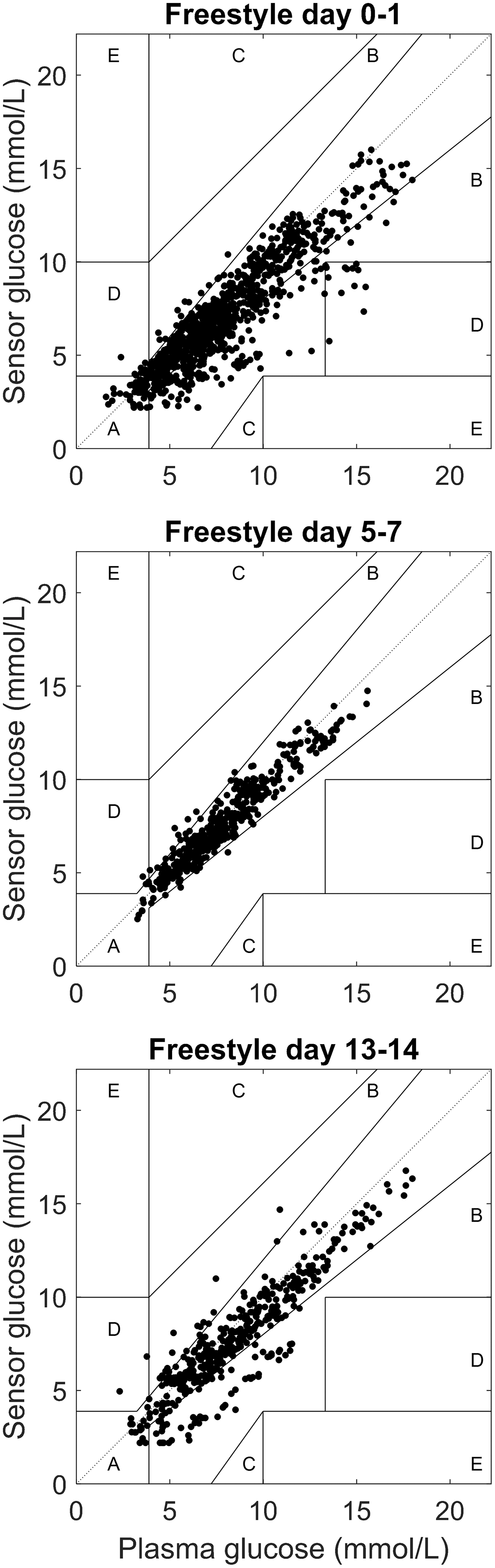
Clarke's error grid analysis for Freestyle Libre sensors aged 0–1 day, sensors aged 5–7 days, and sensors aged 13–14 days.
Sensor Accuracy Outcomes
All Dexcom G5 sensors were aged 1–2 days.
Data not normally distributed.
Bias = sensor—plasma.
IQR, interquartile range; MARD, mean absolute relative difference; ROC, rate of change.
Sensor Accuracy Outcomes at Various Glucose Concentrations
All Dexcom G5 sensors were aged 1–2 days.
Data not normally distributed.
Target range defined as plasma glucose readings [3.9 to 10.0 mmol/L]. Hypoglycemic range defined as plasma glucose readings <3.9 mmol/L. Hyperglycemic range defined as plasma glucose readings >10 mmol/L.
n = number of sensor-plasma pairs.
Compared with 11.2% median MARD for FreeStyle Libre sensors aged 0–1 day, the corresponding Dexcom G5 sensors (aged 1–2 days) had median MARD of 12.1% (P = 0.88). Compared with 6.6% median MARD for FreeStyle Libre sensors aged 5–7 days, the corresponding Dexcom G5 sensors (aged 1–2 days) had median MARD of 11.3% (P = 0.11). Compared with 11.2% median MARD for FreeStyle Libre sensors aged 13–14 days, the corresponding Dexcom G5 sensors (aged 1–2 days) had median MARD of 10.4% (P = 0.32). Overall, the mean MARD for Dexcom G5 sensor was 12.5% compared with the 12.8% for FreeStyle Libre sensors (P = 0.57).
Discussion
Other studies have assessed the accuracy of FreeStyle Libre in type 1 diabetes, 10 –14 but they relied on intermittent capillary glucose measurements. Olafsdottir et al. 10 compared FreeStyle Libre with capillary glucose measurements (≥6 values per day) in 58 adults and reported MARD of 13.6% for week 1 and 12.7% for week 2 (day-by-day data were not reported). Boscari et al. 12 compared FreeStyle Libre and Dexcom G5 with capillary glucose measurements (≥4 values per day) in 20 adults and reported overall MARD of 12.3% for FreeStyle Libre. Moreover, MARD was highest for day 1 (14.5%) and days 13–14 (13.2%–13.5%), and lowest in the days in-between (11%–12%). However, unlike our study, Dexcom G5 had a higher overall accuracy (9.8%) compared with FreeStyle Libre. Bailey et al. 14 compared the FreeStyle Libre with capillary blood using the FreeStyle Precision BG meter and to venous blood using the YSI analyzer in 72 participants. The study reported a lower accuracy on day 1, with an overall MARD of 11.4% with capillary BG meter reference, and 12% with YSI reference. The YSI readings, however, were limited to three in-clinic visits for 8 h period. Charleer et al. 13 assessed the effect of sensor insertion site on its accuracy in 23 adults and reported lower MARD for the arm (11.8%) compared with the abdomen (18.5%). Our participants wore the FreeStyle Libre on the arm.
In this study, we assessed the accuracy of FreeStyle Libre flash glucose sensor as a function of sensor age. Adults with type 1 diabetes were studied for two or three 24-h periods, during which time they wore one FreeStyle Libre aged 0–1 day, 5–7 days, or 13–14 days as well as a Dexcom G5 sensor aged 1–2 days. Sensor readings were compared against frequent plasma glucose measurements through YSI, and our data included measurements pre- and postmeals. We found that the accuracy of FreeStyle Libre is adequate throughout its lifetime but is least accurate during its first and last days. Its accuracy was comparable with Dexcom G5 sensors when both were aged 1–2 days.
Our study has strengths as it compared the sensor with a much more accepted standard (YSI) and not capillary blood measurements, for 24 h period. It also compared accuracy head to head with Dexcom G5 sensor in the first 2 days of use. The main limitation of our study was the small number of participants (n = 14). Not all participants were able to provide venous samples at all the predetermined time points. Another limitation is that Dexcom G5 sensor age did not match that of FreeStyle Libre for days 5–7 and 13–14. As this study is a subanalysis of a larger clinical trial where Dexcom G5 sensor readings were used to dose insulin and pramlintide, the insertion of Dexcom G5 sensor was fixed to 24–48 h before the start of the intervention for all participants. Consequently, direct comparison between FreeStyle Libre and Dexcom G5 sensor was only possible in the first 2 days of use. An additional limitation is that the closed-loop system reduced variability, which resulted in lower number of measurements in the hypoglycemia and hyperglycemia ranges (Table 3), and our protocol lacked deliberate attempts to induce low and high glucose excursions. Finally, the number of study admissions with sensors aged 5–7 days and 13–14 days were half the number of admissions with sensors aged 0–1 day.
In conclusion, FreeStyle sensor accuracy was adequate throughout its lifetime. It does tend to be slightly less accurate at the beginning and at the end of its use. It is, however, of comparable accuracy with the Dexcom G5 in the first 48 h.
Footnotes
Author Disclosure Statement
A.H. received research support/consulting fees from Eli Lilly, Medtronic, AgaMatrix, and Dexcom, and has pending patents in the artificial pancreas area. M.T. received research support from AgaMatrix, consulting fees from Sanofi, and speaker honoraria from Eli Lilly, Novo Nordisk, Boeringher-Ingelheim, Janssen, and AstraZeneca. A.B. is a nurse clinician and insulin pump trainer for Medtronic Canada and Omnipod Canada. E.P. received consulting fees from Animas and speaker honoraria from Medtronic and Animas. J.F.Y. received research support from Sanofi, Bayer, Novo Nordisk, and consulting fees and speaker honoraria from Sanofi, Eli Lilly, Novo Nordisk, Boehringer-Ingelheim, Janssen, Takeda, Abbott, Merck, and Astra Zeneca. L.L. has pending patents in the field of artificial pancreas, received consulting fees from Dexcom, and has received support for clinical trials from Merck, Astra-Zeneca, and Sanofi. No other competing financial interests were reported at the time of writing the article.
Funding Information
This study was supported by funding from Juvenile Diabetes Research Foundation (2-SRA-2016-246-M-R).