




Abstract

The COVID-19 pandemic dramatically reduced outpatient care for U.S. children in spring 2020. 1 Evaluating children with newly diagnosed type 1 diabetes (T1D), we aimed to assess whether there was an increase in diabetic ketoacidosis (DKA), whether it subsided as businesses and schools began reopening, and what factors may predict increased risk of DKA in this population. This study was approved by the Colorado Multiple Institutional Review Board.
The University of Colorado is the only academic medical center in Colorado, and we care for patients throughout the state and beyond. We reviewed records for 744 children with Colorado residence who were aged <18 years and were diagnosed with T1D between March and October 2017–2020 (172 in 2017, 207 in 2018, 182 in 2019, and 183 in 2020). DKA was defined as venous pH <7.3 or HCO3 - < 15 mmol/L, and they were categorized thus: mild (pH ≥7.2 and HCO3 - ≥ 10 mmol/L), severe (pH <7.1 or HCO3 - < 5 mmol/L), with the remainder categorized as moderate. Rural residence was defined by the ZIP code list published by the Centers for Medicare & Medicaid Services. 1
Mean (SD) age was 10.0 (4.5) years. The population was 48.0% female, 36.4% had public insurance, 92.7% spoke English, and 11.3% had rural residence. Fourteen patients (1.9%) had no or unknown insurance. Patients identified as 64.2% non-Hispanic white, 17.7% Hispanic, and 2.4% non-Hispanic black. There were no differences in age, gender, race/ethnicity, insurance, language, or residence between 2017–2019 and 2020.
Four hundred five (54.4%) patients had DKA. The DKA rate increased from 52.0% in 2017–2019 to 61.7% in 2020 (p = 0.03). In March–June, it was higher in 2020 than in 2017–2019 (65.7% vs. 51.4%, p = 0.02), but the difference was nonsignificant from July to October (57.1% vs. 52.7%, p = 0.56) (Figure 1). Rural patients were more likely to have DKA than their counterparts (OR 1.42 [1.00–2.02]; p = .05). Severity of DKA did not differ in the entire observation period or in either the first or second half of the period (p = 0.066, p = 0.94, and p = 0.46, respectively). Severe DKA occurred in 4% more patients in 2020 than in 2017, the next highest year.
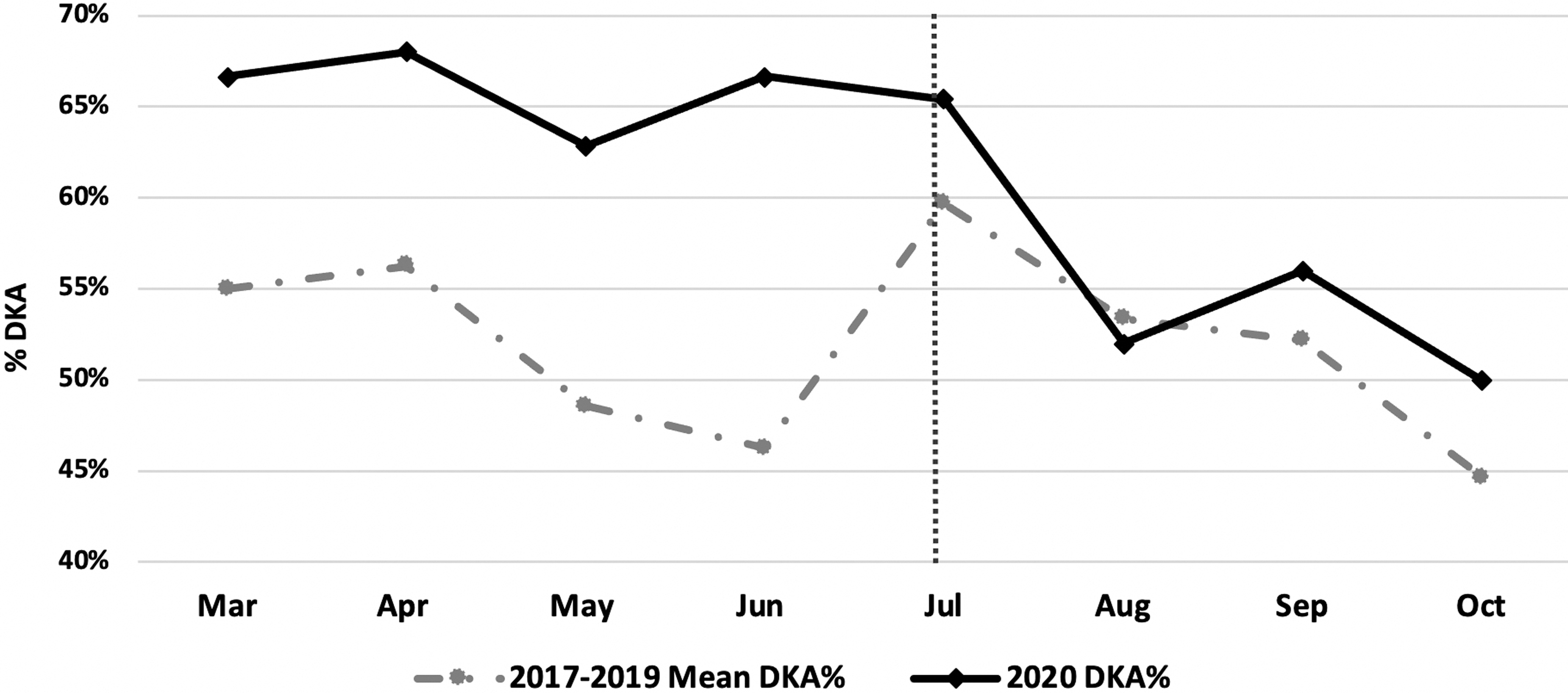
The prevalence of DKA upon new diagnosis of T1D in 2017–2019 versus 2020. The vertical line represents the division between the first and second half of the observation period. DKA, diabetic ketoacidosis.
The rate of DKA at diagnosis of T1D increased in this study population early in the pandemic, consistent with international trends. 2 –5
Colorado was under the Safe at Home order from March 26 to April 26, 2020, transitioning to the less strict Safer at Home order through October. COVID-19 caseload ebbed in May, and society gradually reopened. By July, many pediatric clinics had reopened for routine well-childcare, and DKA rates returned toward historical trends. Trends in our population suggest that decreased outpatient health care accessibility and willingness by people to use it during the pandemic resulted in delayed care and consequent adverse outcomes. However, this appears to have been temporary, as DKA rates did not differ from prior years in July–October.
Consistent with prior data from our center, rural residence was associated with increased risk of DKA. 6 This may represent limited health care access in rural areas.
It is vital for patients to be able to access care at either in person and telemedicine visits and for families to feel safe when needing in-person care. Further research should also aim to reduce barriers to health care access, especially during societal crises.
Footnotes
Authors' Contributions
G.T.A. and C.M. researched the data and wrote the article. S.T. and R.O.-H. researched data and reviewed and edited the article. L.P. performed the statistical analyses and reviewed and edited the article. A.R. researched the data, reviewed the article, and contributed to the discussion. We thank Bing Wang for database support. Drs. Todd Alonso and Arleta Rewers are the guarantors of this study and, as such, had full access to all the data in the study and take responsibility for the integrity of the data and the accuracy of the data analysis.
Ethical Statement
This study was determined by the Colorado Multiple Institutional Review Board (20-2686) to meet criteria for exemption from IRB review (category 4, secondary research). All criteria were met for a full waiver of HIPAA authorization.
Author Disclosure Statement
No competing financial interests exist.
Funding Information
No funding was received for this article.