




Abstract

I
In January 2022, an article in BMJ Open Diabetes Research & Care described the “diabetic hand” as being up to eight times more frequent among patients with T1D. 1 However, individuals with either T1D or type 2 diabetes had more concomitant prevalent hand diagnoses compared with the population without diabetes mellitus. 1 Limited joint mobility syndrome (LJMS) appears to be common in patients with T1D. 2,3 Our case report describes a patient with an unreported complication from repeated motion/use of an insulin infusion pump.
Our patient is a 74-year-old male patient with a 70-year history of T1D. He initially was treated with multiple daily injections but was initiated on continuous subcutaneous insulin infusion therapy in the early 2000s. In May of 2019, he was transitioned to a t:slim x2 with Basal-IQ technology integrated with a Dexcom G6 continuous glucose monitor. With daily use, the average number of digital pump entrees per day was 37.1 ± 11.3 using the Screen On/Quick Bolus button known as the “T” button.
Typical everyday use included pressing the “T” button to turn the screen on to review the pump's home screen and to the quick-access night light due to nyctalopia (night blindness) from diabetic retinopathy and related photocoagulation. Noteworthy, Tandem informed us that the estimated pounds per pressure to press the “T” button is at least 2 pounds per press. The patient describes that his typical use was to hold the pump in his left hand and press the “T” button with his left index finger and use his right hand to control the pump settings (Fig. 1A).
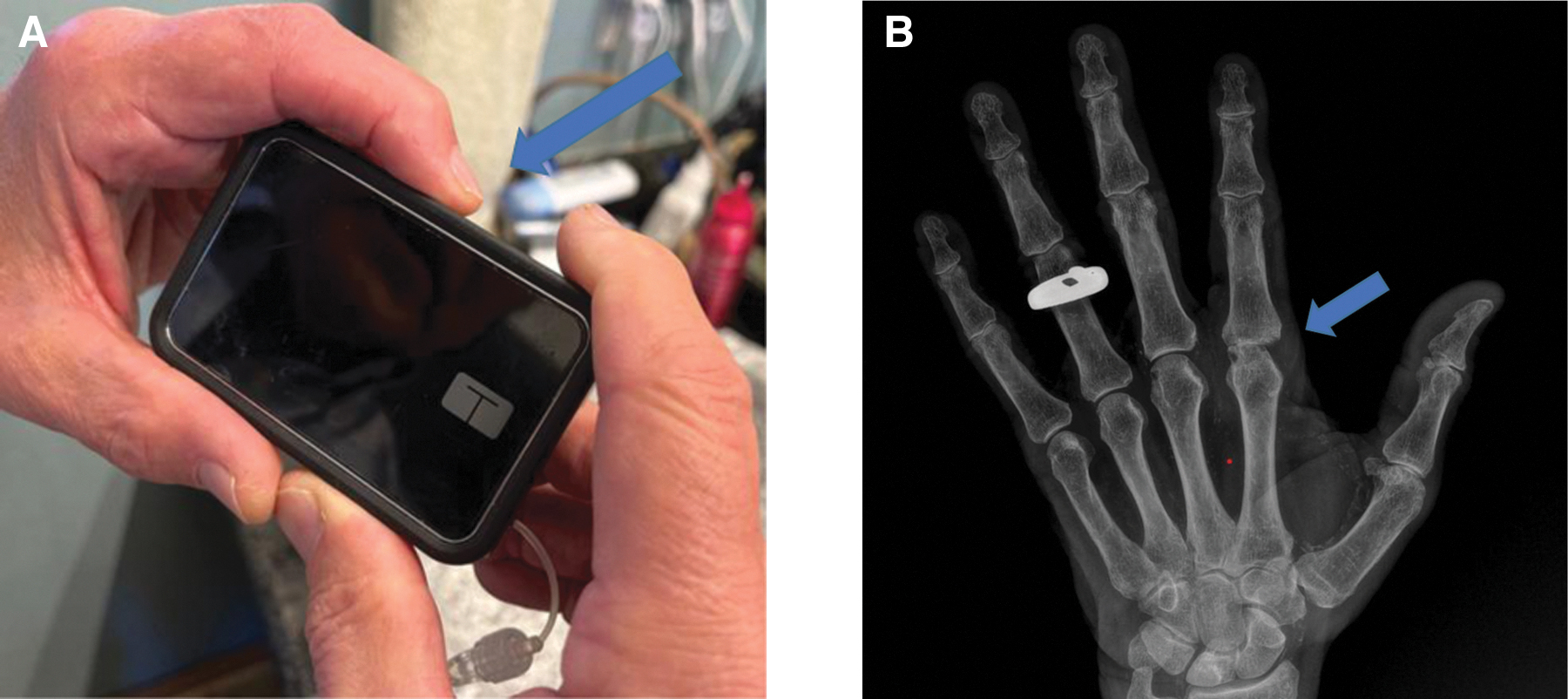
After ∼6 months of progressive discomfort in the left index finger, he was referred to the hand surgery clinic. At the visit he described a ∼2-year history of progressive increase in pain in the left index finger metacarpal-phalangeal (MCP) joint. The patient denied any other known trauma to this joint and repeated use of this joint for other purposes. The patient's clinical examination and radiographic findings (Fig. 1B) demonstrated destruction of the left index finger MCP joint with minimal arthritic changes in other joints.
Repetitive usage is a well-known contributor to osteoarthritis (OA). Given the absence of any known other trauma to his joint and the presence of only minimal OA in other joints, we presumed that the patient had developed joint destruction from his heavy repetitive use activating his insulin infusion pump. After evaluation, the surgeon and patient felt that the severity of symptoms of this joint warranted surgical joint replacement with silastic implant arthroplasty.
Six months after arthroplasty, left index finger MCP joint pain was absent, left hand strength returned to near normal, and total flexion of the finger was modestly limited. Fibroproliferative changes in connective tissue occur in the setting of long-standing diabetes due to advanced glycation end products and collagen cross-linking that can alter joint dynamics with flexion contracture predisposing to osteoarthritic changes. 4
Footnotes
Authors' Contributions
S.L.C. was involved in the article original draft. R.H.E. was in charge of supervision and writing—review and editing. W.T.G. was involved in writing—review and editing. M.G. contributed to formal analysis and visualization. I.B.H. was involved in writing—review and editing. Written consent: A reliable informant granted permission to the Diabetes Technology & Therapeutics the rights to publish the photograph within its pages that includes the Diabetes Technology & Therapeutics case report titled Diabetic Hand Disease Associated with Long-Standing Operation of an Insulin Pump.
Author Disclosure Statement
W.T.G. has served as a consultant on advisory boards for Boehringer Ingelheim, Eli Lilly, Novo Nordisk, Pfizer, Fractyl Health, Alnylam Pharmaceuticals, and Merck, and as a site principal investigator for multicentered clinical trials sponsored by his university and funded by Eli Lilly, Novo Nordisk, Epitomee, and Pfizer. I.B.H. receives research grants from Dexcom, Insulet and Consulting: Abbott, Lifescan, embecta, and Hagar. S.L.C., R.H.E., and M.G. have no competing financial interests exist.
Funding Information
No funding was received for this article.