




Abstract
Background:
For people with type 1 diabetes (T1D), ensuring fast and effective recovery from hypoglycemia while avoiding posthypoglycemic hyperglycemia (rebound hyperglycemia, RH) can be challenging. The objective of this study was to investigate the frequency of RH across different treatment modalities and its impact on glycemic control.
Methods:
This cross-sectional real-world study included adults with T1D using continuous glucose monitoring and attending the outpatient clinic at Steno Diabetes Center Copenhagen. RH was defined as ≥1 sensor glucose value (SG) >10.0 mmol/L (180 mg/dL) starting within 2 h of an antecedent SG <3.9 mmol/L (70 mg/dL). The severity of the RH events was calculated as area under the curve (AUC) and separately for users of multiple daily injections (MDIs), unintegrated insulin pumps, sensor augmented pumps (SAPs), and automated insulin delivery (AID), respectively.
Results:
Across the four groups, SAP and AID users had the highest incidence of RH (2.06 ± 1.65 and 2.08 ± 1.49 events per week, respectively) and a similar percentage of hypoglycemic events leading to RH events (41.3 ± 22.8% and 39.6 ± 20.1%, respectively). The AID users with RH events were significantly shorter compared with MDI users (122 ± 72 vs. 185 ± 135 min; P < 0.0001). Overall, severity of RH was inversely associated with more advanced technology (P < 0.001) and inversely associated (P < 0.001) with time in target range (TIR).
Conclusions:
Groups with insulin suspension features experienced the highest frequency of RH; however, AID users tended to experience shorter and less severe RH events. The association between the severity of RH events and TIR suggests that RH should be assessed and used in the guidance of hypoglycemia management.
Introduction
One of the major barriers of achieving optimal glycemic control for people with type 1 diabetes (T1D) is the risk—or even just the fear—of hypoglycemia. 1 Once hypoglycemia occurs, recovering requires balancing carbohydrate intake with ambient insulin levels and preceding and projected physical activity levels. Symptomatic hypoglycemia might motivate an excessive intake of carbohydrates, 2 which can lead to posthypoglycemic hyperglycemia (rebound hyperglycemia, RH).
The increasing use of continuous glucose monitoring (CGM) devices has enabled users to gain insight into their daily glucose fluctuations, and multiple studies have shown that using CGM combined with multiple daily injections (MDIs) and insulin pumps leads to better glycemic control. 3 –6 Despite the increasing CGM use and the subsequent increase in research using CGM data, the available evidence about RH is scarce.
Recently, the frequency of RH has been described in both adults 7,8 and children and adolescents 9 with T1D. However, none of the previous studies have investigated the impact of the different insulin delivery regimens on RH. A comprehensive characterization of the frequency and nature of RH could contribute to a better understanding of the phenomenon, the impact on glycemic control, and the different treatment modalities’ ability to handle it. This could—in the end—provide valuable insights for individuals with T1D and their caregivers in the effort to optimize glycemic control.
Therefore, this study aimed to determine the frequency of RH in people with T1D treated with different insulin delivery modalities in a real-world setting. Furthermore, the study set out to investigate differences in RH characteristics and the effect on glycemic control between the different diabetes treatment modalities.
Materials and Methods
This cross-sectional real-world study included people with T1D using a CGM attending the Steno Diabetes Center Copenhagen (SDCC), Denmark, and was built on a recent study 10 that compared glycemic metrics across insulin device groups in the same cohort. The study was approved by the Danish Data Protection Agency in the Capital Region of Denmark, R-22031406.
People eligible for the study were adults with T1D using a CGM. Exclusion criteria included unavailability of CGM data in the predefined study period, use of do-it-yourself-looping (with uncommercialized closed-loop systems), and <70% active CGM time during the 4-week period (Supplementary Fig. S1).
Data extraction
The most recent 4-week CGM data available from September 1, 2021, to August 31, 2022, were retrospectively extracted from either SDCC’s own newly established database Stenopool, 11 Diasend/Glooko (CA, USA), or CareLink (Medtronic, CA, USA).
Information on age, sex, insulin treatment regimen, diabetes duration, body mass index (BMI), and HbA1c was collected from electronic medical records (EMR, EPIC systems, Wisconsin, USA). To minimize the risk of errors resulting from time lags, correlations between HbA1c and CGM data were only analyzed when HbA1c was obtained within a range of ±3 months from the extracted CGM data.
To assess any difference between treatment regimens, the study cohort was subdivided into four treatment modality groups: (1) CGM and MDI (including Dexcom or Freestyle Libre with injection pens); (2) CGM and insulin pump with no integration (sensor and unintegrated pump [SUP] including Dexcom or Freestyle Libre with pumps from most companies); (3) CGM and insulin pump with low-level integration (sensor-augmented pump [SAP] including Dexcom or Guardian with Tandem BIQ, Medtronic 640G or Medtronic 554/754); and (4) CGM and insulin pump with high-level integration (automated insulin delivery [AID] including Tandem CIQ or Medtronic 670G/780G). For additional details on the groups, see Supplementary Table S1.
CGM data analysis
All calculations of CGM metrics were conducted in Python (version 3.7.6). RH was defined as an event with ≥1 sensor glucose (SG) value <3.9 mmol/L (70 mg/dL) followed by ≥1 SG value >10.0 mmol/L (180 mg/dL) within a period of ≤2 h (Fig. 1). Frequency of weekly RH events was calculated, and RH events were characterized by duration of the preceding hypoglycemic period and the subsequent hyperglycemic period, time of onset (day or night). Severity of the RH events was described by area under the curve (AUC, mmol/L × min). Using the trapezoidal rule, the mean AUC was calculated for the hyperglycemic period of the RH event where SG levels exceeded 10.0 mmol/L (180 mg/dL), as illustrated in Figure 1.
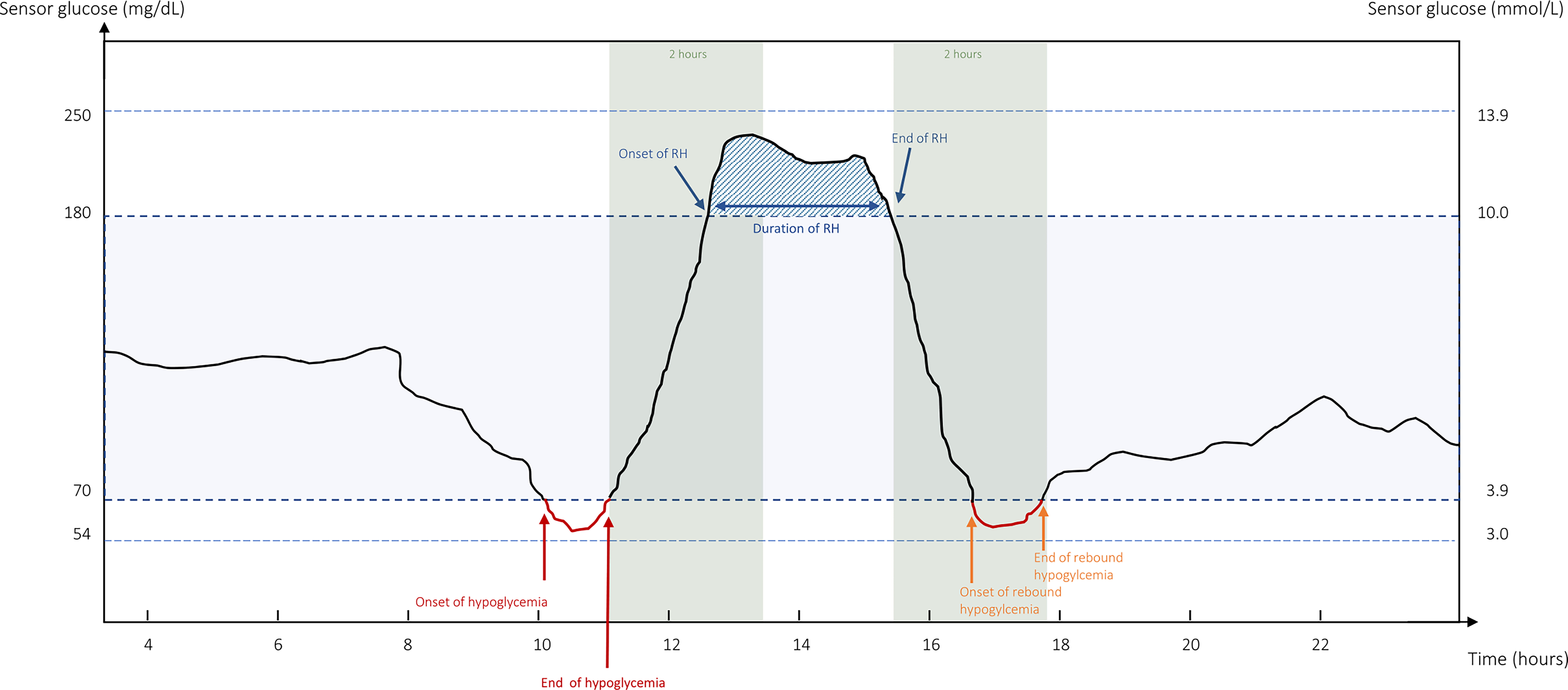
Rebound hyperglycemic event. Diagram of a CGM curve with an RH event followed by a rebound hypoglycemic event. Graphic visualization of sensor glucose values (vertical axis) over time in hours (horizontal axis). The normoglycemic range is 3.9–10.0 mmol/L (70–180 mg/dL). In this example: end of hypoglycemia was at 11 pm, the onset of RH at 12:30, end of RH at 15:30. Hyperglycemia (RH onset) occurred within the 2-h window from the end of hypoglycemia and lasted for 3.5 h. RH was followed by rebound hypoglycemia with onset at 16:30 (within 2 h of the last hyperglycemic SG). The shaded area is AUC, indicating the severity of the RH event. AUC, area under the curve; CGM, continuous glucose monitoring; RH, rebound hyperglycemia; SG, sensor glucose.
Hypoglycemic events were defined as any SG value <3.9 mmol/L (70 mg/dL), and hyperglycemic events were defined as any SG value >10.0 mmol/L (180 mg/dL). A time requirement of 15 min below the threshold to define hypoglycemic events as recommended in the guidelines 12 was not included due to the clinical relevance of capturing all events where users would have been able to react on a single CGM reading outside the target range.
To further visualize any roller-coaster-like fluctuations in glucose levels, the study defined a rebound hypoglycemic event as ≥1 SG >10.0 mmol/L (180 mg/dL) followed by ≥1 SG <3.9 mmol/L (70 mg/dL) within 2 h of the last hyperglycemic SG (Fig. 1).
To describe the glycemic control, the study included CGM metrics in line with the recommended international consensus guidelines. 12 For the entire 4-week study period, the following glycemic metrics were calculated: time in range (3.9–10.0 mmol/L [70–180 mg/dL] [TIR]), time below range (<3.9 mmol/L [70 mg/dL] [TBR]), time above range (>10.0 mmol/L [180 mg/dL] [TAR]), and coefficient of variation (CV) as a measurement of glycemic variability. 12
Secondary analyses were performed to investigate any differences in RH frequency and severity for the different AID types.
Statistical analyses
All statistical analyses were performed with SAS (version 9.2, SAS Institute Inc.; Cary, NC, USA). Group comparisons were statistically tested using analysis of variance (ANOVA) adjusted for age, sex, and diabetes duration. If data were skewed despite logarithmic transformation, the nonparametric Kruskal–Wallis test was applied. Pairwise comparisons were adjusted for multiple comparisons using Tukey’s method. Regression analysis was used to estimate the association between TIR and the severity of RH events (AUC). Results are presented as mean ± standard deviation. P < 0.05 was considered statistically significant.
Results
The final study cohort included 2289 individuals (Supplementary Fig. S1). All clinical baseline characteristics are shown in Table 1. Among all the included, 1317 (58%) used MDI, 396 (17%) used SUP, 279 (12%) used SAP, and 297 (13%) used AID. The AID group included 58 670G-users, 139 Tandem CIQ-users, and 100 780G-users. Further details on subdivisions of the different groups are shown in Supplementary Table S1.
Baseline Characteristics
Data are presented as mean (SD). Analyzed by ANOVA for all devices.
Statistically significant results with P < 0.05 are highlighted in bold.
Cochran–Mantel–Haenszel (CMH).
Logarithmically transformed variable.
Nonparametric Kruskal–Wallis test.
AID, automated insulin delivery; ANOVA, analysis of variance; BMI, body mass index; MDI, multiple daily injection; SAP, sensor-augmented pump; SD, standard deviation; SUP, sensor and unintegrated pump.
Overall, the cohort had a mean age of 48 ± 18 years (ranging from 18 to 95), diabetes duration of 23 ± 15 years, HbA1c of 59 ± 13 mmol/mol (7.5 ± 1.2%), and BMI of 26 ± 5 kg/m2.
The mean TIR for the cohort was 58 ± 19%, and TIR for AID users (73 ± 10%) was superior to all the other three treatment modalities (all P < 0.001).
The SAP and AID group had statistically significantly lower TBR (2.3 ± 2.7% and 1.9 ± 1.6%, respectively) compared with the MDI and SUP users (P < 0.001), and the AID group had a lower TAR (24.9 ± 10.8%) compared with all the other groups (all P < 0.001). CV was 33.1 ± 4.7% for AID users and 34.6 ± 4.9% for SAP users. Both were statistically significantly different from MDI (36.6 ± 6.8%) and SUP (38.6 ± 6.2%) groups (all P < 0.0001) (Supplementary Table S2).
RH and hypoglycemic events
Across the cohort, the mean percentage of hypoglycemic events leading to an RH event was 34.6 ± 22.7%. The SAP and AID groups had statistically significantly higher percentages (41.3 ± 22.8% and 39.6 ± 20.1%), respectively) compared with the MDI (31.7 ± 23.1%, P < 0.0001) and SUP groups (35.1 ± 20.7%, P = 0.001 and P = 0.0154, respectively).
Throughout the cohort, the average frequency of RH was 1.7 ± 1.4 weekly events. Comparison between modality groups revealed a significant difference in experienced weekly RH events between MDI (1.4 ± 1.3) with both SAP (2.1 ± 1.7, P = 0.0002) and AID (2.1 ± 1.5, P < 0.0001) (Table 2). No significant difference was observed when comparing the other groups. Across all modality groups, fewer RH events were seen at night compared with daytime (i.e., 06:00 am to 12:00 am).
Rebound Hyperglycemia and Hypoglycemic Events
Results are presented as mean (SD). Analyzed by ANOVA with logarithmic transformed outcomes or nonparametric Kruskal–Wallis test. RH is defined as ≥1 SG above 10.0 mmol/L (180 mg/dL) starting within 2 h of an SG below 3.9 mmol/L (70 mg/dL). Rebound hypoglycemia defined as ≥1 SG below 3.9 mmol/L (70 mg/dL) starting within 2 h from the last hyperglycemic SG.
Statistically significant results with P < 0.05 are highlighted in bold.
Nonparametric Kruskal–Wallis test was used to compare the average of the sum of ranks between the groups. No pairwise comparison was made. The median (min–max) rebound hypoglycemia events during night were MDI: 0.00 (0.00–2.03), SUP 0.23 (0.00–2.48), SAP 0.23 (0.00–1.81), and AID 0.23 (0.00–2.03).
AUC, area under the curve; RH, rebound hyperglycemia; SG, sensor glucose.
Duration of the hyperglycemic events was, on average, shorter in the AID group compared with all the other groups (all P < 0.0001). The AUC of the RH events was significantly lower for AID users (1560 ± 1057 mmol/L × min [28,108 ± 19,045 mg/dL × min]) compared with all the other three groups, with MDI demonstrating the highest mean AUC at 2520 ± 2057 mmol/L × min (45,406 ± 37,063 mg/dL × min, all P < 0.0001). In addition, a significant association was found between TIR and the AUC of RH events (P < 0.0001) but not with the frequency of RH events (P = 0.7915) (Supplementary Table S3). The duration of the antecedent hypoglycemic event lasted almost twice as long for MDI and SUP users (58 ± 43 and 55 ± 33 min, respectively) compared with the antecedent hypoglycemic events in SAP (34 ± 23 min) and AID users (31 ± 15 min) (all P < 0.0001).
Compared with MDI and SUP users, AID users had a significantly higher frequency of rebound hypoglycemic events, with an average of 2.2 ± 1.6 events per week (P < 0.0001).
In the secondary analyses, when comparing the different AID systems, no statistically significant difference was seen in the frequency of weekly RH events (P = 0.09). Similar results were observed, when comparing the percentage of hypoglycemic events leading to RH events between AID systems. However, there was a significant smaller AUC of the RH events for Medtronic 780G-users compared with Tandem CIQ-users (P = 0.0029). No significant difference in AUC of RH events was seen between Medtronic 670G compared with Medtronic 780G or Tandem CIQ (P = 0.1518 and 0.7072, respectively).
Discussion
This population-based, cross-sectional, real-world study included 2289 adults with T1D using CGM with various insulin delivery modalities. Across the cohort, the average frequency of RH was 1.7 events per week, occurring after ∼35% of all hypoglycemic events. The frequency of RH events was higher in the SAP and AID groups compared with MDI users. In contrast, RH events experienced by the AID group were both shorter and less severe than those experienced by others. Thus, despite experiencing a relatively high number of RH events, the AID group had a significantly better TIR compared with the other groups.
The overall incidence of RH was comparable with previous studies by Acciaroli et al. 7 and Hansen et al. 8 The present study found that RH events were more frequently observed during the daytime, and all groups had a very similar RH frequency during nighttime. This finding suggests that the observed difference in RH between treatment modalities is related to events or actions mainly happening during daytime, such as carbohydrate intake and insulin suspension. In addition, it has been demonstrated that acute hypoglycemia can result in food cravings, 2 which might lead to overcorrections and likely contribute to the observed RH events.
The SAP and AID groups experienced a higher percentage of hypoglycemic events leading to RH compared with the MDI and SUP groups. This could result from a reduction in insulin-on-board before and during the hypoglycemic events (due to insulin suspension features) in the SAP and AID groups. The current study does not provide information on intake of carbohydrates at hypoglycemia treatment. However, the results could indicate that users of SAP and AID might require a lower intake of carbohydrates to avoid RH. This aligns with the new international guidelines, which recommend individuals using AID to consume 5–10 g of carbohydrates, instead of the formerly recommended 15 g for all with T1D. 12 At the time of the study, the new guidelines had not been integrated into our clinical practices. Moreover, it would be expected that the implementation of these changes will require some time for each patient to adjust.
When comparing SAP and AID users, no significant difference was seen in the RH frequency or duration of the antecedent hypoglycemic events. However, SAP users experienced significantly longer and more severe RH events than AID users, suggesting that RH may partly be a consequence of insulin suspension during hypoglycemia seen in both device groups, but that AID users subsequently benefit from the possibility of increased basal insulin and the autocorrection function in their more advanced insulin devices. Comparison of the AID systems may suggest that the primary benefit may stem from increased basal insulin, as results showed no significant difference in severity of RH, when comparing Medtronic 670G-users without autocorrection function with users of Medtronic 780G and Tandem CIQ, both with the autocorrection.
It is worth emphasizing that the definition of an RH event only required a single hypoglycemic SG value due to the clinical relevance of catching all events, where users could have reacted. Interestingly, MDI experienced significantly fewer hypoglycemic events compared with SUP, but no other differences in frequency of hypoglycemic events were observed among the groups. However, results showed that SAP and AID users had the lowest TBR, which could indicate that they experience brief hypoglycemic events. Hence, the incidence of RH events among the groups might vary significantly if the definition included the requirement of 15 min below the hypoglycemic threshold as recommended in the international guidelines. 12
Results in this study showed a statistically significant difference in CV between all modality groups. In contrast, results also observed a higher frequency of RH events and rebound hypoglycemic events in the SAP and AID groups, which would be expected to indicate these so-called roller-coaster-like fluctuations. This could indicate that the statistically significant difference of CV might not be clinically relevant.
The primary strength of this study lies in its large real-world and population-based cohort, including adults treated with devices spanning the whole range of diabetes modalities. Despite its strengths, this study has several limitations. First, some limitations arise from the fact that, as a real-world and nonrandomized study, all individuals in the cohort were treated with devices based on clinical indications and personal preferences. According to the Danish national guidelines for adults, the clinical indications for reimbursement of more advanced technological treatment devices are, for example, poor glycemic control, history of severe hypoglycemia, impaired awareness of hypoglycemia, or fear of hypoglycemia. 13 This applies to both reimbursement of insulin delivery devices and CGMs at the time of the study. However, very recently all individuals with T1D in Denmark can get a CGM fully reimbursed.
Thus, the groups with AID and the most advanced technology were, on average, likely at a higher risk of hypoglycemia due to underlying behavioral or physiological characteristics. Furthermore, it is essential to highlight the different proportions of intermittently scanned CGMs (isCGM) and real-time CGMs (rtCGM) in the device groups. A large proportion of the MDI group used isCGM, many without alarm functionality at the time where the study was carried out, whereas all in the SAP and AID groups used rtCGMs (see Supplementary Table S1). As mentioned above, it is noteworthy that the MDI group, which has the highest proportion of isCGMs and thus is not able to observe real-time glucose drops preceding hypoglycemic events, did not experience more hypoglycemic events compared with the other groups, contrary to what may have been expected. In addition, Visser et al. 14 found that switching from isCGM to rtCGM significantly improved TIR. Hence, this effect needs to be considered when assessing TIR and overall glycemic control between groups in a real-world cohort such as the present one. Second, other limitations result from the lack of data available. For instance, this study has no information about patient-level decisions and factors surrounding the events. For further research, an estimate of what caused the antecedent hypoglycemic event (e.g., physical activity and/or unintentional overbolusing before a meal) and information about attempts to restore normoglycemia would be valuable in determining the factors affecting and causing RH events.
Conclusions
This study provides novel insight into the frequency of RH in adults with T1D treated with different insulin delivery modalities. The SAP and AID users had the highest frequency of RH events and percentage of hypoglycemic events leading to RH events. However, compared with all other groups, AID users appeared to be superior at managing the impact of glucose fluctuations resulting in shorter and less severe RH events. In sum, results found in this study suggest that the use of more advanced insulin delivery devices is associated with better management of RH, but studies on how to prevent RH in AID users are needed. Finally, while this study finds that RH frequency alone does not per se provide a good indication of the quality of diabetes control, the observed association between TIR and higher AUC suggests that RH severity has clinical relevance and should be considered when evaluating the treatment in people with T1D.
Footnotes
Acknowledgment
The authors want to thank Antonius Manders for collecting clinical data from the EMR.
Authors’ Contributions
K.G.T., C.L., A.G.R., and K.N. were involved in the design of the study. K.G.T. collected the data at Steno Diabetes Center Copenhagen and wrote the first draft of the report. L.B.S. implemented and ran the CGM algorithms, and A.G.R. performed the statistical analysis. K.G.T., C.L., A.G.R., and K.N. contributed to data analysis, interpretation, and the drafting and critical revision of the report. K.G.T. and K.N. stand as guarantors of this work, ensuring full access to all study data and taking responsibility for data integrity and analysis accuracy. K.G.T., A.G.R., C.L., and K.N. had access to the study results, reviewed the article, and approved the final version of the report for submission.
Author Disclosure Statement
C.L. was employed by Steno Diabetes Center Copenhagen during the conduct of the study, but as of November 1, 2022, is employed by, and owns shares in, Novo Nordisk. K.N. owns shares in Novo Nordisk; has been a paid consultant for Novo Nordisk and Medtronic; and has received speaker and advisory board honorarium to her institution from Medtronic and Abbott, Novo Nordisk, Insulet, and Convatec, and her institution has received research funding from Zealand Pharma, Novo Nordisk, Medtronic, and Dexcom. K.G.T., A.G.R., and L.B.S. have no conflicts of interest to report.
Funding Information
The authors received no financial support for the study, authorship, or publication of this article. Steno Diabetes Center Copenhagen is a public hospital and research institution under the Capital Region of Denmark, which is partly funded by a grant from the Novo Nordisk Foundation.
Supplementary Material
Supplementary Figure S1
Supplementary Table S1
Supplementary Table S2
Supplementary Table S3
References
Supplementary Material
Please find the following supplemental material available below.
For Open Access articles published under a Creative Commons License, all supplemental material carries the same license as the article it is associated with.
For non-Open Access articles published, all supplemental material carries a non-exclusive license, and permission requests for re-use of supplemental material or any part of supplemental material shall be sent directly to the copyright owner as specified in the copyright notice associated with the article.
