




Abstract
The Automated Insulin Delivery in Elderly with Type 1 Diabetes (AIDE T1D) trial randomized 82 adults ≥65 years with type 1 diabetes (T1D) to hybrid closed loop (HCL), predictive low glucose suspend (PLGS), and sensor-augmented pump (SAP) therapy in a randomized crossover trial. Seventy-five of the 78 completers joined an extension phase in which they were offered the pump mode of their choice for an additional 3 months. Mean age was 71 ± 4 years (range 65–86 years) and mean duration of T1D was 42 ± 17 years (range 1–68 years). Use of HCL was selected by 91%, PLGS by 8%, and continuous glucose monitoring with injections by 1%. For participants selecting HCL, time-in-range 70–180 mg/dL was similar in the randomized controlled trial and extension phase (mean 75% ± 10%). One severe hypoglycemic event was reported. HCL was preferred over PLGS or SAP and remained effective in older adults with T1D.
Clinical Trial Registration: NCT04016662.
Introduction
Type 1 diabetes (T1D) is characterized by severe insulin deficiency and is currently best managed in most people with a hybrid closed loop (HCL) insulin pump incorporating continuous glucose monitoring (CGM). 1 Management of T1D in older adults poses several challenges, including increased consequences of hypoglycemia, concern of dexterity limiting the use of devices, cognitive impairment and decreased executive functioning making disease self-management difficult. The Automated Insulin Delivery in Elderly with T1D (AIDE T1D) crossover randomized controlled trial (RCT) comparing HCL, predictive low glucose suspend (PLGS), and sensor-augmented pump (SAP) therapy using a Tandem t:slim X2 insulin pump, with Control-IQ (HCL), Basal-IQ (PLGS) (Tandem Diabetes Care, San Diego, CA), and Dexcom G6 (Dexcom, San Diego, CA) demonstrated that both HCL and PLGS significantly decreased hypoglycemia compared with SAP, with HCL also significantly decreasing hyperglycemia. 2 Following completion of the trial, participants were invited to join a 3-month extension phase in which they were given the opportunity to choose between HCL, PLGS, and SAP.
Methods
The AIDE protocol (NCT04016662) was approved by the institutional review board (IRB) of the JAEB Center for Health Research. Principal eligibility criteria for this trial included age ≥65 years, clinical diagnosis of T1D >1 year, HbA1c <10.0%, and no use of an automated insulin delivery system within 1 month prior to enrollment. Severe cognitive impairment was an exclusion criterion. Additional eligibility criteria have previously been published (reference). The study was conducted at four academic endocrinology practices in the United States and included the 3-period RCT followed by a 12-week extension phase in which participants chose their preferred method of insulin delivery (HCL, PLGS, SAP, or CGM with injections).
At the end of the 12-week-extension period, a study visit was completed to collect vital signs, insulin pump and CGM data uploads, cognitive assessments, patient-reported outcomes (PROs), and a blood sample to measure HbA1c at a central laboratory. PROs included the Gold Survey score, Hypoglycemia Fear Survey, Hypoglycemia Confidence Scale, and Diabetes Distress scale.
Data are presented as mean ± SD unless otherwise noted. 2
Results
Seventy-five of the 78 participants who completed the RCT opted to continue in the extension phase. Among these 75 participants, age was 71 ± 4 years (range 65–86 years), age at T1D diagnosis was 29 ± 17 years (range 4–66 years) and duration of T1D was 42 ± 17 years (range 1–68 years). Almost all of the participants were non-Hispanic white (97%). A total of 85% had cardiovascular disease at study start, 27% had renal disease, and 49% had rheumatological disease (Supplementary Table S1).
Three participants opted not to participate in the extension phase due to the following reasons: two started study-prohibited antihyperglycemic medications, and one preferred to not use the study pump.
Of the 75 patients who initiated the extension phase, HCL was selected for use in the extension phase by 68 (91%), PLGS, by 6 (8%), and CGM only by 1 (1%). The six participants who chose to use PLGS reported their rationale of having better glycemic control and more individual control than afforded with HCL. Four of the 75 patients used a system other than the one they initially selected at some point during the extension phase. These participants were excluded from the analysis of glycemic outcomes and PROs.
Among the 65 participants who exclusively used HCL during the extension phase, median percentage of CGM use in the extension phase was 98% (IQR 97, 99%) and HCL use was 96% (IQR 94, 97%). Participants on HCL maintained glycemic control during the extension phase with a high time-in-range and low time <70 mg/dL (Table 1, Fig. 1, Supplementary Fig. S1). The proportion of HCL participants meeting glycemic targets is provided in Supplementary Table S2.
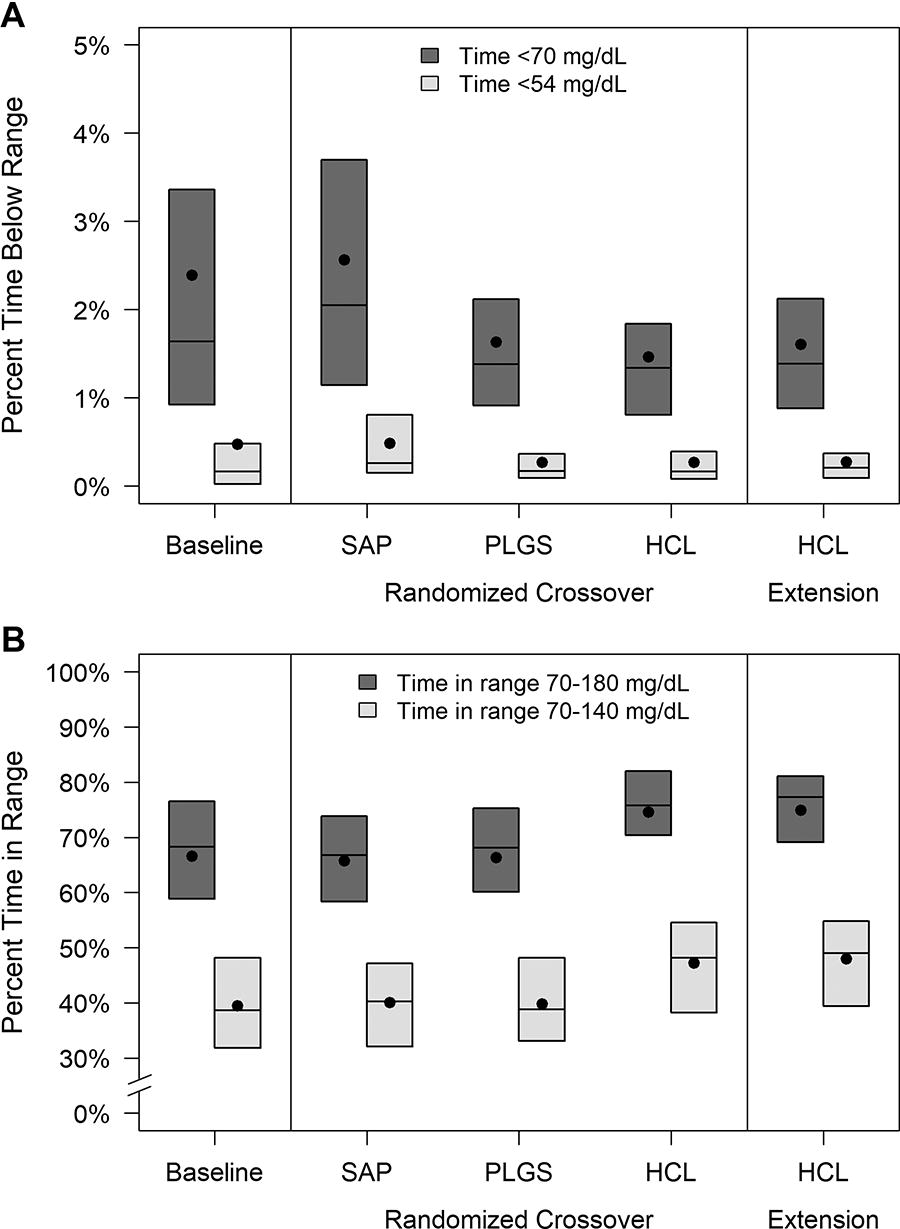
Time below range and time-in-range among participants who used HCL during the extension phase (N = 65). Panel A shows boxplots of percent time-below-range (<70 mg/dL and <54 mg/dL) and Panel B shows boxplots of percent time-in-range (70–180 mg/dL and 70–140 mg/dL). In each box, the black dot represents the mean, the horizontal line inside each box represents the median, and the bottom and top of each box represent the 25th and 75th percentiles, respectively.
Glycemic Outcomes Among Participants Who Used HCL During the Extension Phase
The first 4 weeks of CGM data in each period were excluded to reduce the chance of a carryover effect. Because the hypoglycemia endpoints had skewed distributions, values for these endpoints were winsorized at the 10th and 90th percentiles.
A hypoglycemic event is defined as 15 consecutive minutes with a sensor glucose value <54 mg/dL. At least two sensor values <54 mg/dL that are 15 or more minutes apart plus no intervening values ≥54 mg/dL are required to define an event. The end of the hypoglycemic event is defined as a minimum of 15 consecutive minutes with a sensor glucose concentration ≥70 mg/dL. At least two sensor values ≥70 mg/dL that are 15 or more minutes apart with no intervening values <70 mg/dL are required to define the end of an event. When a hypoglycemic event ends, the participant becomes eligible for a new event.
HCL, hybrid closed loop; SAP, sensor-augmented pump; PLGS, predictive low glucose suspend; CGM, continuous glucose monitoring.
The 5 participants completing the extension phase with PLGS also maintained glycemic outcomes with time <70 mg/dL of 1.85% ± 1.24% and time <54 mg/dL of 0.28% ± 0.23%. CGM-measured hypoglycemic events were 0.5 ± 0.5 per week. Mean glucose was 151 ± 12 mg/dL and time-in-range 70–180 mg/dL 74% ± 7%.
For the 65 patients completing the extension phase with HCL, PROs at the end of the extension phase were distributed similar to baseline: Gold Score Survey changed from 2.8 ± 1.7 to 2.5 ± 1.5, Hypoglycemia Fear Survey from 1.1 ± 0.6 to 0.9 ± 0.5, Hypoglycemia confidence scale from 3.3 ± 0.6 to 3.5 ± 0.5, and Diabetes Distress Scale from 1.7 ± 0.6 to 1.5 ± 0.5. For the 5 patients completing the extension phase with PLGS, PROs at the end of the extension phase were also distributed similar to baseline: Gold Score Survey changed from 3.6 ± 1.8 to 3.8 ± 2.4, Hypoglycemia Fear Survey from 0.9 ± 0.6 to 1.2 ± 1.0, Hypoglycemia confidence scale from 3.5 ± 0.5 to 3.4 ± 0.9, and Diabetes Distress Scale from 1.8 ± 0.7 to 1.5 ± 0.6.
One severe hypoglycemic event with loss of consciousness occurred during the extension phase in an HCL user. The occurrence of the severe hypoglycemic event was anticipated by the patient prior to her losing consciousness for about 4 min. CGM at the time of the loss of consciousness was about 60 mg/dL. Subsequently, she spontaneously regained consciousness and was provided caloric fluid. Emergency medical services (EMS) had been called by the family when the patient lost consciousness and came to the home to provide assistance. CGM signal indicated glucose in the 80s by the time EMS arrived. No further help was needed. No events of diabetic ketoacidosis were reported during the extension period.
Discussion
In this prespecified 3-month extension to the AIDE trial in older adults with T1D, the vast majority (91%) of participants chose to continue using the HCL system. Notably, only 8% of participants who participated in the extension chose the PLGS system. During the extension phase, glycemic control was similar to what had been achieved in the main RCT HCL phase and was also maintained in those who chose PLGS. Collectively, these results demonstrate that older adults with T1D can successfully use advanced automated insulin delivery to durably improve glycemic control and, when given a choice, strongly prefer HCL over other approaches.
There has been concern that older adults with T1D could find HCL insulin delivery overwhelming and therefore might prefer simpler approaches. Our results dispel this notion, at least in the patient population represented in this trial. Although we observed that participants needed somewhat more time to adopt safe and effective CGM and insulin pump and HCL use during the RCT, once they were familiar with the technology they strongly preferred the HCL system during the extension phase. This may be because they appreciated the better control and usability of the technology once they had developed confidence in it. During the extension phase, participants were provided with support comparable to what they might receive in clinical practice. In spite of this, they were able to effectively use the technology and maintain improved glycemic control. This suggests that our results are generalizable to clinical practice.
Current clinical practice guidelines suggest applying less stringent glycemic targets, including higher HbA1c levels, in older adults with T1D to minimize risk for hypoglycemia. 3 Our results demonstrate that HCL can enable older adults to achieve standard targets for glycemic control while reducing risk for hypoglycemia. To our knowledge, in the AIDE trial, HbA1c improved to the lowest that has been achieved safely in older adults with T1D. The current study extends the results of smaller prior studies and demonstrates the effectiveness and safety for a longer period of time in this vulnerable population. 4,5 We are encouraged by the fact that we achieved excellent glycemic control safely in older adults with T1D with the current HCL system.
Strengths of our study include the largest sample size of any trial to date of older adults with T1D. Moreover, the intensity of our support and monitoring was similar to clinical practice. Limitations include relatively short duration of observation. This may have limited our ability to detect any chances in cognitive function or PROs. Although our patients had comorbidities, in general, they were in reasonable health, without major cognitive impairment and independently functioning. Whether similar glycemic control and a lower risk of hypoglycemia can be achieved in a more impaired population of older adults with T1D remains to be determined. Studies of AID need to be undertaken in older adults with T1D and more advanced comorbidities, physical impairments and cognitive dysfunction.
In conclusion, we conducted a 3-month extension phase to the AIDE RCT, which demonstrated that older adults with T1D strongly preferred an HCL insulin delivery system when given a choice. Moreover, they were able to use the system to maintain improved glycemic control with minimal support after initial education and use of the system in the RCT phase. These results demonstrate that advanced automated insulin delivery is an effective and safe approach for the management of T1D in older adults and should be among the options offered to this group that has often been excluded from newer technology-based solutions.
Footnotes
Authors’ Contributions
Y.C.K.: Conceptualization, methodology, writing—original draft preparation. R.J.H.: Resources, project administration, writing—original draft preparation. L.G.K.: Formal analysis, writing—original draft preparation. K.J.: Resources, project administration, writing—review and editing. R.S.W., M.R.R., R.E.P., N.C., D.D., V.P., A.J.P., A.C., S.R.R., S.B., K.J.W., and J.L.J.K.: Investigation, writing—review and editing. K.M., C.K., and R.W.B. Supervision, writing—review and editing.
Author Disclosure Statement
Y.C.K. reports receiving research support from Dexcom Inc. and Tandem Inc., is on an advisory board for Novo Nordisk, USA, and has participated in multicenter clinical trials through his institution funded by Dexcom, Tandem, Medtronic, and Mannkind. R.S.W. reports receiving research support to their nonprofit employer from Tandem, Insulet, Eli Lilly, MannKind, Amgen, Diasome, Novo Nordisk, and study supplies at reduced rates from Dexcom. M.R.R. reports receiving research support from Tandem Diabetes Care. R.E.P. reports receiving the following (through December 31, 2023, directed to his institution; as of January 1, 2024, directed to R.E.P. personally): speaker fees from Lilly and Novo Nordisk; stock options from Altanine, Inc.; consulting fees from AbbVie Inc., AstraZeneca Pharmaceuticals LP, Bayer AG, Bayer HealthCare Pharmaceuticals, Inc., Boehringer Ingelheim Pharmaceuticals, Inc., Corcept Therapeutics Incorporated, Eli Lilly and Company, Endogenex, Inc., Gasherbrum Bio, Inc., Genprex, Getz Pharma, Hanmi Pharmaceutical Co., Intas Pharmaceuticals, Inc., Lexicon Pharmaceuticals, Lilly USA, Novo Nordisk, Pfizer, Regeneron, Rivus Pharmaceuticals Inc., Scholar Rock Inc., and Sun Pharmaceutical Industries; and grants from Biomea Fusion, Carmot Therapeutics, Dompe, Endogenex, Inc., Fractyl, Lilly, Novo Nordisk, and Sanofi. V.P. reports stock options in Tandem Diabetes Care and Dexcom. K.M. is now an employee of Insulet. R.W.B. reports no personal financial disclosures but reports that his institution has received funding on his behalf as follows: grant funding, study supplies, and consulting fees from Insulet, Tandem Diabetes Care, and Beta Bionics; grant funding and study supplies from Dexcom; grant funding from Bigfoot Biomedical, embecta, Sequel Med Tech, and MannKind; consulting fees and study supplies from Novo Nordisk; consulting fees from Vertex, Hagar, Ypsomed, Sanofi, and Zucara; and study supplies from Medtronic, Ascencia, Roche, and Eli Lilly. R.J.H., L.G.K., N.C., K.J., D.D., A.J.P., A.C., S.R.R., S.B., K.W., J.L.J.K., and C.K. report no disclosures.
Funding Information
Trial supported by the National Institute of Diabetes and Digestive and Kidney Diseases (grant number: R01 DK122603). Trial visits at the University of Pennsylvania were supported in part by the National Center for Advancing Translational Science (grant number: UL1 TR001878). Additional trial supplies provided by Tandem Diabetes Care and Dexcom.
Supplementary Material
Supplementary Figure S1
Supplementary Table S1
Supplementary Table S2