




Abstract
MDM2 is a phosphoprotein that interacts with p53 and inhibits its activity. Recently, a T to G substitution (SNP309) in the promoter of MDM2 was identified and associated with increased MDM2 expression and a significantly earlier age of onset of several tumors, including colorectal cancer. Several studies evaluated the association between SNP309 and colorectal cancer risk in diverse populations. However, the results remain conflicting rather than conclusive. To derive a more precise estimation of association between MDM2 SNP309 and risk of colorectal cancer, we performed a meta-analysis of 3347 colorectal cancer cases and 3102 controls from eight published case–control studies. We used odds ratios (ORs) with 95% confidence intervals (CIs) to assess the strength of the association. The results suggested that the variant genotype was associated with a significantly increased colorectal cancer risk (GT vs. TT: OR=1.19, 95% CI=1.06–1.35; p=0.005). In the stratified analyses, significantly increased risks were found among Asian populations (OR=1.28, 95% CI=1.10–1.50; p=0.002) and population-based studies (OR=1.18, 95% CI=1.03–1.34; p=0.016). Although some bias could not be eliminated, this meta-analysis suggested that the MDM2 SNP309 polymorphism is a low-penetrance risk factor for the development of colorectal cancer, particularly among Asians.
Introduction
Recently, Bond et al. (2004) identified a naturally occurring T to G polymorphism at nucleotide 309 in the MDM2 promoter (SNP309), which increased the expression of MDM2 mRNA eightfold and appeared to accelerate tumor formation among individuals carrying a germline TP53 mutation. Interestingly, amplification of MDM2 alone can enhance tumorigenesis (Lundgren et al., 1997), raising the possibility that the G allele of SNP309 may represent a cancer predisposing allele in its own right. Subsequent investigators have investigated the association between MDM2 SNP309 and colorectal cancer risk, but the results were inconclusive. This could be due to factors such as a relatively small sample size or that the effect of this polymorphism on colorectal cancer risk is too small to be detected in those populations. Therefore, we carried out a meta-analysis on all eligible case–control studies to estimate the overall colorectal cancer risk of MDM2 SNP309 polymorphism as well as to quantify the between-study heterogeneity and potential bias.
Materials and Methods
Identification and eligibility of relevant studies
Two investigators searched PubMed for all relevant articles (the last search was updated on May 21, 2011, using the search terms: “MDM2,” “SNP309,” “polymorphism,” and “colorectal cancer”). The search was limited to English-language papers. All eligible studies were retrieved, and their bibliographies were checked for other relevant publications that were not indexed by the PubMed database. When the same patient population was included in several publications, only the most recent or complete study was used in this meta-analysis. Studies included in our meta-analysis met the following criteria: (a) evaluation of the MDM2 SNP309 polymorphism and colorectal cancer risk, (b) case–control studies, and (c) genotype frequency available.
Data extraction
The investigators independently extracted data and reached a consensus on all of the items. For each study, the following data were considered: the first author's last name, year of publication, country of origin, ethnicity, numbers of genotyped cases and controls, and source of control groups (population- or hospital-based controls). Different ethnicities were categorized as European or Asian. For studies including subjects of different ethnic groups, data were separately extracted for each ethnic group whenever possible.
Statistical analysis
First, the observed genotype frequency of the SNP309 in the control group from each study was assessed for Hardy–Weinberg equilibrium using a goodness-of-fit chi-square test. The strength of the association between the SNP309 and colorectal cancer risk was measured by odds ratios (ORs) with 95% confidence intervals (CIs). Pooled estimates of the OR were obtained by calculating a weighted average of OR from each study (Breslow and Day, 1987). We first estimated the risks of the GG and GT genotypes on colorectal cancer, compared with the wild-type TT homozygote, and then evaluated the risks of GG/GT versus TT and GG versus GT/TT on colorectal cancer, assuming dominant and recessive effects of the variant G allele, respectively. To evaluate the ethnicity-specific effect, subgroup analyses were performed by ethnic group. In consideration of the possibility of heterogeneity across the studies, a statistical test for heterogeneity was performed based on the Q-test. The summary OR estimate of each study was calculated by the Mantel-Haenszel method model (Mantel and Haenszel, 1959) when the Q-test p-value was > 0.05, indicating a lack of heterogeneity among studies. Otherwise, the random-effects model was used (DerSimonian and Laird, 1986). Sensitivity analyses were performed to assess the stability of the results, namely, a single study in the meta-analysis was deleted each time to reflect the influence of the individual dataset to the pooled OR. Funnel plots and Egger's linear regression test were used to provide diagnosis of the potential publication bias (Egger et al., 1997). All analyses were done with Stata software (version 8.2; StataCorp LP, College Station, TX), using two-sided p-values.
Results
Characteristics of studies
There were 332 published papers relevant to the search terms (Fig. 1). Through the step of screening the title, 312 were excluded (142 were not on colorectal cancer, and 170 were not on polymorphisms). Abstracts from 20 papers were reviewed and an additional eight studies were excluded, leaving 12 studies for full publication review. Of these, four articles were excluded (two were reviews, one did not report usable data, and one was not case–control study). Finally, a total of eight eligible studies involving 3347 cases and 3102 controls were included in the pooled analyses (Alhopuro et al., 2005; Sotamaa et al., 2005; Menin et al., 2006; Alazzouzi et al., 2007; Talseth et al., 2007; Liu et al., 2008; Chen et al., 2009; Joshi et al., 2011). The characteristics of selected studies are summarized in Table 1. There were five studies of European and three studies of Asian populations. Colorectal cancers were confirmed by histology or pathology in most studies. In addition, controls were mainly matched on age, of which six were population-based and two were hospital-based. The distribution of genotypes in the controls of all studies was in agreement with Hardy–Weinberg equilibrium except for two studies (Alazzouzi et al., 2007; Chen et al., 2009).
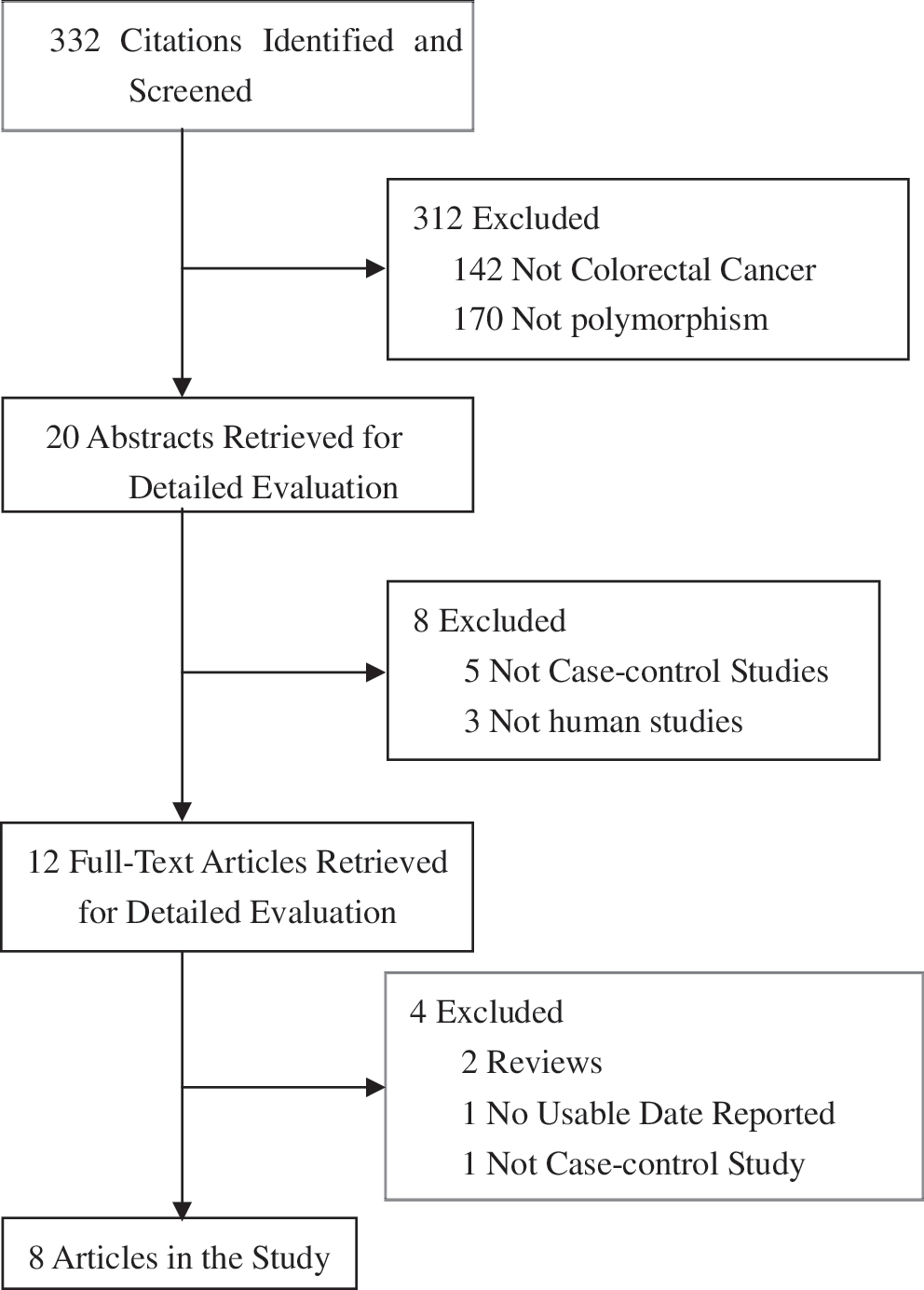
Identification of studies and their inclusion or exclusion.
HWE, Hardy–Weinberg equilibrium.
Quantitative synthesis
As shown in Table 2 and Figure 2, the variant heterozygote GT was associated with a significantly increased risk of colorectal cancer, compared with wild-type homozygote TT (OR=1.19; 95% CI=1.06–1.35). In the stratified analysis by ethnicity and source of controls, significantly increased risks were observed among Asian populations (OR=1.28, 95% CI=1.10–1.50 for GT vs. TT) and population-based studies (OR=1.18, 95% CI=1.03–1.34 for GT vs. TT).
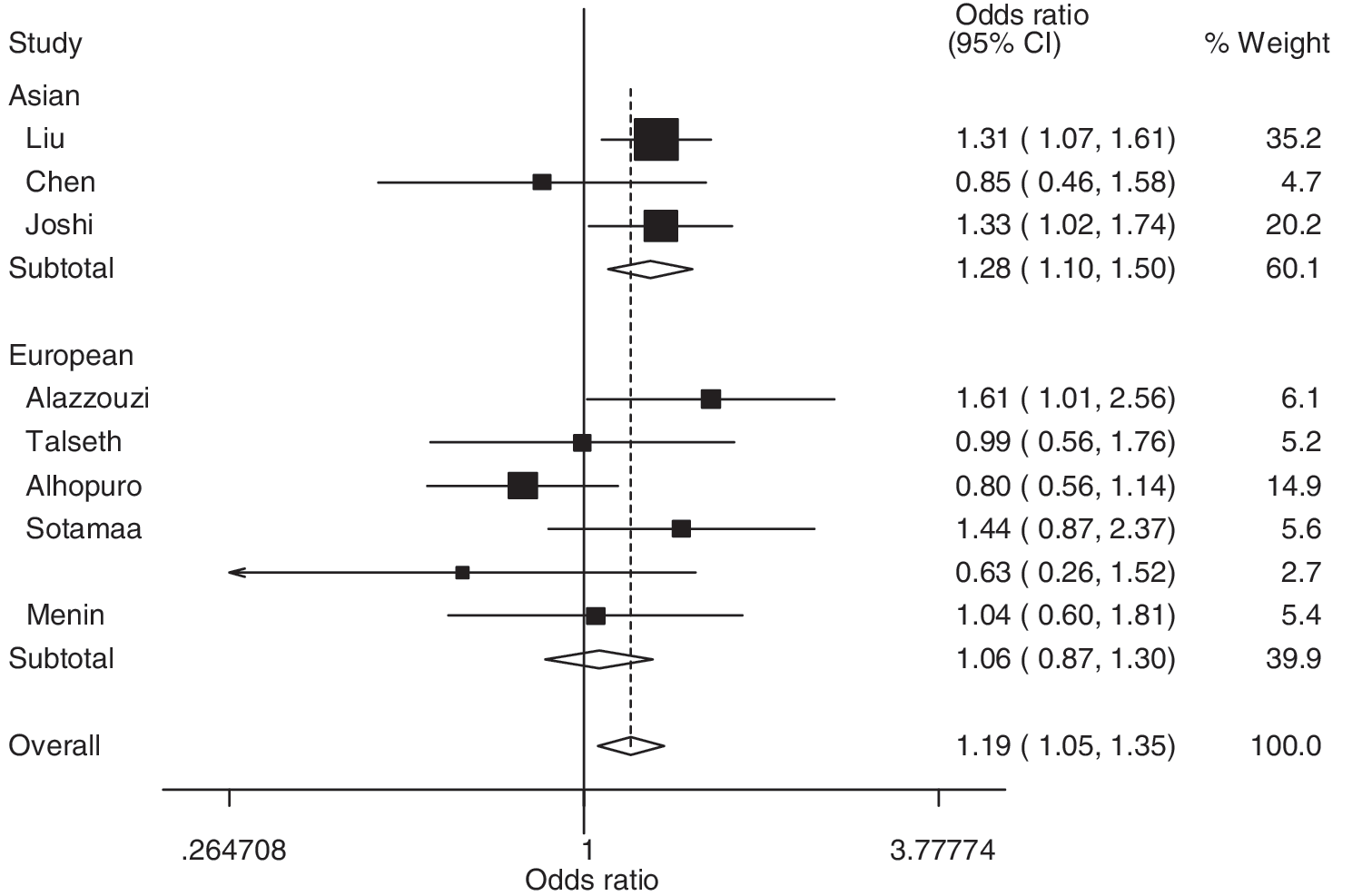
Forest plot of colorectal cancer risk associated with MDM2 SNP309 (GT vs. TT) among Asians and Europeans. The squares and horizontal lines correspond to the study-specific OR and 95% CI. The area of the squares reflects the study-specific weight (inverse of the variance). The diamond represents the summary OR and 95% CI. OR, odds ratio; CI, confidence interval.
Number of comparisons.
p-value of Q-test for heterogeneity test.
Random-effects model was used when p-value for heterogeneity test was <0.05; otherwise, fix-effects model was used.
OR, odds ratio; CI, confidence interval.
Heterogeneity and sensitivity analyses
Significant heterogeneity between studies was observed in overall comparisons except for heterozygote comparison (P heterogeneity=0.137, I 2=35.1% for GT vs. TT). Influence analysis was performed to assess the influence of each individual study on the pooled OR by sequential removal of individual studies. The results suggested that no individual study significantly affected the pooled ORs (Fig. 3).
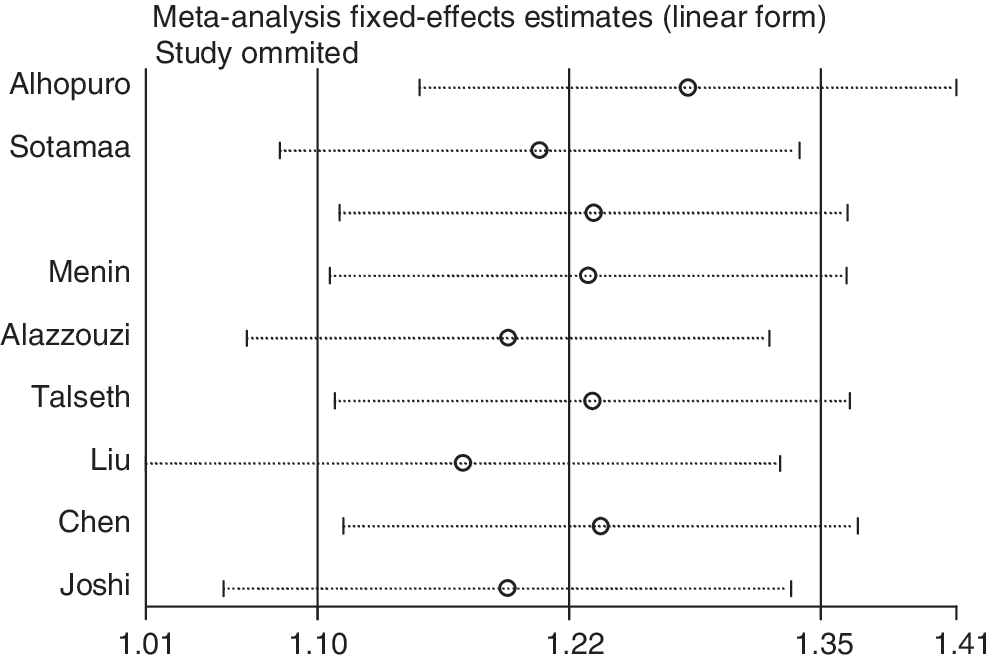
Influence analysis for GT vs. TT in the overall meta-analysis. This figure shows the influence of individual studies on the summary OR. The middle vertical axis indicates the overall OR and the two vertical axes indicate the pooled OR when the left study is omitted in this meta-analysis. The two ends of the dotted lines represent the 95% CI.
Publication bias
Begg's funnel plot and Egger's test were performed to assess the publication bias of included studies. As shown in Figure 4, the shapes of the funnel plots did not reveal any evidence of obvious asymmetry. Then, Egger's test was used to provide statistical evidence of funnel plot symmetry. The results still did not show any evidence of publication bias (t=−1.46, p=0.188 for GT vs. TT).
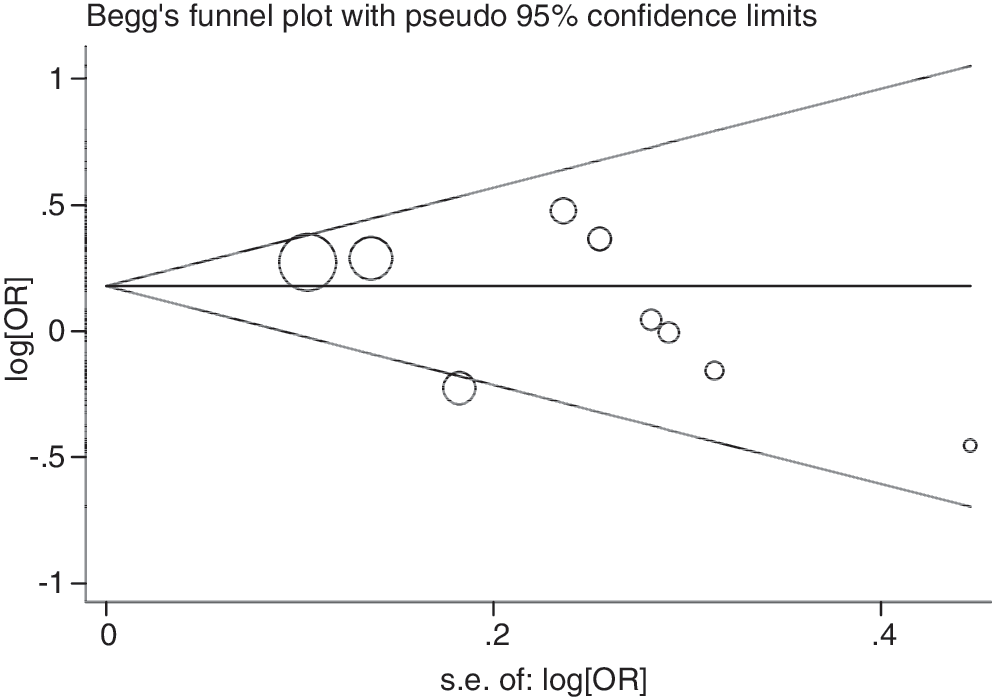
Begg's funnel plot for publication bias test (GT vs. TT). Each point represents a separate study for the indicated association. Log[or] is the natural logarithm of OR. Horizontal line indicates mean effect size.
Discussion
The present meta-analysis, including 3347 cases and 3102 controls from eight published case–control studies, explored the association between the potentially functional polymorphism SNP309 within the MDM2 promoter region and colorectal cancer risk. We found that the MDM2 GT variant genotype was associated with significantly increased risk of colorectal cancer. Given the important roles of MDM2 in the regulation of p53, it is biologically plausible that MDM2 polymorphism may modulate the risk of colorectal cancer.
MDM2 is one of the central nodes in the p53 pathway. The proper regulation of MDM2 levels has been shown to be vital for p53 tumor suppression, and even a modest change in levels could affect the p53 pathway and, subsequently, cancer development (Bond et al., 2005). Bond et al. (2004) demonstrated that T to G substitution at the 309th nucleotide (SNP309) extended the length of an existing DNA binding site for the Sp1 transcription factor, thereby increasing the affinity of Sp1 for the MDM2 promoter and resulting in MDM2 overexpression. Accordingly, the cell lines with the SNP309 GG and TG genotypes expressed higher levels of MDM2 than those with the TT genotypes, indicating that the G allele represents a significant factor in tumor development. The results of our meta-analysis were consistent with these experimental findings.
We found evidence for an association between SNP309 and colorectal cancer risk among Asians, but not among Europeans. Although the exact mechanism for this ethnic difference was not clear, a possible reason is difference in genetic backgrounds and environment (Hirschhorn et al., 2002). The G allele frequency among controls was 0.47 in Asians and 0.39 in Europeans, suggesting a possible ethnic difference. Other factors such as selection bias and different matching criteria may also play a role. In addition, there is no reported study using African populations and there are only two studies using Asian populations. Therefore, additional studies are warranted to further validate ethnic difference in the effect of this functional SNP on colorectal cancer risk, especially in Africans.
We also found that the association was significant among studies using population-based controls but not hospital-based controls. This may be because the hospital-based studies have inherent selection biases because of the fact that such controls may not be representative of the study population or the general population, particularly when the genotypes under investigation were associated with the disease-related conditions that hospital-based controls may have. Thus, the use of proper and representative population-based control subjects is very important in reducing biases in genotype association studies.
Some limitations of this meta-analysis should be addressed. First, lack of the original data of the reviewed studies limited our further evaluation of potential interactions, because the interactions between gene–gene or gene–environment interaction may modulate colorectal cancer risk. Second, misclassifications of disease status and genotypes may also influence the results, because cases in several studies were not adequately confirmed by pathology or other gold standard methods. However, our present meta-analysis also had some advantages. First, substantial numbers of cases and controls were pooled from different studies, which greatly increased the statistical power of the analysis. Second, the quality of case–control studies included in this meta-analysis was satisfactory according to our selection criteria.
In summary, this meta-analysis provided some evidence that MDM2 SNP309 was associated with an increased risk of colorectal cancer. As studies among Asians and Africans are currently limited, further studies including a wider spectrum of subjects should be carried out to investigate the role of this functional variant in other populations, which should lead to better, comprehensive understanding of the association between MDM2 SNP309 and colorectal cancer risk.
Footnotes
Disclosure Statement
The authors are fully responsible for all content and editorial decisions and did not receive financial support or other form of compensation related to the development of the manuscript. No competing financial interests exist.