




Abstract
We aimed to explore the role of allele A/G single nucleotide polymorphism (SNP) of gene Interleukin 10 (IL-10) promoter-1082 in the susceptibility to gastric cancer through a systematic review and meta-analysis. Each initially included article was scored for quality appraisal. Desirable data were extracted and registered into databases. Twenty studies were ultimately eligible for the meta-analysis of IL-10-1082 A/G SNP. We adopted the most probably appropriate genetic model (dominant model), with the combined group of GG-plus-GA genotypes compared with the AA genotype. Potential sources of heterogeneity were sought out via subgroup analyses and sensitivity analyses, and publication biases were estimated. Between IL-10-1082 GG-plus-GA genotypes with the risk of developing gastric cancer, statistically significant association could be noted with overall gastric cancer, being mainly in Asian subgroup, large sample subgroup, high quality subgroup, intestinal-type subgroup, cardia-type subgroup, and some genotyping method subgroups. Our meta-analysis indicates that IL-10-1082 GG-plus-GA genotypes are associated with the overall risk of developing gastric cancer and seem to be more susceptible to overall gastric cancer in Asian populations. IL-10-1082 GG-plus-GA genotypes are more associated with the pathologically intestinal-type gastric cancer or anatomically cardia-type gastric cancer.
Introduction
Lately, the promoter SNPs of IL-1β, a key proinflammatory interleukin (Hwang et al., 2002), associated with the gastric cancer risk have been extensively explored among different ethnicities. A recently published meta-analysis (Xue et al., 2010) found that both IL-1B −511 T allele and IL-1 RN *2 VNTR are significantly associated with an increased risk of developing gastric cancer and even more significantly with noncardia gastric cancer or with intestinal-type gastric cancer and that both are significantly associated with an increased risk of developing gastric carcinoma among Caucasians but not Asians or Hispanics, suggesting the discrepant genetic backgrounds among different ethnic populations.
Likewise, potential associations of SNPs of other interleukins with the risk of gastric cancer should also be quantitatively conducted via meta-analysis. IL-10 is a potent pleiotropic cytokine that has the dual ability to immunosuppress or immunostimulate anticancer properties (Mocellin et al., 2005). The human IL-10 gene, located on chromosome 1q31-32, consists of five exons and four introns. There are three frequently investigated SNPs of IL-10 gene, that is, at position −1082 A/G and −819 C/T SNPs in its proximal promoter region and at position −592 A/C SNP in its 5′-flanking region, but IL-10-1082 was mostly widely reported and −10-1082 G allele was found to be associated with increased IL-10 production (Turner et al., 1997). Correlated with altered IL-10 levels, functional IL-10-1082 polymorphism was suspected to influence cancer susceptibility by altered inflammatory responses (Seifart et al., 2005). Interestingly, the IL-10-1082 AA genotype was also reported to be significantly increased in prostate cancer patients and its action, together with vascular endothelial growth factor and IL-8, was suspected to possibly influence cancer angiogenesis (McCarron et al., 2002). Elevated levels of serum IL-10 were also reported in gastrointestinal carcinoma patients compared with healthy controls, with those patients with metastatic disease showing significantly higher levels than patients with undisseminated disease (De Vita et al., 1999). Thus, it could be presumed that specific IL-10-1082 SNP may predispose to gastric cancer through the elevated IL-10 expression.
Since the year 2002, a lot of studies have focused on the IL-10-1082 G allele association with the susceptibility to gastric cancer, but with mixed or conflicting results (Wu et al., 2002; El-Omar et al., 2003; Wu et al., 2003; Savage et al., 2004; Alpízar-Alpízar et al., 2005; Guo et al., 2005; Lee et al., 2005; Lu et al., 2005; Zambon et al., 2005; Kamangar et al., 2006; Morgan et al., 2006; García-González et al., 2007; Sugimoto et al., 2007; Bai et al., 2008; Crusius et al., 2008; Deng et al., 2008; Zhou, et al., 2008a; Kang et al., 2009; Ko et al., 2009; Xiao et al., 2009; Liu et al., 2011; Zhou et al., 2011). Up to now, there has been just one relevant published meta-analysis regarding IL-10-1082 A/G SNP (Zhou et al., 2008b). Unlike that meta-analysis, our meta-analysis adopted the most appropriate genetic model in an attempt to accurately illuminate the role of IL-10-1082 G allele in the risk of developing gastric cancer among the eligible studies.
Materials and Methods
Search strategy
A comprehensive literature review was conducted for the relationship between IL-10-1082 A/G SNP and gastric cancer risk. The MEDLINE, EMBASE databases, and Chinese National Knowledge Infrastructure were used simultaneously with English and/or Chinese key terms “Interleukin 10,” “IL-10,” “interleukin,” or “cytokine”; “gene”; “polymorphism,” “variant,” or “SNP”; and “gastric cancer,” “gastric carcinoma,” “diffuse gastric cancer,” or “stomach cancer” from 2000 to 2011. The scope of computerized literature search was expanded according to the lists of retrieved articles. The relevant original articles were also sought manually.
Study selection
Studies concerning the association of IL-10-1082 A/G SNP with the risk of developing gastric cancer were included if the following conditions were met: (i) articles in English or Chinese; (ii) study described the association of IL-10-1082 A/G SNP with gastric cancer; (iii) study reported the numbers of both controls and gastric cancer cases; (iv) results expressed as odds ratio (OR) with 95% confidence intervals (CIs); and (v) studies as case-control or nested case-control ones.
Methodological quality appraisal
To identify high quality studies, we mainly adopted predefined criteria for Quality Appraisal (Thakkinstian et al., 2005a; Camargo et al., 2006; Xue et al., 2010; Cui et al., 2011; Xue et al., 2011). The criteria (seen in Supplementary Table 1; Supplementary Data are available online at
Data extraction
The following data from each article were extracted: authors, year of publication, country, ethnicity of participants (categorized as Caucasians, Asians, Latinos, etc.), study design, source of controls, number of controls and of cases, genotyping method, distribution of age and gender, Lauren's classification (intestinal, diffuse, or mixed), and anatomic classification (cardia or noncardia cancer).
The extracted data registered into two databases independently were blind to two investigators (P. N. and H. X.) for journal names, institutions, or fund grants. Any discrepancy between the two investigators was resolved by the third one (H. Xue), who participated in the discussion with them and made an ultimate decision.
Statistical analysis
All statistical analyses were performed using STATA statistical software (Version 10.1; STATA Corp., College Station, TX). Two-sided p-values <0.05 were considered statistically significant.
Hardy-Weinberg equilibrium (HWE) in controls was calculated again in our meta-analysis. The chi-square goodness-of-fit was used to test deviation from HWE (significant at the 0.05 level).
ORs and 95% CIs were employed to assess the strength of associations between IL-10-1082 A/G SNP and gastric cancer risk. OR1, OR2, and OR3 regarding IL-10-1082 A/G SNP were calculated for genotypes GG versus AA, GA versus AA, and GG versus GA, respectively.
The above pairwise differences were used to determine the most appropriate genetic model. If OR1=OR2≠1 and OR3=1, a dominant model is implied. If OR1=OR3≠1 and OR2=1, a recessive model is suggested. If OR2=1/OR3≠1 and OR1=1, a complete overdominant model is suggested. If OR1>OR2>1 and OR1>OR3>1, or OR1<OR2<1 and OR1<OR3<1, a codominant model is indicated (Thakkinstian et al., 2005b). If a dominant model was indicated, the original grouping was collapsed and the combined group of GG-plus-GA genotypes was compared with the AA genotype; if a recessive model was suggested, the GG genotype was compared with the combined group of GA-plus-AA genotypes; if a complete overdominant model was implied, the combined group of GG-plus-AA genotypes was compared with the GA genotype; or if a codominant model was insinuated, the GG genotype was compared with the GA genotype and with the AA genotype, respectively.
The Q statistic was used to test for heterogeneity among the studies included in the meta-analysis. A fixed-effects model, using Mantel–Haenszel (M-H) method, was used to calculate the pooled ORs when homogeneity existed on the basis of Q-test p-value no less than 0.1. By contrast, a random-effects model, using DerSimonian and Laird method (D+L), was utilized if there was heterogeneity based on Q-test p-value less than 0.1. The significance of pooled ORs was tested by Z-test (p<0.05 was considered significant).
Sensitivity analysis was performed, in which the meta-analysis estimates were computed after every one study being omitted in each turn. Included studies, if deviated from HWE, should be tested for the influence on results when those deviated-from-HWE studies were all removed from the meta-analysis.
Finally, publication bias was assessed by performing funnel plots qualitatively, and estimated by Begg's and Egger's tests quantitatively.
Results
Literature search and study selection
After comprehensive searching, a total of 235 articles in English and 8 in Chinese were retrieved. Twenty-two studies (Wu et al., 2002; Wu et al., 2003; El-Omar et al., 2003; Savage et al., 2004; Alpízar-Alpízar et al., 2005; Guo et al., 2005; Lee et al., 2005; Lu et al., 2005; Zambon et al., 2005; Kamangar et al., 2006; Morgan et al., 2006; García-González et al., 2007; Sugimoto et al., 2007; Bai et al., 2008; Crusius et al., 2008; Deng et al., 2008; Zhou et al., 2008a; Kang et al., 2009; Ko et al., 2009; Xiao et al., 2009; Liu et al., 2011; Zhou et al., 2011) were initially included in our meta-analysis. Those 22 studies were preliminarily appropriate to the meta-analysis of the associations with gastric cancer regarding IL-10-1082 A/G SNP. Two studies (Bai et al., 2008; Zhou et al., 2008a) were eliminated finally because they both only described the number of combined group GG-plus-GA rather than the number of genotype GG and the number of genotype GA, respectively; and no responses could be gotten after having sought the relevant data via email contacts. Besides, eight studies (Wu et al., 2003; Savage et al., 2004; Guo et al., 2005; Lu et al., 2005; Crusius et al., 2008; Deng et al., 2008; Liu et al., 2011; Zhou et al., 2011) were deviated from HWE. Generally speaking, any study that deviated from HWE through our calculation should have been removed; however, considering that the numbers of participants in those studies were large and given that sensitivity analyses would be conducted, we remained those studies in our meta-analysis. Minelli et al. stated that studies appearing to deviate from HWE should be included and examined further rather than just excluded unless there are other convincing reasons for doubting the quality of those studies (Minelli et al., 2008). Thus, 20 studies (Wu et al., 2002; El-Omar et al., 2003; Wu et al., 2003; Savage et al., 2004; Alpízar-Alpízar et al., 2005; Guo et al., 2005; Lee et al., 2005; Lu et al., 2005; Zambon et al., 2005; Kamangar et al., 2006; Morgan et al., 2006; García-González et al., 2007; Sugimoto et al., 2007; Crusius et al., 2008; Deng et al., 2008; Kang et al., 2009; Ko et al., 2009; Xiao et al., 2009; Liu et al., 2011; Zhou et al., 2011) with a total of 6431 controls and 3631 cases were ultimately eligible for the meta-analysis of IL-10-1082 A/G SNP. The corresponding characteristics were seen in Table 1. The flow chart of literature search and study selection was illuminated in Figure 1.
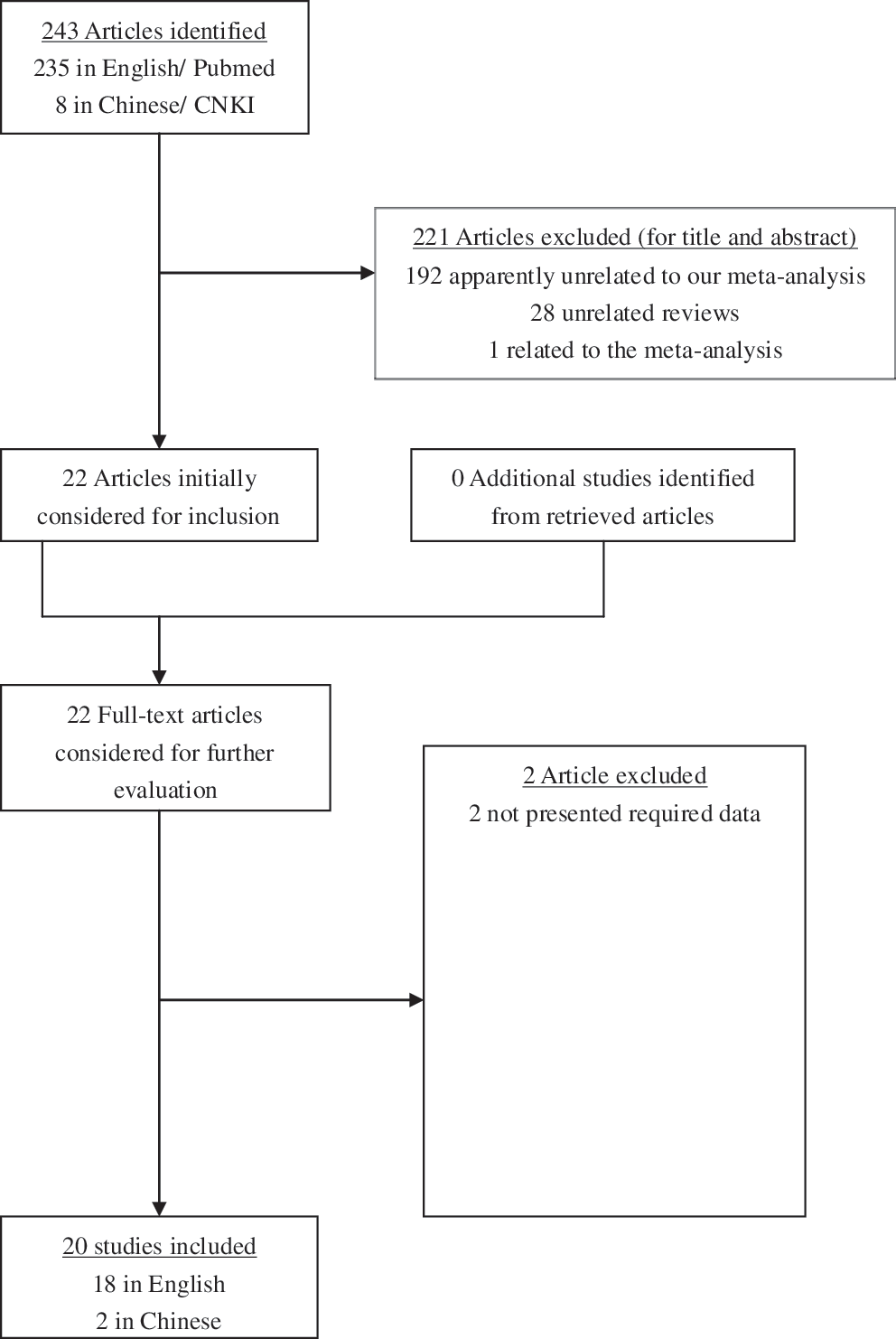
The flow chart of literature search and study selection.
Data of cardia-type gastric cancer were accessible.
Data of noncardia-type gastric cancer were accessible.
Data of intestinal-type gastric cancer were accessible.
Data of the status of Helicobacter pylori of gastric cancer were accessible.
Data of sporadic diffuse-type gastric cancer were accessible.
RFLP, restriction fragment length polymorphism; PCR, polymerase chain reaction; DHPLC, PCR-based denaturing high-performance liquid chromatography; TaqMan, TaqMan PCR method; Direct sequencing, method of methylation analysis using bisulfite-treated DNA utilized PCR and standard dideoxynucleotide DNA sequencing to directly determine the nucleotide resistant to bisulfite conversion; MGBEclipse, MGBEclipse Assay PCR method; Snapshot, the Snapshot assay that provides detection of certain SNPs; Pyrosequencing, a method of DNA sequencing (determining the order of nucleotides in DNA) based on the “sequencing by synthesis” principle. It differs from Sanger sequencing, in that it relies on the detection of pyrophosphate release on nucleotide incorporation, rather than chain termination with dideoxynucleotides; ASP, the allele-specific primer PCR (ASP-PCR) method; SNP, single nucleotide polymorphism.
Overall meta-analysis and subgroup analyses
OR1 (p-value), OR2 (p-value), and OR3 (p-value) of IL-10-1082 A/G SNP were 1.45 (p=0.042), 1.41 (p=0.004), and 1.12 (p=0.544), respectively, suggesting a dominant model effect of putative susceptible G allele (OR1=OR2≠1 and OR3=1). We divided the included studies into Caucasian study, Asian study, and Latino study according to the ethnicity of participants to further confirm our preliminary choice of the most possible genetic model. For Asian study, OR1 (p-value), OR2 (p-value), and OR3 (p-value) of L-10-1082 A/G SNP were 2.27 (p=0.009), 1.79 (p=0.000), and 1.29 (p=0.509), respectively, highly indicating a dominant effect of putative susceptible G allele. Thus, the dominant genetic model of susceptible G allele was finally chosen in all our meta-analyses. Thus, the combined group of GG-plus-GA genotypes was compared with the AA genotype. As in Figure 2, for overall gastric cancer a statistically significant finding could be observed from the fact that the pooled OR (95% CI, p-value) was 1.41 (1.13–1.76, p=0.002). Statistically significant findings were apparently found in Asians but not in Caucasians. The pooled ORs (95% CIs, p-value) in Asians and in Caucasians were 1.81 (1.44–2.27, p=0.000) and 1.01 (0.77–1.33, p=0.926), respectively. The pooled OR in Latinos (Alpízar-Alpízar et al., 2005; Morgan et al., 2006) was 0.67 (0.43–1.06, p=0.087), seeming a reverse association trend but the difference was not significant.
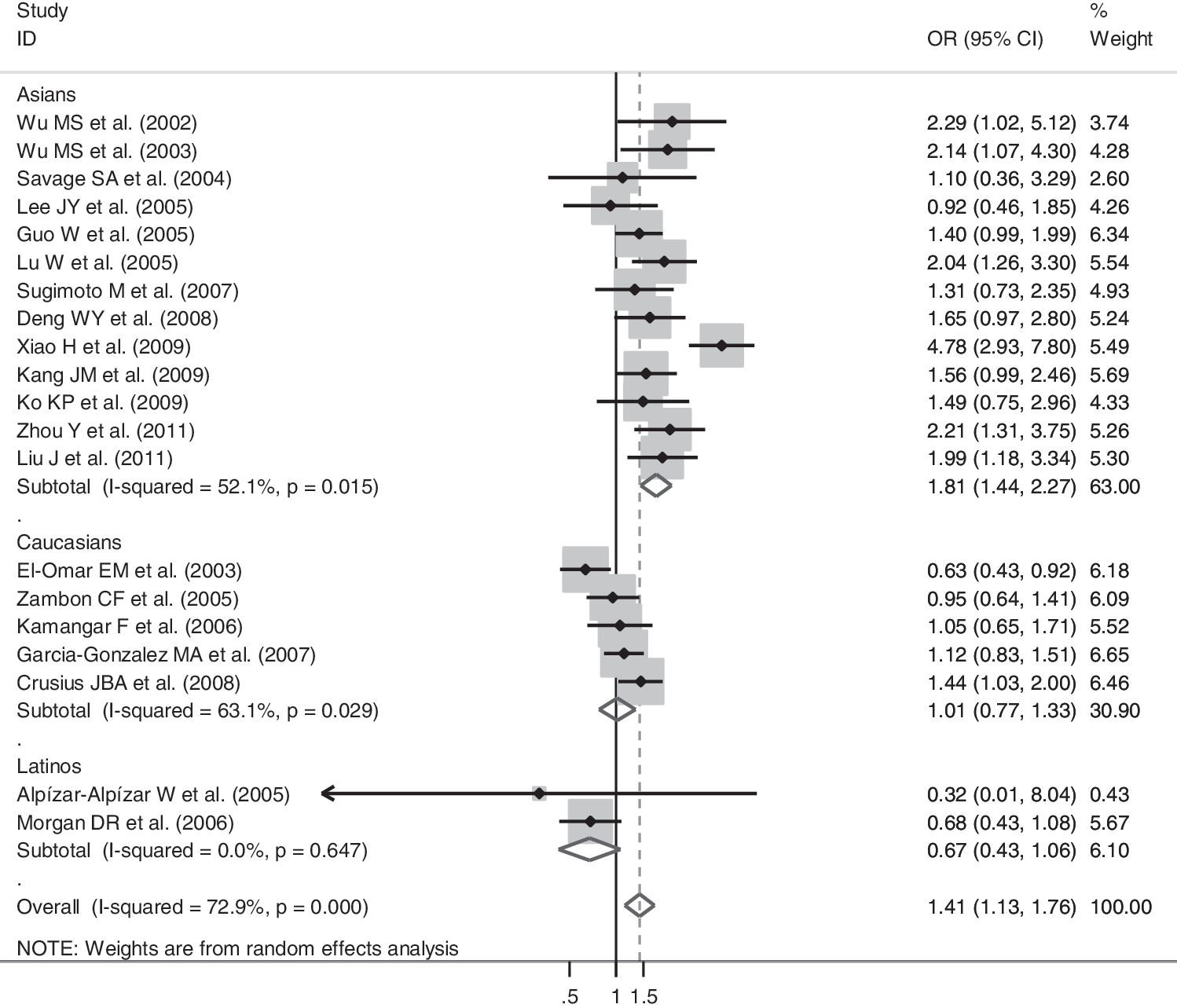
Odds ratios (ORs) for associations between IL-10-1082 A/G SNP and gastric cancer risk (the combined group of GG-plus-GA genotypes was compared with the AA genotype) in all ethnicities and among different ethnicities, in order of increasing publication year, 2002–2011. Studies were entered into the meta-analysis sequentially by year of publication. The sizes of the squares indicate the relative weight of each study. Weights were derived from random-effects analysis. Bars, 95% CI. SNP, single nucleotide polymorphism; CI, confidence interval.
As shown in Table 2, on the basis of sample size, the included studies were divided into two subgroups: large sample (the total number of controls and cases not less than 400) and small-and-moderate sample (the total number of controls and cases less than 400) subgroups. Statistically significant finding was noted in large sample subgroup but not in small-and-moderate sample counterpart, given that the pooled ORs (95% CIs, p-value) were 1.50 (1.10–2.03, p=0.010) for the former and 1.29 (0.95–1.75, p=0.098) for the latter.
M-H ORs (95% CIs), otherwise D+L ORs (95% CIs).
p-Values of M-H estimates, otherwise p-values of D+L estimates.
OR, odds ratio; CI, confidence interval.
The included studies were also divided, in accordance with the quality appraisal scores, into high quality (scores no less than 6.5) and low-and-moderate quality (scores less than 6.5) subgroups. Statistically significant findings were witnessed in both high quality subgroup and in low-and-moderate quality counterpart, given that the pooled ORs (95% CIs, p-value) were 1.49 (1.09–2.05, p=0.013) for the former and 1.26 (1.00–1.58, p=0.049) for the latter.
The included studies were further divided, in line with publication time, into the earlier publication subgroup (articles published prior to or in 2005) and the later publication subgroup (articles published after 2005). A statistically significant finding was observed in the later publication subgroup but not in the earlier on the grounds that the pooled ORs (95% CIs, p-value) were 1.53 (1.15–2.04, p=0.004) in the former and 1.25 (0.88–1.75, p=0.209) in the latter.
When gastric cancers were classified into noncardia (or distal) and cardia subtypes, a statistically significant finding was noted among cardia subtype but not among noncardia subtype on the grounds that the pooled ORs (95% CIs, p-value) were 1.38 (1.11–1.72, p=0.004) among cardia type and 1.12 (0.80–1.58, p=0.514) among noncardia subtype.
In terms of pathology, gastric cancer could be classified into intestinal, diffuse, or mixed subtypes, and a statistically significant finding was observed in intestinal-type cancer but not in diffuse-type cancer, for the pooled ORs (95% CIs, p-value) were 1.33 (1.04–1.71, p=0.024) in the former and 1.53 (0.73–3.21, p=0.260) in the latter.
In terms of H. pylori infection status, two studies provided the detailed data on positive H. pylori infection cases versus negative H. pylori infection controls and the pooled OR (95% CI, p-value) was 2.82 (0.38–20.68, p=0.309).
And when genotyping techniques were considered, no statistically significant finding was noted in TaqMan/MGBEclipse subgroup or Snapshot subgroup, whereas statistically significant findings were observed in PCR-RFLP and Direct genotyping technique subgroups, respectively. Pooled ORs (95% CIs, p-value) were 0.88 (0.69–1.11, p=0.276) in TaqMan/MGBEclipse subgroup, 1.89 (1.25–2.88, p=0.003) in PCR-RFLP subgroup, 1.91 (1.31–2.77, p=0.001) in Direct subgroup, and 1.37 (0.76–2.45, p=0.296) in Snapshot subgroup.
Sensitivity analysis
Meta-analyses were conducted repeatedly when each particular study had been removed. The results indicated that fixed-effects estimates and/or random-effects estimates before and after the deletion of each study were similar at large, suggesting high stability of the meta-analysis results. As shown in Figure 3, the most influencing single study on the overall pooled estimates seemed to be the study conducted by Xiao et al. (2009); the sensitivity analysis, however, indicated high stability of the results from the facts that the ORs (95% CIs, p-value) were 1.41 (1.13–1.76, p=0.002) before the removal of that study and 1.30 (1.09–1.56, p=0.004) after the removal of that study. When studies deviated from HWE were all removed, the overall OR (95% CI, p-value) became 1.23 (0.88–1.72, p=0.217), indicating low stability of the results for overall ethnicity; however, for Asians, the ORs (95% CIs, p-value) were 1.81 (1.44–2.27, p=0.000) before the removal of those studies and 1.80 (1.09–2.96, p=0.021) after the removal of those studies, still indicating high stability of the results for Asians.
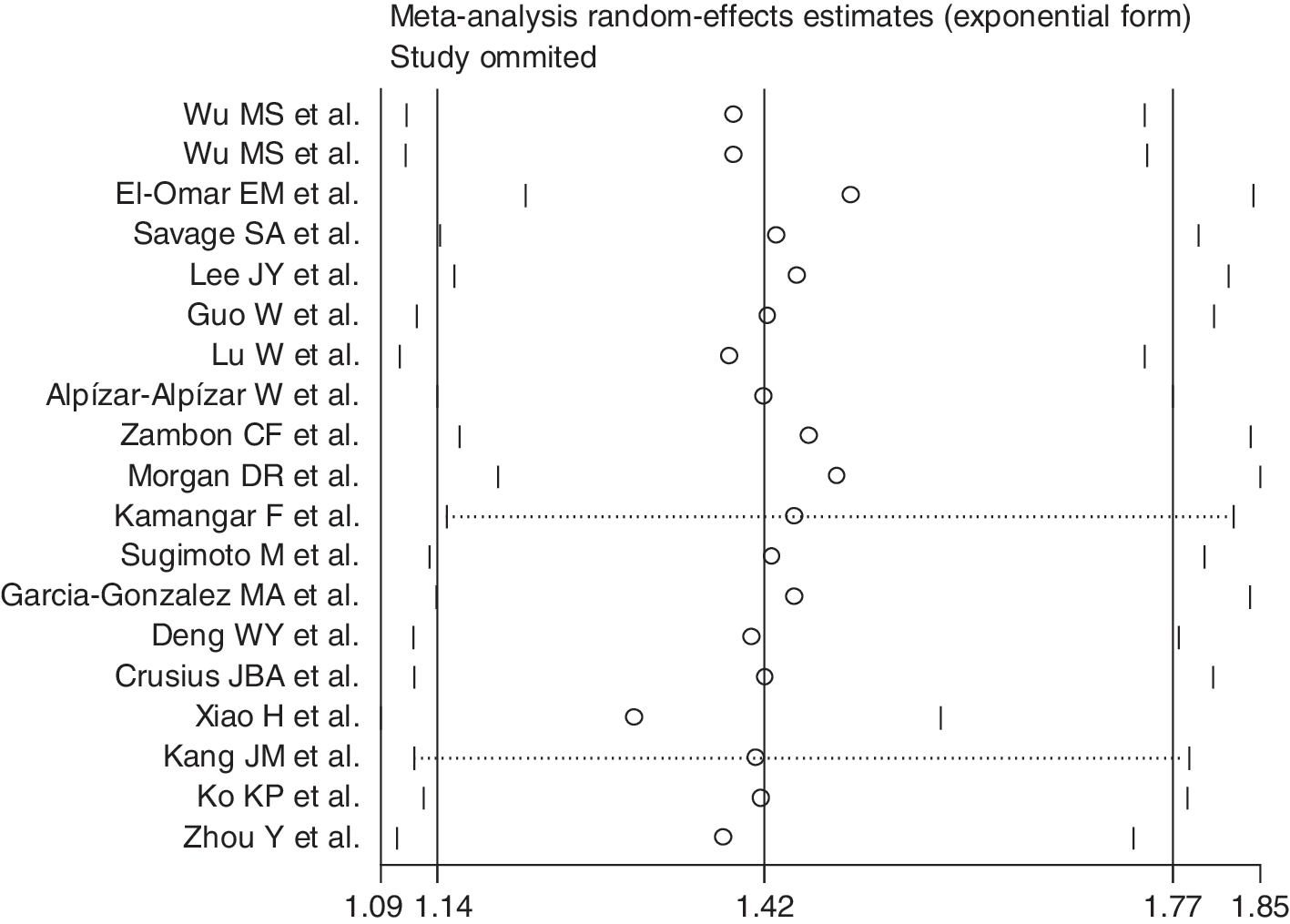
Influence analysis of the summary odds ratio coefficients on the association for the IL-10-1082 A/G SNP with gastric cancer risk (the combined group of GG-plus-GA genotypes was compared with the AA genotype). Results were computed by omitting each study (on the bottom) in turn. Bars, 95% confidence interval. Meta-analysis random-effects estimates (exponential form) were used.
Cumulative meta-analysis
Cumulative meta-analyses of IL-10-1082 A/G SNP association were also conducted among Asians (Fig. 4A) and among Caucasians (Fig. 4B) via the assortment of total number of sample size. As shown in Figure 4A, the inclination, though slightly undulated, toward significant associations with overall gastric cancer was obviously seen among Asians, whereas in Figure 4B, the tendency toward insignificant associations with overall gastric cancer was apparently observed among Caucasians.
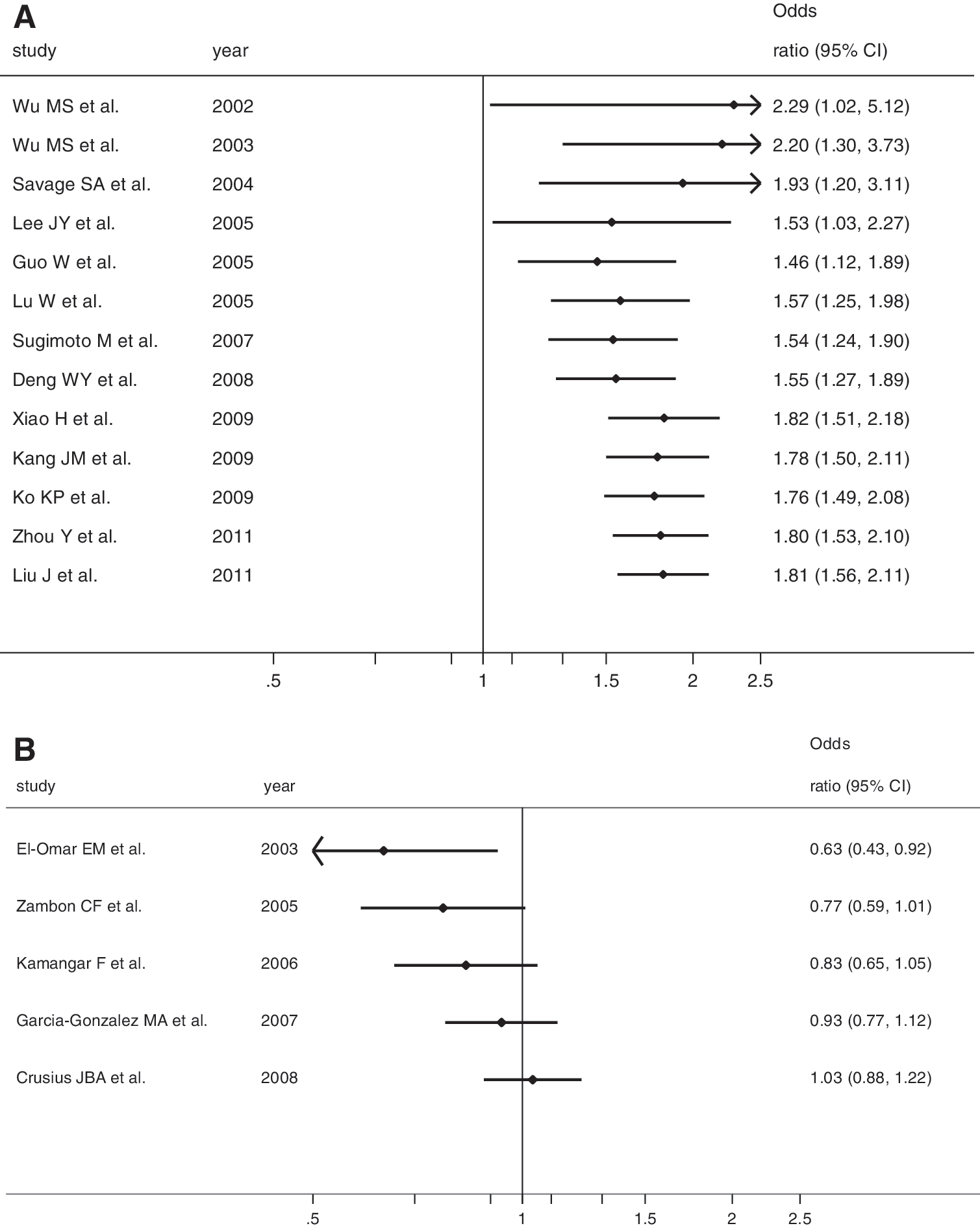
Cumulative meta-analysis of associations between the IL-10-1082 A/G SNP and gastric cancer risk (the combined group of GG-plus-GA genotypes was compared with the AA genotype) among different ethnicities sorted by total number of sample size. Horizontal line: the accumulation of estimates as each study was added rather than the estimate of a single study.
Publication bias analysis
Publication bias was preliminarily examined by funnel plots qualitatively and estimated by Begg's and Egger's tests quantitatively. Its funnel plot (Fig. 5) showed that dots were nearly symmetrically distributed, predominantly within pseudo 95% confidence limits. p-Values were 0.327 in Begg's test and were 0.249 in Egger's test, also insinuating no publication bias.
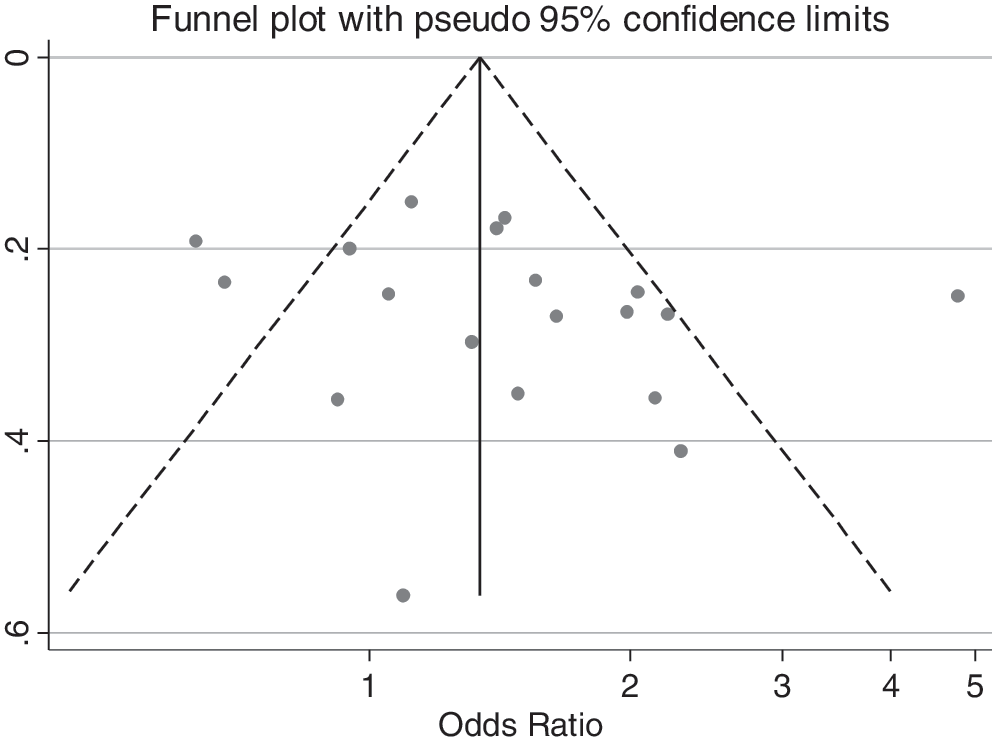
Funnel plot of publication bias for IL-10-1082 A/G SNP with gastric cancer risk (the combined group of GG-plus-GA genotypes was compared with the AA genotype). Note: Funnel plot with pseudo 95% confidence limits was used.
Discussion
In our meta-analysis, a statistically significant finding could be noted with the overall risk of developing gastric cancer and it was more apparently noted in Asians but not in Caucasians (GG-plus-GA vs. AA). Based on the findings of cumulative meta-analyses, the inclinations toward significant associations in Asians could be obviously seen when sorted by total sample size (GG-plus-GA vs. AA). The IL-10-1082 GG-plus-GA genotypes may seem to be more susceptible to gastric cancer in Asians. The differential influence of the IL-10-1082 polymorphisms on the risk of gastric cancer in Asians and Caucasians should be further investigated and reconfirmed in the future (Cui et al., 2011).
Our subgroup analyses also indicate that significant associations could be found in the large sample subgroup but not in the small-and-moderate sample counterpart (GG-plus-GA vs. AA). In large sample subgroup the influences of ORs in the studies conducted by Xiao et al. (2009), Wu et al. (2003), and Lu et al. (2005) are all strong enough (4.78, 2.14, and 2.04, respectively) to make the overall OR at a significant value (1.50), whereas in small-and-moderate sample subgroup the ORs are averagely distributed around 1, and the influence of OR in the study conducted by Wu et al. (2002) is not so strong (2.29), thus the overall OR being at the insignificant value (1.29). A statistically significant finding was also witnessed in high quality subgroup but not in low-and-moderate quality counterpart (GG-plus-GA vs. AA). It is natural that high quality studies should be designed in the future in order to accurately explore the real associations between IL-10-1082 SNP and gastric cancer.
Additionally, 7 (El-Omar et al., 2003; Zambon et al., 2005; Kamangar et al., 2006; García-González et al., 2007; Crusius et al., 2008; Deng et al., 2008; Zhou et al., 2011) out of 18 eligible studies were dealt with anatomically noncardia gastric cancer and 6 (El-Omar et al., 2003; Savage et al., 2004; Guo et al., 2005; García-González et al., 2007; Crusius et al., 2008; Zhou et al., 2011) with cardia gastric cancer. A statistically significant finding could be noted in cardia gastric cancer. Likewise, four studies (Kamangar et al., 2006; García-González et al., 2007; Kang et al., 2009; Zhou et al., 2011) in our meta-analysis were dealt with pathologically intestinal-type gastric cancer and 3 (García-González et al., 2007; Kang et al., 2009; Zhou et al., 2011) out of 18 studies were dealt with pathologically sporadic diffuse-type gastric cancer. A statistically significant finding could be noted in intestinal-type but not in sporadic diffuse-type cancer (GG-plus-GA vs. AA). As is known, cardia-type gastric cancer differs from noncardia-type gastric cancer in etiology, pathology, carcinogenesis, and/or prognosis (Heidl et al., 1993; Kim et al., 2005; Saito et al., 2006), so is intestinal-type cancer versus sporadic diffuse-type cancer. It could be said that the indiscriminate combination of cardia-type and noncardia-type cases or intestinal-type and diffuse-type cases in the majority of eligible studies may mask or at least underestimate the strength of the real associations (Xue et al., 2010, 2011; Cui et al., 2011).
With the coming of sophisticated genotyping technologies like seminested polymerase chain reaction, TaqMan allelic discrimination test, or real-time PCR, we may witness an upsurge of genetic association studies in the future (Xue et al., 2010, 2011; Cui et al., 2011). In our meta-analysis, no statistically significant finding was noted in TaqMan/MGBEclipse subgroup or Snapshot subgroup, whereas statistically significant findings were observed in PCR-RFLP and Direct genotyping subgroups, respectively. The difference should be concerned with great caution. We propose that the sensitivity and specificity of those genotyping techniques need to be further explored in order to seek out the optimal approaches that could minimize the genotyping errors.
Finally, the strength of our meta-analysis could be summarized as follows. We sought to find as many publications as we could by means of various searching approaches. We laid more emphasis on assessing biases across studies and pinpointing the potential sources of heterogeneity via stratification, and sensitivity analyses. We comprehensively assessed the publication biases using several means like Begg's and Egger's tests as well as funnel plot tests. In view of this, we convince that the results of our meta-analysis, in essence, are sound and reliable.
In conclusion, IL-10-1082 G allele is associated with the overall risk of developing gastric cancer and may seem to be more susceptible to overall gastric cancer in Asian populations. IL-10-1082 G allele is more associated with the intestinal-type gastric cancer or cardia gastric cancer.
Footnotes
Acknowledgments
This work was supported by the National Science Foundation of China (Grant No. 30873057) and the Key Basic Project of Shanghai Municipal Science and Technology Commission (No. 08JC1413600).
Disclosure Statement
No competing financial interests exist.
References
Supplementary Material
Please find the following supplemental material available below.
For Open Access articles published under a Creative Commons License, all supplemental material carries the same license as the article it is associated with.
For non-Open Access articles published, all supplemental material carries a non-exclusive license, and permission requests for re-use of supplemental material or any part of supplemental material shall be sent directly to the copyright owner as specified in the copyright notice associated with the article.
