




Abstract
NBS1 plays an important role in the maintenance of genomic integrity, by being involved in cellular response to DNA damage. The NBS1 rs1805794 G>C polymorphism has been investigated in several studies, but its function still remains unclear due to some controversial results. The present work aimed to evaluate the role of this polymorphism in prostate cancer progression, by performing a case–control study comparing 239 patients who were diagnosed with early disease to 186 who presented advanced disease. We also assessed NBS1 mRNA expression among the different groups by quantitative real time (qRT)–polymerase chain reaction. We found that the GG carriers presented an almost two fold increased risk for advanced prostate disease (odds ratio [OR]=1.87; confidence interval [CI]=1.26–2.79; p=0.002). Further, high tumor grade (OR=3.02; CI=2.32–3.92; p<0.001) and high serum prostate specific antigen (PSA) (OR=6.48; CI=4.48–9.38; p<0.001) were consistently associated to advanced disease. Regarding NBS1 mRNA expression, we did not find any association with the different outcomes nor genotypes (p=0.926; p=0.894, respectively). Our results suggest for the first time that rs1805794 GG genotype appears to be associated with a higher risk for advanced prostate cancer, thus, suggesting a possible new role for NBS1 in prostate cancer progression.
Introduction
Tumor microenvironment has been widely proposed to be an important area of investigation, consisting of interaction between the tumor and the host properties, like genetic polymorphisms (Medeiros et al., 2002; Teixeira et al., 2008; Pereira et al., 2010; Sousa et al., 2011). Some polymorphisms in NBS1 have been reported, the rs1805794 G>C being one of the most explored. This single-nucleotide polymorphism is located within the BRCT domain and has been associated with several types of cancer, with the results, however, being conflicting (Medina et al., 2003; Lan et al., 2005; Lu et al., 2006; Margulis et al., 2008; Sobti et al., 2008; Huang et al., 2011).
The goal of this study was to evaluate a possible role for the NBS1 in prostate cancer progression. We determined the allelic frequencies of the rs1805794 G>C polymorphism in a series of prostate cancer cases to predict its relation with different prognostic factors. We also measured NBS1 mRNA expression with the purpose of studying its association with different parameters. To our knowledge, this is the first study to investigate a possible association between the rs1805794 G>C polymorphism and the risk of advanced prostate cancer, and its relation with NBS1 mRNA expression.
Materials and Methods
Population
This study includes 425 Caucasian patients with histopathologically diagnosed prostate cancer, recruited from February 2009 to January 2010 at the Portuguese Institute of Oncology of Porto, with a mean age of 68.2±7.8. Patients distribution according to the stage at the time of diagnosis was 56.2% presenting early prostate disease (stages I and II), and 43.8% with advanced disease (stages III and IV), according to the International Union Against Cancer TNM classification of malignant tumors. All samples were taken after informed consent according to the Declaration of Helsinki.
Sample collection and DNA extraction
A venous blood sample (8 mL) was collected with a standard venipuncture technique. DNA was then extracted from the white blood cells fraction from each individual (Mullenbach et al., 1989).
rs1805794 G>C polymorphism genotyping
The rs1805794 G>C polymorphism was analyzed through polymerase chain reaction (PCR) followed by restriction fragment length polymorphism, as previously described (Medina et al., 2003). The PCR was performed in a final volume of 50 μL, containing rs1805794 G>C primers (forward: 5′-GGATGTAAACAGCCTCTTTG-3′; reverse: 5′-CACAGCAACTATTACATCCT-3′), 1.5 U Taq Polymerase, 2 mM MgCl2, 0.4 μM dNTPs and 60 ng DNA.
PCR products (290 bp) were incubated overnight with HinfI restriction endonuclease, at 37°C. The restricted fragments were then separated by electrophoresis on 3% agarose gels stained with ethidium bromide. The polymorphism was defined by the presence (G) or absence (C) of an additional restriction site (Fig. 1).
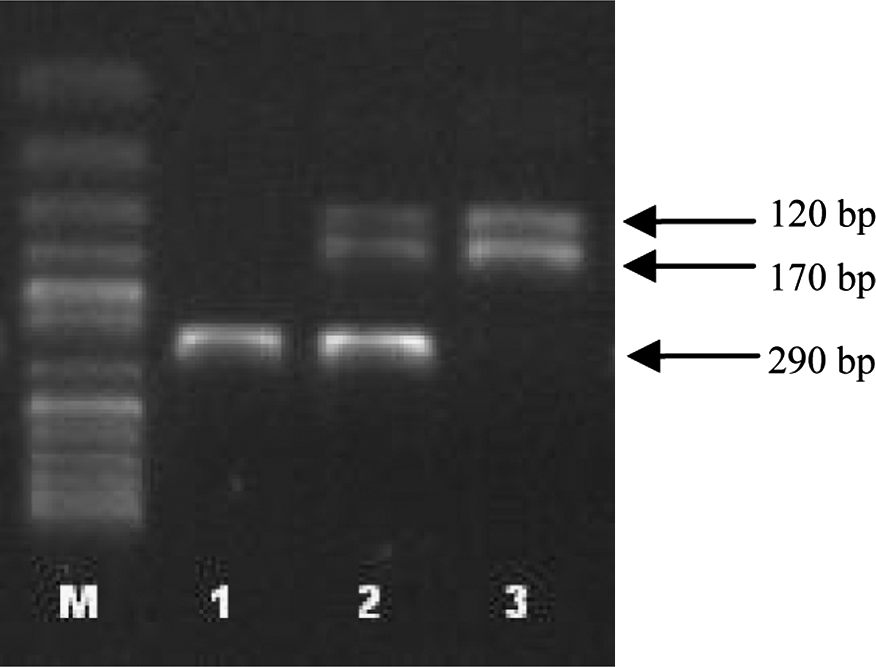
Detection of rs1805794 G>C polymorphism by polymerase chain reaction–restriction fragment length polymorphism method. M, 50 bp DNA ladder; 1, homozygous CC genotype; 2, heterozygous GC genotype; 3, homozygous GG genotype.
Quality control procedures implemented for the NBS1 genotype analyses included double sampling in 10% of the samples to assess reliability and the use of negative controls to step-away false positives. Two authors independently obtained the results, and one ambiguous result was reanalyzed.
Gene expression profiling
The NBS1 mRNA levels of expression were analyzed by a quantitative real-time PCR. Out of the initial population, 39 patients were randomly chosen and total cellular RNA was isolated from each one by TriPure Reagent (Roche Applied Science). RNA was then used as a template for cDNA synthesis, using cDNA synthesis kit ThermoScript™ RT-PCR System (Invitrogen). Finally, reactions were carried out on a StepOne™One qPCR machine and glyceraldehyde 3-phosphate dehydrogenase (GAPDH) was used to normalize the results, since it presents a constant expression level, regardless of the variables in the study. The data analysis was carried out using the StepOne Software version 2.1 (Applied Biossystems) with the same baseline and threshold set for each plate, to generate threshold cycle (C t) values for both genes in each sample.
Statistical analysis
Data analysis was carried out using the computer software SPSS for Windows (version 17.0). Chi-square (χ
2) test was performed to compare the genotype frequencies among the different groups (controls: patients with localized prostate disease; cases: patients with advanced disease). The p-value obtained was considered statistically significant under 0.05. The reference odds ratio (OR) of 1 was set for referent genotype and was calculated with a 95% confidence interval (CI) as a measure of the association between rs1805794 G>C genotypes and different categorical variables. Multivariate logistic regression analysis was used to estimate OR and its 95% CI to evaluate some predictive biomarkers for advanced prostate cancer. Age was included in multivariate analysis. In a secondary analysis, the amplification efficiency (E) and the coefficient of variation (CV) were calculated for each assay. Both 2−ΔΔCt method and Student's t-test were used to evaluate any statistical differences in NBS1 mRNA normalized expression between the different groups. The power of the genotyping analysis was calculated with the PS Power and Sample Size Calculations software (version 3.0) available at
Results
Of the 239 patients who presented early prostate disease, 38.5% were found to be homozygous for the G allele, 49.2% were heterozygous, and 12.3% homozygous for the C allele; and in the 186 patients with advanced prostate disease, the frequencies were 54.3%, 34.9%, and 10.8%, respectively. All genotypic distributions are in Hardy–Weinberg equilibrium (p>0.05). The rs1805794 G>C polymorphism genotype distribution in prostate cancer patients is described in Table 1. We found that the GG genotype was present in 54.3% of cases with advanced disease and in 38.5% of cases with early disease. The analysis revealed that this difference was statistically significant (OR=1.90; CI=1.29–2.80; p=0.001), and this result was confirmed in the age-adjusted analysis (OR=1.87; CI=1.26–2.79; p=0.002). We also found an association between the GG genotype and the high levels of serum PSA those who were equal or above 20 ng/uL (OR=1.61; CI=1.06–2.43; p=0.016). However, no significant associations were found between this genotype and Gleason grade (p=0.526) or with the presence of bone metastasis (p=0.104). In addition, in the multivariate logistic regression analysis, which we used to identify predictive biomarkers for advanced prostate cancer, we also observed that the high tumor grade (OR=3.02; CI=2.32–3.92; p<0.001) and high serum PSA (OR=6.48; CI=4.48–9.38; p<0.001) were significantly associated with advanced disease. Regarding the expression analysis, both assays presented good amplification efficiencies and CVs (GAPDH: E=93.6% and CV=2.5%; NBS1: E=90.1% and CV=0.6%). No statistical differences were found in NBS1 mRNA expression when comparing individuals who presented advanced prostate disease versus early prostate disease (2−ΔΔCt=1.01; p=0.926), nor among individuals with different genotypes (2−ΔΔCt=1.04; p=0.894) (Figs. 2 and 3, respectively). Moreover, the power of the genotyping study was 90.4%.

NBS1 mRNA normalized expression among individuals with prostate cancer presenting early and advanced disease. aStudent's t-test. Black dots and asterisks represent outliers.
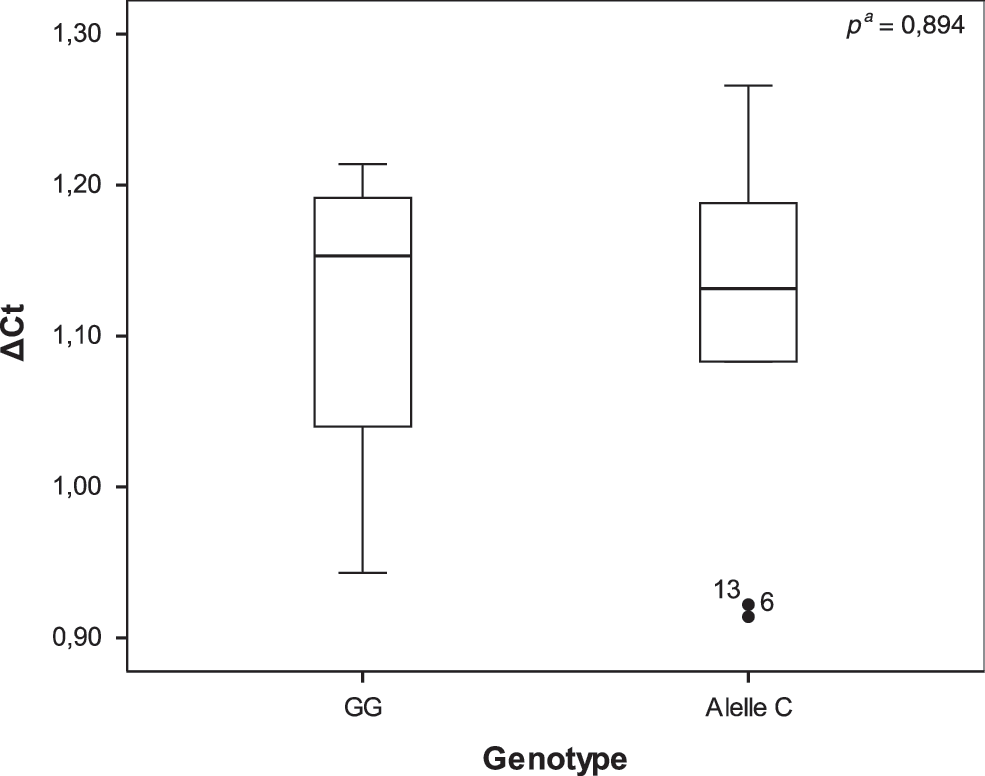
NBS1 mRNA normalized expression among individuals with prostate cancer with different genotypes. aStudent's t-test. Black dots represent outliers.
χ 2 test for categorical variables.
Values adjusted for age in a multivariate logistic regression analysis.
CI, confidence interval; OR, odds ratio; PSA, prostate specific antigen.
Discussion
Prostate cancer is well known by its massive genetic heterogeneity, with its progression from early to advanced disease being characterized by different genetic defects, including centrosome dysfunction and chromosome alterations (Pihan et al., 2001; Cheng et al., 2008). However, the role of DNA repair mechanisms in prostate cancer development and progression still remains unclear.
NBS1 has been proposed to act as a tumor suppressor gene, as it recognizes DNA double-strand breaks and participates in its repair (Carney et al., 1998). Despite very little knowledge regarding NBS1 structure and function, this gene appears to be crucial for the establishment of an appropriate response to DNA damage, as it is essential to MRN activation (Kobayashi, 2004). As a result, genetic variations in NBS1 may affect its normal function, which can lead to diverse genetic defects, such as failure in cell cycle checkpoints and mutations in key genes, resulting ultimately in tumor development. In addition, it has been recently proposed that this gene may also act as an oncogene, since its overexpression also induces epithelial–mesenchymal transition through the Snail/MMP2 pathway (Wu et al., 2011).
The study of genetic polymorphisms constitutes an interesting approach in cancer investigation, as they can influence the activity and function of the encoded protein. To the best of our knowledge, our study is the first to analyze the influence of rs1805794 G>C polymorphism on prostate cancer progression. As previously stated, some reports have suggested that this polymorphism may be associated with tumor development. In this study we were able to find an association between GG genotype and risk for advanced prostate disease. Interestingly, controversial results have been reported in nonprostate cancer studies, as summarized in the meta-analysis carried out by Lu et al. (2009). However, our results are in agreement with those proposed by Lan and collaborators (Lan et al., 2005), where an association between GG genotype and the risk for lung cancer development was found. In addition, they also found a higher prevalence of p53 mutations among carriers of GG genotype. Therefore, inactivation of p53 can lead to tumor development, since it is responsible for several processes that prevent defect cells to proliferate. It has been already established that mutations in p53 appears to lead to recurrence of prostate cancer and progression to advanced disease (Stackhouse et al., 1999; Schlomm et al., 2008). This possible association between GG genotype and inactivation of p53 appears to support our results, suggesting that individuals carrying this genotype will likely tend to accumulate defected DNA due to an incorrect repair program, which will translate into a higher risk of prostate cancer progression.
Regarding NBS1 mRNA expression, our results showed no significant differences when comparing individuals with early and advanced disease. We also didn't find any association between the possible genotypes of rs1805794 G>C polymorphism and the expression of NBS1 mRNA. Taking together, these results suggest that the role of NBS1 in prostate cancer progression appears to be related to its interaction with other genes that may be involved in the course of this disease, as the p53 previously mentioned.
Previous studies have shown that both FHA and BRCT domains appear to be of extreme importance to NBS1 correct function (Zhao et al., 2002; Kobayashi, 2004). These domains have been suggested to be essential for the binding of NBS1 to H2AX, through the interaction with phosphorylated MDC1 (Hari et al., 2010). On the other hand, these domains also appear to influence the recruitment of the MRN complex to the damage site. In addition, BRCT domain is also responsible for the interaction of NBS1 with BRCA1, forming a complex denominated BASC which is responsible for the recognition and repair of defected DNA (Wang et al., 2000). Therefore, modifications of this sequence, such as rs1805794 G>C polymorphism, may influence NBS1 interaction with other genes, preventing a proper response to DNA double-strand breaks which can eventually result in tumor development.
We must also consider the interaction of rs1805794 G>C with other polymorphisms within NBS1 gene, since it has been already suggested that other locations in this gene may also affect its function, resulting in a higher risk for tumor development (Lu et al., 2006; Park et al., 2010; Ziolkowska-Suchanek et al., 2011).
We acknowledge some limitations that this study may present, regarding NBS1 expression, since we were only able to perform this analysis in a limited number of cases. Therefore, further studies are necessary to confirm all these hypotheses, and the role of NBS1 in prostate cancer progression.
Conclusions
This study suggests an association between rs1805794 GG genotype and risk for advanced disease in patients with prostate cancer. The lack of statistical differences in NBS1 mRNA expression among the different groups of patients according to their rs1805794 G>C genotypes supports the hypothesis that the involvement of NBS1 in prostate cancer progression may be related with its interaction with other genes responsible for the repair of defected DNA and cell cycle control, namely p53. However, further studies with larger samples are required to confirm these results and guide future investigations.
Footnotes
Acknowledgments
We thank LPCC, Liga Portuguesa Contra o Cancro (Portuguese League Against Cancer); for her support. This project was partially sponsored by an unrestricted educational grant for basic research in Molecular Oncology from Novartis Oncology Portugal and was realized with the support from Calouste Gulbenkian Foundation (Oncology/2008/Project No. 96736) and from Science and Technology Foundation (FCT/PTDC/SAU-FCF/71552/2006).
Disclosure Statement
No competing financial interests exist.