




Abstract
Our study aims at determining whether genetic polymorphisms of catalase (CAT 1167C/T) and superoxide dismutase (SOD +35 A/C) could be associated with type 2 diabetes mellitus (T2DM). The study was conducted on 105 Egyptian patients with T2DM and 115 control subjects. Genotypes were done by polymerase chain reaction-restriction fragment length polymorphism methods. Homeostatic model assessment of insulin resistance (HOMA-IR), CAT and SOD activities, glycated hemoglobin, and insulin and lipid profiles were assessed. CAT and SOD activities were significantly decreased in T2DM compared with the control subjects. T allele of CAT and C allele of SOD1 were significant risk factors for T2DM. No effects of CAT or SOD1 gene polymorphisms on glycated haemoglobin or on HOMA-IR were found. With regard to the enzymes activities, only +35 A/C of SOD1 was related to SOD activity. Genetic variants C1167T of CAT gene and +35 A/C of SOD1 gene has no role in insulin resistance in T2DM.
Introduction
Catalase (CAT) and copper-zinc superoxide dismutase (CuZnSOD) are well-known antioxidant enzymes. Superoxide is dismutated to H2O2 by CuZnSOD in the cytosol (Maritim et al., 2003). H2O2 is converted to H2O and O2 by CAT in the mitochondria and the lysosomes (Yung et al., 2006).
In this study, we raised the question of whether the genetically determined polymorphisms of the key antioxidant enzymes, CAT and CuZnSOD, could be related to various risk factors of type 2 diabetes mellitus (T2DM). Specifically, we hypothesized that the allele frequencies of these polymorphisms could be associated with IR in diabetic patients.
CuZnSOD, CAT is encoded on 21q22.1. The +35 A/C polymorphism (rs 2234694) is adjacent to the splicing point (exon3/intron3) and is related to SOD1 activity with AA genotype having the higher activity (Flekac et al., 2008). The CAT gene contains 13 exons and is located in chromosome 11p13 (Goth et al., 2001). A number of single nucleotide polymorphisms have been reported in the CAT gene. With regard to diabetes, previous reports suggested that C1167T polymorphism in codon 389 of exon 9 (rs 769217) plays a role in the development of the disease (Schroeder and Saunders, 1987).
Therefore, the purpose of the current study is to assess the possible association of +35 A/C polymorphism in the SOD1 gene and 1167 C/T polymorphism in the CAT gene with T2DM in Egypt.
Materials and Methods
Subjects
A total of 105 Egyptian patients with T2DM and 115 control groups of healthy Egyptian subjects were examined in this study. Diagnosis of T2DM was based on the criteria of the American Diabetes Association (American Diabetes Association, 2010). Subjects were recruited from those attending the outpatient clinics at North Sinai area. The ethics committee of Faculty of Pharmacy, Suez Canal University, approved the study protocol, and written informed consent to participate in the study was obtained from all the individuals.
All the study subjects underwent a complete medical history and complete physical examinations. Anthropometric parameters, including weight and height as well as blood pressure, were measured, and body mass index (BMI) was calculated.
Methods
Laboratory measurements
Venous blood samples were drawn after overnight fasting. Serum was separated and used for assessment of fasting blood glucose and lipid profiles [including total cholesterol (TC), triglyceride (TG), high density lipoprotein cholesterol (HDL-C), and very low density lipoprotein (VLDL-C)] by automated enzymatic methods on a Hitachi −912- analyzer. Low density lipoprotein cholesterol (LDL-C) cholesterol was calculated according to Friedewald formula (Friedewald et al., 1972). Fasting serum insulin level was measured by using ADVIA Centaur® XP Immunoassay System (Siemens Healthcare Diagnostics); IR and β cell dysfunction were assessed by using the homeostatic model assessment of insulin resistance (HOMA-IR) (Matthews et al., 1985). Glycated hemoglobin (HbA1C) was measured in whole blood collecting on EDTA anticoagulant using ADVIA® 1800 Chemistry System (Siemens Healthcare Diagnostics). Plasma CAT activity and erythrocyte SOD activity were determined by spectrophotometer assay kits (Bio-Diagnostic).
Genotype analysis
Genomic DNA was extracted from peripheral blood leucocytes obtained from 200 μL EDTA anticoagulated blood samples using the wizard genomic DNA purification kit (Promega). Determination of C1167T CAT and +35 A/C SOD1 gene polymorphisms were determined by polymerase chain reaction-restriction fragment length polymorphism (PCR-RFLP) using the primers and the restriction enzymes shown in Table 1. PCR was carried out in a final volume of 50 μL, using 300 ng of genomic DNA, 2.5 U of Taq DNA polymerase (Bioron), 0.1 mM of each dNTP (Bioron), and 1 μmol of each of the primers (Metabion International AG). The reaction buffer contains 1.5 mM MgCl2, 10 mM Tris–HCl (pH 9.0), 50 mM KCl, and nuclease-free water to 50 μL. Amplification was done by initial denaturation of 94°C for 5 min. followed by 35 cycles of denaturing at 94°C for 1 min., annealing 55°C or 64°C for 1 min., and extension at 72°C for 1 min. A final extension of 5 min at 72°C was done. For RFLP-PCR analysis, amplified products were digested with a restriction endonuclease (SibEnzyme Ltd.). The digestion products were separated in 2% (weight/volume) agarose gel along with a 100-base pair marker (Axygen Biosciences). The products were then visualized under UV light following staining with ethidium bromide. To assess accuracy, 20 samples were done in duplicate, and the discrepancy rate was 0/20 among the single nucleotide polymorphisms (SNPs) and samples we studied.
Statistical analysis
The genotype and allele frequencies were determined by direct counting. Hardy–Weinberg equilibrium was evaluated using a Chi-square (χ2) test. Statistical comparisons between healthy and diabetic populations were performed using χ2 test, fisher exact test, and two-way student's t-test. Associations of genotypes with CAT and SOD activity were evaluated by analysis of variance test. Backward stepwise multiple logistic regression analysis was used to elucidate the association of rare allele carriage with diabetes using SPSS version 17 program. A value of p<0.05 was considered statistically significant. All data were presented as mean±SD.
Results
The main clinical and biochemical characteristics of the diabetic subjects and controls are shown in Table 2. Age, sex, and HDL-C were not significantly different between diabetic patients and control participants. Conversely, BMI, smoking status, hypertension, family history, blood glucose, HbA1C, serum triglycerides, total cholesterol, LDL-C, and HOMA-IR were significantly different between the two groups. plasma CAT activity and erythrocyte SOD activity were significantly decreased in T2DM compared with the control subjects, both p<0.05.
Age and BMI, FBG, insulin, TAG, TC, HDL-C, LDL-C, and VLDL-C represented as mean±SD. Gender represented as number and percentage of subjects.
Significantly different from normal control p<0.01.
BMI, body mass index; FBG, fasting blood glucose; TAG, triacylglycerol; TC, total cholesterol; HDL-C, high-density lipoprotein cholesterol; LDL-C, low-density lipoprotein cholesterol; HOMA-IR, homeostatic model assessment of insulin resistance; SOD, superoxide dismutase; T2DM, type 2 diabetes mellitus; CAT, catalase.
Allele frequencies and genotypes
The genetic polymorphisms in CAT and SOD1 genes were investigated, and the genotypes are shown in Figures 1 and 2. In total, two SNPs were identified in the CAT and SOD genes. Table 3 presents the name, type, allele frequencies, and location for these SNPs. All SNPs were in the Hardy–Weinberg equilibrium (Table 4). The number of patients carrying the CAT TT genotype was determined to be 8 (7.62%) among diabetic patients, whereras this was identified to be 2 (1.74%) among the control group. The T allele was a significant risk factor for T2DM (odds ratio [OR]=2.94; 95% confidence interval [CI, 1.66–5.23]) (Table 3).When the groups were compared in terms of SOD +35 polymorphism, the CC genotype among the patient group was 11 (10.48); whereas it was 2 (1.74%) in the control group. Consequentially, the C allele was a significant risk factor for T2DM (OR=2.9; 95% CI [1.84–4.6]) (Table 3). When the groups were compared in terms of CAT and SOD1 genotypes, statistical significance was determined (p<0.05).
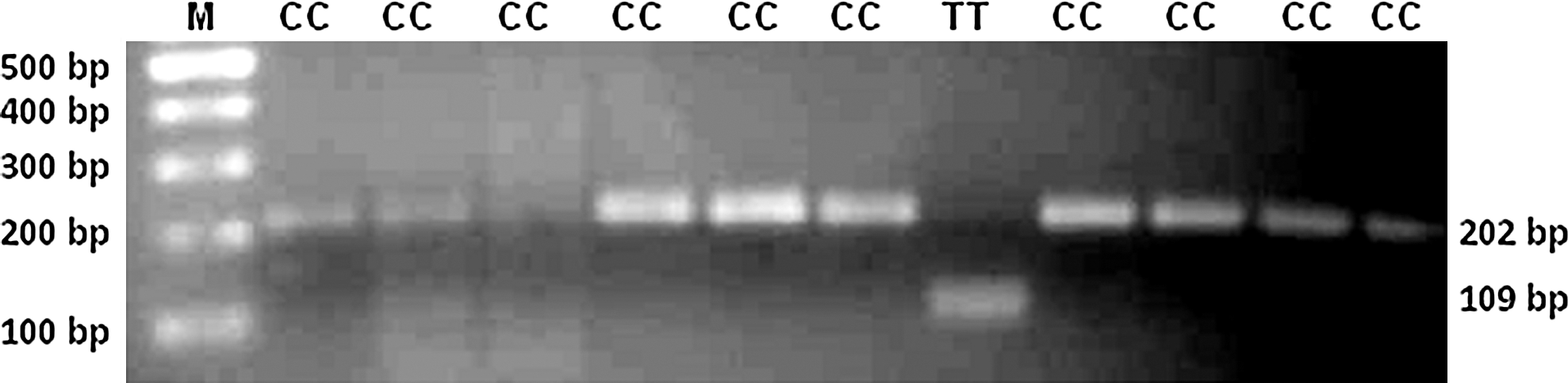
CAT C1167T polymerase chain reaction (PCR) genotype of type 2 diabetic patients on 2% Agarose gel. M: 100 base pair (bp) marker, Lanes 1, 2, 3 4, 5, 6, 8, 9,10, and 11 are CC genotypes and Lane 7 is TT genotypes for type 2 diabetic patients.
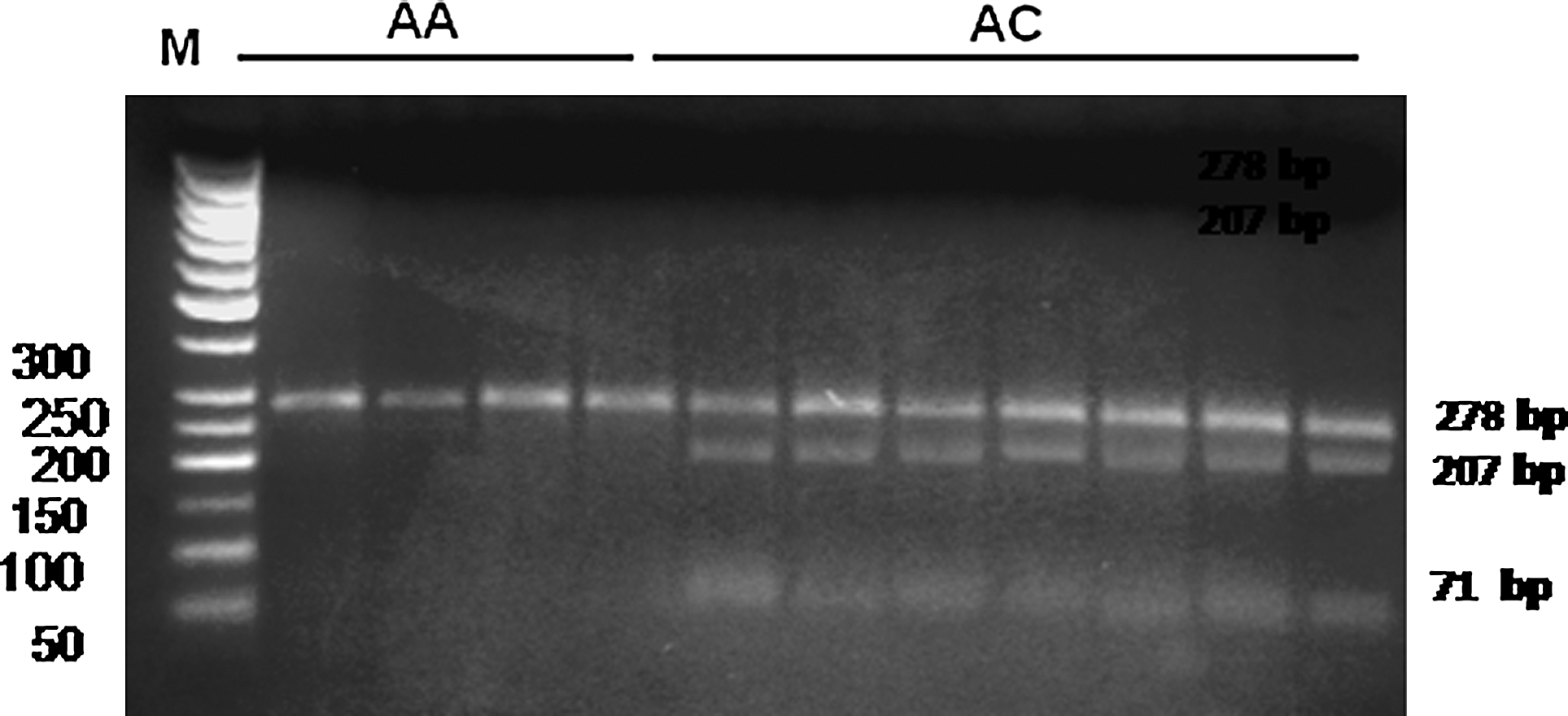
SOD1 +35 A/C PCR genotype type 2 diabetic patients on 2% Agarose gel. M: 50 bp marker, Lanes 1, 2, 3 and 4 are AA genotypes and Lanes 5, 6, 7, 8, 9, 10, and 11 are AC genotypes for type 2 diabetic patients.
T versus C; bCT versus CC; cTT versus CC; dCT+TT versus CC; eC versus A; fAC versus AA; gCC versus AA; hAC+CC versus AA.
Comparisons were performed by χ2 and Fisher's exact tests. p<0.05 is statistically significant.
χ2, Chi square test; CAT, catalase; CI, confidence interval; OR, odds ratio.
Comparisons were performed by χ2 test.
NS, nonsignificant differences.
Association of SNPs with diabetic control, IR and enzymes activities
When laboratory values were compared according to the genotype distribution of CAT and SOD1 genes in diabetic patients, no effect of SNP in the CAT gene on diabetes control was found. Glycated haemoglobin was 9.67±1.7 in the CC genotype and 9.69±1.98 in CT+TT genotypes of the CAT gene, with p>0.05. Similar findings were made in the SOD1 gene; glycated hemoglobin was 9.5±1.9 in AA genotypes and 9.7±1.7 in AC+CC genotypes with p<0.05. Moreover, no effects of the SNPs in CAT or SOD1 genes on HOMA-IR were found.
With regard to the enzyme activities, no effect of SNP in CAT gene on CAT activity was found. Conversely, +35 A/C of SOD1 was related to SOD activity. Higher activities were found in AA than in CC genotypes of diabetic patients (Table 5).
Values are presented as mean±SD.
p<0.05, statistically significant.
Discussion
Oxidative stress is a single mechanism that is related to all major pathways responsible for diabetic damage and can be considered a hallmark of microvascular and macrovascular disorders (Makuc and Petrovič, 2011, Cilenšek et al., 2012, Fukumoto et al., 2012, Santl Letonja et al., 2012). Several genome-wide association studies (GWAS) on susceptibility to type 2 diabetes have now been published (Ahlqvist et al., 2011), and none report association with genes related to oxidative stress. Nevertheless, only ∼15% of diabetes heritability has been explained up to now by the GWAS that has involved mainly individuals of European origin; so, studies on candidate genes and other ethnic groups may still be of value. The current study found an evidence of association between both CAT 1167C/T and SOD +35 A/C gene polymorphisms and T2DM in an Egyptian population sample.
An association between diabetes susceptibility and a C1167T of the CAT gene was earlier reported in ethnic Russians (Chistyakov et al., 2000). Our results also suggest that the CAT gene C1167T polymorphism is associated with diabetes susceptibility with the heterozygote CT genotype being significantly more frequent among diabetic patients than healthy controls. Moreover, we observed a significant increase in the frequency of the T allele in diabetic patients than healthy individuals. With regard to the +35 A/C SOD1 gene polymorphism, our study has indicated that the rare homozygote CC genotype has increased diabetes risk compared with the wild-type AA, and the minor C allele carriers appeared to be susceptible to T2DM. Our study does not contradict the results of Panduru et al. (2010) or Flekac et al. (2008), but some differences of susceptibility may exist that are dependent on the studied population and the presence of diabetic complications, facts that are encountered in other studies.
To elucidate the underlying effect mediating the oxidative stress-induced outcome in T2DM, especially IR and β-cell function, we evaluate the influence of CAT and SOD1 gene polymorphisms on HOMA-IR in diabetic patients. Although there were significant differences between genotypes of the CAT and SOD1 between the diabetic patients and the control subjects, our data suggest that the C1167T CAT and +35 A/C SOD1 gene polymorphisms have no effect on HOMA-IR. Moreover, no impact of these polymorphisms on lipid profile, glycemic control, or other risk factors for T2DM was detected.
It is widely postulated that the etiology of T2DM has a strong association with oxidative stress, originating from increased oxidative stress and impaired antioxidant defense systems (Rahimi et al., 2005). Our data revealed that plasma CAT and erythrocyte SOD activities were significantly decreased in diabetic patients compared with control subjects. Our findings are in agreement with previous observations of other authors (Goth et al., 2001) and (Smaoui et al., 2004). Low CAT and SOD activities and its consequence on high H2O2 level could contribute to the oxidative destruction of pancreatic β cells and decreased insulin effectiveness in diabetic patients (Flekac et al., 2008).
The low activity of antioxidant enzymes in diabetes is accountable by genotype background or by the enzyme glycation effect of hyperglycemia (Flekac et al., 2008). Interestingly, the current study found no association between CAT activity and genotypes of the CAT C1167T polymorphism in diabetics or control subjects. This finding was in accordance with Zovota et al. (2004). The reason behind lack of association was related to the fact that this variation results in a silent substitution of aspartate residue at codon 389; hence, it is unlikely to directly affect CAT activity. On the contrary, other reports approved the association between the CAT polymorphisms and low CAT in vitiligo (Gavalas et al., 2006), hypertension (Jiang et al., 2001), Alzheimer's disease (Capurso et al., 2008), and diabetes mellitus (Tarnai et al., 2007). They explained the association by the possibility that the CAT C1167T polymorphism may be linked to other CAT polymorphisms that are deleterious to the expression of the gene or the activity of CAT (Gavalas et al., 2006). Contrary to the lack of association between the CAT C1167T polymorphism and the enzyme activity, our results are indicative of the potential effect of +35 A/C in the SOD1 gene on enzyme activity. Higher activities were found in AA than in CC genotypes of diabetic patients. Though a previous report by Flekac et al. (2008) found some evidence for an association between the AA genotype and higher SOD activity, significance was borderline and was only achieved by combining data from diabetic and healthy subjects. Deficiency in SOD1 activity can lead to increased levels of vascular superoxide and impaired endothelial dependent relaxation in both large arteries and microvessels, which results in diabetic vascular complications (Rolo and Palmeira, 2006).
In conclusion, the results of our study point to the role of gene polymorphisms of CAT and superoxide dismutase in decreasing the ability of antioxidant defense system in diabetes. Furthermore, it is highly unlikely that genetic variants C1167T of the CAT gene and +35 A/C of SOD1 gene play a role in IR in T2DM.
Footnotes
Disclosure Statement
No competing financial interests exist.