




Abstract
Genetic factors can substantially contribute to the pathogenesis of nonalcoholic fatty liver disease (NAFLD). A missense Pro12Ala substitution in the PPARγ2 gene (rs1801282) has been studied in relation with NAFLD risk in different ethnic groups, but findings have been inconclusive. The aim of this was to evaluate the association between rs1801282 and NAFLD through meta-analysis of all relevant published evidence. A systematic search to find eligible studies was performed in Medline, HuGE Navigator, and SCOPUS databases. The strength of association was evaluated using odds ratios with 95% confidence intervals obtained from a random effect approach and under additive, dominant, co-dominant, recessive, and allelic contrast models. Seven studies comprising 1474 cases and 2259 controls met the eligibility criteria and included in the meta-analysis. Combined results did not indicate any predisposing or protective effect for rs1801282 under any of the assessed modes of inheritance. The rate of heterogeneity was generally high due to the inter-study variations in terms of age, gender, and ethnicity. Evidence from the current meta-analysis indicated that rs1801282 variants are not associated with NAFLD risk. Future large-scale studies are required to substantiate the present findings.
Introduction
As with many other metabolic disorders, NAFLD has a polygenic nature and genetic factors have been suggested to exert substantial contribution to both development and progression stages (Daly et al., 2011; Hernaez, 2012). Peroxisome proliferator-activated receptor (PPAR) genes are among the susceptibility loci that have been studied in relation with NAFLD. PPARs are a group of nuclear transcription factors with α, β/δ, and γ subtypes. PPARγ is an important member of this family with pivotal regulatory effects on the expression of several factors involved in lipid metabolism and insulin resistance. Thus, modulators of PPARγ activity have attracted considerable attention as promising candidates for the treatment of NAFLD and associated metabolic disorders (Kallwitz et al., 2008).
The PPARγ gene is located on chromosome 3p25 and spans over 100 kbp. Transcription of the PPARγ gene is controlled by different promoters as well as alternative splicing. These complex transcriptional regulations lead to the expression of four isoforms of the protein, namely, PPARγ1 to PPARγ4 (Fajas et al., 1997; Gurnell, 2005). The rs1801282 is a missense single-nucleotide polymorphism (SNP) in the PPARγ2 gene that stems from a C→G nucleotide substitution at the gene level, resulting in a Pro-to-Ala conversion at the codon 12 position of the translated protein. This SNP has been reported to be associated with decreased transcription (due to reduced DNA-binding affinity) and activity of PPARγ2 and improved insulin sensitivity (Deeb et al., 1998). However, the impact of this SNP on the susceptibility to NAFLD is still controversial due to the inconsistent findings (Dongiovanni et al., 2010; Gupta et al., 2010; Rey et al., 2010; Cao et al., 2012; Gawrieh et al., 2012; Yang et al., 2012; Bhatt et al., 2013). The present meta-analysis aimed to provide a more comprehensive estimate of the association between PPARγ2 rs1801282 SNP and NAFLD risk through meta-analysis of all relevant studies published to date.
Materials and Methods
Search strategy
A search strategy was devised to identify published studies investigating the association between the rs1801282 and NAFLD. The search followed the guidelines of the 2009 preferred reporting items for systematic reviews and meta-analysis statement and was undertaken in two stages (Moher et al., 2009). Initially, the citations in SCOPUS, MEDLINE, and HuGE Navigator databases were surveyed using the terms “peroxisome proliferator-activated receptorγ” or “PPARγ” or “peroxisome proliferator-activated receptorgamma” or “PPARgamma” or “PPARG”; these terms were combined with “polymorphism” or “polymorphic” or “SNP” or “genetic” or “genotype” or “variant” or “mutation” or “allele,” and all of the above terms were combined with “non-alcoholic” or “fatty liver” or “hepatic steatosis” or “steatohepatitis” or “NAFLD” or “NASH.” The wild-card term ‘‘*’’ was used to increase the sensitivity of the search strategy. Searches were limited to articles published in the English language. No previously published meta-analysis on the association between PPARγ2 rs1801282 SNP and NAFLD was identified by searching in the HuGE Navigator database. Retrieved articles were hand-searched for any additional related studies.
Study selection
Only data from the full-text articles, not meeting or conference abstracts, were included. Studies that were included in the current meta-analysis were published up to November 2012, and (1) had a case–control design, (2) investigated the association between PPARγ2 rs1801282 SNP and NAFLD, and (3) provided sufficient information on the frequency of genotypes in both case and control groups. Studies that (1) did not report complete data on the rs1801282 genotype frequencies, (2) did not fit the diagnostic criteria for NAFLD, (3) were not performed on humans, and (4) were conducted on patients with liver diseases due to alcohol abuse or viral infection were excluded.
Data extraction
From the eligible studies, the following data were extracted using standard protocols: (1) first author's name; (2) year of publication; (3) origin of studied population; (4) number of participants in the case and control groups; (5) age, gender, and body mass index (BMI) of study participants; (6) circulating concentration of hepatic transaminases [aspartate aminotransferase (AST) and alanine aminotransferase (ALT)] and lipid profile parameters [comprising total cholesterol, low-density lipoprotein cholesterol (LDL-C), high-density lipoprotein cholesterol (HDL-C) and triglycerides]; (7) systolic and diastolic blood pressure; (8) fasting glucose concentration; and (9) homeostasis model assessment-estimated insulin resistance (HOMA-IR) index. In case of incomplete data on the genotype frequencies, the authors of the respective article were contacted.
Genotyping
Genotyping of rs1801282 in the included studies was performed by polymerase chain reaction (PCR)–restriction fragment length polymorphism (Dongiovanni et al., 2010; Gupta et al., 2010; Cao et al., 2012; Bhatt et al., 2013) technique or TaqMan probe-associated real-time PCR (Rey et al., 2010; Gawrieh et al., 2012; Yang et al., 2012).
Quality assessment
The quality of each included study was methodologically evaluated based on the scale of Thakkinstian et al. (2005), with modifications in order to be adapted for NAFLD. Briefly, the quality assessment tool employed six items on the source of cases and controls, type of specimen for genotyping, method of NAFLD diagnosis, compliance with the Hardy–Weinberg equilibrium (HWE) in the control group, and population size. The overall score ranges from 0 to 18, with higher scores indicating higher qualities. Based on the overall score, quality of studies could be classified as low (score <6), medium (score 6–12), or high (score >12).
Quantitative data synthesis
Meta-analysis was conducted using the Cochrane Program Review Manager version 5.1. Combined unadjusted odds ratios (ORs) for the association of rs1801282 with NAFLD were generated under additive (GG vs. CC), dominant (GG + GA vs. CC), co-dominant (GA vs. GG + CC), recessive (GG vs. CC + CG), and allelic contrast (C allele vs. G allele) inheritance patterns. Meta-analysis was performed using the Mantel–Haenszel weighting method and under a random effect model due to the inter-study variations regarding age and demographic factors. Heterogeneity analysis was performed using the Cochran Q test and I2 index. Sensitivity analyses were performed using the one-study remove approach to assess the impact of each study on the combined effect as previously described (Morris et al., 2012). The significance of the pooled ORs were assessed using Z-values. Compliance of genotype distribution with the HWE was assessed in the control group of each study using the χ2 test with a threshold of p<0.05 to detect any disequilibrium. Random effect meta-regression was conducted to explore the association between BMI (as a major source of heterogeneity and an important determinant of NAFLD) and calculated ORs under different patterns of inheritance. In all tests, a p-value of<0.05 was considered as statistically significant.
Results
Flow of included studies
From 363 publications that were identified by initial database searches, 7 studies fulfilled inclusion criteria for the systematic review and were selected for further assessment. To identify these 7 articles, the full texts of 11 articles were evaluated. Four articles were found to be irrelevant due to the lack of case–control design (Kotronen et al., 2009; Delahanty et al., 2012) or not evaluating the target (rs1801282) SNP (Hui et al., 2008; Zhou et al., 2010) (Fig. 1).
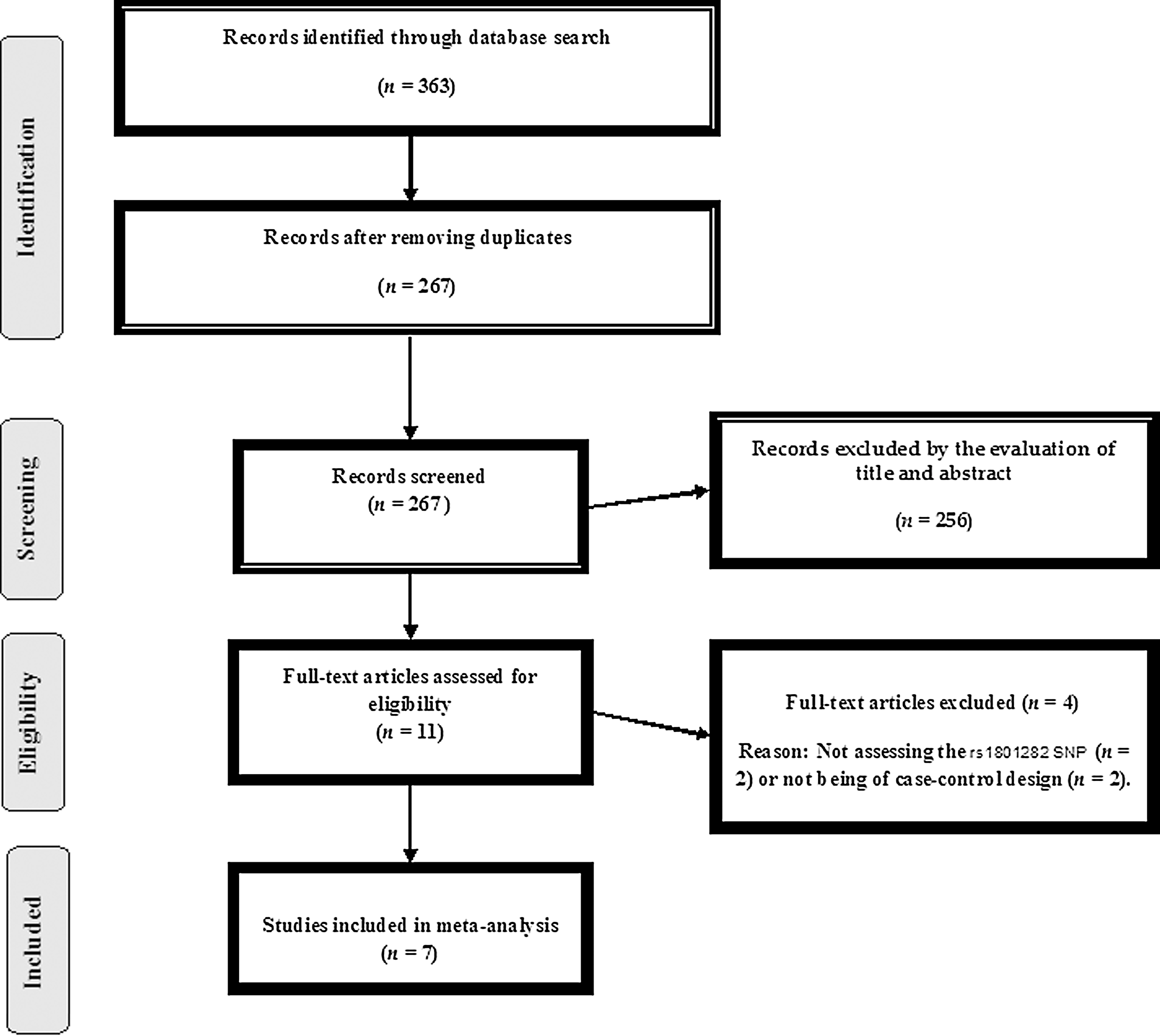
Flow diagram of the study selection process.
Characteristics of included studies
Collectively, a total of 3733 individuals were included across the 7 eligible studies, comprising 1474 cases and 2259 controls. Included studies were conducted in India (Gupta et al., 2010; Bhatt et al., 2013), China (Cao et al., 2012; Yang et al., 2012), Italy (Dongiovanni et al., 2010), Germany (Rey et al., 2010), and United States (Gawrieh et al., 2012). The independent studies varied in population size between 179 (Gawrieh et al., 2012) and 903 (Yang et al., 2012) subjects. Overall, case and control groups in the included studies were matched regarding age and gender. Most of the studies failed to report demographic data on the frequency of important comorbidities such as cardiovascular disease, type 2 diabetes, hypertension, and hyperlipidemia. Besides, the distribution of other covariates such as lipid profile parameters and hepatic transaminases were not uniformly expressed across all studies. Reported data suggested that case patients had higher circulating levels of total cholesterol, triglycerides, LDL-C, AST, and ALT, while reduced levels of HDL-C, as would be expected in NAFLD. Consistently, plasma glucose and HOMA-IR index were higher in NAFLD patients than in controls. None of the included studies provided gender-specific data for the frequency of genotypes. Genotype frequencies in the control groups of all included studies were compliant with the HWE, apart from significant deviations that were observed in the studies by Bhatt et al. (2013) (χ2=12.51; p=0.004) and Gupta et al. (2010) (χ2=5.17; p=0.020) (Rey et al., 2010). Demographic characteristics of included studies' recruited populations are summarized in Table 1. Based on the overall calculated quality scores (Table 2), four of included studies had high quality (Dongiovanni et al., 2010; Rey et al., 2010; Cao et al., 2012; Yang et al., 2012), while the remaining three studies were classified as medium quality (Gupta et al., 2011; Gawrieh et al., 2012; Bhatt et al., 2013). Minor allele frequencies reported in the populations of included studies conformed to those previously reported by studies in the corresponding populations [retrieved from the ALFRED database (Rajeevan et al., 2003)] (Table 3).
Values are expressed as mean±SD unless otherwise stated.
Expressed as median (interquartile range).
No SD reported.
NR, not reported; BMI, body mass index; HOMA-IR, homeostasis model assessment-estimated insulin resistance; LDL-C, low-density lipoprotein; HDL-C, high-density lipoprotein; AST, aspartate aminotransferase; ALT, alanine aminotransferase; CVD, cardiovascular disease; SBP, systolic blood pressure; DBP, diastolic blood pressure.
NAFLD, nonalcoholic fatty liver disease.
All data presented in this table have been retrieved from the ALelle FREquency Database (ALFRED) at
MAF, minor allele frequency.
Quantitative data synthesis
PPARγ2 rs1801282 genotypes were investigated for possible association with NAFLD risk. Combined analysis was carried out using a random effect approach and under additive, dominant, co-dominant, recessive, and allelic contrast models. rs1801282 was not found to be associated with the risk of NAFLD under any of the assessed models (Fig. 2). Leave-one-out sensitivity analysis showed a significant and clinically relevant predisposing effect for the rs1801282 under additive [OR: 2.44; 95% confidence interval (CI): 1.18–5.02; p=0.02] and recessive [OR: 2.37; 95% CI: 1.16–4.88; p=0.02] models following omission of the study by Gawrieh et al. (2012) (Table 4).
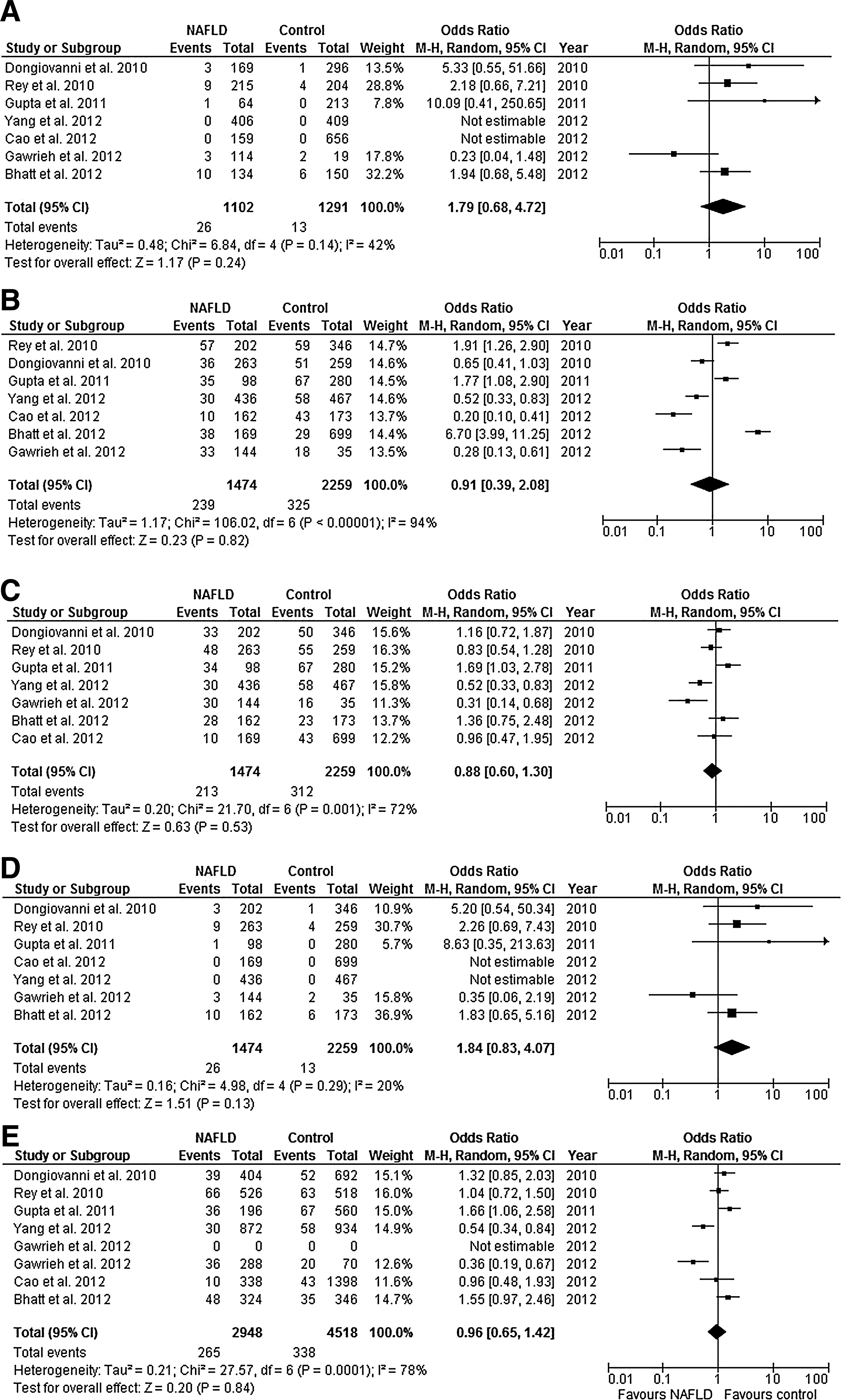
Forest plot detailing unadjusted odds ratios (ORs) and 95% confidence intervals (CI) for the association between rs1801282 polymorphism and nonalcoholic fatty liver disease. The vertical line represents overall OR calculated in the current meta-analysis using a random effects model.
Analysis was performed using a random effects model. OR, odds ratio; 95% CI, 95% confidence intervals. Significant results are bolded.
The rate of heterogeneity was generally high under analysis models (Table 5). Age, gender, ethnic, HOMA-IR, and BMI differences among the included studies are most plausible determinants of this high rate of heterogeneity.
Q, Cochran Q test; df, degrees of freedom; I2, I2 index.
Since the included subjects in the study by Gawrieh et al. (2012) were morbidly obese, BMI values were further investigated as a source of heterogeneity. Random effect meta-regression between LogOR and BMI did not reveal any significant association under any of the evaluated models of inheritance, namely, additive (regression coefficient: −0.15; 95% CI: −0.202 to −0.090; τ2: 0.19; p=0.389), dominant (regression coefficient: −0.04; 95% CI: −0.181 to 0.106; τ2: 2.041; p=0.43), co-dominant (regression coefficient: −0.06; 95% CI: −0.010 to −0.011; τ2: 0.18; p=0.368), recessive (regression coefficient: −0.13; 95% CI: −0.179 to −0.073; τ2: 0.18; p=0.342), and allelic contrast (regression coefficient: −0.05; 95% CI: −0.097 to −0.002; τ2: 0.21; p=0.38).
Discussion
The present study represents the first meta-analysis on the association between PPARγ2 rs1801282 SNP and risk of developing NAFLD. The results failed to indicate any protective or predisposing effect for the assessed SNP under any model of inheritance. Findings from the sensitivity analyses revealed that pooled estimates of OR were sensitive to the study of Gawrieh et al. (2012) under additive and recessive models. In the above-mentioned models, elimination of frequencies extracted from the referred study led to the estimation of a significant positive association between rs1801282 and NAFLD risk. This finding might imply a more complex pathology than NAFLD in the individuals recruited in the Gawrieh et al. (2012) study. As shown in Table 1, both case and control groups of the mentioned study had overwhelmingly high values of BMI in the morbid range. Although further metabolic and clinical chemistry data were not reported, such high BMI values represent an unfavorable metabolic status probably complicated by several morbidities even in the control group.
Given the pivotal role of PPARγ in the regulation of adipocyte differentiation, lipid accumulation and metabolism, and insulin sensitivity, its polymorphisms have been investigated in relation with a variety of metabolic traits. rs1801282 is a missense substitution of Ala for Pro, which results in decreased affinity to peroxisome proliferator response element and a modest impairment of transcriptional activation (Deeb et al., 1998; Masugi et al., 2000). It is widely accepted that PPARγ activation is a useful strategy to improve the global metabolic profile in high-risk patients. There is evidence linking PPARγ2 activation with a multitude of favorable effects, including improvement of insulin sensitivity, enhancement of hepatic fatty acid β-oxidation, upregulation of adipokines including adiponectin, and mitigation of free fatty acid flux to the liver and hepatic inflammation (Kallwitz et al., 2008), though findings on PPAR activators such as thiazolidinediones have been equivocal due to the reported treatment-related hepatotoxicity (Scheen, 2001). rs1801282 has been the most studied PPARγ SNP, but findings of individual studies have been strongly equivocal. Collectively, the Ala12 allele appears to be associated with increased BMI, obesity insulin resistance, and risk of type 2 diabetes (Masud and Ye, 2003; Ochoa et al., 2004; Tellechea et al., 2009; Passaro et al., 2011; Ho et al., 2012). However, such an association does not appear to cause adverse metabolic profile (Gonzalez Sanchez et al., 2002; Passaro et al., 2011). The same controversy also exists among the findings on the association of this SNP with metabolic syndrome (Dongxia et al., 2008; Bego et al., 2011; Passaro et al., 2011). As for the NAFLD, the number of conducted clinical studies has been fewer, and all data on the association between rs1801282 and NAFLD have been published very recently between 2010 and 2013. Three out of seven included studies reported significant allelic difference between NAFLD and controls. Bhatt et al. (2013) and Gupta et al. (2010) indicated a higher prevalence of Ala12 in NAFLD patients in Asian Indians, while Yang et al. found an opposite finding in a Chinese population (Yang et al., 2012).
Given the multifactorial nature of NAFLD and contribution of several risk factors to its pathogenesis, it is most plausible that the contrasting findings are due to the differences in ethnic background, age, gender, environmental, and behavioral differences across the populations studied. Besides, NAFLD, the same as other closely associated metabolic disorders, arises from a complex interplay among several susceptibility loci (Daly et al., 2011; Hernaez, 2012). This multigenic origin necessitates a broader investigation taking into account the interactions of other SNPs within the PPARγ2 gene or other nearby genes.
Aside from the issues of heterogeneity and single-polymorphism analysis, there are other limitations that deserve attention, though some are inherent to the meta-analysis. First, the number of included studies and the population size of each individual study were limited. Second, the pooled ORs were calculated without correcting for environmental covariates, due to the lack of access to the individual data. Third, the chance of publication bias still exists. This problem is due to the inclusion of published studies and lack of availability of any possible unpublished data. Finally, case and control groups were unmatched for metabolic factors in most of the included studies. It might be recommended for future investigations to be undertaken on metabolically matched subjects in order to control for potential confounding effects of different metabolic factors.
In conclusion, the present meta-analysis of seven case–control studies did not provide any evidence on the impact of rs1801282 within the PPARγ2 gene on the susceptibility to NAFLD. While this finding is more robust and suggestive compared to conflicting individual genetic association studies, it is not conclusive. Hence, future large-scale trials are yet to be conducted in order to verify the present findings in larger and more homogenous populations that are matched for different environmental and metabolic factors.
Footnotes
Author Disclosure Statement
No competing financial interests exist.