




Abstract
In this study, we investigated the promoter DNA methylation (DNAm) status of the MMP-9 and TIMP-1 genes in patients with chronic periodontitis to evaluate disease progression. Using pyrosequencing technology, DNAm levels of MMP-9 and TIMP-1 CpG islands were measured in 88 chronic periodontitis patients and 15 healthy controls. We found a positive correlation between methylation levels of MMP-9 CpG islands and the severity of chronic periodontitis. Methylated CpG islands were also closely associated with the duration of chronic periodontitis. Moreover, female patients exhibited lower methylation levels of MMP-9 but higher methylation levels of TIMP-1 compared with male patients, and the methylation levels of TIMP-1 gradually decreased with age. The findings of gender disparity in the DNAm of MMP-9 and TIMP-1 genes provide novel insights into chronic periodontitis.
Introduction
P
In clinical practice, there are differences in the incidence and severity of periodontitis, even in two individuals with identical genetic backgrounds (Ximenez-Fyvie et al., 2006). In recent years, studies have found that, in addition to differences in gene sequences under different environmental exposures, methylation of promoter or regulatory regions could dynamically affect regulation expression (Pacchierotti and Spano, 2015). These findings suggest that, in addition to genetic polymorphisms under the effects of environmental factors, periodontitis-related gene methylation may incur reversible changes.
Recent findings have shown that abnormal protein expression in the MMP family, such as in MMP-1, -3, -8, and -9, and TIMP, is involved in tissue invasion in periodontitis (Li et al., 2016). MMPs are the most important enzyme family in extracellular matrix (ECM) degradation, which includes collagen, proteoglycans, and other ECM components (Syggelos et al., 2013). MMP-9 is an ECM protein found primarily in cartilage and other musculoskeletal tissues, and overexpression of MMP-9 may be related to the severity of periodontitis. Studies have shown that MMP-9 plays an important role in alveolar bone growth and reconstruction, and smoking affects the expression of MMP-9 in human gingival fibroblasts (Posey et al., 2014; He et al., 2016). TIMPs, which control the activity of MMPs, are composed of four family members; of them, TIMP-1 and TIMP-2 have been well characterized. TIMP-1 is an endogenous MMP inhibitor that can bind to most MMPs and is believed to be one of the most important endogenous inhibitors of MMPs. Decreased TIMP-1 levels cause an imbalance of MMP-9 and TIMP-1; however, there have been few studies conducted on the role of MMP and TIMP gene in chronic periodontitis (Brehmer et al., 2003).
Several studies have focused on the role of epigenetics in periodontitis. DNA methylation (DNAm) is an important epigenetic mechanism that operates at the interface between the genome and the environment to regulate phenotypic plasticity. MMPlex regulation occurs across the genome during the first decade of life (Burwell et al., 2011). DNAm may be the most suitable epigenetic marker for large-scale epidemiological studies, since methyl groups are covalently bound to CpG dinucleotide and are not lost during routine DNA extraction, unlike histone modifications. Therefore, existing DNA biobanks can be used to investigate epigenetic risk factors for MMPlex disease (Talens et al., 2010). Periodontitis gene chip data have indicated that the expression of the MMP gene is significantly lower in chronic periodontitis patients; however, few studies have been conducted on periodontitis from the perspective of gene methylation.
To evaluate the role of DNAm on MMP genes in periodontal diseases, we investigated the promoter DNAm status of MMP and TIMP-1 genes in chronic periodontitis, explored the relationship between methylation and gene expression, and analyzed the development of chronic periodontitis from genetic and epigenetic perspectives.
Materials and Methods
Samples and clinical data
Patients were recruited from August 2016 to May 2017, and samples were collected from the Department of Periodontology, Guanghua School of Stomatology, Hospital of Stomatology, Sun Yat-Sen University. Informed consent was obtained from all participants before the procedure, and the Research Ethics Committee of hospital approved the protocol. Each participant completed a questionnaire on gender, age, height, weight, occupation, general health, smoking habits, exercise habits, and mental stress.
Based on a preliminary screening, all participants met the following criteria: (1) a minimum of 20 years of age, (2) a minimum of 20 natural teeth excluding third molars, and (3) more than 70% of teeth in the same classification in each participant. The exclusion criteria were as follows: (1) suffering from systemic diseases (such as cancer, coronary heart disease, diabetes, hepatitis, or blood diseases); (2) smoking; (3) pregnant and lactating; (4) aggressive periodontitis; (5) antimicrobial or anti-inflammatory or periodontal treatment therapy within the previous 6 months; and (6) environmental poison exposure. The diagnostic criteria for chronic periodontitis were classified according to pocket depth, attachment level, and bleeding upon probing. Classification was based on the clinical criteria recommended by the 1999 International Symposium on Periodontitis Classification.
One examiner measured all clinical recordings at six sites per tooth (mesiobuccal, mesiolingual, distobuccal, distolingual, midlingual, and midbuccal). Participants included in the severe periodontitis group (27 patients; mean age: 43.5 years) had pocket depths (6.88 ± 0.83 mm) and attachment loss of >7 mm with bleeding upon probing each tooth. Participants defined as having moderate periodontitis (29 patients; mean age: 34 years) had pocket depths (5.78 ± 1.09 mm) and attachment loss of <6 and 4 mm with bleeding upon probing. Participants included in the mild periodontitis group (32 patients; mean age: 29 years) had pocket depths (2.45 ± 0.21 mm) and attachment loss of <3 mm with bleeding upon probing. Subjects in the control group (15 patients; mean age: 25.5 years) were healthy, with pocket depths of <2 mm and with no attachment loss, bleeding on probing, or radiographic bone loss.
Gingival crevicular fluid (GCF) was sampled with paper strips using the method of Offenbacher et al. (1986) with slight modification (Mogi and Otogoto, 2007). Sampling sites were selected from buccal aspects of the interproximal surfaces and the mesial/distal surfaces of single-rooted teeth. Clinically detectable supragingival plaque was removed carefully without touching the gingiva, and the sites under study were gently dried with an air syringe and isolated by cotton rolls before GCF sampling. One paper strip was used for each collection site, and four sites were selected in each periodontitis patient and each healthy participant. Paper strips were inserted 1 mm into the gingival crevice and left for 30 s. Strips contaminated with blood or saliva were discarded. The paper strips from the individual sites were stored at −80°C for later processing.
DNA extraction and sodium bisulfite modification
GCF samples were processed using a trace Nucleic Acid Extraction Kit (Hangzhou Xinjiang). Bisulfite modification was performed on 500 ng samples of DNA using a DNA Methylation Kit™ (Zymo Research, HiSS Diagnostics, CA) according to the manufacturer's instructions. The samples were then eluted in 15 μL of elution buffer and stored at −20°C.
Generation of PCR products and pyrosequencing
A pyrosequencing assay was used to assess the methylation status of the MMP-9 and TIMP-1 promoters. This assay detects the level of methylation in the promoter regions of MMP-9 gene (chr20:46010497-46011349) and TIMP-1 (chrX:47582179-47583778). Methylation-specific polymerase chain reaction and pyrosequencing primers were designed using the PyroMark Assay Design 2.0. A measure of 20 μL of PCR volume was incorporated with 0.5 μM forward and reverse primers, 10 μL ZymoTaq™ Premix (Zymo Research, HiSS Diagnostics), and 2 μL bisulfite-modified DNA. For the MMP-9 gene, the forward and reverse primer sequences were 5′-TTT TTT TTT TAT TTT TTT GGG TAA GGA GTA-3′ and 5′-biotin-TAA TCC CAA CAA AAA CCC CAC TTC T-3′, respectively, and the sequence primer was 5′-TTT TTG GGT AAG GAG TAT-3′. For the TIMP-1 gene, the forward primer was 5′-TTG ATG GTG GGT GGA TGA GTA ATG TA-3′ and the reverse primer was 5′-AAC CCT ACT TAC CTC TAA TAT CTC TCT-3′ with sequence primer 5′-GGA GGT TTG TGG TTT-3′.
PCR was carried out at 95°C for 10 min, followed by 40 cycles of 95°C for 30 s, 55°C for 30 s, and 72°C for 1 min, with a final extension of 72°C for 10 min. The quality of PCR products was confirmed on 1% agarose gels with ethidium bromide staining, and the primer sequence used was 5′-CCC CTA CCC CCC TCT ACT A-3′. Pyrosequencing was subsequently carried out in the PyroMark™ Q24 pyrosequencer (Qiagen, Inc., Sweden). PyroMark™ Q24 software automatically analyzed the degree of methylation of all six CpG sites. The exact frequency of methylation was determined by the resulting peak patterns, which differed between methylated and unmethylated samples.
Statistical analyses
Categorical variables were compared using a Pearson's chi-square test, and the methylation levels between two and three groups were compared using the t-test and Kruskal–Wallis test. A p-value <0.05 was considered statistically significant. All statistical analyses were performed with PASW Statistics 18.0 software (SPSS, Inc., Somers, NY).
Results
Clinical data
A total of 88 patients and 15 healthy participants are included in this study. The biological characteristics of the periodontitis and control participants are shown in Table 1. Of the 88 patients with chronic periodontitis, 52 were women and 36 were men, and the mean age was 35.25 years (range: 25–62 years). In this study, we selected a locus containing 8 CpG dinucleotides for MMP-9 to explore the association of MMP-9 methylation with periodontitis (Supplementary Fig. S1; Supplementary data are available online at
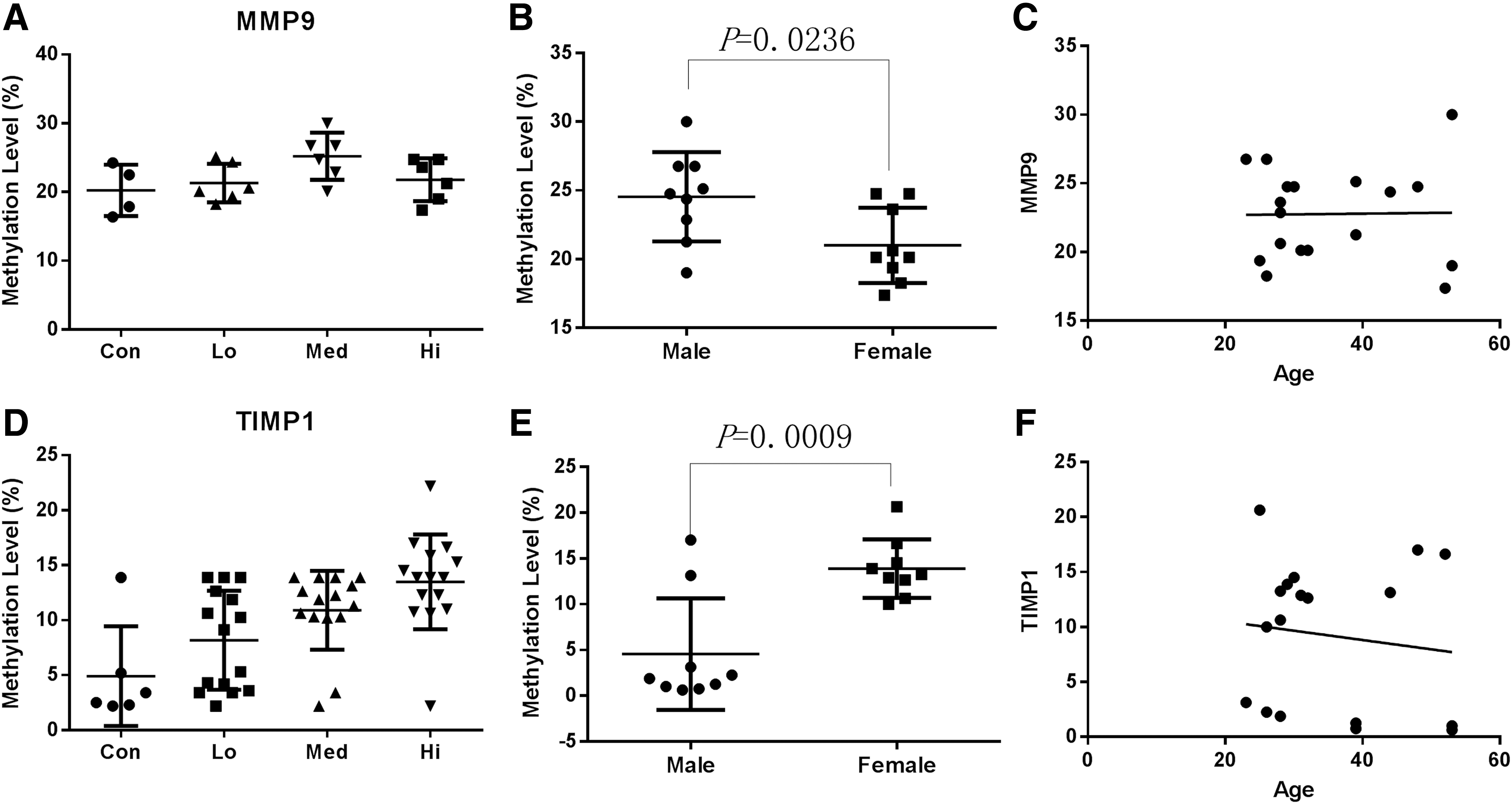
The expression of MMP-9 and TIMP-1 promoter methylation in patients with chronic periodontitis.
p < 0.05 and ** p < 0.01 vs. healthy control.
Association between the methylation status of MMP-9 and TIMP-1 and clinical phenotypes of periodontitis
Attachment level (mm), probing depth, and bleeding upon probing (%) were analyzed to evaluate the association between the methylation status of MMP-9 and clinical periodontitis phenotypes, but no significant association was found (Fig. 2A–C). However, we found that the methylation status of the TIMP-1 promoter was correlated with probing depth, attachment level, and bleeding upon probing. There was also a slight positive correlation between TIMP-1 promoter methylation and probing depth and a significantly negative correlation between TIMP-1 promoter methylation and bleeding upon probing (Fig. 2D–F). In addition, we explored the correlation between periodontitis-related markers and periodontitis severity and found that probing depth and bleeding upon probing were all enhanced in severe periodontitis, and the difference between healthy participants and moderate or severe periodontitis patients was statistically significant (Table 1).
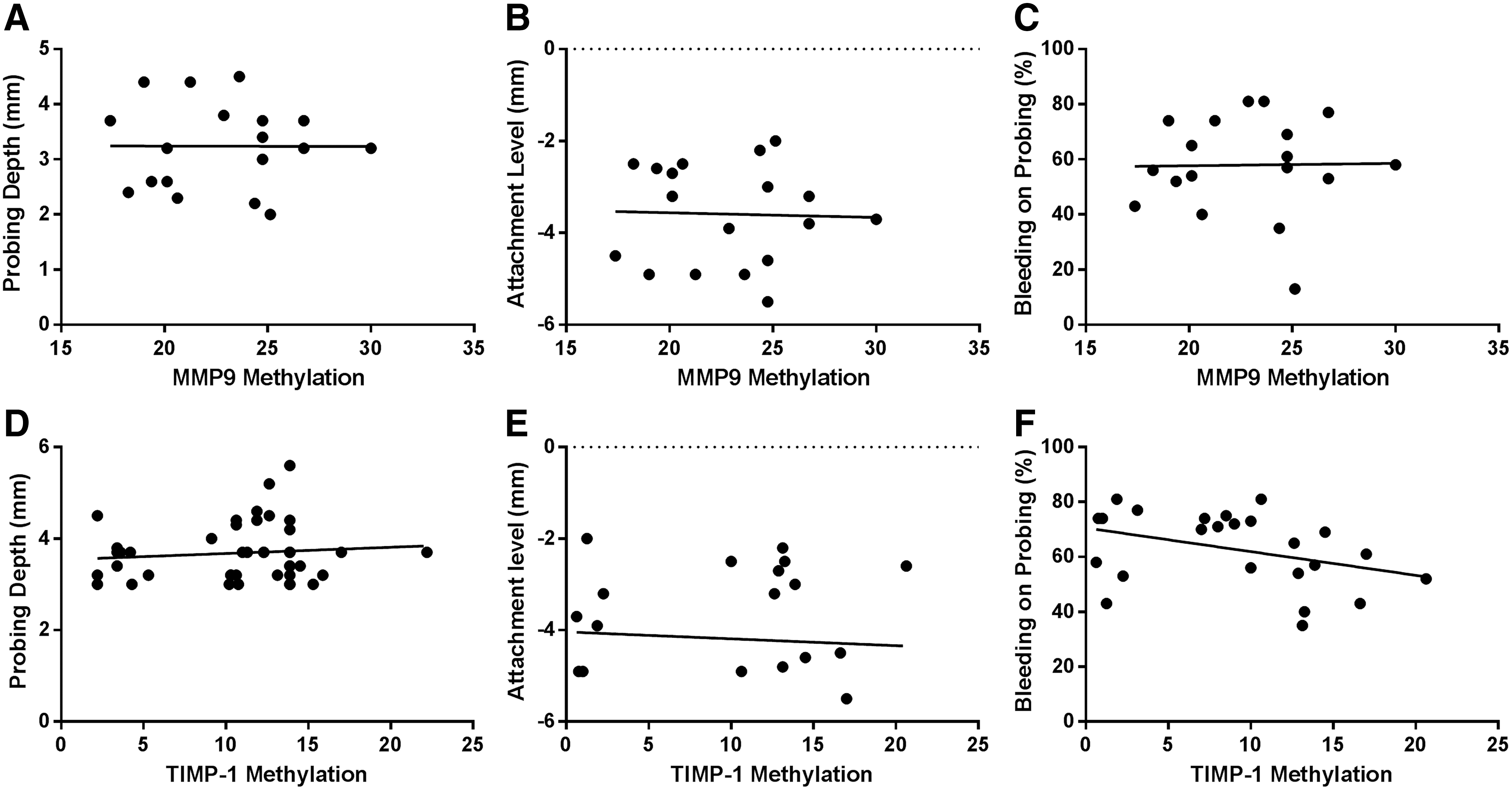
Correlation between MMP-9 and/or TIMP-1 promoter methylation and periodontitis-related markers. The relationship between MMP-9 methylation degree and probing depth
Discussion
Periodontitis is an infectious inflammatory disease, in which ECM degradation of connective and bone tissues is deregulated across disease progression. Polymicrobial infections initiate development of the disease; however, there are several proposed etiological hypotheses regarding the host response (Tatakis et al., 2005)—these hypotheses include connective tissue abnormalities (Taylor et al., 1981), signaling defects (Machida et al., 1996), melatonin (Qiu et al., 2007), asymmetries in the central nervous system (Sahlstrand and Petruson, 1979), abnormal distribution and interaction between melatonin and calmodulin (Kindsfater et al., 1994; Machida et al., 1996), hormonal variation (Nissinen et al., 1993), diet, and posture. Recent evidence has also linked genetic predisposition to periodontitis. Although genetics set the inflammatory capacity for an individual, there is increasing evidence that epigenetics is critical for regulating the inflammatory response in a dynamic way (Kellermayer, 2012). Environmental factors affect the host cell mainly through the induction of gene sequence variation, thereby changing certain tissue structures and triggering antibody response and inflammatory mediator regulation.
TIMPs, recognized for their role in regulating the activity of MMPs, are composed of four family members; of these, TIMP-1 and TIMP-2 have been well characterized. TIMP-1 is an endogenous MMP inhibitor that can bind to most MMPs and is believed to be one of the most important endogenous inhibitors of MMPs. Reduced TIMP-1 levels cause an imbalance in MMP-9 and TIMP-1 (Brehmer et al., 2003), and recent studies have shown that periodontitis is a type of MMP disorder. As reversible and heritable modifications, epigenetic marks, such as DNAm, play an important role in regulating interactions between genetic and environmental factors (Wong et al., 2010; Cheng et al., 2014). Therefore, through gene methylation analysis, this study investigated the development of periodontitis through genetic and epigenetic perspectives to provide novel insights into the development of MMPlex diseases.
To date, very few studies have been conducted on the molecular mechanism of periodontitis. Fendri et al. (2013) reported that MMP gene expression is reduced in periodontitis patients; however, the cause of the reduced expression and its association with periodontitis is still unknown. This study found that MMP gene promoter methylation in periodontitis patients was significantly higher than in healthy participants, and methylation of MMP was more closely associated with duration of the disease. These results indicate that MMP plays an important role in periodontitis, likely related to decreased MMP gene expression through methylation of the promoter region. Studies have also shown that abnormal expression of MMP may lead to abnormal levels of the MMP protein in the ECM (DiCesare et al., 1994). An accumulation of misfolded protein is cytotoxic and triggers premature death of chondrocytes during linear bone growth and reconstruction, leading to shortened long bones (Posey et al., 2014). However, the role of MMP in periodontitis still requires further validation.
The main factors that influence periodontitis are age, gender, and smoking, with more women affected than men (AlJehani, 2014). In this study, we found significant associations between the methylation status of MMP-9 gene and gender, in particular, the age of the female patients. DNAm is an important epigenetic mechanism that operates at the interface between genome and environment to regulate phenotypic plasticity with MMPlex regulation across the genome during the first decade of life (Wong et al., 2010). Recent data suggest that epigenetic responses, including DNAm, are involved not only in cellular differentiation but also in modulation of genome function in response to the environment (Szyf, 2011). Therefore, our study suggests that the occurrence of periodontitis is related to genetics, as well as epigenetics.
This study has put forth a novel hypothesis to explain the etiology of periodontitis. Higher methylation levels of MMP were associated with the severity of periodontitis, suggesting that MMP may be used for molecular diagnosis. Although this association was found in patients with different degrees of periodontitis, adolescent patients were not evaluated. Therefore, a more diverse group of patients, with regard to age, and accompanying analyses of gingival tissue, bone tissue, and saliva would increase the applicability of the results of this study.
In summary, we found a gender dimorphism in MMP methylation in the susceptibility of periodontitis. This epigenetic modification may provide insights into the pathological mechanisms of periodontitis and provide new information regarding the MMP gene. Aberrant methylation of the MMP gene may be valuable as a gender-specific biomarker to monitor the risk and development of periodontitis.
Footnotes
Acknowledgment
The National Science Foundation of China supported this project (Grant No. 81571015).
Disclosure Statement
No competing financial interests exist.
References
Supplementary Material
Please find the following supplemental material available below.
For Open Access articles published under a Creative Commons License, all supplemental material carries the same license as the article it is associated with.
For non-Open Access articles published, all supplemental material carries a non-exclusive license, and permission requests for re-use of supplemental material or any part of supplemental material shall be sent directly to the copyright owner as specified in the copyright notice associated with the article.
