




Abstract
Previous studies revealed that the rs671 polymorphism in the acetaldehyde dehydrogenase 2 (ALDH2) genes is correlated with alcohol consumption in Japanese population. The ALDH2 gene variants and drinking are associated with hypertension and dyslipidemia. However, it remains unclear whether there might be potent relationships among ALDH2 rs671 polymorphism, alcohol consumption, hypertension, and dyslipidemia in Shandong population. A total of 467 male volunteers from Shandong area were enrolled in this study. The ALDH2 rs671 polymorphism was genotyped using polymerase chain reaction–restriction fragment length polymorphism. The concentrations of total cholesterol (TC), triglycerides, low-density lipoprotein, and high-density lipoprotein (HDL) in serum were measured using commercial kits. SPSS 23.0 was used for statistical analysis. The significance of differences between subgroups was determined using chi-square test, and multiple comparisons were performed with the least-significant difference method. The ALDH2 variant frequencies were 80.5% with GG, 17.1% with GA, and 2.4% with AA. The ALDH2 genotypes had significant correlations with alcohol consumption (p = 0.001), whereas the GA genotype was associated with a decreased risk of alcohol consumption (odds ratio = 0.27; 95% confidence interval = 0.130–0.539; p = 0.001). The ALDH2 genotypes frequencies and drinking habits were significantly different between hypertension and healthy individuals (p = 0.034; p = 0.044). The ALDH2 GG genotype individuals have high average lipids levels, and the proportion of TC disorder among GG individuals was higher than that of GA individuals (p = 0.006). Individuals who had drinking habits have a high average lipids levels; especially average TC levels (p = 0.048), and had high proportions of dyslipidemia (TC and HDL; p = 0.016 and p = 0.033, respectively). The frequencies of ALDH2 variants were evaluated according to the Hardy–Weinberg equilibrium among enrolled population. Our study suggested that the individuals with ALDH2 rs671 GA genotype were less prone to developing a drinking habit in Shandong population. The ALDH2 genotypes and drinking habit were associated with hypertension and lipid profiles especially TC profile in Shandong province. The ALDH2 rs671 genotypes indicated that the gene-related drinking habit and gene variant altogether may affect hypertension and dyslipidemia.
Introduction
The rs671 polymorphism in the acetaldehyde dehydrogenase 2 (ALDH2) genes is known to influence drinking behavior (Carr et al., 1991). During the process of alcohol degradation in the liver (Knox, 1946), ALDH2 plays a central role in acetaldehyde oxidation (Corrall et al., 1975). In the first step of alcohol metabolism, alcohol is oxidized to acetaldehyde by alcohol dehydrogenase (Meier-Tackmann et al., 1990), and then the acetaldehyde is oxidized to acetic acid by the catalytic action of ALDH (Lieber, 1999). So far, three types of dehydrogenases have been identified in mammalian species (Vasiliou et al., 1999), among which mitochondrial ALDH2 is the major enzyme responsible for acetaldehyde metabolism (Ehrig et al., 1990). The human ALDH2 gene is located on chromosome 12q24 and has an rs671 single nucleotide polymorphism with three different genotypes; namely, GG, GA, and AA (Enomoto et al., 1991). These different genotypes encode enzymes that catalyze the conversion of acetaldehyde to acetic acid at different degrees (Crabb et al., 1989), where enzymes of the GA and AA genotypes have a very low catalytic activity (Chao et al., 1993). Individuals carrying the rs671 GA or AA genotype usually suffer from accumulation of acetaldehyde after heavy drinking, with symptoms of alcohol flush, dizziness, and heart rate acceleration (Itoh et al., 1997).
Alcohol consumption is very popular in East Asian countries, especially among men (Wall et al., 1997). Excessive alcohol intake is associated with hypertension (Liu et al., 2005). In a study of Mongolians from Inner Mongolia, the ALDH2*2 genotype was found to be a negative risk factor for essential hypertension (Hasi et al., 2011). In addition, the Chinese cohort study found the hypertensive effect of alcohol to be caused by ethanol rather than acetaldehyde (Zhang et al., 2013). However, it is unclear whether the ALDH2 rs671 polymorphism is a risk factor for hypertension in Chinese individuals from Shandong province. Jinan City located in the central area of Shandong Province is a typical representative of Shandong cities. As a political and economic center of Shandong Province, Jinan City attracts employment of people from all regions of Shandong and they represent the population of Shandong.
Previous study showed that ALDH2 rs671 polymorphism is correlated with lipid profiles. In a Japanese study, genetic variation in the ALDH2 gene influenced the high-density lipoprotein cholesterol (HDL-C) levels (Kotani et al., 2012), which was independent of alcohol consumption (Wada et al., 2008). Similarly, in a Chinese study, the rs671 polymorphism of ALDH2 was also associated with HDL-C levels, which were higher in the GG group than in the GA and AA groups (Zhu et al., 2015). However, as it has the highest incidence of coronary heart diseases (CHDs) in China, the link between the ALDH2 rs671 polymorphism and lipid profiles in Chinese individuals from Shandong province is still unclear.
Hypertension and dyslipidemia are risk factors for CHDs (Retsagi et al., 1965). The Chinese generally have a lower incidence of CHDs than other populations worldwide. The population from Shandong area has the highest incidence of CHDs in China (Zhao, 1993), but how the CHD risk factors of this population differ from other Chinese population is not well identified. Previous studies revealed various predisposing factors for CHDs, including hypertension, dyslipidemia, and obesity (Tanaka et al., 1990). Associations between the ALDH2 rs671 polymorphism and hypertension or lipids need to be demonstrated in further studies in the Chinese population, and the ALDH gene variants did not seem to markedly modify the same profiles in a white population (Husemoen et al., 2010). However, the associations of ALDH2 rs671 polymorphism with hypertension susceptibility or lipid profiles are unclear in the Shandong population. In this study, we aimed to clarify these associations in this particular Chinese population.
Materials and Methods
Ethics statement
All subjects gave informed consent before participating in this study. Ethics approval for the study was granted by the Jinan Central Hospital Affiliated to Shandong University, and the institutional approval number for this study is AF/SC-07/02.
Subjects and data collection
This study conducted all the checkups in Jinan Central Hospital as a sampling unit for the overall sampling in Shandong. A total of 467 male volunteers between 25 and 55 years of age were enrolled into this study. Hypertension was diagnosed according to the World Health Organization criteria: systolic blood pressure ≥140 mmHg and/or diastolic blood pressure ≥90 mmHg. Normal reference values of blood lipids were as follows: Total cholesterol (TC), 2.19–5.17 mmol/L; triglycerides (TG), 0.56–1.7 mmol/L; HDL-C, >1.04 mmol/L; and low-density lipoprotein (LDL) cholesterol, <3.12 mmol/L. Volunteers who had other diseases or had taken any medicines within 2 weeks before the study were excluded. Individuals were classified into the alcohol group and nondrinking group in accordance with the following criteria: drinking group: the volunteers had at least 2 years of drinking history, and drank ≥250 mL of an alcoholic beverage containing 42% alcohol each week on an average. Nondrinking group included individuals with levels less than the above-mentioned criteria.
ALDH2 rs671 genotype
Genomic DNA was isolated from blood samples (drawn into ethylenediaminetetraaceticacid anticoagulation tubes) using a genomic DNA extraction kit (Magen, Guangzhou, China). The ALDH2 rs671 polymorphism was genotyped using polymerase chain reaction (PCR)–restriction fragment length polymorphism with the following specific primers: sense primer 5′-GTTTGGAGCCCAGTCACCCTTTGGTGGCTACAAGATG-3′ and antisense primer 5′-AGCCCCCAGCAGGTCCCACACTCACAGTTTTCTCTT-3′. The PCR products were digested with the MboII restriction enzyme (Fermentas; Thermo Fisher Scientific, Waltham, MA) and the fragments were resolved by electrophoresis on a 2.5% agarose gel for 45 min. Digestion of the wild type (WT) allele by the restriction enzyme generated one band of 97 bp band and another of 25 bp. The nondigested allele gave a single band of 122 bp (Fig. 1).

The method of ALDH2 rs671 genotyping using PCR-RFLP.
Blood serum lipid concentration measurement
The concentrations of total cholesterol (TC), TG, LDL, and HDL in serum were measured with the Cobas 8000 modular analyzer, using commercial kits (Roche Diagnostics, Mannheim, Germany). All the experiments were carried out in accordance with the standards of hospital assessment set by China's health ministry.
Statistical analysis
SPSS 23.0 software was used for statistical analysis of the data. The serum TC, TG, LDL, and HDL concentrations were expressed as mean ± standard deviation. The significance of differences between subgroups was calculated using the χ2 test, and multiple comparisons were carried out using the least-significant difference method. Logistic relationships were analyzed using the binary regression model. The strength of the association between variables was measured using odds ratios (ORs) with their 95% confidence intervals (CIs).
Results
Comparison of drinking habits among ALDH2 rs671 genotypes in Chinese men
We established a new ALDH2 genotyping method (Fig. 1). Using the ALDH2 genotyping method, we analyzed the genotype of 467 male individuals in Chinese Han population. The allele frequencies among the study population showed 80.5% with GG, 17.1% with GA, and 2.4% with AA. According to the χ2 test, the frequencies of the genotypes were in Hardy–Weinberg equilibrium (p > 0.05).
To determine the correlation of the ALDH2 single nucleotide polymorphism with alcohol consumption, we analyzed the alcohol-drinking behavior of the individuals according to their different genotypes. The ALDH2 rs671 genotypes had significant correlation with alcohol consumption, and the individuals with GA had lower alcohol consumption (χ2 = 14.5, p = 0.001; Table 1). Specifically, the binary logistic regression analysis showed that the GA genotype decreased the probability of drinking (OR = 0.27; 95% CI = 0.130–0.539; p < 0.001; Table 2).
The Demographic Characteristics in Different Genotypes of ALDH2 in Males
Numerical values are given as mean ± SD (
SD, standard deviation; BMI, body mass index; ALDH2, aldehyde dehydrogenase 2.
Binary Logistic Regression Analysis of the Association of the ALDH2 rs671 GA Genotype with Alcohol Consumption
Alcohol consumption was the dependent variable, where “0” represents “No,” and “1” represents “Yes.” The genotypes studied were ALDH2 rs671 GG and ALDH2 rs671 GA. “Exp (B)” (or “OR”) is the regression coefficient.
SE, standard error.
Impact of alcohol consumption and genotypes on hypertension in Chinese men
Of the 467 participants, 381 had normal blood pressure and 86 had hypertension. To investigate the effect of alcohol consumption on hypertension, we divided the participants into nondrinking and drinking groups and statistically analyzed the incidence of hypertension in each group. Alcohol consumption was significantly correlated with hypertension in men (p = 0.044; Table 3).
The Comparison of Hypertension Among Chinese Male Individuals
The χ2 test showed significant difference (p < 0.05).
Statistical analysis of gene frequencies in hypertension and healthy population showed that there were significant differences in gene frequencies between the two groups (p = 0.001; Table 3). The gene mutation frequency in hypertension population was lower than that in the healthy population.
Lipids profile in different ALDH2 genotypes
Compared with ALDH2 GA individuals, the lipid profiles of GG individuals showed higher TG, TC, LDL, and HDL levels on average, and higher proportion of TG, TC, LDL, and HDL dyslipidemia. The ALDH2 GA group had lower average levels of TC in serum (p = 0.046; Table 4), and the proportion of TC disorder was lower in the GA group (p = 0.006; Table 4). Logistical regression analysis showed that there was a positive correlation between ALDH2 genotype GG and individual hypercholesterolemia (OR = 1.98; p = 0.049; Table 5).
The Lipid Profile in Different Genotypes of ALDH2 in Men
Data are given as mean ± SD.
The columns with the letter “b” are significantly different from the columns with the letter “a,” and are not significantly different from the columns with the letters “ab.”
TC, total cholesterol; TG, triglycerides; LDL, low-density lipoprotein; HDL, high-density lipoprotein.
Binary Logistic Regression Analysis of the Association of the ALDH2 rs671 GA Genotype with TC Dyslipidemia
Total cholesterol dyslipidemia was the dependent variable, where “0” represents “No” (<5.17 mmol/L), and “1” represents “Yes” (>5.17 mmol/L). The genotypes studied were ALDH2 rs671 GG and ALDH2 rs671 GA. “Exp (B)” (or “OR”) is the regression coefficient.
Impact of alcohol consumption on lipids in men
To investigate the impact of alcohol consumption on lipids profile, we analyzed the levels of TG, TC, HDL, and LDL in nondrinking and drinking subgroups. The results showed that the drinking group has higher TC levels than the nondrinking group (p = 0.048; Table 6). The proportions of TC dyslipidemia and HDL dyslipidemia were significantly higher in nondrinking individuals than drinking individuals (p = 0.016 and p = 0.033; Table 6).
Effect of Alcohol Consumption on Lipids in Men
Discussion
Genetic factors are important in affecting an individual's susceptibility to hypertension (Dahl et al., 1962; Takagi et al., 2002). The binary regression analysis carried out in this study showed that the rs671 GA genotype has a negative correlation with hypertension, and drinking individuals are prone to hypertension in Shandong province. Of interest, individuals carrying the GG genotype have a better alcohol metabolism than those with the GA genotype, which may explain GG individuals consuming more alcohol. This result is consistent with that of a previous study on the Japanese population (Tanaka et al., 1990; Iwai et al., 2004), and this may explain that both the ALDH2 variant and drinking behavior are associated with hypertension (Fig. 2A).
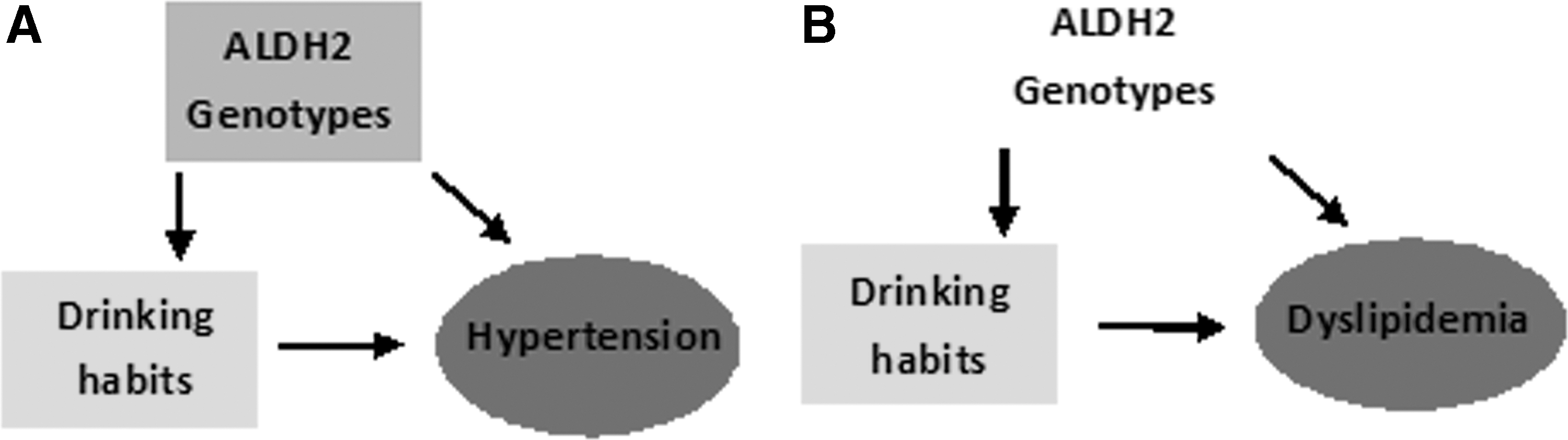
The pattern of the ALDH2 genotype affects individual hypertension and lipids.
Dyslipidemia is another risk factor for the development of CHDs (Takagi et al., 2002; Cho et al., 2015). In this article, we have analyzed the correlation of the ALDH2 rs671 polymorphism with lipid profiles in the Chinese population from the Shandong area. In this regard, individuals with the GA genotype had lower proportions of TC dyslipidemia levels, implying that they are less likely than the GG genotype-carrying individuals to acquire dyslipidemia (Fig. 2B). These studies were consistent with the results of the study on the South Korean population (Cho et al., 2015). Of interest, the individual genotype was associated with drinking behavior, and alcohol consumption was also correlated with lipid levels. The individuals who have drinking habit have higher proportion of TC and HDL, suggesting that halting consuming alcohol may be an effective way to restrict lipids in Shandong people; however, further research is required as to whether the gene polymorphism directly affects the lipids.
Chinese individuals have a lower incidence of CHDs than other populations (Jin et al., 2015). The population in Shandong area is believed to have the highest incidence of CHDs in China (Zhao, 1993). Hypertension and dyslipidemia are risk factors for CHD (Lewis et al., 1974), compared with individuals with genotype GA; individuals with genotype GG are more prone to these two risk factors. Our statistical analysis showed that the frequency of GG gene in Shandong population was 78.8%, which is higher than the frequency of Han nationality by 68.67%; the genotype-dependent propensity for hypertension may explain why the Shandong area has the highest incidence of CHDs in China.
Recently, a large number of susceptibility genes are reported to be associated with hypertension (Zhao et al., 2016), but the mechanism of the susceptibility gene function is a foundation of scientific question. The study on ALDH2 gene polymorphism with hypertension offers a typical gene regulation mode: on the one hand, the gene polymorphism may affect the drinking behavior through the alcohol metabolism and on the other hand, ALDH2 mutation accelerates mitochondrial β-oxidation and decelerates the TC, LDL, and TG levels in serum. This also implies that a genetic disease` can be affected by both social and genetic factors.
Limitation
The information collected from self-reporting may affect the accuracy of research. The number of volunteers enrolled in this study are limited. Shandong is one of the most densely populated areas and a typical representative of the central and eastern regions in China, but it does not represent the entire Chinese population. Drinking habits and hypertension may correlate with age, but we have not collected enough age information for statistical analysis.
Footnotes
Disclosure Statement
No competing financial interests exist.
Funding Information
No funding was received for this article.