




Abstract
Research showed that lanosterol can decrease protein aggregation in lens and reduce cataract formation. Lanosterol synthase (LSS) and 3-Hydroxy-3-methylglutaryl coenzyme A reductase (HMGCR) are the limiting enzymes in the process of synthesis of lanosterol. We demonstrate to investigate the association between functional single-nucleotide polymorphisms (SNPs) of LSS and HMGCR genes and age-related cataract (ARC) risks in Han Chinese population from Jiangsu Eye Study. This is a case–control study. We collected participants' venous blood for DNA genotyping and lens capsule samples for RNA. The SNPs of the genes were assayed with TaqMan RT-PCR genotyping. The quantitative RT-PCR was used to detect the LSS mRNA levels of lens epithelial cells (LECs) in individuals. The chi-square test was used to compare differences between ARC groups and controls of each SNP and to calculate the odds ratio (OR). We found that LSS-rs2968 of ARCs was different from controls (p = 0.018), but the significance was lost after Bonferroni correction (p = 0.072). We then further performed stratification analysis and found that LSS-rs2968 A allele was associated with nuclear type of ARC risk in Chinese population (p = 0.012, OR = 0.68). Consequently, we found that the mRNA expression of LSS was lower in LECs of all subtypes of ARC group than that of control group (p < 0.05). LSS-rs2968 A allele might play a role in the formation and development of nuclear type of ARC risk in Chinese population.
Introduction
Age-related cataract (ARC) is a common ocular disease that is the major cause of blindness in the world (Khairallah et al., 2015). Studies demonstrated that interactions between genes and environmental factors attribute to ARC (Wang et al., 2016; Zou et al., 2018). Although the pathogenesis of ARC is not completely understood, abnormal cholesterol metabolism may be related to the development of ARC (Li et al., 2018; Aleo et al., 2019).
Research showed that lanosterol, the upstream substrate of cholesterol, can decrease protein aggregation in lens and reduce cataract formation (Shanmugam et al., 2015; Zhao et al., 2015; Chen et al., 2018; Kang et al., 2018). The synthesis of lanosterol is a complex process involved more than 20 steps, which begins with acetyl coenzyme A, catalyzes the synthesis of squalene through a series of enzymes (Huff et al., 2005; Fouchet et al., 2008; Gill et al., 2011; Hua et al., 2019), among which the most critical rate-limiting enzymes are lanosterol synthase (LSS) and 3-Hydroxy-3-methylglutaryl coenzyme A reductase (HMGCR) (Gill et al., 2011; Hua et al., 2019). Therefore, we speculated whether LSS and HMGCR would be associated with cataract.
In the last several years, different genetic variations have been identified to be associated with the development and prognosis of ARC in several candidate gene studies, including our previous studies (Gu et al., 2016; Zou et al., 2018; Kang et al., 2019). Studies demonstrated mutation loci on the LSS gene in congenital cataract (Zhao et al., 2015; Chen et al., 2017). Single-nucleotide polymorphisms (SNPs) are the most abundant form of DNA variation in the human genome, and they exist in any regions of DNA, including coding, intron, and untranslated regions (Momtaz et al., 2018). To further explore the role of LSS and HMGCR in ARC, we hypothesized that SNP of the LSS and HMGCR might modify the risk of ARC. In this study, we selected four SNPs of LSS and HMGCR and conducted a case–control study to test the relationship between ARC and these SNPs.
Methods
Study participants
The study was approved by the Ethics Committee of Affiliated Hospital of Nantong University (2014014) and conducted in compliance with the Declaration of Helsinki. All participants were told the purpose and signed the respective informed consent forms.
The study was nested in a longitudinal cohort of diseased eye and in sectional case–control design. The cases and controls were from a population-based epidemiologic cohort of the Jiangsu Eye Study located in Qidong counties. The covered area of the study has a relatively stable and ethnically homogenous population. All participants were unrelated and self-identified Han Chinese (at least all four grandparents were ethnically Han Chinese).
According to the opacity region of lens, the type of ARC was classified into four subtypes: cortical cataract (C), nuclear cataract (N), posterior subcapsular cataract (PSC), and mixed cataract (M) (Klein et al., 1992). The diagnosis and lens opacities were graded according to the Lens Opacities Classification System III (LOCSIII) (Chylack et al., 1993). The details in the inclusion/exclusion of the case–control design were described in our previous study (Zou et al., 2018; Kang et al., 2019). Consequently, 720 ARC patients (C = 384, N = 215, P = 50, M = 71) and 701 controls were included (Table 1) (details are in Supplementary Material). Venous blood was drawn for DNA genotyping.
Demographic Information of Study Participants
ARC, age-related cataract; C, cortical; M, mixed type; N, nuclear; P, posterior subcapsular cataract; SD, standard deviation.
To collect ocular tissue and matched venal blood, additional 40 ARC patients (10 cortical cataract, 10 nuclear cataract, 10 posterior subcapsular cataract, and 10 mixed cataract) and 10 controls from inpatients of our hospital were recruited to collect their lens capsule samples (Table 2). The lens capsule samples were collected for measuring mRNA level of lens epithelial cells (LECs). All those patients' capsule samples were harvested by phacoemulsification. The controls' capsule samples from transparent lens were obtained from patients who had lens extraction during vitrectomy. We excluded the patients (both cases and controls) who had lens trauma, diabetes, uveitis glaucoma, and high myopia (>6D) (Zou et al., 2018; Kang et al., 2019).
Information of Hospital Participants
Selection of SNPs
Haplotype-tagging SNPs of genes were selected by searching Han Chinese data in NCBI dbSNP. The SNPs included minor allele frequency ≥20% using SNP function prediction program and excluded those having strong linkage disequilibrium (LD) between adjacent variants with r2 threshold ≤0.80. To this end, LSS-rs2968, LSS-rs9980968, HMGCR-rs12916, and HMGCR-rs1723848 meet the selection criteria and listed in Table 3.
The Included Single-Nucleotide Polymorphisms of the Selected Genes
The p-value for HWE was calculated from the genotype data in our healthy controls.
HMGCR, 3-Hydroxy-3-methylglutaryl coenzyme A reductase; HWE, Hardy-Weinberg Equilibrium; LSS, lanosterol synthase; MAF, minor allele frequency in Chinese population; SNP, single-nucleotide polymorphism.
DNA preparation and genotyping
Venous blood of all participants being collected were stored at −80°C before use. Genomic DNA was isolated from blood samples using Qiagen Blood DNA Mini Kit (Qiagen, Valencia, CA) according to the manufacturer's instructions. SNP Genotyping was performed with the TaqMan genotyping assay (Thermo Fisher, Foster City, CA) according to the manufacturer's protocols.
RNA, cDNA preparation, and quantification of mRNA expression
The capsule samples (contain LECs) were rapidly frozen in liquid nitrogen, and then stored at −80°C until use. Total RNA from lens capsule samples was isolated using TRIzol reagent (Invitrogen, Carlsbad, CA). cDNAs were reversed using transcriptase kit with random primers (Takara Bio, Kusatsu, Japan).
For quantitative RT-PCR (qRT-PCR), TaqMan gene expression assay probes (Thermo Fisher) were used for human LSS mRNA quantification (assay ID: Hs01552331_m1). Human GAPDH (Hs02786624_g1) was used as an internal control. Analysis settings for the threshold and comparative Ct (cycle threshold) were set to auto and adjusted manually. The fold change of gene expression was calculated using 2^(−ΔΔCt).
Statistical analyses
Statistical analyses were performed with a commercial statistical software program (IBMSPSS22.0; IBM, Armonk, NY). Statistical comparisons of the average values of two groups were performed using the t test. The χ2 test was performed to test the association between the alleles frequencies of all ARC patients and normal controls and various subtypes of ARC, and to estimate odds ratios (OR) and 95% confidence interval. The χ2 test was also used to test Hardy-Weinberg Equilibrium of genotype distributions. If any positive association was found in the initial allele analysis, Bonferroni correction was performed. Various genetic model analyses were performed to characterize the association as dominant, recessive model, additive model, and heterozygote advantage model. We only present the significant model in the results. The qRT-PCR assay in this study was repeated at least three times independently. Data are presented as means ± standard deviation. p < 0.05 was considered as statistically significant.
Results
Characteristics of the participants for the association study
The participants of the study were recruited from the epidemiologic population and hospital. The general demographic details of the study participants are summarized in Tables 1 and 2. There was no difference in age or sex between the ARCs and controls (p > 0.05).
Bioinformatics selection of candidate SNPs
A total of 11 SNPs were identified, but most SNPs were found to have a value of r 2 > 0.8 and a strong LD between adjacent variants in the Broad Institute database. Therefore, only four SNPs were included. Their basic characteristics are listed in Table 3.
Association between SNPs and risk of ARC
Among the four SNPs, the allele frequency of LSS-rs2968 of ARCs was different from controls (p = 0.018), but the significance was lost after multiple comparison correction (Bonferroni correction) (p = 0.072) (Table 4). We then further performed stratification analysis to explore the SNP involvement in subtypes of ARC. The results showed that frequency of the minor alleles in the LSS-rs2968 was higher in the nuclear type of ARC than in the healthy control subjects (p = 0.012, OR = 0.68) (Table 5).
Summary of Associations Between the Single-Nucleotide Polymorphisms and Age-Related Cataract
Bold value indicates p > 0.05.
pa, p-value after Bonferroni correction.
CI, confidence interval; OR, odds ratio.
Association Between rs2968 and Subtypes of Age-Related Cataract
Bold values indicate p > 0.05.
The genetic model analysis found that two SNPs (HMGCR-rs12916; LSS-rs2968) were associated with the relevant types of ARC in the dominant model (p < 0.05) (Tables 6 –8).
Association Between rs2968 and the N Type of Age-Related Cataract
Bold values indicate p > 0.05.
Association Between rs2968 and Age-Related Cataract
Bold values indicate p > 0.05.
Association Between rs12916 and the C Type of Age-Related Cataract
Bold value indicates p > 0.05.
Quantification of mRNA expression of ARCs and control
As shown in Figure 1, the mRNA expression of LSS was lower in LECs of all subtypes of ARC group than the control group (p < 0.05).
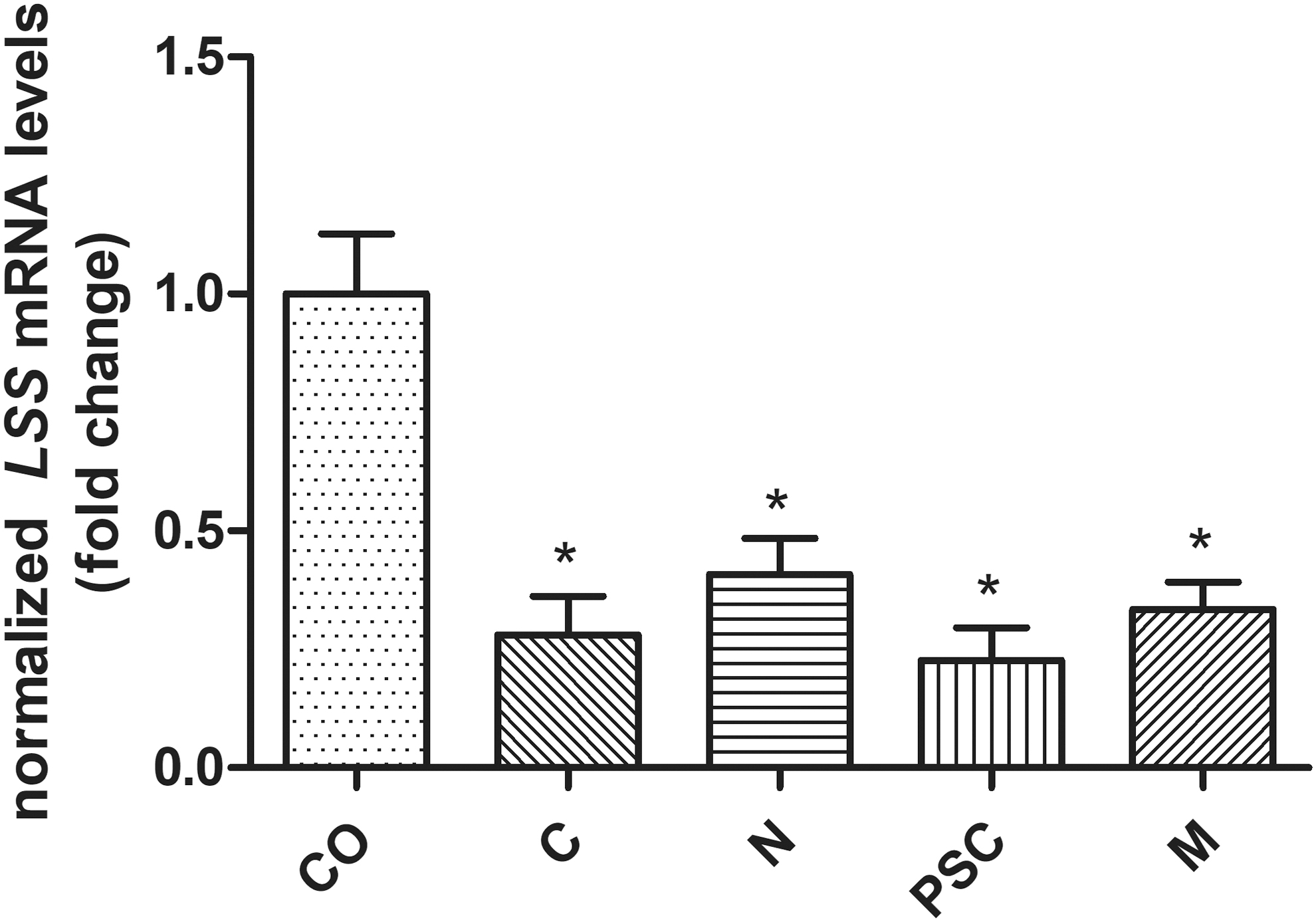
Levels of LSS mRNA expression in anterior capsules. LSS mRNA levels were lower in ARCs than the controls. *p < 0.05. ARC, age-related cataract; LSS, lanosterol synthase.
Discussion
As the world's first blinding eye disease (Khairallah et al., 2015), clarifying the mechanism of ARC is very important, Research found lanosterol can decrease protein aggregation in lens and reduce cataract formation (Shanmugam et al., 2015; Zhao et al., 2015; Chen et al., 2018; Kang et al., 2018). Lanosterol and 25-hydroxycholesterol were two mechanistically different lead compounds of anticataract drug design (Chen et al., 2018). But there is no suitable solvent that can dissolve lanosterol without harming the eyes (Zhao et al., 2015), so the clinical application of the drug is still a difficult problem to solve. The most important interest rate-limiting enzymes in the synthesis of lanosterol are LSS and HMGCR (Gill et al., 2011; Hua et al., 2019). Research found that inhibiting LSS activity induced rat lens opacity, and lanosterol effectively delayed the occurrence of lens opacity (Shen et al., 2018). LSS might prevent cataract by protecting LECs from crystalline degeneration and apoptosis (Hua et al., 2019).
Genetic variations have been identified and associated with the development and prognosis of many diseases (Li Ma, et al., 2015; Arne De Roeck, et al., 2019). Research found that Genetic Variants of LSS is related with Chronic Kidney Injury (Iatrino et al., 2019) and rare recessive neuroectodermal syndrome named alopecia with mental retardation syndrome (Besnard et al., 2019). Studies demonstrated mutation loci on the LSS gene in congenital cataract (Zhao et al., 2015; Chen et al., 2017), LSS on chromosome 20 might be the main pathogenic gene of Shumiya cataract rat, which is a cataract strain with the characteristics of hereditary cataract (Mori et al., 2006). We have reported that genetic variations in several candidate genes were associated with the development and prognosis of ARC (Gu et al., 2016; Zou et al., 2018; Kang et al., 2019). In this study, we selected four SNPs of LSS and HMGCR and found LSS-rs2968 is associated with N types of ARC in Han Chinese population, in which the A allele was the susceptible gene. Research found that the expression of LSS in the lens of cataract of rats and human was decreased (Mori et al., 2006; Shen et al., 2018). In this study, we found that the expression of LSS in LECs is decreased in all subtypes of ARC compared with controls.
Our study found that LSS-rs2968 may influence an individual's susceptibility to nuclear type of ARC in Han Chinese population. What's more, we confirmed the expression of LSS is decreased in all subtypes of ARC compared with controls. rs2968 is located in the 3′-UTR region of LSS gene where microRNAs (miRNAs) mainly bind to. Once miRNA binds to targeted genes, it may lead to mRNA degradation or posttranscriptional inhibition, which in turn inhibits gene expression (Dong et al., 2013). So, we speculated that rs2968 might change the binding energy between LSS and miRNAs. Unfortunately, we did not find any miRNAs who can bind to rs2968 through the online software programs miRNASNP and TargetScan. This result told us that there maybe other key mechanisms leading to the expression of LSS in lens decreased in LECs of ARC patients.
In conclusion, we first proposed the relationship between the SNP of upstream gene of lanosterol, LSS and HMGCR, and ARC. However, there were also some limitations in this study: First, the sample of the epidemiologic population is not large enough and the quantity of selected SNP is small. Where possible, future studies should continue an epidemiological survey and expand the epidemiologic population to explore the relationship between the SNP and ARC. Second, we did not explain the association between LSS-rs2968 and the decrease of LSS in LECs in ARC patients. We will continue to collect clinical patient samples and conduct genotype testing to clarify whether there are LSS expression differences in LECs between patients with different genotypes. What's more, we need to try and explain the mechanism of correlation between LSS-rs2968 and the decrease of LSS in LECs through bioinformatics analysis and other experimental examinations.
Footnotes
Acknowledgment
This publication is the work of the authors, this submission has not been published anywhere previously, and it is not simultaneously being considered for any other publication.
Disclosure Statement
No competing financial interests exist.
Funding Information
This study was supported by the National Natural Science Foundation of China (No. 8187040994) for epidemiological investigation and Changzhou science and technology project (No. CJ20190062) for reagents for experimental research.
Supplementary Material
Clinical Data
References
Supplementary Material
Please find the following supplemental material available below.
For Open Access articles published under a Creative Commons License, all supplemental material carries the same license as the article it is associated with.
For non-Open Access articles published, all supplemental material carries a non-exclusive license, and permission requests for re-use of supplemental material or any part of supplemental material shall be sent directly to the copyright owner as specified in the copyright notice associated with the article.
