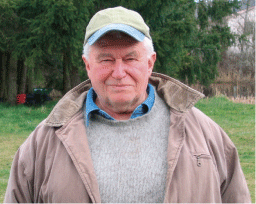
Robert Greenway is Professor Emeritus in Psychology at Sonoma State University, Rohnert Park, California. He has explored human-nature relationships for over 40 years. In this wide-ranging interview, Robert discusses his personal history; the development of his wilderness expedition program at Sonoma State; his thoughts on science and the value of multiple modes of knowing in developing an authentic language of human-nature relationships; and his hopes for the field of ecopsychology. The text of this interview with Ecopsychology editor Thomas Joseph Doherty was compiled from telephone and e-mail correspondence and a visit to Robert’s farm in Port Townsend, Washington.
Ecopsychology: Robert, you have spoken of the wilderness experiences you facilitated at Sonoma State University as “a retreat from cultural dominance.” Can you say more about this? What aspects of culture were you retreating from in the late 1960s and 1970s? What aspects of culture do you think people benefit retreating from in 2009?
Robert Greenway: The simple answer is, having come through some very deep-level learning experiences in the 1960s—much of it fighting various oppressions, imagined and otherwise—I saw “culture” as a box, a set of constraints, “mechanisms of repression,” and I saw the universities in general as supporting that culture. So, given a unique freedom at Sonoma State, sensing immediately that the students were in a rebellious mood, and wanting my teaching to be “real”—to be rooted in real self-exploration rather than being entertaining, or just going through the usual academic motions—I justified the wilderness work by seeing it as “a retreat from cultural dominance.”
The roots of this go back to my childhood. I had fought my way out of a very dysfunctional family and then fell in deeply with a very good and eclectic psychology department; had my own family at a very young age; drove taxis at night to support the family while a graduate student at Brandeis; fell in with the Peace Corps as a “trouble-shooter” and was sucked into very radical student movements (CIA infiltration, and all that); and ended up on a career track at University of California Santa Cruz to be groomed for a high academic leadership position, from which I was fired—all this prior to Sonoma State. So the idea of “retreat from cultural dominance” was probably as much a quest for simple freedom as a “reconstruction” of my own wounded and embattled “self-system.” And I found little room in “the culture” or in “academia” to undertake this kind of exploration. The job at Sonoma State University was very fortuitous, as its psychology department granted me freedom to develop the wilderness courses—and I think it worked out very well. I’m deeply grateful to my colleagues there, then and now.
To compare that with, say, 2009 is almost nonsensical. Of course, I now see “culture” in a much more nuanced and multilayered way—so much that is good, so much that is pathogenic. I see, now, “the wilderness experience” almost as an escape from the cultural reformation work needed, from reforms needed for survival of life on the planet. Wilderness-as-therapy seems (in my more cynical or frightened moments) as an indulgence—an experience primarily available to a relatively wealthy tiny minority of the planet’s human population. Still, on the other hand, there is an ancient and, for the last 100 years, intense program to link up “mind” and “nature.” I see the grip of the mental “dualistic habit” still tightly wrapped around the Western mind and I know, from former students, that immersion in the wilderness loosens that grip.
EP: As a former wilderness therapist, I’m curious about what you think of programs that perform mental health and substance abuse treatment for adolescents in backcountry expedition settings. In the current nomenclature, many of these programs refer to themselves as “outdoor behavioral healthcare.” How is this different and how is this the same as some of the trips that you led?
RG: My wife works at such a treatment center [Gray Wolf Ranch] and some of the wilderness techs work on our farm—so I know that program well, and several former students work in such programs as well. From the narrow perspective of addiction therapy, I think at least some of the programs work very well—although I see a wide range of approaches and qualities among the programs I’ve looked into. To oversimplify, I think the “grip of the dualistic culture” permeates the lives of kids growing up in America. Coupled with exploitative (or absent) parental parenting, it creates a high incidence of behaviors—behaviors attempting to connect in self-destructive ways—that can easily fall under the sway of psychological or substance addiction. Again, the removal of the usual (and very constant) cultural conditioning when one is in the wilderness sometimes jolts the psyche out of patterns behind the addictive dynamics—but usually only superficially, unless followed up with considerable “reconstructive” therapy upon return from the wilderness. Most of the programs I’ve seen seem very naïve to me. But then, when “wilderness becomes the teacher,” that’s a pretty potent teacher. So, “seeds of harmony and connectedness” can get planted, sometimes not bearing fruit until quite a long way into life.
I learned to make two very clear distinctions in my university-based wilderness trips: (1) they were NOT therapy, and (2) we weren’t going into the wilderness for our personal (read, “narcissistic”) healing. The wilderness was doing fine without us. We were entering into “sacred space” or fully functioning communities, and we were there to listen and learn. At first, I pushed lots of rituals, and then realized that, in 2 and 3-week trips, I was creating conditions so incompatible with students’ “normal” lives that they might not be able to readjust. So, I pulled back, realizing that “just learning to discover the wilderness as teacher” was plenty, and could be a lifelong benefit.
EP: Various writers have provided history of your work on “psycho-ecology” dating back to 1963 and some of the influential thinkers that you studied with in your training (e.g., Abraham Maslow, Erik Erikson, Rollo May, Carl Rogers, Aldous Huxley). Take us back in time for a moment to some memories of your graduate training and influential people and events for you.
RG: My “ecopsychology” is clearly rooted in childhood. I became a very intensive gardener as a boy (the Japanese gardeners were all carted off to concentration camps). There was a huge void (in Oakland, California), and I filled it. I learned gardening via “Victory Gardens,” developed a museum in the basement, raised pigeons—just really fell into “nature”—and had a few extremely momentous epiphanies—clouds parting and God talking to me—or later, as a very unhappy teenager, living in Seattle by then, running off to the Cascades to end my life, and instead of freezing to death just getting pissed off at the wet snow, waking to a glorious morning high in the mountains, stuff like that. So, then I hit Brandeis … A long story and very funny actually: I had four children by that time. I got into a big argument with this nice furry guy in the middle of the night at a conference on an island off New Hampshire. The conference was “religion in an age of science.” I was covering it for the Bulletin of Atomic Scientists. (I had been an editor and science writer at Stanford Research Institute after college.) It turned out the guy was [Abraham] Maslow, and he invited me to come and be his writer and “He’d get me a PhD.” Sounded good to me. But it was weird, as I’d never had a single psychology course—only ecology and biology—and Maslow and I never got along too well. But I absorbed his work. I had to, as his ghost writer, and the Brandeis psychology faculty was just fantastic—Ulric Neisser, James Klee, Richard Jones—they were very eclectic. Stars like Erik Erickson, [B. F.] Skinner, [Carl] Rogers, and [Aldous] Huxley would visit the graduate seminar almost weekly. I loved every second of it. That was the context—passionate integrative growing up within major natural systems—that is, “ecology”—and then a kind of rebellious anti-behavioral, anti-Freudian but very diverse psychology—lots of cutting-edge stuff, while deeply trying to enter in to Maslow’s mind. I read widely, while driving taxis at night all over Boston (I never slept) and somewhere in there I read “The Mind as Nature” by Arthur Koestler and had another life-changing epiphany. I knew that the title alone would set a path for my life—that most branches of the field of psychology either didn’t acknowledge “the mind” at all, or else attempted to study it via objective approaches, when, all along, “mind and nature” were obviously integrated. I began reading Aldous Huxley intensely, found great resonance in the experiments going on at Harvard at the time, worked at the Harvard Center for Cognitive Studies, and realized (romantically and hopefully) that we were on the brink of great changes and insights into the broken human–nature relationship—that “the break” was an illusion, but a very devastating one—and, again, found resonance on all sides—bridges as it were—in gardening, in intensive sexual practices, in meditation—and more and more in Buddhist doctrines—especially Tibetan Buddhism—fellow travelers all over the place—sailing journeys across the pacific, deep immersion in Native American rituals, [Stanislaus] Grof, the shaman movements—and deep grounding in John Dewey (a crystal clear exploration of dualism) and Gregory Bateson, whom I came to know quite well in his last days at Esalen Institute. Those are just a few of my influences.
EP: The counterculture of the 1960s and ‘70s seems to be inextricably linked with eco-psychology, can you speak to this?
RG: All I really know is that the various movements of the 1960s gelled my own interest in ecopsychology. I always called it “psycho-ecology” until around the middle of the 1980s, when Ken Wilber laughingly told me that “psycho-ecology” sounded “kind of crazy.”
From my perspective, the rich levels and rapid personal and cultural evolutionary flows of the 1960s have not been fully plumbed. There had been huge pent-up energies of injustices, racial injustice of course, but all the other chauvinisms as well—women, students, corporate power—all reflecting dualistic forms of thought, all reaching some kind of denouement. I believe humanistic psychology (and the quick morph into transpersonal psychology) was a crucial force. Drugs, of course—and the cross-cultural experience of thousands of Peace Corps volunteers, and hundreds of thousands of returning Vietnam veterans. From all sides, rigid cultural forms were dissolving. To be in the middle of that, and to be a “nature-boy psychology student” made the recovery of a healthy “human-nature relationship” (the essence of ecopsychology) just one of many healings that were taking place.
EP: You have spoken of a “wound” or “flaw” or “mistake” in our psychological makeup, an “activity that has been fundamental to our evolutionary survival and now has become an instrument of our demise.” Can you speak to this? Is it necessary to think in terms of injuries or wounds to understand how humans interact with the biosphere and the natural environment?
RG: Well, to answer your last point first—yes, if “the wound” stands in the way of healing—which I think it does. “Green-washing” is just one example of the superficiality of attempts at creating mass movements that will “save the planet.” I take “the wound” to be the dualistic illusion that humans are “above” or “separate” from the natural world. And I mean here a “radical dualism”—not just two pairs of something (i.e., men and women, etc.) but distinctions that become disjunctions. If the world is “one” or “whole,” these disjunctions are illusory. But we act on them nevertheless, and so they create severe distortions of reality—for example, that humans are really separate from nature—“the terrible illusion.”
There are two ways (at least) to deal with this. We can assume that all human creations—cities, cars, roads, etc.—are also “nature,” or we can assume that our cultural artifacts—beautiful as some of them are—have created an illusion that we are separate from any evolutionary flow. Or, we can assume that healing lies somewhere in between—by using our artifacts, but with restraint, and within some kind of deeper awareness of just how nature works. In other words, instead of playing dumb—and just blindly “saving all the trees” or “preventing the death of whales,” we might use our rapidly expanding consciousness to explore in much greater depth just how consciousness (loosely speaking “mind”) interacts with, say, whales, watersheds, butterflies, and bacteria, etc. This, to me, is the place where ecopsychology has a huge contribution to make—if it could get its act together.
EP: In other places you’ve spoken of ecopsychology as a necessary “language.” Is it possible to think of environmental problems as resulting from improper language?
RG: Yes, as a student of metaphor, I’m a believer in the immense power—not just utility, but the creative power—of words, symbols, and narratives to heal the dualistic program. I think there are stories and ideas couched in words that have tragic consequences. The 20th century, until the present, was loaded with such mistakes. Because language has been used as a tool for oppression, many young people since the 1960s decided that language itself was the villain, throwing out the baby with the bathwater.
Dewey’s Experience and Nature is very useful in this regard. To what degree can we escape cultural habits—via drugs, wilderness, and meditation, tantric this or that—and find language (mathematics? music? poetry? new metaphors?) that depicts accurately what we “know so far” about the dynamics of the various systems in which we’re immersed? For these reasons I feel that language is central to an ecopsychology that will not reflect cultural programs that got us in this fix, but will provide tools for recovery. Language can do that, but most likely it will have to be poetic or musical uses of language.
EP: In our previous conversations, you spoke of a number of principles for ecopsychology (e.g., How does one define nature? What is the relationship between psychology and other fields?). Can you identify some of the key principles that you see as necessary for an ecopsychology?
RG: There is no common definition of “ecopsychology.” To many, in and out of academia, it has come to mean any or all of the following: a kind of “pop psychology” or quasi-therapy that helps ease fears about the decline of the “natural world”; just about any kind of environmental-social or environmental-political topic; gardening; hikes in the wilderness; fishing; or anything to do with “humans” and “nature” (with “nature” usually meaning something separate from humans).
I work towards an ecopsychology that will find within language an accurate articulation of the human-nature relationship. This will of course be based on experience, but will be couched in language, and perhaps deepened by ritual and art. It must take up the deepest meanings of relationships in general and relationships between “mind” and “nature” in particular. It will be based on a variety of “modes of knowing” (neither ignoring nor privileging science). It must not be within the constraints of a particular psychology nor within a specific natural history discipline, but will be “integral,” in that it will draw insight from all past and current attempts to depict “nature” from the human perspective.
If ecopsychology is meant to accurately depict the human–nature relationship, it must rise above and beyond configurations and communities of thought that are embedded in the dualistic illusion. Ken Wilber’s work with his colleagues Sean Hargens and Michael Zimmerman (see Integral Psychology) attempts to do this by pulling together all psychologies and philosophies. This is bearing fruit as an overall map, but most of the elements comprising the map are, at base, dualistic. One wonders whether integrating all dualistic psychologies will lead to a nondualistic (or, in their words, “transcendent”) ecopsychology. Is this important? I think so, if a critical healing of the human-nature relationship is to take place, not just at the experiential level, which happens rather easily already, but at the “fully mental” (symbolic) level as well.
EP: Can you speak to how you have addressed the need to document the results of your wilderness therapy work? You question the perspective of a discrete self or consciousness separate from a larger consciousness or mind. How can we make use of empirical methods while also recognizing the limitations of reductionism?
RG: Those are cosmic questions, and we could certainly write a book about both of them. I really was imbued with the idea when I was working with Maslow that we’re all pioneers and we’ll leave it to others to do the work to pin down the theories and assumptions. But I did do extensive follow-up studies of several thousand wilderness students.
I’m ambivalent. Though I love science and was scientifically trained in my initial academic work, I’ve never been able to shake the belief that science based on data—not the theoretical or meta-science aspect, but the data collection—this very reductionism is at the very heart of the human–nature relationship problem, which ecopsychology hopes to at least clarify, if not fix.
So I’ve adopted multiple modes of knowing. I like that idea very much. I find truth in music and other forms of knowing along with empirical science. To advance our understanding, we shouldn’t submit to the favored status of science over other modes of knowing. This, of course, places me in the status of not only a nut, but also a poet over scientist, mystic over data, etc. That saddens me, but I see no way out of it. Ken Wilber has been a great help on this in his writings on multiple modes of knowing, and especially his book The Eye of Spirit. I think he’s got it right, and so I’m pretty much in that camp.
EP: What you’re speaking to, especially in the first part of your response, goes to the challenge of the Ecopsychology Journal, which is to do our best at honoring multiple modes of knowing. I think using pluralism as an underlying philosophy is one imperfect but helpful direction. Do you have any response to that?
RG: That’s a very big topic and has been a very favorite topic of mine throughout the years. I saw the emergence of ecopsychology in my own self in the 1960s, and I realized a lot of it had to do with reading nature and natural histories. Gary Snyder was coming on the scene about that time, and he, for me, is as much a father of ecopsychology as anyone else I know of. So the roots of ecopsychology, as I see it, are many, and poetry is one, and science and nature study are others.
The problem with something called ecopsychology is, on the one hand, you have ecology, which is a fairly tough empirical science, and, on the other hand, you have psychology, which, as you know, is a mess of different fields ranging from mystical fields to very tough empirical science. So the question becomes, which psychology are you willing to pick? And that’s why ecopsychology is all over the map, because if you pick transpersonal psychology, you’re into meta-psychology and meta-theories and quantum this and quantum that. And if you pick behaviorism, you’re into, you know, “Where’s the data?”
So ecopsychology, in my opinion, has never been able to get itself together because of the variety of psychologies, let alone a real ecology that means more than just “nature.” So I think “ecopsychology”: I’d love to drop the term. I’d love to work on the human–nature relationship without being bound by the biases of this or that psychology.
EP: It’s been helpful for me to think of ecopsychology not as “ecology-psychology,” which would be literally the bridging of two very different and diverse fields, but as “eco-psychology,” psychology placed in its biospheric, ecological context. I think that frees us from the obligation—the naïve idea—that we’re actually going to link these two fields. Any reactions to that?
RG: Off the top of my head, I probably would disagree with that on a couple grounds. I have argued for many, many years that ecopsychology is not just another psychology. But most of the people interested in ecopsychology are either therapists or psychologists. So they’re always trying to claim ecopsychology as a type of psychology. I’ve always wanted to resist that, because I think it’s something unique. I would like it better if it was a linking of the two fields, as long as ecology meant almost a Buddhist kind of systems study, which for some ecologists it does, and as long as the psychology was, say, transpersonal or at least humanistic psychology. But then again, I’m biasing it. That’s why I throw up my hands and say “I think we’ve got a unique field here by the tail.” To try to resolve which psychology it is, or if it is the linking of the two fields, is sort of an endless circular kind of argument.
EP: I really like that last quote about having a new field by the tail. It captures some of the difficulty for new people coming into this field. I just spoke to an undergraduate student in environmental studies who is interested in trying to get involved, and it’s challenging to orient a young person with all the back story that you’re well familiar with. So it is still an open question and quite interesting and daunting. I can see where you would want to throw up your hands.
RG: Yes. The courses I taught on ecopsychology (i.e., “psycho-ecology”) involved a 2-year series of courses—the back stories as you call them—wilderness excursions, yoga and meditation classes, and a combing of various fields of psychology and ecology that seemed to provide insight into the human–nature relationship.
But I totally agree with you. I mean, it’s such a fascinating field, and if the earth weren’t at stake, it would be a lot of fun just to spend another 50 years or so rambling around about all these various issues that the field brings out. That’s another issue that I didn’t see in your questions, but there’s incredible pressure on this field and on young people groping to find something meaningful to do about the state of the environment. And they hear “ecopsychology,” and that resonates with them: “Aha. This must be what I’m looking for.” And I’ve seen many of those students become very disturbed and disappointed when they find out that nobody can quite tell them what ecopsychology is, or even how to help create it in a way that gathered together a “community of depth.”
EP: Yes, I can identify with that last point! One of your ideas that I found most helpful when I did wilderness therapy work was being mindful of crossing the boundary from the front country to the back country. How are you attentive to this boundary in your life now and how does this manifest in your work on your farm?
RG: I had to chuckle (wryly) at this. Having spent years out-hiking the “guys” in my wilderness classes with 80–90 lb packs, I’m now pretty decrepit and don’t go into high altitude much anymore—which I deeply miss. I’ve been doing this little farm for 18 years or so. I found a place with six acres right in the middle of town, and nobody seemed to want it—terrible soil—and I started digging a garden. It had everything to do with ecopsychology, but it was a parallel universe, almost, to wilderness work. And I began discovering that and got fascinated with it and became obsessed with the garden. It got out of control and turned into a three-and-a-half acre French biodynamic method, super-intensive, high-productive organic farm. We sell at the farmers’ market and at the local restaurants and could grow enough food for about 100 people year round if we wanted to.
And somewhere in the middle, I was out crawling around on my hands and knees, which I did endlessly, and I felt this longing to go to the wilderness just come roaring out. When I looked up, I could see the Olympic Mountains. I crawled up to the roof of my house and was sitting up there looking at them and looking at the farm in front of me. I remember thinking, “My God, I’m spending my life killing the wilderness instead of hanging out in it. What am I doing?” It was kind of a joke, but it’s what I felt when I realized the kind of weed control it takes to do farming. You’ve got to control the weeds, and that’s the wilderness pushing up against your little cultural rows of things all over the place. And I stayed with it. It’s a deep political commitment now that local food has become a rage across the country, and we’re one of the pioneers in the local community and a deeply respected, small but potent farm. And so it’s been a whole other phase of my life.
I find incredible beauty in the farm, incredible beauty in at least certain aspects of our culture (I’m a closet musician), and I do not think our salvation rests in slavish adherence to what we think of as “nature”—for the very reason that most or all of those views of nature are projections from our still-imprisoned dualistically-besotted definitions of nature (that problem with language again).
We have snow on the ground, right at that borderline—the ecotone—where water freezes. We’d been planting and getting beds ready to plant for the past few weeks—caught once again in that “false spring” that we always seem to get towards the end of February.