




Abstract
Abstract
We as a species are losing rich and diverse forms of interaction with nature: the awe, for example, of encountering an animal in the wild or a slug underfoot, of sleeping under the night sky, or of even seeing the night sky in our urban settings. The loss is happening quickly (in terms of decades) and potentially impoverishing us as a species, physically and psychologically. Toward addressing this problem, we propose a new research agenda that is focused on generating what we are calling a Nature Language—a way of speaking about patterns of interactions between humans and nature and their wide range of instantiations, and the meaningful, deep, and often joyful feelings that they engender. Many of these patterns presumably emerged during the course of our evolutionary history. In this article, we share some of our initial thinking about a nature language so as to initiate dialog with the ecopsychology community. If a nature language project proves successful, it will allow people to speak more readily and comprehensively about what is beautiful in our relation with nature, and what is missing but still possible if we change course.
Introduction
When this form of conversation happens, we usually try to articulate to the person the experiences in nature that the person would enjoy. Perhaps we will mention the experience of walking along the ocean's edge with a friend, a dog, or a child, or picking and munching on huckleberries on a hot summer's day. We might speak of the awe of encountering an animal in the wild or a slug underfoot, of sleeping under the night sky, or of even seeing the night sky in our urban settings. We might point out that all of us have lost many profound experiences with nature. Few of us, for example, have experienced the plethora of winged life. Muir (1976) wrote of experiencing the now extinct passenger pigeons:
I have seen flocks streaming south in the fall so large that they were flowing over from horizon to horizon in an almost continuous stream all day long, at the rate of forty or fifty miles an hour, like a mighty river in the sky, widening, contracting, descending like falls and cataracts, and rising suddenly here and there in huge ragged masses like high-splashing spray … (p. 45)
We try to convey such experiences because we are convinced—like many readers of this journal—that all of us in the 21st century have lost and are still losing deep and meaningful ways of interacting with nature. But our responses such as those above have always been happenstance. They are whatever might occur to us at the moment.
In this article, we offer the beginning of a more systematic response. It involves generating what we refer to as a Nature Language. At this early junction in our thinking, this language would be comprised of deep and meaningful patterns of human interaction with nature, many of which emerged through tens if not hundreds of thousands of years in our evolutionary history. For example, one likely interaction pattern involves being recognized by a nonhuman animal. One instantiation of this pattern can be seen in the following account from an earlier article in this journal (Kahn, 2009):
The bear came back a few days later. I was quiet in the kitchen and watched him lumber onto the porch … He ambled the length of the porch, and turned partly around, where he could look through a window into the kitchen. That's what he did. We were now a few arm's lengths from one another. That's when our eyes met. Me to him, bear to me. Then I felt the explosion. It was a jackrabbit's jump in a bear's body: muscle and power and mass in motion. (p. 43)
Other instantiations of this pattern happen with wild animals in an unlimited number of contexts: encountering a dolphin or a whale at sea, an elk or moose holding their ground in the forests, a rattlesnake rattling its presence as we walk a desert landscape, or the eye of an alligator along a swampy edge (Fig. 1). This pattern can be instantiated in a domestic form. Many people find it meaningful to come home from work and to be greeted, for example, by one's puppy, perhaps with it jumping and spinning, with tail wagging. In turn, this pattern can be enacted in what we are calling a “perverted” form. For example, if you go to a zoo, you can sometimes see a child, or even adult, throwing food or a pebble at an animal, such as a lion, leopard, or great ape—even when the signage says not to. The person is trying to get the animal's attention. Why?
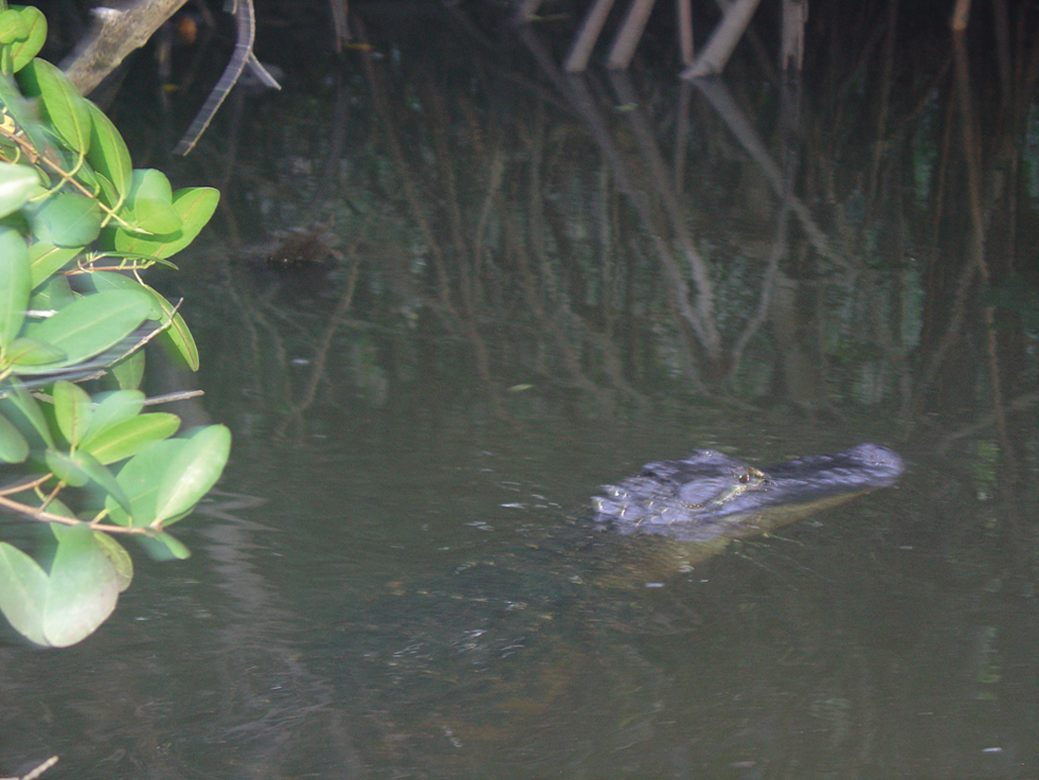
Being recognized by a nonhuman other. An alligator looks back toward the photographer. Photo credit: Jolina H. Ruckert.
We think it is because for the entire history of our species we have not only been aware of wild animals, but aware that they have been aware of us, and the desire for this wild form of interaction persists today.
We share our initial work on generating a nature language. Our ideas can perhaps best be read with an extra measure of the reader's generosity, recognizing that this is only the very beginning of what we hope will be a long-standing conversation.
Possible Interaction Patterns and Instantiations
Our framing of a nature language draws in part on Christopher Alexander's work in architecture, wherein, over decades, he and his colleagues generated 253 patterns in the built environment that they believe engender meaningful human living. For example, one of their patterns is titled “Light on two sides of every room.” They write: “The importance of this pattern lies partly in the social atmosphere it creates in the room” (Alexander et al., 1977, p. 748). They also write that this “pattern, perhaps more than any other single pattern, determines the success or failure of a room” because “when they have a choice, people will always gravitate to those rooms which have light on two sides, and leave the rooms which are lit only from one side unused and empty” (p. 747).
For Alexander, and us, patterns are not rigid molds, as in those made by cookie cutters where every cookie looks identical. Rather, patterns embody an underlying unified structure that allows for infinite instantiations. It is in this sense that Alexander (1979) writes that patterns always have a “quality without a name,” which “let our inner forces loose, and set us free” (p. x).
We described one possible interaction pattern above: Recognition by a Nonhuman Other. To illustrate what patterns might look like in human–nature interaction, some other contenders are given below.
The winding and contoured path
Winding and contoured paths lead one forward in anticipation of what comes next and engender human interest and engagement (Kaplan, 1992; Kaplan & Kaplan, 1989). Hiking a mountainside or trekking through a forest or desert, the paths are rarely, if ever, straight. Winding and contoured paths usually are instantiated on land (Fig. 2). They can also be instantiated through water (Fig. 3).

The winding and contoured ski path. Photo credit: Rachel L. Severson.

The winding and contoured water path. The photographer is about to float on her back down this stream as it courses into the ocean. Photo credit: Jolina H. Ruckert.
Using nature to find respite from nature
Thomas (2006) has a wonderful photograph taken in 1950 of her family sitting with Bushmen in the Kalahari desert. They are all sitting in the sand in a squiggly sort of circle. Thomas points out that the odd shape of the human configuration follows perfectly the pattern of shade from the tree above them. Similarly, this pattern emerges in modern society when we step under a tree to find a brief respite from a thunderstorm or a hot summer sun, or when we sit in a smoothed groove among jagged forms of a rock in a city park (Fig. 4).

Resting using the affordances of nature in Central Park, New York City. Photo credit: Peter H. Kahn, Jr.
Reading the signs of nature
Nature provides us with various signs that, when we take notice and respond, enhance our wellbeing. We might see cumulus nimbus clouds take shape in the distance and plan our day's clothing accordingly. The sound of a rattler is always a good sound to heed. Thomas (2006) writes that for Kalahari hunters “[e]ven the tiniest sign, such as the tracks of a beetle superimposed upon a footprint of the [hunted animal], would have meaning … especially if the beetle was of a type that moved about after the day had reached a certain temperature” (p. 100).
Encountering a nature that can hurt us
It seems likely that most of us fear the fear of nature, but should not, at least not as much as we do. Personally, at least, we have found that being in nature where there exist animals that (on occasion) can hurt us or even (more rarely) kill us (e.g., mountain lions and sharks) makes us more aware of our surroundings, in a quiet and focused way. Such fear can also contribute to feelings of awe, wonder, and humility. In modern times, some people intentionally engage in dangerous activities—such as rock climbing, mountain climbing, and surfing—to engage this form of interaction with nature.
Moved by water
The push of the current, the thrust of the wave, and the flow of the river moving forward the buoyant body or the ocean pushing forward the buoyant boat: water moves us physically. The movement can be sought for enjoyment, as in the surfer slicing the waves with her board; or the movement can sustain life, as in the fishermen flowing in the same currents that push their catch.
The cycle of life and death
All experience this cycle. One experiences life. For death, it can be the child's loss of a pet, the gardener's loss of their seasonal blooms, the death of one's parents, or thoughts of the approach of our own passing.
Periodicity of nature
The naturalist Pyle (2007) writes the following:
I live where I do so I can look out or walk outside at any time and instantly be within “nature.” Of course, one is in nature everywhere, since there is nothing else. But I mean a place where you can actually see all the swallows depart on a certain day in the fall and see the first arrivals in the spring in all their joy and relief and know there is nothing sentimental in saying so. (p. 6)
Pyle is tapping into a profound form of interaction with nature that involves experiencing its periodicity: the seasons changing, the day turning to dusk, birds migrating (Fig. 5), waves hitting the shore, and the dew melting with the morning sun.
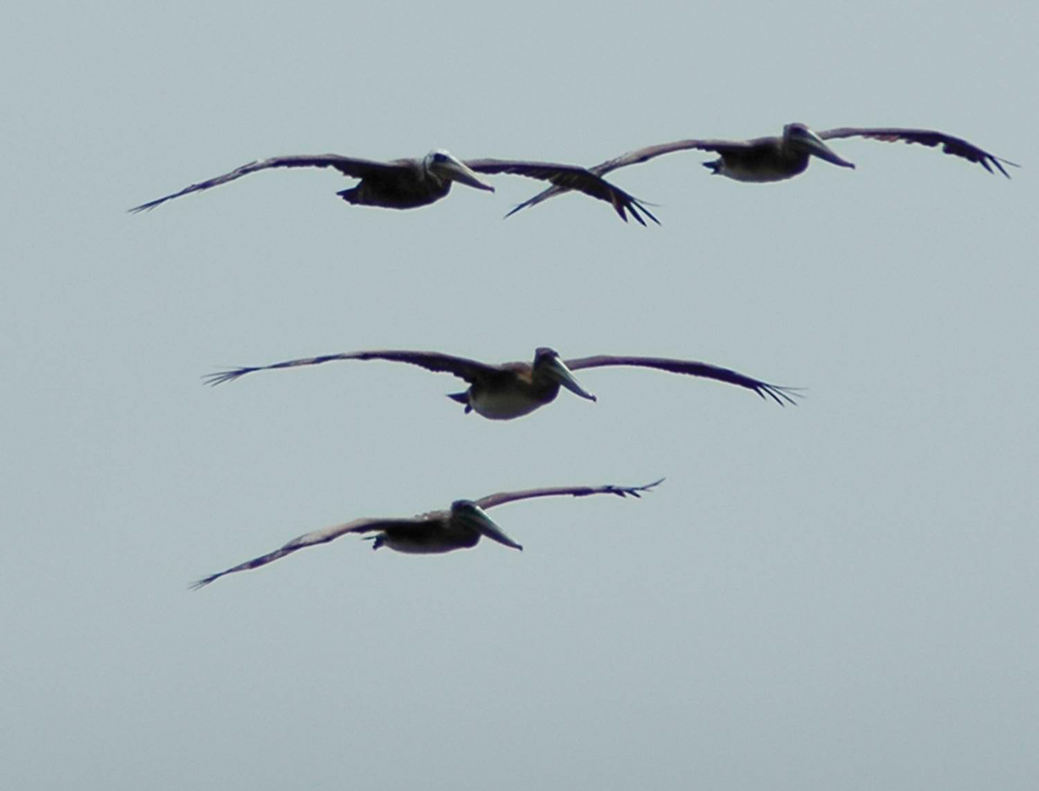
Periodicity: pelicans migrating. Photo credit: Peter H. Kahn, Jr.
Space limitations preclude our descriptions of more interaction patterns. Although we have been generating plenty of contenders, we have at this time only modest levels of confidence in our characterizations of many of them. Still, without commentary, here are a few others that likely have some merit: hunting, walking away from human settlement, cohabitation, waiting, prospect and refuge, in the grip of nature, gardening, foraging, tracking, combating the destructive forces of nature, tunneling, climbing, skipping rocks, walking, running, keeping company, following the light through a thicket, art through nature, splashing water on one's body, immersed in water, around a campfire, and under the night sky.
Characteristics of Interaction Patterns with Nature
How many human–nature interaction patterns might there be? We are not sure. Christopher Alexander worked for more than a decade and generated 253 patterns for the built environment; so perhaps between 200 and 300 human–nature interaction patterns could be an initial goal.
The reader might wonder: Are there not actually an infinite number of interaction patterns that correspond to the infinite number of ways humans interact with nature? We do not think so. What we suspect is that “new” patterns will be seen at some point in the characterization as providing very little new information to an existing pattern, and either subsumed within an existing pattern or recognized as an instantiation of it. For example, you can splash water on your right cheek, left cheek, kneecap, elbow, big toe, and so forth. All of these activities seem of a piece with splashing water on one's body and do not in themselves appear like individual patterns. Is splashing water on one's body enough in itself to count as a pattern? Perhaps. In terms of meaning and experience, this activity seems different enough from, for example, immersing one's body in water (e.g., swimming and bathing). However, we recognize that it is not at all straightforward at this early formulation of a nature language to know how to categorize all the variants of possible interaction patterns, especially those that have this form of complexity, and how best to establish the basis for grouping or differentiating them.
That said, we do think that all interaction patterns, by virtue of being patterns, share common characteristics. We highlight five here.
Interaction patterns characterize the structure of engaged and meaningful activity of humans in and through and with nature. To be clear, they do not characterize patterns in nature itself, which comprises much of the scientific enterprise, such as delineating the chemical pattern of a molecule or formulating the mathematical pattern of a black hole. Interaction patterns are specified abstractly enough such that many different instantiations of the patterns can emerge. We had mentioned this characteristic earlier, but it is worth emphasizing. As a point of contrast, imagine the pattern for a shirt that specifies the form, size, material, and color. It is a pattern, but not of the form that we are interested in, for though one could create a multitude of shirts from the pattern, the products would all be the same. Instantiations of interaction patterns are themselves infinite because there is always variation in the specific form of nature, person, place, context, and time. For example, people can watch waves crashing into a rocky shoreline (an instantiation of the pattern of periodicity) for long periods of time in part because the instantiation of each wave is always different. Interaction patterns are distinguished from the psychological experiences they engender. These psychological experiences include joy, awe, humility, fear, happiness, focused attention, surprise, thoughtfulness, vastness, curiosity, and calmness. In our initial thinking, we had conflated interaction patterns and experiences. For example, we had characterized a potential pattern as “the awe of being recognized by a nonhuman animal,” and it took us some time to recognize that the experience of awe can emerge through many different interactions, and the interactions themselves can elicit many different psychological experiences. An interaction pattern usually coexists with many other interaction patterns and dynamically brings forth many instantiations and experiences. As a rough analogy, think of an interaction pattern as a word in a language. Words have definitions. Words can be isolated. But words rarely exist by themselves. Usually words are combined to convey meaningful information and to bring forth ideas. Words can be combined in an endless number of ways. Similarly, although it is useful to generate individual interaction patterns, to help gain clarity of their forms we should not lose sight of how the interaction patterns mix and can topple on top of one another in our lived lives with nature. A quick example: if you swim in the ocean, you are enacting at least four of the seven interaction patterns sketched above. You are encountering a nature that can hurt, being moved by water, interacting with periodicity (e.g., of the waves and tides), and reading the signs of nature (e.g., of the waves, tides, and weather).
Next Steps in Generating a Nature Language
At this early junction, we see five hard but tractable next steps for generating a nature language. One step is to generate dozens if not hundreds of possible contenders for interaction patterns and, as those accumulate, to sift and sort and then to conceptualize the most comprehensive and elegant way of characterizing them.
A second step is to systematize how one even identifies an interaction pattern. To date, we have used three approaches. One approach has been to read across diverse fields, including anthropology (Nelson, 1983; Thomas, 2006), environmental psychology (Heft, 2001; Melson, 2001; Myers, 2007; Myers & Saunders, 2002; Sobel, 2002; Ulrich, 1993), biogeography (Diamond, 1997, 2005), architecture and landscape architecture (Alexander, 1979; Kellert, 2005), nature writing (Muir, 1976; Nelson, 1989; Pyle, 2007), historical accounts (Lewis & Clark, 1953), ecology (Ehrlich & Ehrlich, 2008), sociobiology (Barkow et al., 1992; Wilson, 1975, 1984), and environmental ethics (Kohak, 1984; Rolston, 1989), with an eye toward recognizing forms of human interaction with wild and domestic nature. A second approach has been to examine pictures of people in diverse landscapes and cultures. The interaction pattern Using Nature to Find Respite from Nature was generated, as mentioned earlier, from a photograph of the Marshall family sitting on the ground with members of the Ju/wasi of the Kalahari desert. Third, those that we have drawn from our own personal experiences in nature and from the experiences of people within our purview. It remains an open question what other approaches would also be valuable. One idea, which we are pursuing, is to host an interactive website where people worldwide can contribute their experiences and thoughts on interaction patterns and their instantiations, and on a nature language more broadly. We invite the reader to participate online: www.naturelanguage.com.
A third step is to extend and refine an account of the psychological experiences that the interaction patterns elicit. Notice, we have cast the relationship between interaction patterns and psychological experiences as unidirectional (interaction patterns elicit a psychological response). However, the relationship between interaction patterns and psychological experiences may be more dialectical. For example, a psychological experience (feeling sad) may motivate a pattern (sitting quietly alongside a river), which can then elicit a different psychological experience (feeling peaceful). When we say that interaction patterns engender psychological experiences, it should be understood that we have sought for now to simplify the problem space.
A fourth step is to identify “keystone interaction patterns.” In conservation biology, a keystone species refers to a species that has a disproportionate benefit to its environment relative to its abundance (Mills et al., 1993). Similarly, if it was the case that certain interaction patterns provide disproportionately large benefits to human wellbeing and human flourishing, then they would likely warrant special consideration in, for example, educational curriculum, urban design, and environmental policy.
Finally, a fifth step is to begin to validate a nature language. Perhaps the most common empirical approach to validation is evident in psychometrics, where the goal is to provide a warranted interpretation of a measure (Cronbach, 1971; Cronbach & Meehl, 1955; Messick, 1989, 1995). For example, in psychological and educational testing, one might collect data on school performance and intelligence quotient (IQ) and attempt to validate the conclusion that IQ predicts school performance. Notice that it is not the case that IQ itself is valid or not valid (Messick, 1995). Rather, the proposition is that IQ can be used to accurately predict something else, and once that something is specified, then whether that conclusion is warranted can be assessed. Similarly, from the psychometric standpoint, it is not sensible to ask whether an interaction pattern, or more broadly a nature language, is valid or not valid. Rather, we would need empirically to propose and test specific hypotheses. For example, it could be hypothesized that people flourish more in environments that correspond to wild patterns. To test this proposition, we would need to develop a measure of “human flourishing,” and then compare the wild and domestic instantiations of the same set of patterns using this measure. In addition to psychometrics, there are other approaches to validity that include what we have elsewhere termed philosophical validity, literary validity, modeling validity, and structural validity (Kahn et al., 2010). All are worthwhile approaches to take to this problem.
Conclusion
In an interview with this journal, Greenway (2009) said:
I work towards an ecopsychology that will find within language an accurate articulation of the human-nature relationship. This will of course be based on experience, but will be couched in language…. It must take up the deepest meanings of relationships in general and relationships between “mind” and “nature” in particular. It will be based on a variety of “modes of knowing” (neither ignoring nor privileging science). (p. 50)
Like Greenway, we think language needs to be used to articulate, save, and recover the human relationship with nature. That language—what we are calling a nature language—needs to focus not just on nature “out there,” as in naming and categorizing species, but in meaningful and deep forms of interactions people have with the natural world. That is the goal of our nature language project. It is not dissimilar to an idea that Shepard (1995) had toward the end of his life, when he said in an interview:
I recently tried to identify fifty or sixty mobile characteristics of Pleistocene life that can be dealt with more or less separately. Allowances and adjustments might have to be made, but that's no reason we can't begin to identify and recover at least aspects of what we truly are. To do that we need to know more about our heritage. (p. 253)
Although we are not exactly clear what Shepard meant by the idea of “mobile characteristics,” and to our knowledge he never wrote further about this specific topic, he is pointing in the direction we think is worthwhile to go.
Let us imagine that we and others move forward with this research agenda for the next 5 years, and we generate some substantial amount of a nature language, which encompasses wild and domestic patterns of humans interacting with nature, instantiated in endless ways, and engendering meaningful psychological experiences. What would such a nature language make possible? For one thing, we could then speak with people more readily and more comprehensively about what is beautiful in our relation with nature, and what is missing, but still possible if we change course.
With a nature language, we could also show why and how we need to put human psychological wellbeing and human flourishing into the calculus of environmental discourses. As a case in point, consider the long-standing discussions about global population and the carrying capacity of our planet. These discussions often revolve around energy, food production, clean water, fertile land, human health, human life span, and economic prosperity. But rarely does the discussion center on the deep qualities of human interaction with nature. We are losing our understandings of what it means to flourish as a species. By analogy, consider animals in a zoo. Some die, unable to adapt. Others adapt and biologically live. But they do not flourish, not given their genetic code and their evolutionary history of rich and daily interactions with nature. You cannot take a lion out of Africa, put the lion in a zoo, add a few “enrichment activities,” and expect the lion to flourish. We are becoming those animals in a zoo. We are losing the knowledge that is so. Even if our planet could sustain 6 billion (or 10 billion) of us in terms of all of us being biologically alive, it fundamentally cannot support that magnitude of human population while allowing us to flourish meaningfully as a species.
Footnotes
Author Disclosure Statement
No competing financial interests exist.