




Abstract

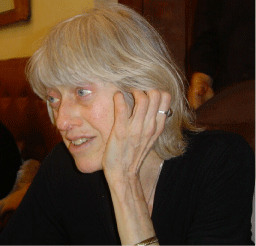
In this wide-ranging interview, psychoanalyst and author Shierry Weber Nicholsen discussed ways she addresses environmental issues with clients in her psychotherapy practice, the background of her book The Love of Nature and the End of the World (2002), and her thoughts about the benefits of a psychoanalytic perspective on individual and group processes regarding environmental issues. Nicholsen also spoke about her intellectual and professional development and current artistic pursuits as a stone carver and practitioner of the cello. She spoke to Ecopsychology editor Thomas Joseph Doherty from her office in Seattle, Washington.
Sarah Conn has spoken of ecopsychologists offering, in her words, “permission” for people to express their environmental concerns. Under what conditions does the natural environment, the “more than human world,” to use David Abrams’ (1996) phrase, enter into your work with people?
If I think about the patients that I have been working with the last few years and how the nonhuman world or the more than human world does come into the work, there are a variety of ways. There are some people for whom historically the natural world and their time in it is very important and a very solid piece of their life. And those people will talk about it in their sessions, but they won’t talk about it with pain. It will be more something that is obviously important to them, which I certainly see and confirm, and which may contrast with the difficulties of not being out in the wilderness, say, which we would then talk about. That is one way that it comes in, and that is an unproblematic way.
Another way that it comes in is people will have some very specific pain, usually grief, about, say, a beloved pet who has died or a beloved tree that has been cut down, and they may come in just plain sad, knowing they are sad, needing to express the sadness. No problem. But they may also come in saying, “Well, I feel silly, or I feel unjustified, or I feel selfish. You know, this wasn’t a person, this was a tree or a dog or a cat, whatever.” And that is a minor way in which I need to give them space to feel, to go beyond the embarrassment, and the sense of illegitimacy and feel that grief.
And then the third way—and I’m sure there are others, but these are the ones that came to mind—is that people will come and they will be very tormented by the state of the world, which often means environmental issues for them, and self-tormenting about it. “I should be doing something. I don’t know what to do. I can’t do anything. Nothing I can do would make any difference anyway. How come I’m not doing anything?” Or “I send all these e-mails preaching to everybody I know about X and Y, and they don’t respond”— in other words, the preaching or the feeling of guilty impotence.
Often, in those cases, it is a question not only of the things that they are concerned about, but also of their expectations of themselves. It is a question of feelings of impotence, of self-criticism, of a grandiose sense that they should be heroic and saving the world, so to speak, as a single person, and so forth. And the question is partly exploring that intense self-criticism, and partly getting to the point where they find what they can do that feels like a legitimate contribution.
Usually my job as an analyst or therapist is more to explore and moderate the harsh self-criticism and the despairing feeling of helplessness than to figure out with them what specific contribution they end up feeling they can make. They may come in feeling despair about the environment, but not end up doing something that is specifically related to the environment.
Along the same lines, the idea of ecopsychology has done an important service in championing the idea that emotions about the natural world and environmental degradation can be validated as normal, and not simply reduced to underlying intrapsychic or interpersonal concerns. On the same token, in my work, I have found it helpful at times to redirect environmentally engaged clients to a reflection on the dynamics in their family of origin or to the attention and repair of their current home life, or significant relationships that may be less attended to or ignored. Can you speak on how you would handle the tension between validating someone’s activism and also directing awareness back to some of their blind spots regarding their self or their family or their personal history?
So I guess I would say it is not necessarily a matter of redirecting. It is more like: What are the psychological issues that are being manifested there? In the course of the work, attention may get directed to family of origin issues or current relationship issues. But the general trend would be toward increased self-awareness, increased self-responsibility, increased use of capacities, even though these are scary and risky, in any sphere of life—but also toward increased awareness of limitations.
At the end of college and in the early 1960s, I was introduced to the work of the Frankfurt School—Theodor Adorno, Herbert Marcuse, Jürgen Habermas and others—who were very interdisciplinary, very sophisticated, social critics combining philosophy, attention to the arts and aesthetics, and validation of psychoanalysis with social criticism.
I went to study in Frankfurt with Adorno in 1965, and while I was there, I was also able to have psychoanalysis at a very cheap rate of US$6 an hour. I was very, very lucky. During that year, I listened to a lot of modern classical music, so to speak, and also had an opening in that direction. That year was probably the most life-changing year of my life. I felt that I became who I am much more that year.
And then I got to experience in the late 1960s in Cambridge, Massachusetts, and was part of the antiwar movement and part of the beginnings of that wave of feminism. In those experiences, I was working more directly with people. Then, I had the opportunity to move to California and be part of the new California Institute of the Arts. During that period, I learned from the humanistic psychology movement and the various forms of body awareness and bodywork and meditation that were part of that subculture. All of those awarenesses have stayed part of what I use in whatever I do—those awarenesses.
Then I spent a very long time in different places working with Antioch University doing adult experiential education at the undergraduate and then the graduate level. In between, I had a year teaching at a tribal college. And when I was in California, I spent a lot of time in the Mojave Desert and Joshua Tree, which were my most personal connection with nature, and actually being out in the natural world.
At Antioch in Yellow Springs, where I was teaching in the 1990s, I had the opportunity to start new graduate programs for practitioners. When we got to the third one, I said, “This is the one I want to be part of as a faculty member.” That was the Environment and Community program, which was a program for activists and people working in nonprofits and so forth, that was social science rather than hard science oriented. It included environmental philosophy and environmental psychology, and gave me a chance to teach those subjects. In the course of that experience, I had the opportunity to read a wide diversity of things related to environmental issues, and also to get to know students—not only from North America—and find out what they were doing in the various organizations they were part of. That was a tremendous learning experience for me, and all of that went into my book.
I want to add something. This will sound funny. Obviously, I am not a person who grew up with parents who went camping or spent a lot of time in the wilderness with friends. That was not me. I was not athletic either, and I have never been able to develop that very much. But something that was crucial for me in developing my environmental awareness happened in 1969, while I was in Cambridge involved in all these social justice activities. A friend, who was a vegetarian, visited me and my partner, and after spending time with him it made sense to me not to kill animals to eat them. Now I would say, “OK, if you are a hunter, yes.” But then, no. Around that time we also adopted a pair of cats. And that made a big difference. It was like, “Oh, I see. A living creature, a very interesting living creature to be respected.”
Let us talk a bit about your book, The Love of Nature and the End of the World (2002). I think it is a profound meditation on the experience of environmental issues and, as you say in your book, the conjunction in each of us of “a connection to the environment, and also to the psychological forces that allow environmental destruction to continue” (p. 1). Can you speak about the thinking and the experiences that led you to create that book?
And so when I was going to write a book about the natural environment, which I did at the invitation of MIT Press, it made sense to me to combine reflections on beauty, safety, growth, and creativity with my thinking about the experience of trauma.
The way it works in psychotherapy and psychoanalysis is that the therapist provides that kind of containing and holding for what the patient puts out and works with the patient so that the patient can have the experience of both feeling the pain, articulating the pain, and also paying attention to it. That is what we would call the development of the observing ego, which is one side of the binocular vision.
And so, in my work, I might see somebody for a year repeatedly come in and be in a rage at, say, a brother-in-law and we would talk about it and look at it from different angles, but it would still keep coming up. Eventually, my patient might say, “Yeah, I’m noticing a pattern there.” And the tone would be different. It is the arrival of an interest in examining the same thing they had been more immersed in, earlier. That is an example of the process by which the binocular vision about a particularly painful area gets developed, and it is not something you can just will. It is something that you could say grows, the capacity to observe as well as experience growth. And, of course, you have to begin by undoing the denial that you even have any emotions about whatever it is.
I will just highlight a few things from that book. One is the idea that to deal with problems that we don’t already have a way to deal with is going to require new learning, and not just technical learning. It is going to require new psychological and social learning, and that is going to mean pain. And so just as an individual patient is going to have to go through pain, painful awareness of painful feelings in order to change, so also groups and organizations and societies are going to have to deal with pain.
And part of learning is the sense of some degree of safety provided by some form of holding environment, and part of it is directed attention, and thus lack of denial. Heifetz is very helpful in distinguishing between leadership, which is functioning to start to address those learning experiences, and authority in the sense of formal authority and official position.
One of the things he says about leadership when you are not in a position of formal authority is that you get to focus on a single issue, which someone who is the head of some big organization or government body cannot do, because they are responsible to all their constituents. So, in the case of a lot of environmental work, single issue is the way to go. It provides an opportunity to relentlessly focus attention on something and think of ways to deal with it and try to get it actually done. And when something actually gets done it helps everybody to be aware that some change is possible.
And in terms of the single issue focus, the luxury of the single issue, can be, I think, a liability for a leader at times because they may miss the bigger picture or other key factors. I am thinking, in particular, of the work of Shellenberger and Nordhaus (i.e., The Death of Environmentalism) who have taken the environmental movement to task for having a small-bore single-issue focus and missing the larger dynamics of social justice, economics, and political savvy. So I think it goes both ways. I think the single issue has a shadow side.
And that would bring us back to Bion. In my personal experience—I am not sure if this has been something that you have seen—I have observed some individuals and organizations in the environmental movement and in ecopsychology falling into some of the basic assumption modes that Bion talks about. I know these are part of our experience, so it is impossible to avoid them. But I wanted to talk a bit about that, the idea of individuals falling into a dependency mode, where they are looking for a strong leader or some sort of emotional consolation, or a fight-or-flight mode, where people are looking for an enemy or a scapegoat or really falling into a despair, kind of an end-of-the-human-species scenario. And then, there is the idea of pairing, the ongoing hope for a new idea or innovation or some new social structure or movement, that will somehow solve our problems. I see some of that energy in initiatives like Transition Movement. I am wondering if you could speak a bit about basic assumption modes, and how they operate in ecopsychology or in the environmental movement.
Thinking back about my own history, for instance, I realized, “Okay, I was situated in the suburbs of Chicago with a dysfunctional family. But the Art Institute was there. I was situated in graduate school, and I was able to go to Frankfurt. I was situated in Cambridge, and here was the women’s movement. I was situated in Antioch and Yellow Springs, and, oh, we could start an environmental program.” So there are opportunities for activism, if you like, no matter where you are and what organizations or groups you are connected with.
The basic assumption groups do operate, as you say, Thomas, because everyone has an unconscious, and the unconscious has contact with other people’s unconscious. There are always these currents running through any group, and one can distinguish between the dependency, the fight/flight and the pairing tendencies. There is no way any group process can avoid having those energy currents running through it.
The issue is, can those energies be tapped by consciousness to be put to work at whatever the actual work challenge is so that you have a work group drawing on the energies of the unconscious rather than being sabotaged by those energies?
Take, for instance, the fight/flight energy. It is very useful to recognize it and to be able to say, “Hm, a lot of aggressive energy here. Can that be appropriately directed towards an actual obstacle, where strong, forceful energy is actually needed and will be useful?” as opposed to “Okay, now we’re going to rip each other to shreds. We’re going to split and denounce the Trotskyites, or we’re going to scapegoat this person or that person within the group.” The same thing goes for the dependency energy, which you also find in environmental groups who act helplessly dependent on the wisdom of the strong leader. Probably the fight/flight is the most obvious way that the basic assumption energies sometimes take over environmental groups.
And, I just want to validate what you said about the dark side of the single-issue focus. Maybe the thing to say is you can start with a single issue, but you cannot end there. And if you are not going to see the way your issue fits into the larger picture, you have gotten blocked somewhere.
And one of the values of that for me is that I am a total beginner, right? So, I have to plod along, and I really have to notice that each step follows from the step before, but it is only one step at a time, and it falls so short of the star performer whose work I admire. And I think that is, kind of, like an object lesson for anybody wanting to contribute in any way to beauty or making things better. It is one step at a time, and boy, are you limited. So that is one of the aspects.
The stone carving, if I want to take that as a contrast, has to do with making something that was not there before and that has never existed before. And that one I also have to do one step at a time. I have to really, really look and feel with my hands what I have done so far. So, my perception has to really open up in order to notice where it is dead or lumpy or whatever, stuck, rigid. And the place in it that will be the next step to take to make it better. And it is like a challenge at each step, because I am not working from a preconceived, “This is what I need to build. I know it all ahead of time.” I am working as I go along.
And I think that is precisely true of the kind of adaptive challenges that Heifetz is talking about when we take what looks like the right next step, and then we have to look around. The landscape looks a little different now. We have to look around and see what next.
These things are related to what I wrote about in my book about beauty and the arts, although, there, I wrote mainly about the opening up of perception. Here, I am also talking about the practical, about having a practice. I have to practice my cello, and I carry on the practice of stone carving. I am also talking about the way an activist would engage in practice or a therapist would have a practice.
Essentially, the artistic, the aesthetic experience that people have reminds them of the intensity and value of life energy. Ideally, anyway, people feel more alive and enlivened in aesthetic experience, and this helps them tolerate the frustrating, grubby, administrative, plodding, administrative, and technical experiences involved in working for lower carbon emissions or whatever.
And in terms of the hopes, I think issues about hope and disappointment and disillusionment are really important. It is interesting for me to notice that as I learn more and more about the world, and especially about non-Western parts of the world—which is something I am paying a lot of attention to these days—and as I get a greater picture of history, it all seems pretty gruesome. There is not much about history that makes me feel hopeful except for what I would call the freedom fighters of various kinds, who have existed throughout history, and the artists and musicians who have also always been there. They make me hopeful. I do not succeed in being hopeful about the big picture, but why should I be pretentious enough to say I can see the big picture?
I see lots of change for the better in my psychoanalytic practice. I see lots of change for the better in all sorts of people working for social justice. (As you can see, I am thinking of ecopsychology as a social justice movement in its own way.) I like very much the idea of your journal with its openness and its broad reaching out. The way you are reaching out to include research, for instance, I think is really useful. So big picture, who knows? But little picture, yes, it is good.