




Abstract
Abstract
This research investigated the associations between hegemonic cultural values, gender equality, and environmental protection. Psychologists have largely studied domination of people over other people (e.g., men over women) rather than domination of people over the environment. Ecofeminism, however, theorizes that hegemonic systems of power and oppression materialize both as domination of men over women and as domination of people over the environment, leading to degradation of the ecosystems. Consequently, we theorize that gender inequality and impacts on the natural world should be related at a national level, and that cultural tendencies to prioritize hegemonic values of hierarchy of people (rather than egalitarianism) and mastery over the environment (rather than harmony) should be related to negative environmental impacts and gender inequality. Data from the United Nations (2009) on gender equality and women's empowerment, Schwartz's (2006) assessment of cultural value orientation, and Yale's Environmental Performance Index (2008) generally support ecofeminist predictions: controlling for gross domestic product, gender empowerment is related to a country's tendency to exploit the environment, and cultural hegemonic values are predictive of gender inequality and environmental exploitation. However, gender empowerment mediates the relationship between hegemony and environmental health, whereas it is mutually predictive with hegemony of ecosystem vitality. These results may be influenced by women's representation in law and policy creation as well as by men's differential self-interest in their own health over the health of animals, the biosphere, and marginalized human groups.
“He says that woman speaks with nature. That she hears from under the earth. That wind blows in her ears and trees whisper to her. … He says he is not a part of this world, that he was set on this world as a stranger. He sets himself apart from woman and nature”
Ecofeminism theorizes that the treatment of both women and the natural environment results from an overarching, patriarchal, and hegemonic value system (Berman, 1994; Sandilands, 1991; Warren, 1997). To date, however, empirical support for an ecofeminist framework derives largely from individual levels of analysis, examining relations among individual's beliefs, and testing for gender differences in views about nature. A cultural level of analysis, instead, tests whether a broader system of hegemonic values is connected to the patterns of domination of women and nature. We propose that cultures that adhere to a larger dominance framework will be more likely to value the domination of men over women and people over the environment, leading to the exploitation of both women and nature.
Individual differences
One approach in examining the link between gender and nature is to study gender differences in environmental beliefs and attitudes. Women have sometimes been argued to be innately more in-tune with nature because of an ability to expand their presumed natural care-giving skills from children and other people to animals and the earth (Sandilands, 1999). Accordingly, studies have, to varying degrees, typically found that women are more likely than men to care about and report engaging in more proenvironmental behaviors and activism (e.g., Zelezny et al., 2000). However, alternative explanations for this link include differences in women's socialization to be oriented toward others or toward taking responsibility for ameliorating social problems (Zelezny et al., 2000). It may also be that women, being members of a low status group, are aware of and have more empathy for others in lower status groups (e.g., Kravitz & Platania, 1993; Ratcliff et al., 2006).
Rather than focusing on innate gender differences, modern ecofeminism describes relations among values and attitudes, which can be endorsed by either women or men. This argument maintains that those who endorse sexist beliefs will also endorse the exploitation of nature because positioning some groups (e.g., women or nature) as lower in a hierarchy of power promotes the advancement of others (e.g., men). Consistent with this argument, Wang (1999) found that those who endorse more traditional attitudes toward women (Spence & Helmreich, 1972) are less likely to endorse proenvironmental beliefs regarding how humans use and relate to nature (as measured by the New Environmental Paradigm, Dunlap & Van Liere, 1978). Further, rejecting traditional gendered roles mediates the positive relationship between women and the same proenvironmental beliefs (Smith, 2001). This suggests that women are more likely to be connected to nature than men because of their tendency to endorse feminist beliefs that reject domination and exploitation rather than something innate to being female.
Culture and hegemonic values
Individual beliefs within cultural systems
These studies, however, do not fully address an ecofeminist interpretation connecting the domination of women and nature. First, research assessing environmental attitudes does not measure the actual treatment of women and nature. Second, studies on gender differences and attitudes at an individual level do not examine the cultural or ideological values that support such treatment. While individual behavior is in part influenced by an individual's world views, the cultural context within which individuals live may also influence both individual and national-scale behaviors (Darnton, 2008; Swim & Becker, 2010). Specifically, cultural views may impact institutions, policies, or the behaviors of individuals within the culture, which lead to less education, agency, or power for women and increased contributions to global climate change. Additionally, the appropriate level of analysis for predictors of cultural-level outcomes is the cultural group rather than the individual (Hofstede, 1980; Schwartz, 1999). The goal of the present research is to provide an empirical test of relationships between the cultural-level values and outcomes identified by ecofeminism, which are also assumed to impact individual's beliefs and behaviors as well as the treatment and well-being of individuals within a society.
Hegemonic values
Hegemony, as defined by Merriam-Webster, is “the social, cultural, ideological, or economic influence [or authority] exerted by a dominant group” (Hegemony, n.d.). An important aspect of hegemony, though, lies in the implicit meanings and practices that often go unrecognized, making them seem natural, thus suppressing forms of resistance, but nonetheless shaping the social context (Merry, 2003). Conceptualizations of masculinity are one application of the naturalization of hegemonic values. Hegemonic masculinity refers to culturally valuing certain attitudes, beliefs, and behaviors that legitimate men's dominance by constraining and shaping power relations (Barrett, 1996; Carrigan, Connell, & Lee, 1985; Donaldson, 1993). Although there are many components of idealized masculinity, an essential process by which men maintain power is through domination of women and other men (e.g., gay men).
Within an ecofeminist framework, hegemonic values extend from dominating people to dominating nature as well (Berman, 1994; Sandilands, 1991; Warren, 1997). For example, Allister (2004) argues that it is the social construction of masculinity that values domination, rather than an innate characteristic of men, which explains the domination of women and nature. He proposes that cultures that adhere to masculine role norms and value domination are more likely to exploit both women and the environment than those that do not. Thus, cultural hegemonic values may set the stage for policies or individual behaviors that lead to these forms of domination. Conversely, cultures that oppose benefitting from the exploitation others or sympathize with its negative consequences may oppose these outcomes because they ultimately reject a larger system of hegemonic values.
Consistent with ecofeminism, we propose that there are two basic dimensions of cultural values that are specific instances of hegemony: Hierarchy of people over other people (as opposed to Egalitarianism), and Mastery of people over the environment (as opposed to Harmony) (Schwartz, 1999). Schwartz's Cultural Value Orientation Model assesses values endorsed within countries by averaging individual responses to seven scales. These values have been consistently measured by Schwartz (2006) and reflect large-scale values about the social processes used to evaluate and behave toward commonly faced problems, including the way that societies work amongst people and the way that societies relate to the natural and social world. The cultural value of Hierarchy includes beliefs about inevitable or desirable power, role, and resource distributions between people. In contrast, Egalitarianism includes beliefs that people should be moral equals and express concern for others' welfare. Thus, cultures that value domination of people over other people would be more likely to value Hierarchy over Egalitarianism. The cultural value of Mastery includes beliefs about asserting oneself over the natural and social environment to obtain personal goals or needs. In contrast, Harmony includes beliefs about fitting into, appreciating, and accepting the world rather than changing it. In other words, cultures that value domination of people over the natural environment would be more likely to value Mastery and not Harmony. 1
Research by Kasser (in press) suggests cultural level support for this theoretical framework. He argues that cultures that support self-interest over the interests of others (as defined by valuing Hierarchy over Egalitarianism and Mastery over Harmony) should show less concern for current and future generations of children, including the destruction of the environment. Consistent with this argument, Kasser found that cultural values of Hierarchy and Mastery predicted poorer current welfare of children (i.e., lower safety, health, education, or subjective well-being), and poorer future welfare of children (i.e., higher national carbon emissions). Although treatment of women was not examined specifically, these values also predicted fewer parental leave policies, which arguably reflect women's empowerment.
Present research
In this work we tested whether countries that tend to dominate women would also tend to dominate nature because both are products of a larger cultural hegemonic value system. Our first hypothesis was that the less gender equality there was in a country, the more the country would exploit the environment. We proposed that hegemonic countries set a cultural context for domination over women and nature and thus their inequitable treatment. Therefore, our second hypothesis was that countries high in hegemonic values would also have less gender equality and more environmental exploitation. Additionally, if domination over women and nature is connected because of a higher-order relationship with hegemonic values, the relationship between gender inequality and exploitation of nature (i.e., hypothesis 1) should be reduced when hegemonic values are taken into account. Thus, our third hypothesis was that when controlling for hegemonic values, gender inequality and environmental exploitation would no longer be related.
Method
Data were taken from three outside sources that, when combined, measured 60 countries globally (see Table 1 and Fig. 1 for countries used in analyses).
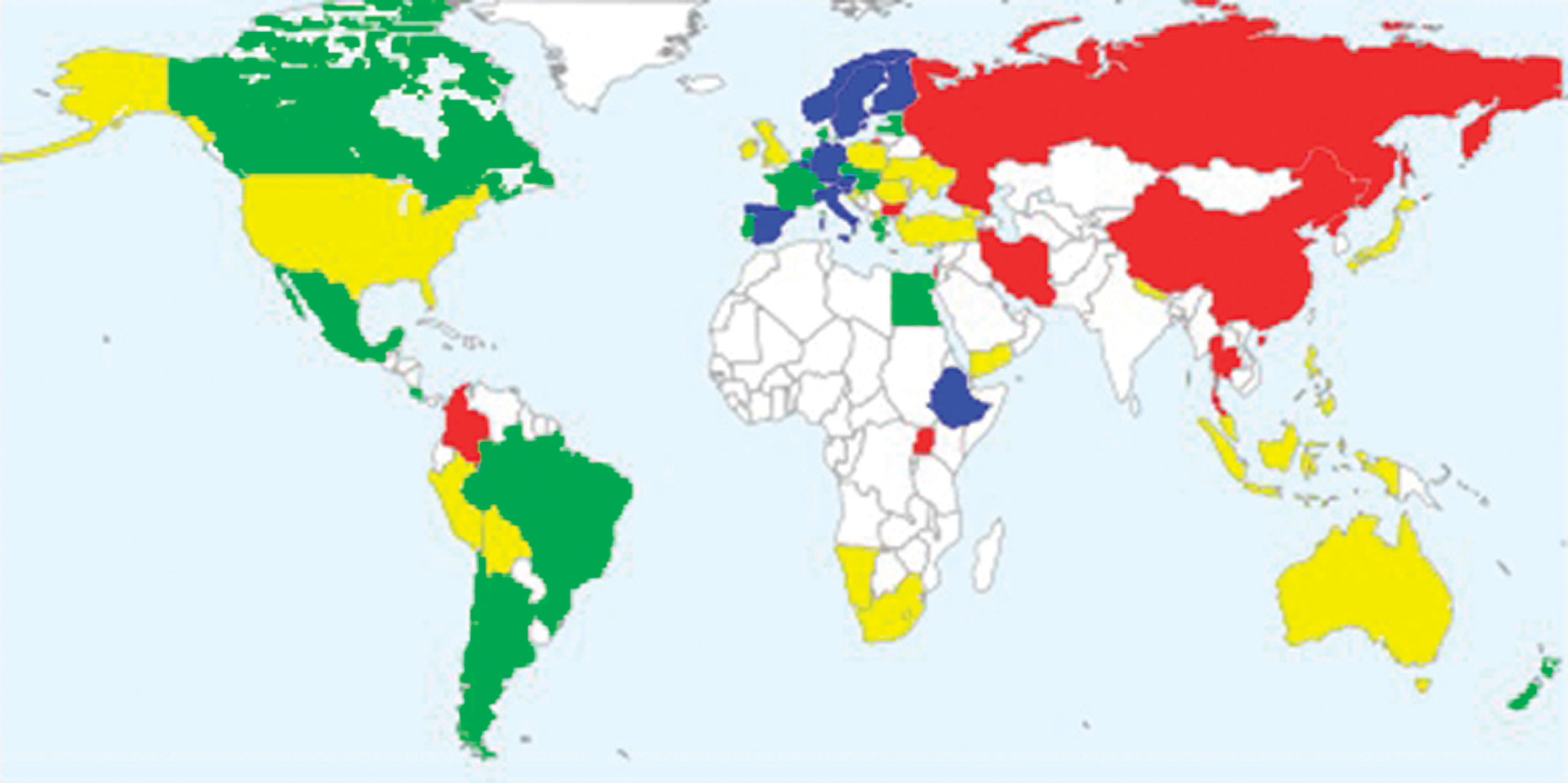
Countries used in analyses, color coded for hegemonic values. Blue represents countries more than one standard deviation below the mean for hegemonic values. Green represents within one standard deviation below the mean; yellow represents within one standard deviation above the mean; and red represents countries that are more than one standard deviation above the mean.
Countries Used in Analyses, in Order from Highest to Lowest Hegemonic Values
Hegemonic values
Country-level hegemonic values were based on Schwartz's (personal communication, May 2009) Cultural Value Orientation assessment (originally measured and validated in Schwartz, 2006). We averaged scores for Hierarchy, Egalitarianism, Mastery, and Harmony (with Egalitarianism and Harmony reverse scored) to create a hegemonic values scale (α = 0.74).
Gender (in)equality
Country-level gender equality was assessed using the gender empowerment measure (GEM) taken from the United Nations country data on Gender Inequality (2009). The GEM assesses women's power over economic resources as measured by the proportion of income earned by women; women's participation and decision-making power as assessed by the proportion of female legislators, senior officials, and managers and proportion of females holding professional and technological positions; and women's political power as assessed by shares of parliamentary seats in government held by women (United Nations, 2008). Thus, the greater the GEM score, the more agency and representation women possess, and the more gender equality they experience economically and in the workplace.
Environmental exploitation
Country-level environmental exploitation was taken from Yale's (Yale Center for Environmental Law and Policy, 2008) Environmental Performance Index. A country's overall performance is divided into two components: ecosystem vitality (a measure of impacts on animals and the biosphere, including air pollution, water pollution, conservation and protection of biodiversity and habitat, production of natural resources, and climate change-causing emissions), and environmental health (a measure of environmental impacts on human health, including clean water, air pollution, and disease). Scores are calculated by comparing each country's performance with a global target. For example, if a country meets the target at 100%, it is given a score of 100. If a country falls 20% short of the target it is given a score of 80. Thus, higher scores indicate better environmental performance, whereas lower scores indicate greater environmental exploitation.
Gross domestic product
Gross domestic product was used as a covariate in all analyses, to control for national industrialization, which is typically correlated with gender equality and a country's environmental impact through emissions. This information was obtained from the United Nations (2009).
Results
We used partial correlations to test our hypotheses, using gross domestic product as a covariate in all analyses. The results are presented in Table 2. Our first hypothesis was that gender empowerment would be associated with exploitation of the environment because both are products of a larger hegemonic system. Consistent with predictions, the more women were empowered in a country, the less the nation exploited the environment in terms of both human health and ecological systems.
Partial Correlations Controlling for Gross Domestic Product
N = 60.
p < 0.01.
p < 0.05.
GEM, gender empowerment measure.
Our second hypothesis was that hegemonic values would be negatively related to gender empowerment and positively related to environmental exploitation. Results supported this hypothesis, such that the more hegemonic a country, the lower women's empowerment, the weaker the environmental health, and the weaker the ecosystem vitality.
Our third hypothesis was that because hegemonic values should account for the relationship between gender empowerment and environmental exploitation, the relationship between these outcome variables should become weaker when controlling for hegemonic values. Consistent with predictions, when controlling for hegemony, the relation between gender empowerment and ecosystem vitality became nonsignificant, pr (56) = 0.17, p = 0.21. However, hegemonic values also became unrelated to ecosystem vitality when controlling for gender empowerment, pr (56) = −0.17, p = 0.21. This suggests that gender empowerment and a lack of hegemonic values are both necessary for promoting vitality of the ecosystem.
In contrast, the relationship between gender empowerment and environmental health remained significant when controlling for hegemony, pr (56) = 0.50, p ≤ 0.001. Yet, hegemonic values were no longer related to environmental health when controlling for gender empowerment, pr (56) = −0.01, p = 0.92. This pattern of results suggested a mediation model such that hegemony results in more threats to environmental health via a reduction in women's empowerment. Consistent with this model and previous analyses, regressions revealed that hegemonic values predict gender empowerment, β (57) = −0.48, p < 0.01, r2 = 0.27, gender empowerment predicts environmental health, and the relation between hegemonic values and environmental health went from being significant, β (57) = −0.28, p < 0.05, r 2 = 0.39, to nonsignificant when controlling for gender empowerment, β (56) = −0.01, p = 0.92, r 2 < 0.01. The Sobel test comparing the direct and indirect paths for this mediation was significant, Sobel = 2.95, p = 0.003.
Discussion
This study lends support for an ecofeminist framework regarding the relationship between cultural values and treatment of women and the environment on a national level. The results indicate that countries that endorse hegemonic values have a tendency to dominate women and the environment as reflected by their treatment nationally. The results, however, suggest that there may be different explanations for these associations when considering environmental exploitation by way of ecosystems or human health. Rejection of hegemonic values within a culture is predictive of women's empowerment and representation in government, which then leads to greater protection of environmental impacts on human health. This may be because impacts on human health are more visible, harming men as well as women, and the rich as well as the poor. Thus, when women are given a voice in government, they may be more likely to argue for environmental protection and more easily pass laws that promote the self-interest of other law makers (e.g., men, the wealthy), independent of their hegemonic values.
In contrast, both women's empowerment and a rejection of hegemonic values are necessary precursors for environmental protection of ecosystem vitality. Impacts on animals and the biosphere are also more likely to have invisible and disproportionate impacts on women, children, and the poor, due to limited access to resources, dependency on farming for livelihood, proscribed social roles, and relative lack of income, which may hinder adaptation to future environmental changes (Nelson et al., 2002). These deprivations may create food shortages or induce food hierarchies (i.e., men in the household eat first and receive better food), increase labor to obtain resources, or increase vulnerability to natural disasters. Hegemonic values often take the form of hidden or justifiable behaviors that harm those in subordinate positions rather than outright claims of one group's or individual's domination or authority over another (Feygina et al., 2010). As such, it may be harder for women in government to argue for and pass environmental laws that do not benefit those in power (e.g., men) without an accompanying cultural rejection of hegemonic values. Similar to this idea, Schultz et al. (2005) found that individual values of self-enhancement (related to cultural values of Hierarchy and Mastery) were positively related to egoistic concerns about environmental degradation (i.e., how it would affect one personally) but negatively related to biospheric concerns (i.e., how it would affect plants and animals).
Thus, it is consistent with ecofeminism that domination of nature is associated with domination of other human beings, and that a cultural rejection of hegemonic values is specifically necessary to reduce harms to animals, the biosphere, and secondary harms to people whose position in society increases their vulnerability to these impacts as well.
Limitations and Future Directions
Within-country variability likely exists (e.g., by region, community, or individuals) that would impact overall national-level measures. For example, certain states within the United States are perhaps more likely to strongly favor hegemonic values regarding utilization of natural resources, whereas others are more likely to strongly oppose such values, which may lead national U.S. ratings of attitudes about natural resource production to fall somewhere in the middle range. Additionally, the indices used to measure treatment of the environment are largely based on impacts that occur through large-scale industrialization and use of carbon-producing technology. Although we found that environmental exploitation was related to gender empowerment and hegemony, it is likely that these effects were tempered by countries that value domination over the environment but simply do not possess the ability to exploit it in the same manner as industrialized countries. Thus, some developing countries may score low on environmental exploitation despite scoring high in hegemonic values.
This study examined cultural, not individual-level, data, and it is important that measures of cultural data not be taken out of context. Although we found evidence of gender inequality and environmental exploitation on a cultural level, it is not clear whether these outcomes are products of individual behaviors that add up to impact national-scale outcomes, or if they are the product of national-scale policies. Our data do not demonstrate that cultural values affect individual behaviors that are then translated into national policies, whether individual behaviors may cumulatively make an impact on nationally measured outcomes, or what role cultural norms have on individual values that are then translated into national-scale behaviors. It is likely that national-scale outcomes are a product of all of these processes. Our data indicate that future research should therefore address effective ways of exploring and addressing the processes that translate cultural hegemonic values to cultural-level outcomes. While much research focuses on interventions at an individual level, we should also explore interventions aimed at altering cultural values and behaviors related to treatment of women and the environment. Further, studies might explore whether shifts in concern about outcomes lead to a change in hegemonic values, or whether recognizing and rejecting hegemonic values is necessary to produce concern about outcomes of gender inequality and environmental exploitation.
Finally, while this study focused on treatment of women and the environment, ecofeminism does account for the domination of all under-recognized peoples, including people of color, children, and the poor (Warren, 1997). Thus, psychological research addressing hegemonic value systems at either an individual or cultural level may be just as applicable to outcomes toward these groups as well. We venture that cultures that more strongly support hegemonic values will also be more likely to show high cultural levels of racism and meritocratic and capitalist beliefs, asserting supremacy of the rich over the poor. Correspondingly, research illustrates that values of Hierarchy and Mastery are positively related to certain characteristics of corporate capitalism (i.e., competitive over cooperative coordination) (Kasser et al., 2007; Schwartz, 2007).
This study found that, consistent with ecofeminist theory, domination of women and nature is related at a cultural level and that both are related to a larger hegemonic value system and which predict greater gender inequality and environmental exploitation. However, further research can illustrate how these processes may occur and possible interventions that may address both gender inequality and environmental exploitation on a cultural level.
Footnotes
Acknowledgment
The authors thank Shalom H. Shwartz for personally sending his most current Cultural Value Orientations data for this project.
Author Disclosure Statement
No competing financial interests exist.
1
Other research on cultural values includes Hofstede's (1980) dimension of masculinity–femininity, which addresses emotional roles displayed by men regarding concern about individual empowerment over welfare of individuals within a society. In masculine cultures, men are more aggressive, assertive, and competitive, as opposed to feminine cultures, in which men display emotional roles more similar to women, including being more caring, nurturing, and accepting of others. Hofstede (2000) reports that the masculinity–femininity dimension is related to Schwartz's mastery–harmony dimension at a cultural level. However, items in the masculinity–femininity scale more specifically tap gender role expectations, including men's differential self-interest over the interests of caring for others, rather than a cultural belief among all members of a society to value domination rather than equality and harmony. We also found that data taken from www.geert-hofstede.com/hofstede_dimensions.php for masculinity (MAS) scores by country were not correlated either with our data for Schwartz's cultural values or with country-level environmental performance index or GEM. This is consistent with later research by Smith et al. ( ), showing that masculinity is unrelated to any of Schwartz's cultural values.