




Abstract
Abstract
The intention of this work is to explore the concept of emotion regulation in nature. Natural environments can potentially have direct and indirect effects on emotional processes—directly by activating or reducing emotions, and indirectly by influencing other important processes related to emotions or emotion regulation. Executive functioning and certain aspects of self-regulation are fundamental for emotion regulation, and research indicates that exposure to nature may have a beneficial impact on these functions, for example, by making it easier to think about feelings. Research also demonstrates that exposure to nature may increase positive emotions and decrease negative emotions. In general, people may be more or less aware of the effects of nature and more or less inclined to regulate emotion in nature. However, natural environments can be used instrumentally to achieve emotional effects, and there is reason to believe that some people do so. The regulation of emotion in nature can be considered as belonging to the situation selection and situation modification stages in the process model of emotion regulation. Individual differences in how environments are perceived, and in strategies for regulating emotions, indicate that for some people the presence of nature may be central to psychological health.
Research indicates that natural environments have specific and measurable effects on everyone, that is, objective effects. However, people may be more or less aware of these effects and may turn to nature to varying degrees and for various reasons, that is, subjectively. A conceptual discussion on emotion regulation and natural environments, therefore, needs to address two related questions:
1. What are the effects of nature on emotional processes, and how can we understand them? 2. How might people use the environment for emotion regulation?
What Is Nature?
It is difficult to exactly delineate what a natural environment is. For example, one might ask how many and what kind of natural elements should be present for an area to be regarded as nature. A small park with vegetation and some trees could be considered a natural environment in the sense that it may offer at least some of the potential benefits of nature. The potential for restoration is most likely central to the use of nature, and natural environments are perhaps the most typical example of a restorative environment (Kaplan, 1995; Kaplan & Kaplan, 1989) (see next section). For many of us, going out into nature would mean seeking an environment that is different from an urban environment, dominated by natural elements, and sufficiently large for us to experience some level of absorption in this environment. A prototypical example could be a green landscape with trees, hills, and perhaps a stream, with limited or minimal human impact.
The notion of a natural environment is not unitary in the research literature. About a third of the studies on health effects and nature focused on comparing natural and urban environments (Velarde et al., 2007). Within environmental psychology, research on the effects of natural environments is often synonymous with research on restorative environments. Research may be conducted in the field (e.g., Berman et al., 2008; Hartig et al., 2003) by using films (e.g., Laumann et al., 2003; van den Berg et al., 2003) or with pictorial stimuli (e.g., Berto, 2005). Some relevant studies also have considered favorite places, where natural environments may be overrepresented or form an important category (e.g., Korpela, 2003; Korpela & Hartig, 1996). For an environment to be categorized as natural, it may be sufficient that it includes some natural elements (Korpela, 2003; Kuo & Sullivan, 2001). Related to this issue are questions regarding level of exposure: how much nature and for how long is it necessary for there to be a detection of effects? Here, the results are mixed. Mediated nature, for example, films of scenery, may not have the same effects as real nature (Kahn et al., 2009), but even pictorial stimuli of rather short durations may have positive effects on attentional resources (Berto, 2005). One study that has investigated wilderness experiences indicates that longer exposure can be related to a greater degree of restoration; the wilderness areas in this study were mountainous terrains with forests, meadows, and lakes (Cole & Hall, 2010). On the whole, it appears that more research is needed regarding the effects in relation to the level of exposure.
Restorative Environments and Emotions
Environments can influence emotional processes both directly and indirectly. One example of a direct influence could be a specific environment that tends to activate certain emotions. Indirectly, environments may influence other processes that could, in turn, be relevant for emotional processes. For example, it may be difficult to concentrate in noisy environments, which, in turn, makes it difficult to process emotions. Some environments might have similar effects on almost everyone, but there may also be individual variations. This points toward the importance of considering the transaction between an individual and the environment, as not all individuals are affected by the environment in the same way. Let us consider two persons who both become angry in noisy environments: one of them is able to concentrate and self-regulate, whereas the other cannot. Theoretically, restorative environments make it easier for us to concentrate.
Researchers often rely on two theoretical frameworks when investigating restorative environments: attention restoration theory (Kaplan, 1995; Kaplan & Kaplan, 1989) and a psychophysiological theory of stress reduction (Ulrich, 1993). These theories can be seen as complementary and are similar in that both regard natural environments as offering the potential for recovery from a depleted state, such as stress or directed attention fatigue.
Attention restoration theory considers directed attention, that is, an effortful and voluntary ability to focus and inhibit distractions (Kaplan, 1995), to be a limited resource which can become fatigued by sustained effort. Natural environments are one typical example of settings that restore this resource (Kaplan, 1995). According to Kaplan & Kaplan (1989), restorative environments have four factors or qualities which contribute to the restoration of attention: being away from your normal surroundings; compatibility between what you want to do and what the environment affords; an environment of sufficient coherence and scope, termed extent; and, finally, restoration is more likely to happen when attention is directed toward something that is interesting and yet undemanding, a concept termed fascination (Kaplan & Berman, 2010).
In general, empirical findings offer support for attention restoration theory (Kaplan, 1995; Kaplan & Berman, 2010). For example, two groups of students were tested on the digit-span backward task before and after a walk in a natural and urban environment. Research participants first performed a task designed to fatigue their attentional resources and then went for a walk either through a natural park or downtown in a city. The researchers concluded that only the walk in the natural environment restored attentional resources (Berman et al., 2008). In another study, two groups of participants were exposed to a series of pictures of nonrestorative or restorative environments. A continuous performance test, which was itself fatiguing, was used to measure sustained attention, and those exposed to restorative environments improved their performance significantly on three measures. Interestingly, performance on one measure also improved after exposure to the nonrestorative environment (Berto, 2005). The study also investigated between-group differences, and the group exposed to restorative environments scored significantly better on a reaction time measure, but differences between groups on the other measures were nonsignificant (Berto, 2005).
According to Ulrich's (1993) theory, we are to some extent genetically predisposed to prefer certain natural environments, typically environments that have been particularly important with regard to survival, food, water, and safety for early humans. Further, being able to relax and be restored in nonthreatening environments may have offered certain advantages. Due to this, human beings have innate and adaptive responses to natural environments that lead to their recovery from psychophysiological stress (Ulrich, 1993). When the environment itself was not dangerous, it may have been adaptive to respond with feelings of safety and restoration. There is also some logic in feeling safe in an environment of high survival value, because it could increase the likelihood of remaining there. An exposure to restorative environments will elicit a range of responses: increased positive emotions, reduced negative emotions, reduced physiological arousal, and decreased stress responses (Ulrich, 1993). This could also be considered a theory of emotion regulation, because it specifies the effects of natural environments on emotional processes, and because it includes preferences.
Research indicates that the exposure to natural environments may lead to reduced physiological arousal. In one study, two groups of research participants watched a film of a natural or urban environment while their cardiac inter-beat interval was measured, and lower heart rates were found in the group exposed to nature (Laumann et al., 2003). The study by Hartig et al. (2003) also supports the stress-reducing effects of nature. Although significant differences in blood-pressure readings could not be established in a comparison of those who had taken a walk through a natural environment with those who had taken a walk in an urban environment, there, nevertheless, appeared to be an effect of the environment. Further, they have found that sitting in a room with a window that affords a view of nature (trees and hillsides) reduced blood pressure more than sitting in a room without a window (Hartig et al., 2003).
Although the effects of nature on physiological measures may not be that large, the effects on self-reported emotional states appear to be greater (Bowler et al., 2010). A number of studies have demonstrated that going for a walk in a natural environment reduces negative emotions and increases positive emotions (Berman et al., 2008; Hartig et al., 1991, 2003). One study has explored emotional restoration in natural and urban environments. The research participants viewed a frightening film followed by a filmed walk through either a natural or an urban environment. The self-reported emotions before and after the film demonstrated that the viewing of the nature film increased happiness and reduced negative emotions. Some degree of emotional restoration could also be inferred from the reports by those viewing the urban film (van den Berg et al., 2003).
Kaplan & Kaplan's (1989) four components of restorative environments may be relevant to emotional responses. Research participants in one study imagined themselves in three different places (a city centre, their favorite place, and an unpleasant place), then rated their emotions, and completed the Perceived Restorativeness Scale (Hartig et al., 1997; Korpela & Hartig, 1996). All factors except coherence significantly correlated with positive affect for all three environments. Coherence, which should be closely related to extent, significantly and negatively correlated with anger/aggression (Korpela & Hartig, 1996); in other words, environments lacking in coherence may make us angry.
Emotion Regulation in Natural Environments
Emotion regulation has not been a primary focus in research on effects of natural environments, although some relevant perspectives can be found in research on favorite places (e.g., Korpela, 2003). The purpose of this section is to integrate some relevant results from environmental psychology with the concept of emotion regulation, as it is used in other areas of psychology.
At first glance, the literature on emotions and feelings may appear confusing. For example, different researchers use the same terms for different phenomena. However, Gross (1998) appears to have identified a consensus: emotions are responses to events that we evaluate to be relevant to us (by offering us challenges or opportunities), for example, losing or finding something of value, and emotions tend to lead to experiential, behavioral, and physiological changes. This is quite similar to Frijda (1988), who considers emotions to be responses to events that are important to us. These responses are subjective experiences, often overt behavior, a specific state of action readiness, and physiological changes that can support action, including hormonal and autonomous activation. Izard (2007) distinguishes between basic emotions, that is, rapid and partially nonconscious responses, and emotion schemas, which are a more complex and organized integration of cognition and emotion. These definitions could be considered as belonging to an emotions-as-entities approach. See Barrett (2006) for an important discussion on this view and on basic emotions. See also Scherer (2004) for an interesting approach where subjective experience or feelings are considered as a monitoring component that integrates all other responses. What we mean by emotions and how they are necessarily defined influence our views of emotion regulation. If feelings are seen as readouts that integrate all other responses, then they would be considered more important than if they are seen as more peripheral or epiphenomenal.
Although this may seem somewhat academic, emotion and emotion regulation can be distinguished from mood and mood regulation by differences in duration and intensity. Moods are typically longer in duration, forming something such as a background feeling (Gross, 1998; Larsen, 2000).
The environmental perspective may not have been adequately explored in emotion theory. As was stated earlier, environments that lack coherence may make us angry. Changes in emotional arousal may be needed to operate efficiently in different environments. These changes can be related to the physiological responses that support a state of action readiness (Frijda, 1988). Speculatively, a certain level of arousal may be needed to operate efficiently in a noisy environment, and this arousal could be interpreted as anger. For example, one study has demonstrated that arousal increases when undergrowth is heavier (Hull & Harvey, 1989). Emotions and environments appear to be tightly coupled.
Emotion regulation can be more or less automatic, and a more or less conscious or unconscious process (Gross & Thompson, 2007). We can choose to put ourselves in situations where we know we shall feel good, or we can choose to do something about those situations that do not have the emotional outcomes we want. We can choose to do this consciously because of previous learning, or we can do this without thinking about it. Emotion regulation can dampen, increase, or sustain an emotion, and it comprises processes that influence the experiential, physiological, and behavioral components of emotions (Gross & Thompson, 2007). A process model of emotion regulation has been proposed encompassing five families of strategies: situation selection, situation modification, change of attentional focus, cognitive change, and response modulation (Gross, 1998). The strategies take place at different stages in the emotion-generating process; the first four have been termed antecedent focused, and response modulation has been termed response focused (Gross, 1998; Gross & Thompson, 2007). Strategies may influence the onset, duration, or intensity of emotion. Situation selection involves choosing situations that make it more likely to experience the emotions one wants, but it can also be about avoiding situations. Situation modification involves changing situations once they are selected. The two other antecedent-focused strategies relate to changing what one attends to in a situation, and changing what one thinks about a situation, for example, a reappraisal. Suppression of emotional response is an example of response modulation. It is important to note that response modulation also involves behavior that may influence the situation and lead to situation modification (Gross, 1998; Gross & Thompson, 2007).
During a day, one moves through different environments and different emotions, and one may experience a need to consciously seek suitable environments and situations for regulating emotions. These processes may also operate subconsciously. For example, after a particularly stressful day, one may find oneself walking a slightly different route home than usual without having thought about it, or one might visit a particular restaurant. Investigating both the conscious and subconscious processes that are activated could be very fruitful research.
Theoretically, one factor from Kaplan & Kaplan's (1989) attention restoration theory could share features with Gross' (1998) process model of emotion regulation. Being away comprises elements of situation selection and situation modification, but where situation selection is about choosing a setting, being away is about how the setting is perceived. By employing situation selection, people may choose to put themselves in restorative environments. This point will be returned to in a later section.
There is reason to believe that antecedent-focused strategies are more effective. In addition, they appear to be positively related to psychological well being. The greater use of reappraisal has been found to be related to higher levels of psychological well being, higher levels of positive emotions, and lower levels of negative emotions (John & Gross, 2007). Schutte et al. (2009) included all antecedent-focused strategies in their study and have demonstrated correlations with psychological well being and emotional intelligence. Experimental studies indicate that emotional suppression, a response-focused strategy, does not reduce the subjective experience of negative emotion, and may even increase it. On the other hand, it appears to be possible to suppress positive emotions (John & Gross, 2004). Further, emotional suppression appears to be taxing. An increase in physiological activation similar to stress responses was found when participants suppressed their responses, but not when they used reappraisal (John & Gross, 2004). This may also apply to interpersonal regulation. When interaction partners suppressed their emotions, increased physiological activation could be observed in the (nonsuppressing) participants (John & Gross, 2004). It is important to point out that all strategies for emotion regulation can be adaptive or maladaptive; for example, with the latter, they can serve to maintain psychopathology (Campbell-Sills & Barlow, 2007). A longitudinal study followed students for almost 2 years and concluded that emotional suppression was an important strategy. Those who had the ability to use this strategy reported lower levels of distress by the end of the study. The flexible use of different strategies may be important (Bonanno et al., 2004). Several studies have demonstrated that suppressing emotions is a cognitively demanding type of regulation. Suppressing emotions increases the cognitive load so that less is remembered from conversations or pictures shown (John & Gross, 2004). Although suppressing emotions may not be beneficial in general, there may be situations where it would be more sensible to suppress an emotion, at least for a while, in order to maintain social relations or to act in accordance with what is socially acceptable. Having the ability to use several strategies is probably advantageous (see also the section on personality).
Let us return to the idea that an environment can have direct and indirect effects on emotional processes. An environment has the potential to directly increase or decrease our emotional responses. One example is the emotional effects of specific natural environments in Ulrich's (1993) theory. Indirect effects of an environment invoke other mental processes such as attentional processes, executive functions, self-regulation, or other cognitive functions, which, in turn, have an effect on emotions or emotional processes. The important factor here is that environments have an effect on these processes.
If it can be shown that, for example, executive functioning is important for emotion regulation, and executive functioning is more efficient in natural environments, then this would be an example of an indirect effect. See Figure 1 for an illustration of the ideas discussed next.
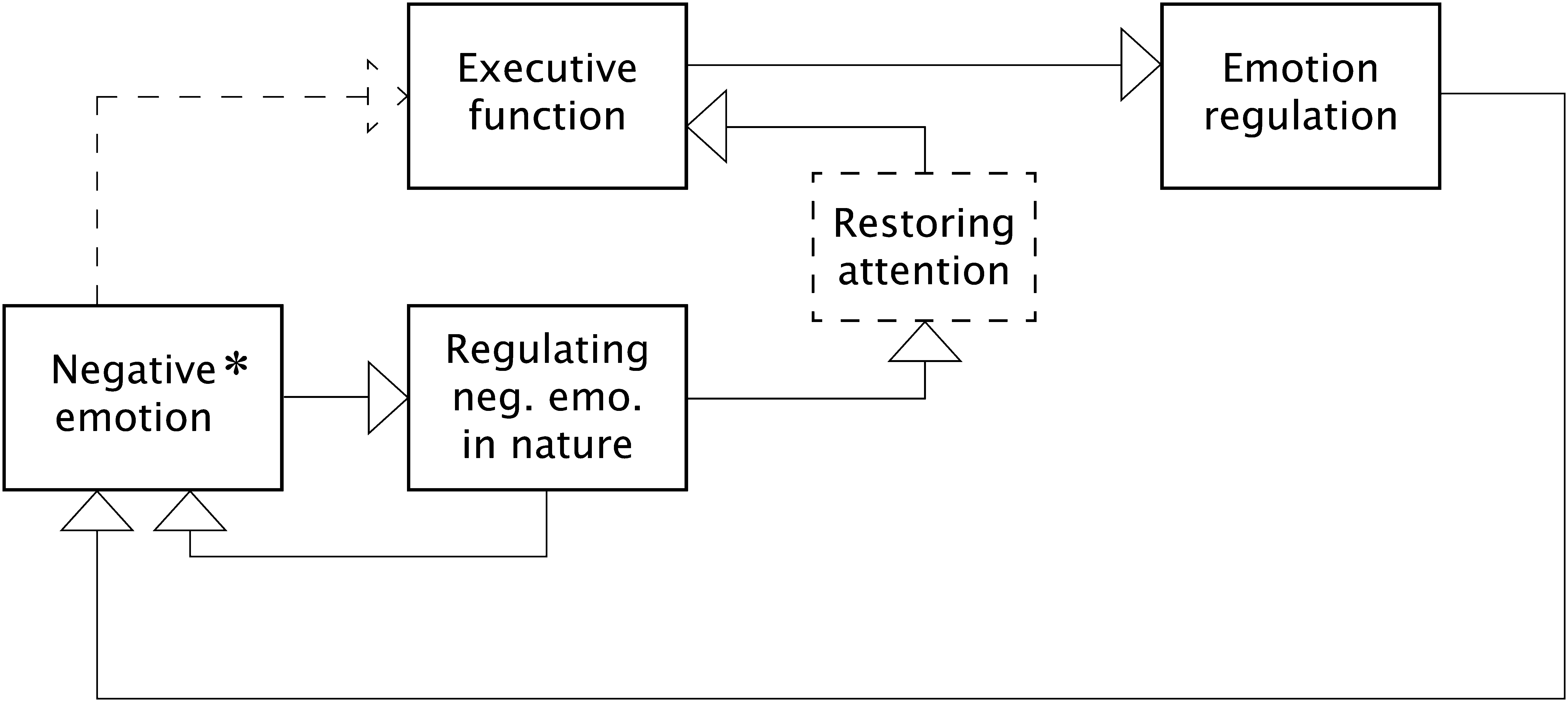
Regulation of emotion in nature (* or anticipated emotion).
Emotion regulation can be considered a problem-solving activity where one evaluates the current emotional state, defines a goal state, formulates a plan for achieving this state, executes the plan, and evaluates the outcome. Accordingly, it is dependent on executive functioning (Zelazo & Cunningham, 2007).
Kaplan & Berman (2010) have proposed that both self-regulation and executive functioning depend on a common resource, namely, directed attention. An important element of self-regulation is the ability to apply effort in order to achieve one's goals, although this ability appears to be limited and may become fatigued with use (Gailliot et al., 2008). This fatigued state has been termed ego depletion, and it has, for example, been demonstrated that emotional suppression can lead to ego depletion (Baumeister et al., 1998). According to Kaplan & Berman (2010), there is a considerable overlap between directed attention fatigue and ego depletion. Further, although the empirical evidence for linking these concepts may be somewhat limited, as indicated by Kaplan & Berman (2010) themselves, they, nevertheless, present a convincing case for their relatedness.
The developmental literature has also employed a similar concept. Executive attention refers to the volitional control of attention and includes the focus of attention on targets, resisting interference, and resolving conflicts among processes by, for example, the inhibition of inappropriate responses (Rueda et al., 2005). Individual differences in executive attention have been linked to effortful control, which is a temperamental concept and refers, among other things, to how well this ability functions (Rueda et al., 2005). A higher level of effortful control is probably related to social competence, general adjustment, and more efficient emotion regulation (Eisenberg et al., 2007). However, the concept of effortful control appears to include more than just a limited resource for self-regulation. Interestingly, a task often used in developmental literature to study effortful control and executive attention is a children's version of the task used by Berman et al. (2008) to demonstrate how exposure to nature restores attentional resources (Fan et al., 2002; Rueda et al., 2004).
One example can serve to illustrate the relevance of this for emotional processes. If one's preferred strategy for emotion regulation is emotional suppression, then an exposure to natural environments may help one from becoming too fatigued. The indirect route may also have some relevance with regard to depression. It has been shown that thought suppression may be exerted by people vulnerable to depression in order to avoid negative thinking, and since this activity is effortful, depressive episodes may occur when people are mentally fatigued, or conversely, when the cognitive load is high (Wenzlaff et al., 2002). Hypothetically, exposure to nature could also make it easier to use an inefficient strategy. Kuo & Sullivan (2001) have investigated whether the proximity to natural surroundings might have any impact on anger and aggression, because irritability can be a consequence of directed attention fatigue (Kaplan, 1995). The sample consisted of women living in a relatively poor area of a city, whose close proximity to natural elements appeared to have a significant impact on anger and aggression. The connection to directed attention fatigue was supported as well (Kuo & Sullivan, 2001). The exposure to nature not only directly impacts emotion, but may also impact other relevant processes for emotion regulation (Fig. 1). People who make use of nature for emotion regulation may not be able to distinguish between the two.
Place Attachment and Emotion Regulation
Processes of attachment and emotion regulation are highly related. Feeling safe is the goal of the attachment system, and in a well functioning dyad, emotion is regulated, for example, to support exploration (Sroufe, 1996). Morgan (2010) discusses how place attachment may develop from a child's movements between caregiver and place: positive emotions arise in connection to the mastery and exploration of a specific place, but distress leads to the seeking of the caregiver. The possible next step may be to experience safety in the place, and feelings of security did indeed emerge as a theme in the narratives reported by Morgan (2010). It may even be possible to speak of the place as a secure base, and even nature itself as a secure base, as indicated by Jordan (2009). Although an interesting idea, this stretches the concept of the secure base. However, should we follow this line of thinking, despite having some reservations, people may enter into relationships with specific natural places, feel safe, and feel soothed by being in a specific place. The use of favorite places for self-regulation may not be that uncommon as discovered by Korpela (1995): retrospective essays written by adolescents were analyzed, they seemed to indicate that people use their favorite places for self-regulatory purposes, including emotion regulation (Korpela, 1995), and so there may be some merit to this idea. Positive emotions related to mastery should be an important part of people's emotional experiences in nature.
Perceiving Emotional Affordances?
Following the evolutionary informed logic of Ulrich (1993), many of us should perceive specific natural environments as being better suited for creative thinking and reflection on feelings. Some environments may be implicitly perceived as suitable for emotional expression, whereas others are not. Thus, there may be important individual differences. For example, not everyone would feel comfortable expressing anger while standing in line waiting, but some do. In addition, some environments may be perceived as risky and dangerous and not at all suitable environments for reflecting on feelings. To some extent, a situation may afford the expression of a certain emotion. Gibson's (1986) theory of affordances considers the relation between an individual and the environment; that is to say, the fit between what the environment provides and some behavior is immediately perceived. One part of this fit is termed affordance, and it refers to the properties of the environment in relation to this behavior (Gibson, 1986; Greeno, 1994). Emotional affordance would then refer to aspects of the environment that allow for the expression of certain emotions. Although some feel free to express themselves in any environment, many of us may experience today's hectic environments as unsuitable for the expression of emotional feelings. So, an environment can not only activate certain emotions, but also afford the expression of certain emotions to varying degrees. This factor can be considered to be related to the concept of compatibility as well (Kaplan & Kaplan, 1989). Some may perceive natural environments as being better suited for thinking about important events, for deeper reflection, and perhaps for experiencing or regulating emotions. When experiencing a negative emotion, some may perceive an incompatibility with their normal environment, and seek natural environments instead. Studies by Korpela (1995, 2003) offer some support to this view, as the respondents tended to report that negative feelings or life events often preceded their visits to favorite places, and after their visits, they reported less negative and more positive feelings.
Activating Positive Emotions Is One Path to Restoration
Manipulations that elicit mild positive emotions have beneficial effects on thinking, motivation, and social perception [see Isen (2004) for a review]. Attempting to increase positive emotions can be a strategy for reducing negative emotions. Then, there is reason to believe that positive emotions can have this restorative effect, for example, with beneficial impacts on the physiological effects of negative emotions (Fredrickson, 1998; Fredrickson & Levenson, 1998). In addition, according to Fredrickson's (1998) broaden-and-build theory, positive emotions may influence thinking so that it becomes more flexible and creative. Moreover, Ulrich (1993) links this to the possibly adaptive value of being creative in specific natural environments. Thus, activating positive emotions may reduce negative emotions and benefit cognition. It has also been shown that positive emotions may, to some extent, counteract ego depletion (Tice et al., 2007).
Using Nature for Emotion Regulation
As human beings, we adapt and use our surroundings in various ways. The idea explored here is that different environments could be used as a means in order to achieve emotional ends. Specifically, the central idea here is that some people may utilize the natural environment as an environment conducive to emotion regulation. Another example of this view can be found in research by Korpela (e.g., 1995, 2003). This depends on their knowing something about the effects of nature. This kind of knowledge is an important component of effective emotion regulation (Wranik et al., 2007). It is not necessarily the case that people are completely aware of all the effects that nature has on them, nor of the processes that lead them to spend time in nature. All the same, some level of knowledge should be an important part of an environmental usage perspective on emotion regulation. In addition, proximity to nature may be relevant.
We like some environments better than others. The motivations for approaching certain environments and avoiding others may, at least in part, be based on preferences. Speculatively, an organism may construct these preferences based on needs. Accordingly, environmental preferences may be one example of how we become aware of a need for environmental change. How could this occur? Research on environmental preferences and attentional fatigue illustrates this point. Students reported preferences for a walk in a natural and an urban environment early in the morning and in the afternoon after a lecture, with low and high conditions of attentional fatigue, respectively. Although natural environments were highly preferred in both conditions, the difference in preferences was significantly larger in the high-fatigue condition. Preferences for the urban environment were also significantly lower in the high-fatigue condition than in the low-fatigue condition (Hartig & Staats, 2006). Intentional change of environment could be considered a strategy for restoring attentional resources, as well as a strategy for regulating emotions. Negative emotion appears to influence self-regulation negatively (Baumeister et al., 2007), and directed attention fatigue leads to less effective thinking and self-regulation (Kaplan, 1995), possibly creating a negative spiral. People who use environmental strategies may not necessarily distinguish between impaired thinking caused by emotional distress and impaired thinking because of directed attention fatigue, particularly so if they are in a negative mood. Further, the need for nature may arise in both conditions (see Fig. 2 for an illustration). The preference for nature should be particularly strong when directed attention is fatigued and the presence of negative emotion is strong. We obtain information about the environment through our emotional reactions and adapt accordingly. In a modern urban environment, it may be difficult to benefit from adaptive responses, as these may not be activated. Even though there may be a preference for nature, this particular environmental option may not be available. The negative spiral just mentioned could clearly be exacerbated in an urban environment. Conversely, if available and used, nature could remedy this. Some support for the beneficial effects of using nature for emotion regulation comes from one recent ecotherapy program (see Mind Ecotherapy Report, 2007).
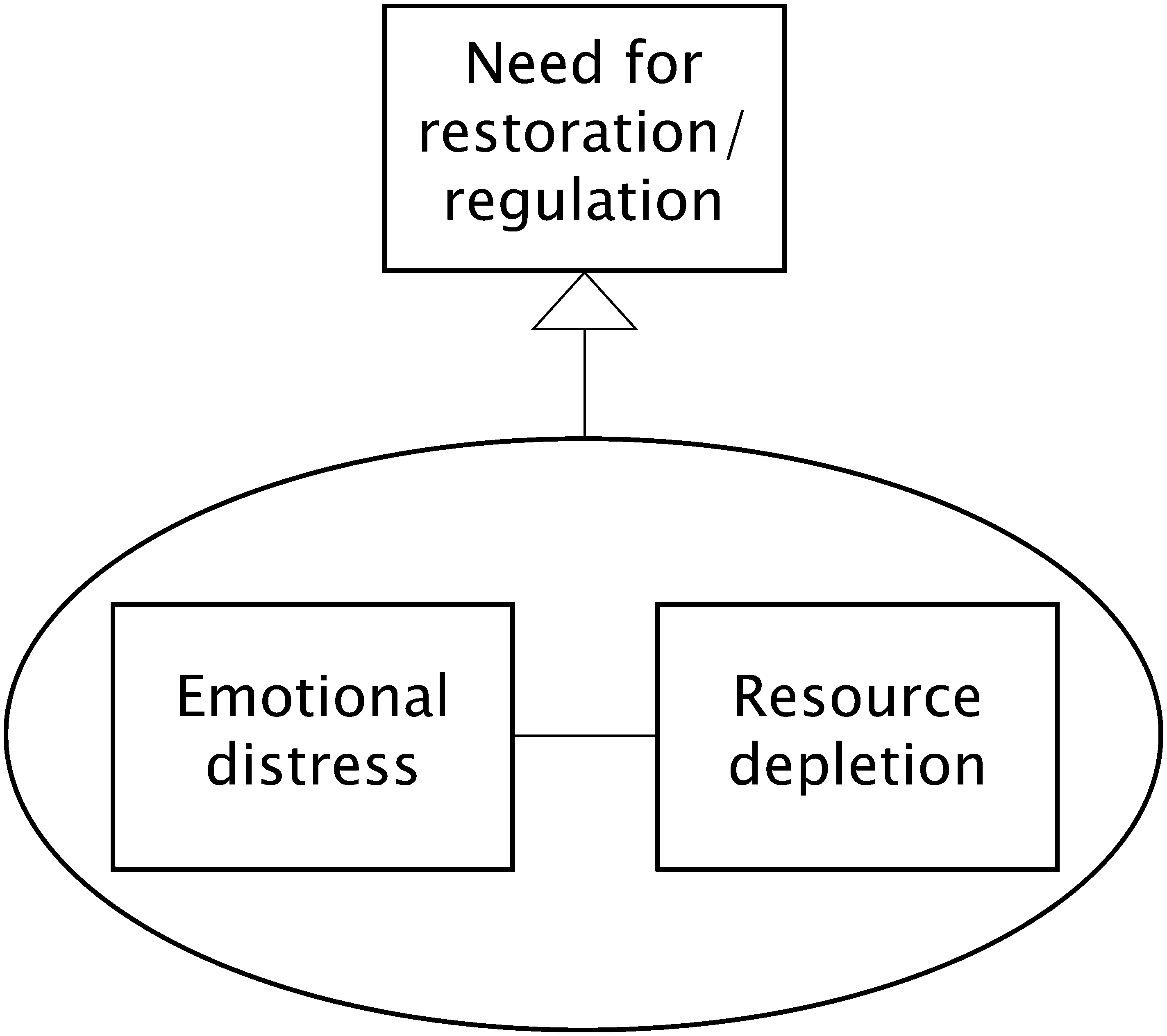
Antecedents of regulation and restoration.
Environmental strategies for emotion regulation, such as using nature for emotion regulation, may in general be considered to belong to the families of situation selection and situation modification. Regulation of positive emotion in nature should be considered a variant of situation selection, because we seek nature in order to experience positive emotions, that is, to activate them. However, it could also be the case that one wants to upregulate or maintain an already activated positive emotional state, and, thus, in this case, the strategy would belong to the family of situation modification. Regulation of negative emotion in nature should be considered a variant of situation modification, because we seek nature in order to reduce negative emotions, that is, to reduce them once they have been activated. For example, if one were to suggest a relocation of a discussion to the park in order to reduce tensions, this would be an example of situation modification.
Theoretically, people could try to use natural environments to upregulate negative emotion and to downregulate positive emotion; but, in practice, people probably expose themselves to nature in order to upregulate positive emotion and downregulate negative emotion.
Of course, emotion regulation in nature could also be about pure avoidance, that is, running away before an unwanted situation arises. However, in this case, many situations could hypothetically suffice, and it may not necessarily be about nature. However, it is important to consider that we may feel pushed from our normal environments into natural environments not because of the benefits of nature but because of unwanted aspects of our normal environments. We could also consider this in terms of push and pull motivations. If we are pushed toward natural environments because of some aversive event, such as emotional distress, then emotion regulation in nature would be considered a modulation of response that leads to situation modification. If we are pulled toward nature because we believe it will have positive emotional effects, then emotion regulation in nature would be considered as situation selection. All of these strategies, to some extent, depend on the proximity to nature.
Personality May Influence Strategy Choices
Several studies have documented a relationship between mood and personality traits. Positive affect has been associated with extraversion, whereas negative affect has been associated with neuroticism (e.g., Costa & McCrae, 1980; Watson et al., 1999). This may be not only because of general differences in mood, but also because individuals high in neuroticism react more strongly to negative emotional stimuli and those high in extraversion react more strongly to positive emotional stimuli (Gross et al., 1998). Personality traits may be relevant for emotion regulation as well. Gross & John (2003) have found that emotional suppression was negatively related to extraversion, whereas reappraisal was negatively related to neuroticism. Further, it has been demonstrated that persons high in extraversion maintain a positive mood better than low scorers do (Lischetzke & Eid, 2006). The use of nature to increase positive emotion could be more common among those high in extraversion. On the other hand, people low in extraversion may be more comfortable in expressing emotions when alone. In addition, if your preferred strategy for emotion regulation is suppression, then this may be easier to do in nature through the indirect route (Fig. 1). Those who are high in extraversion probably perceive very different emotional affordances compared with those who are low in extraversion. Some might regard social situations as an opportunity for emotional expression, whereas others opt for suppression in such circumstances.
It seems likely that personality can impact mood by acting as a set-point stabilizer or by influencing strategic choices, and subsequently emotion and mood (Fig. 3). John & Gross (2007) have predicted that neuroticism is negatively related to nearly all emotion regulation strategies. However, people high in neuroticism may to a larger extent rely on environmental strategies, thus seeking outside themselves the emotional stability they lack. For example, a recent study has found a positive association between neuroticism and the use of music for emotion regulation (Chamorro-Premuzic & Furnham, 2007). In earlier times when natural environments were more immediately available, the time spent processing negative emotional information may not have been as taxing as it can be today. Speculatively, it may even make evolutionary sense to process a lot of negative information given that safe natural environments have emotionally restorative effects. One idea that could be further researched is that there is a positive relationship between neuroticism and the regulation of negative emotion in nature.
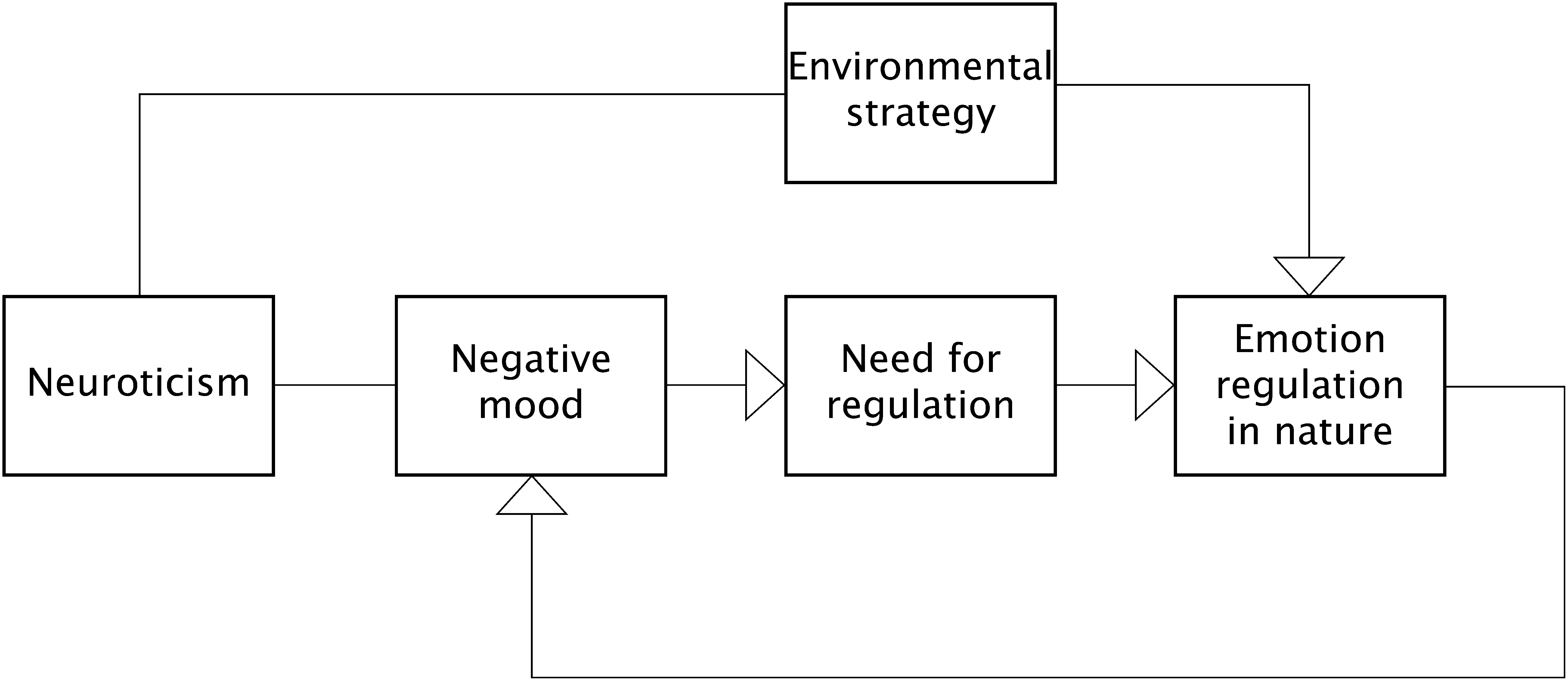
Personality and emotion regulation.
A Few Suggestions for Further Research
There are several possible avenues for research based on what has been discussed here, as well as some unanswered empirical questions. The similarities between ego depletion and directed attention fatigue need to be experimentally explicated. Spending time in a natural environment appears to be beneficial, but the most relevant environmental components and what duration is necessary to experience gains merit research. Further, the functional elements of ecotherapy could also be more closely examined.
More studies on the emotional restorative effects of nature would strengthen this research area. One example may be the use of emotion induction procedures, and it would also be interesting to consider combining this with directed attention fatigue. If this is found to be detrimental, then one might wonder about the long- and short-term consequences of combining negative emotion and directed attention fatigue. What happens to emotion regulation when restoration is difficult?
Research in this area might also be relevant for psychotherapy. In psychotherapy, the ability to tolerate experiences without becoming too disorganized is often an important task; some level of exposure to the natural environment may be beneficial in this regard. The dynamic integration of cognition and emotion may be more easily achieved by increasing the restorativeness of a typical therapeutic environment. As such, integration may be desirable; clinical researchers might find it rewarding to consider the physical environment as well.
The idea that those of us with higher scores on neuroticism may benefit more from nature should perhaps be explored further. However, it is important to note that this is not about neuroticism per se. Visiting a natural environment should have beneficial effects on many types of stress and emotional challenges. Another empirical question is whether people with easy access to nature are psychologically healthier than others. Given what has been discussed here, it is possible that for some people being deprived of nature may be particularly detrimental to psychological health. Access to nature may operate as a moderator variable. For example, there may be a lower incidence of symptoms and psychopathology among those with a higher score on neuroticism with access to nature than among those without access to nature. However, since an element of neuroticism is symptomatic, one might also suspect a lower incidence of neuroticism in areas with nature more immediately available.
Environmental strategies for emotion regulation, of which the use of nature for emotion regulation is one example, should be researched further. Perhaps, initially, the use of experimental methods, but also survey methods and interviewing could be employed. Finally, the models proposed here could also offer a starting point for research.
Conclusions
How we choose to regulate our emotions may be central to our psychological health. The use of nature for emotion regulation should be highly effective in increasing positive emotions and decreasing negative ones. Natural environments' role in restoring attentional resources should also have beneficial effects on emotional processes. Consequently, people who choose to spend time in nature in order to regulate their emotions should find it effective. Some may even use nature strategically for emotion regulation. More research is needed both into how people use nature for emotion regulation and into what long-term effects this strategy may have. Research is also needed to investigate the association between ego depletion and directed attention fatigue. A first step would be to investigate whether the exposure to nature can counteract ego depletion. Individual differences in the choice of strategies for emotion regulation indicate that in practice some may benefit more from exposure to nature than others. For example, if your preferred strategy for emotion regulation is mentally taxing, then spending time in nature would be helpful. Further, people vulnerable to depression may benefit highly from exposure to nature, because it should increase their ability to resist negative cognitions. Associations between emotional distress and self-regulation also indicate that there may be individual differences in the effects of natural environments that have not yet been sufficiently investigated. Individual differences in the perception of emotional affordances also indicate that nature may affect us differently. Although most of us may perceive nature as a setting suitable for reflection, some of us may, in fact, need nature in order to reflect. Moreover, although almost everyone can experience the benefits of nature, some of us may actually need these benefits to a higher degree than others. Spending time thinking about negative emotional information may have been more adaptive when human beings spent most of their time in natural environments. This clearly points toward the advantage of having natural environments readily accessible.
Footnotes
Author Disclosure Statement
No competing financial interests exist.