




Abstract
Abstract
This article considers definitions of wildness as a system that produces wilderness and wild things. Wildness is defined as a quality of interactive processing between an organism and its surroundings in which the realities of base natures are met, allowing the construction of durable systems. Wildness is a process that has become an otherness to humans but nevertheless remains a source of insight and inspiration. In seeking to define wildness, a distinction is made between wildness and naturalness so that, while everything is natural, the quality of wildness can vary or become dysfunctional. In relation to wildness, an organism's internal quality is improved through the parsimonious arrangement and coordination of one's adaptations and internal drivers, while its external quality is achieved through attunement with one's surroundings. With wildness, an organism gains internal clarity, thereby presenting a consistent face or purpose to which other organisms can adapt. In comparison, the rejection of wildness and the use of artificial systems produce a confused and unstable basis for internal and external interaction, resulting in rapid change. The inability of humans to be wild in our social system is due to confusion about the drivers in our biological core that foils attempts at attunement.
The term wild has a history that predates postmodern construction. Spelled wilde in Old English, it has Proto-Germanic origins from about 1500 BC–1000 BC, which in turn was derived from the Indo-European (ca. 4000 BC–6000 BC) word ghwelt (the Welsh word for wild is gwyllt) (Ayto, 2005). Similarly, the term wilderness is thought to have derived from Old Gothonic languages meaning “will-of-the-land” (Vest, 1985). “Thanks to Vest, we are able to understand that this word, wilderness, is not a coinage of modern civilization, it is a word of the Bronze and Iron Ages” (Foreman, 2000).
The meaning behind wildness is less clear and often elicits poetic license, as rather than being an object that is easy to study it describes an approach to life. It has been called a border concept (Drenthen, 2005). Ambiguity about the meaning of wildness has hindered its research in the biological sciences. Very little is written in a mechanistic sense on wildness and how it operates, even though on the surface it appears to be such a distinguishing feature of nature not under human control. Incomplete, romantic, and spiritual definitions have not helped to attract the attention of scientists who prefer reductionist examinations. A definition is needed that can provide a more contestable basis from which to analyze results and show that wildness is not simply a synonym of naturalness.
Existing Impressions
To some, wildness is an uncontrolled state, where base desires and instincts take over and result in social upheaval and violence. Then, wildness leads to animalistic behavior and is to be shunned. Examples abound, fictional and nonfictional, where living in wildness without restraint causes social breakdown (Ballard, 1999; Brand & Smith, 2000; Golding, 1954; Groes-Green, 2010). The fear of wildness sometimes led white colonialists to commit extreme cruelties against the Indians they considered the epitome of the “wild man” (Taussig, 1987).
To others, wildness and wilderness can be like a refreshing tonic and source of insight (Adams, 2002; Ausema, 2008; Lister-Kaye, 2011; Shaw, 2011; Thoreau, 1906). They can be themes that inspire art, such as the paintings of John Constable and J. M. W. Turner, the photography of Ansell Adams and Eliot Porter, and the poetry of Gary Snyder and Robinson Jeffers. Wildness has been described as a quality produced in nature (Thoreau, 1906), as that which emerges from a place or forest (Micoud, 1993; O'Rourke, 2000), as the spirit of the wild (Waterman & Waterman, 1993), and as a level of achievement in nature (Cookson, 2004). Wildness is a process rather than a place (Higgs, 2006), and it is about behavior (Ridder, 2007). Another important aspect of wildness is that “Nature retains a measure of autonomy, or wildness, apart from human constructions” (Evanoff, 2005).
These features suggest that wildness is an approach to life that spans two levels of organization, an internal arena that draws upon base natures and an external arena that self-organizes a quality that many find inspirational. To be wild, there should be a level of honesty and directness, of spontaneity and instinctiveness. Organisms cannot properly participate in wildness until they reach a level of internal quality or clarity, where they have direct and honest touch with their base information and motivations, as otherwise there would be instability in the system to which they contribute. These features suggest a possible definition for wildness: Wildness is a quality of interactive processing between organism and nature where the realities of base natures are met, allowing the construction of durable systems. Wildness can therefore be called a process, method, system, or approach to life, but it carries the caveat that those processes should be of a certain quality or standard. Wildness can then produce its quality system, structure, relationships, wilderness, ecosystem or even “the wildness” (in an organizational rather than methodological sense). Being a self-organizing system, wildness builds upon itself both as a process and as a developing structure in which its processes become more fluent.
Base Nature Quality
The internal effect of wildness is that it draws upon base natures, instincts, and desires. Using wildness or going wild lets one do, or try to do, whatever one wants. Here, wildness provides an interesting contrast between animals and humans. Wildness in humans is usually seen as disruptive, while wildness in animals is essential to the health of their ecosystems.
The importance of maintaining wildness in animals is recognized in the management of national parks, where feeding wild animals is discouraged, as they may lose the skills needed to fend for themselves (Mallick & Driessen, 2003; Orams, 2002). Animals released into the wild often must be weaned from humans toward the mind and skills needed to survive, with famous examples being Elsa the lion (Adamson, 1960) and rescued orangutans (Smits et al., 1995). These are particularly good examples of how the released animals must learn a new set of instincts and quality of processing to survive in the wild.
While wildness is important to the survival of animals in nature and to the health of their ecosystems, for humans wildness would likely be destructive and irresponsible to our social system (Ostermann, 2005). Going wild gives more power to base impulsive actions, whether disruptive or not. Criminals are often portrayed as behaving like wild animals during their violent acts. Humans seem to have a subconscious fear and resistance to wildness, as it can venture into areas that are taboo.
Such contrast may suggest why wildness works in nature but not in humans. Wildness draws upon base natures but can only work properly when those base natures are direct and honest. Only then can the result of wildness be supported by and beneficial to the system housing that organism. Thoreau (1906) wrote the famous phrase, “In wildness is the preservation of the world.” Presumably this means that if we could process our thoughts and vision through wildness, we would be better creatures. According to Botkin (2000), his focus was on the “importance of wildness to people, not wildness for wildness's sake.” He saw “wildness as a spiritual state existing between a person and nature.” Another Thoreau quote, “The most alive is the wildest,” suggests that quality improves with wildness.
The corollary of this argument is that the inability of humans to use wildness constructively is an indictment on the quality of our base natures. “The concept of wildness often rather expresses a moment of fundamental criticism toward human culture as such” (Drenthen, 2009). If humans do not make the grade needed to use wildness constructively, then wildness becomes an otherness that is shunned. Humans have rejected wildness, producing a dichotomy where wildness is now an otherness (O'Rourke, 2000). The degree of otherness depends upon how far along the dichotomy a culture has traveled. For many indigenous peoples who have lived in “wilderness” areas for thousands of years, the wilderness does not feel like otherness but like home. In a quote from Standing Bear in 1933, he did not see the land as infested with wild animals and savage people. “To us it was tame” (Callicott, 2000).
The philosophical objection to wilderness designation is that it enshrines an untenable human/nature dualism (Keeling, 2008). We should strive to remove the dualism (Borgmann, 1995). There could be a “relaxation of rigid oppositions of civility and wildness; and ultimately, a human Self more conversant with its own wild side, dedomesticated and unbound” (Anderson, 1997).
An apparent requirement of wildness is that an organism should be biologically sorted about its internal drivers so that it can give direct and durable interactions and intentions to its environment. Then a sustainable ecosystem can evolve. However, humans are unsure of our core, of whether we have inherited instincts, a blank slate, are motivated by good, evil, selfish genes, God, desires, or emotions. We are unresolved and therefore lack the quality of internal clarity needed to produce wildness as it is found in other animals.
Other animals also may not consciously understand their biological core, but do not need to. However, humans do need to understand, for our own peace of mind and because the ability to understand is an important component in our package of adaptations. Unfortunately, there may not be an in-between stage for understanding that can set up the stability and quality needed for wildness. You either understand or don't. While our understanding is incomplete, confusion fills the gap with mistaken views and ideas, misinterpretations, and a lack of realization. Further, the effects of confusion are compounded when those views are carried with conviction as beliefs and opinions. Much can be glossed over through belief, and many atrocities have been committed for many a deluded cause.
Humans generally consider that we are the pinnacle species in nature due to our intelligence and conquests. However, a number of other animals are also quite intelligent and can also do things that we cannot, such as live sustainably, fly, swim at depth unaided, and follow their true desires. An alternative view is that the most distinguishing characteristic of humans is the ability to delude ourselves (author included, of course). No other species operates according to scenarios, belief systems, and stories built up and closeted in their own minds, where those thoughts can remain untested but so influential. There can be little comfort in pretending that our current understanding is free of delusion. Indeed the extent of human problems plaguing the world today suggests a lack of understanding. We know many dots (which is why we can exploit so much), but we do not know how to join them. The most interesting and distinguishing biological characteristic of humans may be confusion, not intelligence.
The view that we are in a state of stunted mental confusion, even madness, is not new (Shepard & Rawlins, 1998). In Australia, it is estimated that more than one in five adults have some kind of measurable mental disorder (Henderson et al., 2000), perhaps underpinned by a general malaise based on confusion. It has long been felt that humans lost something good about themselves when we departed from nature's ways, as suggested by Rousseau (1712–1778) (Mendham, 2011). By not applying nature's tests for quality we can take liberties and shield ourselves from life's reality as it occurs elsewhere.
Wildness is a process that does not allow confusion, padding, phoniness, and avoidance. It sorts to produce clarity, simplicity, and parsimony. Wildness is a way of counteracting delusion. Our confusion also explains why wildness can be such a source of insight. It is its very otherness, its independence and ability to give objective view that is so valuable. “Not yet subdued to man, its presence refreshes” (Thoreau, 1906).
Quality in External Systems
Sorting one's biological core into its most direct and simplest arrangement is a process based on parsimony (Cookson, 2004). For wildness, parsimonious efficiency is also required externally during interactions with the environment. The importance of parsimony in nature has already been suggested through its key role when constructing evolutionary trees (Stewart, 1993). Improvements in parsimony externally could occur by attuning with one's environment, as then an animal could receive key and unsullied information directly with minimal effort. Attunement has been suggested in skill acquisition (Araujo & Davids, 2011) along with parsimony in direct learning (Jacobs et al., 2009). Attunement learning should improve one's skills and abilities within the partner environment. For example, “Black trackers” were often responsible for the location and rescue of White children lost in the outback because they could read the signs of their land more skillfully than colonialists (Pierce, 1999). There is a low success rate when translocating wild animals from their endangered habitat to new locations (Griffith et al., 1989), perhaps indicating that the animals were not attuned with the details of their new environments and found it difficult to relearn those details as mature animals.
If interactive quality with one's external environment can vary, then there should be a scale that can measure these differences and provide location for our various concepts surrounding wildness. Figure 1 suggests a scale, where at one end interactive quality is high, allowing wildness, and at the other end it is dysfunctional and alienated. All positions along the scale are natural; however, the stability of an organism varies along the scale, depending upon the quality of interaction it has with the other components it meets. If interactions are poor and there are continual clashes for even what should be simple tasks (such as finding food or a mate), the existing position will be uncomfortable and problematic due to a lack of fulfillment from one's achievements and antagonism from other components. Therefore, organisms with low-quality interactions will be forced to change rapidly, while those with high-quality interactions will have little reason to change. For example, humans are changing rapidly, while some lineages such as the crocodile, the tuatara, and the cyanobacteria that produce stromatolites have remained virtually unchanged for millions of years. Terror management theory describes a fear of mortality (Cozzarelli & Karafa, 1998) that may be heightened by an alienated human self that cannot sense its home within an attuned “mother earth.”
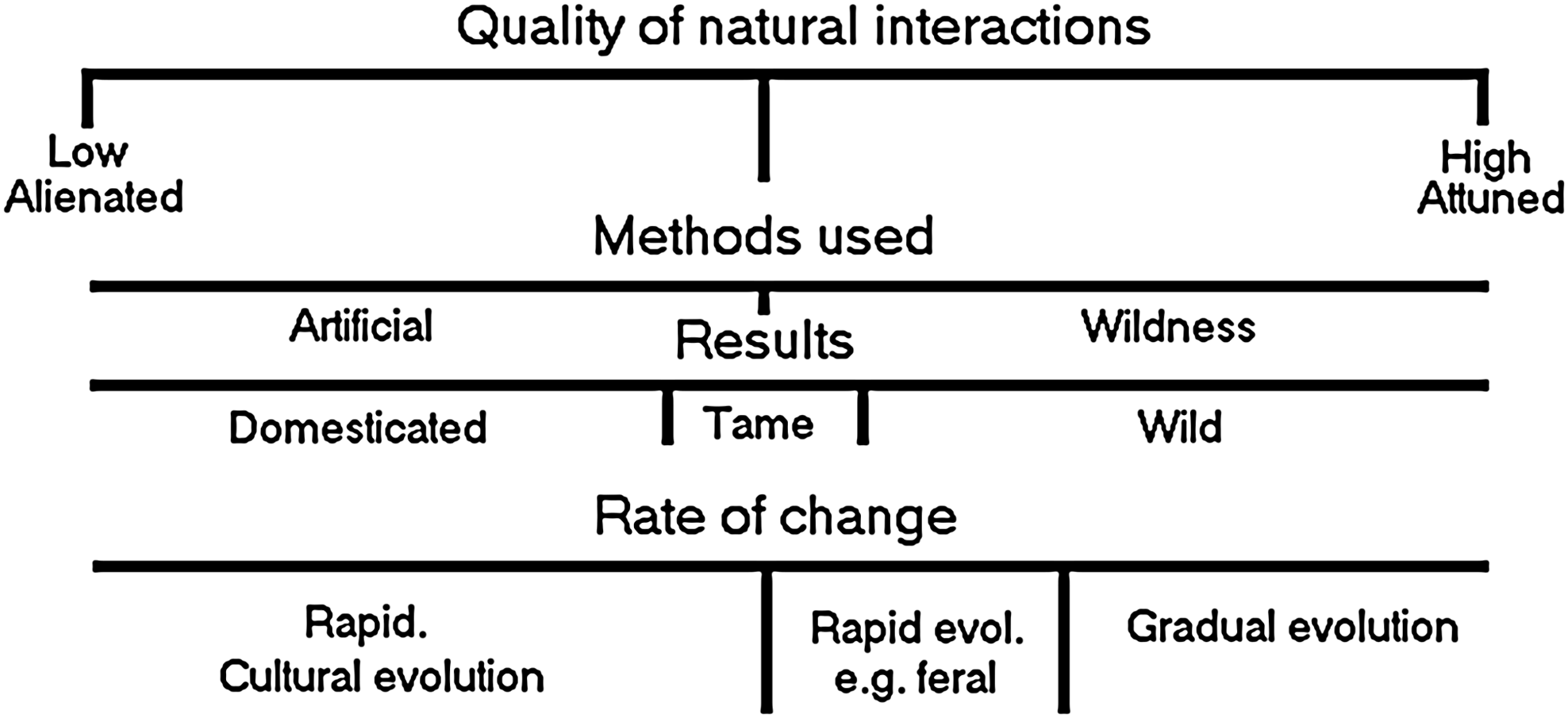
Scale for quality of interaction.
Within wild nature there can still be variations in wildness quality due to specific differences in parsimony and attunement. There have always been species that are no longer suited to a particular wilderness and become extinct. The species going extinct is natural and wild. However, for whatever reason, it can no longer complete the wildness package sufficient to find the interactive connections and resources needed to remain a part of that wilderness.
Another variation within wildness is the feral animal, which is internally wild but has reduced wildness quality because it is not attuned with the external environment. What makes wild animals feral is their existence in an ecosystem to which they did not evolve but were introduced through human intervention or inadvertent cause (e.g., stowaways). A fox that is wild in Europe will be feral in Australia because it did not arrive naturally. Its wildness is disruptive to the ecosystem, so while internally it is biologically honest its external interactions are abrasive and harmful to the ecosystem. Feral animals can cause rapid change and extinctions in the new environment. However, if the animal is left to its own devices, adjustments will occur so that the quality of the interactions involving the feral animal eventually settle with the surviving species, and the animal's contribution to the remaining wilderness improves. The dingo was probably introduced as a domesticated companion of the aborigine from the Indonesian archipelago. At that time, it could have been viewed as feral. Now, however, it is an integral part of the Australian wilderness. Similarly, organisms that find natural bridges (e.g., from changed sea heights or rafts of floating vegetation) to new environments may initially be as disruptive as a feral animal.
The tame animal provides another variation in wildness. Tameness centers on how the animal interacts with humans, whether willingly or not. Wahlsten et al. (2003) devised a rating scale for wildness in mice based on difficulty of handling. Some wild animals become tame when tourists offer food; then their ability to survive in the wilderness reduces, and they become tinged with artificial dependencies. There is now an unprecedented prospect for wildlife loss via domestication in wilderness areas (Peterson et al., 2005). A tame animal bridges the boundary between wild and artificial living and may be caught between the security and bonds of wildness and the temptation of readily provided resources.
When leaving wildness, we enter the artificial domain of the human. Artificial processes and products are man-construed and man-made. To some this is a contentious issue, resorting to the view that everything is natural, so how can something be artificial (Callicott, 1998, pp. 350–351; Vogel, 2003, p. 162). Indeed, artificial is a paradox if it is described in opposition to natural. However, there is no paradox if the contrast is made with wildness. Humans are not alien to nature, but they do lack the naturalness, ease, and freedom of the wild animal (Biro, 2005). A distinction needs to be made between natural and wild processes. In Wikipedia, nature is listed as everything that exists, from the biotic to lands and stars. Wildness and its requirement for interactive quality could make it a subset of this “everything,” and then humans could be natural but not wild. Aplet et al. (2000) provide a “continuum of wildness” where artificial things are contrasted with increasing wildness.
The difference between artificial processes and wildness can be seen in their products, due to variations in contained parsimony. Humanity has restricted the breadth of influences that we are willing to accept, thereby setting limitations on human products and tarnishing them as artificial. They have not survived the test of wildness. Things made through wildness have had to comply with the interactions of a host of other organisms and physical environments that moulds a simple efficiency. Wildness-influenced things gain a natural elegance, simplicity of function stripped of fat and padding, yet enduring. Artificial productions lack input from a broader set of forces and influences and so will be narrower in concept. Humans cannot fashion the acrobatics and functions of a fly but need a large and clunky machine to do the same thing. We cannot live harmoniously within a land but degrade it because we do not know how to live sustainably. Wildlife extinction represents a failure of being able to live and attune with neighbors, showing a lack of elegance.
An example of artificial production is domesticated animals. Most domesticated animals were selected by humans over the last 4000 years–11000 years (Anderson, 1997; Tixier-Boichard et al., 2011; Vigne, 2011), although the domestication of wolves probably began around 13,000 BC–15,000 BC (Vigne, 2011), even 29,000 BC (Parker et al., 2010). Fellow life-forms were drawn into the fold of human activity—or “domus”—progressively “improved” in human terms, and stripped of what came to be called their “wildness” (Anderson, 1997).
The process of domestication aims to reduce wildness and make the organism more manageable to humans. However even today, some animals still need to be “broken” so that they will make their final switch from a natural wild state to human control. “I rejoice that horses and steers have to be broken before they can be made the slaves of men” (Thoreau, 1906). The reduction in wildness is strongly correlated with physical change rather than brain wiring that alters inherited instincts. Domestication usually occurs by selecting for juvenile traits such as lighter coats and softer features, where the animal remains in a more tolerant or “open” form (Trut, 1999). The “hunting or chasing instinct” in dogs appears to vary according to the length of the visual streak in their eyes and the level of stimulation that the dog therefore receives (McGreevy et al., 2003) rather than altered “inherited hunting instincts” in the cerebral cortex. However, domestication is an artificial and therefore unstable state in animals. Domestic animals such as pigs, horses, rabbits, and cattle will often return to a wild or feral state once human influence is removed (O'Rourke, 2000).
The way wildness acts on its participants to produce ecosystems has some parallels with our own system of resource interaction and organization (where we manage those resources), the economy. Wildness could be considered nature's system for resource interaction (not managed, self-organizing), where various components build sustainable relationships. The economy and wildness, both are not items that can be pointed at directly, although they have indicators of prosperity (gross domestic product, interest rates, employment/species diversity, species populations, ecosystem resilience). Only their components can be seen directly. But they both feel forceful, even inspirational within their given systems when those components work together efficiently and strongly. They combine to give nature a shared theme called wildness, and humans a shared system called the economy. “When camping in such a wilderness as this, you are prepared to hear sounds from some of its inhabitants which will give voice to its wildness” (Thoreau, 1864). So wildness is a process or system of doing things and is also the resulting level of organization, ecosystem, or cohesion that results from that self-organizing system. The economy depends on the confidence of people to make it thrive and grow. Wildness depends on the quality of interaction from and among its components before it can spread through nature to produce wild things and wilderness.
Footnotes
Author Disclosure Statement
No competing financial interests exist.