




Abstract
Abstract
Community art programs that incorporate environmental education into their curricula offer a unique opportunity to engage urban neighborhoods with their surrounding green space. One such program implemented in Mount Washington, which overlooks Pittsburgh, Pennsylvania, aimed at reconnecting community members with their adjacent parks through a comprehensive blend of art and eco-literacy. Youth learned about their local environment while creating nature-themed artworks, and the community was mobilized to revive neglected green space. In the manner of a case study, the present article describes this arts-based eco-literacy/community program in detail. The theoretical basis for the program and the structure and components of the program are provided. Additionally, the implementation process of the program is described, along with a discussion of the successes and challenges of the program and recommendations for future initiatives.
“We can be ethical only in relation to something we can see, feel, understand, love, or otherwise have faith in.”
Similarly, the theoretical underpinnings of ecopsychology promote expanding the boundaries of the self to include others, the community, the earth, and even the universe. De-emphasizing an individualized representation of the self is a necessary step in healing the dysfunctional relationship humans have historically had with non-human nature, eventually creating a healthier relationship characterized by respect and reciprocity. Various approaches have been developed by environmentalists to effectively apply ecopsychology theory, from traditional therapy to restoration projects and workshops (O'Connor, 1995; Shapiro, 1995), all of which share the goal of facilitating the development of a de-individualized self while expanding the self to include the “community” as Leopold defined it.
The arts are inherently synonymous with a force greater than one's self (DeForge, 2004). Engaging in art projects promotes a creative expansion of the self and is a nondidactic means through which to encourage guided exploration of our sense of self in relation to the world (Cameron, 1992). Teaching others how to access these broader realms through the process of art making is a powerful means to shed an insular, narrow self and cultivate an expanded self that includes non-human “others” and living systems. As Dewey (1934) reminds us, “the sense of relation between nature and man in some form has always been the actuating spirit of art” (p. 352).
There is an emerging interest in using the arts to educate students and youth about natural systems and their interconnectedness (Capra, 1994; Kellen-Taylor, 1998). An arts-based eco-literacy program has the capacity to facilitate stewardship and reconnection to nature by broadening the scope of the self (Kellen-Taylor, 1998). Through the use of various art techniques and nature-focused exercises, participants begin to move outside their previously delineated boundary of self and make connections between their existence, their behavior, and the well-being of the environment. Such a program would be an innovative approach to applying and exercising the philosophies of Leopold and ecopsychology.
The present article describes an arts-based eco-literacy program that was designed with Leopold's land ethic and ecopsychology in mind. Emphasis on community-based and collaborative approaches, rather than individualized self-expression, was a primary concern and influenced the structure and scope of the activities offered. A detailed account of the program is provided, as well as challenges and recommendations for future implementation. This unique case study adds to the literature on innovative environmental education programs.
Creative Reconnection in Action
The Community Trail Art Initiative (CTAI) was an arts-based environmental education program (2007–2009) through the Steel Valley Trail Council that intended to reconnect urban communities in Pittsburgh to local trails, rivers, and adjacent green space. The present article focuses on the implementation of the CTAI in the community of Mount Washington.
Historical Overview
Mount Washington has one of the most stunning overlooks of “The Point” in Pittsburgh, where the Monongahela and the Allegheny Rivers meet to form the Ohio River. It is a favored destination for locals and tourists alike to enjoy the breathtaking panoptic view of the city and the Three Rivers, oftentimes arriving courtesy of the Duquesne Incline—a motorized transport that glides up and down the mountainside.
What is less apparent from this grand overlook is the rich history of Mount Washington and how it has changed over time. Before the installation of an incline, residents of this hilltop community would descend and ascend the slopes on a long stretch of stairs. The hillside was where residents spent considerable time, as they made their way into the city and back home again. With the advent of cars and a road that climbs the hill, the stairs were removed, and residents became disconnected from the hillside and adjacent wooded areas. The hillside became an impromptu landfill, where people illegally disposed of unwanted cars, tires, kitchen appliances, and other bulky refuse. Residents distanced themselves from the hillside, no longer feeling its rise and fall beneath their feet. Instead, they began to see it as a dangerous and undesirable area.
Program Design and Implementation
In the Summer of 2009, CTAI director Ann Rosenthal organized a series of eco-literacy and art workshops for Mount Washington youth that provided the opportunity to learn about and explore the historical and environmental assets of their community. The program was initiated through the Mount Washington Community Development Corporation (MWCDC), with assistance from Karen Celedonia, a student at the time in the Graduate School of Public Health at the University of Pittsburgh, and additional assistance from undergraduates at the Art Institute of Pittsburgh and MWCDC staff.
The program was initiated with a series of eco-literacy workshops, each led by a staff educator from a local environmental organization. Participating youth learned about local flora and fauna through trail walks that included plant identification and guided observation (Fig. 1). Participants suited up with hard hats, gloves, and shovels to experience first-hand how to build a trail from the Student Conservation Association. The history of Mount Washington was conveyed by a local historian through vintage photographs and maps. These programs were generously provided by the organizations at no cost.
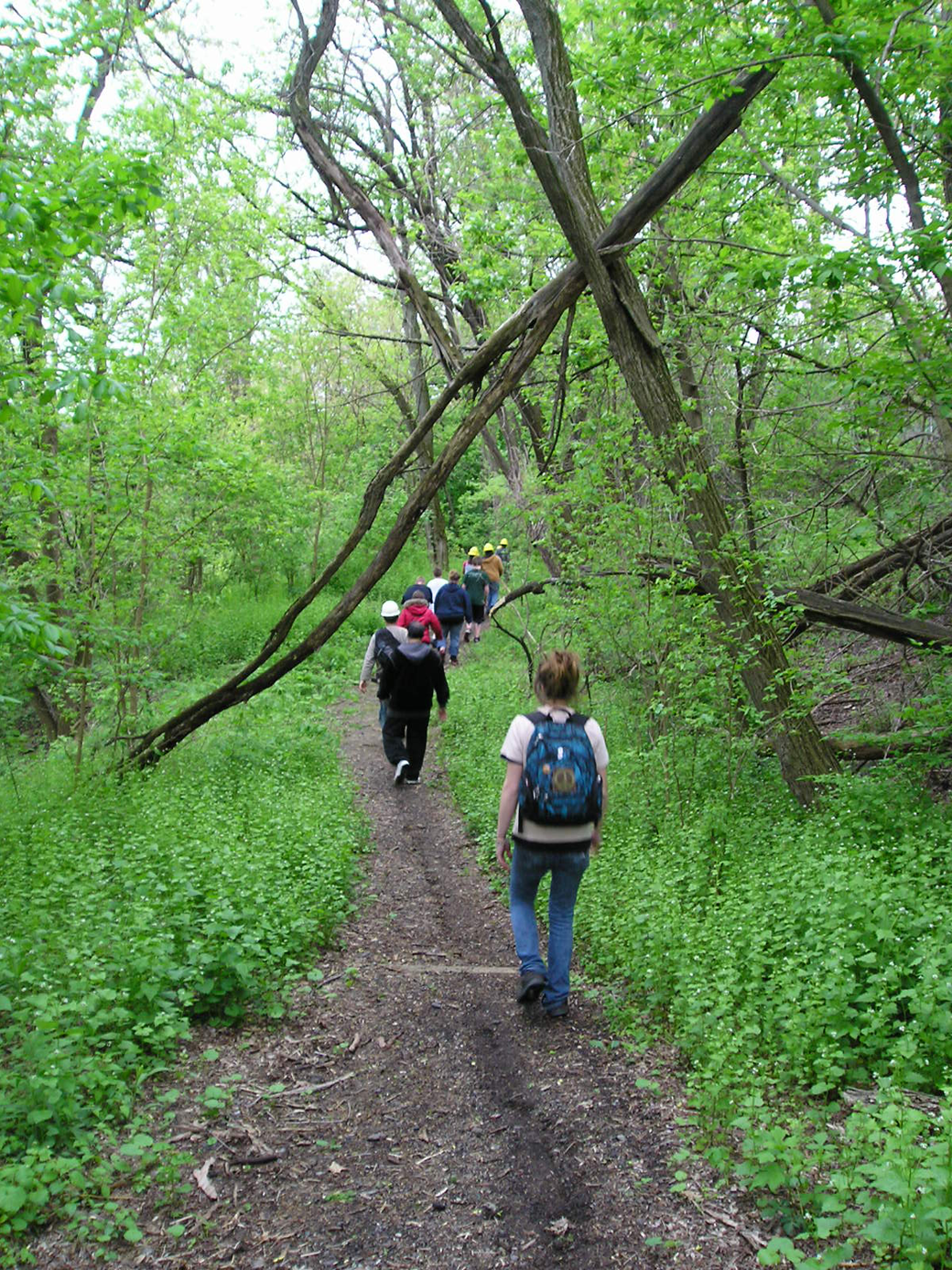
Trail Walk (Photo Credit: Ann Rosenthal).
The eco-literacy workshops were followed by art workshops led by Ann Rosenthal and university student assistants, using a community recreation center as a home base. The art workshops built off one another sequentially to design and create a final product: trail art banners to be displayed in the community. The banners conveyed the natural and historic features of Mount Washington, allowing for a creative application of what the youth had learned during the environmental workshops. A total of four banners were completed, each with a specific theme: Animals, Plants, Trees, and Historic Landmarks. Each banner worked in concert with the others, providing a visual snapshot of the ecological and cultural story of the community.
The art workshops were characterized by a balance of freedom of expression and expert instruction and guidance, occurring within a cooperative, collaborative atmosphere. The design and production process comprised three stages: researching and drawing flora, fauna, and historic landmarks; arranging these elements into a visually compelling design on the banners; and then painting the banners. The research and drawing took place at the community recreation center. Those who were less confident in their drawing skills could trace imagery from books, Internet printouts provided by program staff, or photographs the youth had taken on their field trips. Due to time constraints, arranging and transferring the drawings onto the banners primarily took place at the lead artist's studio with the help of program staff. (In prior years of the CTAI program, participants actively engaged in this design process.) The youth then painted the banners at the recreation center, with groups working on each banner simultaneously (Fig. 2). The staff guided the participants in choosing colors that unified each design while remaining true to what was represented. The youth were encouraged to express themselves in their own artistic style, while the staff guided their creative work. After the program, the lead artist and staff refined the painting by cleaning up spills, sharpening edges, and adding some details to achieve a finished, professional result (Fig. 3).
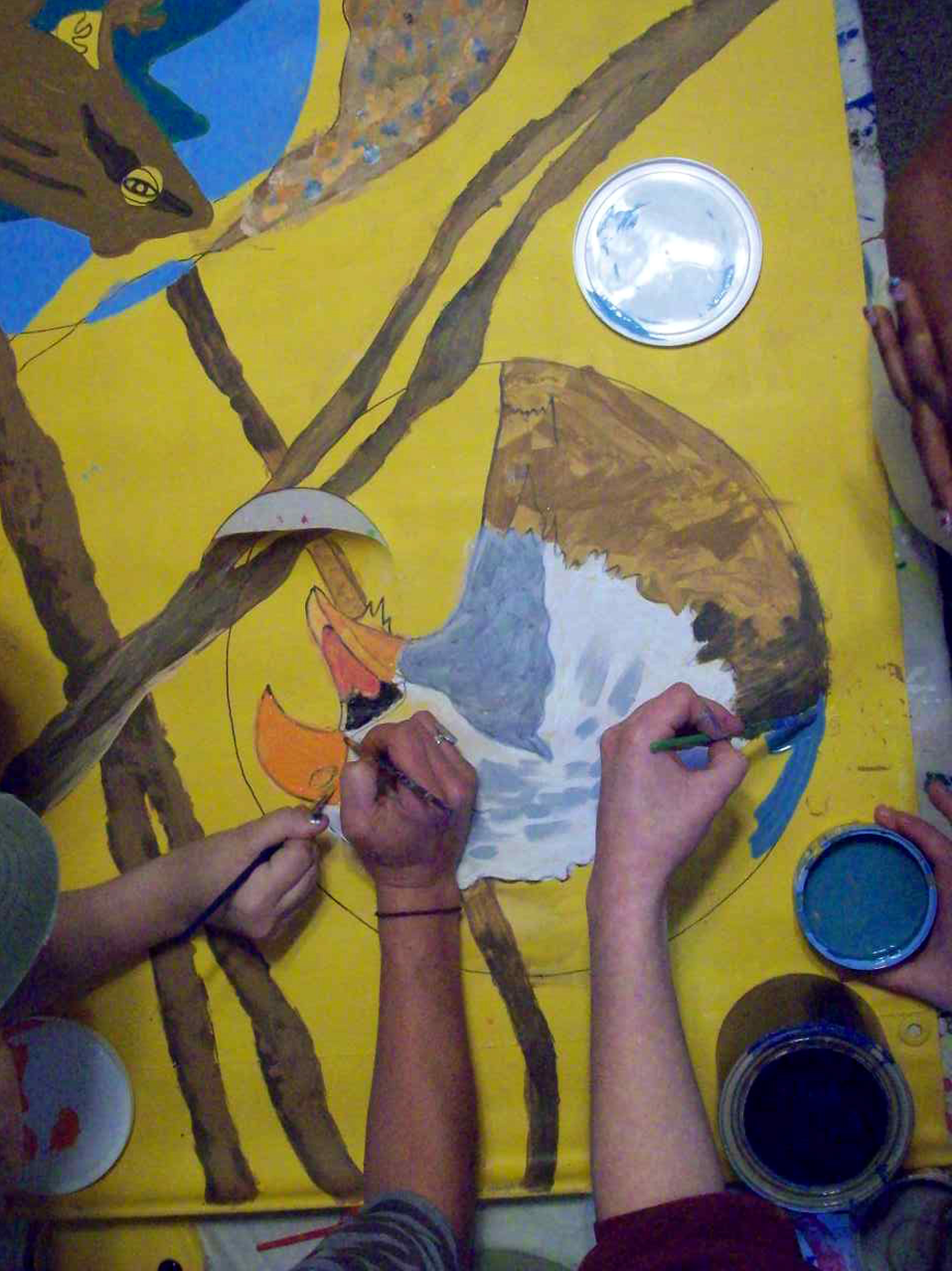
Banner Painting (Photo Credit: MWCDC).
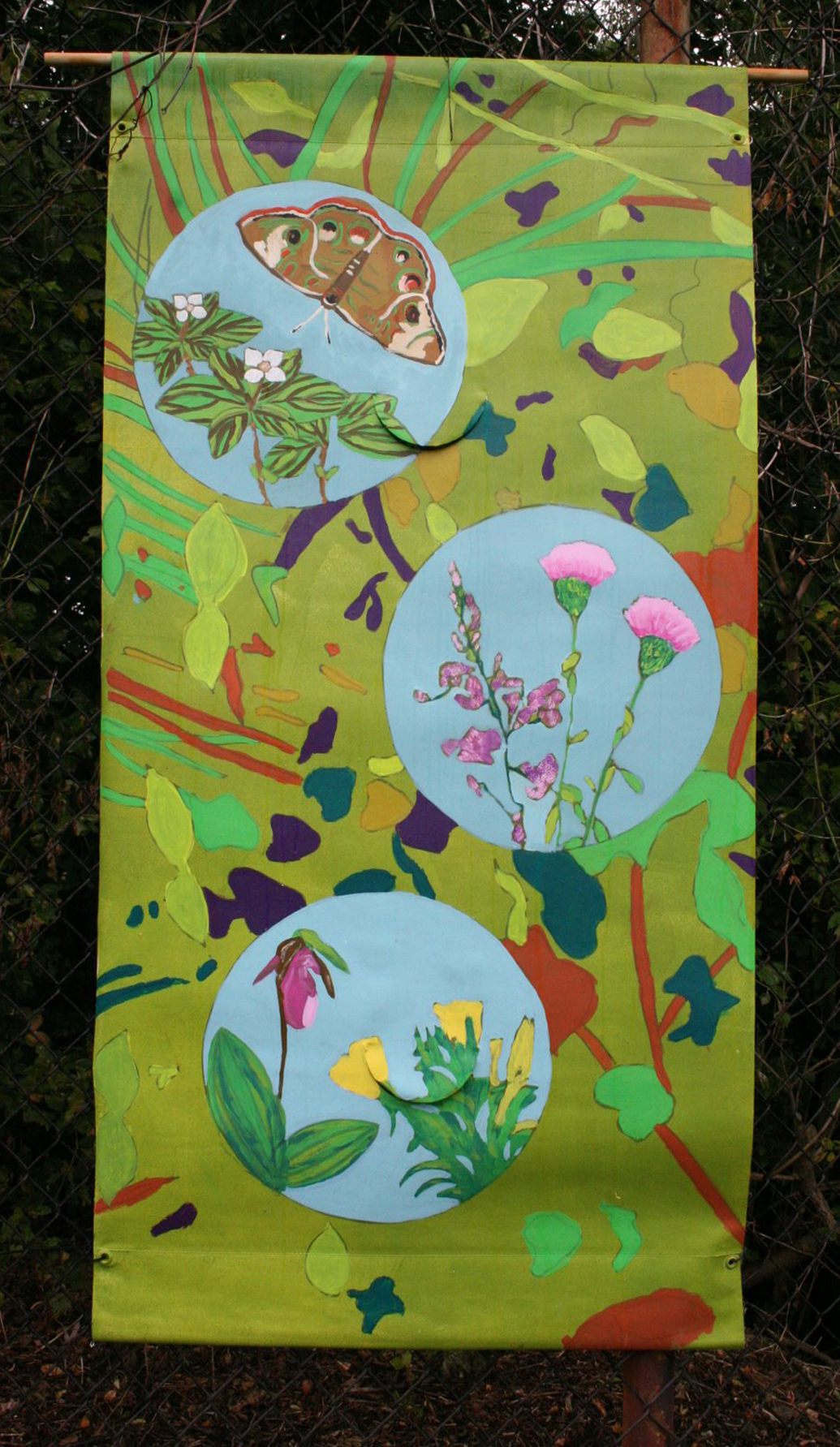
Completed Banner (Photo Credit: Ann Rosenthal).
Program staff strived to create a community of artistic expression and shared learning. The designated room—or studio—for the program at the recreation center was set up to stimulate the youth's creativity in an organic manner, as well as create a safe, cooperative environment in which the youth felt comfortable expressing themselves and sharing what they created. Large tables were used, and there was no assigned seating. All materials the youth would need for drawing (pencils, markers, paper, etc.) were provided by the program and placed on the tables in advance. Nature guides and historic photographs and maps of the Mount Washington area were circulated and remained available throughout the program. One wall of the room was transformed into a bulletin board that served two purposes: (1) to compile visual and informational research from previous components of the program, and (2) to share the artwork the youth had created. The “studio's” boundaries were also extended to include the local park and woods: some painting sessions took place outside under a pavilion at the park, and nature walks occurred during which the youth took photographs and sketched specimens of interest for the project. The resulting banners combined the drawings and design decisions of several participants. The youth learned that their creative work could contribute to a greater whole that had more presence and impact than what they could achieve alone. Thus, individualized art making was expanded into collaborative works that reflected and were created for the community.
While not pursued in an explicit way, the program activities were deliberately designed to foster the beginnings of a land ethic. Activities such as observing, drawing, and painting a creature or plant required sustained and careful examination, often leading to an identification with and appreciation for that life form. Engaging the youth in experiential research in the woods and art making in the park were indirect means to connect the participants to the green space in their neighborhoods and promote a sense of stewardship. Referring back to Leopold's requisites for ethical behavior, the program provided varied opportunities to “see, feel, and understand” Mount Washington's natural assets, while avoiding didacticism and confrontation. Not only was such an approach appropriate and beneficial for the program's less academically oriented participants, but it is also congruent with ecopsychological theory.
The culmination of the program was the Wild Art Wild Trails Festival, where the banners created by the youth were unveiled. This celebration of Mount Washington's park and trail system kicked off with a cleanup of an illegal dumpsite—one of many within the park. Volunteers from the community and beyond donated their Labor Day morning to haul decades-old trash off the hillsides amid a cold, persistent rain. Items salvaged from the dumpsite—tires, scraps of metal, and kitchen appliances—were used by selected local artists to create impromptu sculptures during the festival (Fig. 4).

Festival Trash to Art Sculpture (Photo Credit: Ann Rosenthal).
Festival-goers of all ages and backgrounds braved the soggy weather to watch and sometimes assist the artists in working their creative magic. A climbing wall, kayak demonstration, ultimate Frisbee, and live music were among the activities offered. There was also a hands-on art station where the public could help paint additional banners designed by the youth, and festival-goers could engage in a treasure hunt designed by one of the workshop participants. Illustrated signage along the trail, designed by two of the Art Institute of Pittsburgh students and funded by the Allegheny County Health Department, provided a guided health walk with practical tips for safely enjoying the trails (e.g., wearing a hat, bringing snacks, and simple stretches). Appetites were satiated by the healthy snack foods station. Then visitors returned to watch the artists at work one last time before the end of the day, noting the progress made and delighting in the final results.
Assessing the Strengths and Challenges of the Program
While the Mount Washington CTAI program was successful in its goals of providing eco-literacy sessions, completion of the trail art banners, and the organization of the festival, the process elucidated the challenges of implementing a community-based arts program. Relying on facilities with poorly maintained infrastructures and unreliable communications among volunteer staff partners made it difficult to establish and promote a structured program, such as the CTAI. Without the vested support of all stakeholders in the program's implementation, the program was vulnerable to fragmentation and dissolution.
Social barriers common to economically challenged communities such as Mount Washington also impeded the smooth implementation of the CTAI program. Many of the youth who frequented the recreation center had chaotic home lives, characterized by instability, lack of parental involvement, and/or parental substance abuse. This may have contributed to our difficulty in contacting youth interested in participating in the program, despite numerous outreach efforts made by the program staff. It is also possible that the youths' family dynamics contributed to the inconsistent attendance rate that the program experienced.
It was discouraging and frustrating for the dedicated CTAI and MWCDC staff that attendance from one week to the next was unpredictable. The CTAI was designed for sustained attendance and commitment, and it had been successfully implemented in a classroom environment in 2007–2008. In hindsight, presenting such a structured program as a summer, after-school offering to at-risk youth might have been overly idealistic.
The Future of the CTAI Program
The general consensus of the staff and partners in assessing the 2009 CTAI program is that the successes far outweighed the challenges that impeded a flawless implementation of the program. In particular, the MWCDC concluded that the Wild Art Wild Trails Festival was an engaging and creative way of bringing people from inside and outside Mount Washington to the parks while addressing the illegal dumpsites that need attention and care. Thus, they have refined and have continued to produce the festival.
Wanting to make art a more central and interactive part of the Wild Art Wild Trails Festival, the MWCDC involved artists sooner in the process for the 2011 program by including them on the festival planning committee. The artists agreed on a theme for the artwork that they would create from the removed waste, and they designated one area as an interactive station where the public could provide the artists with suggestions or pitch in on making the artwork.
A report issued by the MWCDC on the 2010 program evidenced continued interest and participation from community members and local artists, as well as a positive impact involving local citizens in their surrounding environment. More than one hundred people attended the 2010 festival, 60 percent of which came from within blocks of the park. Results from a brief survey of participants revealed that 90 percent of the participants were interested in future stewardship opportunities beyond the one-day event. Additionally, 85 percent of attendees noted that the park looked cleaner than when they had last visited. While preliminary, these descriptive statistics provide a promising indication of the festival's effectiveness.
Unfortunately, the eco-literacy and trail art banner workshops have not continued. This modification was due in large part to a change in community partnerships resulting in the loss of the recreation center space that was used for the workshops. Additionally, funding has been challenging in the current economic climate, requiring the MWCDC to implement the program on a more stringent budget than what was available for the first year's program. Instead of the eco-literacy workshops, local youth were involved as Engagement Volunteers, assisting the artists in the creation of their artwork for the 2010–2011 Wild Art Wild Trails Festival.
Looking toward the future, plans are being made to install the trail art banners in the park, pending city approval. This would fulfill the goal of the CTAI program to connect the community to their local parks and trails through the youth's creative work. In turn, the youth would receive public acknowledgment, which would reinforce their connection to the community. This was a powerful end result in some previous CTAI programs where the youth received public recognition from their city council and the mayor.
Discussion
The CTAI program serves as a pioneering model for those interested in developing arts-based environmental education programs that are in the spirit of Aldo Leopold's land ethic and ecopsychology. Through its deliberate design and execution, the program organizers sought to connect the community's youth and adults to their local environment through both the eco-literacy and art workshops and through the Wild Art Wild Trails Festival. With art as a primary tool for fostering community-driven stewardship and a land ethic, the ecopsychology goal of an expanded sense of self was pursued by emphasizing experiential, hands-on learning, and collaborative creative work. Though singular self-expression was encouraged and evident in the youth's individual contributions to the trail art banners, the final designs expressed a whole that was greater than the sum of its parts. Likewise, the festival artists, while having their own creative vision, worked together with input from festival-goers to celebrate the creativity of the community. Thus, collaborative creative production replaced traditional psychological models and art-making practices that emphasize the individual over the collective. Collaboration was also reflected in the design and implementation of the program by the staff, who became an effective and supportive team. One of the more satisfying aspects of the program was the relationship between staff members, and particularly between the college students and the professionals.
Using the implementation at Mount Washington as an example, ideas for how to structure similar programs may be formulated, as well as potential implementation strategies. The partnerships established between community and environmental organizations, the teaching artist, and the artist's team served as the foundation for the program and were crucial to the sound execution of the program. Future programs should follow suit by creating strong community partnerships before launching an implementation initiative.
Partnering with local schools could provide the support and incentives that were lacking in the 2009 program. Both working in a classroom with an art teacher and working through an afterschool program overseen by an art teacher proved to be successful in the 2008 CTAI program. Many cities also offer artist-in-residence programs in the schools or other structured programs, such as summer camps, that could provide a successful venue for combining eco-literacy and art programs.
The positive outlook of the program directors and staff was of equal import to the program's successful implementation. The program leadership and staff believed in the mission of the program and possessed a generally optimistic attitude. These qualities were important in times of uncertainty when concerns over program participant attendance and generation of funds threatened the success of the program. The program may have collapsed under the leadership and support of a more pessimistic group.
Recommendations for future programs
To address inconsistent participant attendance, future programs could recruit a committed group of interested youth before the program's commencement. In the 2007 CTAI program, a high school teacher selected students whom she identified to be most interested in and best served by the program. A contract system could be used to help legitimatize and concretize the youth's agreement to participate in the program. The contract would outline the expectations of participants in terms of activities to be completed and number of sessions attended. An incentive system was used to encourage attendance in the 2009 program, but it proved ineffective. Furthermore, there has been some criticism of token economy-based approaches to prompt desired behavior, with the concern that they may discourage the development of cognitive coping skills (Berglas & Levendusky, 1985; Levendusky et al., 1983).
The program challenges and successes discussed in this essay are anecdotal, relying on the perceptions of the program directors and staff. To generate empirical support for the observed effectiveness of the program, future programs should incorporate an evaluation component into the program design. Measures of civic engagement and psychosocial measures aimed at assessing qualities of the self (e.g., narcissism) would be useful indicators of the applied concepts of a land ethic and a broadened sense of self. The perceived successes of the program are indeed valuable, but a more rigorous assessment of the program would yield objective evidence of the program's effectiveness, something that funders may appreciate when deciding on the allocation of funds. Given the recent push for evidence-based practices and interventions in the public health sector (Kohatsu et al., 2004; Kratochwill & Sternoff, 2003; New Freedom Commission on Mental Health, 2003), it seems reasonable to expect that educational programs and interventions—and in particular, environmental education programs—may follow a similar trend.
Conclusion
Ultimately, it is hoped that all those who took part in the Community Trail Arts Initiative—the youth, the college students, the environmental and art educators, the staff, and the community—walked away from this unique experience with a nascent or renewed appreciation for the natural treasures of their communities and the exhilaration of creative collaboration. This foundation of appreciation laid by art-based environmental education programs may facilitate a realization that one's community does not only include people, houses, and businesses but also wildlife, trees, and rivers. By considering “The Land” as both a part of the community and an asset to the community, a respectful relationship toward the natural world may take root and eventually mature. Using art as a means to forge a healthier and more ethical relationship with local green space may place us one step closer to establishing the elusive land ethic Leopold envisioned years ago.
Footnotes
Acknowledgments
Funding for the 2009 CTAI program and the Wild Art Wild Trails Festival was provided by The Buhl Foundation, The Grable Foundation, the Allegheny County Health Department, Maya Design, and Sargent Electric Company. The authors would like to thank the following individuals: Amber Kear, graphic designer and graduate of the Art Institute of Pittsburgh, for her initial vision for the program and her subsequent contributions as program staff and graphic designer; Ilyssa Manspeizer, Director of Park Development and Conservation; and Kathryn Hunninen, Community Sustainability Coordinator of the MWCDC; Julia Lundgren, graphic designer and graduate of the Art Institute of Pittsburgh, for graphic design and programming; and Sarah Ferry, for her assistance with the arts workshop portion of the program. Additional thanks to the staff of the MWCDC, including Rebekah Keating, and to the many local environmental organizations and individuals who provided free programs.
Author Disclosure Statement
No competing interests exist.