




Abstract
Abstract
In this article, we look to better understand what it takes to live sustainably as a family. Building on a previous study into the process of adopting eco-sustainable actions in families, the present study goes a step further by examining the case of a family already living a sustainable lifestyle. In this instrumental single case study, qualitative in nature, we first conduct a thematic analysis of interviews with family members to appreciate the experience of sustainable living as communicated by participants of the case family. A secondary competence analysis is then undertaken to find out if certain competences demonstrated during the process of change (context of our previous research project) are still part of prolonged habitual sustainable family living (context of the present research project). A holistic examination of all findings suggests that competences such as collaboration, perseverance, self-efficacy, problem-solving, decision-making, self-regulation, and organizational skills not only play a role during the processes involved in adopting new eco-sustainable actions, but also are prevalent in families already living sustainably. Moreover, members of the single case family echoed previous findings regarding the importance of family values and harmonious family dynamics in maintaining a sustainable lifestyle. Finally, through grounded theory, the present article proposes a series of concluding hypotheses on a conceptual model of eco-sustainable change in the context of family, focusing on the interplay between three emergent constructs: collective competences, shared biospheric values, and collaborative family dynamics.
This article adds to the growing body of research concerned with environmental problems such as climate change and the need to adopt a more sustainable way of living at the local level. In the case of climate change, Whitmarsh and O'Neill (2011) underline the fact that despite general concern and public awareness with the issue, there is a lack of meaningful societal engagement. We wonder: How does this cognitive dissonance between awareness and action apply to families as social groups? What processes are involved in developing collective eco-sustainable behaviors in the context of family?
Context of the study
In a previous study, we looked to better comprehend the processes involved in adopting climate change mitigation behaviors in three families who attempted such a lifestyle change over the course of 8 months. In that study, as is the case in the present article, we chose to study eco-sustainability in families after our literature review revealed that this particular context of study was largely unexplored in the fields of environmental education and environmental behavior. We did however find several studies involving families in fields such as family systems and, to a greater extent, psychoanalysis. These studies mainly looked at how General Systems Theory (Bertalanffy, 1967), and its permutations such as Family Systems Theory or Bowen Theory (Bowen, 1978), can lead to better diagnosis and treatment of psychological issues affecting family function. Essentially, fields like community psychology, organizational psychology, and family systems theory all share the fundamental view that an individual cannot be fully understood apart from the social and organizational systems in which he participates (Bowen, 1978).
In the present article, exploratory in nature, we do not apply family systems theory as a theoretical framework to our study. Rather, we simply wonder if the notion that an individual's actions are linked to a greater social structure has similar bearing on eco-sustainable change in the context of family. It should be noted that, for the purposes of our study, we define the term family based on what Statistics Canada (2006) refers to as a census family: “[…] a married couple and the children, if any, of either or both spouses; a couple living common law and the children, if any, of either or both partners [where all] members of a particular census family live in the same dwelling.”
The present article builds on our previous results which essentially pointed to three conceptual constructs at play in families seeking to adopt sustained mitigation behaviors: common competencies within the family unit; common biospheric values among all family members; and collaborative family dynamics. Though literature on environmental behavior has led to a better understanding of possible barriers to change and various influencing constructs like attitudes and social norms, few studies have considered such notions as they relate to the family. In this follow-up qualitative case study, we aim to find out whether the conceptual constructs which emerged from our initial study on three families trying to affect eco-sustainable change are indeed present in a fourth family already adept at living sustainably.
As expressed by Randall (2009) in his work on loss and climate change, “there is a need for role models and stories that tell of the experience, of the process of change.” Indeed, by experiencing sustainable living vicariously through intergroup comparisons (between families for instance), a given group may be more inclined to shift its norms and perceptions toward more eco-friendly values, beliefs, and behaviors (Ferguson et al., 2011). Through a better understanding of how families successfully adopt eco-sustainable change, our hope is that educators and policy makers alike will be better equipped in dealing with major environmental problem such as climate change at the local and community level. Drawing from the results of all four families (three families from previous study plus the present case study family), using grounded theory-based conceptual modeling whereby relationships are sought between key conceptual constructs (Soulliere et al., 2001), this article proposes a conceptual model outlining the processes associated with eco-sustainable change in the context of family. It is also our aim to not only generate working hypotheses regarding the processes at play when attempting to live sustainably, but also offer practical suggestions as to how to implement any program seeking to help families undertake eco-sustainable change. In line with these objectives, the following research questions guided the present study: (1) What role do competences, values, and family dynamics play in maintaining a sustainable family lifestyle? (2) How does a family living sustainably successfully maintain such a lifestyle?
Methods
The methodological approach guiding this study is rooted in the qualitative research paradigm and is comprised of two principle parts. First, we undertook a single instrumental case study (Creswell, 2007) focusing on the issue of sustainable family living. Through interviews conducted at the Martineau family home, we set out to explore this single bounded case with the intention of understanding how this family manages to maintain a sustainable livelihood. Second, the present study represents the next step in a larger grounded theory approach (Charmaz, 2006; Paillé, 1994) through which we are attempting to understand relationships between inductively established patterns in empirical data, organized in such a way as to represent the process of eco-sustainable change in the context of sustainable family living. Throughout our research, we adhered to the four tenets of the grounded theory as expressed by Charmaz (2006): (1) minimizing preconceived ideas about the research problem, (2) using simultaneous data collection and analysis to inform each other, (3) remaining open to varied understandings of the data, and (4) focusing data analysis to construct middle-range theories.
In keeping with our epistemological position in regard to qualitative research, which is in line with those of authors such as Glaser (1992), Paillé (1994), and to a certain extent Charmaz (2006), the present work did not take direction from a priori theoretical framework. Rather, we chose to approach the issue under study with a clear mind, free of any potentially leading preliminary theoretical framing. In line with Glaser's view of Grounded Theory, whereby theory should emerge from data and not the other way around, we consciously “bracketed” (suspended) our preconceived theoretical knowledge when initially looking at the collected data. Consequently, this article does not contain a precursory section entitled Theoretical Framework as would be the case in a traditionally quantitative study. Notwithstanding, established theory from scientific literature does come into play during later interpretive stages of our analysis.
The data from our preliminary qualitative multi-case study (21 interviews) were compiled over 8 months and followed the change experience of three families as they attempted to integrate various mitigation behaviors (Table 1 outlines certain characteristics of these three families). Thematic qualitative content analysis of these transcribed interviews revealed three main emergent constructs. In this article, we look to build on these results by exploring the case of the Martineau family, asking essentially the same questions posed to the three families from our previous study, though on a much shorter time scale. The Martineau interviews were not intended to follow that family's change process, but rather to better understand the conditions of success surrounding one family's already established lifestyle of sustainability. As such, we chose to conduct individual interviews with members of this single case family.
Characteristics of the Three First Families (Previous Study)
The Martineau family was chosen by applying the same criteria used in our preliminary study: at least one member had to express prior environmental attitudes and behaviors; all members of the family had to accept to share their experience with researchers. Since we were looking to further explore the processes behind maintaining a sustainable family lifestyle, the obvious additional criterion was applied: we needed a case family already living sustainably. Through word of mouth among researchers at the Université de Moncton (Canada), we ultimately identified the Martineaus as a potential case family. They were approached and accepted to share their day-to-day experience of sustainable living.
Who are the Martineaus? The father, Gaston, is an organic farmer and earns a living by selling his crop to the local population. Gaston is considered the leader of the family on issues relating to sustainable living. Nancy, the mother, is also engaged in the family business. Both parents hold a master's degree in environmental studies and are therefore quite knowledgeable on issues of sustainability. Joannie, Gaston's adolescent daughter from a previous marriage, attends a local high school and leads the typical teenaged life. As such, though she adheres to the ideals and values shared by her parents, Joannie's activities (she needs to be driven to meet with friends for example) require that the family maintain two cars. As Gaston also noted, “we live away from the city, which requires us to use a car more often than we would like, mostly to distribute produces from our farm.” The family also includes Tanya, Gaston's 21 year old daughter from a previous marriage, and Gaston and Nancy's 5 year old son Matty.
Researchers visited the Martineau family home and conducted subsequent one time hour long semi-structured interview with three of the five family members: Gaston, Nancy, and 16 year old daughter Joannie. Regretfully, we could not interview Tanya since she was unavailable at the time of data collection. We also chose not to interview Matty given his age. Though Nancy's testimonial seems to indicate that both Joannie and Tanya have similar lifestyles, posing similar environmental challenges (they both require use of a vehicle for gatherings and transportation to summer jobs for instance), we recognize that the absence of Tanya's point of view regarding family life and, to a certain extent, our decision not to interview Matty represent appreciable research limitations.
During the interviews, the participants were asked to talk about their experience as members of a family living sustainably and, in their view, how this lifestyle affected family life in general. Here are examples of questions asked: Talk about the means used by your family and yourself to successfully carry out the environmental actions you chose? Talk about the help you received from some members of your family? Talk about what drives you to continue performing your actions? Do the interactions among members in your family contribute to your success at maintaining environmental behaviors? If so, please explain.
Data analysis
From the Martineau family interviews, a within-case thematic analysis was first undertaken to identify and describe the various themes surrounding the discourse of all family members. Examining the data openly and free of any theoretical framing, two analysts independently established codes to represent emerging themes and compared their results for all Martineau family members. An inter-rater reliability score of 97% gives validity to this initial thematic analysis. With this primarily open coding complete, both analysts then proceeded with a more theoretically framed competence analysis of the Martineau data, applying the Table of Competence Indicators proposed by Kerry (2010). In her proposed table, Kerry links certain competences with specific indicators. For instance, self-regulation is associated with one's ability to control emotions and perseverance to one's refusal to quit in the face of adversity. This secondary competence analysis also opened the door to a higher level of comparative analysis between the present single case study and our preliminary three family multi-case study, since both studies explored manifested competences in much the same way.
In effect, we followed up our analysis of the Martineau case by adding to these results the emergent themes from the three families of our preliminary research. By interfacing conceptual constructs common to all four families with already established theory on behavioral change and environmental behavior, we then carried out a higher level of analysis to data from all families by first applying what Charmaz (2006) calls “focused coding.” This coding allowed us to sort through the imposing amount of data and determine more centralized codes, which we then scrutinized to evaluate which ones best interpret the empirical data. It is from these more focused codes that we were able to accurately determine our three major conceptual categories.
Ultimately, after comparing data from all four families involved and after comparing our proposed conceptual constructs or categories to established theory on human behavior, we undertook yet another step in the grounded theory process as viewed by Paillé (1994): conceptual modeling. Indeed, the present article concludes with a proposed conceptual model that we believe, through application of grounded theory, accurately blends established theory with new context-specific conceptual constructs involved in the process of adopting eco-sustainable behavior in the scarcely explored context of families.
Results and Discussion
From the Martineau family interviews, we were able to go beyond our initial exploration of the change process (preliminary research) and concentrate on understanding certain elements of established eco-sustainable behavior in the context of family. Following our thematic analysis and subsequent competence analysis of these interviews, it was apparent to us that the Martineau family not only demonstrated many of the competences seen in the families from our initial research, but also shared several previously identified themes relating to values and inter-relational family dynamics. For example, the Martineaus were highly aware that their daily actions have an important impact on the planet's climate and future ecological well-being. As Nancy points out: “It's the little things I do daily that gradually help to restore balance in my environment […] and might help other to think about their own actions.”
The positive association between this heightened sense of awareness and environmental behavior is echoed in other studies such as Hondo and Baba's (2010) look into the sociopsychological impacts of introducing energy technologies in family life. In that study, it was determined that the more aware families were regarding their environmental actions (installing a photovoltaic system in their house), the more they tended to manifest other environmental behaviors. Moreover, all family members spoke of their interest in contributing to a “healthier planet for future generations” (Nancy). They also communicated their love for nature and their satisfaction in knowing that they are “making a difference by choosing to live sustainably” (Gaston). Our results seem to indicate a manifestation of shared biospheric values in the Martineau family. Interestingly, values also seem to be transmitted from generation to generation. For instance, Joannie (the 16 year old daughter) mentions that she “has the values my parents taught [her].” During the parents' interviews, Gaston says that many of his values “come from [his] mother and grand-mother,” and Nancy shares what she thinks is the root of her own environmental values:
When I was growing up, my mother would compost in the backyard […] she would even take a bucket to the neighbor's house to collect their table waste. I guess my decision to compost and make sustainable choices comes from my past. I was exposed to that [way of] thinking from an early age. It's always been a part of my life.
Similarities between the Martineaus and the families from our initial study were also discernible in regard to inter-relational group dynamics. In fact, members of the Martineau family demonstrated a high degree of collaboration and team work in their daily living. They also seemed to approach conflict with dialogue and a respect for one another's points of view, contributing to a general harmony and positive family spirit. As Joannie put it, “everybody just does their part; but it's not like this huge action plan or anything, we just make an effort to help out and participate all together.”
Indeed, it was apparent to us that managing an eco-sustainable family lifestyle involved many of the same competences seen in our preliminary study, namely collaboration, perseverance, self-efficacy (Bandura, 1997), and decision-making. Unlike the other families, however, such competences seem to be more consistently applied and with more depth in the Martineau case. For example, when making decisions, members of this case family made compromises, chose realistic goals according to their knowledge and circumstances, and made well-thought-out collective choices regarding their actions. Gaston shares his perception on the family decision process:
[Understanding] one another's needs is the key. If I sense reluctance when I suggest a course of action to the family, I relax and let it go. If I see something is important to Nancy or one of the kids, I have to accept that it might be too soon for that particular change. The important thing is that we can always think about it and talk about it together another time.
As for their ability to persevere and problem solve, the Martineau family creatively pushed through obstacles and did not seem bothered by the perceptions of others. Members of the Martineau family seem to accept that they live differently and embrace their lifestyle choices. For example, about 2 years ago, they decided to get rid of their electric clothes dryer. “Being a handy person, Gaston constructed a drying rack that can be hoisted up behind the wood stove during the winter month” (Nancy). Mostly responsible for household chores, Nancy adds that she “tries to time the wash with sunny days so that [she] can dry the clothes outside.”
Our thematic analysis of the Martineau family interviews also revealed the following emergent themes: a high degree of technical competency (i.e., gardening skills), strong convictions (for example: they use a small toaster oven instead of a conventional oven to bake and warm up food, saving considerable energy), an appreciation for simplicity in living (for example: they do not own a clothes dryer, opting for air drying even during the winter months), a strong attachment to nature (seemingly anchored in positive childhood experiences with nature), modest pride in their choice for sustainable living, a desire to help others make more environmentally sound choices, and last the belief that environmental actions become easier as they develop into habits (this last theme was also apparent in the data from two of the three preliminary research families).
Finally, like the other families, inter-relational dynamics among members of the Martineaus were characterized by collaboration and an authentic sense of dialogue and consultation in the face of conflict. However, in the case of the Martineau family, there was an additional element of harmony with nature that seemed to permeate through their daily interactions with one another. This family is not only harmonious in its inter-member dynamics, but also shares in a more balanced relationship with nature that seems to foster an appreciation for simple living, a condition Kasser (2009) considers conducive to a sense of well-being and which he submits may contribute to an ecologically sustainable lifestyle. It should be mentioned that the Martineau family built their home, an ecological dwelling made of hardwood and straw, and developed many of their daily living habits through consultation with other families living sustainably whom they befriended, admittedly benefiting from knowledge shared and moral support when facing challenges. Gaston remembers the building process, recounting the “many days of work [his] friends contributed during construction.” He adds:
They gave their time and shared their expertise. There are not many families living sustainably in an ecological house around here. We've all become good friends and often get together. It's encouraging to share ideas and experiences with people who think the way you do. Our lifestyle is different and it helps to get support from friends who can relate to the challenges involved.
Conceptual modeling
This article now directs its focus on the relationships between the three emergent conceptual categories discovered through constant comparison analysis (Glaser, 1992) of all four case study families: collective competency (i.e., skills manifested by family members which contributed to sustainable behavior within the entire family), shared biospheric family values (i.e., a shared family value system where members apply a cost-benefit analysis in terms of biospheric ecological sustainability), and collaborative family dynamics (i.e., a harmonious family dynamic characterized by collaboration, team work, and mutual understanding between members).
At this stage, we looked to examine the possible links between these constructs and already established relevant theories from scientific literature to better understand their influence on prolonged eco-sustainable family behavior. Most notably, in the field of behavioral change, we considered Ajzen's (1991) often cited Theory of Planned Behavior (TPB), which states that behavior is determined by behavioral intentions, where behavioral intentions are a function of personal attitude toward the behavior, subjective norms surrounding the performance of the behavior, and perception of the ease with which the behavior can be performed or behavioral control. Though we also explored links to the Transtheoretical Model of Change proposed by Prochaska et al. (1992) and to Bandura's conceptualization of self-efficacy (1997), it is Ajzen's TPB which seems to apply most to our findings from an interpretive standpoint.
We also acknowledge the potential importance of environmental competences in adopting new environmental behaviors, a concept initially brought forth by Hungerford and Volk (1990) and more recently applied to environmental education by Kerry (2010) in her study on adaptation to climate change. Whereas Ajzen (1991) explains behavior by looking at the determinants of behavioral intention, our exploration of eco-sustainable family behavior concentrates on conceptual constructs involved in solidifying eco-sustainable collective (family) behavior assuming intention is already established. Interestingly, our results seem to point to a more holistic and qualitative framework, as opposed to an exclusively quantitative outlook where the focus of change is limited to adopting actions such as using less electricity. For instance, the collective aspect of certain competences demonstrated by our study's participants seems to indicate that not only were they able to adopt environmental actions, but also they influenced each other in adopting additional actions. In this regard, as suggested by Jenson and Schnack's (1997) framework on “action competence,” environmental education should look to make students (or families in this case) capable of envisioning alternative ways of development and help them to act more sustainably. In other words, “the aim of environmental education must be to make present and future citizens capable of acting on a societal as well as a personal level” (Jenson & Schnack, 1997, p. 164). Accordingly, we believe that families do not become “sustainable” solely by reducing energy consumption and recycling for example, but rather by also learning from participation in such activities, thus becoming more competent in choosing and maintain future actions.
From the sum of our data, analyzed and compared to established theory, here then is our proposed conceptual modeling of the interplay between discovered constructs involved in promoting sustainable living among families (Fig. 1).
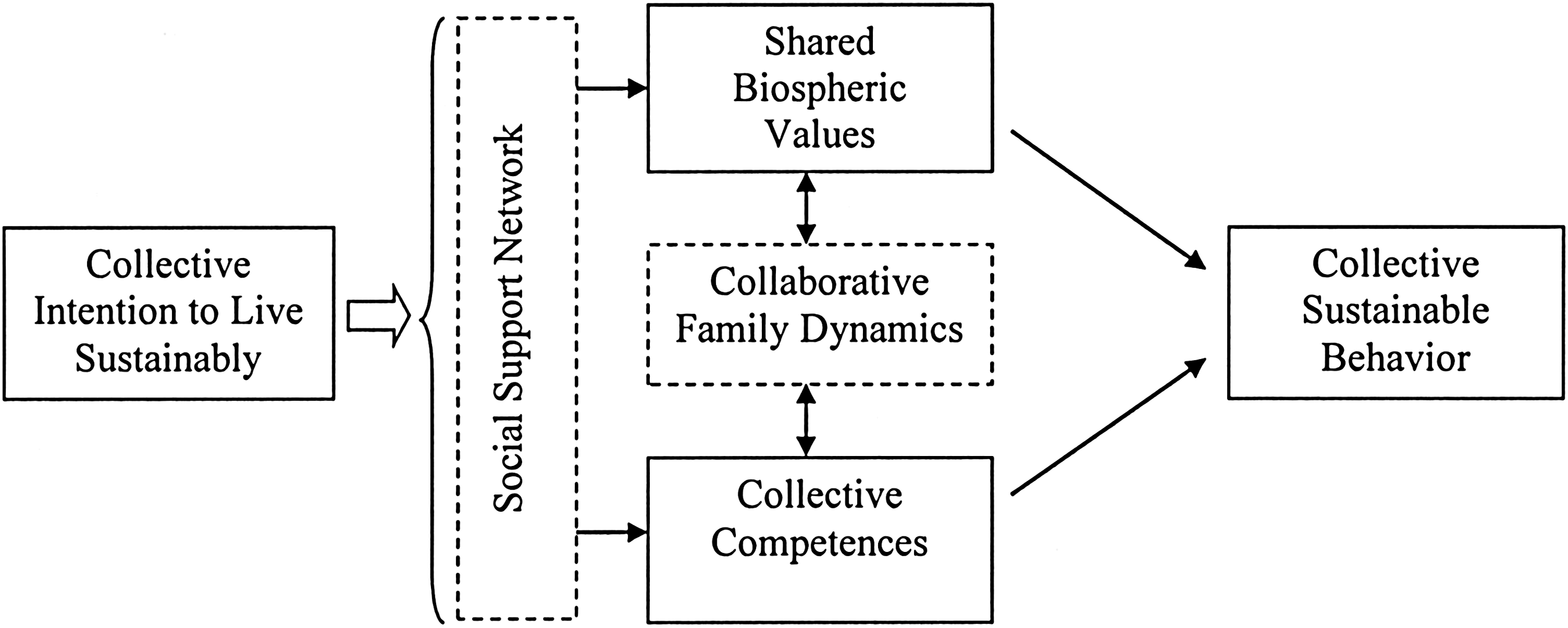
Conceptual modeling of collective sustainable behavior in families.
As illustrated, assuming an initial condition of intent by a group to live sustainably, collective (family) sustainable behavior seems to be linked to two determining conceptual constructs according to our findings: shared biospheric values and collective competences. First, as supported by our data, long-term sustainable family behavior seems dependent on all family members sharing common biospheric values. In a family where one member does not share environment-sensitive values in a family striving to adopt sustainable habits, that family may be less inclined to successfully integrate more difficult sustainable behaviors such as composting and car pooling. This seems especially relevant when the family member with nonbiospheric values occupies the role of parent. In the case of families such as the Martineaus, however, an established intergenerational biospheric value scheme is shared by all and seems to fuel their motivation for contributing to a healthier planet through habitual sustainable actions.
As for the second determining construct associated with collective behaviors of sustainability in families, our data reveal that families engaged in the process of adopting new sustainable behaviors and those already living sustainably demonstrate competences that seem to enable them to overcome potential obstacles to their goal behaviors. Competences observed in data from all study cases included collaboration, self-regulation, organizational skills, perseverance, self-efficacy, problem-solving and decision-making. Moreover, our results indicate that the more these competences are developed and mastered, such is the case with the Martineaus where both parents hold degrees in environmental sciences, the more a family social group will be inclined to succeed in adopting and maintaining sustainable behaviors, especially more difficult ones. Another curious observation surrounding these competences was their seemingly transferable or collective nature. When one family member showed perseverance in preparing waste-free lunches for example, the other family members seemed to share in that competence and strived to succeed in that chosen action. This quality of observed competences also applied to different competences. In the Martineau family, the father's notably strong sense of self-efficacy seemed to inspire confidence in other family members, who in turn expressed that they were more inclined to persevere in such challenging behaviors as sustainable gardening. Indeed, collective competences seem to regulate established family-wide sustainable behavior.
Last, we submit that two peripheral constructs contribute to moderate the scope of the above-mentioned behavior determining conceptual constructs. In the first place, according to our findings, the more inter-relational dynamics were characterized by collaboration and dialogue within a particular family, the better that family seemed at applying common competences when striving to maintain sustainable actions. For example, in the case of the Martineau family, we observed a heightened level of collaboration in their family interactions that we believe contributed to their more in-depth expression of collective decision-making (they were better at compromise, at anticipating the impacts of their actions, and at setting attainable goals, all aspects of decision-making). Our data therefore seems to point to a link between collaborative family dynamics and increased family-wide competences during attempted sustainable behavior. It should be noted that this link is reciprocal since, logically, as members of a family stimulate the manifestation of competences in others through their own demonstrated competences, the more that family's inter-member dynamic would be positively affected. It would stand to reason that the same logic of reciprocity would also apply to the link in our model between collaborative family dynamics and shared biospheric values.
As with the observed influence of family dynamics on the collective nature of manifested competences, harmonious family dynamics also seem to be associated with a more uniform environmentally based value scheme within the family. In fact, when we observed differing value schemes within a particular family, inter-relational dynamics among that family's members were sometimes noncollaborative, and there was a discernible sense of underlying conflict.
In the case of the second moderating construct, we found that the two main conceptual categories of shared biospheric values and collective competence were also influenced by participating families' network of social support or lack thereof. In other words, in the Martineau case, both parents stated that interaction with and support from other families living sustainably helped to keep them motivated in their own goals regarding sustainable living. As for the three participating families from our initial study (Landrys, Pelletiers & Goguens), they all indicated in their closing group interviews that they may have been able to take their own change experience further had they benefited from a similar social support network. Hence, we believe the conceptual construct of a social support network to have a moderating effect on the shared value scheme and collectively applied competences in a family attempting to adopt a more sustainable lifestyle. First off, it seems logical to conclude that a family whose members are willingly engaged in a process of behavioral change would already possess relatively biospheric values. In our view, a supporting social network could serve to enhance or even possibly strengthen a family's collective value system in terms of its biospheric nature. In regard to the influence of a social support network on a family's collectively manifested competences, we contend that exposure to experienced families demonstrating competences such as self-efficacy and perseverance in their daily living could promote, even inspire, a novice family in their own attempt at a sustainable lifestyle.
The following diagram (Fig. 2) attempts to compare all four families involved in our grounded theory in terms of their manifested competences, values, family dynamics, and social support. This comparison also aims to visually represent the weight of such conceptual constructs in relation to (1) the level of conviction with which they are expressed among family members, (2) a family's rate of success in maintaining attempted sustainable behaviors, and (3) the level of difficulty in attempted behaviors. As the diagram suggests, the Landrys and Pelletiers both demonstrated shared biospheric values, collaborative family dynamics, and collective competences while attempting to adopt new mitigation behaviors. They succeeded quite well, though these behaviors were relatively easy (e.g., shutting out the lights, reducing hot water consumption etc.), and the level of conviction in applied competences would sometimes waiver. As for the Goguens, we see that their level of success was comparatively low as a family. They in fact dropped out of the project midway through and therefore did not maintain collectively attempted actions. The father did however continue with some actions on his own, his level of conviction having always been strong. In the case of our model family, the Martineaus, their strong convictions as a family seem to have played a role in their high level of success at sustainable living. Moreover, the Martineaus were very successful at more difficult actions such as sustainable gardening and composting. Interestingly, they were also the only case family to make reference to a strong social support network, though the Landrys and Pelletiers did indicate that they would have liked the opportunity to share in their experience.
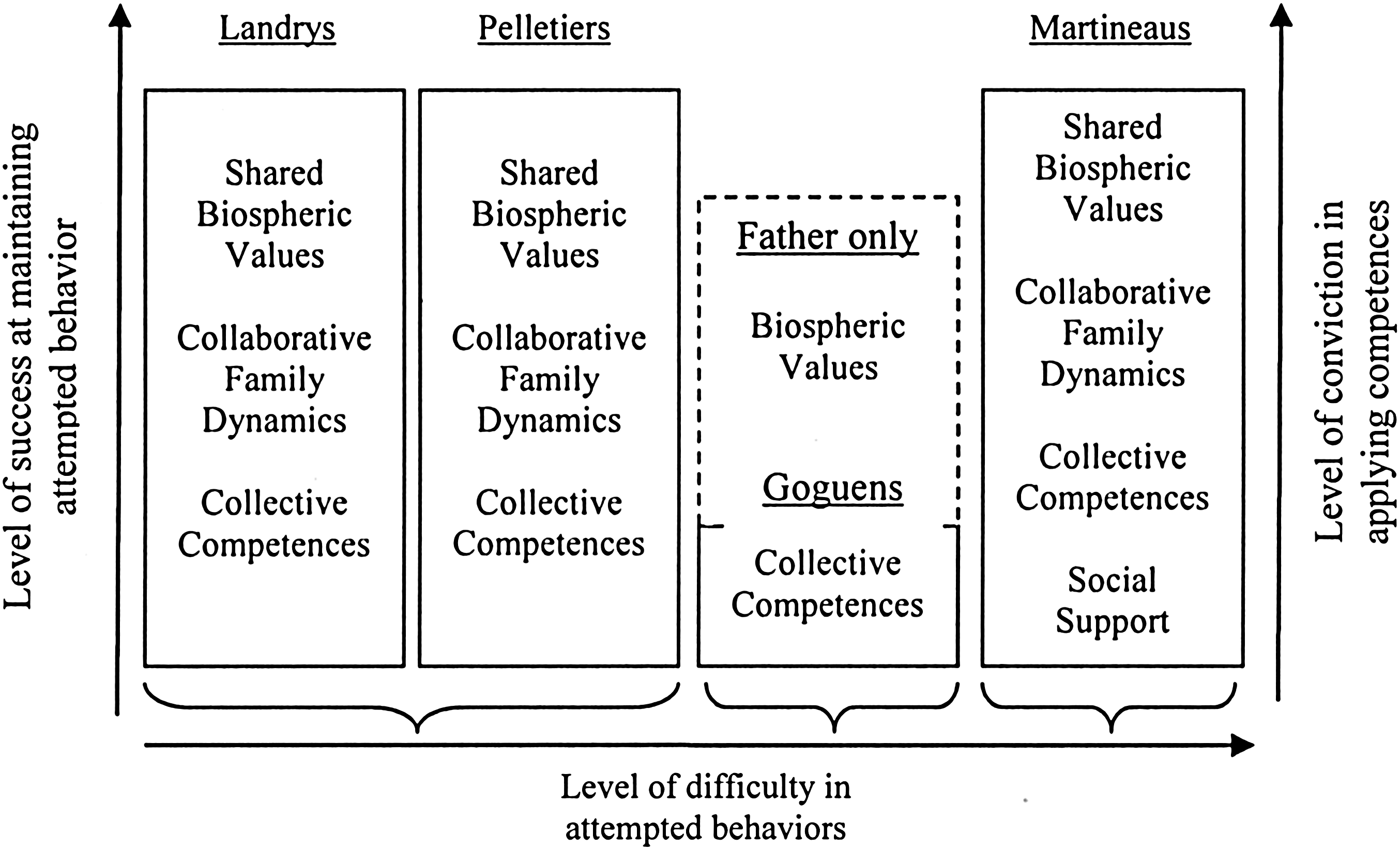
Comparing all four case families in terms of resulting sustainability behavior.
Concluding Hypotheses
From the 21 separate interviews conducted (13 individual interviews and 9 group interviews) with families attempting to live more sustainably, our preliminary research brought to light three emergent categories or conceptual constructs seemingly involved in the process of behavioral change as experienced by our three study families. In an ongoing grounded theory approach, the present study looked to explore the experience of already established sustainable family living by investigating the case of the Martineau family. Four subsequent interviews with the Martineau family (three individual interviews and one group interview) served as theoretical sampling (Corbin & Strauss, 1990) in our grounded theory process, adding to our body of data on the subject and giving us an in-depth look into the workings of a family presently living a sustainable lifestyle. In short, we are satisfied that our conclusions adequately respond to the research questions posed at the start of this article: (1) What role do competences, values, and family dynamics play in maintaining a sustainable family lifestyle? (2) How does a family living sustainably successfully maintain such a lifestyle?
Our phenomenological exploration of these questions opens the door to further study, elucidating the particularities surrounding the issue and more specifically describing the role of four seemingly determinant constructs: collective competences, shared biospheric values, collaborative family dynamics, and social network. Derived from our conceptual modeling, the following are a series concluding hypotheses which, on the one hand, serve as a possible answer to our research questions and, on the other hand, may serve to guide future research into adopting sustainable behaviors in the family setting:
1. If all members of a family share biospheric goals, then that family will tend to adopt and maintain their intended collective sustainable behaviors. 2. A family in which members demonstrate more competences (i.e., decision-making skills, perseverance, self-efficacy, environmental knowledge etc.) will tend to adopt and maintain their intended collective sustainable behaviors. 3. A family member who demonstrates a particular competence as he or she strives to adopt a collective sustainable behavior will tend to induce expression of that same competence in other family members. 4. If a family's relational dynamics are collaborative in nature (i.e., characterized by team work and dialogue), then that family will tend to share more common goals and express more analogous competences in its attempt to adopt collective sustainable behaviors. 5. If a family attempting to live sustainably is supported by a network of others experiencing similar change, that family will be more inclined to adopt more difficult sustainable behavior (such as composting and car pooling).
Directions for Future Research
While examining relevant behavioral theories during the conceptual modeling phase of our grounded theory study, we discovered similarities between two of our conceptual categories and Ajzen's TPB (1991). Though our model explores the passage from intention to action while Ajzen's TPB concentrates on the determinants of intention itself, our shared biospheric values category could constitute what Ajzen calls a behavioral belief, and our collective competence category could be what Ajzen calls a control belief. As a result, it could prove interesting to explore the possible application of Ajzen's TPB to the context of sustainable family behavior. To our knowledge, TPB has been applied to many fields such as health and economics, but not yet to the field of environmental education. Our study suggests that such an application could be a relevant course of research.
Further, we encourage further study of the conceptual categories brought forth in the present article and we believe these concepts to be of particular importance to the field of environmental education. We also believe that understanding behavioral change processes as they apply to the context of sustainable family living could lead to effective societal change on a large scale such as at the community level. Accordingly, exploring the validity of the five proposed hypotheses in this article seems an obvious course of continued research on the topic. Ultimately, based on the conceptual modeling proposed in this study, we would envision the production of educational material or even a broad scale program designed to help typical families (urban, suburban, or rural) in their efforts to bridge the gap between good intentions and prolonged sustainable behavior. In our experience stemming from earlier research in environmental education within elementary schools, we see great potential for such a program as part of a science or environment curriculum where learning would extend from the school to the family. As research in environmental education already points to an intergenerational learning relationship between child and parent (Ballantyne et al., 1998; Sutherland & Ham, 1992; Uzzell, 1999), we suggest that further exploration of this learning relationship is warranted in the context of a family's intent to live sustainably.
Given the noted importance of family dynamics as a moderating construct in the present study, it may also be appropriate to analyze family relational dynamics from a General Systems Theory (Bertalanffy, 1967) point of view. This theory's elements of adaptability and circularity seem to be particularly appropriate when considering a family's collective attempt to adopt eco-sustainable change. In their Circumplex model of family systems, Olson et al. (1983) state that adaptability “focuses on the ability of […] the family system to change” (p. 2), citing that a family has the potential to develop and grow as a system (morphogenesis). As for the concept of circularity, Bertalanffy explains that the relationships between two or more elements of a system (or members of a family) are never unilateral, but rather complementary (one affects the other and vice versa). For his part, Minuchin (1985) points out that circularity is at the root of a fundamental shift in the way we look at behavioral change from a systems perspective, suggesting that “cause and effect are not linear, that behavior is simultaneously the result of and trigger for other behavior, and that circles are thus more accurate descriptions of human interactions than are straight lines.” Accordingly, in an ongoing effort to theorize on the issue of collective eco-sustainable change in the context of family, it may be more appropriate in future studies to consider a subsequent circular version of our model.
Finally, in light of our findings, we believe that an educational program geared toward promoting sustainable behavior in families should strive to encourage common biospheric family values, nurture a collaborative relational dynamic between members, and develop competences among members in the face of behavioral challenges, and involve a social support network. In conclusion, we offer four practical suggestions as to how such a program could incorporate these postulated conditions of family-wide behavioral change:
1. Begin by allowing family members to express their values and establish realistic personal and collective behavioral goals for sustainable living; 2. Promote the school as a meeting place, ideally allowing a participating family to interact with other participating families in the context of an on-site school project (e.g., community garden, car pooling) where children could take on a leadership role in applying their classroom knowledge; 3. Foresee opportunities for vicarious learning (Bandura, 1969) by allowing participating families to meet with a model family already living sustainably, thus encouraging the development of certain competences believed to facilitate behavioral change (e.g., collaboration, perseverance, self-efficacy, decision-making). 4. Incorporate other opportunities for engaged families to gather, whether through organized meetings (e.g., climate action clubs) or via social networking sites, thus facilitating the sharing of knowledge, success strategies and other competences, and ultimately contributing to active Communities of practice (Pruneau et al., 2006; Wenger, 1998).
Critical Reflections and Study Limitations
Admittedly, it would be naïve to assume that our conceptual model and seed theory could stand as is, having been derived from only four participating families. Notwithstanding our attention to scientific rigor during both data collection (multiple sources of data collected over a significant period of time during preliminary research and subsequently triangulated with the Martineau case in the present research) and data analysis (independent initial coding with applied inter-rater reliability score of 97% and adherence to Charmaz's grounded theory tenets), we recognize that our approach poses certain methodological limitations. For instance, besides the relatively small number of families that were questioned over the course of the study, the Goguen family did not complete the project and, in the case of the Martineau family, two of the five family members were not interviewed for logistical reasons. As a result, we suggest that using discriminant sampling, as described by Creswell (2007), could further our understanding of sustainable family living by gathering additional data from individuals similar to those initially interviewed to see if our proposed theoretical modeling holds true. Though we feel confident that 26 interviews generated a reasonable amount of data to support a grounded theory design, we would like to see the resulting model applied to multiple families to verify its validity.
Footnotes
Acknowledgments
First and foremost, the authors wish to thank all the families who participated in the study, investing their time and sharing their personal change experience so honestly. The authors also wish to acknowledge the invaluable contributions of Maryse Cousineau and Monique Langis in assisting during data collection and initial analysis of interviews. Also, this project would not have been possible without funding from the following organizations: Écoaction, the New Brunswick trust fund for the environment and the Faculty of higher education and research at the Université de Moncton.
Author Disclosure Statement
No competing financial interests exist.