




Abstract
The three studies reported in this article detail the development of the State of Interdependence with Nature Scale (SINS), a new self-report measure specifically designed to assess momentary fluctuations in feelings of deep connection, or “oneness,” with nature. Using exploratory factor analysis, Study 1 (N = 228) identified eight optimally performing items to be retained in the SINS. Using confirmatory factor analysis, Study 2 (N = 126) supported the SINS' unidimensional structure. Using bivariate correlation analysis and linear modeling, Study 3 (N = 73) found the SINS demonstrated strong positive correlations with legacy measures capturing the dispositional tendency to feel connected with nature and was sensitive to behavioral intervention. Nature-based interventions increased SINS scores relative to a control condition. Together, these three studies provide preliminary evidence that the SINS is psychometrically sound.
Introduction
Human beings depend on the natural environment for survival, whereas the natural environment's survival is increasingly dependent on human behavior (Oskamp, 2000). Presently, the natural environment is strained from human-driven causes, including climate change, pollution, population growth, and overconsumption (Wamsler, 2017). It is clear that pro-environmental actions must disrupt, and ultimately reverse, current environmental harms. However, promoting positive environmental changes requires understanding what motivates one person to engage in behaviors that benefit the environment whereas another person does not. Importantly, individual differences in human–nature connectedness predict pro-environmental behavior (Nisbet, Zelenski, & Murphy, 2009; Rosa, Profice, & Collado, 2018). Thus, additional tools to measure states of nature connectedness are needed to understand person-specific factors in nature connection. The present study examined a new self-report measure specifically designed to assess momentary fluctuations in feelings of deep connection or interdependence with nature.
Defining Interdependence with Nature
Some humans feel deeply connected with nature, experiencing “a sense of oneness with the natural world” that the present study defines as interdependence with nature (Mayer & Frantz, 2004, p. 504). Others feel little connection with nature, experiencing themselves as fully independent from the natural world. These two positions—interdependent and independent—may be considered poles on a human–nature connectedness continuum, with interdependent individuals at one pole and independent individuals at the other (Fig. 1). Individuals experiencing interdependence with nature view nature as an extension of their sense of self, making damage to the natural world equivalent to damaging the self. Thus, interdependent individuals are likely to be more motivated to protect the natural world and work to reverse environmental damage. Alternatively, independent individuals typically view nature as “other,” with nature as a commodity to be used for personal gain and/or a dangerous entity to be avoided.
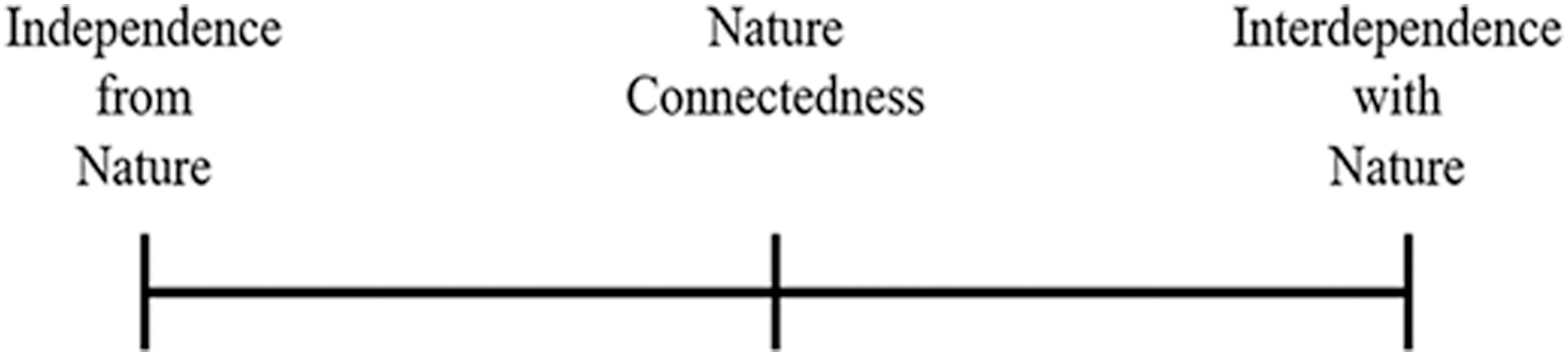
As a pole on the human–nature connectedness continuum, interdependence with nature is conceptualized here as a deeper form of nature connectedness. Thus, nature connectedness and interdependence with nature differ primarily by degree. The nature connectedness construct denotes an emotional connection with the natural world (Mayer & Frantz, 2004), whereas the interdependence with nature construct denotes an emotional connection with nature so profound that it changes how the sense of self is conceived. Interdependence with nature reflects an experiential understanding that nature is an extension of the self. The experience that the self and nature are “one,” inextricably bound, is the distinguishing feature of the interdependence with nature construct. Thus, interdependence with nature can be conceptualized as an intensely personal form of nature connectedness, characterized by feelings of connection so deep that they carry implications for the sense of self. Given this self-referential quality, interdependence with nature might even be classified as a distinct sub-type of self-transcendent experience (Yaden, Haidt, Hood, Vago, & Newberg, 2017).
Although individuals may tend toward one end of this human–nature connectedness continuum or the other, most humans may be capable of experiencing the continuum's full range. Discrete experiences, such as reaching a beautiful mountain summit, may shift the established human–nature connectedness “set points,” as has been proposed for similar psychological constructs [e.g., the set-point theory of happiness (Lucas, 2007) and the cybernetic model of personality (DeYoung, 2015)]. Thus, over time, the accumulation of discrete, “peak” experiences with nature may fundamentally alter the way an individual relates to nature.
Interdependence with Nature: Theoretical Perspectives
Several theoretical perspectives frame the concept of interdependence with nature, including Wilson's (1984) biophilia hypothesis, place identity theory, and interdependence theory. Wilson's (1984) biophilia hypothesis suggests that evolutionary processes predispose humans to seek connection with the natural world. Wilson (1984) contends that this drive to connect with nature is so basic to the human experience that it is genetically encoded. Wilson's theory suggests that a sense of nature connectedness is more than a psychological phenomenon. It is instead biologically based, but dormant for some. Wilson proposes a type of nature connectedness that is part of the self, an interdependence with nature so deeply engrained that it is coded in the genome.
Place identity offers a slightly different lens for understanding the theory behind nature interdependence. Place identity theory extends the biophilia hypothesis by more explicitly linking feelings of connection with geographic places to personal identity. Based in a social constructivist perspective, Proshansky (1978) defines place identity as “dimensions of self that define the individual's personal identity in relation to the physical environment by means of a complex pattern of conscious and unconscious ideas, feelings, values, goals, preferences, skills, and behavioral tendencies relevant to a specific environment” (p. 155). People feel strongly about a range of places, including built environments, such as homes and cities, as well as natural environments, such as national parks and wilderness. Interdependence with nature can be conceputalized as a type of place identity, an identification with natural environments such that nature comes to comprise a core component of the sense of self.
Finally, interdependence theory (Thibaut & Kelley, 1959), originally developed to broaden the level of analysis of human behavior beyond an individual actor's motivations, offers another lens for considering human's interdependence with nature. If “interacting people influence one another's experiences” (Van Lange & Balliet, 2015, p. 65), such reciprocity may extend to one's relationship with the natural environment as well. Humans with a strong sense of interdependence with nature may consider how nature impacts them, as well as how they impact nature. Thus, interdependence theory is useful when thinking about humans and nature because it provides an avenue to consider how and to what extent humans consider nature a part of themselves, integral to their own survival and well-being, or alien to themselves, a force to be managed, controlled, or avoided.
The Utility of Identifying the State of Interdependence
Individuals who identify as independent from nature are less likely to engage in pro-environmental behavior whereas interdependent individuals are more likely to do so (Cheng & Monroe, 2012; Davis, Green, & Reed, 2009; Nisbet et al., 2009). Some research has explored this area. Specifically, Vaske and Kobrin (2001) found that place attachment, one's attachment to a local natural resource, influenced environmentally responsible behavior. The researchers found that place identity mediated the relationship between place dependence and pro-environmental behaviors such as sorting recyclables (Vaske & Kobrin, 2001). Similarly, Dutcher, Finley, Luloff, and Johnson (2007) used the term “connectivity with nature” to describe a sense of sameness between one's self, other people, and natural environments, describing that connectivity as involving the “dissolution of boundaries” and a feeling of shared core between self, natural environments, and other people (Dutcher et al., 2007). In their research, connectivity to nature showed a strong, positive relationship with pro-environmental behavior (Dutcher et al., 2007).
Significant research suggests that pro-environmental behavior can be taught and is responsive to tailored intervention (Daamen, Staats, Wilke, & Engelen, 2001; Shafiei & Maleksaeidi, 2020). Research exploring what enhances pro-environmental behavior identifies important psychological factors—both internal and external to each human, suggesting interventions to improve pro-environmental behavior be tailored to individuals' specific values and orientations (Li, Zhao, Ma, Shao, & Zhang, 2019). Such tailoring is improved with an instrument that can help practitioners to identify individuals' specific state of interdependence with nature, a critically important lens into one's attitude toward the natural world.
The health of the planet depends on shifting independent mindsets into interdependent mindsets. However, this transformation can be difficult to achieve. Over time, it has become clear that knowledge of environmental problems alone is often not sufficient to produce pro-environmental behavior (Kollmuss & Agyeman, 2002). Humans need to feel connected with nature to want to protect it. Steg and Vlek (2009) argue that promoting environmental behavior change is best addressed by targeting specific pro-environmental behaviors, examining which factors motivate those behaviors, and applying interventions to modify those behaviors.
Thus, researchers need an instrument that can measure the state of interdependence with nature, a self-report measure that can assess momentary fluctuations in feelings of deep connection or “oneness” with nature. Such an instrument will be critical as scientists examine how best to cultivate a state of interdependence with nature, as developing humans' state of interdependence with nature may be key for conservation efforts (Restall & Conrad, 2015). Many humans already endorse the trait of interdependence with nature and thus are motivated for pro-environmental behavior, whereas many others feel resistant to such perspectives and thus should be the target of interventions that aim at cultivating first feelings of deep connection with nature, the state of interdependence with nature.
Measuring Interdependence with Nature: Trait versus State
Identifying efficacious interventions that are capable of enhancing humans' feelings of nature interdependence relies on measurement strategies that capture (1) feelings of interdependence with nature as a more durable trait, and (2) feelings of interdependence with nature as a more transient state. A number of validated scales measure the former, but no extant scale appears to be explicitly designed to assess the latter. The absence of a state scale precludes direct investigation of whether the transient tendency to feel interdependent with nature—critical for pro-environmental behavior—can be developed by a prescribed intervention, such as regular nature exposure.
At least 18 extant scales capture aspects of a trait-like interdependence with nature (see Restall & Conrad, 2015; Tam, 2013 for a full review). Some of the most commonly used are the Environmental Identity scale (EID: Clayton, 2003), the Connectedness to Nature Scale (CNS: Mayer & Frantz, 2004), the Connectivity with Nature scale (CWN: Dutcher et al., 2007), the Nature Relatedness Scale (NRS: Nisbet et al., 2009), the Commitment to Nature scale (COM: Davis et al., 2009), and the Love and Care for Nature Scale (LCN: Perkins, 2010). Each of these scales includes items that explicitly assess either states of interdependence with nature (e.g., CNS: “I feel a sense of oneness with nature”), or items that could be slightly reworded to more clearly capture interdependent states (e.g., EID: “I think of myself as a part of nature, not separate from it.”->“I am part of nature, not separate from it.”). Given these existing instruments, a ready pool of validated items exists that could be leveraged to create a self-report scale that is sensitive to transient states of interdependence with nature elicited by behavioral interventions.
Notably, one of these instruments, the CNS, was modified to assess the state of nature connectedness (Mayer, Frantz, Bruehlman-Senecal, & Dolliver, 2009). However, psychometric data for this modified instrument appear not to have been published. In addition, the Inclusion of Nature in Self scale (INS) measures how interconnected an individual feels with nature, but it does so by using a different methodology: asking participants to circle one of seven Venn-like diagrams that show “nature” and “self” as two separate or increasingly overlapping circles. Although these existing instruments are useful, neither appears to capture the transient state of nature interdependence as conceptualized in the current study.
The Present Study
To address this gap in measuring interdependence with nature as a transient state of deep connection or “oneness” with nature, three studies were carried out. These studies lead to the development of the State of Interdependence with Nature Scale (SINS), a new self-report measure designed to assess these fluctuating feelings of deep connection with nature. The purpose of Study 1 was to identify items that should be retained in the SINS before the items were tested to confirm the SINS' structure (Study 2). Study 3 had two purposes: (1) to explore the SINS' convergent validity, and (2) to determine whether the SINS was sensitive to behavioral intervention.
Study 1
Method
Preliminary item selection
A pool of 94 potential items were derived from six existing scales: the EID, CNS, CWN, NRS, CNS, and LCN. Five of six scale authors consented in writing to the use of their instruments' items for the potential inclusion in this new instrument. One scale author (the author of the LCN) did not respond to multiple outreaches from the researchers. From the initial pool, items designed to measure beliefs about nature (e.g., “In general, being part of the natural world is an important part of my self-image” or “It seems to me that humans and the environment are interdependent”), preference for outdoor activities (e.g., “I really enjoy camping and hiking outdoors” or “I like to garden”), and pro-environmental behaviors (“When I make plans for myself, I take into account how my decisions may affect the environment” or “Engaging in environmental behaviors is important to me”) were removed due to the new scale's particular focus on transient, state-type feelings of interdependence with nature. This initial screening process yielded 44 items that could be directly adopted or adapted with minimal rewording to assess transient, state-like feelings of interdependence with nature. Item adaptation was undertaken to minimize cognitive elements in the retained items' wording (“I think…” or “I believe…”) and emphasize immediate, felt experience. An example of an adapted item comes from the CNS. The original item reads: “When I think of my life, I imagine myself to be part of a larger cyclical process of living.” This item was adapted to read: “I am a part of a larger cyclical process of living.” A large Western university IRB approved all study procedures and forms before data collection.
Participants and procedures
A total of 300 American adults were recruited from Mechanical Turk (MTurk) to take the preliminary SINS survey with all 44 items. To ensure data integrity, only those participants with an established history of providing good quality data (i.e., successful completion of >500 previous tasks with a task approval rate of >95%) and that took sufficient time to read all survey items (e.g., completed all survey items at a reading rate of <300 words per minute) were included in the final sample (N = 228; see Table 1).
Participant Demographics for Study 1
Minimum sample size recommendations for exploratory factor analysis (EFA) have traditionally ranged from 100 to 300 (Cattell, 1978; Gorusch, 1983; Guilford, 1954; Thompson, 2004), with Cattell (1978) suggesting 3–6 participants for every 1 variable (N/p ratio). More recently, analytically derived sample size recommendations have confirmed that smaller sample sizes (e.g., N < 50) may also be appropriate when conducting EFAs if communalities are high (de Winter, Dodou, & Wieringa, 2009). Thus, by both traditional (i.e., Cattell, 1978; N/p ratio = 5.18) and more recent standards (i.e., de Winter et al., 2009), our final sample size would more than sufficiently power an EFA assuming a single factor solution, involving 24–48 variables, with factor loadings in the 0.4 range (N = 52–46).
Participants were compensated 25 cents for completing the online survey in a single testing session. A set of instructions introduced the items: “Now you will be asked whether you agree or disagree with a series of statements. There are no right or wrong answers. Answer each question as quickly and honestly as you can.” Items were scored on a five-point Likert-type scale (1 = Strongly disagree to 5 = Strongly agree), and item order was randomized. The average survey response time was 10 min (SD = 5.15).
Measures
The EID is a 28-item measure of “the extent to which the natural environment plays an important part in a person's self-definition” (Clayton, 2003, p. 52). The CNS is a 14-item assessment “designed to measure individuals' experiential sense of oneness with the natural world” (Mayer & Frantz, 2004, p. 504). The CWN is a five-item measure of “a perception of sameness between the self…and the natural world” (Dutcher et al., 2007, p. 474). The NRS is a 21-item measure of “the affective, cognitive, and experiential aspects of individuals' connection to nature” (Nisbet et al., 2009, p. 715). The NRS comprises three subscales. The NRS-Self subscale assesses how strongly respondents identify with nature. The NRS-Perspective subscale assesses how respondents' relationships with nature are represented attitudinally and behaviorally. The NRS-Experience subscale assesses physical familiarity with and attraction to nature. The COM is an 11-item measure of “psychological attachment to and long-term orientation toward the natural world” (Davis et al., 2009, p. 178). The LCN is a 15-item measure of “love and deep caring for nature as an expression of people's personal and explicitly emotional relationship with nature” (Perkins, 2010, p. 455).
Results
The EFA with the maximum-likelihood method was used to examine the factor structure of the 44 interdependence with nature items. The Kaiser measure of sampling adequacy was 0.97, and Barlett's test of sphericity was highly significant (χ2 = 10544.19, p < 0.001). Parallel analysis suggested the retention of only one factor, as only the first factor's eigenvalue was greater than the random data eigenvalue (Factor 1: eigenvalue = 27.34, random data eigenvalue = 2.07; Factor 2: eigenvalue = 1.81, random data eigenvalue = 1.93; Factor 3: eigenvalue = 1.15, random data eigenvalue = 1.84, etc.). The first factor contained 16 items and accounted for 62% of the total variance across factors. To shorten the scale, items with redundant or very similar wording were removed one by one from the full item list until only a single factor remained. Then, to further shorten the scale, all items with loadings less than 0.75 were removed. Table 2 presents the resultant eight-item SINS. The final item set accounted for 72% of the total variance, the average factor loading was 0.82, none of the retained items evidenced pronounced skew or kurtosis, and the SINS' internal consistency was excellent (α = 0.94).
Factor Structure of the State of Interdependence with Nature Scale
Wording adapted from original scale.
CNS, Connectedness to Nature Scale; COM, Commitment to Nature Scale; CWN, Connectivity with Nature Scale; EID, Environmental Identity Scale; NRS, Nature Relatedness Scale.
Study 2
Study 2 utilized confirmatory factor analysis (CFA) to re-evaluate the SINS' structure by using data from a new sample of American adults (n = 126). This sample was recruited by using multiple strategies to yield a diverse sample of individuals with a demonstrated interest in spending time in nature. A portion of this sample was recruited at trailheads and outdoor adventure stores in the American Mountain West (N = 57). The average age of these participants was 41; the majority were female (68%) and white (83%). The remainder of the sample was recruited on a college campus in the American Southwest (See Table 3 for demographics). The CFA sample size recommendations suggest that 100 participants are needed to achieve excellent model fit when the variable-to-factor ratio is 8 (Mundfrom, Shaw, & Ke, 2005). The variable-to-factor ratio in the present study was 15.75, suggesting that the present CFA was well powered.
Participant Demographics and Baseline Statistics for Study 3
IRL, in-real-life; INS, Inclusion of Nature in Self Scale; SINS, State of Interdependence with Nature Scale; VR, virtual reality.
The CFA was performed by using maximum-likelihood estimation and the MPlus 8 program. Four fit indices were used to evaluate model fit: the comparative fit index (CFI; Bentler, 1990), the Tucker–Lewis Index (TLI; Tucker & Lewis, 1973), the root mean square error of approximation (RMSEA; Browne & Cudeck, 1993; Steiger, 1990), and the standardized root mean squared residual (SRMR; Bentler, 1995). The CFI and TLI values above 0.95, RMSEA values below 0.06, and SRMR values below 0.08 indicate that the model fits the data well (Brown, 2015; Hu & Bentler, 1999). The model's fit indices indicated that the correspondence between the single factor model and the sample covariance matrix was good: CFI = 0.97, TLI = 0.96, RMSEA = 0.051, and SRMR = 0.031. All eight items were significantly (all ps < 0.001) related to the latent factor (Table 2). Internal consistency (alpha) was 0.93. These results provide further evidence that the SINS is psychometrically sound.
Study 3
Study 3 aimed at examining the SINS' convergent validity and at assessing whether SINS scores were sensitive to different types of nature exposure. First, bivariate correlation analysis was used to examine whether the SINS evidenced positive relationships with legacy, trait nature connectedness scales. Second, an analysis of covariance (ANCOVA) strategy (Frison & Pocock, 1992) was used to assess the SINS' sensitivity to spending time in a natural setting and a virtual reality (VR) nature experience. Consistent with the ANCOVA approach for analyzing randomized trial outcomes, baseline SINS values were co-varied to ensure that post-intervention SINS values by treatment group were independent of baseline differences.
Method
Participants and procedures
A total of 73 college students were recruited from a large university in the American Southwest. See Table 3 for the full sample's demographics as well as demographics by condition. Participants were randomly allocated to one of three conditions: an in-real-life (IRL) nature condition, a virtual nature condition (VR nature), or a virtual library control condition (VR library). Participants in the IRL nature condition took a short hike, in groups of two to five, to a small pond where they spent 10 min alone in nature. Participants were asked to spread out and remain silent during the experience. The location of the hike was chosen based on being near-nature (Levi & Kocher, 1999; Nisbet et al., 2009; Pyle, 2003) and utilized publicly available spaces along a trail near the pond. Both virtual conditions were filmed with a 360° video camera and viewed on a head-mounted display, the Oculus Go. All technology utilized was consumer grade. Participants in the VR nature condition experienced 360° video of the same hike and spent time via VR at the same pond alone. Participants in the VR library condition viewed content filmed in a school library with similar editing to the VR nature condition. Before beginning their respective experimental manipulation, participants completed a self-report survey containing the SINS, the INS, and the NRS (Nisbet et al., 2009). Immediately after experimental manipulation, participants completed the SINS again. G*Power determined that a sample of 73 students was needed to detect an overall between-group effect on baseline-adjusted SINS scores (f = 0.40 or of large size) with 80% power, two-sided p < 0.05.
Measures
The INS is a single-item, visual scale that uses pairs of overlapping circles to measure how closely a respondent identifies with nature. The NRS and the SINS are described earlier.
Results
Relationships with other measures
Bivariate correlations revealed that the SINS was strongly associated with two legacy measures assessing trait-like nature connectedness (Table 4). The SINS was also positively correlated with each of the NRS subscales, evidencing strong associations with both the Self and Experience subscales and a moderate association with the Perspective subscale.
Correlations Among the States of Interdependence with Nature Scale, Inclusion of Nature in Self Scale, and Nature Relatedness Scale
p < 0.001.
Sensitivity
No significant between-group differences were observed at baseline for any of the nature-related variables. An ANCOVA revealed a statistically significant effect of condition on interdependence with nature as assessed by the SINS (F2,6 = 13.96, p < 0.001, partial η2 = 0.30). Specific contrasts indicated that participants assigned to the IRL (x̄ = 33.18, 95% CI: 31.14–35.22; p < 0.001) and VR (x̄ = 31.47, 95% CI: 29.59–33.34; p < 0.001) nature conditions reported significantly higher baseline-line adjusted SINS scores at post-intervention compared with those assigned to the VR Library condition (x̄ = 25.49, 95% CI: 23.26–27.72). Although the post-intervention SINS scores for the IRL nature condition were larger than the VR nature condition, the between-group difference was non-significant (x̄ difference = 1.71, p = 0.22). A sensitivity analysis, adjusting for participant characteristics—such as age, gender, year in school, or major—did not substantively alter the model (F = 9.14, p < 0.001).
Within-group effects are reported in Table 5. Spending time in nature significantly increased SINS scores, a VR nature experience did not change SINS scores, and a VR library experience significantly decreased SINS scores.
State of Interdependence with Nature Scores as a Function of Condition and Time
Data are given as mean (SE).
p < 0.05, **p < 0.01.
ES, within-group effect size (Cohen's d).
Discussion
Human beings and the natural world are interdependent, whether humans acknowledge this to be true or not. Humans influence the natural world, and the natural world influences humans. Unfortunately, the influence of humans on the natural world has produced dire environmental conditions necessitating immediate corrective action. Understanding how or why an individual engages in pro-environmental behaviors requires understanding one's relationship with nature. The inextricable enmeshment of humans with nature leads some to suggest that a sense of interdependence with nature is an inherent way of being (Wilson, 1984). However, feelings of interdependence vary considerably. Some people feel completely independent from and even antagonistic toward nature. Others feel completely interdependent with nature, reporting a sense of oneness with the natural world. It is possible that the same person may feel differently about their connection with nature at different times, demonstrating contextually or behaviorally influenced fluctuations in their sense of interdependence with nature. For instance, individuals' place-identity and associated well-being significantly decreased after a natural disaster (Knez et al., 2018). This variability suggests the existence of both inter-individual and intra-individual differences in interdependence with nature. A number of extant scales are capable of measuring inter-individual differences in interdependence with nature (e.g., INS, NRS), but a new measurement tool was needed to sensitively assess intra-individual differences in interdependence with nature. To address this measurement gap, the researchers used a series of three studies to create the SINS.
Study 1 used EFA to identify a subset of items optimally suited to assess momentary states of interdependence with nature. Eight items, all loading on a single factor, were retained for the final version of the SINS. Study 2 used CFA to confirm the SINS' unidimensional structure in a new sample. Study 3 found evidence of convergent validity, with the SINS demonstrating strong positive correlations with legacy measures capturing the dispositional tendency to feel connected with nature. These correlations suggest that people who consider themselves to be connected with nature, in general, are also more likely to feel interdependent with nature at any given moment. To the researchers' knowledge, this study represents the first time the relationship between nature connectedness and nature interdependence was examined directly. Importantly, Study 3 found evidence of the SINS' sensitivity to behavioral intervention, a critical finding for a measure designed to capture momentary fluctuations in states of interdependence with nature. Results indicate that spending time in nature effectively increases SINS scores relative to a control condition. Moreover, results suggest that spending time in a virtual, unnatural environment can decrease feelings of interdependence with nature. Together, these three studies provide preliminary evidence that the SINS is psychometrically sound.
Implications of the present study
With the SINS, researchers will now be able to assess more skillfully the effectiveness of their nature-based interventions. Used in this way, SINS data have the potential to help (1) improve how we encourage states of interdependence with nature; (2) promote more durable beliefs about being connected with nature; and (3) encourage more pro-environmental behavior. Indeed, the SINS will allow researchers to directly examine whether the regular cultivation of states of interdependence with nature lead to more durable beliefs about being intimately connected with nature, which, in turn, may motivate pro-environmental behavior. Now, researchers can comprehensively test this hypothesized chain leading from feeling to action in randomized controlled trials that use the SINS in conjunction with legacy measures of nature connectedness (e.g., INS, NRS) and pro-environmental behavior.
The SINS will also be useful in identifying types of nature-based interventions that are optimally suited to encourage states of interdependence with nature. Better-designed nature experiences are likely to produce better experiences in nature. For instance, incorporating mindfulness-based interventions in natural settings or on outdoor adventure trips appears to show particular promise in this regard (Kirwin, Harper, Young, & Itzvan, 2019).
Future research
Although findings from the present series of studies are promising, there is the need for continued psychometric work on the SINS. Future studies should clearly investigate the extent to which the SINS measures a state, rather than a trait. For example, future studies should explore whether an intervention to enhance pro-environmental behavior might affect scores on the SINS, but not scores on existing trait measures such as the CNS, NRS, or INS. In addition, future studies should establish whether the SINS has adequate discriminant validity. Further, future studies should explore how exposure to other types of natural and non-natural environments affects SINS scores.
Similarly, although the authors grounded their study in concepts of independence and interdependence, there are many other theoretical lenses that consider that the relationship between self and the natural environment exists. For example, the concept of ecological self, drawing from transpersonal psychology, includes a self that is expansive and has unlimited identifications with place and world (Bragg, 1996: Strumse, 2007). Using this or other conceptualizations of the relationship between self and natural environment to measure this important relationship is an important area for future study.
Limitations
First, the researchers' ability to assess states of interdependence with nature was limited by the item pool derived from existing measures that were originally designed to assess nature connectedness in a more durable sense. It is possible that alternative items or item wordings are better suited to assess immediate states of interdependence with nature. Future studies, potentially employing item response theory analyses, are needed to examine the SINS items in a more granular fashion. Relatedly, continued validation work (e.g., known-group validity, discriminant validity) is needed to ensure that the SINS is psychometrically sound. Specifically, future research should explore how the INS and modified NRS, in contrast to the newly developed SINS, can capture the changes of transient feelings of nature interdependence in response to interventions.
The use of MTurk for recruitment purposes may also be a limitation in the present study. Although evidence suggests that MTurk participants provide valid and useful data (Buhrmester, Kwang, & Gosling, 2011; Mason & Suri, 2012), continued use of the SINS in more diverse samples recruited through alternative means is indicated. Finally, future research is needed to determine whether momentary experiences of interdependence with nature can cultivate more durable, dispositional beliefs about the fundamental relationship that exists between humans and nature, and whether moments of interdependence can accrue into a biospheric valuation (de Groot & Steg, 2008).
Finally, the researchers used a secular and Western worldview in conceptualizing “independence from nature.” In this article, independence from nature suggests that one views nature as “other,” something distant and disconnected from self. By contrast, some authors and contexts view the concept of other as sacred, important, or an extension of self (Leary, Tipsord, & Tate, 2008). Thus, underpinning the concepts in the present study are specific cultural orientations and assumptions. Unpacking concepts of self and other is beyond the scope of the present study, but the authors wish to acknowledge these cultural assumptions underlying the concepts in the present study.
Conclusion
Human-caused environmental degradation is likely the most pressing issue of our time (Oskamp, 2000). Although small-scale changes in human behavior are unlikely to reverse human-caused environmental damage entirely, finding ways to change how individuals feel about the environment and act toward it must be part of the globe's environmental restoration strategy. The SINS will allow researchers to identify the activities and interventions that are most likely to encourage the internal states that are conducive for pro-environmental behavior.
Footnotes
Acknowledgments
The authors wish to acknowledge the important contributions of Sara Tipler who assisted in the final editing of this article.
Author Disclosure Statement
No competing financial interests exist.
Funding Information
No funding was received for this article.