




Abstract
Some prior studies suggest that nature exposure can bolster creativity in adults and adolescents, but little is known about the effect of nature stimuli on children's creativity. We investigated the effect of exposure to static images of natural and urban scenery on verbal creativity in children using a between-subjects repeated measures design. Fifty-five children (ages 8–15 years; mean = 11.05) were randomly allocated to the urban or nature condition and completed two verbal creativity measures (alternative uses and similarities tasks) before and after viewing 100 urban/nature images. Twenty-four participants were tested in-person and, due to COVID-19, 31 were tested online. Independent samples t-tests indicated that participants tested online versus in-person did not differ on characterization variables (e.g., age, gender, verbal cognitive ability) or creativity measure scores, and thus, the groups were combined for subsequent analyses. Repeated-measures analysis of variance did not support the hypothesis that children in the nature condition would demonstrate more improvement in verbal creativity than those in the urban condition. These findings suggest that short exposures to nature scenery were not sufficient to enhance verbal creativity in children. This research is the first to examine the effect of brief nature exposure on verbal creativity in children and provides important directions for future research.
Introduction
There is mounting evidence that exposure to nature, both real and virtual, improves some important aspects of cognition including attention and working memory. These effects have been demonstrated across various age groups and populations (Berman, Jonides, & Kaplan, 2008; Cimprich & Ronis, 2003; Gamble, Howard, & Howard, 2014; Johnson, Snow, Lawrence, & Rainham, 2019; Stenfors et al., 2019; Stevenson, Dewhurst, Schilhab, & Bentsen, 2019; Taylor & Kuo, 2009). It has been suggested that spending time in nature also has the potential to enhance creativity because natural environments are full of open-ended elements that can stimulate divergent thinking skills, a foundation of creativity (Bento & Dias, 2017; Kiewra & Veselack, 2016).
To date, however, research evidence supporting this notion is scarce and further investigation is warranted. A potential link between nature exposure and creativity is particularly important given that there have been significant declines in the amount of time people spend in nature (Clements, 2004; Soga & Gaston, 2016) and on objective measures of creativity in recent decades (Kim, 2011). The few studies that have examined the effects of nature on creativity have focused mainly on adult samples, whereas the decline in creativity has been identified in children and adolescents (Kim, 2011). To this end, we examined the effects of exposure to digital nature images on creativity in children and young adolescents.
Defining creativity
Creativity is a higher-order cognitive construct that plays an integral role in innovative thinking, insights, and discoveries. Although there is no single definition of creativity, there is general consensus among researchers that creativity involves the generation of a novel idea, product, or solution that is beneficial at an individual or societal level (Hennessey & Amabile, 2010). One of the prominent definitions of creativity was provided by Guilford (1967), who described it as a form of problem-solving that relies heavily on divergent production.
There are several indicators of creativity utilized in research, including fluency (number of generated nonredundant items), cognitive flexibility (the breadth and number of distinct cognitive categories and perspectives being employed), and originality (uncommonness and novelty of the generated items) (Baas, De Dreu, & Nijstad, 2008).
Creativity in children and adolescents
An extensive analysis of the normative data of the Torrance Tests of Creative Thinking, a widely used measure of creative potential/divergent thinking, revealed a decline in creative thinking over the past 20–30 years in children spanning kindergarten through grade 12 (Kim, 2011). More specifically, the scores obtained on the subtests indicated that children and adolescents have become less apt at generating numerous ideas (fluency scores) and have gradually declined in their ability to contemplate, ponder, and expand on thoughts and ideas (elaboration scores). Kim (2011) concluded that children and adolescents are becoming less imaginative and unconventional and coined the term “the creativity crisis,” which has been supported in subsequent studies (Runco, 2015).
There is speculation that the decline in children and adolescents' creativity could be linked to a reduction of unstructured playtime and an increased dependence on technology (Kim, 2011). This is concerning because creativity is one of the key factors that fuel an individual's ability to generate new ideas, innovations, and solutions to problems, all of which are important for the prospering of our societies.
Along with the decline in creativity, there is accumulating empirical evidence demonstrating that children now spend less time in natural settings compared with previous generations. For instance, a nationwide survey in the United States found that 70% of mothers reported playing outside daily in their childhood compared with only 31% of their offspring, and 56% stated that they spent 3 or more hours at a time playing outdoors whereas only 22% of their children did so (Clements, 2004). Similarly, Rainham, Johnson, McSweeney, and Awan (2019) examined 9 days of global positioning system and daily diary data for youth in Nova Scotia and found that they spent ∼5% of their time outdoors and <1% in natural settings. The majority of children's time was spent indoors engaged in sedentary behaviours and primarily interacting with screens. Since exposure to nature has the potential to foster creativity due to its inherently stimulating features and endless opportunities for unstructured play (Bento & Dias, 2017; Kiewra & Veselack, 2016), we speculate that there is a link between children's decreasing exposure to nature and the reduction in creativity described by Kim (2011).
Nature and cognition
The cognitive benefits of spending time in nature, primarily in the area of attention, are grounded in substantial research (Stenfors et al., 2019). These attentional improvements can also be attained by viewing natural scenery (e.g., a window view of nature) and static nature images (Berman et al., 2008; Berto, 2005; Lee, Williams, Sargent, Williams, & Johnson, 2005). In contrast to the effects of nature on attention and working memory, its impact on creativity has been the topic of only a few studies.
Research examining the impact of features in the physical work environment on creativity suggests a perceived positive association between the presence of natural elements in the workplace and creativity. For instance, offices that housed more plants (Ceylan, Dul, & Aytac, 2008), had a window view of a natural setting (McCoy & Evans, 2002), or contained natural elements (e.g., wood) (McCoy & Evans, 2002) were rated by managers as higher on creativity potential than offices without these characteristics.
In a similar vein, students' performance on a visual creativity test (The 30 Circles Test) was better in university classrooms with a window view of nature and/or plants in the room than in a control classroom lacking these features (Studente, Seppala, & Sadowska, 2016). Similarly, undergraduate students performed better on a creativity task (i.e., an association task requiring participants to generate up to 30 words that are linked to a given word) in the presence of a potted plant in a room than in the presence of a magazine rack (Shibata & Suzuki, 2004).
Spending time in nature and creativity
Atchley, Strayer, and Atchley (2012) examined the effects of immersion in nature on hikers. A pre-hike group completed the Remote Associates Test (RAT), a measure of convergent creative reasoning, before starting the hiking trip, whereas the in-hike group completed the measure on the fourth day of the trip. Findings revealed 50% better performance in the group exposed to nature. Ferraro (2015) reported the same pattern of results on the RAT for a group who had completed a 6-day wilderness trip compared with a control group who had not experienced recent nature exposure.
Wojciehowski and Ernst (2018) investigated the impact of spending time in nature on preschoolers' creative thinking using a quasi-experimental design that examined creativity at the beginning and end of the school year in three “nature” preschools and a “control” preschool. In all nature preschools, children spent a significant proportion of their day interacting in and with the natural environment. Children in the nature preschools showed a significant improvement on the Thinking Creatively in Action and Movement, a divergent thinking test, from pre- to post-test in contrast to those in the control preschool.
Although these findings appear to support a link between nature exposure and better creativity in both children and adults, detangling the potential factors contributing to higher levels of creativity in the nature-exposed groups is difficult given the methods employed. In the studies with adults, it is unclear whether the findings were due to exposure to nature, a reduction in the use of technology, physical activity, other variables associated with the trips, spending time outside, or a combination of several factors. Similarly, in the preschool study, confounding factors include physical activity, other potential differences in school curricula, and/or other factors outside of the preschool environment (e.g., activities at home that stimulate creativity).
Digital nature and creativity
In addition to interacting with or being close to nature, viewing images of nature can also foster creativity. van Rompay and Jol (2016) examined the impact of nature photographs that varied on predictability (i.e., mysterious/unpredictable vs. predictable) and spaciousness (i.e., open vs. confined) of the depicted natural environment on nonverbal creativity. Unpredictable scenes are defined as those that offer a mysterious quality and encourage the viewer to explore what is not depicted within the image (van Rompay & Jol, 2016).
Unpredictable images depict wild and natural scenes (e.g., forests, lakes, shorelines, mountains), whereas predictable scenes are typically manicured or uniform landscapes (e.g., parks, gardens, orchards). A slideshow of four photographs depicting one of the four combinations of predictable/unpredictable and spacious/non-spacious or urban scenery was presented to high school-aged participants before and throughout (on “repeat”) the completion of a creativity measure, the Test for Creative Thinking—Drawing Production. Only the unpredictable-spacious and unpredictable-non-spacious natural imagery conditions led to better creativity performance than the urban control condition.
This suggests that the unpredictability of landscapes, perhaps through instilling an urge to explore, discover, and go deeper, may be important for stimulating creative thinking (van Rompay & Jol, 2016). A recent study conducted by Palanica, Lyons, Cooper, Lee, and Fossat (2019) compared the effect of natural versus urban settings on creativity across different levels of reality by exposing adult participants to 4-minute videos depicting either a natural or an urban setting through a two-dimensional medium (i.e., mobile tablet) or a three-dimensional medium (i.e., virtual reality [VR] headset).
Consistent with previous research, the nature stimuli group performed better on measures of creativity than those who viewed urban stimuli. Interestingly, however, increased immersion in the natural setting through the VR headset did not yield better creativity output than viewing the natural environment on a tablet. Given the paucity of research examining the impact of viewing digital nature scenes on creativity and the potential importance of identifying simple and effective ways to increase creativity in children and adolescents, further research in this area is needed.
Current study
The goal of this study was to build on the limited but growing body of literature examining the relationship between nature and creativity by investigating the effect of digital nature scenes on verbal creativity in children and adolescents. We opted to employ a set of static nature images that have been shown to generate improvements in attention (Berman et al., 2008). This is the first study to examine the impact of viewing images of nature, in comparison to viewing urban images, on children's divergent thinking, a common way of conceptualizing creativity.
A between-subjects repeated measures design was employed to investigate the effects of viewing static digital images of nature or urban settings on two measures of divergent thinking in children and young adolescents, ages 8–15 years. We hypothesized that participants exposed to images of nature would demonstrate more improvement on the two measures of creativity after viewing the images, compared to those exposed to urban scenery. Identifying ways to improve creativity in children and adolescents is important in light of research that has indicated declining abilities in this critical cognitive domain.
Methods
Power analysis
An a priori power analysis using G*Power 3.1 (Faul, Erdfelder, Buchner, & Lang, 2009) for a between-subjects repeated measures analysis of variance (ANOVA) revealed that 32 participants in total were needed to achieve a power of 0.80. Alpha was set at 0.05 and the effect size estimate of 0.257 was based on the findings of a prior study that examined the effect of watching urban and nature videos on creativity (Palanica et al., 2019). More specifically, for a conservative estimate, we used the smallest effect size obtained for the creativity outcomes measured by Palanica et al. (2019). To generate a conservative estimate of the sample size required, a correlation among repeated measures of 0.5 was used.
COVID-19 accommodation
Owing to the COVID-19 pandemic and the distancing regulations at the time, part of the study was conducted online. Therefore, a subset of participants (pre-COVID-19) completed the study in-person, whereas the remainder of participants (during COVID-19) completed the study online through Zoom. This study received ethics approval from Dalhousie University's research ethics board for both in-person and online testing.
Participants
Children and adolescents between the ages of 8 and 15 years were recruited from the general public. The study was advertised on social media, Dalhousie University's community newsletter, and through word of mouth. Interested parents completed an online screening form and eligible participants were contacted. Owing to the demands of the study, children and adolescents were ineligible to participate if they had a prior diagnosis of an intellectual disability or a reported visual impairment, or did not speak and/or comprehend English fluently. For online testing, participants were required to have access to the internet, a computer with microphone and camera, and a quiet space in their home.
Fifty-five children and adolescents participated in the study; however, two participants were excluded due to a procedural error and outlier scores on both creativity tasks, respectively, resulting in a final sample of 53 participants (age: mean [M]: 11.1 years, median: 10.9, range: 8–15, standard deviation [SD]: 2.0; 24 boys, 29 girls). All children and adolescents were residents of Canada. Thirteen (25%) of the participants reported being diagnosed with at least one neurodevelopmental or psychological disorder (11% attention-deficit/hyperactivity disorder, 9% learning disability, 4% autism spectrum disorder, 4% generalized anxiety disorder, 2% obsessive-compulsive disorder). Twenty-four participants completed the study in-person and 29 were online participants. Participants were randomly assigned to either the nature (N = 29) or urban condition (N = 24).
Materials
Characterization measures
Demographic and history questionnaire
This questionnaire was used to gather information regarding each participant's demographics, psychiatric and medical history, and current medications and was completed by a parent/guardian.
Connectedness to nature scale—youth version
“Connectedness to nature” pertains to an individual's level of emotional, cognitive, and experiential connection to nature and is viewed as a trait that varies among people (Capaldi, Dopko, & Zelenski, 2014). The Connectedness to Nature Scale-Youth Version (CNS-Y; Mayer & Frantz, unpublished manuscript) is a 10-item rating scale used to measure self-reported connectedness to nature. Each item is rated on a 7-point Likert scale ranging from “strongly disagree” to “strongly agree.” Higher scores indicate stronger self-reported connectedness to nature.
Wechsler Abbreviated Scale of Intelligence, Second Edition
The vocabulary subtest of the Wechsler Abbreviated Scale of Intelligence, Second Edition (WASI-II; Wechsler, 2011) was used to estimate participants' verbal cognitive abilities to compare the verbal skills in the two experimental groups.
Divergent thinking/creativity measures
The alternative uses task
The alternative uses task (AUT; Guilford, 1967; Wallach & Kogan, 1965) is a standardized verbal task that requires participants to generate uncommon uses for familiar objects in a fixed amount of time (e.g., chair; see Supplementary Appendix SA1 for stimuli).
The similarities task
The similarities task (ST; Wallach & Kogan, 1965) is a verbal subtest that requires participants to state as many similarities as possible between pairs of items (e.g., cat and mouse; see Supplementary Appendix SA1 for stimuli). A modified version of the ST was used (i.e., different word pairs) as access to the original version could not be obtained before the start of data collection.
Stimuli
Digital images
In total, 100 photographs of either urban or nature scenery were presented for 7.5 s each. Our stimuli were the digital nature and urban images presented by Berman et al. (2008). The nature stimuli depict Nova Scotia, and thus familiar terrain to most participants in this study. In addition, this set of images was chosen because they have been effective in improving attention (Berman et al., 2008), and because all stimuli are consistent with van Rompay and Jol's (2016) unpredictable category (i.e., wild and natural scenes rather than manicured and uniform scenes) and the majority are spacious.
Procedure
This study employed a between-subjects repeated measures design, and each participant completed the study in a one-on-one session with a trained researcher. Consent was obtained from a parent (in-person before COVID-19 and online during COVID-19) and assent was obtained from each participant (in-person before COVID-19 and online with guidance from a parent and again with the researcher when starting the study session during COVID-19).
Before the experimental manipulation, the parent completed the demographics and history questionnaire (in-laboratory paper-and-pencil version or an online questionnaire), while the participant completed the CNS (in-laboratory hard copy or an online questionnaire). The participant then completed the two creativity measures, AUT and ST, followed by the vocabulary subtest of the WASI-II (in-person or online through Zoom).
Next, the participant viewed 100 randomly presented nature or urban images for 7.5 s each, for a total of ∼12.5 min. We used the same number of stimuli and exposure duration as Berman et al. (2008) because this study demonstrated improved attention in young adults in the nature condition compared with those in the urban condition. Pre-COVID-19, each participant viewed the stimuli in the laboratory on a 0.55 m monitor desktop; whereas during COVID-19, the stimuli were moved to an online platform (Pavlovia). The participant was sent the Pavlovia link through the Zoom chat function. Therefore, the participant viewed the stimuli on their own laptop/computer screen. Parents were requested to report the device used and the dimensions. For each image, each participant was asked to indicate how much they like the image by selecting 1–7 on a keyboard according to a Likert scale presented with each image (1 = not at all, 7 = very much). Ratings were included to encourage the participant to view and attend to each photograph. During both in-person and online sessions, the researcher observed the participant to confirm that they were engaged and completing the task properly and were available to answer questions and/or resolve any issues that arose.
After the presentation of the images, the participant again completed the AUT and ST (in-person or online through Zoom). Two versions of each measure were utilized to minimize practice effects: one version pre-exposure and the other post-exposure. The order of the creativity measures, as well as the order of the two versions, was counterbalanced within each condition.
Results
The Q-Q plot of studentized residuals indicated that the normal distribution assumption was met for the two creativity measures (AUT and ST). Subsequently, through a series of independent samples t-tests, we compared the sample characteristics and baseline performance on the AUT and ST for participants who completed the study in-person versus online. The creativity baseline scores for the in-person participants did not differ from the scores of the online participants. Similarly, there were no group differences for any characterization data (i.e., age, WASI-II scaled scores, connectedness to nature).
The Ms, SDs, t-test results, 95% confidence intervals (CIs), and effect sizes are reported in Table 1. Given that these comparisons indicated highly similar groups and no apparent effect of the mode of administration, data collected from in-person and online participants were combined for all subsequent analyses.
AUT, alternative uses task; CI, confidence interval; CNS, connectedness to nature; d, Cohen's d; M, mean; SD, standard deviation; ST, similarities task; WASI-II, Wechsler Abbreviated Scale of Intelligence, Second Edition.
Next, we performed a second series of independent samples t-tests to compare the two experimental groups on the obtained characterization data. The experimental groups did not differ on any of the variables (see Table 2 for Ms, SDs, t-test results, 95% CIs, and effect sizes). To address the research question (i.e., examine the effects of nature vs. urban images on creativity), a 2 × 2 repeated measures ANOVA was conducted for each of the creativity tasks with “condition” (i.e., nature vs. urban images) as the between-subjects independent variable and “measurement phase” (i.e., pre- vs. postexposure) as the within-subjects independent variable.
The dependent variable at both time points was the fluency score (i.e., total number of acceptable responses produced across all items) for both the AUT and ST. The assumptions were checked for both ANOVAs. The Levene's test indicated that the homogeneity of variance assumption was met, ST: F(1,49) = 0.44, p = 0.51; AUT: F(1,49) = 0.45, p = 0.50. We screened for univariate outliers using histograms and z-values, and one outlier (SD >2.5) was identified for ST and, therefore, excluded from the ST ANOVA. No outliers were identified for AUT, but one participant had incomplete AUT data and was, therefore, excluded from the AUT ANOVA. Thus, both the AUT and ST analyses included data from 29 participants in the nature condition and 22 in the urban condition.
For the nature condition, the AUT fluency score (M = 17.00, SD = 1.44) increased slightly after viewing photographs of nature scenery (M = 18.72, SD = 1.76); whereas for the urban condition, there was a small decrease from the AUT baseline fluency score (M = 19.18, SD = 1.65) after viewing photographs of urban scenery (M = 17.55, SD = 2.02) (Fig. 1). However, there was no main effect of time, F(1,49) = 0.00, p = 0.965, ηp2 <0.001 or condition, F(1,49) = 0.05, p = 0.843, ηp2 = 0.001, and the time × condition interaction effect was nonsignificant, F(1,49) = 2.90, p = 0.095, ηp2 = 0.06.

Mean fluency scores for AUT as a function of condition and time. Error bars represent 95% CI. AUT, alternative uses task.
A similar pattern was observed for the ST fluency scores. For the nature condition, the ST fluency score (M = 17.72, SD = 1.29) increased slightly after viewing images of nature scenery (M = 18.86, SD = 1.33); whereas for the urban condition, there was a small decrease from the ST baseline fluency score (M = 17.00, SD = 1.48) after viewing the photographs (M = 15.68, SD = 1.53) (Fig. 2). Likewise, there was no main effect of time, F(1,49) = 0.02, p = 0.90, ηp2 = <0.001 or condition, F(1,49) = 1.10, p = 0.299, ηp2 = 0.02, and the time × condition interaction effect was nonsignificant, F(1,49) = 2.91, p = 0.095, ηp2 = 0.06.
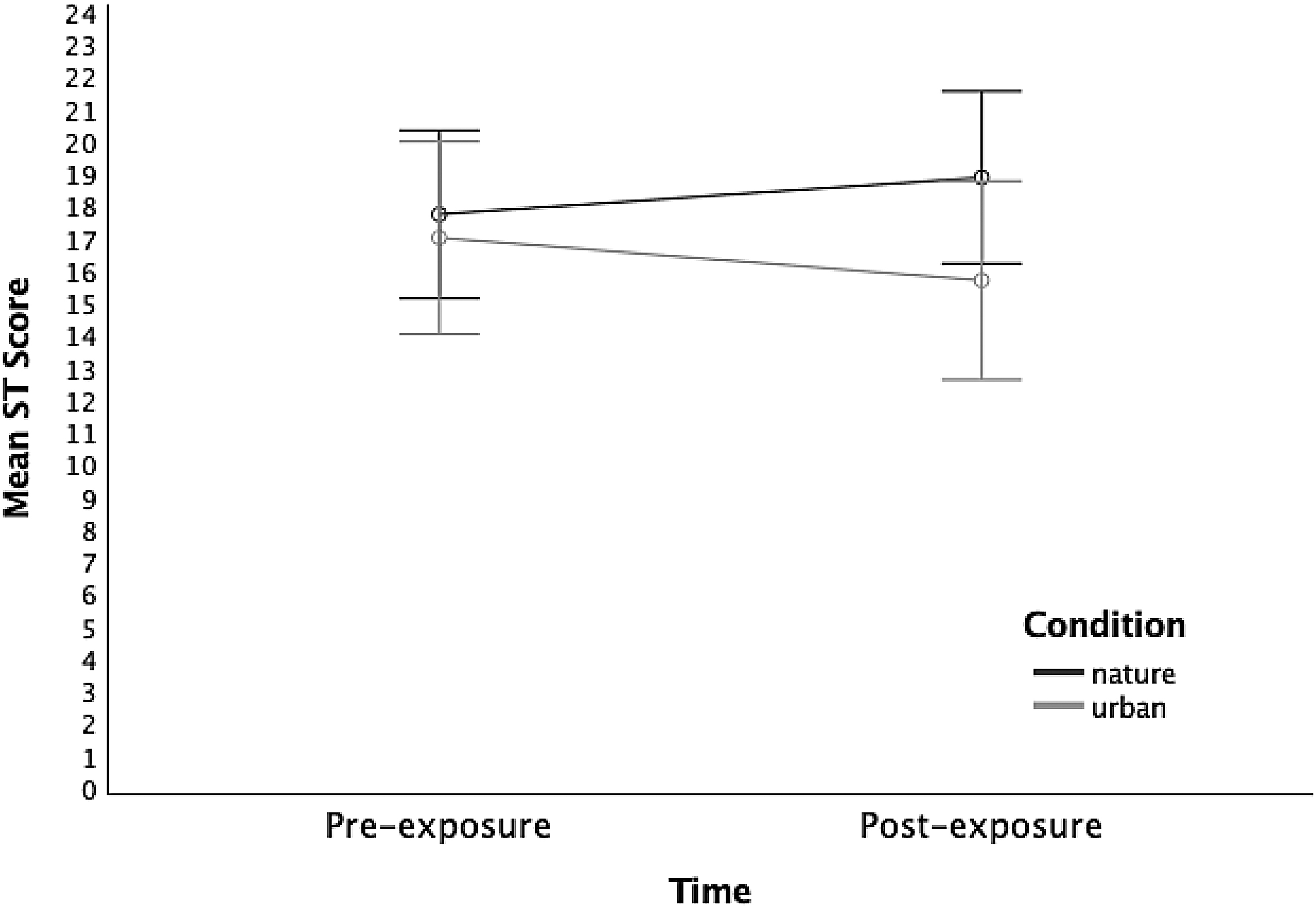
Mean fluency scores for ST as a function of condition and time. Error bars represent 95% CI. ST, similarities task.
Discussion
Recent research has revealed an increase in verbal creativity in adults (Palanica et al., 2019) and nonverbal creativity in high school students (van Rompay & Jol, 2016) after exposure to nature images. In this study, we examined the effect of viewing digital images of nature and urban settings on verbal creativity in children and young adolescents. Considering previous research findings, we hypothesized an increase in creativity in the nature condition, but not in the urban condition. The hypothesis was not supported by the study findings. These null results are important as they further define the parameters of nature stimuli that are and are not beneficial for specific cognitive abilities and particular populations.
Does nature enhance creativity?
We argue that the answer to this question is “Yes, under some conditions, but we do not yet have sufficient data to clearly state the characteristics of the conditions or the individuals who may benefit.” Based on studies to date, there is promising evidence that multiday immersive nature experiences lead to large boosts in verbal creativity (Atchley et al., 2012; Ferraro, 2015). The sizeable improvements in creativity and the consistency across these two studies are impressive, but uncontrolled confounding variables, such as physical activity and reduction in technology use, temper strong conclusions about nature immersion.
There is also solid evidence of a benefit to creativity after short video presentations of nature (Palanica et al., 2019), although less striking than those reported by the nature immersion studies. Although some types of digital images, particularly those deemed to be spacious and unpredictable, have been shown to benefit some participants (van Rompay & Jol, 2016), our null results indicate that this is not always the case and that factors beyond the type of exposure and stimuli are likely important.
Similarly, window views and potted plants were reported to positively impact creativity (Studente et al., 2016), but not on all types of creativity, suggesting that how we measure creativity is another consideration. We discuss the aspects of our study that may have contributed to the null result and how the current findings can inform future research hereunder.
Limitations and future directions
We speculate that the type of nature stimuli and duration of exposure employed in this study resulted in attenuation of the beneficial effects associated with exposure to nature scenery. Contrary to the small–medium effect sizes found in our study, the effect sizes of studies that involved immersion in actual nature settings were large, and around a 50% increase in performance on creativity tasks was attained (Atchley et al., 2012; Ferraro, 2015). This is to be expected for several reasons. Real nature engages more modalities than digital nature. In real nature, there are visual, auditory, olfactory, and tactile components, whereas there was only one sensory modality (i.e., visual) engaged when participants in this study viewed images of nature. Furthermore, our eyes can capture a wider view of nature scenes than depicted in images (Shuttleworth, 1980), and the benefits of spending time in natural environments have been reported to surpass those elicited by viewing images or videos of natural scenery (Browning et al., 2020; Kjellgren & Buhrkall, 2010; White et al., 2018).
The duration of exposure is another important factor to consider. Atchley et al. (2012) and Ferraro (2015) had participants spend several days in the wilderness and thus received a much larger dose of nature than that received by participants in this study (12.5 min). Kaplan (1995) argued that there are several stages involved in the process of attention restoration and that one must spend enough time in the natural environment for full restoration of attentional capacity to be achieved. Nevertheless, he indicated that restoration can occur even after brief exposures, but to a lesser extent.
Accordingly, while our manipulation may have resulted in a minor increase in creativity for the nature condition, the short duration of exposure was not sufficient to harness the necessary level of nature-induced beneficial effects (e.g., restoration, mood enhancement, relaxation) required to significantly improve creativity. It is possible that viewing more stimuli or viewing each stimulus for longer periods would have resulted in group differences. In fact, some argue that children need to be engrossed in their interactions with nature for creativity to be elicited (Kiewra & Veselack, 2016), suggesting that spending sufficient time in/viewing a natural setting is essential for promoting creativity.
Further research is needed to understand the relationship between the duration of exposure to nature (i.e., dose) and the attained level of creativity enhancement. Such studies may be able to identify the amount of exposure necessary to achieve optimal levels of creativity and further elucidate the impact of various periods of exposure to nature on creativity.
Similarly, prior studies that employed digital nature stimuli obtained larger effect sizes than this study (Palanica et al., 2019; van Rompay & Jol, 2016). There are several factors that may have contributed to our smaller effect sizes. Participants in the two previous studies viewed the stimuli before and during completion of the creativity task. In contrast, participants in this study did not have access to the stimuli while completing the creativity tasks, which may have dampened the effect provided by the natural environment. In addition, the nature experience may have been more potent in the aforementioned studies.
Palanica et al. (2019) used videos of nature, which involved video and audio and, thus, provided a more realistic representation of the natural setting. Consistent with our study, van Rompay and Jol (2016) used visual images. However, they instructed participants to envision themselves strolling in the displayed locations, thus eliciting more enriched processing of the stimuli. In contrast, participants in our study were told to view and rate each image. Our findings suggest that only viewing and rating digital images of nature are insufficient to improve creativity, and specifically so in school-aged children and young adolescents.
It is possible that rating the images during the current study taxed cognitive and attentional resources, which may have in turn diminished the beneficial effects of exposure to the natural scenery. However, Berman et al. (2008) also required their young adult participants to rate images, yet found improved attentional performance after the same amount of exposure to nature images.
Future research should continue to examine the impact of presenting nature stimuli across various mediums (e.g., images, videos, VR) as well as the effect of different sets of instructions (e.g., imagining being in the scene vs. looking at it) on creative output. Head-to-head comparisons of specific types of stimuli and instructions will be more informative than attempts to compare across studies. It is important that we continue to explore the potential mediums and instructions regarding nature exposure that may improve creativity.
A better understanding of the most impactful mediums and instructions will provide a foundation of knowledge that may be used to devise activities and interventions that can effectively and efficiently bolster children's creativity. We also advocate for more research comparing the effect of nature on verbal and nonverbal creativity given the inconclusive results in the published literature (Palanica et al., 2019; Studente et al., 2016).
Conclusion and Implications
Our results indicate that a short period (12.5 min) of exposure to digital images of nature scenery did not enhance verbal creativity in children. Although it is possible that the effects previously reported in adults (Atchley et al., 2012; Ferraro, 2015; Palanica et al., 2019; Shibata & Suzuki, 2004; Studente et al., 2016) and high school students (van Rompay & Jol, 2016) may not extend to verbal creativity in younger children, we expect that differences in methodology are a more likely explanation for our null results.
Given the current state of the relevant literature and the mixed findings across studies, a full understanding of the conditions required for nature exposure to enhance creativity is not yet clear. The effect of nature exposure on creativity appears to depend on several factors including type of exposure/stimulus, dose of exposure (i.e., duration, frequency), creativity measures employed, and likely additional factors yet to be identified.
With the recent advances in technology, repetitive process-driven tasks are being increasingly automated using software and machines (Petrone, 2019). Creative people, however, are irreplaceable and play a vital role in propelling our communities toward growth, development, and prosperity. Given that today's youth are tomorrow's workforce and leaders, it is essential that we find ways to reverse their diminishing creativity. To our knowledge, this study is the first to examine the effect of exposure to nature on verbal creativity in children. The findings pave the way for future research to devise more powerful experimental manipulations to identify conditions that cultivate creativity in children.
Footnotes
Authors' Contributions
The author Y.A.I. was responsible for the study design and data collection of the online portion of the study, the analysis and interpretation of the final data set, and prepared the first draft of the article. The author T.S. was responsible for the study design, data collection and data entry of the in-person portion of the study, and reviewed the article. The author S.A.J. supervised all aspects of the study and revised and finalized the article.
Author Disclosure Statement
No competing financial interests exist.
Funding Information
No funding was received for this study.

References
Supplementary Material
Please find the following supplemental material available below.
For Open Access articles published under a Creative Commons License, all supplemental material carries the same license as the article it is associated with.
For non-Open Access articles published, all supplemental material carries a non-exclusive license, and permission requests for re-use of supplemental material or any part of supplemental material shall be sent directly to the copyright owner as specified in the copyright notice associated with the article.
