




Abstract
A strong connection with nature promotes behaviors that help conserve the natural world. However, it is likely that this relationship is reciprocal, with proconservation behaviors positively impacting nature connectedness by increasing sensory contact with nature. Proconservation behaviors vary in terms of how much visible biodiversity, and therefore contact with nature, they produce. It is likely that conservation behaviors that support higher visible biodiversity will result in more sensory contact with nature and, therefore, greater levels of nature connectedness. This research explores the relationship between garden-focused pronature conservation behavior, noticing nature and nature connectedness using data from Natural England's People and Nature Survey in the United Kingdom (n = 4206), a large national survey that includes items to measure noticing nature, nature connectedness, and pronature conservation behaviors. Results are consistent with the hypothesis that undertaking garden-based pronature conservation behaviors that enhance visible biodiversity leads to an increase in noticing nature, which, in turn, leads to an increase in nature connectedness. These results point to a relatively simple way to boost nature connectedness: boost and engage people with visible biodiversity.
Introduction
Nature connectedness refers to a sense of oneness with nature, reflecting the inclusion of nature in one's self-definition (Capaldi, Dopko, & Zelenski, 2014) and the emotional connection one has to the natural world (Mayer & Frantz, 2004). A variety of subtly different concepts and measures have been created to capture nature connectedness, but factor analytic research suggests that they all pertain to a common construct (Tam, 2013). Fostering nature connectedness is important for human and nature's well-being. Cross-sectional survey research has found that those higher in nature connectedness report higher levels of mental well-being (Capaldi et al., 2014; Martin et al., 2020; Mayer & Frantz, 2004; Nisbet, Shaw, & Lachance, 2020; Nisbet, Zelenski, & Murphy, 2011; Pritchard, Richardson, Sheffield, & McEwan, 2019; Richardson, Passmore, Lumber, Thomas, & Hunt, 2021; Zelenski & Nisbet, 2014).
Other, experimental research provides direct evidence of a causal link between nature connectedness and mental health (McEwan, Richardson, Sheffield, Ferguson, & Brindley, 2019). Research has also found a positive association between feeling psychologically close to nature and making an effort to conserve it (Carr & Hughes, 2021; Gosling & Williams, 2010; Knapp, Phillips, Celements, Shaw, & Osborne, 2020; Richardson & Hamlin, 2021; Richardson et al., 2020).
Given this established relationship between nature connectedness and proconservation behaviors, that is, actions aimed at safeguarding biodiversity, there is a sound basis for proposing that higher levels of nature connectedness cause proconservation behavior. However, this relationship should be reciprocal: pronature conservation actions that result in an increase in nature visible or audible to the actor, such as actions to enhance biodiversity in the actor's garden, should also foster stronger nature connectedness through the sensory contact with nature connectedness (Lumber, Richardson, & Sheffield, 2017).
Actions that improve habitat are likely to increase sensory contact and opportunities to notice nature, which has been shown to be associated with nature connectedness (Richardson, Hamlin, Butler, Thomas, & Hunt, 2021) and well-being (Passmore & Holder, 2017; Passmore, Yang, & Sabine, 2022). Furthermore, experimental studies provide empirical support for a causal relationship between sensory contact with nature and nature connectedness (McEwan et al., 2019; Richardson & Sheffield, 2017). Taken together, these studies provide a strong basis for the belief that exposing people to salient biodiversity can lead to increases in nature connectedness.
Pronature conservation behaviors vary in terms of how much exposure to visible biodiversity—and therefore sensory contact with nature—they produce. For example, in the context of actions to improve garden biodiversity, encouraging a thick leaf litter rather than tidying away leaves, although good for a host of invertebrates, would be unlikely to produce much visible biodiversity. In contrast, hanging a birdfeeder in one's garden is likely to encourage relatively more salient biodiversity.
It is likely that nature conservation behaviors that support higher visible biodiversity will result in more salient wildlife for sensory contact with nature and, therefore, greater levels of nature connectedness, thus going some way to alleviate the decline in human–nature interaction and provide positive feedback to improve the human–nature relationship (Richardson et al., 2020).
Figure 1 captures the findings of previous research and provides the motivation for this study. The model represents existing findings that nature connectedness is linked to improved well-being through noticing nature (i.e., through actively paying attention to the natural world) (McEwan et al., 2019; Richardson et al., 2021), that nature connectedness is linked to greater pronature behaviors through noticing (Pocock, Hamlin, Christelow, Passmore, & Richardson, 2021; Richardson et al., 2020), and that pronature behaviors that increase biodiversity are linked to improved well-being (Cameron et al., 2020; Hepburn, Smith, Zelenski, & Fahrig, 2021; Nghiem et al., 2021).
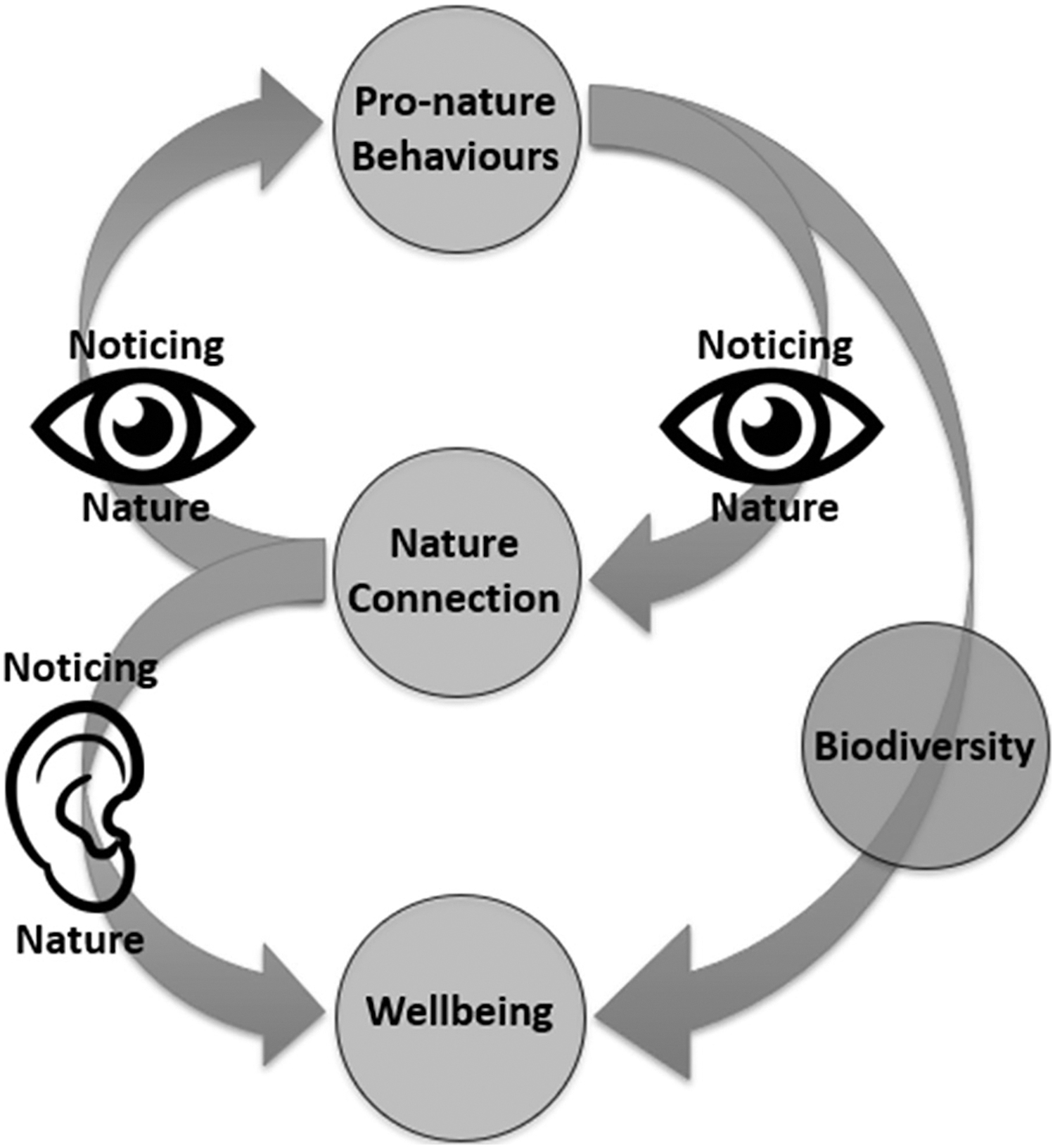
The Noticing Nature Model summarizing the relationships between pronature behaviors, nature connectedness, well-being, and biodiversity—with the role of noticing nature.
Building on this previous research and to address the paucity of research on the efficacy of interventions to increase nature connectedness (Carr & Hughes, 2021; Zylstra, Knight, Esler, & Le Grange, 2014) by investigating the possible nature of the fourth relationship shown in Figure 1, this research investigates the relationship between garden-based pronature conservation behaviors and nature connectedness through noticing nature using data from Natural England's People and Nature Survey (PANS) in the United Kingdom (Natural England, 2020). This large national survey includes items to measure noticing nature, nature connectedness (Richardson et al., 2019), and garden-based pronature conservation behaviors (Barbett, Stupple, Sweet, Schofield, & Richardson, 2020).
Specifically, we hypothesize that the garden-based pronature conservation behaviors explicitly designed to increase visible biodiversity will predict significant increases in noticing nature, a proxy of contact with nature, compared with those behaviors that have relatively little impact on visible biodiversity. We also hypothesize that the garden-based pronature conservation behaviors that increase noticing nature will predict levels of nature connectedness and that this relationship will be mediated by levels of noticing nature.
Methods
Participants
The data set consisted of a representative sample of 4206 respondents collected as part of a national household survey. In the PANS data set, ages ranged from 16 to 93 years (M = 47.62, SD = 17.49). Gender was almost evenly split between females (51%) and males (48.9%), with the remaining 0.1% identifying with another gender.
Measures of dependent variables
The PANS survey (Natural England, 2020) assesses various constructs associated with engagement with and nature connectedness. We measured the extent to which participants notice nature using the item “I am taking more time to notice and engage with everyday nature (e.g., listening to birdsong, noticing butterflies).” Respondents rated the item on a 7-point scale from 1 = completely disagree to 7 = completely agree. Nature connectedness was measured using the single item “I feel part of nature” from the Nature Connection Index (Richardson et al., 2019). Respondents rated the item on a 7-point scale from 1 = completely disagree to 7 = completely agree.
Measures of predictor variables
Garden-based pronature conservation behaviors were measured using the four gardening behaviors taken from the short-form Pro-nature Conservation Behaviour Scale (Barbett et al., 2020), an 8-item scale that measures pronature conservation behaviors grouped into civil and gardening behaviors. Because they come from the only validated pronature conservation behavior scale, these items were selected for inclusion in PANS. Each item was rated on a 5-point scale from 1 = never to 5 = very often. Two items pertained to actions that would be expected to promote a relatively large amount of visible biodiversity.
“I plant/maintain pollinator-friendly plants” refers to an action that by its very definition involves creating visible biodiversity in the form of flowers. Furthermore, even small (4 m
Two items pertained to actions that would be expected to promote relatively little visible biodiversity. “I maintain plants with berries/fruits” captures a behavior that provides a finite amount of food for a finite amount of time and for a select number of species. This stands in contrast to providing supplementary food for birds (as captured by the previous item), which in Britain is generally done throughout the year (Orros & Fellowes, 2015) and so would be expected to produce a greater amount of visible biodiversity. “I add log piles or other materials that can be used as a home or shelter by wildlife” captures another activity that would be expected to produce relatively little visible biodiversity.
Most saprolxylic species—that is, species that depend on decaying wood during their lifecycle (Alexander, 2008)—spend most of their life as larvae hidden within decaying wood. Furthermore, by design, log piles are usually intended to provide hiding places for animals rather than increase their visibility. Indeed, in a study of the biodiversity attracted to garden log piles, Gaston, Smith, Thompson, and Warren (2005) found that the vast majority of invertebrates attracted to log piles belonged to groups that hide in damp dark conditions under and between logs, such as woodlice, springtails, and earthworms.
Several demographic variables were measured. Age was measured to the year. Gender identification was recorded using three categories: “male,” “female,” or “in any other way.” Work status was coded into three categories for this article. One category “working” consisted of participants who were in full- or part-time employment or were self-employed. A second category “not working” consisted of participants who were unemployed, retired, had caring responsibilities for children or adults, or were long-term sick or disabled. A final category “student” consisted of participants who were in full- or part-time education.
Marital status was coded into three categories for this article. One category contained participants who were “single.” Another category, “in a relationship,” contained participants who were married, in a civil partnership, or cohabiting. A third category, “separated,” consisted of participants who were separated, but still legally married or in a civil partnership, who had divorced or had their civil partnership dissolved, or who were widowed or were the surviving partner of a civil partnership. Ethnicity was coded as a binary variable for the purposes of this article: participants were recorded as being white or of a minority ethnicity.
Results
After an analysis of the bivariate correlations between the main variables of interest, we present the results of a multiple regression that investigates the relationships between several proconservation gardening behaviors and a global measure of noticing nature, enabling key proconservation behaviors to be identified. A mediation analysis then examines whether noticing nature mediates the relationship between proconservation behaviors and nature connectedness.
Correlations between garden-based proconservation behaviors, noticing nature and nature connectedness
To investigate the relationship between the four predictor items of interest (“I plant/maintain pollinator-friendly plants,” “I add log piles or other materials that can be used as a home or shelter by wildlife,” “I maintain plants with berries/fruits,” and “I provide food for wild animals such as birds”) and the dependent variables (noticing nature and nature connectedness), a series of bivariate correlations were performed. As given in Table 1, there were significant correlations between all variables.
Bivariate Correlations Between the Main Variables of Interest
N in parentheses.
*p < 0.01.
Multiple regression to examine relationships between garden-based pronature conservation behaviors and noticing nature
To further investigate the relationship between the four garden-based pronature conservation behaviors and the dependent variable, noticing nature, we performed a hierarchical multiple regression. We included an initial block of demographic variables consisting of age, gender, employment status, and ethnicity. The assumptions for multicollinearity and independence of errors were met (Variance Inflation Factor = 1.01–1.98, tolerance = 0.51–0.99, Durbin–Watson = 1.98). As given in Table 2, the model was significant [F(11,1172) = 22.12, p < 0.001, R2 = 0.16]. As expected, “I plant/maintain pollinator-friendly plants” (t = 5.02, p < 0.001) and “I provide food for wild animals such as birds” (t = 5.73, p < 0.01) were the two strongest predictors of noticing nature. Indeed, they were the only two significant predictors.
Standardized Regression Coefficients Predicting Noticing Nature
*p < 0.001.
Two demographic variables predicted noticing nature. Being female was significantly associated with noticing more nature (t = 5.02, p < 0.001) and not working was associated with noticing less nature than those in employment (t = 3.02, p < 0.01).
Mediation analysis
To investigate whether noticing nature mediated the relationship between garden-based pronature conservation behaviors and nature connectedness, a mediation analysis was performed using PROCESS. The outcome variable was nature connectedness. The predictor variable was a composite of the two garden-based proconservation behaviors that emerged as significant predictors of noticing nature in the multiple regression. The composite measure was obtained by averaging scores on the two items.
The mediator variable was noticing nature. The indirect effect of garden-based pronature conservation behaviors on nature connectedness was statistically significant (effect = 0.17, 95% CI 0.14–0.21), suggesting that undertaking this pair of garden-based pronature conservation activities might lead to higher levels of nature connectedness through an increase in noticing nature.
Discussion
The results provide insight into possible pathways between garden-based pronature conservation behaviors and a closer human–nature relationship. The two pronature conservation behaviors designed to promote visible garden biodiversity—maintaining wildflowers for pollinating insects and putting out food for birds and other wildlife—were significant predictors of the extent to which participants noticed nature, whereas the remaining garden-based pronature conservation behaviors were not. These pronature conservation behaviors were in turn significant predictors of nature connectedness. Importantly, the relationship between garden-based pronature conservation behaviors and nature connectedness was mediated by the extent to which participants noticed nature.
Taken together, these results suggest that if garden-based pronature conservation interventions cause increases in nature connectedness, they do so by increasing the amount of nature noticed. Furthermore, the results suggest that noticing is facilitated by undertaking nature conservation behaviors that are designed to promote visible garden biodiversity.
The finding that increases in noticing nature are associated with increases in nature connectedness is consistent with previous research (McEwan et al., 2019; Richardson & Sheffield, 2017; Richardson et al., 2021), as is the association between nature connectedness and pronature conservation behavior (Martin et al., 2020; Richardson et al., 2020). Previous research though usually interprets these relationships as evidence for nature connectedness, causing more noticing of nature and more pronature conservation behaviors.
This study investigated the possible nature of these relationships if they operated in the opposite direction: the study found evidence that supports the possibility that increases in visible biodiversity might mediate the relationship between the actions one undertakes in one's garden and nature connectedness, as predicted by Lumber et al.'s (2017) pathways to nature connectedness and found by Pocock et al. (2021). Furthermore, the finding that nature connectedness is predicted by actions to promote visible biodiversity, and the resultant increases in noticing nature, provides further evidence for the importance of “sensory contact” with the natural world as a pathway to nature connectedness.
In the context of the interconnected web of all life on Earth, such inter-relationships, as depicted in Figure 1, are to be expected. Human well-being and the vitality of anthropogenic and natural ecosystems cannot be separated (Nelson, Prescott, Logan, & Bland, 2019). The simplification of such inter-relationships in evidence-based models, such as that depicted in Figure 1, helps understand and communicate the human–nature relationship and can suggest actions to improve it. Richardson et al. (2020) took a systems perspective to consider improving the human–nature relationship at a societal scale.
A key aspect in that analysis was feedback loops. There is potential to provide and strengthen positive self-reinforcing feedback loops to combat the continuing decline in human–nature interactions—the “extinction of experience” (Soga & Gaston, 2016). This research suggests that visible biodiversity and the promotion of salient wildlife could form part of an important feedback loop: an environment with greater opportunity for sensory interaction with nature can increase nature connectedness and, in turn, pronature conservation behavior, which can lead to even more sensory interaction with nature.
The results also point to possible avenues of future research on how best to promote nature connectedness through conservation behavior and biodiversity, particularly in urban and residential areas. There is a need to empirically establish which nature conservation activities lead to the most visible biodiversity. Or, more directly, it would be advisable to establish which conservation actions can facilitate or lead to the highest levels of noticing nature and greatest increases in nature connectedness. Such research should also seek to identify, and in the future address, any negative cultural associations of wildlife that might undermine the benefits.
Candidate conservation activities include the construction of hoverfly lagoons (containers full of water and organic material such as leaf litter and grass cuttings); erection of bee hotels (blocks of wood drilled with deep holes suitable for nesting solitary bees and wasps); and bird nesting boxes, digging of ponds, and provision of bird food and pollinator-friendly plants. Even within each of these categories of action, steps can be taken to maximize visible biodiversity. For example, creating and maintaining a wildflower area that consists of a relatively high diversity of plants will by definition increase biodiversity relative to a less floristically diverse wildflower area.
Erecting a variety of different nest box types could lead to an increase in the diversity of breeding birds. Similarly, bee hotels with different sized holes will attract a greater variety of species than those with holes that are of uniform size, and so by extension attract species with different phenologies, providing bees and wasps throughout much of the spring and summer. There is clearly a role for both ecological and psychological studies to measure what leads to most visible biodiversity, nature noticing, and nature connectedness.
The results have implications for the design and management of green spaces. Although of principle concern in an ecological context is the creation and management of green spaces to maximize all types of biodiversity, special consideration should be given to creating green spaces that contain features that promote visible biodiversity. For example, areas rich in flowers that attract salient pollinators, such as bumblebees and butterflies. Similarly, ponds in urban parks often have manicured edges of little value to wildlife. Providing long vegetation in places around otherwise neatly mown pond edges should provide places for dragonflies and damselflies to shelter and breed, allowing them to be readily seen by visitors.
In addition, consideration should be given to designing green spaces so that habitat features that promote salient biodiversity are located in salient places. For example, if a tree planting scheme contains small amounts of mast-bearing species such as oak or beech, then it would be desirable if some of these species are planted close to paths, so that the species they attract can easily be seen by site users. Similarly, mirroring the suggestion of Richardson et al. (2020), transport policy should not just be geared to green commuting, but should also include “slow commuting,” providing places to pause and engage with nature, places designed so that biodiversity is highly visible and audible.
Several limitations of our results should be highlighted. First, because our analyses were correlational in nature, the causal relationships between pronature conservation behaviors, noticing nature, and nature connectedness cannot be inferred with confidence. Although some empirical work has been noted, it would be desirable if further complementary experimental research was undertaken to further investigate some of the potential causal pathways highlighted in this research. Second, owing to the contents of PANS, the present research investigated only a limited number of conservation actions. The findings of the research may, therefore, in part reflect differences between the two sets of conservation behaviors other than the extent to which they promote visible biodiversity.
It would be desirable to replicate the present results using a wider variety of actions that vary in terms of how much they promote visible biodiversity. Third, it is unclear the extent to which the item “I am taking more time to notice and engage with everyday nature (e.g., listening to birdsong, noticing butterflies)” measures recent levels of noticing nature rather than simply recent increases in noticing nature. It is conceivable that those who have recently increased their levels of noticing nature will be experiencing higher levels than those who have not experienced recent increases, but this cannot be inferred with certainty.
However, whether the effects reported in this research are driven by current levels of noticing nature or by recent increases, they clearly highlight the important role that noticing nature plays as a mediator. Nonetheless, further research is required to clarify what aspect of noticing nature (i.e., current levels or recent increases) is driving this effect.
Conclusion
Biodiversity loss is a sign that the human–nature relationship is failing. A new and sustainable relationship with nature is needed. Research evidence shows that “noticing nature” is a key part of improving nature connectedness for human and nature's well-being. This study highlights a further important aspect of rebuilding the human–nature relationship: bringing visible and salient nature to people, through nature recovery networks in urban areas, interventions to prompt people to notice the nature, and advice on nature conservation options for the public.
Footnotes
Authors' Contributions
I.H. contributed to conceptualization, methodology, data curation, formal analysis, writing—original draft, and writing—review and editing. M.R. was in charge of conceptualization, methodology, writing—original draft, and writing—review and editing.
Author Disclosure Statement
No competing financial interests exist.
Funding Information
No funding was received for this article.