




Abstract
Taking microbreaks (breaks lasting fewer than 10 min) is an important aspect of maintaining a healthy work routine. To determine whether the type of microbreak matters for improving mood and on subsequent snack preferences, online workers engaged in a standard email work task, followed by a microbreak in which they watched a video of walking through a park, a city, or in our control condition, a Microsoft teams tutorial. After the break, they completed a dietary decision task. Exposure to the nature video improved mood relative to both of the other conditions. Although positive mood was associated with less craving for unhealthy foods relative to healthy foods, the type of microbreak had no effect on food preferences. We also found that frequent use of green spaces was similarly associated with less craving for unhealthy foods relative to healthy foods. These results not only demonstrate the importance of taking breaks during the work day to maximize rejuvenation benefits, but also of providing employees access to natural environments, even in a context as light touch as virtual microbreaks.
Introduction
Employees in the United States spend approximately one-fifth of their time each year working (OECD, 2021). Office workers in particular not only perform mentally demanding tasks, but—given the sheer nature of their job bound to a desk with little access to the natural world—also spend a significant portion of their work time indoors (World Health Organization, 2014). Office workers span many professions, but examples include software developers, secretaries, and accountants. Taking regular brief breaks from mentally demanding tasks is important not only in restoring psychological resources (e.g., energy and attention), but also in improving mood at the end of the workday (Bennett, Gabriel, & Calderwood, 2020; Kim, Park, & Niu, 2017). Repeatedly neglecting to take breaks to recover from work-induced short-term fatigue can lead to detrimental long-term effects such as psychological overload, chronic fatigue, burnout, and sleeping problems (Sluiter, Frings-Dresen, Meijman, & van der Beek, 2000).
Considering the indoor workplace of office workers and given the restorative effects of exposure to (virtual) natural environments on well-being (Bowler, Buyung-Ali, Knight, & Pullin, 2010; Capaldi, Passmore, Nisbet, Zelenski, & Dopko, 2015; Kaplan, 1995; Ulrich et al., 1991; White et al., 2021) and mood (Berman, Jonides, & Kaplan, 2008; Mayer, Frantz, Bruehlman-Senecal, & Dolliver, 2009), we seek to investigate whether virtual microexposure to natural environments after a stressful work task can uplift mood. As past research findings suggest office workplaces to have a detrimental effect on eating behavior (Clohessy, Walasek, & Meyer, 2019), and mood swings have been associated with cravings and increased high-calorie snacking (Cardi, Leppanen, & Treasure, 2015; Schmidt & Martin, 2017; Udo et al., 2013), we also investigate whether microexposure to natural environments could improve snacking choices.
Microbreaks
Microbreaks—defined as breaks of less than 10 min (Sluiter et al., 2000)—and their effectiveness on the recovery from mental workloads have been studied extensively within the occupational workplace setting, where time constraints often dictate break duration. The degree to which psychological resources recover from work demands during such a break depends not only on the duration of the break, but also on the type of break activity, such as relaxation, nutrition intake, social, cognitive, and work-related break activities (Bennett et al., 2020; Kim et al., 2017; Sluiter et al., 2000).
Whereas spending time during a break on nonwork activities (i.e., activities that require less behavioral regulation, such as socializing) was found to be associated with the experiences of positive emotions (Trougakos, Beal, Green, & Weiss, 2008), spending this time on relaxing activities (i.e., activities that can relax body and mind, such as stretching, walking around the office, daydreaming, or following a guided mindfulness meditation video) not only restored fatigue and vigor (Bennett et al., 2020), but also reduced negative affect at the end of the workday (Kim et al., 2017). However, spending time on work-related activities during a break was positively related to negative emotional experiences (Trougakos et al., 2008). Moreover, work-related activities during microbreaks further decreased vigor, and depending on the amount of time spent on the activity, further increased fatigue compared to before the microbreak (Bennett et al., 2020).
Taken together, these studies clearly show the importance of both break activity and length of the break.
Nature exposure and well-being
One potentially beneficial way to spend a microbreak is in nature. Several theories suggest a positive influence of exposure to natural environments on well-being. According to the biophilia hypothesis (Wilson, 1984), humans are innately drawn to nature as a result of evolutionary processes. Similarly, stress reduction theory (Ulrich et al., 1991) states that natural environments are more restorative than artificial or urban environments because evolutionarily, humans may have developed the capacity to restore when being surrounded by unthreatening nature. Attention restoration theory (Kaplan, 1995) argues that modern urban life can deplete human's limited capacity of directed attention leading to mental fatigue.
Natural surroundings in contrast can replenish such mental fatigue through activating effortless “soft fascination” (Kaplan, 1995) rather than depleting our directed attention. Indeed, a vast amount of research supports these theories, and has demonstrated a positive impact of physical exposure to natural environments on attention and well-being (Bowler et al., 2010; Hartig, Evans, Jamner, Davis, & Gärling, 2003), cognitive function (Berman et al., 2008), as well as stress recovery (Hartig et al., 2003; Tyrväinen et al., 2014) and increased mood (Hartig et al., 2003; Mayer et al., 2009; Stigsdotter, Corazon, Sidenius, Kristiansen, & Grahn, 2017).
Furthermore, similar benefits also extend to the virtual environment. The exposure to pictures or videos of natural settings has shown to provide benefits in terms of mood (Mayer et al., 2009; McAllister, Bhullar, & Schutte, 2017; McMahan & Estes, 2015; Stewart & Haaga, 2018), stress recovery (Van den Berg et al., 2015), cognitive function (Berman et al., 2008), and attention (Lee, Williams, Sargent, Williams, & Johnson, 2015), as well as psychological well-being (Bratman et al., 2019; Capaldi et al., 2015; Gilchrist, Brown, & Montarzino, 2015; White et al., 2021).
These benefits could also extend to office workers who are particularly prone to spending time indoors (World Health Organization, 2014). Indeed, being exposed to natural environments at work—that is work breaks spent outdoors, but also natural lights, plants, or views of natural elements from a window—has been found to have beneficial effects on employees' stress levels, well-being, and health complaints (Gilchrist et al., 2015; Largo-Wight, Chen, Dodd, & Weiler, 2011; Largo-Wight, Wlyudka, Merten, & Cuvelier, 2017). Thus, bringing natural environments to the workplace may be an efficient tool to improve well-being of office workers.
Given the beneficial effects of taking regular breaks from work and those gained from exposure to virtual natural environments, work that combined microbreaks and virtual contact with natural environments has shown benefits in terms of attention, recovery, and mood. For example, Lee et al. (2015) found that students perceived a virtual flowering green roof as more restorative than a virtual bare concrete roof. They also found that students who viewed the flowering green roof during a microbreak scored better on an attention task than students who viewed the bare concrete roof during the microbreak. Thus, this article focuses on virtual contact with natural environments during microbreaks on mood in office workers—a population that has been largely ignored in the literature.
Nature exposure, mood, and food intake
In addition to the numerous already identified benefits of spending time in natural environments as well as being exposed to natural environments virtually, nature exposure has even farther-reaching benefits. For example, spending 20 min on a walk in a park (vs. a busy city street) has shown to increase the percentage of healthy snacks consumed by participants afterward (Langlois & Chandon, 2022). Again, the same findings also extend to the virtual environment (Langlois & Chandon, 2022). Healthy snacking—or food cravings more generally—has also been associated with mood, although the direction of the association between affect and cravings is still unclear.
Across studies, both negative and positive mood have been found to be associated with increased high-calorie snacking (Cardi et al., 2015; Reichenberger et al., 2018; Schmidt & Martin, 2017; Udo et al., 2013). The association between mood and cravings seems to further depend on the population, such as restrained or overweight and obese individuals* (Evers, Dingemans, Junghans, and Boevé, 2018; Udo et al., 2013) as well as clinical vs. nonclinical settings (Cardi et al., 2015).
However, cross-sectional research on the connection between self-reported nature exposure and cravings suggests that exposure to nature is associated with reductions in cravings, and that this relationship is partially mediated by reductions in negative affect (Martin, Pahl, White, & May, 2019). Particularly, having access to a garden/allotment and estimating the proportion of green space seen from one's home to be at least 25% were associated with a reduction in both craving strength and frequency. Thus, improving mood through microbreaks from work may help employees in more than one way; it may also reduce their urge for unhealthy foods.
Taken together, previous research findings suggest beneficial effects of both taking microbreaks from work and exposure to virtual contact with natural environments. In addition, there are some indications of healthier snacking after exposure to natural environments.
Present study
In this article, we, therefore, test whether virtual contact with natural environments during a microbreak from mental work improves mood, as well as whether that exposure reduces the subsequent desire to eat unhealthy snack foods. We do so by first exposing online workers to a work task within a simulated office environment. We then randomly assign them to a relaxing microbreak activity with exposure to nature (operationalized as watching a video of walking through a park), a relaxing microbreak activity without exposure to nature (operationalized as watching a video of walking through a city), or a work-related microbreaks activity (operationalized as watching an instructional video). Finally, we examine the desire for healthy/unhealthy snack foods and measure participants' access and exposure to nature (see Fig. 1).
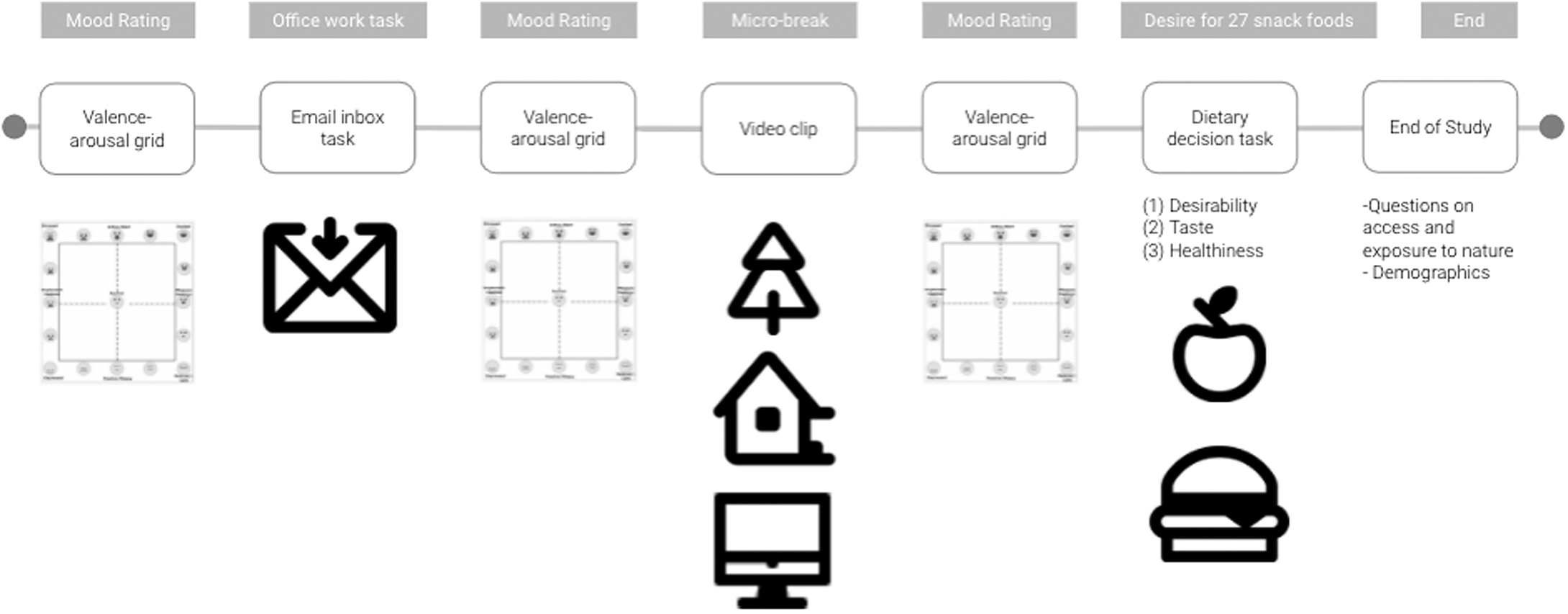
Study procedure.
We hypothesized that after engaging in a work task, (1) self-reported valence would improve more after watching the nature video as compared with watching the instructional video, (2) participants would report less desire to eat higher calorie foods after watching the nature video than after the instructional video, and (3) the desire to eat unhealthy foods would be associated with self-reported valence after the break activity. Specifically, we predicted a greater desire to eat higher calorie snacks, the more negative the ratings of valence. A preregistration link of our study can be found on the OSF website (https://doi.org/10.17605/OSF.IO/HTDUW).
Materials and Methods
Participants
Upon ethical approval from Duke University [2019-0490], a total of 606 participants were recruited through Positly to complete an internet survey for US$4.15 during September 23–25, 2020. The aim was for ∼200 participants per condition, though there was no justification for this sample beyond resource constraints. Whereas one of the biggest downsides to recruiting participants online is the threat to external validity, the state of the world in 2020 provided a unique set of circumstances in which most office workers faced a very similar work environment to that of the average online survey taker.
The global COVID-19 pandemic and its ensuing social distancing measures forced a significant proportion of American office workers to complete their work in an at-home “office” setting (Parker, Menasce Horowitz, & Minkin, 2020). Thus, the work environment of our sample of online participants is rather representative of that of most office workers at the time.
We excluded participants based on the following preregistered culling rules: participants who noted dietary restrictions that would interfere with our dietary decision task and those who put nonsensical answers in the dietary restrictions text box (n = 37) as well as participants who got fewer than two of our attention questions correct for the videos that they watched (nnature video = 12, ncity video = 17, ncontrol video = 43). The clear imbalance between conditions suggests that our attention check was more difficult in the control condition, but as we preregistered this culling rule, we kept it as is for the analyses reported in this article. However, there were no substantial changes to our results when we reran all of our analyses with the full sample (see Supplementary Data). We also removed 13 participants who told us that they did not actually watch the entire video. Finally, in our work task, participants had to write responses to email requests. One of the authors coded these responses as either sensical or nonsensical and we removed responses that were unintelligible (n = 109). All but this final culling rule were preregistered. This left us with a cleaned sample of n = 437 (nnature video = 150, ncity video = 142, ncontrol video = 145), as there was overlap across each culling category.
The remaining sample was 39.54% female, 60% male (the remaining percentage selected other categories), with a mean age of 37.7 years (standard deviation [SD] = 10.9, min = 20, max = 71; 14 participants had what could have been dates and one negative number (age was gathered through Positly's system) and were not included in the age descriptives). The sample was 76% White, 6% Black, 4% East Asian, 3% Hispanic/Latino, with the rest of the groups reflecting less than 2% of the sample. The median income was between 40,000 and 50,000 U.S. dollars annually, and it took participants an average of 23.6 min (SD = 7.4) to complete the survey.
Procedure
After accepting the consent form, participants rated their mood and completed an adjusted version of the email inbox task (Parker, Laurie, Newton, & Jimmieson, 2014). For this purpose, participants were instructed to adopt the role of a HR manager and to respond to five employee emails within 10 min. In addition, participants were told to provide quality responses that address the main concerns of the employees emailing them. While answering the emails, a timer was visible to the participants indicating the remaining time they had to answer all emails. This setting has been shown to represent a moderately high level of work pressure (Parker, Jimmieson, & Amiot, 2013a; Parker, Jimmieson, & Johnson, 2013b; Parker et al., 2014). After the email task, another mood rating was administered.
Subsequently, participants were randomly assigned to one of the three videos: walking through a city park (exposure to nature), † walking through a city (no exposure to nature), ‡ or an instruction video about Microsoft Teams (work-related microbreak) § (Microsoft, 2019). The videos used for the relaxing microbreak activities were created by previous research to represent contact with nature or no contact with nature (McAllister et al., 2017). The videos had a duration of 2 min 22 s to 2 min 30 s, which has been shown to effectively induce affect to nature and to be more likely for participants to watch the full video (McAllister et al., 2017).
For this study, McAllister et al.'s urban nature (city park) video was chosen for the “exposure to nature” condition instead of their “wild nature” video that featured an Australian rainforest, as employees may access a city park setting (which featured public parks and gardens with roads and buildings in the background) more easily during their workday. All videos were recorded from an internal perspective and sounds of nature and/or city were associated with the respective video. After having watched their assigned video, participants completed an attention check and once again rated their mood.
Next, participants completed a dietary decision task (O'Leary, Hutcherson, Smith, Shiv, & Gross, 2019) in which participants rated how much they desired to eat 27 snack foods. They also rated how tasty and how healthy they thought the foods were (all on a 1 “strong no” to 5 “strong yes” scale). Finally, participants completed questions on access and exposure to nature and demographics.
Measures
Mood
We operationalized mood relying on the circumplex model of affective experience (Larsen & Diener, 1992; Russell, 1980; Scholsberg, 1941)—measuring valence, or the hedonic tone (positivity or negativity) of one's affective state (Barrett & Bliss-Moreau, 2009), and arousal (their appraisal of the intensity of the affective state) through an affect grid. The grid had individuals rate their mood using emojis to display different expressions (Toet et al., 2018) and words to reflect different emotions (Russell, Weiss, & Mendelsohn, 1989) that varied in terms of valence on the x-axis (ranging from unpleasant to pleasant) and arousal on the y-axis (ranging from passive/sleepy to active/alert; see Fig. 2).
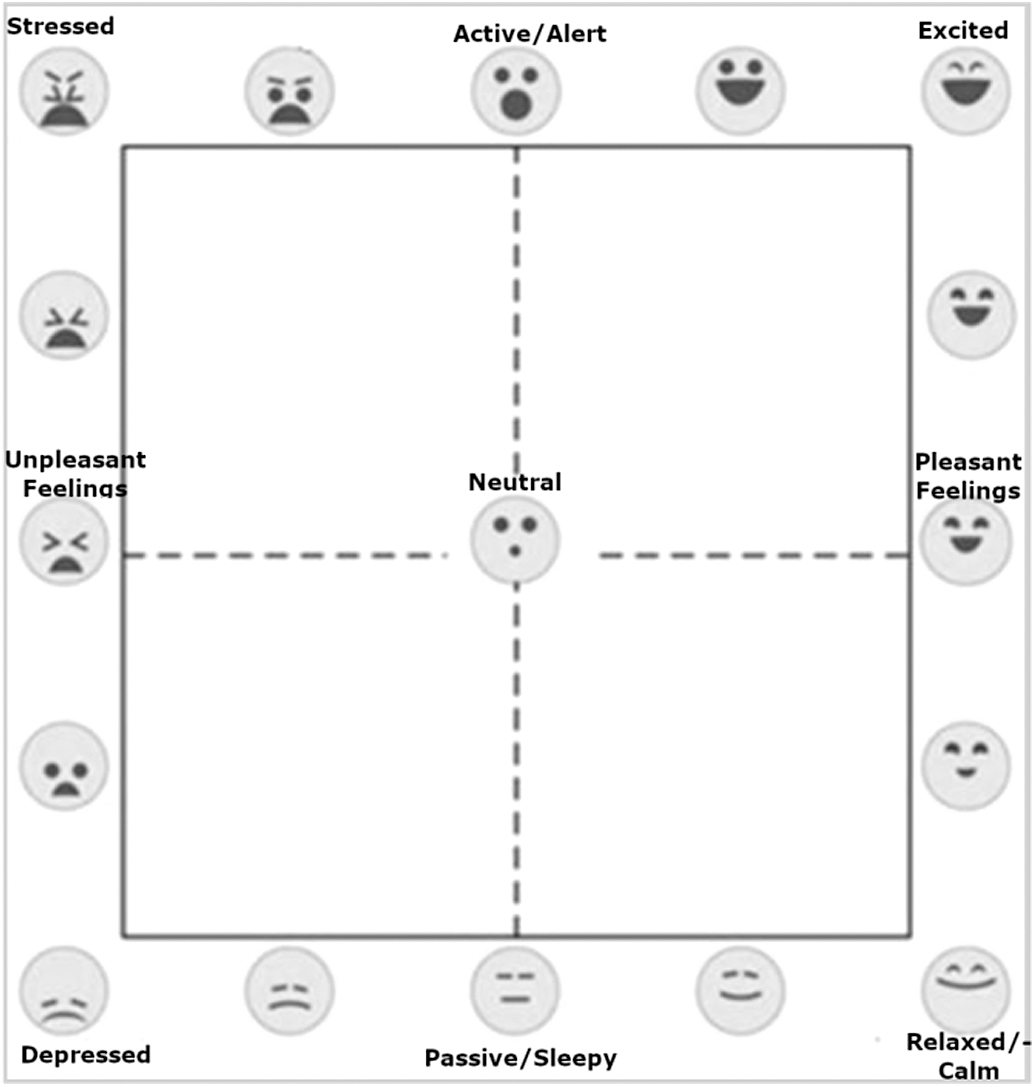
Whereas prior affect grids only display words or (more recently) emojis to reflect emotional states along the valence and arousal spectrums, we chose to include both in an attempt to be as clear as possible regarding the mood states reflected at each point on the grid. Participants rated their mood by choosing a location on the grid (using the heat map question in Qualtrics; Qualtrics, Provo, UT, USA). Scores for valence and arousal were calculated based on x and y axes locations, respectively, and ranged from 0 (lowest) to 630 (highest).
Food picture database
For the dietary decision task, we selected 27 pictures from the food-pics database (Blechert, Lender, Polk, Busch, & Ohla, 2019). All pictures ** were familiar to Americans, unanimously rated as snack foods suitable to an office context by two research assistants, and were within 1.5 SDs of the mean on arousal, familiarity, and palatability norms (see Blechert et al., 2019). We chose pictures that varied by total calorie content and craving ratings.
We then grouped the pictures into low, medium, and high categories such that low-, medium-, and high-calorie foods all contained foods that were rated low, medium, and high on cravings. Low-calorie foods belonged to the bottom 25th quartile, medium-calorie foods were within the interquartile range, and high-calorie foods were above the 75th quartile (M = 216.08, SD = 258.38, min = 8.7, max = 1070.) The same rule was used for grouping foods by craving ratings.
Access and exposure to nature
Access and exposure to nature were measured by self-reported access to a private garden/allotment (M = 0.46, SD = 0.5; Ward Thompson, Aspinall, Roe, Robertson, & Miller, 2016), participants' estimation of the proportion of green space they can see from their home (M = 41.59, SD = 26.26, min = 0, max = 100), and the frequency of visits to the nearest green space over the past 12 months (M = 4.33, SD = 2.08, min = 1 (never), max = 8 (more than once per day); Martin et al., 2019). In addition, participants indicated their current and preferred living area (urban vs. rural).
Additional questions
Participants' neighborhood satisfaction, satisfaction with social support, and neighborhood cohesion were measured (Martin et al., 2019) as well as their most recent break and food intake (“how recently have you eaten?” and “how long has it been since you last took a break?”). Ninety-one percent of participants reported they had not eaten in the 2 h before the study, which is in accordance with our instructions for participants to only take part if they had not eaten in the past 2 h. The average participant reported taking their last break approximately an hour before the study.
Demographic questions
Age, gender, income, and education were automatically obtained through Positly, whereas respondents indicated their ethnicity, and socioeconomic status using the MacArthur Scale of Subjective Social Status (Adler, Epel, Castellazzo, & Ickovics, 2000).
Attention check
Based on Stewart and Haaga's (2018) study, we presented three multiple-choice test questions to the participants as an attention check, for example, “what was presented in the video?” or “what color were the flowers at the beginning of the video?” Participants needed to answer two questions correctly to be included in the sample. Similar to McAllister et al. (2017), participants reported whether and how much of the video they had watched. Participants were included in the sample if they had watched the entire video.
Results
Effects of work task and nature video on valence and arousal
To examine the effect of the work task, as well as the video interventions on valence, we computed a Bayesian linear mixed-effects model with valence as our outcome (we standardized this score for ease of interpretability). We included the predictors of video type, measurement time (prework, postwork, postvideo), and the interaction of these two factors. Finally, we included participant as a random effect (see Supplementary Data for information about priors as well as alternative modeling approaches. †† ). As expected, valence ratings dropped after the email work task was completed, but showed a recovery after watching the nature video relative to the control (Medianpostvideo nature − control = 0.47, 95% CI [0.26–0.69], probability of direction [pd] = 1.0 ‡‡ ), and city (Medianpostvideo nature − city = 0.31, 95% CI [0.10–0.53], pd = 0.996) videos (see Fig. 3).
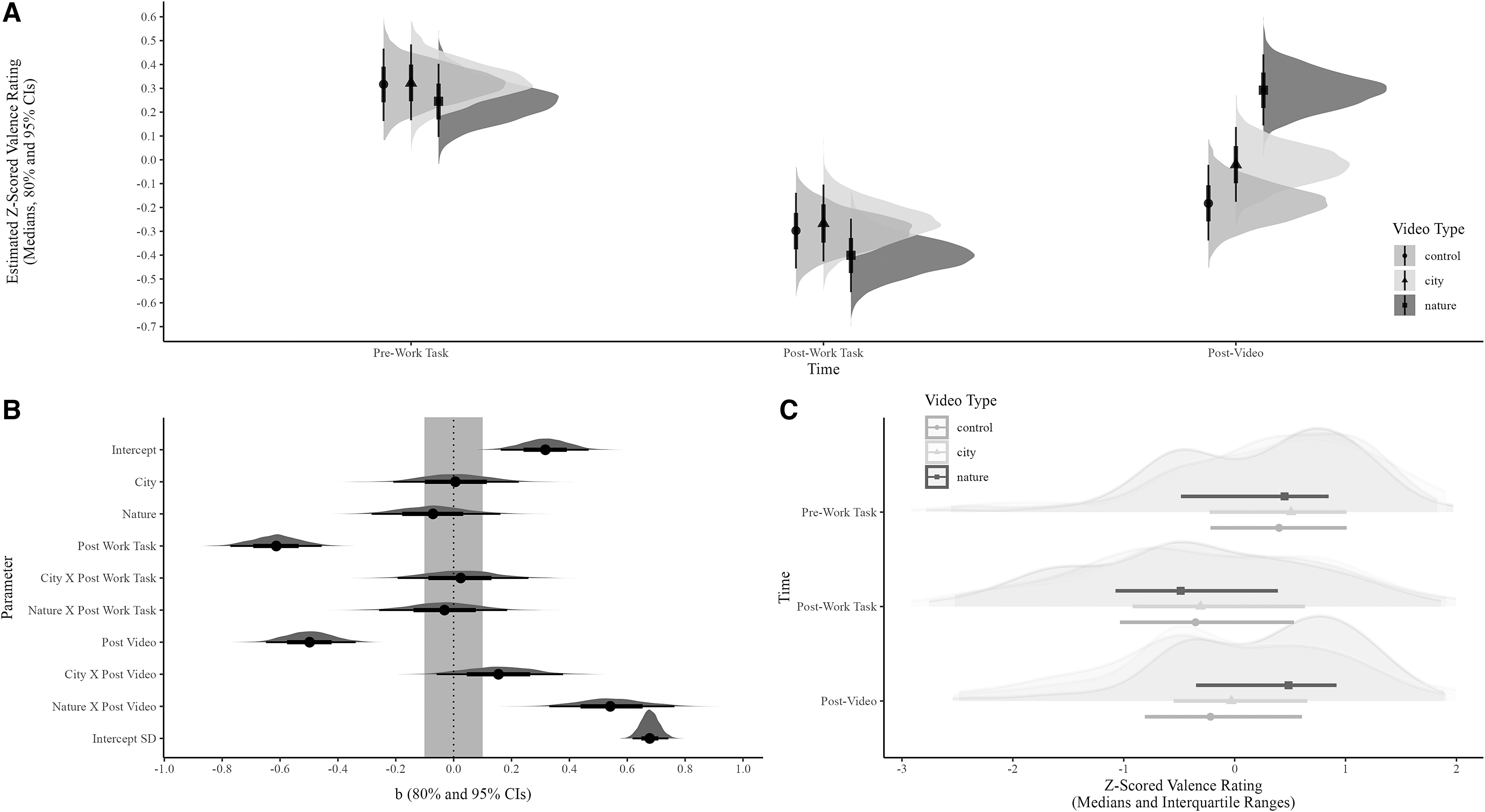
Valence ratings over time comparing nature, city, and work-related break activities:
Next, we ran the identical model from the previous analysis, but this time we estimated arousal ratings. Results showed an increase in arousal ratings after the work task for all conditions, but as compared with the control condition, a corresponding decrease in arousal ratings for those who watched either nature (with a pd = 0.999) or city (pd = 0.995) (see Fig. 4). Taken together, this means that for all conditions, the work task decreased valence and increased arousal (which is to be expected given the likely frustrating nature of an email response task). Yet, for arousal, either of the nature and city videos managed to reduce arousal to the same degree, whereas the nature video had a larger effect on valence than the city video. §§
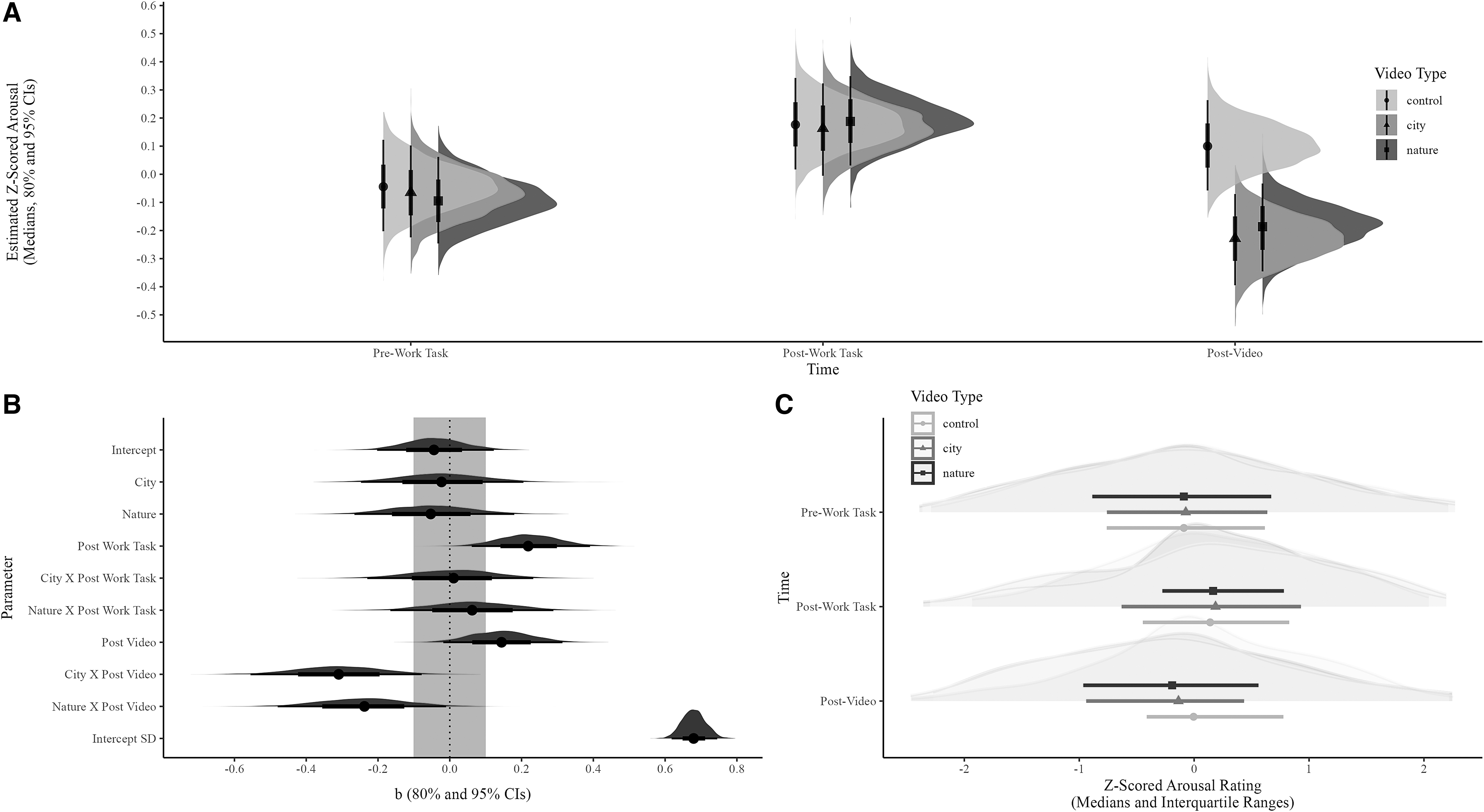
Arousal ratings over time comparing nature, city, and work-related break activities:
Relationship between valence/arousal and cravings
To determine whether valence ratings after watching each video affected desire to eat snack foods varying in calorie content, we conducted three Bayesian linear mixed effects models estimating desire rating with three different key dependent measures, respectively—calorie content, health ratings, and taste ratings. *** We conducted two- and three-way interactions between the key variable in each model and z-transformed valence and arousal ratings. We also included timepoint (prework task, postwork task, postvideo) of valence/arousal measurement and the interaction between timepoint and the valence and arousal measures. Given that participants had a limited response time for choice, there were a total of 122 missing choices (1% of the 11,799 possible choices) that were deleted before analysis.
Results of the three models indicated that more positive valence and increased arousal were associated with higher desire for all foods, unless the food was rated as higher in calories, rated as tastier, or rated as less healthy (see Table 1). In other words, feeling more positive and excited makes healthier foods more desirable. Furthermore, there was no effect of timepoint, suggesting that the effects of valence and arousal on food ratings were not affected by the work task, nor the videos.
Estimating Cravings with Valence and Calorie Content
Effect of nature video on cravings
To test whether the videos had an effect on choice for healthy versus unhealthy foods, we estimated desire ratings with calorie content and the interaction, including participant and food item as a random effect. Both city and nature videos were associated with a small increase in desire for foods (Bcity = 0.11, 95% CI [−0.02 to 0.24]; Bnature = 0.07, 95% CI [−0.07 to 0.20]). There was no indication of an interaction between calorie content and either of our video conditions relative to the control (Bnature×calorie = −0.00004, 95% CI [−0.0002 to 0.0002]; Bcity×calorie = −0.000001, 95% CI [−0.0002 to 0.0002]). Repeating this analysis with health and taste as predictors yielded similar results (see Section S7 and S8 in Supplementary Data). Overall, our results did not support the hypothesis that nature videos reduced the desire for unhealthy foods.
Exploratory analyses
Self-reported nature exposure
Thus far, we have demonstrated that exposure to a brief nature video has the most beneficial effect on valence following a standard work task. However, the beneficial effect on valence failed to translate into a preference for healthier snacks. Although the nature video did not translate into healthier snack choices, it could be the case that those with more exposure to nature in general [as found in Martin et al. (2019)] prefer to eat healthier foods. To test this hypothesis, we examined the interaction between caloric amount of the presented snack choices and self-reported frequency of spending time in green spaces on cravings with a Bayesian mixed effects model.
The model revealed a main effect of spending time in green spaces (B = 0.06, 95% CI [0.04–0.09]) as well as an interaction with calories (B = −0.00007, 95% CI [−0.0001 to −0.00004]), meaning that spending more time in green spaces is associated with greater desire for healthier foods. The interactions between time spent in nature and health variables persisted even when accounting for socioeconomic status and neighborhood satisfaction variables. The same relationship was found when replacing frequency spent in nature with percentage green space seen from one's home or whether one has access to a garden (see Section S9 in Supplementary Data).
The same pattern of results was also found when replacing calories with health ratings (Bgreen space = 0.09, 95% CI [0.06–0.13], Bgreen space×health = 0.02, 95% CI [0.02–0.03]). However, when looking at taste ratings, the interaction between taste ratings and use of green spaces was positive (Bgreen space×taste = 0.15 95% CI [0.009–0.022]), suggesting that the relationship between taste ratings and desire for healthy foods is stronger for those who spend more time in green spaces. Whereas we failed to find a causal effect of the nature video on food cravings, we did replicate prior correlational work showing that in terms of health and caloric content, those who report spending more time in green spaces tend to show greater desires for healthier foods.
Discussion
Given the restorative effects of exposure to pictures and videos of natural environments as well as the benefits of taking microbreaks from mentally demanding tasks, we set out to assess the causal effects of three different virtual microbreak activities (relaxing nature exposure, relaxing urban exposure, or work-related microbreak) from a mental work task on mood and the subsequent desire to eat unhealthy snack foods.
We found that even brief breaks from a mentally demanding work task can have positive effects on mood—specifically by increasing positive valence and reducing levels of arousal. Our research not only supports prior work showing that relaxation breaks are superior to work breaks in restoring mood (Kim et al., 2017), but also extends upon that work by showing that even when experienced virtually, exposure to natural environments is superior to breaks involving exposure to virtual built environments.
Our findings also extend prior research that has made a distinction between psychological resource recovery, whereby psychological resources return to prework task levels (i.e., baseline levels), and resource replenishment, where merely an improvement in the level of psychological resources is observed after the break activity, but no full recovery (Bennett et al., 2020). Specifically, Bennett et al. (2020) find that relaxing microbreak activities (watching a guided meditation video) of 1, 5, or 9 min facilitate both a replenishment of fatigue and vigor, whereas work-related break activities of all lengths further decreased vigor.
Our study extends their research by considering another affective state, namely mood. Our results suggest that relaxation breaks that involve nature even through virtual means facilitate mood recovery, whereas virtual relaxation breaks without exposure to nature facilitate a replenishment. Although our work-related break activity did not lead to even more negative valence ratings, it failed to facilitate a replenishment or recovery either.
Our finding of the superior benefits of spending microbreaks with virtual exposure to natural environments compared with virtual city exposure becomes even more relevant when considering the ever-increasing rate of urbanization around the globe (United Nations, 2018). This has clear implications for employers in that providing employees with appropriate screen savers or posters around the office could counteract the lack of natural environments surrounding the office building. However, even though our results indicate a positive effect of virtual natural environments on mood, it seems obvious that spending one's break surrounded by real nature yields even more pronounced improvements in well-being (Berman et al., 2008; Browning et al., 2020; Mayer et al., 2009).
Relationship between nature video, mood, and cravings
Relative to the work-related break activity, we found a positive effect of the nature video on valence. In addition, we found a positive association between valence ratings and preference for healthier foods. However, the video condition did not directly influence preference for healthier foods. One reason why we did not find an effect of the video condition on food choices could be that trait-level stress rather than state-level stress (as impacted by a video) drives food desire results. Indeed, prior research has shown that trait-level stress moderates the relationship between momentary stress and cravings, and that this moderation remains significant even after controlling for negative affect. Specifically, participants with high trait-level stress displayed a relative increase in food cravings, whereas participants with low trait-level stress showed a relative decrease in cravings (Reichenberger, Pannicke, Arend, Petrowski, & Blechert, 2021). Our video condition may have influenced state mood while trait mood influences food choice leading to our nonsignificant findings. Future research should, therefore, distinguish between state and trait mood and their relationship with food choices.
Another possibility as to why we did not find an effect of the video condition on food choices is that the effect of our brief experimental manipulation was simply not strong enough. Again, a larger shift in mood, such as through exposure to real-world natural environments (see Browning et al., 2020; Mayer et al., 2009), might be required to have a measurable effect on food preferences. This may highlight the importance of matching the size of one's intervention with one's intended behavior change. If we want to provide an opportunity to refresh after a period of work, a microbreak with virtual contact with nature may be sufficient. However, exposure to real-world natural environments instead of virtual environments may be required to achieve the necessary level of improvement in mood to affect food cravings.
Conclusion and Future Research
To conclude, regular breaks from work are important and our findings indicate that brief breaks from a moderately stressful work task can restore mood. Yet, even in a context as light touch as a virtual microbreak, the type of break still matters. When given a short amount of time to shift one's attention away from work, our findings suggest that one should look for a natural environment—even if it is a digital environment.
Future research
Given the lack of a causal effect of either video on preference for healthier foods, but a positive association between valence ratings and preference for healthier foods, future research could benefit from measuring trait-level mood in participants. This would allow researchers to assess whether our video condition may have influenced state mood while trait mood influences food choices. In addition, given the association between exposure to green spaces and a greater desire for healthier foods in our study, it may be worth examining how providing more green space in the workplace, such as plants, in addition to providing healthy options, could reduce unhealthy snacking.
Given that our video conditions may have been too weak to influence food choices, future research could also investigate the influence of real natural environments on food choice. Lastly, although we only considered the effect of microbreaks on mood, future research could benefit from considering alternative psychological resources that are relevant to office work, such as self-efficacy or autonomy.
Footnotes
Authors' Contributions
All persons who met authorship criteria are listed as authors, and all authors certify that they have participated sufficiently in the study to take public responsibility for the content, including participation in the concept, design, analysis, writing, or revision of the article.
Data Availability Statement

Author Disclosure Statement
No competing financial interests exist.
Funding Information
This research was supported by Zilveren Kruis Zorgverzekeringen N.V.
References
Supplementary Material
Please find the following supplemental material available below.
For Open Access articles published under a Creative Commons License, all supplemental material carries the same license as the article it is associated with.
For non-Open Access articles published, all supplemental material carries a non-exclusive license, and permission requests for re-use of supplemental material or any part of supplemental material shall be sent directly to the copyright owner as specified in the copyright notice associated with the article.
