




Abstract
This research explores the relationships between nature connectedness, pro-nature conservation behavior, life satisfaction, and mindfulness in children aged 9–11 years and assesses the impact of a three good things in nature writing intervention. Participants were assigned to either an experimental condition, writing about three good things in nature (previously adapted from a positive psychology intervention), or a control condition, writing about any three things they noticed, over a period of 5 days. In total, 138 children provided complete pre-intervention (baseline) data. Multivariate analysis of variance was used to explore the impact of the writing task. Increases in nature connectedness, mindfulness, and life satisfaction were observed for both the nature writing and control conditions, but not for pro-conservation behavior. A significant multivariate interaction was observed between the writing condition and time, for both nature connectedness and pro-conservation behaviors. Post hoc tests showed that pro-conservation behaviors increased over time for the nature writing group. Nature connectedness was significantly higher in the nature writing group than the control at the second time point, but not at follow-up (∼2-month later). Multiple regression showed nature connectedness and environmental perceptions predicted pro-nature conservation behavior, whereas nature connectedness and mindfulness predicted life satisfaction. Data were collected during late spring/early summer, which may result in seasonal effects; in future, this could be addressed by collecting data throughout the year. This research demonstrates support for relationships between nature connectedness and both pro-conservation behavior and life satisfaction in children. This indicates that short interventions tested in adults can have an impact on nature connectedness and pro-conservation behavior in children, although the impact on nature connectedness was relatively short-lived.
Introduction
Nature connectedness is a psychological construct that includes the feelings that people have in nature and toward nature and can include emotional affinity and the relationship between nature and self (Mayer & Frantz, 2004), and interventions have been developed for improving the connection between people and nature (Lumber et al., 2017; Richardson, et al., 2020a). Given the benefits of nature connectedness, and the dip in nature connectedness that occurs from and before 10 years of age (Hughes, Rogerson, Barton, & Bragg, 2019; Price et al., 2022), the present paper tests an intervention that is designed to improve children's nature connectedness.
There is a growing body of evidence demonstrating the impact that increased nature connectedness can have on mental health and well-being for adults (McKewan et al., 2019; Pritchard et al., 2019; Windhorst & Williams, 2015) and children (Barrable & Booth, 2020; Roberts, Hinds & Camic, 2020). Recently, nature connectedness has emerged as an important factor in mental well-being, over and above time in nature (Richardson et al., 2021; Liu, Nong, Ren & Liu, 2022; Martin et al., 2020). Although the evidence for this relationship in children is more limited, there is a growing body of evidence that shows the benefits of nature connection for children, for example in relation to psychological functioning and well-being (Sobko, Jia & Brown, 2018).
However, many studies focus on time spent in nature or activity in nature rather than connecting to nature (Giusti, Svane, Raymond & Beery, 2018). Unfortunately, studies have now identified a decline in nature connectedness around the ages of 8 to 11 years (Hughes et al., 2019; Price et al., 2022). Concerns that people are becoming increasingly disconnected from nature have grown (Louv, 2010), with many researchers now exploring ways in which people can be reconnected with nature (Braun & Dierkes, 2016; Arbuthnott & Sutter, 2019; Barragan-Jason, de Mazancourt, Parmesan, Singer & Loreau, 2021).
Well-being is not the only potential benefit from increased nature connectedness, and the potential link between nature connectedness and pro-nature conservation behaviors is also of interest. This is particularly timely given the increasing awareness of planetary health and the impact of climate change (Ceballos, Ehrlich, & Dirzo, 2017), along with the loss of species and natural habitats as highlighted in the State of Nature Partnership report (Hayhow et al., 2019). Nature connectedness has been found to be a key factor in pro-nature conservation behaviors (Richardson & Hamlin, 2021; Richardson et al., 2020b) and a causal factor in pro-environmental behaviors (Mackay & Schmitt, 2019).
Pro-environmental behaviors can be seen as behaviors that benefit the environment by minimizing the impact of an individual's actions on the environment and potentially reduce their carbon footprint (Lange and Dewitte, 2019). Behaviors such as recycling, reducing water usage, using public transport, or cycling and walking instead of taking the car, etc. are all examples of pro-environmental behaviors. Pro-nature conservation behaviors focus on actively supporting both plant and animal biodiversity (Ceballos et al., 2017) and can include behaviors such as creating habitats to support wildlife, or volunteering for a local nature group, yet these pro-nature conservation behaviors rarely feature in measures of pro-environmental behavior (Gkargkavouzi, Halkos, & Matsiori, 2019).
Relatively, a few studies have focused on pro-nature conservation behaviors, which examine behaviors that directly support and protect nature, especially in children, although Hughes et al. (2018) and Otto and Pensini (2017), for example, have explored links between nature connectedness and pro-nature conservation behavior, establishing positive relationships. Exploring links between nature connectedness and both environmental perceptions, which measure attitudes toward the environment (Larson, Green & Castlebury, 2011), and pro-nature conservation behaviors in children is important.
It provides an opportunity to consider relationships between children's attitudes toward the environment (environmental perceptions), and how and why children might engage in pro-nature conservation behaviors, which, potentially, may help to establish ingrained behavior change for a sustainable future.
Previous research has also demonstrated positive links between environmental behaviors and both mindfulness (Barbaro & Pickett, 2016) and life satisfaction (Schmitt, Aknin, Axsen, & Shwom, 2018) with adults. Research with adults has also shown links between nature connectedness and mindfulness (Schutee & Malouff, 2018). Moreover, mindfulness-based interventions in adults have been found to increase nature connectedness, particularly when they are conducted in nature (Choe, Jorgensen & Sheffield, 2020a, 2020b). However, a few nature-based interventions have measured mindfulness with children.
Given the evidence supporting relationships between nature connectedness and pro-nature conservation behaviors and well-being, evaluating interventions that may increase both may be considered useful. One such intervention was adapted from a positive psychology intervention (PPI)—the “three good things” writing task (Rippstein-Leuenberger, Mauthner, Sexton & Schwendimann, 2017). During this task participants are asked to write down three good things that have happened during each day; this has been shown to have a positive impact on various factors, including happiness and depressive symptoms (Seligman, Steen, Park, & Peterson, 2005) as well as self-leadership in students (Konradt, Brombacher, Garbers & Otte, 2019).
This task was adapted by Richardson and Sheffield (2017), who demonstrated that writing about three good things “in nature” each day led to an increase in nature connectedness in adults. The twist of the original PPI was designed to activate the pathways to nature connectedness, the five values of biophilia (Kellert, 1993) found to explain levels of nature connectedness (Lumber et al., 2017).
For example, the intervention prompts sensory contact with nature with the need to list “good things in nature” prompting reflection on emotional experiences, nature's beauty, and the meaning of nature. Support was further demonstrated for the impact of the three good things in nature writing task with adults through the use of a Smartphone App, where noting three good things in nature led to improvements in mental health (McKewan et al., 2019), whereas additional research demonstrated sustained benefits of the three good things in nature task for mental well-being (Richardson et al. 2021). The present study extends work in this area by implementing a similar three good things “in nature” writing task with children.
This study had several aims: It begins by extending the work of Richardson and Sheffield (2017), McKewan et al. (2019), and Richardson et al. (2021) to assess the impact of writing three good things about nature with children. It is hypothesized that the intervention will result in an increase in nature connectedness, environmental perceptions, pro-nature conservation behaviors, life satisfaction, and mindfulness, compared with a control condition. In addition, this study explores the relationships between pro-nature conservation behaviors and measures of nature connectedness, environmental perceptions, mindfulness, and life satisfaction.
It is expected that positive relationships will be observed whereby pro-nature conservation behaviors will be predicted by nature connectedness, environmental perceptions, mindfulness, and life satisfaction; and life satisfaction will be predicted by nature connectedness, pro-nature conservation behaviors, environmental perceptions, and mindfulness.
Methods
Ethical approval for this research was granted by the University of Derby Psychology Research Ethics Committee.
Participants
Initially, the head teachers at 20 state primary schools across Derbyshire and Nottinghamshire were contacted, with 3 schools subsequently agreeing to take part. Parents were contacted by letter via the school to gain their consent for their children to take part in the research or to opt out if they preferred. Further consent was gained from the children directly at the start of data collection. The schools ranged in size with the largest school having four classes, each of 26–30 school year 5/6 children (aged 9–11 years) and the smallest school having just one class of 26 year 5/6 children. A total of 166 children aged 9–11 years, in years 5 and 6 participated.
These comprised 81 girls (49%) and 85 boys (51%) with a mean age of 10 years and 7 months. Of these children, 138 provided complete data for all 3 time points. Participants were assigned to conditions based on class membership, with a whole class being randomly assigned to either the control or experimental condition to help avoid cross-contamination between conditions. In total, 7 classes participated, with 4 being allocated to the experimental condition and 3 being allocated to the control condition. Eighty-four children (42 female, 42 male) were allocated to the experimental condition, whereas 82 children (39 female, 43 male) were allocated to the control condition.
Design
The main investigation employed a 2 × 3 mixed measures design, with one within-participants' factor with three levels: pre-intervention; post-intervention—after the final intervention took place; and follow-up, at ∼2-month post-intervention. There was one between-participants' factor with two levels, where participants were assigned to one of two writing groups comprising an experimental group and a control. The experimental group was asked to write about three good things in nature that they noticed each day, whereas the control group was asked to write about any three things they noticed each day. Examples of text from the nature condition include a beautiful butterfly flew past me at the park, and I noticed how green the grass looks. Examples of text from the control condition include today I had hoops for breakfast chocolate hoops and I went dancing.
The dependent variables were the self-reported scores taken from questionnaires completed at the three time points. These include nature connectedness; life satisfaction; pro-conservation behavior; children's environmental perceptions; and child and adolescent mindfulness.
Additional investigation using a cross-sectional correlation design focused on pre-intervention data collected from all children. Relationships were determined between the following variables: nature connectedness; life satisfaction; pro-nature conservation behavior; children's environmental perceptions; and child and adolescent mindfulness.
Materials
Children's pro-nature conservation behaviors measure
The seven questions used to measure pro-nature conservation behaviors were developed for the study through collaboration between the Royal Society for the Protection of Birds (RSPB) staff and psychology researchers at the University of Derby (Richardson et al., 2015). The questions were devised to ask young children about a range of pro-nature conservation behaviors that they might be expected to perform, along with their membership of wildlife-related organizations.
Participants were asked to respond yes or no to the following questions: I often put food out to feed garden birds; I have made homes for nature at school or in the garden; I put insects safely outside when I find them stuck indoors; I grow flowers and plants that birds and insects will like; I take part in events to help nature (e.g., Big Garden Bird Watch); I am a member of a wildlife or nature group outside of school (e.g., RSPB, Wildlife Trust, etc.); and I am a member of a wildlife or nature group at school. Scores are totaled to give a maximum potential score of 7 and a minimum of 0.
Reliability testing using the Kuder Richardson 20 technique (Kuder & Richardson, 1937) was employed, which showed reasonable reliability across the three time points with alphas of 0.63 at pre-intervention, 0.70 at time 2, and 0.70 at time 3. At all three time points, there was no indication that reliability would be improved if any items were deleted so all items were retained for future analysis, providing good support for the measure. The questions have also been used in further research (Hughes et al., 2018).
Student's Life Satisfaction Scale
The Student's Life Satisfaction Scale (Huebner 1991 adapted for the Children's Society) was used to assess satisfaction with life, with phrasing adapted for children. It comprised seven items measured on a 6-point Likert scale, where 1 = Strongly disagree and 6 = Strongly agree and includes a mixture of positively and negatively phrased items. Example items include My life is going well and I have what I want in life.
Connection to Nature Index
Nature connectedness is measured by the Connection to Nature Index (Cheng & Monroe, 2012), a 14-item scale that contains items that represent how connected to nature the children feel, including items such as I like to hear different sounds in nature and I enjoy touching animals and plants. These are scored on a 5-point Likert scale ranging from 1 = Strongly disagree to 5 = strongly agree. This scale was selected, as it has been successfully used with children in a range of research (e.g., Bragg, Wood, Barton & Petty, 2013).
Children's Environmental Perceptions Scale
Children's attitudes toward the natural environment are measured by the Children's Environmental Perceptions Scale (Larson et al., 2011). This scale contains 16 items measured on a 5-point Likert scale ranging from 1 = strongly disagree to 5 = strongly agree. Example items include I like to learn about nature and We need to take better care of plants and animals.
Child and Adolescent Mindfulness Measure
Mindfulness was measured using the Child and Adolescent Mindfulness Measure (Greco, Baer & Smith, 2011) and consists of a 10-item scale that uses a 5-point Likert scale with responses ranging from 0 = never true, through to 4 = always true. Example items include I stop myself from having feelings that I don't like and It's hard for me to pay attention to only one thing at a time.
In addition to completing the questionnaires, children also provided demographic details, including their gender, age, ethnicity, school year, and time spent outdoors and in nature during the previous week.
Procedure
Schools were initially contacted by telephone and email, and three schools agreed to take part. Information about the study, letters to parents, and consent information was provided to the schools along with information about how to opt out of the study should parents prefer that their child did not participate. Each class was assigned to either the nature or control condition. All phase one data were collected on a Friday where children were provided with information about the study and what taking part would involve.
They were provided with information about how to withdraw from the study and given the opportunity to ask any questions. A unique code was used to ensure confidentiality, to permit matching of the responses at the different time points, and to identify their responses should they wish to withdraw. The children then completed the first questionnaire pack during school time. After its completion, they were provided with an interim debrief and those in the nature condition were told that they would be writing about things they noticed in nature the following week. They were asked to spend some time over the weekend noticing things in nature that they might like to write about the following week.
Children assigned to the control condition were told they would be writing about things they had noticed each day so they might like to see what they could notice over the weekend that they might like to write about the following week.
The following week, the researchers attended the schools at the start of the school day every day from Monday through to Friday. A detachable name sheet was used on the front of the questionnaire booklets to ensure that each child used their own booklet. Children also completed their unique codes inside of the questionnaire booklets. Children were then asked to write about three good things in nature they had noticed during the last 24 h if they were assigned to the nature condition, or to write about any three things they had noticed during the last 24 h if they were assigned to the control condition.
On the final day of the writing task, children also completed the questionnaire booklet for the second time (post-intervention). When all data were collected, the name sheets from the questionnaire booklets were removed and destroyed. Children were provided with a verbal debriefing, reminded about their right to withdraw, given the opportunity to ask any questions, and thanked for their participation. A written debrief containing this information was also sent home to their parents. This also reminded them that data would be collected for a final time later in the year.
Approximately 2 months after collection of the post-intervention data, the participants completed the questionnaire pack for the final time (follow-up). A verbal debriefing was again provided to the children, and a written debrief was sent home to their parents. By way of thanking the schools for their participation, the schools were provided with a nature-related gift pack, including books, bird feeding and nesting equipment, and insect-related equipment. The schools were unaware that they would receive these gifts to avoid any undue pressure to participate. An overview of the experimental process is shown in Figure 1.
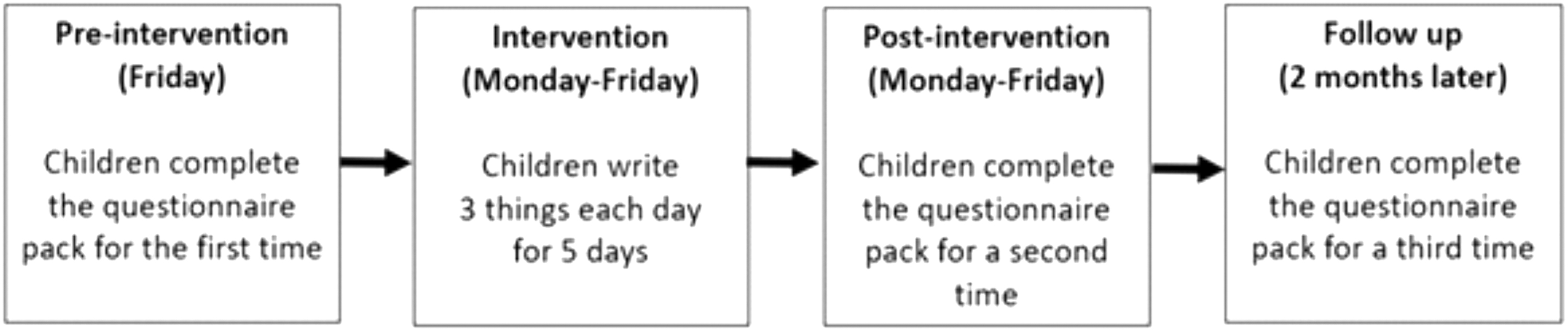
The experimental process.
Analysis
Group comparisons at pre-intervention were conducted using Fisher's exact test, for proportions, and analysis of variance (ANOVA), for continuous variables. Multivariate analysis of variance (MANOVA) was used to examine changes in all outcome measures over time in the two groups using an intention to treat approach; values from the pre-intervention time point were used when missing values were present at either post- or follow-up. Follow-up analyses were conducted by ANOVA and t-tests. Relationships between changes were also investigated by calculating correlation coefficients.
No adjustments were made for multiple comparisons, but effect sizes (Cohen's d) are reported to aid interpretation using Cohen's (1988) criteria: d = 0.2 is small; d = 0.5 is medium; and d = 0.8 is large. Correlation and regression analyses to determine relationships between variables when measured at the first time point were also conducted. SPSS version 26.0 was used for analyses using an alpha of 0.05.
Results
Sample characteristics
Complete data at the three time points were available from 138 children, including 72 of the 84 children from the experimental group and 66 of the 82 children in the control group. There were 69 boys and 69 girls, of whom 85 were in year 5 (9–10 years old) and 53 were in year 6 (10–11 years old). An initial check confirmed that similar proportions of boys and girls were recruited in the experimental and control conditions; Fisher's exact test, p = 0.53. The age groups of children recruited in the nature and control conditions were also similar; Fisher's exact test, p = 0.11.
There were no differences in pet ownership or garden access (p = 0.37 and p = 0.51, respectively) and no differences in the number of days spent outdoors (t = −1.38, p = 0.17), but children in the nature condition reported spending more days (mean ± standard deviation [SD] = 4.6 ± 1.9) in nature at pre-intervention than those in the control condition (mean ± SD = 3.9 ± 2.2; t = 2.02, p = 0.05).
Intervention
MANOVA was used to examine group differences (nature and control) in changes over time (three time points) of the outcome measures (nature connectedness, pro-nature conservation behavior, mindfulness, environmental perceptions, life satisfaction). It revealed a significant multivariate effect of time (F[10,127] = 14.30, p < 0.001, ηp2 = 0.53); there were significant univariate effects for nature connectedness (F[2,272] = 39.01, p < 0.001, ηp2 = 0.22), mindfulness (F[2,272] = 8.11, p < 0.001, ηp2 = 0.06), and life satisfaction (F[2,272] = 10.32, p < 0.001, ηp2 = 0.07) (Table 1). Environmental perceptions and pro-nature conservation behaviors did not change.
Means (Standard Deviation) of Nature Connectedness, Mindfulness, and Life Satisfaction Over the Intervention Period
Different superscripts indicate significant differences. Dissimilar superscripts denote values that differ significantly.
There was also a significant multivariate time x group interaction (F[10,127] = 2.40, p = 0.01, ηp2 = 0.16). Although there was no main effect of time, univariate ANOVA revealed time x group interactions for pro-nature conservation behavior F(2,272) = 3.45, p = 0.03, ηp2 = 0.03 and nature connectedness (F[2,272] = 3.55, p = 0.03, ηp2 = 0.03). For pro-nature conservation behavior, post hoc t-tests indicated no group differences at pre-intervention (t = 0.62, p = 0.54), but pro-nature conservation behavior was higher in the nature condition at post-intervention (t = 1.96, p = 0.05, p < 0.1) and at follow-up (t = 2.17, p = 0.03) (Fig. 2).

Group differences in mean pro-nature conservation behavior over time with standard error bars.
For nature connectedness, post hoc t-tests indicated that nature connectedness was higher in the nature condition at all three time points; at pre-intervention (t = 2.57, p = 0.01), at post-intervention (t = 3.34, p < 0.001), and at follow-up (t = 2.08, p = 0.04) (Fig. 3). The change in nature connectedness from pre-intervention to post-intervention was greater in the nature group than the control group (t = 3.01, p = 0.003); there was no group difference in the change in nature connectedness from pre-intervention to follow-up (t = 0.64, p = 0.52).
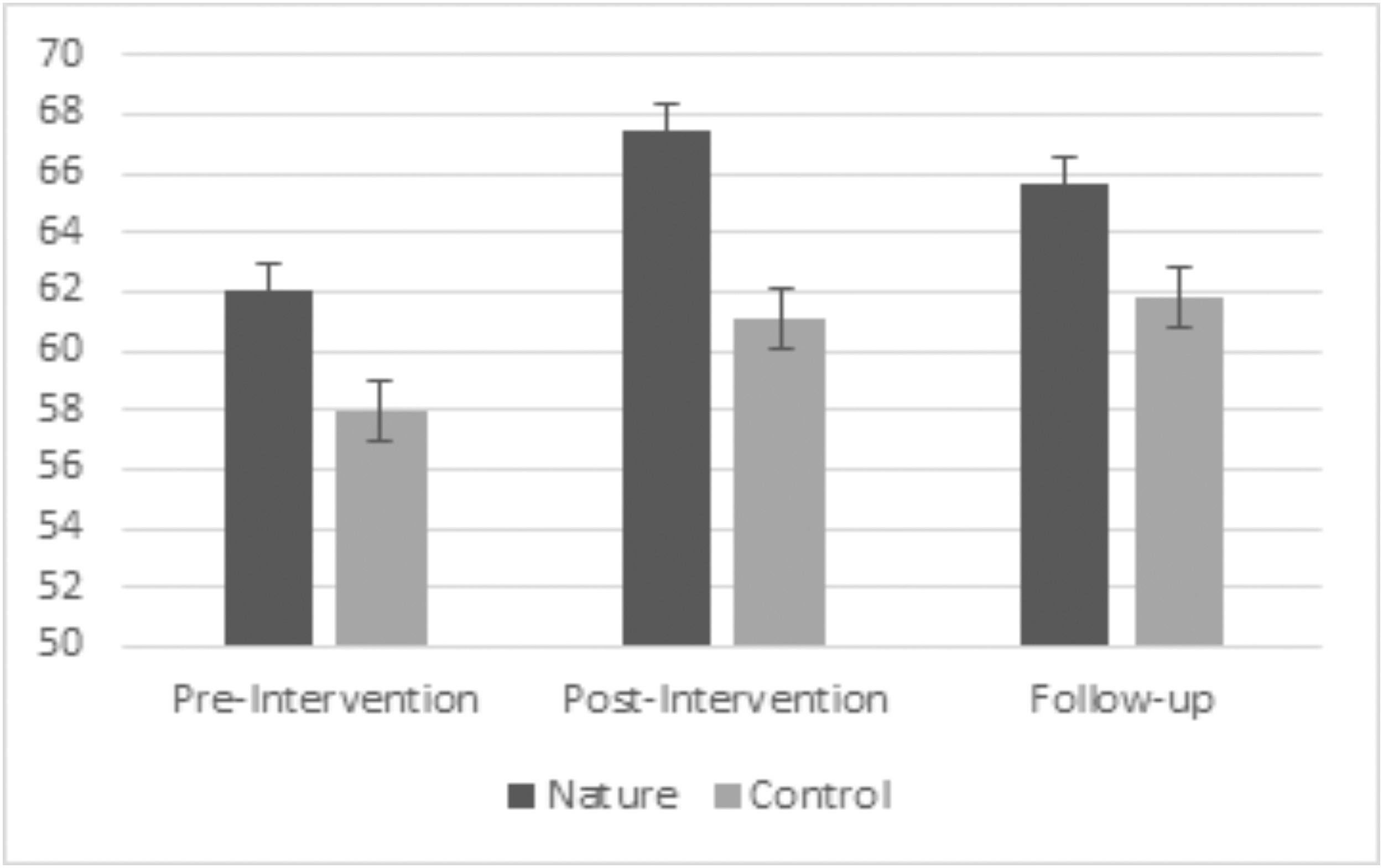
Group differences in mean nature connectedness over time with standard error bars.
Finally, changes in nature connectedness from pre-intervention to post-intervention were correlated with changes in pro-nature conservation behavior from pre-intervention to post-intervention (r = 0.23, p < 0.05) but not in the control group (r = -0.05, p > 0.1). Changes in nature connectedness from pre-intervention to post-intervention were not correlated with changes in pro-nature conservation behavior from pre-intervention to the 2-month follow-up in either group (r's < 0.04, p's > 0.01).
Relationships
Complete data collected pre-intervention were available from 138 children (83.1%). Pearson correlations revealed several significant relationships (Table 2); in accordance with Cohen (1988), correlation coefficients of >0.1 reflect a weak relationship, >0.3 reflect a moderate relationship, and >0.5 reflect a strong relationship. Life satisfaction was positively related to nature connectedness where a moderate correlation was observed, whereas weak correlations were also present between life satisfaction and both mindfulness and environmental perceptions.
Correlation Coefficients Between the Variables
p < 0.001; **p < 0.01; *p < 0.05.
Pro-nature conservation behaviors were positively related to nature connectedness and environmental perceptions, where strong correlations were observed. Nature connectedness was positively and strongly related to pro-nature conservation behaviors and environmental perceptions, and to life satisfaction where a moderate correlation was observed.
Regression was used to determine independent predictors of life satisfaction and pro-nature conservation behaviors. For life satisfaction, after entering school year and gender at step one (R2 = 0.01), a significant regression equation was found (F[6,131] = 4.44, p < 0.001) with a change in R2 = 0.16 (all variance inflation factors [VIFs] <4); with connectedness to nature and mindfulness emerging as independent predictors (Table 3). Pro-nature conservation behaviors and environmental perceptions were not independent predictors of life satisfaction.
Regression Using Life Satisfaction as the Criteria
p < 0.01; *p < 0.05.
For pro-nature conservation behaviors, after entering school year and gender at step one (R2 = 0.04), a significant regression equation was found (F[6,131] = 20.62, p < 0.001) with a change in R2 = 0.28 (all VIFs <4); nature connectedness and environmental perceptions were independent predictors of pro-nature conservation behaviors, but mindfulness and life satisfaction were not (Table 4).
Regression Using Pro-Nature Conservation Behaviors as the Criteria
p < 0.01; *p < 0.05.
Discussion
The study employed a mixed-measures design to examine the impact of a “three good things in nature” writing intervention in children. This research showed that writing about the good things in nature increased pro-nature conservation behaviors and connectedness to nature to a greater extent between pre- and post-task than neutral writing, providing support for the three good things in nature writing intervention in children. In contrast, mindfulness and life satisfaction were not altered by the writing intervention.
The research also examined the relationships between nature connectedness; life satisfaction; pro-nature conservation behavior; children's environmental perceptions; and child and adolescent mindfulness. Both nature connectedness and mindfulness were positively correlated with life satisfaction, whereas both connectedness to nature and environmental perceptions were positively correlated with pro-nature conservation behaviors. Nature connectedness and mindfulness also emerged as independent predictors of life satisfaction in the regression analysis, whereas nature connectedness and environmental perceptions similarly emerged as independent predictors of pro-nature conservation behavior. No other significant relationships were observed.
Although nature connectedness was higher at pre-intervention in the nature writing condition compared with the control, it was higher than the control at all three time points and the increase in nature connection from pre-intervention to post-intervention was significantly higher for the nature writing condition than the control. This indicates that the intervention resulted in an increase in nature connection; however, this increase was not sustained through to the follow-up ∼2 months later. This indicates that the impact of the three good things writing task had a short-term impact on nature connectedness.
This adds to the work of Richardson and Sheffield (2017), who found a sustained increase in nature connection in their sample of adults following a similar three good things in nature writing intervention. The increases they observed with adults were present at both post-intervention and follow-up, implying that the effect of the writing task may have a greater long-term impact for adults than for children. This implies that for a sustained increase in nature connection in children, the intervention may need to be engaged with for a longer time period or repeated periodically. Alternatively, other more direct interventions may be more beneficial for engaging children with nature, for example through utilizing what is known of the pathways to nature connection, for example, contact, emotion, compassion, beauty, and meaning Lumber et al. (2017). Using these pathways to inform interventions to help increase nature connection in children has the potential to maximize any increase in nature connection by tailoring the intervention to suit with the things that children are most likely to be aware of in nature (Harvey et al., 2020).
When considering pro-nature conservation behaviors, no differences were observed in pro-nature conservation behavior at pre-intervention between the nature and control conditions; however, importantly, pro-nature conservation behavior was higher in the nature condition at both post- and follow-up time points, indicating that the three good things in nature writing task resulted in sustained increases in pro-nature conservation behaviors.
Further to demonstrating sustained increases in pro-nature conservation behaviors, the present study found positive relationships between nature connectedness, pro-nature conservation behaviors, environmental perceptions, and life satisfaction. Hughes et al. (2018) established a link between higher levels of nature connectedness and increased pro-nature conservation through the analysis of cross-sectional data. Here, it is suggested that interventions that lead to an increase in nature connectedness with children may have the potential to bring about sustained increases in pro-nature conservation behaviors.
Indeed, changes in nature connectedness in the nature group were related to changes in pro-nature conservation behavior from pre-intervention to post-intervention (r = 0.23, p < 0.05). However, there was no relationship between changes in nature connectedness and changes in pro-nature conservation behavior at the 2-month follow-up. This is an interesting finding given current concerns about the state of the environment and climate (e.g., Ceballos et al., 2017; Hayhow et al., 2019).
The present study showed a clear relationship between nature connectedness and life satisfaction, supporting the findings of previous research with adults (e.g., McKewan et al., 2019; Chang et al., 2020; Frauman & Shaffer, 2017). Similarly, the relationship between mindfulness and life satisfaction that has been demonstrated in adults (Dhandra, 2019; LeBlanc, Usun & Aydemir, 2019) and adolescents (Wang & Kong, 2020) was also supported. Both nature connectedness and mindfulness also emerged as independent predictors of life satisfaction. Although life satisfaction showed a positive relationship with nature connection supporting previous research such as Frauman and Shaffer (2017), McKewan et al. (2019), and Chang et al. (2020), the nature writing intervention had no effect on life satisfaction.
In contrast to previous research, relationships were not found between nature connectedness and mindfulness, contradicting the findings of Schutte and Malouf (2018). Similarly, no significant relationships were observed between pro-nature conservation behaviors and either life satisfaction or mindfulness, contradicting the work of Schmitt et al. (2018) and Barbaro and Pickett (2016), respectively, although this research was conducted with adults rather than children as in the present study. It is unclear why these relationships did not emerge in the present research with children, and further work to understand the differences in findings here when compared with previous research with adults could be of benefit.
Of note are the significant univariate effects of time for nature connectedness, mindfulness, and life satisfaction, where all three variables were found to increase over time in both conditions. The writing task started during the spring/early summer, with follow-up data being collected by early July. This coincided with improvements in the weather, increased day light hours and more opportunity for children to spend time outside in nature. It is possible that the overall increase in nature connection over time, observed during the study, was due to these extraneous factors, or could simply be because the children were feeling more focused on nature due to being aware of the study that they were taking part in, and completing measures that encompassed the nature connection.
The improvements in weather and increased daylight hours might also be linked with the reported increases in mindfulness and life satisfaction; however, this could also relate to many other external factors, potentially things being associated with school and the run up to the end of the summer term.
The present research is not without limitations. First, the timing of the study during the spring and summer months potentially acts as a confounding variable. It would be helpful to repeat the study throughout the year so that any such effects are reduced. Second, the measure of mindfulness employed was validated with a U.S. sample of older adolescent children. Some questions may have been a little difficult for the children to understand and although a researcher was present to answer any queries at all data collection points, it is possible that this measure did not fully capture mindfulness with the children in the present study.
In addition, although the regression analysis shows some significant independent relationships, it is impossible to unpack the temporal order or causal nature of any of those relationships. Finally, although the present study did show an impact of the three good things in nature writing intervention on nature connectedness and pro-nature conservation behaviors, there are potentially more impactful interventions that could result in greater and more sustained increases in both nature connectedness and pro-nature conservation behaviors, which may be an area for future research to explore.
This study has demonstrated that a short and simple intervention such as writing about three good things in nature, each day for 5 days, can lead to significant increases in nature connectedness and sustained increases in pro-nature conservation behaviors. The effect sizes observed were relatively small, however this is the normal indication of reality with many small effects being observed (Götz, Gozling & Rentfrow, 2021). Finding sustained increases in key outcomes such as pro-nature conservation behaviors, especially in children, is important at a time of biodiversity loss as these pro-nature conservation behaviors may have the potential to redress this issue.
It is essential to build on these findings by developing the intervention further and exploring other approaches to increase nature connectedness and pro-nature conservation behaviors. It may be that such written interventions can provide a “stepping-stone” to other activities that may have a stronger impact on both nature connection and pro-nature conservation behaviors. Future research could compare the impact of specific interventions that aim at increasing nature connectedness and pro-nature conservation behaviors in children, providing more robust evidence of the interventions likely to have the greatest impact.
The current research clearly demonstrated a relationship between nature connectedness and pro-nature conservation behavior, and it appears that nature connectedness acts as a pathway to increased pro-nature conservation behavior. Therefore, interventions that may lead to an increase in nature connection may also lead to an increase in pro-nature conservation behavior.
Footnotes
Authors' Contributions
C.H.: Conceptualization, data collection, analysis, and writeup. D.S.: Conceptualization, analysis, and writeup. M.R.: Conceptualization and writeup. R.W.: Data collection and writeup.
Author Disclosure Statement
No competing financial interests exist for any of the authors.
Funding Information
No funding was received for this research project.