




Abstract
How do spiritual ties to place (i.e., place spirituality) contribute to a meaningful spiritual life? Previous work has focused on sacred places, but a proposal is put forward for examining the spiritual connections people develop with many types of places in their search for meaning. The proposed theory examines spiritual ties to place across three dimensions—affective, cognitive, and behavioral—that may be a critical way in which people satisfy spiritual yearnings and fulfill spiritual needs due to (1) the sacred in a place, (2) social activities in sacred places, and (3) spiritual realities in a place. Furthermore, a proposal is put forward for a measure of spiritual ties to place that can be adapted to numerous specific individual, environmental, and community-level contexts. Adaptation of the measure for a variety of contexts is provided so that the proposed approach can be used across cultures. Discussion is also given to the psychology of religious places, and the broader implications for well-being. This could be useful for tracking and reflection purposes, and it might ultimately be used for assessing religious/spiritual realities experienced within the milieu of place.
Introduction
Religious beliefs and spiritual experiences are ubiquitous phenomena and an important part of the lives and identities of most people on earth (Kinnvall, 2004; Silberman, 2005). Although spirituality is often viewed as an ethereal, almost other-worldly concept, one's practice of a faith is nevertheless embedded within places, and the ties that people have to particular places are often referred to as spiritual (e.g., Counted & Watts, 2019).
For example, religious practice is generally lived within faith-based communities, which are themselves situated within specific physical settings, such as churches, temples, and mosques. The design of these places shapes the worship experience and can have a substantial influence on the thoughts, emotions, and ritualized behaviors of worshippers. In fact, research suggests that entering certain settings or places may be the most effective means of eliciting transcendent spiritual experiences, since certain sensory/perceptual experiences provide the necessary cognitive scaffolding for connecting with the divine (e.g., Counted & Zock, 2019; Meagher, 2018, 2022).
The scientific study of place can, therefore, provide a number of insights into how individuals and communities live out and express their spirituality. The concept of place encompasses multiple spatial dimensions that are part of our daily routines, such as the physical environment, the memories associated with certain places, and the cultural identity expressed in places.
Although these multiple understandings of place have been well documented in place theories, they are rarely engaged when discussing spiritual ties to place. Counted and Zock (2019) note that a place is an important avenue by which people access their spirituality. Their research revealed that spirituality is associated with strong feelings of connection and commitment to a place that is meaningful to the individual (see also Counted, 2019). Interdisciplinary engagement that involves environmental psychology and the study of religion can help clarify the science behind spiritual ties to place, as it arises from multiple spatial dimensions and across different cultures.
In light of the mentioned insights, the aim of this article is to provide a conceptual overview of spiritual ties to place. Specifically, we will examine some of the approaches that researchers have used to study spiritual ties to place, especially how this experience occurs across affective, cognitive, and behavioral dimensions (Counted, Cowden, & Ramkissoon, 2021; Scannell & Gifford, 2010).
This includes the bonds with physical features of places such as the beauty of scenery or the aesthetics of nature (Lewicka, 2011), cognitive processes that bind people to the cultural identity of a place (Proshansky et al., 1983), and individual's engagement (i.e., behavioral, religious, cultural, social) in a place (Counted & Watts, 2019). We also discuss how this new conceptual framework can help inform the next wave of research and practice, thus concluding with a discussion of some possible research agendas that could be followed to further our understanding of spiritual ties to place.
Conceptual Background
A spiritual connection to a place can be approached in a number of ways, but perhaps the most relevant framework that can be applied is the concept of place attachment (Counted et al., 2021; Lewicka, 2011; Scannell & Gifford, 2010). Place attachment refers to the strong emotional connection people feel toward particular places (e.g., neighborhoods, towns, villages; Counted et al., 2021). Although place attachment is often discussed in terms of subjective experiences (e.g., feelings of attachment, comfort, belongingness), there is a growing body of quantitative empirical research addressing the concept.
For example, researchers have examined the demographic and spatial characteristics of place attachment (e.g., age, gender, education, migration status, social class), the factors predictive of place attachment (e.g., physical infrastructure, environmental aesthetics, social relationships), and the well-being and mental health outcomes (e.g., life satisfaction, positive affect, meaning in life, sense of belonging, lower stress, anxiety, depressive symptoms) associated with place attachment (e.g., Counted, 2019; Counted et al., 2021; Meagher & Cheadle, 2020; Scannell & Gifford, 2010).
Recent research suggests that our attachment to specific places is shaped by a variety of factors, including experiences and our current interactions with those places (Baumeister & Leary, 1995; Counted et al., 2021). Place attachment is also influenced by how we perceive specific places and the feelings we have when interacting with them (Lewicka, 2011). These factors determine the kind of attachments that are formed and help us understand the different ways we engage with the spaces around us.
Notably, one way in which research on place attachment has lagged behind work on interpersonal attachment relates to distinct types of attachment (Scannell et al., 2020). Whereas decades of work have explored how interpersonal attachment varies by style (e.g., secure, avoidant) and relationship type (e.g., child–parent, romantic partners), there exists a relatively limited research literature on how attachment bonds to different types of places may vary.
We propose that one important type of attachment is the potential formation of spiritual ties to place. Spirituality represents one's search for the sacred, often referred to “a divine being, a divine object, Ultimate Reality, or Ultimate Truth as perceived by the individual” (Hill et al., 2000, p. 66). Viewing something as sacred entails perceiving it as having value that transcends the self, which invokes feelings of reverence and respect.
Thus, spiritual ties to a place are conceptualized here as one's attachment to the sacred within a place. Although traditionally associated with holy places of worship and religious symbols, the term sacred has also referred to other cultural symbols, such as the mountains and forests of particular regions or the wildlife that lives there (Temper & Martinez-Alier, 2013). This type of “ecological sacredness” can be the unique characteristics of a given environment that make it distinctive and worthy of protection and respect.
As a result, although spiritual ties may be most likely to form within traditionally religious places (e.g., churches, temples), other types of places may also be viewed as possessing sacred qualities as a result of the lived experience of the individual within them (e.g., natural environments, homes). Many different aspects of life can be viewed as sacred (e.g., marriage, vocation), and the extent to which they are has been shown to be uniquely predictive of a number of important outcomes, including commitment, satisfaction, and well-being (Mahoney, 2013). Nevertheless, the application of this process of sanctification to the context of place attachment has rarely received empirical attention.
Importantly, developing a spiritual connection to a particular place requires a deeper connection with that place than a purely physical connection (Cowden, Counted, & Ramkissoon, 2021). It is through such relational experience that expressions of spirituality emerge in the context of hope, connectedness, and beliefs. Spiritual connections can take many forms and, essentially, they are whatever one takes to be sacrosanct in their life.
Such connections are constantly evolving and changing as a person moves through life (Havik, Elands, & van Koppen, 2015). Furthermore, individual experiences as well as changing circumstances and environmental forces can influence these bonds over time. Because of these factors, it is difficult to measure and evaluate the extent to which people are spiritually connected to particular places. Consequently, a better understanding of spiritual ties to place is needed to fully comprehend the importance of this unique type of person–place bond.
In addition, the importance of understanding spiritual ties to place has become increasingly relevant in the current context of religious/spiritual yearnings in modern society. In light of the well-documented association between spirituality and well-being (Villani et al., 2019), understanding how individuals form and maintain spiritual ties to different places can be a valuable method for developing ways to improve the lives of individuals and the communities in which they are embedded.
This process may be particularly important for those who are struggling to find meaning in their daily lives, do not have a religious framework guiding their lives, or do not engage in behaviors known to foster spiritual development (e.g., prayer, reading sacred texts). For these people, entering certain settings may be a primary means of eliciting spiritual experiences. Moreover, since people's perception of the divine and their spiritual beliefs often inform their understanding and experience of the natural world, it is important to understand the nature of spiritual ties to place.
Dimensions of Spiritual Ties to Place
What types of processes lead an individual to form a bond with the sacred qualities of a place? Drawing from Scannell and Gifford's (2010) tripartite model of place attachment, we view the formation of spiritual ties to place as similarly occurring across affective, cognitive, and behavioral dimensions (Counted et al., 2021). Individuals can form bonds to places through strong emotional experiences, which are potentially elicited by physical features such as the beauty of the scenery or the aesthetics of nature (Lewicka, 2011).
Spiritual ties to place can also be the result of the individual's behavioral and social engagement with the activities that occur in a place (Counted & Zock, 2019). For example, people can be drawn to geographical settings that elicit communal practices of spiritual significance (e.g., retreats, psychedelic-assisted therapy; Counted & Watts, 2019). Spiritual ties to place can also occur through cognitive processes that link people's identity to a place.
Self-concepts often incorporate important places (Proshansky et al., 1983), and these may reinforce or support the acquisition of spiritual realities (e.g., the experience of a secular Jew in Jerusalem). These three processes are discussed in more detail below using the affect, behavior, and cognition model of social attitudes in place psychology (Counted et al., 2021; Jorgensen & Stedman, 2001; Sutton & Douglas, 2020): the affective dimension refers to how people feel about a place that fosters spiritual connections; the behavioral dimension has to do with people's spiritual intentions or activities in a place; and the cognitive dimension addresses how people think about themselves in relation to the sacred in a place.
Emotional processes fostering spiritual ties to place: Affective dimension and environmental characteristics
The first dimension of spiritual ties to place has to do with a person's emotional connection to the sacred within a place. Affective connections to places can be experienced in a variety of emotionally laden ways, such as love, pride, attachment, nostalgia, or happiness (Bonaiuto et al., 2019; Kaplan & Kaplan, 2009). The emotional connection one has to a place can be considered sacrosanct when the patterns of activity within self-organizing systems in the environment inherit a memory from previous similar patterns.
Sheldrake (2019) calls this process “morphic resonance.” The thesis of Sheldrake's biological perspective is that all cells inherit fields of organization because they come from other cells. Consequently, human societies have self-organizing memories that are transmitted across time and space through traditions, such as pilgrimage, religious/cultural holidays (e.g., Christmas celebration, American Thanksgiving dinner), and religious worship rituals (e.g., Jewish Passover celebration, Christian Lord's Supper).
These traditions re-enact the sacramental image of places through which the past becomes the present with people who share in those traditions (Sheldrake, 2019). People tend to feel a sense of familiarity when in the presence of a sacred place and often have a strong desire to return for spiritual rejuvenation. Such positive feelings toward a place of sacred significance can have a significant influence on the individual's attachment to that place (Mazumdar & Mazumdar, 2004). Places of spiritual importance may have a strong emotional impact on the individual, including feelings of joy, sadness, anger, loneliness, anxiety, comfort, and/or fear depending on the circumstances (Meagher, in press).
Emotional responses are often elicited by particular physical features of a place, such as the beauty of its scenery (Lewicka, 2011). Time spent within a sacred place often involves experiences with different visual, auditory, and somatic sensory activities, though spiritual realities in those places often tend to be more visual and/or somatic than auditory for many, regardless of their religious backgrounds.
The sensory connection to spiritual places is also central to many traditions, demonstrating the role that sacred physical places have in evoking religious/spiritual realities that are outside the convention of organized religion (Chen et al., 2020; Thomas, 1999). For example, the scale of monumental religious architecture (e.g., cathedrals, the pyramids of Giza) can be sufficient for eliciting transcendent emotions, such as awe. Joye and Verpooten (2013) argue that such structures exploit a human sensitivity for “bigness” (p. 54).
These built structures parallel similarly strong emotional experiences produced by certain types of natural environments, such as mountains or oceans (Shiota et al., 2014; Van Cappellen & Saroglou, 2012). By dwarfing the usual visual stimuli individuals encounter in their regular life—either in terms of scale, beauty, or significance—certain places can trigger emotions associated with spirituality, thereby communicating its sacredness to observers. Nevertheless, the same physical environment can trigger quite different emotional responses across observers, fostering a spiritual connection to some people while potentially repelling others.
Ultimately, emotional responses to the sacred qualities of such places will also be dependent on individual-level variables, such as one's history of socialization marked by place visits, the use of religious objects, or storytelling. Unsurprisingly, whether one identifies as religious has a substantial impact on how they respond emotionally to religious symbols in their environment (Bilewicz & Klebaniuk, 2013; Levi & Kocher, 2013; Ruback, Pandey, & Kohli, 2008). Even among the religious, distinct conceptualizations of the divine can lead to different responses to the same worship space. In other words, what feels sacred to one person may not to another.
For example, Meagher (2016, 2018) found that positive emotional responses to church interiors were a product of the fit between the worshiper's religious orientation (e.g., Quest) and their judgment of the space's design (i.e., its perceptual mystery and coherence). Emotional responses to natural environments show similar individual differences, with feelings of transcendence most likely to be experienced among those with a strong existing sense of connection to nature (Davis & Gatersleben, 2013). Thus, the emotions that are characteristic of a bond to the sacred in the place will depend on the extent to which attributes of the person and the attributes of the place are congruent.
Religious activities fostering spiritual ties to place: Behavioral dimension and community-level characteristics
Aspects of place that involve personal and social engagement with the lifeworld and activities in a particular place are also essential for understanding the intersecting dynamics of spiritual ties to place (Counted & Zock, 2019). For example, people are drawn to particular pilgrimage sites and religious settings because they enable them to participate in communal healing practices (Counted & Watts, 2019; Gesler, 1996).
Traditional places of worship such as these are, in ecological terms, behavior settings: discrete, self-regulating standing patterns of behavior that are sustained by the collective action of the social system's members in a particular location at a particular time (Barker, 1968). In other words, a setting is a place of worship specifically because of the activity of the people there. As a consequence, it can become sacred to those present because they engage in and contribute to the social activities that occur within it.
Importantly, the actions that characterize praxis and ritual are not independent of religious belief; rather, they guide belief. Over the past two decades, numerous studies have demonstrated that higher level mental activity is informed by bodily processes (Alessandroni, 2018), and several scholars have highlighted the implications for how communal worship behaviors (e.g., kneeling, singing) can constrain or facilitate practitioners' conceptualization of the divine (Barsalou, Barbey, Simmons, & Santos, 2005; Soliman, Johnson, & Song, 2015). In this way, what one is doing within the setting is going to be inextricably intertwined with their experience of the sacred within that place.
In fact, a variety of different studies have demonstrated a strong correlation between emotional and behavioral responses in people visiting sacred places, and the magnitude of their spiritual experience (Counted, 2019; Meagher, 2018, 2022). This relationship holds across a broad range of cultures, religions, and beliefs, suggesting that the tendency to form these types of attachments is not specific to any single religion or culture (e.g., Basu, 2019; Counted & Watts, 2019; Latifa , Hidayat, & Sodiq, 2019; Meagher, 2022).
Although religious practices may increase the likelihood of forming spiritual ties to place, these spiritual ties to place can also influence people's subsequent engagement with that setting. Research has shown that people are not only more likely to visit a sacred place when they perceive it as spiritually significant, but also tend to be more receptive to the messages offered by these places when they are there (Agyekum & Mantey, in press; Mazumdar & Mazumdar, 2004). People are generally more receptive to activities when they occur in sacred places or have a religious/spiritual dimension (Mazumdar & Mazumdar, 2004).
Several studies have found that the presence of certain spiritually significant design features can enhance people's enjoyment of activities held in these spaces (e.g., Mazumdar & Mazumdar, 2004; Meagher, 2022; Snell & Simmonds, 2013). For example, in a study of visitors attending mass in a Catholic church in Brazil, researchers found that the presence of stained glass and ornate woodwork in the church building enhanced their experience of the service and made it more enjoyable for them (Burdick, 1996; Pinto et al., 2015). Similarly, an Australian study of visitors to a Buddhist temple showed that those who were more highly attached to Buddhism reported greater levels of satisfaction with their visit to the temple than those who were less attached (Jaeger, 2013).
These findings indicate that strong spiritual ties to a place of worship enhance people's experience of religious/spiritual activities, which may encourage people to attend more often and increase their level of engagement with religion/spirituality more generally. Thus, sacred spaces can play an important role in helping individuals to maintain their commitment to the religious/spiritual activities that form an integral part of their lives. To fully understand the role that attachment plays in sacred places, it is important to investigate the psychological mechanisms underlying the behavioral dimension of spiritual ties to place.
Thought processes fostering spiritual ties to place: Cognitive dimension and individual characteristics
Another dimension of spiritual ties to places can occur through cognitive processes that bind people to the cultural identity and elements of a place (Counted et al., 2021). Important places can be incorporated into one's self-concept (Proshansky et al., 1983), and places that facilitate the experience of the “self-as-spiritual” will often be central to one's sense of connection with the sacred. For example, the cognitive aspect of spiritual ties to place can bind people to the sacredness of a place through its social or cultural identity (e.g., Mecca as the highest priority pilgrimage destination for Muslims).
The desire to understand more about the history and culture of a particular place encourages people to travel to new places (Poria, Butler, & Airey, 2004) and adopt religious practices associated with those cultures (Mazumdar & Mazumdar, 2004). Moreover, a stronger cultural connection to a place can encourage individuals to adopt a more environmentally sustainable lifestyle, as studies have shown that there is a strong correlation between concern for the environment and religious beliefs (Wexler, 2014).
In addition, spiritual ties to place may facilitate certain spiritual goals requiring metacognition, such as personal growth and self-improvement. There is evidence that people who have a stronger spiritual connection to place are better able to see and understand the “big picture” (i.e., they are more holistic in their worldviews) and understand or make sense of life events, relationships, and the self more holistically as well (Counted, 2019; Howell, Passmore, & Buro, 2013; Vess, Arndt, & Cox, 2012).
One possible explanation for this is that people who feel more spiritually connected to a particular place tend to be more introspective and are able to spend more time reflecting on their experiences in that place (Counted, 2018; Mazumdar & Mazumdar, 2004). This introspection may lead them to develop a greater awareness of their own personal values and moral codes, as well as a broader understanding of human relationships with the natural world (Brown et al., 2019; Counted, 2019).
These new insights are an important part of the cognitive dimension of spiritual ties to place. Research has shown that the stronger the spiritual connection people have to a particular place, the greater their level of empathy toward other people who inhabit the same space (Brown et al., 2019; Knapp, 2005). This suggests that people with strong spiritual connections to a place have a greater understanding of and compassion for their fellow human beings and their natural environment, which may increase their likelihood of working together to improve their environment (Knapp, 2005).
This cognitive ability is essential to developing theological values that increase cooperation among people of faith and allow them to work toward the common good of society and the environment (Knapp, 2005). Therefore, spiritual ties to place must take into account a person's ability to reason and develop personal beliefs that are grounded in the teachings of their religion.
A common approach to studying spiritual ties to places starts with basic assumptions about human cognition. Cognitive theory assumes that humans are rational beings who make decisions based on considerations of self-interest (Nielsen, Gwozdz, & De Ridder, 2019). Humans are generally thought to have two broad systems of cognition (i.e., intuitive vs. rational), though there is no consensus about terminology (Akinci & Sadler-Smith, 2013; Kahneman, 2003).
Generally speaking, intuition involves using experiences or cues to make quick decisions about what to do in the present without conscious reasoning. Rational thinking involves the use of logic and objective analysis to reach decisions after considering all relevant facts and information. The two systems are often seen as complementary rather than mutually exclusive.
Both the intuitive and rational systems of cognition have mechanisms (e.g., attachment, perceived security, presence) through which people's interactions with places support their acquisition of religious/spiritual realities. However, the role that cognitive mechanisms play in the acquisition of religious/spiritual realities is an area that requires further investigation. For example, there is evidence suggesting that people can be inspired to create religious artworks or monuments in places that evoke strong emotions or memories (Bjørnvig, 2012; Deeley, 2004; Páez, Bellelli, & Rimé, 2008; Whitehouse, 1996), but little is known about the psychological processes that are involved in this process.
Similarly, although there is evidence that meaningful objects in a place can provide people with a spiritual connection to the past (Latham, 2013; Mazumdar & Mazumdar, 2009), it is still unclear how such objects can contribute to the advancement of an individual's spiritual journeys (e.g., transformation, growth). Future research could investigate how places influence individuals' intuitive and rational systems of cognition and their psychological development (e.g., formation of personal values, religious identity formation). This could provide valuable insights into how people acquire religious/spiritual truths in the context of their place attachments.
Particular aspects of the physical environment can facilitate memory formation through physiological, perceptual, and emotional processes. However, relatively little attention has been given to the cognitive dimension of place attachment, as well as the mechanisms that influence the acquisition of spiritual realities in a place. Research in cognitive science suggests that both intuitive and rational systems play a key role in the acquisition of beliefs and that these systems operate separately but synergistically in many aspects of cognition (Watts, 2020). To effectively explain the development of spiritual ties to place as place-based memories and beliefs, researchers need to examine the mechanisms by which systems of cognition are involved in the process (Fig. 1).
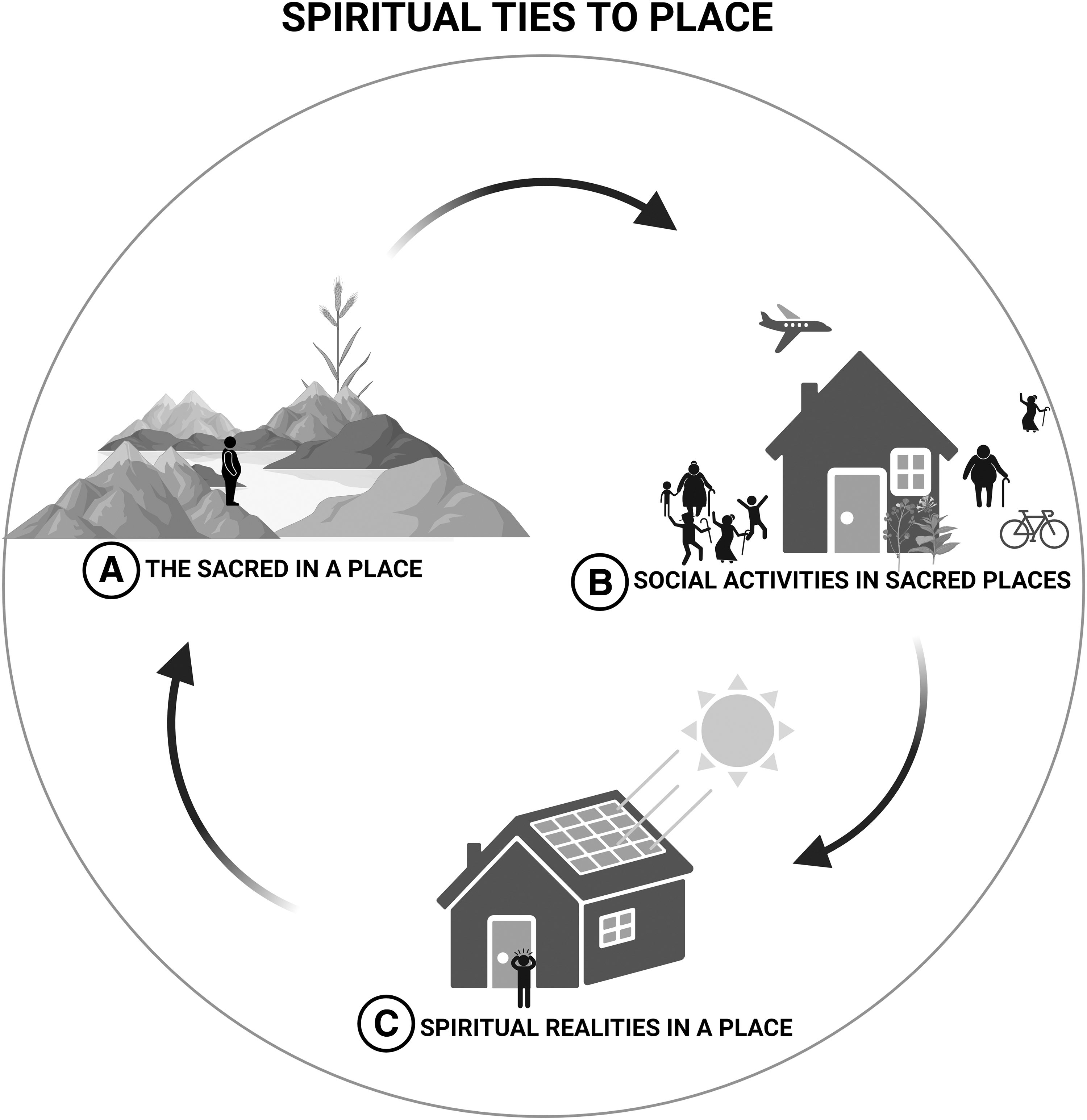
Conceptualization involving the three dimensions of spiritual ties to place:
A Template for Spiritual Ties to Place
In this section, we present a template for studying spiritual ties to place. As already discussed, the broad conceptualization of spiritual ties to place focuses on the different types of emotions, thoughts, and behaviors a person has when interacting with a place perceived to be sacred. Spirituality is a complex concept that is influenced by a variety of factors, including an individual's cultural background and life experiences.
Although a person's religious and spiritual beliefs and practices may vary based on these factors, certain patterns tend to emerge within different cultures that provide the basis for identifying and assessing particular beliefs about the sacredness of a place. These similarities have been used to develop a template that can be applied to people of all cultures and backgrounds who express a meaningful connection with a specific place. Understanding these common cultural patterns and similarities can foster a deeper understanding of how meaningful relationships with a particular place promote health, well-being, and positive environmental stewardship.
In the generic items provided in this section, the expression “place,” which would be replaced in a more specific setting, is underlined. However, the items can be iterated to various adaptations for spiritual ties to specific settings (e.g., church, mosque, nature, home, etc.). Also included in the items are excerpts from consultations with researchers who describe what the concept of “spiritual ties to place” means to them and how they can be assessed. Researchers can review these and adapt them to suit their own needs. Further iteration could also be made to specific versions of the items to ensure they are in line with the name of the significant place being referenced and other concepts developed within the spiritual ties to place framework.
The language used could be simplified to one that is accessible to a wide range of people or includes references to local customs and rituals that may make the assessment more accessible in different contexts. The emphasis could be placed more on reflecting on personal values or the philosophy that drives one's relationship with their “place” in the world than on tangible descriptions of their physical surroundings. In addition, other questions or prompts could be added to the questionnaire that would allow for a deeper understanding of individual responses and allow participants the opportunity to share their own experiences and preferences regarding spirituality and place.
This is an important step in the design and evaluation of a pilot study on spiritual ties to places as it will ensure that the core elements of a place spirituality assessment have been thoroughly thought through by researchers.
The proposed measure is structured around three dimensions: emotional connection to the sacred in a place, engagement in spiritual activities within a place, and the acquisition of religious/spiritual beliefs in a place. The first dimension captures how strongly participants feel attached to and connected to a place of spiritual importance. This can be captured by asking the participant to indicate the degree to which they feel a sense of the sacredness of the place on a scale of 1–5 (where 1 indicates no attachment to the sacredness of the place and 5 indicates a strong sense of spiritual attachment to place).
The second dimension refers to the degree to which participants engage in religious activities at a place such as prayer, meditation, rituals, or participating in religious ceremonies. Participants would be asked to indicate the frequency of these activities on a scale of 1–5 (where 1 indicates less engagement in spiritual activities and 5 indicates the strength of the engagement in spiritual activities in a place). The third dimension captures the degree to which participants acquire their religious beliefs in a place such as where they first learned about these beliefs and whether they continue to practice those beliefs at the sacred place.
Participants would be asked to indicate how often they acquired their beliefs at this location on a scale of 1–5 (where 1 indicates less interest in acquiring the beliefs at this location for the first time in their life and 5 indicates greater interest in acquiring the beliefs at the place of attachment). Essentially, participants will be asked to indicate how much they felt connected spiritually to the significant place on an ordinal scale ranging from “not at all” to “very much.”
Each of these items is designed to capture aspects of developing a bond with the sacred elements of a place that may not be captured by traditional measures of place attachment, such as the strength and frequency of individual visits to a place of worship or the satisfaction of a visitor's experience at a particular setting. The combination of all three dimensions is expected to provide a more comprehensive measure of a participant's spiritual ties to place than can be achieved by measuring only one of these factors in isolation. These dimensions are adapted from Counted and Zock's (2019) study of spirituality and place attachment and used, in part, to capture both the intensity of spiritual ties to place and the extent to which participants believe in the spiritual significance of places they have visited.
Items for the different dimensions were designed based on previous literature in the field and can be assessed on a 11-point scale of 0 to 10 or anchored only at the end points (e.g., 0 = strongly disagree, 10 = strongly agree). Alternatively, fewer response options could be used, such as a five-point response scale from 1 (not at all) to 5 (very much).
The proposed items are as follows:
Emotional dimension of spiritual ties to place: I have a strong spiritual connection to this place. This place feels sacred to me. I often experience a sense of divine presence in this place. Behavioral dimension of spiritual ties to place: I enjoy engaging in religious/spiritual activities in this place. This place is an ideal setting to connect with the divine. It is easy to pray or meditate in this place. Cognitive dimension of spiritual ties to place: I have benefited spiritually from visiting this place. I am more spiritual after spending time in this place. I feel motivated to be a better person after spending time in this place.
Discussion: Research Agenda and Future Directions
One of the main goals of this article is to develop a framework for conceptualizing spiritual ties to place that could inform subsequent research. Future research that investigates how individual, environmental, and community-level variables influence the development of spiritual ties to a place is crucial to the advancement of the field. This article offers some preliminary insights on what exactly it means to have spiritual ties to place. A review of research on spiritual ties to place has shown that a sacred place elicits positive feelings from a person, causes them to feel closer to place and the people in those spaces, and restores their sense of purpose and meaning in life (Counted & Watts, 2019).
However, little is known about the factors that influence the development of spiritual ties to place across individual, environmental, and community levels. Although the research community has not yet reached consensus on what it means to have spiritual ties to place or how to measure such ties in a meaningful way, it is important to continue pursuing this line of research because of the potential impact that a better understanding of these connections can have on sustainability and human flourishing. This article discusses some of the questions that we wish were being addressed in the field to better inform policy, practices, and the well-being of individuals, communities, and the environment.
One important direction for future research is to identify the factors that influence the strength of spiritual ties to place. As discussed in previous sections, there are three broad types of factors that may influence the development of spiritual ties to place: individual characteristics, environmental characteristics, and community-level factors. Understanding the influence of these factors can help identify how to promote stronger feelings of connectedness within religious communities or places of religious importance.
First, we need to consider the role of individual factors in the development of spiritual ties to a place. The individual characteristics of spiritual ties refer to the “top-down” processes that inform ideas about the sacred and draw people to the sacred elements of a place. Feelings of spiritual connection to a specific place may stem from an individual's perception of the natural world and the psychological meaning attached to places. For example, individuals view certain places (e.g., Mecca, Jerusalem) in a positive light and feel a sense of wonder about them. These sensory perceptions are often more likely to help the individual develop deep religious/spiritual connections with those places.
In addition to an individual's psychological factors, there are also certain characteristics of the environment itself that may contribute to a person's sense of spiritual connection to place. For example, having the opportunity to interact with the natural world or religious buildings plays an important role in shaping a person's perception of the environment and his or her feeling of attachment to it (Watts, 2019). In other words, simply spending time in nature or in religious architecture can be enough to foster a sense of connection to the sacred. However, it is important to note that there are certain environmental features that can enhance this experience even further.
For example, some research has shown that experiencing physical proximity to bodies of water, such as lakes or rivers, can increase a person's emotional attachment to the landscape (Hunt, 2008). This is likely due to the fact that these locations are often associated with fond childhood memories of a similar experience (Bixler, Floyd, & Hammitt, 2002). The same is true with religious buildings, such as churches and mosques, which may exude a deeper longing for spiritual realities among those who grew up in religious homes, regardless of their current religious status.
As such, environmental factors that contribute to the spiritual development of a person are essential to understanding spiritual ties to place. This aspect is important because there is currently very little data on how the physical environment influences the formation of spiritual ties to place.
In addition to the physical environment and religious buildings, it is important to consider the social context in which a person finds meaning and the sacred when examining the level of spiritual connection that they have to place. Studies have shown that belonging to a close-knit religious community is associated with greater well-being and a sense of place attachment (see Meagher, 2019; VanderWeele, 2017; VanderWeele, Balboni, & Koh, 2022; VanderWeele, Li, Tsai, & Kawachi, 2016). This may be because people are more likely to have relationships with fellow members of a religious community if they participate in their services.
Besides, many religious traditions encourage building such relationships (e.g., “love thy neighbor as thyself” as found in the Christian bible). These sorts of social factors influence the development of spiritual ties to place. This dimension is important because it will determine how individuals connect with other people who are also connected to the same sacred place. However, it is important to note the interconnectedness between these individual, environmental, and social factors. For example, people's conceptualization of God informs their impression of both worship spaces and members of the religious community and interacts with the design of the space to influence emotional experience during worship (Meagher, 2018, 2022).
At the same time, one's social ties to the community in the place inform the individual's own beliefs about God (Collins, 2004) and their investment in the setting. Thus, further research could focus on how the integration of the three mentioned dimensions collectively and interactively influence the development of spiritual ties to place. Such research could examine how the physical environment and social interactions of people in a sacred place have an effect on their perception of the spiritual aspects of place. It could also consider the ways these different dimensions of spiritual ties to place interrelate with each other.
Limitations and Concluding Remarks
There are a number of limitations to studying spiritual ties to place. First, it is difficult to measure the extent of these ties. People usually do not willingly disclose their beliefs or practices with others. Therefore, obtaining accurate data on the extent to which people maintain close relationships with the spiritual places they visit is limited. This also means that the proposed items need to be modified on a need-to-know basis. Second, the term “spiritual” is ambiguous and subjective. What is considered “spiritual” to one person may not be to another.
Finally, different studies have used different definitions of spirituality, which makes it difficult to compare and apply their definitions to the proposed conceptualization. Despite these limitations, some spiritual ties to place can still be assessed using a range of approaches such as surveys, interviews, and focus groups using the proposed items.
In conclusion, there are links between spirituality and place. These links are complex and they vary greatly across individuals. Some people feel a deep sense of connection to the spiritual places they visit, whereas others perceive these places as purely functional. The spiritual connections that people have to place can have a significant impact on their ability to flourish and the way they view the world around them. Therefore, it is important to continue research into this phenomenon, as it could help us understand how people develop attachments to places of spiritual importance and identify ways to enhance this relationship and meaning-making process.
Footnotes
Author Disclosure Statement
No competing financial interests exist.
Funding Information
No funding was received for this particular paper.