




Abstract
As many studies show, action for nature is related to connectedness with nature, and both have roots in nature experiences during childhood and youth. Through a literature review, we combine empirical studies on the interplay between experiences in nature during childhood and youth, connectedness with nature, and action for nature and uncover a new way of structuring understandings of connectedness with nature: humans and nature as separate yet related entities (intertwined), one as part of the other (including), and as one entity (indistinguishable). Although the interplay between experiences, connectedness, and action for nature has been clearly demonstrated, the underlying mechanisms are still to be unraveled. Studying this interplay through the lens of these three different understandings of nature contributes to elucidating the underlying mechanisms. We suggest how connectedness can be strengthened in terms of the findings of the studies included in the review and present two potential pathways: through experiences and through identification. Finally, we provide recommendations for future research using the integral ecology framework and call for more diversity in research methodologies and respondents.
Introduction
Connectedness with nature is considered a key concern in nature conservation and protection (Restall & Conrad, 2015; Zylstra, Knight, Esler, & Le Grange, 2014): merely recognizing that nature has value does not necessarily result in action to protect nature, a form of connection is also needed (de Groot, Drenthen, & de Groot, 2011; Nolt, 2006). Motivation and willingness to protect nature are often rooted in a connectedness with nature (Hatty, Smith, Goodwin, & Mavondo, 2020; Ives et al., 2018; Restall & Conrad, 2015; Schultz, 2001, 2002). Two recent meta-analyses conclude that there is “exceptionally good evidence for a strong association between nature connection and pro-environmental behaviour” (Mackay & Schmitt, 2019, p. 5) and that the relationship between connection to nature and pro-environmental behavior is “positive, significant, and moderately sized” (Whitburn, Linklater, & Abrahamse, 2020, p. 188).
The current biodiversity and climate crises underscore the importance of strengthening human connectedness with nature. There is a growing concern that, in Western cultures, a “hyper-separation” is looming, in which humans behave as a separate entity that is not reliant on their counterpart nature (Plumwood, 2006; Zylstra et al., 2014). Consequently, the fact that nature and human connection with nature are under threat (Pyle, 2003) amplifies the call to connect with nature (Ives et al., 2018; Zylstra et al., 2014).
The importance of connectedness with nature is also reflected in the increase in studies on this topic for the past decades. The concept is approached from different fields and disciplines (Ives et al., 2017), and along with a multitude of scientific disciplines comes a multitude of terminologies, definitions, and conceptualizations (Braun & Dierkes, 2017). Recent literature reviews focus on, for instance, the potential of connectedness with nature for nature conservation (Restall & Conrad, 2015; Zylstra et al., 2014), different dimensions of connectedness with nature (Ives et al., 2017), and different spatial scales of the nature component (e.g., local or global) (Klaniecki, Leventon, & Abson, 2018).
Keaulana et al. (2021) studied different measures of connectedness, and Lengieza and Swim (2021) reviewed antecedents of connectedness. D'Amore and Chawla's (2020) review stressed the importance of significant life experiences during childhood in connecting with nature. Several studies have also demonstrated the effects of childhood experiences with nature (especially alone and with friends) on connectedness with, or action for, nature and the environment (Asah, Bengston, Westphal, & Gowan, 2018; de Groot, Bonaiuto, Dedeurwaerdere, & Knippenberg, 2015; Rosa, Profice, & Collado, 2018; van den Born et al., 2018).
Most calls for (re)connection, however, are considered “vague” (Ives et al., 2018, p. 1389), as they do not specify what this connection entails, nor do they specify the mechanisms underlying the reconnection process (Braun & Dierkes, 2017). Although the urgency of connecting with nature is agreed upon, the remaining vagueness surrounding connectedness and the connection process impedes answering these calls for connection. To contribute to making these calls for (re)connection less “vague” (Ives et al., 2018, p. 1389), insight into the different understandings of what this may entail is crucial. Moreover, insight into the relations between connectedness with nature, motivations to act for nature, and childhood and youth nature experiences is required, as the underlying processes remain elusive (Lengieza & Swim, 2021).
We have undertaken a literature review covering empirical studies on these three concepts and their interrelationships. We focus on empirical studies, as most reviews on connectedness with nature are theoretical reflections within the domains of philosophy, ethics, or conservation biology. Our aim is to further articulate the interplay between these concepts, specify pathways for connecting with nature, and identify research gaps and directions for future research. Our literature review is, therefore, directed by the following research questions:
How is connectedness with nature described in scientific literature? What pathways for connecting with nature emerge from empirical studies on the interplay between nature experiences during childhood and youth, connectedness with nature, and motivations to act for nature? What research gaps and directions for future research can be identified in this domain?
Methods
To answer our research questions, we collected empirical studies on the interplay between connectedness with nature, experiences in nature during childhood and youth, and motivations to act for nature (Fig. 1). We did not specify a direction in the interplay between the concepts. To study the relationships between the concepts, we created search strings on the overlay of conceptual domains and disciplines (Stevens, Aarts, Termeer, & Dewulf, 2016) and queried the Scopus database with four search strings based on the intersection of the concepts in Figure 1:
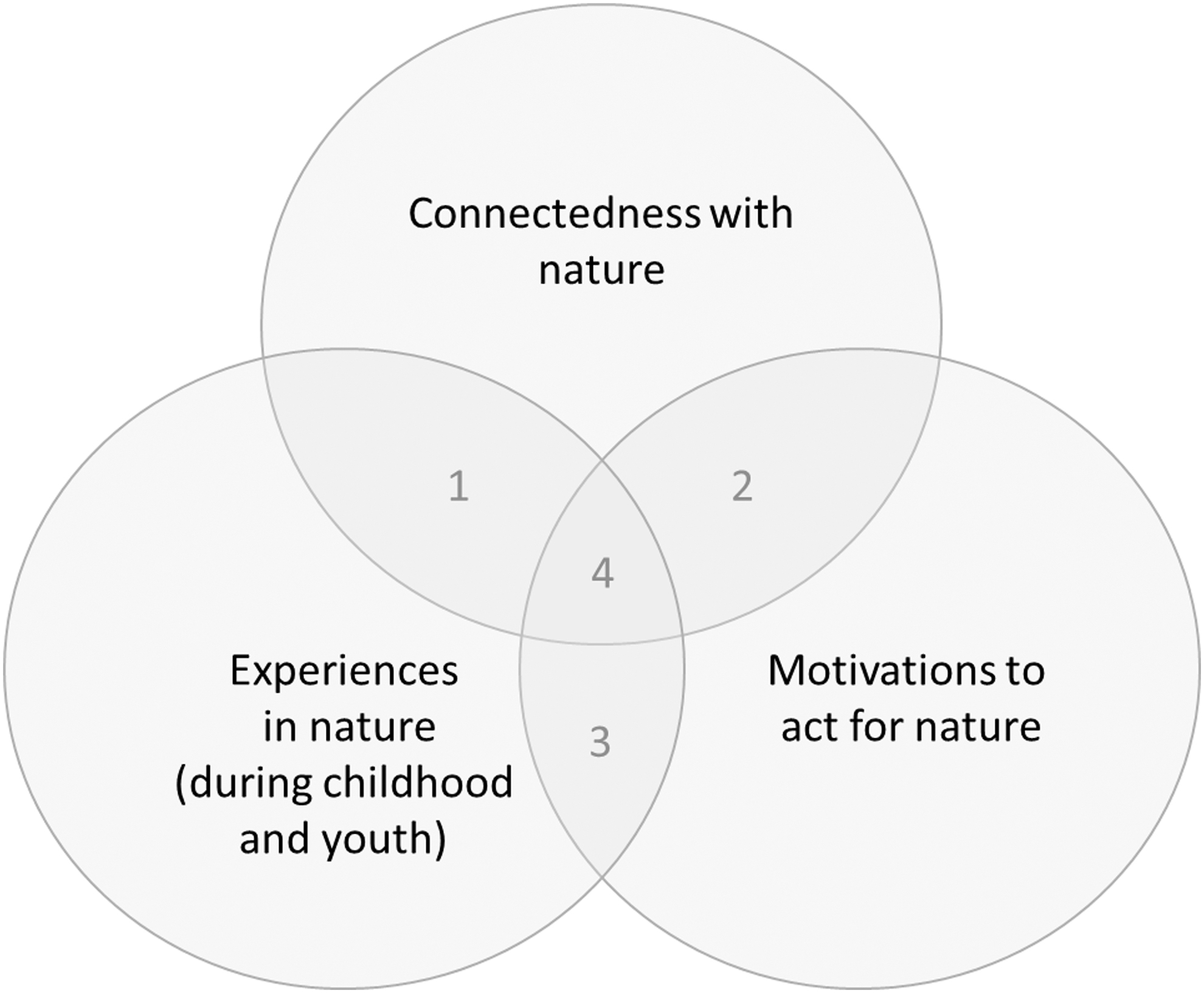
Core concepts and search strings. Overlay of the three concepts in this review, resulting in four search domains.
Connectedness with nature and experiences in nature during childhood and youth.
Connectedness with nature and motivations to act for nature.
Experiences in nature during childhood and youth and motivations to act for nature.
Connectedness with nature, experiences in nature during childhood and youth, and motivations to act for nature.
The search string on connectedness with nature was based on the one used by Ives et al. (2017). Through snowballing and the use of synonyms, additional keywords were chosen for each concept. The full search strings that we applied are included in Supplementary Data S1.
In the Scopus database (all years), titles, abstracts, and author keywords were searched between April 29 and May 7, 2021. The four search strings resulted in 76, 286, 60, and 14 articles, respectively. First, 53 duplicates from the search strings were removed. Next, 19 articles not written in English but in, for example, Spanish (Páramo & Mejía, 2004) and 15 articles that remained unavailable after attempting to contact the authors were removed. When the remaining 349 articles were studied (Table 1), we excluded 19 articles on another topic. Next, 141 articles were excluded that did not focus on the perspective of (experiences in) childhood and youth (in retrospect or with respondents <30 years old). Last, 67 reviews or other articles without empirical contributions to the relationships between the concepts were excluded.
Search Results and Excluded Articles
We inventoried the characteristics of the remaining 122 studies, such as year of publication, type of respondents, and research approaches. Next, the articles were coded for (1) conception of connectedness with nature, (2) relations between nature experiences during childhood and youth and connectedness with nature, (3) relations between connectedness with nature and motivations to act for nature, and (4) relations between nature experiences during childhood and youth and motivations to act for nature. The coding process for this thematic analysis was undertaken primarily by the first author in an iterative process of open, axial, and selective coding (Flick, 2009).
Results and Discussion
We first present the general characteristics of the included studies (Study Characteristics section). Next, we describe and discuss the different meanings and understandings of connectedness with nature emerging from our literature study (Understandings of Connectedness with Nature section). In Interplay Between the Core Concepts section, we delve into the studies' findings on the interplay between the three core concepts.
Study characteristics
All of the included 122 articles appeared in the past two decades, with an exponential increase in recent years (Table 2). More than three-quarters of these studies adopt a quantitative approach, 14 are qualitative, and 15 combine both quantitative and qualitative approaches. The quantitative studies are designed mostly to study the relationship between, for example, connectedness with nature and pro-environmental behavior by statistically analyzing correlations between quantitative measures of these concepts. These are often measured in an experimental context. Most studies use a quantitative self-report scale for measuring connectedness with nature.
Characteristics of Included Studies
The most frequently studied group of respondents in the empirical studies are college students (Table 2). Almost half of the studies include children of primary and secondary school age, predominantly in fixed settings such as school activities, camps, or programs.
Geographically, the studies are rather uniform, as they examine predominantly Western countries (Table 2). More than 30 studies are located in East Asia, but the rest of Asia, Eastern Europe, Oceania, Central and South America, and Africa are underrepresented. A bias might have resulted as, in our study, only articles in English were included and consequently most of the journals were Western. This dominance of Western studies also implies that our findings in terms of understandings of connectedness and pathways to connect with nature are applicable mainly in Western contexts.
Understandings of connectedness with nature
To find pathways to connect with nature, we should first examine how connectedness with nature is understood. The included studies use a range of terms (Terminology section; Table 3) and understandings (Types of Connectedness section) to make their empirical contributions to elucidating connectedness with nature.
Specification of What Is Studied Within Each Core Concept
Although referring to a common topic, they cover a variety of dimensions, ranging from physical to spiritual, of which emotional or affective, cognitive, experiential, and behavioral components are most frequently specified. The latter two imply that, in some understandings of connectedness with nature, (childhood) experiences in nature or acting for nature are not considered as related to connectedness with nature, but rather are connectedness with nature. For example, Wang (2019, p. 2) uses early-life outdoor experiences to measure correlations between “connections with nature” and environmental attitudes. In this approach, early-life outdoor experiences are considered as part of, rather than something that leads to, connectedness with nature.
This has implications for how the interaction is understood and studied; although considering connectedness as being the experiences in, or action for, nature may be fruitful in some contexts, experiences might need to be considered as interaction to understand the underlying mechanisms. Applying a framework such as that provided by Ives et al. (2018) is useful, as they argue that the five forms of connectedness with nature (e.g., cognitive or emotional) have different amounts of leverage to inspire change, while still recognizing the interaction between the different dimensions (see Factors Strengthening the Interplay and Connectedness with Nature section). This allows for analyzing the different dimensions of connectedness and their different influences on transformative change.
Terminology
Most articles included in the review use the word connect (e.g., connection(s) with nature, connectedness to nature, and nature connections). Some articles use a term that reflects love or affection toward nature (e.g., biophilia and love for nature); others use terms such as identifying with nature; values, attitudes, and views toward nature; and relationships with nature. Sometimes, specific characteristics are added to the terminology used to specify a demarcation, for example, psychological connection (Molinario et al., 2020), emotional affinity (Collado, Staats, & Corraliza, 2013), or affective attitudes (Soga, Gaston, Yamaura, Kurisu, & Hanaki, 2016).
Finally, some articles describe a connection to place rather than nature specifically. Place attachment is included in this study, as also in other reviews (Ives et al., 2017), because it can sometimes, although not necessarily, describe a connection to a natural area. Taking place attachment into account when studying connectedness with nature can provide valuable insights only when it concerns nature bonding (Raymond, Brown, & Weber, 2010).
Types of connectedness
In the included studies, different types of connectedness can be distinguished depending on the descriptions given. We identified three types of connectedness in terms of how, and the extent to which, humans and nature are connected (Fig. 2). The first type is where nature and an individual/humanity are not considered as part of each other but two separate entities that are somehow related and intertwined. An example from the studies in our review is where humans and nature are positioned as two separate entities, but there are relations between them. For example, “affective, cognitive and physical relation between human and the natural world” (Prasetyo, Djuwita, & Ariyanto, 2018, p. 1). In the second type, connectedness between humans and nature is considered as being part of each other or including one in the other.

Three types of connectedness with nature. Conceptualization of the three different types of definitions found in the literature based on how, and the extent to which, humans and nature are considered connected: humans and nature as separate yet related entities (intertwined), one as part of the other (including), or as one entity (indistinguishable).
This can mean either nature being part of an individual/humanity or an individual/humanity being part of nature. These definitions are often rooted in the work of Schultz (2001, 2002). The following is an example: “the extent to which individuals include nature as part of their self-definition” (Clayton et al., 2021, p. 2). Bruni, Ballew, Winter, and Omoto (2018, p. 1), for example, quote Schultz’ work in their definition: “Connectedness with nature is an individual's beliefs about the extent to which he or she is part of the natural environment” (Schultz, 2001, 2002). In the last type, nature and an individual/humanity are considered as one indistinguishable entity that cannot be considered separately and where connectedness is understood as a sense of “we-ness” (Boeve-de Pauw & Van Petegem, 2017; Frantz & Mayer, 2014).
To concretize calls for reconnection, it is worth applying this lens to see whether these different types are also recognized by authors and whether people recognize (although subtle or seemingly marginal) differences in connectedness with nature in different contexts, types of nature, dimensions, or life phases. Moreover, different types of connectedness relate to different types of action for nature and motivations. If a study on connectedness is, although unintentionally, rooted in one of these understandings, others might be (unintentionally) excluded. Unraveling the different meanings that connectedness with nature may entail could allow for specifying future research on pathways to connectedness.
Besides different understandings, there are differences in whether connectedness is considered to reflect individual or collective beliefs (Bruni et al., 2018; Tam, 2013). Arendt and Matthes (2016, p. 454) for example—similar to Schultz (2001, 2002)—consider connectedness as “the degree to which a person sees himself or herself as part of nature.” In contrast, less frequently, connectedness with nature can reflect mankind's or humanity's connection to nature as opposed to their own; for example, including “their beliefs about whether humans are part of or separated from nature” (Arbuthnott, Sutter, & Heidt, 2014, p. 103).
Making explicit whether individual and/or collective beliefs are described may provide more nuanced insights into understanding the relationship between humans and nature (worldviews) and an individual and nature (identity). Both identity and worldviews can influence how people act for nature to varying extents (Steg, De Groot, Dreijerink, Abrahamse, & Siero, 2011; van der Werff, Steg, & Keizer, 2013), but, as we elaborate on in Future Research in the Terrain of Cultures section, studies within collective terrains are underrepresented.
Interplay between the core concepts
In the following sections, we first describe the childhood experiences (Childhood Nature Experiences section) and (drivers of) action for nature (Drivers to Act for Nature section) studied in the included publications. In Factors Strengthening the Interplay and Connectedness with Nature section, we discuss our findings emerging from this review on how connectedness with nature can be strengthened. From this, pathways (research question b) are developed in Interplay and Pathways to Strengthen Connectedness with Nature section.
Childhood nature experiences
Childhood experiences in nature are often studied as leading to connectedness with nature rather than the other way around (Lumber, Richardson, & Sheffield, 2017). Based on a broad array of types of nature experiences (Table 3), the studies investigating the relationship between childhood nature experiences and connectedness with nature show that indeed nature experiences contribute to connectedness with nature (Asah et al., 2018). Some studies, however, report a lack of effect possibly because of a ceiling effect (Bruni et al., 2018; Mullenbach, Andrejewski, & Mowen, 2019; Nisbet, Zelenski, & Murphy, 2011): the level of connectedness is already high and, therefore, can hardly increase more. The context of these experiences in nature or the type of experience is often left unspecified (Table 3). Contextualizing these experiences might increase our understanding of how childhood experiences in nature and connectedness relate to each other.
Some studies specify aspects of nature experiences that contribute to connectedness. Yilmaz, Çığ, and Yılmaz-Bolat (2020), for instance, show that children connect with nature when they can “lead their own play and followed their own steps” (p. 1736) instead of their teacher's. Also, everyday contact with nature can increase connectedness (Mustapa, Maliki, Aziz, & Hamzah, 2019). Mullenbach et al. (2019) and Asah et al. (2018) find that outdoor play contributes to connectedness. In particular, creative and private play/solitude in nature (Asah et al., 2018; Moore, Morrissey, & Robertson, 2019; Szczytko, Stevenson, Peterson, & Bondell, 2020) or appreciative experiences where children enjoy nature without altering it (Hoover, 2021) are shown to nurture connectedness with nature. In sum, predominantly self-directed experiences in everyday nature contribute to connectedness with nature.
Drivers to act for nature
Most studies find correlations between connectedness with nature and (drivers of) acting for nature (Diessner, Genthôs, Praest, & Pohling, 2018; Hehir, Stewart, Maher, & Ribeiro, 2021). The studies included in this review focus frequently on drivers to act for nature rather than action for nature. Examples of drivers of action include emotional concern (Davis & Stroink, 2016) or ecological worldview (Dunlap, Liere, Mertig, & Jones, 2000). In relation to studying action for nature, this is predominantly everyday pro-environmental behavior (such as recycling or energy saving), whereas fewer studies look at (committed) action for nature or sustainability; examples include participating in a climate march (Dewey, 2021), planting trees (Waite, Goodenough, Norris, & Puttick, 2016), or committed activism (Driscoll, 2018) (see Table 3).
Factors strengthening the interplay and connectedness with nature
In addition to the multiple dimensions of experiences in nature and connectedness, multiple drivers that have been found to strengthen connectedness with nature emerge from this review. We refer to these drivers as factors, even though the word “factors” has a broader meaning, to prevent misunderstandings, as we also use the word drivers to describe drivers for action for nature as a core concept. In the following section, the key findings are presented and structured along the five mechanisms hypothesized by Ives et al. (2018): material, experiential, cognitive, emotional, and philosophical. These dimensions are discussed separately for structuring purposes, but in practice they interact and influence one another (Ives et al., 2018).
Material
The material dimension is the most external dimension and describes connecting with nature through the use of materials and consumption (Ives et al., 2018). Compared with the other categories, material factors emerge least from the review. Possibly, the consumption of materials is least relevant for children and youngsters on the predominantly studied individual level. An exception is vegetarian or plant-based diet, studied as an example of pro-environmental behavior linked to a high connection with nature (Krizanova & Guardiola, 2021; Krizanova, Rosenfeld, Tomiyama, & Guardiola, 2021). The material dimension is sometimes associated with a form of nature experience, for example, outdoor play with natural materials (Moore et al., 2019) or in education programs on the origin of food (Sobko, Brown, & Cheng, 2020).
Experiential
The experiential dimension describes connecting with nature through direct interactions with the natural environment (Ives et al., 2018). Research on promising experiences for connecting with nature shows the importance of connecting through everyday contact with nature, for example, through outdoor play in (early) childhood (Rosa et al., 2018). This requires nature or natural elements to be near home and accessible, especially as children's home ranges decrease (Freeman & van Heezik, 2018; Woolley & Griffin, 2015), creating opportunities for autonomous experiences (Asah et al., 2018).
The social context of experiences in nature during childhood and youth is relevant in strengthening connectedness. As mentioned earlier, autonomous experiences strengthen connectedness with nature, but a social context that supports or mentors children and youngsters in regard to nature also emerges as important (Ahmetoglu, 2019; Dewey, 2021; Krasny & Delia, 2015). This social context, however, is often left unspecified in the included studies (Table 3; Childhood Nature Experiences section).
Outdoor experiences as an adult are considered as a mediating variable between childhood nature experiences and adult connectedness with nature and environmental citizenship (Asah et al., 2018; Rosa et al., 2018). This implies that adult nature experiences are also important in fostering environmental citizenship (Cleary, Fielding, Murray, & Roiko, 2020), but that experiences as an adult can be strengthened if they can resonate with childhood experiences. This highlights the importance of studying the mediating processes between childhood and adulthood nature experiences and connectedness with nature.
These findings highlight the importance of a balance between autonomous nature experiences and social/parental support to foster children's inherent biophilia (Kellert & Wilson, 1993): for example, having nature near home available for children (at every level of urbanization and in every neighborhood) and the opportunity to experience and explore this autonomously. An important consideration in creating nature experiences near home for children is that they speak to all their senses and allow for immersion.
Cognitive
The cognitive dimension describes connecting with nature through knowledge and attitudes toward nature (Ives et al., 2018). Learning and knowledge are frequently studied mediating factors in strengthening connectedness with nature (Mustapa et al., 2019). Interest in learning about nature is a predictor of aspiring to a career in nature (Sheldrake & Reiss, 2021). If, however, this learning takes place within the classroom, it can be “stifling” or “irrelevant,” according to young environmental leaders who felt that school limited their action for nature (Arnold, Cohen, & Warner, 2009, p. 34). Knowledge and learning are especially fruitful when a person has the opportunity to learn outdoors (Kelly, 2018), learn experientially (Arnold et al., 2009; Kelly, 2018; Torkar, 2014), through extra-organizational guides influencing youngsters (Driscoll, 2018), and guided by their own curiosity (Asah et al., 2018).
An example of fostering connectedness with nature with attention on cognitive drivers is allowing for out-of-the-classroom learning and opportunities for children to learn from their own curiosity and questions in, for example, outdoor play.
Emotional
Feelings and empathy toward nature are examples of the emotional dimension described by Ives et al. (2018). Predominantly, emotions that are generally considered as positive are studied in relation to forming connections with nature, such as experiencing affective relationships with animals (Barthel, Belton, Raymond, & Giusti, 2018; Giusti, 2019) or emotional affinity (Collado et al., 2013; Soga, Tsuchiya, Evans, & Ishibashi, 2019). Although people underestimate the positive emotions that experiencing nature may bring, it increases mood, connectedness with nature, and pro-environmental behavior (Nisbet & Zelenski, 2011).
Especially in relation to driving action for nature, negative emotions also are described, such as concern (Bruni & Schultz, 2010) or witnessing environmental loss (Driscoll, 2018). Multiple studies, however, find no significant relations between connectedness and concern (Bruni & Schultz, 2010). An exception is a study by Howell and Allen (2019) who found a relationship between acting for nature and concern, but not linked to affective connections to nature.
Fear or biophobia is an example of a studied emotion relating to a lack of nature experiences and connectedness (Soga et al., 2020). Fear of nature is, in some contexts, constructive; in other contexts, however, aversion to living things may lead to alienation from nature and reduced motivation to protect biodiversity (Soga et al., 2020).
Encouraging connecting with nature through emotions would encourage people (of all ages) to reflect on, or discuss, their emotions regarding nature, (changing) landscapes, and biodiversity loss, as these feelings might be a pathway to connecting with nature. Ecological grief and eco-anxiety are expressions of connectedness with nature too, and one way of coping with these emotions is through action to protect nature (Chawla, 2020). Coping with emotions, such as fear regarding biodiversity loss, may cultivate “constructive hope” (p. 619) and finding meaning in countering biodiversity loss (Chawla, 2020).
A tangible way to strengthen connectedness through emotions would be to allow room for emotions in education programs; not just for children but for all ages, for example, in zoos or through nature excursions. Conversations about feelings regarding biodiversity loss and actions people take against natural loss can contribute to social trust as a prerequisite for constructive hope (Chawla, 2020).
Philosophical
Finally, the philosophical or reflective dimension is the most internal dimension described by Ives et al. (2018) and entails worldviews and reflections on our relationship with nature. Within the philosophical dimension, identity is frequently studied regarding strengthening connectedness with nature. People may connect with nature through identifying with nature; this emerges from experiences and results in acting for nature (Boeve-de Pauw & Van Petegem, 2017). Feeling a connection and finding similarities in the identity of humans and nonhumans strengthens the drive to act for nature (Kashima et al., 2014).
Boeve-de Pauw and Van Petegem (2017) find that connectedness with nature is tied to an identification process that strengthens intrinsic motivation to act for the environment. Research among students shows that students who are more connected to nature are concerned about environmental problems for biospheric reasons (plants and animals) rather than altruistic reasons (people and future generations; Dornhoff, Sothmann, Fiebelkorn, & Menzel, 2019). Pursuing or fostering such identification with nature engenders more reflective and philosophical connections, which have a stronger leverage according to Ives et al. (2018).
Identification is thus important for strengthening connectedness with regard to the philosophical dimension. This identification may be fostered by initiating philosophical or Socratic conversations in schools and through formal and informal learning for adults. Another example is reflecting on the meaning that certain experiences have: for example, a study on travel showed that reflecting on the meaning that a trip had for one's life increased one's money donations to environmental organizations after travel (Lengieza, Swim, & Hunt, 2021).
General Discussion and Pathways to Connectedness
The general discussion is structured along our three research questions. First, we discuss the findings on connectedness with nature (Connectedness with Nature section). Next, we discuss findings on the interplay between connectedness with, experiences in, and action for, nature (Interplay and Pathways to Strengthen Connectedness with Nature section) and formulate two promising pathways. Finally, we identify research gaps and give directions for future research (Research Gaps and Directions for Future Research section).
Connectedness with nature
Connectedness with nature is predominantly considered on a continuum: people are not considered as either connected or not connected with nature but, rather, connected to a certain “extent” (Ibáñez-Rueda, Guillén-Royo, & Guardiola, 2020, p. 2) or “level” (Hoover, 2021, p. 895) in a certain context (e.g., on holiday or in relation to threatening animals). Similarly, connectedness characteristics described in this review (e.g., different understandings and types) are not mutually exclusive and vary in context and over the life course. A life course perspective allows for unraveling when turning points occur and the experiences that may influence this and engagement with nature conservation (Wells & Lekies, 2006).
The broadness or richness of connectedness with nature in terminology, understandings, and dimensions sometimes gets lost in translation, as it is defined, used, and operationalized interchangeably. Consequently, it risks being or becoming a catch-all term. From a social constructivist perspective, this underscores the need to pay attention to how the concept is operationalized and understood by different people in different contexts (Klaniecki et al., 2018; Wyles et al., 2019).
The conceptual diversity of connectedness with nature may complicate the comparison of research findings regarding connectedness, as it makes differences and similarities more difficult to identify. The meaning that connectedness has for people is not uniform and, in addition to measuring the extent to which a person is connected with nature, the very nature of the connection or the meaning that this connection has for respondents or researchers in the studied context should be included.
Closely related to this is whether connectedness is considered as a fluctuating “state response to situational factors” (Zylstra et al., 2014, p. 128) or relatively stable and trait-like (Wyles et al., 2019). If one assumes, for example, that connectedness is relatively stable, this raises the question of how effective short-term interventions can be. Although connectedness might be relatively stable within a certain range, it changes within that range over time and in different contexts. Therefore, contextual research over longer periods of time is required to understand how connectedness with nature can be strengthened.
Interplay and pathways to strengthen connectedness with nature
From the interplay, multiple interacting potential pathways emerge; two potential pathways are presented in this study.
First, our review stresses the importance of specifying experiences in nature, because some characteristics of childhood nature experiences appear especially important for strengthening connectedness, as different types of experiences may have different effects on connectedness. To strengthen connectedness with nature, we need to organize opportunities for unorganized childhood nature experiences: everyday outdoor experiences where children can follow their own curiosity and play in, and learn about, nature. This requires the availability and accessibility of nature close to home, regardless of where children grow up. In creating these places, parents' worries, society's risk-averseness (Little, 2015), and children's wishes (Van Lieshout & Aarts, 2008) need to be acknowledged.
Second, identification with nature emerges as a promising pathway. By self-transcending, the sixth and highest tier on Maslow's Hierarchy of Needs, and relating to other species and nature, people engage in selfless care and action for others (Maslow, 1969; Venter, 2012). Stimulating children and youngsters to reflect on their relationship with nature may strongly increase their connectedness. Stimulation can take multiple forms—for example, as mentioned, philosophical or Socratic conversations with children and youngsters about connectedness with nature. However, ways need to be found for these conversations to be available for everyone without risking exclusion.
Another possibility for identifying with nature is related to the first pathway, through immersive experiences (van Woerkum, 2019). Van Woerkum (2019, pp. 62–63) argues that to become one with nature—which he considers the ultimate connection with nature—we need to go through different gradations of experiencing nature. One has to direct time and attention to being in nature and all the senses need to be triggered, allowing time off for conscious thinking. Consequently, experiences become immersive and boundaries between humans and nature disappear when one explores one's surroundings without predefined intentions and is led by one's senses (van Woerkum, 2019). These meaningful experiences can be fostered through landscapes suitable for experiencing nature with all the senses.
Research gaps and directions for future research
The increase in literature for the past decades can be considered an acknowledgement of the importance of this subject. Despite the search strings' careful and structural design, undoubtedly not all relevant articles were found.
Understanding the interplay of connectedness, experiences, and action for nature is complex: cause and effect are difficult to separate, the interplay is context dependent, and there appear to be many variables and mechanisms in play. This complexity might also be what makes the relationship so strong, as “Robust phenomena are often robust because they are multiply determined” (Kuo, Barnes, & Jordan, 2019, p. 6). Yet, the multitude of different aspects and dimensions could also cloud our understanding of the (causal) mechanisms involved. Future research should focus on better understanding the mechanisms underlying this interplay. A similar conclusion is drawn by Lengieza and Swim (2021), who emphasize the need to develop theories to explain and understand these relationships. To identify causal relationships between explanatory variables, for example, causal mediation analysis can be explored (Hicks & Tingley, 2011).
In other domains—for instance, motivations to choose a specific kind of food (meat, vegan)—research shows that many contextual aspects influence decision-making, and different aspects should be studied in mutual coherence to capture patterns in different contexts (Nijland, Aarts, & Van Woerkum, 2018). Similarly, the interplay between connectedness, experiences, and action for nature should be studied in mutual coherence, paying attention to the dynamic processes and context dependence, and with regard for the differences between people and within life courses. New insights into this research domain may emerge from a more interactional and dynamic research approach (Kuo et al., 2019; Nicolosi & Corbett, 2018; Rosa & Collado, 2019) and by complementing the rather uniform populations that are currently dominant (see Study Characteristics section; Nicolosi & Corbett, 2018).
Because of the multitude of relevant perspectives, we used the integral ecology framework (Esbjörn-Hargens & Zimmerman, 2009) to help structure our suggestions for future research (Future Research in the Terrain of Experiences section, Future Research in the Terrain of Behaviors section, Future Research in the Terrain of Cultures section, and Future Research in the Terrain of Systems section) to increase understanding of how and why (childhood) nature experiences foster connectedness with nature and how this fuels motivations to act for nature.
The integral ecology framework labels the four quadrants of human perspectives as four terrains that one should include when trying to understand or solve environmental problems (Esbjörn-Hargens & Zimmerman, 2009). These four terrains are structured along two axes: individual and collective, and visible (exterior) and invisible (interior), realities (Esbjörn-Hargens & Zimmerman, 2009). The terrain of experiences includes beliefs, perceptions, motivations, and attitudes (Esbjörn-Hargens & Zimmerman, 2009). The terrain of behavior contains visible behaviors and their visible impact (Esbjörn-Hargens & Zimmerman, 2009). The other two terrains are collective: the terrain of cultures includes cultural factors such as worldviews, group norms and values, mutual understandings, and disagreements; and the terrain of systems includes enduring relationships such as political dynamics, institutions, and economic variables (Esbjörn-Hargens & Zimmerman, 2009).
Future research in the terrain of experiences
Most of the included studies focus on experiences that youngsters or children have had in nature. However, within the (individual) experiences terrain, not all types of experiences attract attention, and the different meanings that experiences hold for people require more contextualization and attention. Specifically, we recommend studying whether or not the three types of conceptualizations found in the connectedness literature (intertwined, included, and indistinguishable) reflect the different ways in which people experience connectedness with nature, paying attention to different understandings when conceptualizing and operationalizing connectedness with nature (see Connectedness with Nature section).
Specifying the meaning of connectedness in different contexts and for different people could enhance our understanding of how individual understandings of connectedness interrelate with their experiences and action for nature. Moreover, in addition to experiences that are currently predominantly studied, attention should be paid to negatively perceived experiences in nature (e.g., fear of spiders, being stung by wasps, wild animals, harm to crops, and elephants) and their consequences for connectedness with, and action for, nature.
Regarding individual perspectives on these understandings of connectedness with nature, several questions arise: do people experience a difference between, on the one hand, feeling a tight link between themselves and nature as if it were a tight knot (intertwined) and, on the other hand, feeling as one with nature (indistinguishable)? Do people experience a difference between feeling as if nature is part of them and feeling part of nature (including), and does this depend on, or influence, what they seek to do in or for nature? Does one kind of connection exclude another kind or can they exist alongside one another? Do the different kinds of connectedness relate to different dimensions and scales of connectedness?
Research within this terrain would require a more qualitative and holistic approach, allowing more focus on different real-life contexts. The answers could provide new directions in further unraveling, specifying, and grasping the broad concept of connectedness with nature, how it forms, and what it means for people's actions.
Future research in the terrain of behaviors
Within the behaviors terrain, more specifically action for nature, there have been many empirical studies. Future research in this terrain could focus on a more detailed understanding of the interplay between, for example, experiences and action for nature by addressing the kinds of behaviors that people exhibit in nature and under what circumstances, and whether these drive different types of actions for nature. Specifically, studying the interaction between the suggested pathways (Interplay and Pathways to Strengthen Connectedness with Nature section) and the effect of (combinations of) pathways for different people and in different life stages could provide insights into how and why different types of connectedness form. This aligns with Lengieza and Swim's (2021) call for more focus on developing theories on the process of how connectedness forms, as they too observe a lack of theory in research on how connectedness with nature forms.
Understanding the involved behaviors requires attention on situational contexts (Lengieza & Swim, 2021) and consideration of the multiple dimensions of experiences in nature (Clayton et al., 2017). Differences in some of the dimensions might nurture, for example, a connectedness with nature, reflecting humans as part of nature.
Future research in the terrain of cultures
The collective terrains of cultures and systems have attracted notably less attention than the individual experiences and behaviors terrains. An implicit assumption about how connectedness with nature is studied and described is that of uniformity in how people understand connectedness with nature within the studied group. Yet, this can vary between people with different worldviews, religions, and ideologies. More insight into these collective perspectives and the role of different cultures in experiencing and understanding connectedness with nature is an important research direction that may reveal various pathways for connecting with nature. Examples of shifting the research toward more collective perspectives could include studying how groups of youngsters experience nature or act for nature together, and how they interpret and discuss this and what meaning these experiences hold for them.
Our review also shows the importance of interactions among children and youngsters. However, in relation to parents for example, most studies do not take note of the social contexts, let alone focus on the dynamics of these interactions. Yet, the collective interdependence of humans and conversations and people's interactions is of the essence in (fundamental) changes (Aarts, 2018), such as (re)connecting with nature. To gain further insight into this domain, a line of research to pursue is how different groups of children and youngsters discuss and interact with one another regarding their experiences in nature, the meaning that these encounters with nature hold, and how this influences their own action for nature.
Answering these questions and gaining more insight into the cultures terrain requires us to step away from convenience sampling, as also advocated for by Nicolosi and Corbett (2018), and aim for more diversity in cultures in sampling. As our review focused on childhood and youth, we found few studies with children, although the literature does suggest the importance of (early) childhood experiences (de Groot et al., 2015). Studying this among a broad range of people (paying special attention to children and youngsters), different people's connectedness with nature, or in different contexts, cultures, or life phases can help us better understand what connectedness with nature is, what makes certain experiences formative, and how this drives action for nature.
Future research in the terrain of systems
Empirical studies on the role of political and institutional structures (the systems terrain) were least represented in this review, although this could also be related to the sampling approach focusing on experiences and action. Nevertheless, given the extent of change needed, the role of political and institutional systems must be studied to further elucidate the barriers to, and opportunities for, connecting with nature that emerge from these systems. This would require a fundamental change but has the potential to “address systemic structures and paradigms that underpin the actions and behaviors contributing to the current global environmental crisis” (Ives et al., 2018, p. 1390). Examples include studying the role that legislation on biodiversity protection and nature in neighborhoods can play in fostering formative nature experiences in childhood and youth.
The research gaps in the different terrains, especially in the collective quadrants, require an approach that complements the currently dominant quantitative retrospective short-term studies. Ascertaining whether people recognize different understandings of connectedness with nature in different aspects or contexts in their lives and unraveling the mechanisms underlying the interplay between the three concepts requires more qualitative or mixed-methods and long-term approaches. These complementary approaches answer different questions, provide other perspectives, and contribute to a richer understanding of the topic.
Conclusions
Through this literature review of empirical studies, we aimed to contribute to elucidating answers to calls to connect with nature. We aimed to concretize what is understood by connectedness with nature by specifying the process of connecting with nature through identifying pathways for connecting with nature and by identifying research gaps and directions for future research.
First, we found a broad range of understandings: viewing the connection between humans and nature as intertwined, mutually inclusive, or indistinguishable. Moreover, there are different (often implicit) understandings of connectedness with nature and the dimensions and aspects that connectedness with nature reflects. All these characteristics of connectedness with nature should be considered in context and on continuums.
Second, our literature review has once again stressed the importance of childhood nature experiences in forming a meaningful connectedness with nature and in driving action for nature in adulthood. The influential factors in the interplay between the three concepts suggest multiple pathways, through everyday experiences and identification with nature.
Finally, we conclude that future research should make the different understandings of connectedness with nature explicit among a broad range of population groups to pay attention to the different contexts and experiences that could foster different aspects of connectedness and drive different types of action for nature. As connectedness with nature is not as uniform as perhaps assumed, research on connectedness should be studied more holistically from a broader range of approaches, with more diverse research populations and more attention on context. Therefore, we call for more qualitative, mixed-methods, and multidisciplinary research in this field, including greater diversity in respondents.
Footnotes
Acknowledgments
We thank Kris van Koppen for his valuable feedback on the concept version of this article, and the editor and two reviewers for their inspiring and constructive suggestions for revisions.
Authors' Contributions
Conception or design of the study, data analysis, and final approval of the version to be published by B.F.v.H., R.J.G.v.d.B., and N.A. Data collection and drafting of the article by B.F.v.H. Critical revision of the article by R.J.G.v.d.B. and N.A.
Author Disclosure Statement
No competing financial interests exist.
Funding Information
No funding was received for this article.

References
Supplementary Material
Please find the following supplemental material available below.
For Open Access articles published under a Creative Commons License, all supplemental material carries the same license as the article it is associated with.
For non-Open Access articles published, all supplemental material carries a non-exclusive license, and permission requests for re-use of supplemental material or any part of supplemental material shall be sent directly to the copyright owner as specified in the copyright notice associated with the article.
