




Abstract
This study focuses on a nature-based group treatment (Flow with Nature [FWN] treatment) for working-age adults diagnosed with clinical depression. We searched for different subgroups of depression and restoration levels to see who, in particular, benefits from FWN treatment. In total, 108 people participated in the study at various locations in Finland. The participants were 44.8 years old on average (range = 19–64), and most were female (81.5%). We used Latent Profile Analysis to identify different profiles of level and change in depression and restoration in the participants of FWN treatment to investigate who particularly benefits from it. We found three different profiles of depression level and observed a significant reduction of depression scores in the group with the lowest depression level. In addition, two different profiles of restoration were identified and depression symptoms were significantly alleviated in the group with higher restoration, whereas no such change was observed in the group with lower restoration. FWN can be especially beneficial as a low-threshold treatment for mild depression in addition to treatment-as-usual. Further, the results suggest that it is advisable to purposively support restoration by nature-based treatments for depression.
ClinicalTrials.gov public website (Identifier: NCT04897685)
Highlights
Flow with Nature (FWN) treatment alleviated depression symptoms, especially for those suffering from mild depression symptoms.
Depression symptoms were significantly reduced in the group with higher restoration.
FWN offers one option for the rehabilitation of depression, in addition to treatment-as-usual.
Enhancing restorative experiences might be especially beneficial in nature-based treatments for depression.
Introduction
Depression is one of the leading causes of disability worldwide, and it causes human suffering and considerable socioeconomic burden (WHO, 2017). In Finland, mental health problems have been the number one cause of work disability retirement since the year 2019, with depression being the most common diagnosis (Finnish Centre for Pensions, 2020). With growing prevalence, there is a need to develop treatments that support depression patients' functioning and which are transferable to their everyday life.
There is a growing body of research indicating that nature environments have a wide range of well-being effects (Wendelboe-Nelson, Kelly, Kennedy, & Cherrie, 2019), and consequently a multitude of different nature-based interventions (NBIs) to support mental health are being developed and studied (Wilkie & Davinson, 2021). As interventions grow in number, it is necessary to find out who benefits from them. In our study, we focused on working-age adults diagnosed with depression.
Specifically, we investigated the profiles of levels of and changes in depression and restoration in patients undergoing a nature-based group treatment called Flow with Nature (FWN; Salonen, Hyvönen, Paakkolanvaara, & Korpela,, 2022), which was applied in addition to treatment-as-usual (TAU). We assumed that the restorative, stress-reducing well-being effects of nature in the context of a group treatment could significantly contribute to positive mental health and ameliorate depressive symptoms (Hyvönen et al., 2023; Korpela, Stengård, & Jussila, 2016).
Nature's diverse well-being effects
Nature environments have a wide range of positive effects on human psychological, physiological, and social well-being (Bratman et al., 2019). Different nature experiences have been shown to increase positive affect (Bowler, Buyung-Ali, Knight, & Pullin, 2010; White, Alcock, Wheeler, & Depledge, 2013) and decrease negative affect (Bratman, Olvera-Alvarez, & Gross, 2021; McMahan & Estes, 2015), improve social cohesion, interactions (Jennings & Bamkole, 2019), and sleep (Grigsby-Toussaint et al., 2015).
Various cognitive benefits have also been observed, such as enhanced sustained attention (Lee, Park, Ohira, Kagawa, & Miyazaki, 2015; Pasanen, Johnson, Lee, & Korpela, 2018), improved working memory, and cognitive flexibility (Stevenson, Schilhab, & Bentsen,, 2018). The positive physiological effects of different nature experiences include, for example, reduced risk of heart disease (Wang et al., 2019), enhanced immune regulation (Roslund et al., 2020), and even lower risk for all-cause mortality (Rojas-Rueda, Nieuwenhuijsen, Gascon, Perez-Leon, & Mudu, 2019).
In addition, one of the major health effects of contact with nature is restoration. By restoration we mean a reduction of stress, which shows psychologically in, for example, enhanced and sustained attention (Ohly et al., 2016; Stevenson et al., 2018). The physiological effects of restoration include, for example, reduction of blood pressure (Ideno et al., 2017) and cortisol levels (Roe et al., 2013) as well as greater parasympathetic activity of the autonomic nervous system (Park, Tsunetsugu, Kasetani, Kagawa, & Miyazaki, 2010; Song et al., 2014; Tsunetsugu et al., 2013).
Further, a review of 52 studies on NBIs has indicated that they improve adult health and well-being outcomes; NBIs improve positive mood and decrease negative mood and anxiety, and they are linked to positive cardiovascular outcomes, increased physical activity, and lower levels of stress (Wilkie & Davinson, 2021). Respectively, a meta-analysis has shown that NBIs improve positive affect and reduce anxiety, depressive mood, and negative affect (Coventry et al., 2021). According to the same meta-analysis, the most effective interventions had a duration of 8–12 weeks with each session taking from 20 to 90 min.
NBIs for depression
In general, evidence gathering of the benefits of NBIs for depression is only beginning but the preliminary findings are encouraging. Nature walks, whether a single walk (Berman et al., 2012) or a recurrent activity embedded in a treatment program for depression (Korpela et al., 2016), have been shown to improve mood and restoration. Heilmayr and Miller (2021) found that nature exposure treatment, that is, spending time in nature for two weeks, improved participants' physical health, well-being, diligence, and reduced fatigue as efficiently as engaging in established exercises concerning positive psychology.
A 12-week therapeutic horticulture program with depressed adults was found to clinically and statistically significantly decrease depression scores in a series of single-group studies (Gonzalez, Hartig, Patil, Martinsen, & Kirkevold, 2009, 2010, 2011). Kim, Lim, Chung, and Woo (2009) applied psychotherapy based on cognitive behavioral therapy (CBT) to aid patients with major depressive disorder, providing treatment in either forest or hospital surroundings and included a control group whose members received only TAU.
The depression scores of the forest-based group decreased significantly compared with both the hospital and control groups. This result highlights the possible added benefit that nature surroundings may have on mood in interventions for depression.
Further, a systematic review and meta-analysis, conducted by Roberts, van Lissa, Hagedoorn, Kellar, and Helbich (2019), found a small reduction in individuals' depressive mood after a short-term exposure to a natural environment. However, they noted that confidence in these results is limited due to a high risk of bias as well as due to the low quality and number of studies.
Accordingly, the effects of NBIs in general were typically small, assessed short-term, and involved only limited exploration of differences per clinical group (Wilkie & Davinson, 2021). Studies in this field are recommended to include clear, full descriptions of the settings and intervention techniques and should feature a health behavior change framework (Roberts et al., 2019; Wilkie & Davinson, 2021).
FWN treatment
FWN treatment (Salonen et al., 2022) is a theory-, research-, and practice-based rehabilitation intervention for clinical depression. The developers of the FWN method are not only psychotherapists and psychologists but also researchers. The intervention was developed through years of professional psychological practice (Salonen et al., 2022) involving nature-based methods in therapeutic work with mental health patients. There is also a previous 5-week NBI (FWN group; Hyvönen et al., 2018) that was developed for supporting occupational well-being that was a forerunner for developing this treatment.
Further, FWN is an integrative group treatment that is rooted in the theoretical understanding of nature's effects on human well-being, namely, the Attention Restoration Theory (e.g., Kaplan, 1995) and the Stress Reduction Theory (Ulrich et al., 1991). Moreover, FWN is highly influenced by broader views on the human–nature relation, including environmental self-regulation (Korpela & Ylén, 2009), nature connectedness (Mayer, Frantz, Bruehlman-Senecal, & Dolliver, 2009), deep reflections while in nature (Winter & Koger, 2004), and comprehensive nature experiences (Salonen, Kirves, & Korpela, 2016).
From a psychotherapeutic point of view, this treatment is also greatly influenced by mindfulness-based cognitive therapy (e.g., Hayes, Strosahl, & Wilson, 2012), evidence-based practice (e.g., group cohesion, empathy, feedback; Norcross & Wampold, 2018), creative arts therapies (e.g., Zubala & Karkou, 2018), and the Transtheoretical Model of Behavior Change (e.g., Prochaska, Norcross, & Saul, 2020) as well as years of professional experience in nature-based methods used in therapeutic practice with clients suffering from a variety of mental disorders. Although the exercises of FWN can be used in individual therapy work as well, the group approach offers the advantage of both peer support and better cost-effectiveness over the individual approach.
Nature, in FWN, is seen to include both human- and non-human nature, and one of the pathways to enhance psychological well-being is to support participants' connection with non-human nature (in addition to the connection with other group members). Nature plays an active rather than passive role in FWN. That is, nature is not merely a physical setting in which the rehabilitation takes place, but an essential part of the treatment (Salonen et al., 2022).
For example, by supporting nature connectedness, individuals can experience oneness with nature and identify nature elements that symbolize (nature symbols) their inner experiences. The participant's inner experiences become visible in the natural landscape and a symbolic elaboration of experiences occurs, which offers a possibility for sharing, healthy distancing or change of perspective.
In FWN treatment, both nature and social connections are sources of support (Salonen et al., 2022). However, these two are not separate from one another; social support is also realized in nature. For example, nature experiences (including inner experiences) are shared by visiting each others' nature places. According to our previous study, it seemed to be important for participants that the whole treatment (including social support) was implemented in nature environments. It should also be noted that FWN is a phase-based treatment, which means that the development of nature experiences and connectedness as well as social cohesion is a process that continues through the treatment.
Our previous study (Hyvönen et al., 2023) indicated that participants with depression attending FWN treatment in addition to receiving TAU benefited from the FWN treatment. The benefits included a reduction in depression symptoms and psychological distress, and an increase in restorative experiences and self-reported work/study ability. The decrease in psychological distress and the increase in restorative experiences were significantly stronger in the FWN treatment group compared with the control group.
Moreover, work/study ability at the post-treatment measurement was reported to be higher among participants in the treatment group than among those in the control group. In addition, nature sessions produced restorative experiences that mediated a decrease in depression scores. However, the depression scores of participants in the control group also reduced significantly, and no significant differences were observed between the treatment and control groups regarding depression. The results of our previous FWN study do, however, still leave open the question of who in particular benefits from this type of treatment and what additional developments are required to further aid those who benefit less.
Objective
In the present study, we were interested in finding out (1) whether there are distinct profiles in regard to levels of and changes in depression symptoms measured at the three measurement points (pre, post, and follow-up) of FWN treatment to identify who benefits from this treatment the most. Our second focus of interest was (2) whether there are different profiles of restoration, since restoration seems to be one of the underlying mechanisms mediating or acting as a parallel process in contributing to the positive well-being effects of nature, particularly that of positive change in mood. Thus, we also investigated (3) the relation of restoration scores to depression scores.
We expected to (1) identify different profiles for the various levels of and/or changes in depression and to gain a greater understanding of which subgroups in particular benefit from FWN treatment. Second, we anticipated to (2) identify distinct profiles of restoration, and (3) expected these to be related to changes in depression symptoms, with higher restoration relating to a greater decrease in depression symptoms over time.
Due to the exploratory nature of person-centered analyses, we could not set firm hypotheses regarding the number of profiles or their respective levels of depression or restoration. However, as we aimed at featuring a heterogeneous sample of clients in the treatment, we expected to find more than one profile.
Materials and Methods
Procedure
This study is part of a larger intervention study on nature-based group treatment for depression. First, we conducted a randomized controlled trial to compare the benefits of the nature-based group treatment in addition to standard care with a control group receiving standard care only (TAU). Second, we offered the control group a waiting-list opportunity to participate in a nature-based treatment as well, but only after a follow-up period.
The present study focuses on this second phase of the research that included all the participants who received FWN treatment. The research is registered on the ClinicalTrials.gov public website (Identifier: Anonymised). Also, the Board of Research Ethics at the Tampere University Hospital made a favorable statement regarding this research (ETL code: R18162).
The participants were recruited between February 2019 and February 2020 in collaboration with communal and vocational health care services in several cities. Newspaper advertising and social media were also utilized. People interested in participating in the study contacted the researchers by phone or e-mail to book a time for a screening interview conducted over the phone. The participants were also told that nature-based methods are safe, participation does not require physically demanding exercises, and that the groups were facilitated by experienced health professionals.
The inclusion criteria for participating in this study were a depression diagnosis (evaluated by a medical doctor and confirmed in a screening interview with Beck Depression Inventory [BDI]-questionnaire; Beck Depression Inventory-I [BDI-I ]score 10 or above), being 18 to 64 years of age, being willing to commit to a group treatment taking place in nature, having adequate Finnish language skills to be able to communicate with and understand others, and being willing to have active treatment contacts also outside this group. The exclusion criteria included psychotic symptoms, predisposition to suicidal behavior, substance abuse problems, pain that restricts the ability to independently move about in nature, and pregnancy.
One hundred seventy-nine screening interviews were conducted, resulting in 137 participants who fit the criteria and were included in the study and randomized to either the treatment or control group. Altogether, 16 nature-based treatment groups were arranged in 5 cities in Finland, led by 8 therapists trained for FWN. The group facilitators were all health care professionals (7 psychologists of which 2 were also psychotherapists and 1 nurse/psychotherapist) and took part in a 10-day training programme to grasp the theoretical knowledge and practical know-how to guide FWN treatment groups. We (two of the authors) also provided regular work-counseling with the six other group facilitators every three to four weeks to ensure treatment uniformity.
All the group meetings took place in nearby nature environments (in urban parks and forests, by lakes, etc.). The group sizes ranged between 3 and 10 participants and all of these were closed groups (the group members remained the same for the whole treatment period). Due to the COVID-19 pandemic, some of the group treatment sessions were performed online.
For this, we instructed all participants to find their favourite nearby nature surroundings during the group meetings. We used Zoom Cloud Meetings as a platform for our online video connection with the participants. The exercises in the face-to-face and online-delivered treatments were the same.
All the participants signed an informed consent form that had been posted to them with a return envelope before the pre-treatment measurements of the research commenced. Each therapist contacted their treatment group members by phone for a brief interview about their expectations of the treatment. Electronic surveys were conducted pre-treatment, post-treatment, and three months after the treatment by sending the participants a link to a Webropol-based survey via e-mail, or by post for those who preferred that option. We also collected feedback about treatment experiences after the last group meeting.
Nature-based group treatment
The FWN treatment consists of 12 sessions that are 90 min each and that happen once a week. The structure of the group meetings is always similar: First, participants have a chance to connect with nature with their senses and process their own experiences individually, and then they share their favorite place in nature and other psychological experiences in nature and possible insights in pairs or as a group.
The FWN has three separate stages (Horizon, Growth, Path) (Salonen et al., 2022). Each stage has four exercises that combine nature, social support, and specific FWN exercises but emphasize them differently. First, during the Horizon stage, focus is directed at enhancing mindful awareness and nature connectedness, as well as identifying how the nature environment and social support affect one's well-being, such as in the form of restoration.
The participants are facilitated to, for instance, identify their favorite places in nature to support environmental self-regulation. Second, at the Growth stage, the aim is to support positive psychological processing, such as in the form of psychological flexibility, positive change in self-perception, and personal emancipation. Exercises in this phase include, for example, processing past experiences and strengthening one's positive self-image with the help of nature symbols. Third, at the Path stage, attention is turned toward the future and experimenting with how participants could twine social support and nature in their everyday life to enhance their well-being, for instance by exploring future dreams and alternatives.
Participants
The present study included 108 participants who took part in FWN treatment for depression between the spring of 2019 and that of 2020. Eighteen participants dropped out during the treatment, whereas 90 participants completed the treatment. As said, 137 participants in total were included in the randomized controlled trial (RCT) phase of this research and allocated to either the treatment (n = 59) or control group (n = 77). For ethical reasons, the participants in the control group were also offered the opportunity to participate in FWN treatment, only after all the measurements of the RCT study had been collected. This resulted in 49 more participants engaging in FWN treatment groups after the RCT measurements. This study includes all the participants to have participated in the FWN groups.
All participants were working-age adults, on average 44.8 years old (ranging from 19 to 64 years of age). There were 88 women (81.5%), 19 men (17.6%), and 1 transgender participant (0.9%). Fifty-five (50.9%) of the participants were studying or working when the treatment took place, and 51 (47.2%) were unemployed or on sick leave. For 20 (18.5%) participants, their current depression episode was their first one, whereas 86 (79.6%) participants reported having had one or more previous depression episodes.
The majority, 65 (60.2%) of the participants, were on medication for depression, whereas 41 (38%) were not taking any medicine for the condition. Due to COVID-19 restrictions, 36.1% of the participants took part in online-based or hybrid treatment (partly face-to-face, partly online).
Measures
The severity of the participants' depression symptoms was evaluated with the BDI-I (Beck, Steer, & Brown, 1996), which they completed. The questionnaire has 21 items that are scored from 0 to 3, and so the overall values range between 0 and 63 with higher scores indicating more severe depression. A score from 0 to 9 indicates no or very few depressive symptoms, 10 to 18 mild depression, 19 to 29 moderate depression, and 30 to 63 severe depression. For statistical analysis, we calculated the mean sum scores (Table 1), and the Cronbach alphas for the BDI) scores were 0.91 for the pre, 0.93 for the post, and 0.94 for the follow-up measurements.
Information Criteria Values of the Tested Latent Profile Analysis Models for the Beck Depression Inventory
BIC, Bayesian Information Criterion; LMR, Lo–Mendell–Rubin adjusted LRT Test; VLMR, Vuong–Lo–Mendell–Rubin likelihood ratio test.
As a measure of restoration, we used the 6-item Restoration Outcome Scale (ROS; Korpela, Ylén, Tyrväinen, & Silvennoinen, 2008) that reflects attentional restoration, relaxation, and calmness as well as clearing one's thoughts. The items are scored from 0 = not at all to 6 = very much, and the overall values range from 0 to 36 with high scores pointing to greater restoration. Again, we used the mean sum scores (Table 1) in the analysis phase. For the ROS, the Cronbach alphas were 0.88 for the pre, 0.94 for the post, and 0.93 for the follow-up measurements.
Statistical analysis
We used latent profile analysis (LPA) to identify possible distinct profiles representing certain levels of and changes in BDI and ROS scores during the treatment (meaning both the treatment of the initial group and the deferred treatment for participants in the control group) at the pre, post and follow-up measurement points. The analysis was conducted using the Mplus statistical package (Version 8.4) with full information maximum likelihood estimation. Missing data were assumed to be missing-at-random. Means were estimated separately between classes, and variances were set equal between classes at each measurement point. Covariances were not estimated.
The ideal number of profiles was determined by several model fit indicators (Jung & Wickrama, 2008). The first step was to calculate the Bayesian Information Criterion (BIC), the Akaike Information criteria, and to carry out the Vuong–Lo–Mendell–Rubin (VLMR), Lo–Mendell–Rubin (LMR), and parametric bootstrapped likelihood ratio tests.
The optimal solution was indicated by the lowest BIC value, p < 0.05 in the VLMR and LMR tests (checking if k profiles are more appropriate than k – 1 profiles), and a high entropy value (ranging from 0 to 1). Once the optimal solution of the profiles was selected, we used the Bolck–Croon–Hagenaars method with an arbitrary secondary model (Asparouhov & Muthén, 2014a) to test how the BDI scores behave in the restoration (ROS) profiles when using latent change scores in those profiles.
Further, we used a statistical 3-step method (DE3STEP option) as the AUXILIARY command in analyzing if there were significant differences in how the participants in the face-to-face and online/hybrid facilitated groups were divided between ROS- and BDI-profiles (Asparouhov & Muthén, 2014b).
Before the beginning of RCT, we calculated that 64 participants in both the intervention and control group (128 participants in total) were needed to reach 0.25 effect size with one-way analysis of variance (alpha = 0.05; power = 0.80; Faul, Erdfelder, Lang, & Buchner, 2007) (Hyvönen et al., 2023). As we included all participants—including those from the waiting list (additional 44 people) who received FWN treatment as delayed, the statistical power of the present study is stronger than was calculated for RCT.
Results
Identified profiles of depression and restoration
We identified three profiles of depression levels measured with the BDI. Table 1 summarizes the model test results of the BDI, and the 3-class result appears to be the ideal solution. Specifically, the VLMR and LMR values suggest that the 3-class solution provides a better fit than the 2- or 4-class solutions. The BIC value decreases the most between the 2- and 3-class solutions, thus also supporting the 3-class model, as does the entropy value. The mean sum scores and standard errors for the three profiles can be seen in Table 2.
Mean Sum Scores and Standard Errors for the Beck Depression Inventory and Restoration Outcome Scale at Each Measurement Point
SE, standard error.
However, these profiles reflect the level of depression rather than the change in it since there were no significant differences in the change of BDI scores between the classes as confirmed by the Wald test of the parameter constraints (p = 0.12). We did, nevertheless, find a significantly decreasing change (p < 0.001) in the class of the lowest depression symptoms (Profile 3) between the pre- and post-treatment BDI scores (Fig. 1).

Beck depression inventory profiles.
As for the level of restoration scores, we found the 2-class model to be the most appropriate solution (Table 3). The BIC value showed a notable decrease when the 1- and 2-class models were compared. The VLMR and PLMR values indicate the 2- or 4-class models to be favorable. Adding the entropy value to the latter, the statistical criteria suggest the 4-class model to be the preferable choice.
Information Criteria Values of the Tested Latent Profile Analysis Models for the Restoration Outcome Scale
However, as we were interested in conducting further statistical analyses, the group sizes were taken into account as well; and since one of the 4-class models' group sizes remained as low as 4 participants, we considered the 2-class model to be the more suitable option. The mean sum scores and standard errors for the two profiles are gathered in Table 2.
Participants in Profile 1 (n = 47) demonstrated higher levels of restoration throughout the treatment, whereas participants in Profile 2 (n = 61) had lower levels of restoration from the beginning to the end of FWN treatment (Fig. 2). The change in restoration scores (ROS) differed between these two profiles but remained non-significant (Wald (2) = 5.19, p = 0.07). The change in depression scores (BDI) did, however, differ between these two profiles (Wald (2) = 7.04, p = 0.03).
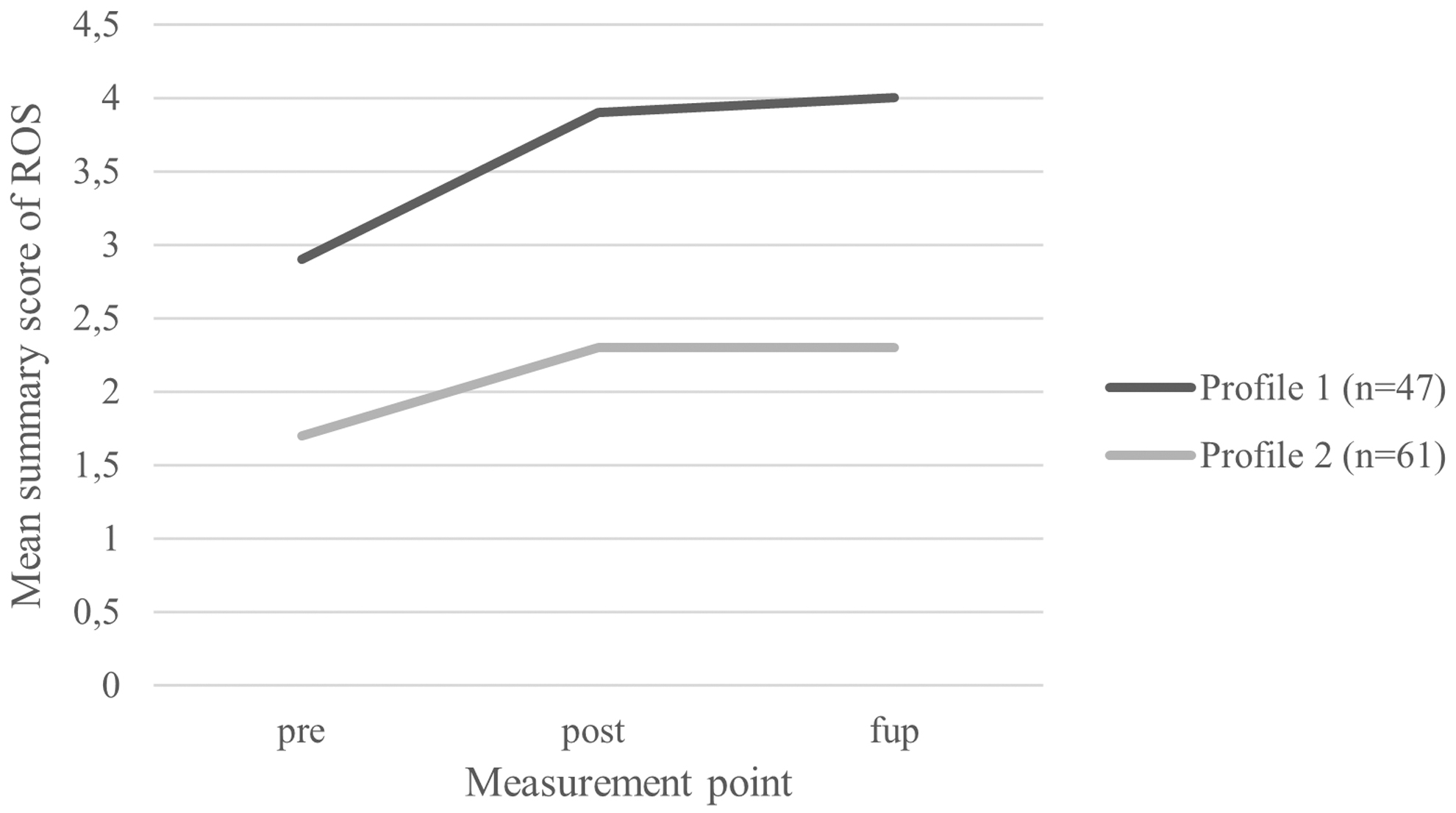
ROS profiles. ROS, restoration outcome scale.
In the profile with higher restoration (Profile 1), the change in depression scores (BDI) was significant (Wald (2) = 25.04, p < 0.01); the depression scores were lowered significantly between the pre- and post-treatment measurements (B = −0.169, p < 0.01) as well as between the post-treatment and follow-up measurements (B = −0.113, p < 0.05), whereas in Profile 2 with the lower restoration scores the depression scores did not demonstrate a significant change over time (Wald = 1.496, p = 0.47) (Fig. 3).

Changes in depression scores in the ROS profiles.
According to the three-step method, the distribution of participants in the face-to-face and online-/hybrid-facilitated groups differed statistically significantly in the profiles of restoration (χ2(1) = 0.404, p = 0.036); we found that there were more participants from the online-/hybrid-facilitated groups than from the face-to-face groups in the profile with higher restoration. There were no statistically significant differences in the distribution of participants from the face-to-face and online/hybrid facilitated groups in the profiles of depression.
Discussion
We found three different profiles of depression levels, and a significant reduction in depression scores in the profile with the mildest depression symptoms (raw scores 16.8–12.6 between pre- and post-treatment BDI scores) indicating that those suffering from milder depression symptoms benefited from FWN treatment (combined with TAU) the most. This is an important observation when considering the application of FWN treatment in mental health services; it seems that FWN as a 12-session group treatment could be especially applicable in secondary prevention of depression at the early stages of treatment.
We acknowledge, however, that FWN treatment was conducted in addition to standard care, and therefore the current study does not provide evidence for the effects of FWN on depression without TAU.
The result implies that FWN treatment might have benefited patients with milder depression and that the duration (3 months) as such was suitable for this type of group. For these patients, the phase-based structure seems to have been successful and sufficient. We infer that participants with milder depression may have more resources to connect with themselves, nature and the group, and to experience being accepted as they are, particularly in the first stage (Horizon) of FWN treatment.
They might, in other words, benefit from the treatment early on, as suggested by a previous study about a shorter version of FWN developed to support occupational well-being (Hyvönen et al., 2018). This group may subsequently be more equipped and ready to engage in the second, processing stage (Growth) of the treatment and then subsequently transfer their insights to their everyday life as well (Path). Again, no conclusions can be drawn from the benefits of FWN treatment alone, since all our participants also got TAU alongside FWN.
It should, however, be noted that the previous study with this data has shown that an added benefit of FWN treatment was observed in a reduction of psychological distress, an increase in restorative experiences, and improved self-reported work or study ability (only at the end of the group intervention) compared with standard care only (Hyvönen et al., 2023).
We propose that the exercises of FWN treatment are generally easily transferred to patients' everyday life (regardless of the level of their depression) to support their functioning and well-being. We improved the transferability of the FWN exercises to everyday life by providing a brief guide so that participants can more easily apply the exercises on their own after the treatment ends.
Although the statistical power was improved by a larger sample size than in the original RCT, we only had 11 participants in the profile with the highest depression scores, which is an inadequate sample to make any firm conclusions. These results might, however, offer tentative results worth considering a bit further. We suggest that further development of FWN treatment (as well as TAU) might be needed for the subgroup with more severe depression.
As said, we suspect that those with milder depression have more resources to better engage in the first two stages of FWN treatment. By contrast, those with more severe depression might need a longer introductory stage (Horizon) to support their restoration and nature connectedness to build sufficient resources before proceeding to the second, processing stage (Growth) of the treatment. It should also be noted that a significant proportion of depression patients are considered “treatment resistant” as they do not respond to different treatments (Scott et al., 2022).
For these patients, in addition to the changes mentioned earlier, we could include elements from CBT to FWN, since CBT seems to be one of the more effective treatments for more severe depression (Scott et al., 2022).
Further, two different profiles of restoration levels were identified among the participants of FWN treatment for depression. The depression scores decreased significantly during FWN treatment among participants in the profile with higher restoration, but not among the participants with the profile with lower restoration. Thus, the results highlight the significance of restoration as one of the potential mediators for a decrease in depressive symptoms.
Here again, the results speak for the holistic effect of FWN treatment on restoration as we cannot parse out the effects of the natural surroundings versus social influences. Similar holistic results include a study that found an increase in restorative experiences in an 8-week group depression rehabilitation intervention with both indoor and outdoor sessions.
Restorative experiences after sessions in nature (but not indoors) mediated an increase in positive mental well-being, which, in turn, mediated a decrease in depression (Korpela et al., 2016). Further, in a previous study about FWN treatment, we found that an increase in restorative experiences mediated a decrease in depression scores (Hyvönen et al., 2023).
The results from the few studies that have studied the social context of restoration show that social support and the company of others can be conducive to restoration (Korpela & Staats, 2021). In particular, having company while visiting a natural environment may help a person to feel safe, both physically and psychologically. The negative effects of social company involve distracting attention away from the physical environment or disrespect of the environment by others (Korpela & Staats, 2021). These negative effects were taken into consideration and addressed if necessary, during FWN treatment.
Interestingly, we also found there were relatively more participants from the online/hybrid facilitated group than from the face-to-face facilitated groups in the profile with higher restoration. As for the environment, we hypothesize that having the opportunity to choose one's own favorite nature environment for each group session in the online facilitated groups might have supported restoration better than participating in an environment the group chose together (face-to-face groups).
It is also possible that being alone in one's favorite place has allowed more attention to be directed toward the physical environment. Regarding previous studies and our current results, it is advisable to pay special attention to supporting restoration in NBIs for depression. Further developments of the nature-based parts of FWN treatment could include, in particular, (1) more mindfulness-influenced exercises since mindfulness has been proposed to support psychological restoration in nature (Lymeus et al., 2020; Macaulay, Lee, Johnson, & Williams, 2022); (2) stronger support for strengthening nature connectedness, which seems to closely interrelate with restoration (Mayer et al., 2009); and (3) supporting environmental self-regulation by, for instance, encouraging participants to visit their own favorite nature place on a daily basis to enhance restorative experiences (cf., Korpela & Ylén, 2009).
In other words, FWN treatment could feature a longer Horizon stage (first stage) to maximize the restorative experiences from nature that mediate the alleviation of depression symptoms (Hyvönen et al., 2023; Korpela et al., 2016).
With a relatively large sample of a wide range of clients in terms of age and background, and a longitudinal design, the study at hand is an important step toward stronger evidence for the safe use of nature-based treatments in mental health care. The study is also unique due to the use of various group facilitators at different locations. Further, to our knowledge, this is the first study focused on identifying subgroups of participants in nature-based treatment on levels of depression and restoration.
Further, studies about NBIs have recommended including clear descriptions of intervention techniques (Wilkie & Davinson, 2021), and, accordingly, FWN treatment has a clear structure and feature-specific intervention techniques, which is described in even more detail in another recent study (Salonen et al., 2022). However, still more research is needed to gain sufficient understanding of the benefits and potential of NBIs.
In addition, one of the notable features of FWN is that it has been developed specifically to be carried out wholly in nature environments. Nature is seen as more than just a setting for the meetings: it is an integral part of all the exercises and of the rehabilitation process, a therapeutic partner, if you will, for the group facilitator. A similar approach has been presented by Naor and Mayseless (2021) as well as Berger and McLeod (2006).
Further, since nature connectedness is associated with better well-being (Howell, Dopko, Passmore, & Buro, 2011), in FWN the connection with nature is purposely and routinely facilitated at every meeting. In the future, to use nature-based treatment more widely, this could be taken into account in urban planning as well: Natural environments should be available for everyone, preferably near one's home.
This study has some limitations besides its usefulness. Most of the participants were women (81.5%), and therefore more gender-balanced data would be desirable in future studies. On the other hand, the data are in line with the observation that depression is more prevalent among women than men (Albert, 2015). As for the methods used in this study, one should be cautious about attaching too much meaning to a latent class (profile) or its label; although LPA is an appropriate tool for exploring the interconnections among a set of variables, it is a rather explorative method. In addition, the sample sizes in the different profiles of depression and restoration were partly very small and thus the results need to be considered tentative.
One prominent limitation to our study is the use of a homogenous sample of white, Finnish speaking adults with a highly uniform ethnic background. Moreover, no information about participants' sexual orientation or religion was collected in this study. Thus, the results of this study cannot be generalized to other nationalities, ethnicities, or age groups. In addition, the treatment group sizes varied from 3 to 10 participants, which might have affected the outcome, and more equal groups sizes would be preferrable in future studies.
It should also be noted, that while we consider nature- and group-based methods, especially FWN, to have a huge potential as part of the treatment of depression, nature is not the only ingredient in the treatment and the role of the therapist and the group require important consideration as well. Thus, the nature-based methods in mental health care should be evidence-based, professionally implemented, and further developed when the results are more modest than expected, as in our present study regarding more severe depression.
Further, due to the COVID-19 pandemic, some of the group meetings were facilitated either partly or wholly online, which may have had some influence on how the participants benefited from the treatment. This is an important aspect for future study of FWN treatment, since the group facilitators' qualitative observations during the treatment were both positive and negative.
Some of the participants reported, for example, being able to concentrate better on the exercises and their own personal process via online connections; conversely, some negative experiences were also described, such as frustration with how the Zoom program works and difficulties with using technical devices. On a larger scale as well, it would be intriguing for future research to target the possibilities that online-facilitated NBIs might have in supporting human well-being.
Since the evidence for the physiological benefits of nature environments is accumulating (Mygind et al., 2019), it would also be of interest to include physiological and other indicators of physical health in future studies of NBIs in the context of mental health care.
We have also seen evidence of increased, self-reported work and/or study ability among participants in FWN treatment (Hyvönen et al., 2023). One possible future development for the treatment could be modifications specific to the needs of young adults in student health care programs. This is supported by a recent study indicating that nature environments have both affective and cognitive effects on university students (Shrestha, Di Blasi, & Cassarino, 2021).
Yet another possibility would be to modify FWN treatment for the needs of children and adolescents. This is supported by previous studies that indicate children's and adolescents' nature exposure to be connected with greater psychological restoration (Roe & Aspinall, 2011), improved attention (Kuo, Brown, & Benner, 2017), and better mental health (Dzhambov et al., 2018). In addition, it could be hypothesized that, as green spaces contribute more to the healthy ageing of disadvantaged groups than affluent groups (John et al., 2022), NBIs might be especially beneficial in the previously mentioned groups. We hypothesize that specifically adapted treatments using particular FWN stages and nature-based exercises would offer some added benefits to both age groups.
Conclusion
We found a significant reduction in depression scores in the group with the mildest depression participating in FWN treatment who were also receiving standard care (TAU). The result suggests that FWN treatment could be safely incorporated to secondary prevention of depression. Further developments might be required to meet the needs of tertiary prevention of depression. Moreover, this study highlights the importance of restoration in a nature-based group treatment for depression, since depression was alleviated significantly in the group with greater restoration. Accordingly, it is advisable to pay special attention to enhancing restorative experiences in NBIs for depression.
Footnotes
Acknowledgments
First, the authors are grateful to all their participants. Second, they would like to express their gratitude to their collaborators: city of Tampere's Mental Health and Substance Abuse Unit and Non-Institutional and Housing Services, and Finla Occupational Health. The authors thank the following people for their great work as group facilitators: Johanna Seppälä, Susanna Homanen, Jaana Mäki, Nina Leikas, and Petra Sainio. This research was conducted in cooperation between the University of Jyväskylä and Tampere University and was also supported by the JAMK University of Applied Sciences. Third, the authors want to express their gratitude to the Finnish Social Insurance Institution for providing the funding for this research project.
Ethical Approval
The research protocol and methods, including the analysis used in this study, were evaluated and approved by the Regional Ethics Committee of the Experts Responsibility area of the Tampere University Hospital.
Authors' Contributions
J.-V.P.: Conceptualization, investigation, writing—original draft, and data curation. K.H.: Conceptualization, investigation, reviewing, and editing. K.S.: Funding acquisition, conceptualization, investigation, reviewing, and editing. J.M.: Methodology, formal analysis. K.K.: funding acquisition, supervision, project administration, conceptualization, reviewing, and editing.
Author Disclosure Statement
No competing financial interests exist.
Funding Information
This research was funded by the Social Insurance Institution of Finland (KELA; grant number: Dnro 24/26/20218). KELA had no role in conducting this study.