




Abstract
At the 2019 Canadian Institute of Mining, Metallurgy and Petroleum (CIM) sales expo, a blip in the capitalist discourse was introduced: an Earth Gratitude Booth (EGB). The booth was created to provide the Earth a gentle space of representation as more-than-object in a quintessentially Earth-objectifying environment, as well as to offer people at the convention an opportunity to consider and reflect on Earth–human interconnection. At the convention, participant observation methods were employed as convention-goers walked past the booth, took part in an Earth gratitude community art creation, and/or listened to a stoney soundscape available at two listening posts. Challenges such as maintaining physical and emotional boundaries were encountered. The experience of the booth highlighted both ecofeminist and ecopsychological perspectives, and those systems have been employed for the analysis. Despite several incidents of poignant disrespect, the outcome of the booth was positive: 64 CIM Convention-goers laid gratitude stones and many more engaged positively with the booth. This gentle placement of an EGB at a mining convention may well have served as a portal to reflection on the interconnected self.
Introduction
At the 2019 Canadian Institute of Mining, Metallurgy, and Petroleum (CIM), a break in the Earth-objectifying, discourse was introduced. Among the booths selling heavy-machinery lubricants and desalination technologies sat a gentle offering of reflection: an Earth Gratitude Booth (EGB). This experiential, sensory environment sat juxtaposed against a patriarchal capitalist backdrop and offered convention-goers the opportunity to engage with it.
What would happen? How would convention-goers respond to this highly unconventional space? To present what I experienced and witnessed at the CIM convention, I focus my analysis on two distinct but related fields: ecofeminism and ecopsychology.
Ecofeminism, Ecopsychology, and the Healing Potential of Gratitude
Ecofeminism contemplates the human relationship to the Earth through a gendered lens (for early ecofeminist work see Baker, 1993 and Merchant, 1996). Ecofeminism is both a “philosophical critique” (Baker, 1993, p. 5) and a call to action for a more balanced and just relationship with the natural world (Mies, Shiva, & Salleh, 2014; Moore, 2008). As a critique of capitalist, patriarchal, colonialist society, ecofeminism presents a compelling case: as women are suppressed, so too is the Earth (Banerjee & Bell, 2007; Merchant, 1996; Oksala, 2018). Much of ecofeminism highlights the body and reproduction (Field, 2000), which has exposed the field to being critiqued as essentialist (see, e.g., Evans, 2015). However, ecofeminism can be considered a call to embrace the ecofeminine (Mallory, 2018), those aspects of creation that have been socially constructed as—feminine such as the human body, the Earth's body, human emotions, and human subjectivity. It is this perspective that I adopt in relation to the EGB.
Some early ecofeminists might have called the placement of an EGB in the heart of a mining expo, a form of “guerrilla discourse” (Bullis & Glaser, 1992, p. 57): The EGB was in the extractivist heart of the capitalist system and did, by its very nature, contradict the Earth-objectifying discourse that surrounded it. In a place where all other displays were designed either to sell products or services to support the exploitation of the Earth as a lifeless commodity, the inclusion of a passive homage to the Earth being hosted by a white, cisgendered female PhD student in her late 30s stood out in contrast. However, the dichotomy implied by the term “guerilla” discourse was not the intended spirit of the booth. I wanted to honor the Earth through an alternative discourse not by being against something, but through gently integrating something else. After all, a holistic, relational ontology, such as that often championed by ecofeminists (e.g., Plesa, 2019), is an inclusive ontology; this suggests to me that healing and respect for the ecofeminine would need to take place in even the most anti-ecofeminine of environments—environments such as that of a mining convention.
The EGB was also about Self/Earth healing and that is where ecopsychology comes into the discussion. In pursuing a holistic perspective, ontologies themselves, even ones that have become Earth-destructive, cannot be separated from the Earth and may well be part of the Earth's own process (Clark, 2014).
Theodore Roszak described ecopsychology as having a goal to “bridge our culture's long-standing, historical gulf between the psychological and the ecological, to see the needs of the planet and the person as a continuum” (Roszak, 2001, p. 14). From the perspective of a continuum, the human psyche is part of nature, and rather than a collective (un)consciousness at the human level, there is a “world unconscious” (Aizenstat, 1995, p. 95) that includes the psyches of all animate and inanimate matter. It has been suggested that ecopsychology effectively identifies the Earth (nature) as self (Davis, 2011), a scenario in which there is no separation between the rocks beneath our feet and the thoughts we are having about the rocks. The human mind, therefore, develops and considers itself because the Earth's mind is developing and considering itself. Ecopsychology is used here from this perspective, that the EGB and all the various reactions to it mirror the Earth's own mental processes, that the human mind is the Earth's “self-consciousness” (Berry, as cited in Scharper, 2001, p. 189). Among other benefits, this view made possible a sense of compassion during the more challenging moments at the convention.
As critiques of patriarchal, capitalist culture, both ecofeminism and ecopsychology have highlighted how the construction of dualities (man–woman, mind–body, culture–nature, etc.,) has served to foster the current Earth eco-crisis (Fisher, 2012; Gaard, 2015; Phillips, 2014). Both these fields suggest that we need renewed practices of connection to heal the divides and to foster healing of the Earth. This was a part of the intention of the EGB, not only to observe the interactions but also to foster and support connection. To do this, I themed the booth in the emotion/affect of gratitude.
Gratitude is an action that nurtures connection through acknowledging interdependence (Lambert, Clark, Durtschi, Fincham, & Graham, 2010). Gratitude to the Earth resists capitalist and patriarchal discourses because it relies on an ontology that conceives of the natural world not as a “free gift” used to increase capital (Burkett, 1999, p. 91), but rather as a “sacred” gift that sustains life (Clark, 2014, p. 159). Capitalism, by comparison, does not, and cannot, acknowledge the Earth as a subjective entity worthy of gratitude. Therefore, the EGB, infused with gratitude, sat in direct contrast to the world around it, and it did so as gently and inclusively as possible.
The EGB: The Spark
Where did the booth come from? What urged it into being? From an ecopsychological perspective, the EGB manifested itself through me, bringing itself forth from the void, sparking an idea within my mind. The booth was then to become an embodied reality out of that idea, a material space, a place that called for recognition of the Earth's body.
The EGB started in a trip to Toronto.
Every year, the Prospectors and Developers Association of Canada (PDAC) holds an international convention in downtown Toronto, Canada. It is “regarded as the premier international event for the mineral industry” (PDAC, 2019, pg. 5). Upwards of 25,000 people attend. While throughout the four-day convention are featured a series of talks, information sessions, and technical short courses, the event in general has a reputation as being largely about networking and deal-making, activities undertaken with copious amounts of alcohol. There is also a reputation of swanky suits, short skirts, and sex. I made plans to attend the spring, 2018 event.
The trade show at the PDAC consisted of rows of booths that included countries, territories, and provinces, demonstrating their potential mineral wealth. There were mining companies, technology companies, and consulting firms—everywhere around me the Earth was being bought and sold and objectified en masse. This was where extractivism, with its belief that humans have a right to flourish at the expense of the Earth through “subjugation, violence, depletion, and non-reciprocity” (Chagnon et al., 2022, p. 760), went to mingle. I found myself yearning for comfort, for a sense of deeper connection to the world, for something grounding to grasp onto, but instead I was drowning in a sea of frenetic objectification and business suits.
From this experience, the idea for the EGB was born. The vision for the booth itself was gentle. The vision was for there to be a quiet, Earthy space at the following year's PDAC, a place where the Earth would not be represented only as raw matter for an industrialized society. However, I must be honest, the mass Earth-objectification at the PDAC had angered me, so there was also an undertone of I defy you in the vision as well; how dare you objectify me. This dual experience of the booth as a peaceful, quiet gift, as well as a defiant, powerful, boundary, lingered throughout the EGB creation and presentation process. I do not know which vision the Earth supported. Perhaps both. Perhaps neither.
Know me for all that I am.
Materials and Methods
Proposing
The idea of mounting an EGB was proposed to both major mining organizations headquartered in Canada: the PDAC and the CIM.
While the PDAC invited me to Toronto to present the proposal in person, they declined to support the EGB. The CIM, however, was willing. The CIM convention is considerably smaller than that of the PDAC: 5000 attendees to the PDAC's 25,000. The CIM is Canadian, while the PDAC is international. Perhaps there was less risk in taking a chance on Earth gratitude in these circumstances? The organization agreed to donate the space and the furnishings for the EGB.
I felt it important that the EGB be supported by the mining organization hosting the convention. I did not want to exacerbate the potential that the booth would be viewed as an act of protest or a place of animosity. The quiet, Earthy space was simply about the Earth, allowing it to be present and honored. I wanted it to be inclusive and inviting. It was not about being anti-mining: it was about being pro-Earth.
Emplacing
A quiet, Earthy space was the goal of the EGB. What would that look like on the convention floor? Rather than risk being a disjointed series of Earth images, the booth needed to be rooted in a place with history, complexities, images, and sounds that resonated together. It needed to be emplaced.
The emplacing was also a matter of ideas sparked and connections made. I had decided to incorporate an Earth gratitude community art creation as part of the booth. Following the death of my dog, I had gone to Big Sandy Bay on Wolfe Island, Ontario, and had created a circle of stones as part of my healing cycle (Fig. 1). That stone circle became the inspiration for the community art creation, and from that inspiration, the booth came to revolve around Wolfe Island itself.
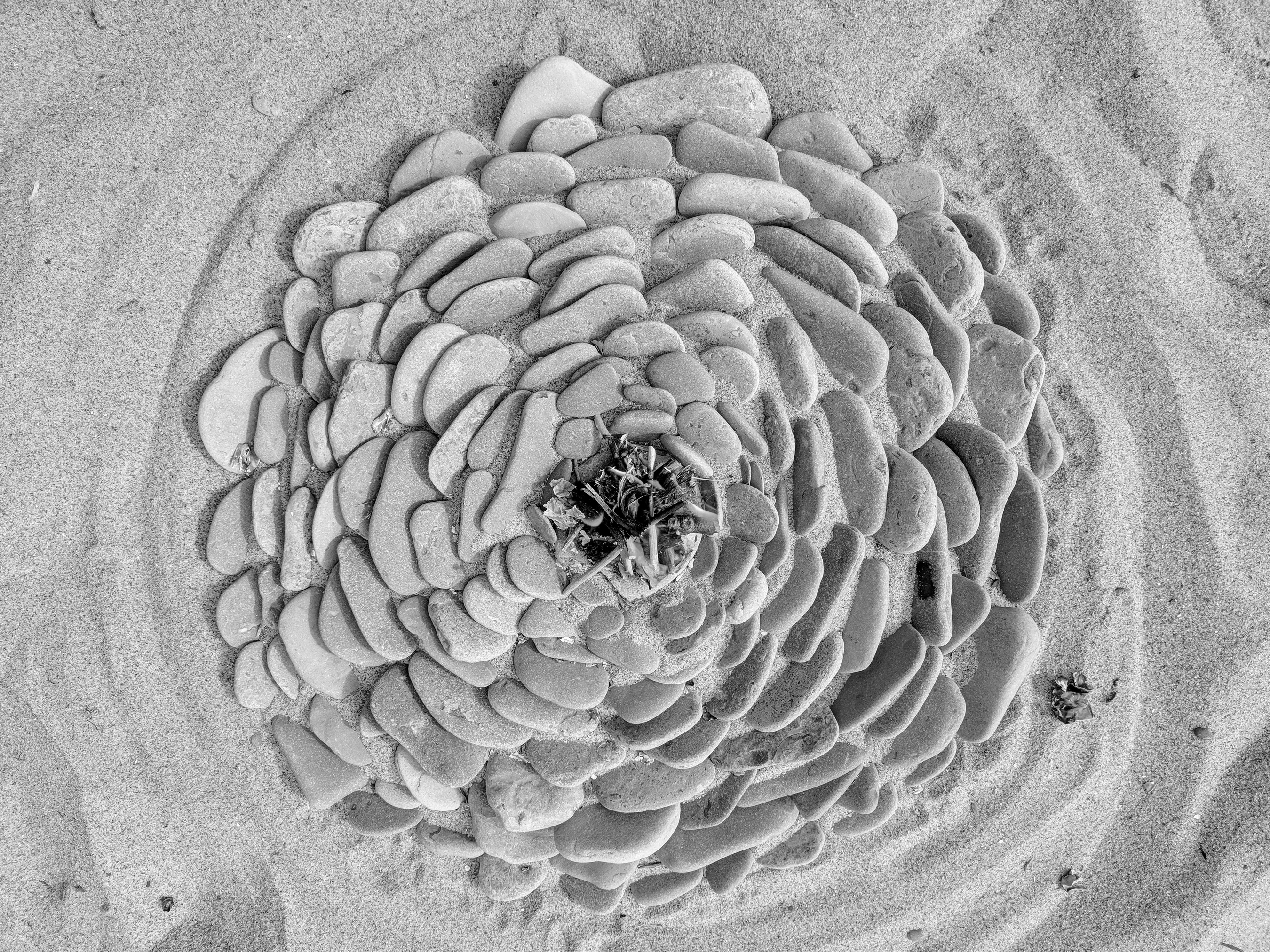
Lily Dog's memorial, inspiration for the community art creation in the Earth Gratitude Booth.
I had lived on Wolfe Island, Ganounkouesnot, the largest of the Thousand Islands, for the period of a year. I had felt it hard to connect with the island at first; it felt barren and angry. My difficulties to connect can be seen in the segment of a blog post that I wrote about the island at the time:
Mostly bare of trees, the winds off of Lake Ontario scour the deadened, grassy earth, whipping limbs off the scrubby trees and tossing them onto country homes. To me, the surge of spikey, thorny, spiny plant life; the winds; the lashing waves, all of this has come to suggest that the island is speaking to us a general refrain…get…off.
Wolfe Island became the perfect muse for that second undertone in the EGB: I defy you. How dare you objectify me.
Honour me, in all that you are.
The stones of Big Sandy Bay are 450 million year old limestones (Eyles, 2002), smoothed into flat circles, triangles, squares. These were to be used for the community art creation. The intention became for people to choose one of the stones, to think of something they were grateful for, and to add their stone to the community art creation. The stones would later be returned to Lake Ontario, sending the gratitude into the waves.
The stones from the bay, I carried out in bags. The process was a slow one, heavy, and humbling: the stones had agreed to come. For each stone, a small pinch of tobacco was laid. As a person of European ancestry, I had sought out the advice of a local First Nation Elder in how best to collect the stones in a manner respecting of the original inhabitants of the area. He advised me to greet the stones in a manner fitting of my own spirituality, but to lay tobacco, something in keeping with what the spirit-beings of Ganounkouesnot would be expecting. I was told only to choose the stones that volunteered for the trip to Montreal, as others might simply want to stay on the beach, baking in the sun. This humbling process of Indigenous reciprocity (Harris & Wasilewski, 2004), I followed to the best of my ability.
A stony soundscape was created with the assistance of sound artist Matt Rogalsky and historical geographer Laura Jean Cameron. A soundscape was an important inclusion, as the realm of the visual only provides one element in the “density of interconnections from which the world is made” (Dunn, 1999, p. 13); a soundscape would deepen and enrich the emplacement of the booth. On a misty morning, we headed to Big Sandy Bay to record. The recording moved from underwater, to the shore, to the birdsong-filled marsh beyond, and eventually deeper onto Wolfe Island where the constant whummm-whummm-whummm of the windmills could be heard. The sound of the mechanical movement of the windmills was included to create “weaves between nature-culture” where the sounds of the windmills contributed to the “ecology of place” (Jones & Fairclough, 2016, p. 100). The vision for the booth grew to include two listening posts where people could sit down, put on a pair of provided headphones, and be transported to the world of the stones.
The soundscape, the stones, the scent of white pine used in the aromatherapy mister, and the large silken images displayed around the booth were all designed to provide a sensory experience of place, a place of holding for/from the natural world (Hordyk, Dulude, & Shem, 2015), a place to facilitate attunement: “a felt sense of union with other people, other life forms, objects, surroundings, the Divine…” (Kossak, 2009, p. 15). This place of hearing, touching, smelling, and seeing nature would stand in stark contrast to the “reductionist written representations” (Hordyk et al, 2015, p. 574) of the Earth that would otherwise be on display at the expo.
By creating the booth in Wolfe Island sound, imagery, and stone, it became infused with a cohesive energy. As I had contemplated, connected with, and honored the island, I could also ensure a more seamless transition between the booth-scape and my own physical body. I would be at peace in the space created. I myself would be entwined and attuned with the energy of the booth. This entanglement had the potential to aid me at challenging moments during the convention.
Change can be painful, hopeful.
Observations
Throughout the course of the CIM Convention, participant observation methods were used. As a method, participant observation allows for a contextual understanding of the dynamics in a particular place and at a particular time (Kearns, 2016). Participant observation is not a method that dives deeply into the intentions behind people's actions or reflections of their own experience, rather the researcher immerses herself in an experience and pays careful attention to all that takes place. As with any participant observation, therefore, what was observed has been filtered through my own subjective abilities of seeing; in light of that, all gender terms refer to the gender that individuals presented as, rather than what they may have self-identified as being.
Setting: A gendered environment
The CIM holds its conventions alternating between Montreal, QC, and Vancouver, BC. When in Montreal, the convention takes place in the Palais de Congrès, the Montreal Convention Centre. Entering the expo floor to set up the EGB, I was met with a scene of crates, forklifts, corporate displays being assembled, machine parts, video displays, and men. It is important to stress that this was the sales expo. The intention of the expo is to sell, whether the products being sold were physical objects such as pumping technologies for tailings slurry, drilling tools or lubricants, or were services such as geophysical consulting or business development strategies.
I had to overcome some fear and discomfiture to set up the EGB in that sea of machinery and gloss. A large part of me considered simply leaving, avoiding putting myself or the stones on display. It started to sink in just how different the booth was going to be. What kept me there were the stones. I felt they had agreed to come, they had made the journey with me, and they deserved my calmest and bravest self to represent them.
The mining industry is an industry dominated by men, with women representing less than 10% of the global large-scale mining workforce (Kansake, Sakyi-Addo, & Dumakor-Dupey, 2021). While women are increasingly entering the field of mining, currently it is still largely an industry of men, power, money, and ongoing objectification of the Earth and women. Gareth Morgan wrote, “the links between the male stereotype and the values that dominate many ideas about the nature of organization are striking … Organizations are often encouraged to be rational, analytical, strategic, decision oriented, tough and aggressive, and so are men” (Morgan, 2006, p. 162). While Morgan originally wrote about these gendered expectations over thirty years ago, little has changed within the mining industry; the atmosphere of the expo oozed these dynamics of toughness and aggression.
This was a gendered environment. While there is a “universalism at play in ecofeminist and feminist scholarship” (Kings, 2017, p. 66) which assigns traits such as being tough and aggressive to men while women are more often portrayed as the life-providing nurturers (Baker, 1993), in the experience of the CIM, these gendered norms were palpable. This was likely compounded by the fact that the percentages of men to women at the expo mirrored those of the industry in general: the space was designed to perpetuate western social-constructions of men. Opening night of the expo, for example, was reserved for very important persons, invite-only. There were circus performers on stilts trailing long ribbons; there was a mime, a caricature artist. Many, if not most, of the women attendees were dressed in short skirts, tight shirts, bright make-up, stiletto heels, and the men were in business suits. It was a gala, a party, a celebration of corporate power and success. The oikos as patriarchal and hierarchical was unquestioned.
Inside of the booth was stillness—me and the stones. Outside of the booth was hustle and bustle: pacing on cell phones, boisterous talking and laughing, carts with alcohol and food being set up, announcements on the loud speaker about the silent auction, and everyone on the move. I poured my intentions into the EGB, trying to make the booth's energy immune to the madness of capitalist culture outside the limits of the forest green carpet.
Passersby and participants
There were many interesting moments of engagement with the EGB. Here, I recount a few highlights.
The first person who took part in the EGB was a white man in his 40s, another exhibitor, a technical consultant. He told me it was the image of the stone circle, the one that I had created for my Lily Dog, that had drawn him in. He took the time to read the materials, to listen to the soundscape, and to lay the first stone in the community art creation. Before he left, he told me how much he appreciated that I was there, how it was important for the booth to be there. He said he understood that everything is a circle, that life is a circle, and that the community art creation helped represent that. He said he hoped others would “get it,” but he did not think that many of them would.
Over the course of the two and a half days of the expo, there were dozens of people who walked past the booth and smiled, or commented on how relaxed I looked (in fact I was deeply alert, drawing energetic reserves, holding space with such intensity that it took weeks to recuperate). There were many double takes, side-eyed readings of the banner stands. Some people grabbed a pamphlet and then quickly walked away. I heard one man mutter, “Greenpeace” to his companion, while another said, “Feng Shui” to his. Several people walked past the booth dozens of times before finally stopping to ask, “What is this all about?” There was a sense of hesitant interest. I had one man ask, “What are you selling, then? Rock?” When I answered, “Nothing!” he laughed, “You're probably the only person here not trying to sell me something!”
Many passersby simply didn't look, eyes averted, they strode past. Others glanced and then scoffed. Throughout it all, I sat on the couch, holding space.
On the second day of the expo, a group of men, white, 20s, walked by the booth. One of them stated loudly, “This one is a beast.” I looked up to see a face sneering at me, anticipating a response. This was the setting of the EGB; while inside the confines of the space was tranquil, white pine misting out of the diffuser, stones sitting in silent grace, outside the confines was an atmosphere where young men felt entitled to refer to a woman, a stranger, as a “beast,” eliciting joy from the attack.
Sometimes the outside atmosphere bled into the boundaries of the space. Two men, white, early 40s, entered the booth, each sat at a listening post. They were giggling, mocking the booth. They started taking photos of each other “headbanging” to the soundscape. One man wanted a photo of himself pretending he was asleep. It took a lot of energy for me to stay centered amidst such a show of disrespect. However, as the outside bled in, the inside transformed. Listening to the sound-story of the stones, both men became silent, their eyes softened. Putting the headphones down one man looked at me, contrite, humane, and said, “that was really nice, actually.” This experience brought to mind the socially constructed-self, the self that operates to fit within a system to survive (Everitt-Penhale & Ratele, 2015). The Earth, however, when heard through the headphones, caused an Earth-minded self to emerge within the men. They became softer, respectful. Perhaps the soundscape brought them into their Earth-bodies.
Throughout the convention there were four Indigenous men, business developers, who came to speak with me. One man, self-identified as Innu, 30s, said that he saw the booth, and saw me in the booth, and that he could hardly separate us: the booth was me, and I was the booth. He wanted to speak with me. This man told me that the stones were there to support me, as much as I was there to support them. That the voices of the ancestors speak through the stones, that the booth made him take off his business hat and put on his healer one. His presence soothed me, having arrived shortly after I had been condemned as a beast. The memory of this visit makes me cry.
Experience the separation. Feel the unity.
Many people came only to listen to the stone soundscape. One man's eyes were misty after his listening. He told a passing friend, “It takes you to another place, you have to try it.” Several people came to listen and sat for over 20 minutes, eyes closed, four 5-minute loops of the track. One man appeared suddenly, made a rapid approach to an armchair, and sat for over 30 minutes. We sat in peace, he absorbed as a “slice of time/place” (Jones & Fairclough, 2016, p. 102) unfurled within him; me, heart warmed that the man had come and honored to have helped create the space for him. When his need for attunement was satisfied, he left as quickly as he had come.
The community art creation elicited its own forms of engagement. The vision for the community art creation had been for people to choose a stone, to think of something they were grateful for, and to add their gratitude stone to the art creation. I had set up the community art creation as a series of circles on the floor, in front of the listening posts (Fig. 2).
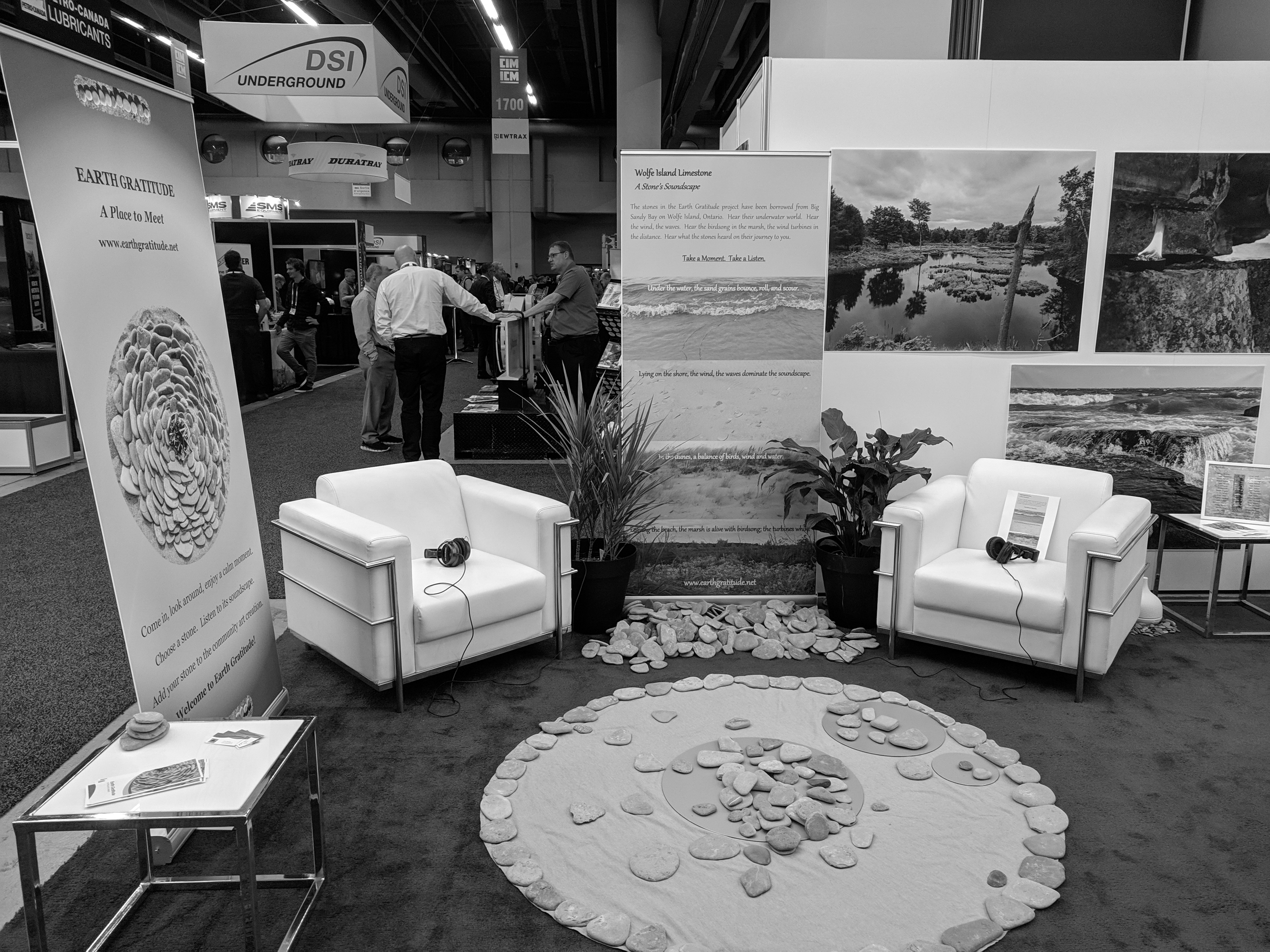
The Earth Gratitude Booth at the Canadian Institute of Mining, Metallurgy and Petroleum sales expo.
To lay a stone, people needed to actively, with their bodies, enter the perimeter of the circle, bend over, and lay the stone. The embodied reality of that seemed to be difficult for some people. It may account for the fact that fewer stones were laid than there were people who interacted with the booth in other ways, such as listening to the soundscape or talking with me. For those who did lay a stone, however, many first held the stone in their hands, rubbing their palms over the smooth surface, bonding with it. Others were less comfortable with the process, but still wanted to take part, dropping the stone quickly, seemingly uncertain in the experience of their bodies.
I had intended for people to lay their stones in some sort of pattern, but instead people laid their stones in a place that felt right to them. Many hesitated while deciding where to place their stone and then, with intention, set it on top of another stone, or out by itself. Several people then came back to the booth to check on their stone, as though the stone and they had experienced a space of encounter (Mayblin, Valentine, Kossak, & Schneider, 2015, p. 75) that now connected them to each other and to something other-than each other. One man even moved another stone that was covering his. He then worried that he had brought “bad luck” on himself by touching another person's stone, suggesting a form of agency of the stone, or something other-than the stone. Those who had left a stone would often walk by, glancing privately at their stone in the circle.
Listen to me singing, hold my bones in your hands!
Other people, meanwhile, actively resisted laying a stone. Another exhibitor, a seller of metal wire with whom I had developed comradery, came to speak with me several times. He listened to the soundscape; he spoke with me about a dying pet that he had back home. And, yet, he would not lay a stone. What did the follow-through mean to people like this man, or the several others who similarly shied away from the act of stone-laying? Was it the subsequent sense of indebtedness that they feared? For some, showing gratitude means an imbalance is acknowledged, particularly if the gift is simply too big to repay (Layous et al., 2017; Van den Noortgaete, 2016). Perhaps this was the hesitation?
In the end, 64 stones of gratitude were laid. Each stone required the participant to step outside the social structure of the convention and to instead become absorbed in, however briefly, an experience of Earth gratitude.
Reflections
Returning the stones to Big Sandy Bay following the CIM convention required several hours of hard labor, pulling the stones upon a flooded path, mayflies swarming my head. I felt oddly defeated after the convention. What had I expected? A great awakening of Earth consciousness? A line-up of convention-goers seeking to take part in Earth gratitude? In my secret heart, yes, that was what I had hoped would take place. Rather, it was the exhaustion of holding boundaries, of insisting that the EGB be treated respectfully, that stuck with me. That a booth representing the Earth for its own sake should have been such a challenge to hold space for in just one, relatively small, mining convention, overwhelmed me with a feeling of hopelessness.
However, the stones reminded me, as I pulled and pushed and lugged them along the path, that a mining convention might well be considered the heart of the capitalist system, a seat of utter Earth objectification, and the mind run amuck as it clinically explores and exploits its own objectified body for resources. And yet, there, in that space, sat an EGB.
In a heavily objectifying, deeply capitalist, environment, a blip in the discourse was introduced. The blip was not just introduced, however, it was allowed and supported by the Canadian Institute of Mining, Metallurgy, and Petroleum. While the gendered realities of a capitalist, patriarchal, system were apparent outside the boundaries of the booth, and sometimes within, the less-desirable incidents or moments experienced or witnessed were outnumbered by the laying of 64 gratitude stones.
That says something, because if humanity in all its manifestations are aspects of the Earth's own evolution and development, then each person who stepped over the threshold, who considered gratitude and felt the stones of the Earth in their hands, represents a shift in consciousness away from the dominant discourse toward something new. Some participants came to the EGB and seemed to find it comfortably resonant with their own being; others, perhaps less familiar with a feeling of gratitude for the Earth, awkwardly, but determinedly, allowed a shift in perception to occur through the action of taking part in the booth experience. For all who engaged, the perceived boundary that separates the individual human self from the more-than-human world would have become blurred, and all who took part were, on some level, open to that blurring.
In her short article on activist ecopsychology, Elizabeth Bragg (2014) reminds us that, “It is the inner world…the realm of philosophy, creativity, and psychology, where deep transformative change can occur” (p. 16). The inner worlds she is referring to are those of each person, but her statement becomes much more ecopsychological if it is applied to the Earth itself (yes, says the Earth, it is
I think the EGB demonstrated that there may be a blossoming of awareness underway, or poised to be underway—a paradigm shift toward an interconnected Earth/self. It seems likely that the Earth needs more moments of pause and reflection in precisely those places where it is most foreign to offer them, to support its own healing—and ours.
Know me for all that I am.
Honour me, in all that you are.
Change can be painful, hopeful.
Experience the separation. Feel the unity.
Listen to me singing, hold my bones in your hands!
It is I who am transforming.
Footnotes
Author Disclosure Statement
No competing financial interests exist.
Funding Information
No funding was received for this article.