




Abstract
Climate change is a source of anxiety and stress. To be resilient to the changes that are occurring, individuals must cope with that stress. Two studies (Study 1 N = 340, Study 2 N = 274) conducted via MTurk examined variation in coping strategy use among Americans who reported some concern about climate change to understand generally how people cope with such stress, and whether it can be predicted from their level of climate change concern, political ideology, and their dispositional coping style. Overall, greater climate concern predicted greater use of most coping strategies. However, political ideology moderated the relationships between concern and use of certain coping strategies: conservatives who were more concerned reported greater use of avoidant strategies to cope, whereas the relationship between concern and these forms of coping for liberals was weaker. This interaction was not observed for problem-focused or social-focused coping strategies. Study 2 also examined the role of dispositional coping, finding that use of a strategy to cope with stress in general was strongly associated with use of that same strategy to deal with climate change concern. However, climate change concern remained an important predictor of coping, even when controlling for dispositional coping.
Introduction
Given the projected and documented impacts of climate change (IPCC, 2021), it is crucial that we understand not only what can be done to slow climate change, but also what can be done to help humans adapt, survive, and thrive in a climate changed world (Pielke, Prins, Rayner, & Sarewitz, 2007). Adaptation is needed at multiple levels. Adaptation efforts include altering ways of working and living, changing land-use and disaster-preparedness policies, and improving infrastructure (e.g., Berrang-Ford et al., 2019).
Individual psychological preparedness and adaptation are also important as people learn to live in a climate-changed world. Beginning over a decade ago, psychologists (Doherty & Clayton, 2011) raised the alarm over potential impacts of climate change on mental health and well-being.
One important aspect of this ongoing work is to investigate the ways in which people respond behaviorally and cognitively to stress (i.e., cope) to better understand personal resilience to climate change as a stressor. Thus, the research reported here investigated the relationships between climate change concern and coping in the context of climate change.
Climate change concern
Recent polling suggests that most Americans are concerned that climate change will cause them harm within their lifetime (Bell, Poushter, Fagan, & Huang, 2021); this concern can manifest as climate change anxiety (e.g., Clayton & Karazsia, 2020). Generally, this anxiety is associated with feeling a lack of control, certainty, or predictability from the threat of climate change. Climate anxiety may be chronic and could lead to functional and cognitive impairment but is distinct from general anxiety and depression (Clayton & Karazsia, 2020).
These feelings of climate anxiety can be measured in different ways depending on the context and aims of that measurement (Ojala, Cunsolo, Ogunbode, & Middleton, 2021)—in the current work, we study concern about climate change, including cognitive and affective stress responses.
Fear, worry, and anxiety are emotions associated with recognition of a threat and motivation to act to mitigate or avoid that threat (e.g., Borkovec & Roemer, 1995). In the context of climate change, worry is correlated with greater engagement in pro-environmental behaviors and policy support (Brosch, 2021; McNeill & Dunlop, 2016; Verplanken et al., 2020).
For example, a study of adolescents found that those who reported consistently high (or increasing) worry about climate over the 8-year study tended to report more environmental engagement (Sciberras & Fernando, 2022). However, this same study illustrated the downsides of these negative emotions: adolescents with consistently high climate change worry tended to be depressed and anxious.
Although some concern about climate change may motivate engagement and adaptation, high levels of persistent worry may harm well-being. Studying how climate change concern may lead to more or less adaptive coping responses would help us to better understand the links between concern, action, and well-being.
Coping strategies
When people are faced with stress, they may use a variety of behavioral or cognitive coping strategies to manage that stress (Folkman & Moskowitz, 2004). One way to assess how people cope is to use detailed and concrete inventories with which people indicate how frequently they use different coping strategies (e.g., COPE; Carver & Scheier, 1994; Ways of Coping Questionnaire, Folkman & Lazarus, 1988; for other approaches see Folkman & Moskowtiz, 2004; Jensen, Turner, Romano, & Strom, 1995; Park & Folkman, 1997).
Inventories such as the COPE (Carver & Scheier, 1994) and Brief COPE (Carver, 1997) have been used in a wide range of domains such as among cancer patients and those living with other illnesses (e.g., Badr, 2004; Mackay et al., 2021), with emerging adults and students (e.g., Cramer et al., 2020; Park & Levenson, 2002), and victims of disasters (e.g., Carver, 1997). These studies (outside the climate domain) show that coping responses predict important outcomes such as well-being, marital adjustment, alcohol consumption, aggression, and symptom severity. Thus, it may be useful to build a bridge between coping research and work on human responses to climate change.
Existing research on coping with climate change stress
Some research has examined coping responses to climate change stress, and other climate-specific emotions such as eco-grief (e.g., Cunsolo & Ellis, 2018; Ojala et al., 2021). Ojala (2012, 2013) asked children, adolescents, and emerging adults in Sweden to report how they cope with their worries about climate change. Her findings suggest that participants who relied more on problem-focused coping strategies reported greater negative effect, whereas the use of strategies such as positive reframing or fostering hope was associated with a sense of purpose, positive effect, and hope.
Use of these meaning-making strategies attenuated relationships between problem-focused coping and negative affect (Ojala, 2012). Homburg, Stolberg, and Wagner (2007) measured coping with environmental stressors. Small positive associations were observed between stress and expression of emotion, problem-solving, and positive reframing, but not avoidant coping strategies such as minimization. People who reported more problem-solving, emotional expression, and self-protection also reported greater engagement in pro-environmental behaviors.
This existing work informed our investigation and pointed toward several important gaps in prior research. In previous work, measures of coping that were tailored to the issue of climate change not only had advantages in terms of specificity, but also made it more difficult to compare to coping with other stressors, and in relation to people's dispositional coping styles.
In our work, we wanted to understand whether the ways people cope with climate change are explained by the ways they cope with stress in general or whether there is something specific about concern related to climate change that influences how people cope. This may be the case because, whereas some commonly studied stressors may be more within individuals' control, the existential threat of climate change is almost entirely outside of any given individual's ability to address. Thus, there is a possibility that the ways people cope with stress in their daily lives could diverge from those they use when thinking about the threat of climate change.
To promote adaptive ways of coping in response to climate change stress, understanding how people already cope (and what might influence that coping) should aid in developing future efforts to increase resilience to climate change stress.
Dispositional coping styles and situation-specific coping
Coping is generally assessed with regard to a specific stressor impacting someone (e.g., a person responding to a cancer diagnosis). Certainly, aspects of specific stressors (e.g., their controllability) inform which coping responses people prefer in that situation. However, people also tend to show a consistent pattern of coping across different kinds of stressful situations (Carver & Scheier, 1994; Ptacek, Pierce, & Thompson, 2006).
Dispositional coping style is a way to characterize how people habitually cope with stress; in contrast, situational coping refers to how people cope in a specific situation. For instance, a person with an avoidant dispositional coping style might consistently rely on strategies such as distracting themselves, denying the stress, or using substances to cope regardless of the situation. Past research suggests that while dispositional coping styles predict situational coping, they do not explain all the variance in situational coping, and that context is important (Bouchard et al., 2004; Carver & Scheier, 1994; Cerea et al., 2017, Ptacek et al., 2006).
Because climate change poses a number of different challenges, understanding dispositional coping styles (which have been found to predict situational coping) could provide insight into how a person might cope with any number of climate-specific stressors.
Political ideology and responses to climate change
In the United States, climate change is a politically polarized issue (Ballew et al., 2019). Although environmental protection was once a nonpartisan issue, in the 1980s Democrats and Republicans began to diverge around issues of environmental regulation (Dunlap & McCright, 2008). The divide between conservatives and liberals in opinions about the government's role in addressing environmental problems has persisted (Mitchell, 2019).
Republicans and Democrats on average differ in climate change beliefs and knowledge (e.g., Dunlap et al., 2016), attitudes toward climate policies (Ballew et al., 2019), emotional responses to, risk perceptions from, and motivation to change behavior following climate change communication (Ettinger, Walton, Painter, & DiBlasi, 2021), and responses to framing of climate change as an issue of energy dependence or national security (Gainous & Merry, 2022).
These differences have many potential explanations, for example, differences in moral foundations (Milfont, Davies, & Wilson, 2019) or perceptions of ingroup norms (Cole, Ehret, Sherman & Van Boven, 2022). Although Republicans and Democrats differ in their perceptions of and responses to climate change, polling suggests that most Republicans are in fact worried about climate change, just to a lesser extent than most Democrats (Brenan, 2022).
Given that there are many ways in which political ideology moderates relationships between relevant climate-change related predictors and outcomes, it is also important to consider what role political ideology might play in climate-related stress and coping. A person's political ingroup may have social norms that influence whether people make pro-environmental decisions (Geiger, Pasek, Gruszczynski, Ratcliff, & Weaver, 2020).
Group norms might also inform the ways that Republicans and Democrats respond to concern about climate change (i.e., how they see others in their group dealing with that concern). Thus, our research examines how political ideology (in conjunction with climate change concern) predicts coping strategies for climate change stress.
The current studies
The aim of our studies was to understand how people cope with climate change, and what predicts the use of specific coping strategies, including climate change concern, dispositional coping, and political ideology.
The first study sought to establish the ways people cope with climate change stress and how use of particular coping strategies related to individuals' climate change concern and political ideology. The second study aimed at replicating findings from Study 1 and at assessing dispositional differences in coping to understand the extent to which dispositional coping styles predict responses to climate change stress.
Study 1
Methods
Procedures
In the first study, we asked people about their concern about climate change followed by a recall task in which they wrote about a time that they felt stressed about climate change. Then, they completed questionnaires about specific coping methods that they employed in that and similar situations. All studies were reviewed and approved by the institutional review board. Measures and materials are presented in full in the Supplementary Data.
Sample
Participants were recruited via MTurk and were paid $1.00. We recruited 425 individuals. We aimed for a sample N = 300, based on a priori power analyses for a regression with two predictors, α = 0.01, and power set at 0.99. The sample after exclusions (see Supplementary Data) consisted of 340 individuals, 52.5% of whom identified as men, 47.1% as women, and <1% as another gender. 70.2% of the participants reported having received a bachelor's or more advanced degree. The sample was 72% white, 12% Black, 6% Hispanic, 5% Asian, and 4% other/multiple races.
Ages ranged from 18 to 78 (M = 37.4, SD = 11.3). Data were collected in two batches, during the first and last week of February 2020. There were no significant mean differences between these two samples, so analyses were conducted on the combined sample controlling for study sample.
Measures
Climate change concern
Items measuring climate change concern were developed based on Campbell's (1983) conception of ambient stressors (chronic, perceptible, urgent). For each of the 12 items, participants rated their agreement from 1 (Strongly disagree) to 7 (Strongly agree). For example, “Climate change is likely to cause me imminent harm”; “I believe that climate change is currently one of the most serious threats to the world.” A composite concern variable was calculated by averaging these items (Study 1: α = 0.95, Study 2: α = 0.80).
Stress recall task
Participants were instructed to “think about a time you felt stressed about climate change. You might have a hard time remembering an event like this or it might be quite easy. This might be something that happened once, or something that happens more frequently. You may also only have felt a little bit stressed or may have been very stressed. We would just like you to remember this event as best you can. Please write about the experience, what you thought and felt at the time, and anything else that comes to mind.” Participants were then provided with a text box.
We wanted to get people thinking about stress related to climate change so that they would be better prepared to answer subsequent questions about how they coped with climate change stress, such as in the recalled situation. Thematic coding was used to understand the types of stressors experienced, see Supplementary Data.
Coping strategies
The Brief COPE (Carver, 1997) was used to measure the frequency of use of 14 coping strategies: active coping, planning, self-distraction, venting, positive reframing, instrumental support-seeking, emotional support-seeking, religious coping, behavioral disengagement, humor, self-blame, acceptance, denial, and substance use. Two items measure each strategy, and statements were adapted in relation to climate change stress, for example, “When I'm feeling stressed about climate change, I turn to work or other activities to take my mind off things” (self-distraction). For each item, participants reported how frequently they use the strategy: I don't do this at all (1), I do this a lot (4). For each subscale, the mean of the two items was calculated.
Political ideology
Participants rated their political views from 1 (Liberal) to 9 (Conservative) and their political identity on a scale from 1 (Democrat) to 9 (Republican). Because these measures were highly correlated (r = 0.78, p < 0.001), a composite ideology variable was created, where higher values represented more conservative/Republican self-identification.
Results
When we examined mean usage of coping strategies (Table 1), there was a high level of coping using acceptance strategies (i.e., accepting the reality of the fact that it is happening), as well as active and planning strategies (i.e., taking action to make the situation better; trying to come up with a strategy about what to do). Some of the least reported coping strategies were substance use and denial.
Study 1 Mean Usage of Coping Strategies and Correlations with Climate Change Concern and Ideology
Problem/social-focused coping and disengagement coping are positively and significantly correlated, r = 0.52, p < 0.001. Higher values of ideology indicate more conservative/republican beliefs.
p < 0.05, **p < 0.01.
Associations between coping, concern, and ideology
Concern for climate change and political conservatism were negatively correlated, r = −0.18, p < 0.001. Climate change concern was positively and significantly related to the use of all coping strategies apart from denial, see Table 1. Conservative ideology was significantly and positively related to use of behavioral disengagement, substance use, self-blame, denial, humor, religious, instrumental support-seeking, and positive reframing strategies.
We conducted a principal components analysis with varimax rotation of the COPE scale to try to reduce the number of outcomes, details of which can be found in the Supplementary Data. From this, a meaningful two-factor solution emerged. The first factor, which we refer to as disengagement strategies, included denial, self-blame, behavioral disengagement, substance use, and humor strategies. We believe these strategies are associated with avoidance of the stressor.
The second factor, problem/social-focused strategies, included active coping, planning, and instrumental and emotional support-seeking strategies. These strategies are alike as they represent a tendency to engage with the issue of climate change and involve more approach-oriented strategies. In the results included here, we present analyses that focus on the two primary factors (problem/social-focused and disengagement). We also conducted analyses where each of the 14 coping subscales was treated as an outcome, see Supplementary Data.
We used regressions to predict each composite from climate change concern and political ideology. For each of these analyses, we first applied Preacher and Hayes (2004) Model 1 regression Macro, with climate change concern predicting coping, moderated by ideology. When the interaction term was not significant, we regressed coping on political ideology, concern, and study source simultaneously to examine their main effects.
Disengagement strategies
Climate change concern predicted disengagement coping but the relationship was moderated by ideology, b = 0.03, 95% CI [0.01–0.06], SEb = 0.01, p = 0.012, see Figure 1. For liberals, concern was not significantly related to disengagement strategies, b = 0.08, SEb = 0.05, p = 0.11. There was a significant positive relationship for conservatives, b = 0.24, 95% CI [0.16–0.31], SEb = 0.04, p < 0.001. Thus, climate change concern predicted increased use of disengagement strategies, but this relationship was more pronounced among conservatives. This model explained 25.2% of the variance in disengagement coping.
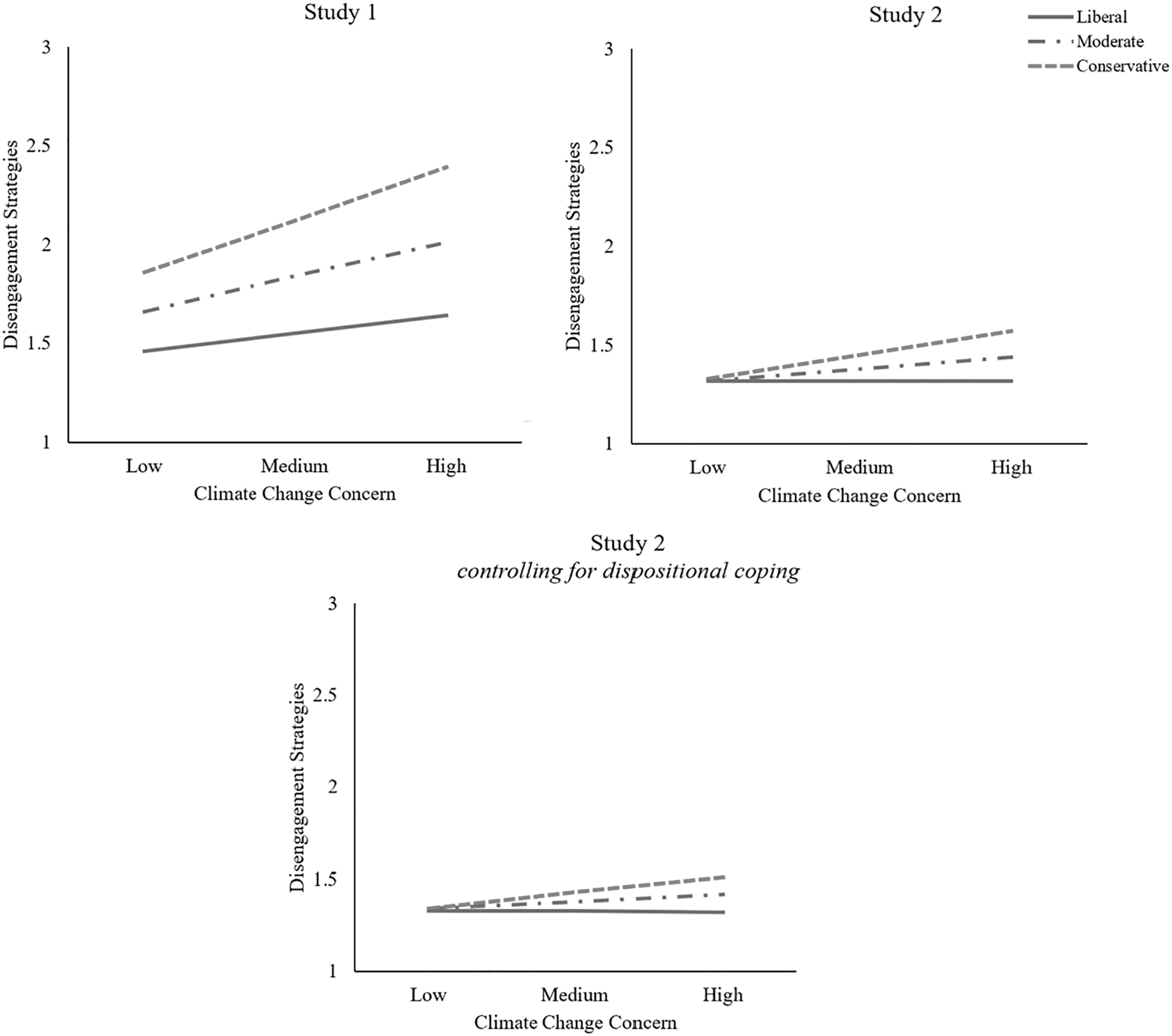
Disengagement strategy use by concern and ideology. Disengagement coping by concern and ideology are shown for study 1 and study 2 (with and without controlling for dispositional coping). COPE items are rated on a scale from I don't do this at all (1) to I do this all the time (4). Climate change concern values represent 1 SD below the mean (“Low”; Study 1: 4.18; Study 2: 3.11), the mean value (“Medium”; Study 1: 5.29, Study 2: 4.44), and 1 SD above the mean (“High”; Study 1: 6.41, Study 2: 5.78). Liberal (solid line), Moderate (dash-dot line), and Conservative (dashed) lines are representative of 1 SD below the mean for political ideology (Study 1: 2.20, Study 2: 1.72), the mean value (Study 1: 4.78, Study 2: 3.94), and 1 SD above the mean (Study 1: 7.36, Study 2: 6.16).
Problem/social-focused strategies
Ideology did not moderate the relationship between concern and use of problem/social-focused strategies (b = −0.01, SEb = 0.01, p = 0.67, see Fig. 2). In an unmoderated regression, climate change concern strongly predicted use of problem and social-focused coping strategies, b = 0.34, 95% CI [0.28–0.40], SEb = 0.03, p < 0.001. Ideology also predicted use of these strategies, controlling for climate change concern, b = 0.07, 95% CI [0.04–0.09], SEb = 0.01, p < 0.001. This model explained 29.6% of the variance in problem/social-focused coping.
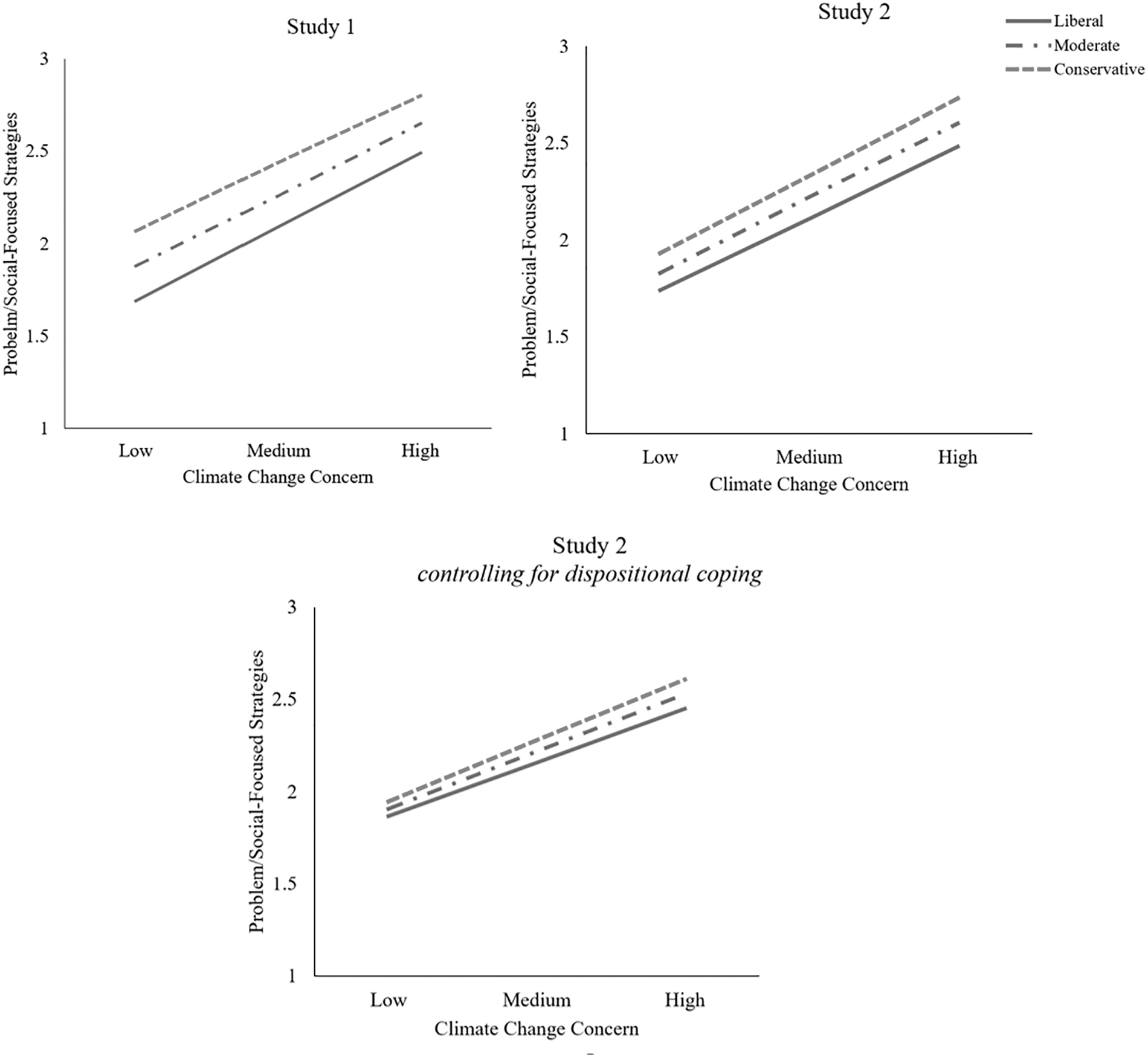
Problem/social-focused strategy use by concern and ideology. Problem/social-focused coping composite by concern and ideology for study 1 and study 2 (with and without controlling for dispositional coping). COPE items are rated on a scale from I don't do this at all (1) to I do this all the time (4). Climate change concern values represent 1 SD below the mean (“Low”; Study 1: 4.18; Study 2: 3.11), the mean value (“Medium”; Study 1: 5.29, Study 2: 4.44), and 1 SD above the mean (“High”; Study 1: 6.41, Study 2: 5.78). Liberal, Moderate, and Conservative lines are representative of 1 SD below the mean for political ideology (Study 1: 2.20, Study 2: 1.72), the mean value (Study 1: 4.78, Study 2: 3.94), and 1 SD above the mean (Study 1: 7.36, Study 2: 6.16).
Discussion
In this systematic investigation of the coping strategies used by Americans to cope with the stress of climate change, we find modest levels of engagement with a wide variety of coping strategies. Participants named a range of stressors related to climate change, but the majority seemed to be experiencing weather impacts. Participants reported high levels of acceptance coping. As climate change and its impacts become harder to ignore and given the relative lack of power an individual has to address climate change, perhaps acceptance is a necessary emotion-focused strategy. Participants also reported high levels of active coping strategies, suggesting that people do find ways to deal with their stress productively, despite the chronic and insurmountable nature of the problem of climate change.
Higher levels of concern about climate change were associated with increased use of almost all individual coping strategies (apart from humor and denial) and the two composite COPE measures. Ideology also predicted coping strategy use. At the bivariate level, conservatism was associated with disengagement coping and, more weakly, with problem/social-focused coping. Our regression analyses provided greater insight into these associations.
For conservatives, as concern increased, so did use of disengagement coping strategies, whereas the relationship between concern and use of these strategies was much weaker for liberals. For problem/social-focused strategies, there was no interaction of ideology and concern. Rather, concern strongly predicted use of the strategies regardless of ideology. However, it remained unclear whether these patterns of situational coping driven by concern and ideology could be accounted for by the ways that liberals and conservatives might differ in how they cope with stress in general.
Study 2
In the second study, we sought to replicate the observed relationships between concern, ideology, and coping found in Study 1. We also sought to address several further questions. First, are there differences in conservatives' and liberals' dispositional coping styles? Second, are the ways that people cope with climate change predicted by their dispositional coping styles? From a methodological perspective, we also wanted to isolate the situational coping task from other measures of political ideology concern, and pro-environmental behaviors, and we therefore had participants complete these tasks and measures at two time-points.
Methods
Procedures
This online study was completed at two time-points. At Time 1 (March 2021), participants completed measures of dispositional coping, concern about climate change, belief in climate change, pro-environmental behavior, and demographic measures including political ideology. At Time 2 (April 2021), 7 days after Time 1, participants were asked to complete the stress recall task used in Study 1. After this, they completed the situational Brief COPE (framed in relation to stress associated with climate change) that was used in Study 1.
Sample
Participants were recruited via MTurk. At Time 1, 493 participants completed the study and 308 (62.5%) returned at Time 2. After exclusions (see Supplementary Data), our sample consisted of 274 individuals. Ages ranged from 19 to 89 (M = 40.2, SD = 12.8). The sample was majority male (55.3%), 44% female, and included two people who did not report gender. The sample was mostly white (80.4%), 8.7% Asian, 6.5% Black, 5.1% Hispanic/Latino, and 0.7% American Indian. Most of the sample (59.7%) reported that they had attained a bachelor's or higher degree.
Measures
Measures of ideology, situational coping, demographics, and concern, as well as the instructions for the stress recall task were identical to those used in Study 1. We also measured pro-environmental behavior, but analyses associated with this measure are available in the Supplementary Data.
Dispositional coping
To measure dispositional coping style, we used the Brief COPE (Carver, 1997), instructing participants to report how they generally cope with stress in their lives, see Supplementary Data.
Results
Time 1
Overall, the sample was fairly concerned about climate change (M = 4.46, SD = 1.34) and was somewhat liberal (M = 3.94, SD = 2.22) compared with Study 1 (M = 4.78). In Study 2, political conservatism had a moderate negative correlation with climate change concern (r = −0.44, p < 0.001), a stronger correlation than was observed in Study 1 (−0.18). Compared with Study 1, the Study 2 sample was somewhat more liberal and showed a stronger association between ideology and concern.
On the dispositional brief COPE, in which people reported how they generally coped with stress, planning (e.g., “thinking hard about what steps to take”) was the most reported strategy, and denial the least, see Table 2.
Study 2 Dispositional Coping strategy Means and Correlations with Political Ideology and Climate Change Concern
p < 0.05, **p ≤ 0.01.
Because our goal was to examine how differences in dispositional coping may predict coping responses to climate stress, we were interested in how climate change concern and political ideology might predict dispositional coping (given the role of these variables identified in Study 1). Testing the correlations between dispositional coping and ideology, we found that the only significant correlations were between ideology and positive reframing, religious coping, and denial, see Table 2. Climate change concern was positively correlated with dispositional positive reframing, instrumental support seeking, emotional support-seeking, and humor, see Table 3.
Study 2 Mean Usage of Climate Change Stress Coping and Correlations with Climate Change Concern, Political Ideology, and Matched Dispositional COPE Strategy
Concern and conservative ideology were negatively correlated, r = −0.44, p < 0.001.
p < 0.05, **p ≤ 0.01.
Time 2
Dispositional coping and climate change coping
When we examined mean usage of coping strategies for climate change stress (Table 3), we found that acceptance strategies were used most frequently. Next, we examined how strongly correlated the use of each dispositional coping strategy was with the use of the same strategy to cope with climate change-related stress, see Table 3. Correlations between each dispositional coping strategy and its situational counterpart were positive and significant (rs ranging from 0.27 to 0.84, ps < 0.001). The strongest correlations were observed for religious coping (r = 0.84) and substance use (r = 0.60). Thus, dispositional coping (measured 1 week earlier) was associated with situational coping to climate-related stress.
Associations between coping strategies, concern, and ideology
We first examined bivariate relationships between coping strategies, concern, and political ideology, replicating analyses from Study 1; see Supplementary Data. For disengagement and problem/social-focused coping composites, we observed good replication of the Study 1 findings. For disengagement strategies, ideology moderated the relationship between climate change concern and use of these strategies, b = 0.02, 95% CI [0.01–0.04], SEb = 0.02, p = 0.011, and the model explained 5.1% of the variance in use of the strategies, see Figure 1.
There was no significant moderation by ideology of the relationship between concern and problem/social-focused coping, b = 0.005, SEb = 0.01, p = 0.70, see Figure 2. In an unmoderated regression, both concern (bconcern = 0.29, 95% CI [0.23–0.36], SEb = 0.03, p < 0.001) and ideology (bideo = 0.05, 95% CI [0.01–0.09], SEb = 0.02, p = 0.014) were associated with increased use of the strategy and explained 23.1% of the variance.
Although these findings using composite COPE factors replicated Study 1 results, it should be noted that at the subscale level the replication was less clear, see Supplementary Data.
Dispositional coping
Next, we examined how people's dispositional coping styles might explain the prior results. We conducted confirmatory and exploratory factor analyses but did not find that the items in the dispositional COPE scale factored in the exact same way as the situational COPE items, see Supplementary Data. Nonetheless, we created parallel dispositional disengagement and problem/social-focused composites to control for dispositional use of these strategies. The Supplementary Data contains the analyses of the 14 COPE subscales.
When controlling for dispositional disengagement strategies, the significant interaction between ideology and concern continued to emerge when predicting disengagement climate stress coping, b = 0.01, 95% CI [0.002–0.03], SEb = 0.01, p = 0.03. For conservatives, there was a positive association between concern and use of disengagement coping for climate concern, controlling for dispositional disengagement coping, b = 0.06, 95% CI [0.02–0.10], SEb = 0.02, p = 0.002. There was no such association for liberals, b = −0.003, SEb = 0.03, p = 0.92.
In this model, dispositional disengagement coping was associated with situational disengagement coping, controlling for ideology and concern, b = 0.51, 95% CI [0.43–0.60], SEb = 0.05, p < 0.001. Thus, the interaction seen in the prior analyses remains, and furthermore dispositional coping was a strong predictor of situational coping to climate stress.
In models controlling for dispositional coping, there was no interaction of ideology and concern in predicting problem/social-focused coping, b = 0.01, SEb = 0.01, p = 0.57. In the unmoderated regression, climate change concern was associated with situational problem/social-focused coping, b = 0.24, 95% CI [0.18–0.29], SEb = 0.03, p < 0.001. Ideology was not significantly associated with this form of coping, controlling for the other predictors, b = 0.03, SEb = 0.02, p = 0.14.
Dispositional problem/social-focused coping was strongly associated with situational problem/social-focused coping with climate stress, b = 0.51, 95% CI [0.40–0.63], SEb = 0.06, p < 0.001. This model explained 40.2% of the variance in problem/social-focused situational coping.
In comparison to the prior analyses that did not control for dispositional coping, climate concern remained a strong positive predictor of problem/social-focused coping but the small positive relationship between ideology and problem/social-focused coping in the prior analyses was not found when controlling for dispositional coping. This analysis also shows that dispositional coping is a strong predictor of situational problem/social-focused coping for climate stress.
While we were focused on identifying the broader patterns of coping via disengagement or problem/social-focused coping, one interesting finding was that ideology significantly predicted both situational and dispositional religious coping (the religion subscale was not included in either of the composites).
People high in conservative ideology reported more use of religion when coping with climate-related stress, and this was accounted for by their greater reliance on religion across coping contexts (i.e., dispositional coping). For more details on these analyses, see Supplementary Data.
Discussion
Study 2 had two key findings: first, dispositional coping styles are important for prediction people's use of situational climate change coping strategies (but do not entirely account for variance in the use of these strategies). Second, we replicated the findings of Study 1 where problem/social-focused coping and disengagement coping were both predicted by concern, and this link was strengthened for disengagement coping whereby conservatives who were concerned reported the greatest use of these strategies.
The links between ideology and situational coping for climate stress may be more fully explained by dispositional coping, in particular religion. When controlling for dispositional coping, ideology was no longer a significant predictor of some strategies. This does not mean that political ideology is unimportant. Rather, it appears to be the case that conservatives' use of some coping strategies for climate change stress (in particular, religion) is explained by their greater dispositional use of this coping strategy (across many domains).
General Discussion
In our current work, we have sought to further explore one component of climate change resilience, namely coping responses to the stress people report being linked to climate change. From these studies, we draw several key take-aways and highlight ways in which the current research can be further tested and applied.
Understanding people's coping responses to climate stress may be useful as clinical approaches and public policy programs are developed as part of climate change adaptation efforts. In line with past work on stress and coping, we find that people's level of concern about climate change is a significant predictor of coping responses to climate stress.
However, we also find meaningful variation between coping responses. The link between climate concern and coping is clearest for COPE responses that relate to connection with other people and active coping (i.e., emotional and instrumental support-seeking, active coping, and planning). Thus, one take-away is that climate concern does seem to be linked to coping responses that are generally viewed as adaptive.
A second take-away concerns the way in which political ideology and concern operate both independently and interactively with one another to predict coping responses. We found only a moderate negative correlation between ideology and climate change concern in both studies. Further, in both studies, after controlling for climate change concern, we find a small positive relationship between ideology and problem-focused coping in response to climate stress.
However, at the bivariate level looking simply at the relationship between ideology and use of these more active coping strategies without controlling for concern, ideology was unrelated to problem-focused coping. These findings run counter to a view of political conservatism as always being linked to dismissive or maladaptive responses to climate change.
However, more in line with this negative view of the relationship between political conservatism and climate change engagement, we found that higher levels of avoidant coping strategies such as denial and behavioral disengagement were linked with climate concern for people also high in conservatism.
Our findings on the moderating role of political ideology point to the need for more nuanced future study of this issue in response to climate change coping and adaption. Individuals differ not only in terms of global assessments of their political ideology (e.g., “conservative” or “liberal”) but also on more discrete components or dimensions of ideology (e.g., social vs. economic issues), and these different dimensions may interact in non-straightforward ways with both climate change concern and the use of various coping strategies.
Much work has shown, for example, that Democrats and Republicans differ in how much weight they give to different moral values such as harm/care and purity/sanctity (Graham, Haidt, & Nosek, 2009; Kivikangas, Fernández-Castilla, Järvelä, Ravaja, & Lönnqvist, 2021), and these differences could potentially interact with coping strategies individuals use in ways that are more complex than the findings presented here using a more global measure of political ideology.
In our work, we found that conservatives who indicated concern about climate change reported both more active and also more disengagement-focused ways of coping. The relationship between conservatism and use of religion to cope in general and with climate stress was strong, yet we found that dispositional religious coping was a stronger predictor of situational religious coping and conservatism was not.
Future work in this area might assess the psychological underpinnings of ideology using measures more detailed than the ones we chose to use to better understand the links between a person's political beliefs and identity and their coping strategies.
A third broadly important take-away is the robust link between people's dispositional coping responses and their climate specific coping responses. This finding indicates that responses to climate stress are not merely driven by people's environmental and ideological values but are also a product of people's habitual responses to stress. In at least once instance (religious coping for conservatives concerned about climate change), dispositional coping style may be critical for understanding responses to climate stress.
The studies presented here provide a starting point for more closely investigating how people respond to the stress associated with climate change. Future research can strengthen and expand upon our work in several ways. First, more work is needed to examine coping responses to more specific forms of climate stress. Our approach of asking people to describe times in which they felt stressed about climate change (and then describe coping responses) was valuable for eliciting experiences that were personally relevant for our participants.
However, the heterogeneity in responses means that further work should examine coping to different forms of climate-stress. Future work, for example, could compare coping with indirect forms of climate-change stress (e.g., watching a nature documentary about loss of biodiversity) versus more direct stressors (e.g., attributing biodiversity loss in one's own community to climate change).
Second, work is required to understand the dynamics of using different coping responses over time. For example, we find that conservatives who are concerned about climate change report increased reliance on both active and distancing responses. Future work that follows people longitudinally will give us better insight into how coping to climate stress evolves over time. Most importantly, does habitual reliance on distancing strategies reduce (over time) people's use of more active coping strategies?
Climate change represents a profound threat to human well-being. Scholarship and action on climate change differentiate between climate change mitigation (i.e., efforts at reducing greenhouse gas emissions) and adaptation (i.e., managing the consequences of climate change). Adaptation to climate change includes a wide range of responses, but a key component of adaptation is building community and personal resilience to climate change impacts (Mah et al., 2020).
Given that climate change is and will be a source of stress, work from psychologists is needed to understand how to help to promote adaptive ways of coping. In two studies, we found that coping strategies that we would consider to be related to personal resilience are already being used by most people who are concerned about climate change.
Our results suggest that among conservatives who are concerned, work may need to better understand and decrease their use of more maladaptive coping strategies. This research is only a first step in understanding personal resilience to climate change. Continued study of ways to increase resilience as climate change continues to impact people and communities is vital.
Ethics Approval and Consent to Participate
All studies were reviewed and approved by the UMass Amherst IRB under protocols no. 1359 and no. 1422. Participants provided their informed consent to participate in the studies.
Data Availability
The datasets generated and analyzed during the current study are available on OSF at https://osf.io/pb4hq/
Footnotes
Authors' Contributions
A.M. and B.L. conceived and designed the work with feedback from E.M. and A.R. The data collection, analysis, and interpretation were done by A.M. and B.L. The article was drafted by A.M., and revised following feedback from B.L., E.M., and A.R.
Author Disclosure Statement
No competing financial interests exist.
Funding Information
No funding was received for this article.

References
Supplementary Material
Please find the following supplemental material available below.
For Open Access articles published under a Creative Commons License, all supplemental material carries the same license as the article it is associated with.
For non-Open Access articles published, all supplemental material carries a non-exclusive license, and permission requests for re-use of supplemental material or any part of supplemental material shall be sent directly to the copyright owner as specified in the copyright notice associated with the article.
