




Abstract
Two studies examined the facets of active and passive forms in outdoor recreation. Study 1 demonstrated construction and validation under the Active/Passive Outdoor Recreation Scale (APORS). An exploratory factor analysis was conducted with 186 participants (M = 21.40; standard deviation [SD] = 2.50) and resulted in two factors. A confirmatory factor analysis was performed using another sample of 194 participants (M = 23.10; SD = 3.10), and the results verified the two-factor structure. The results suggest that the APORS has acceptable internal consistency (active recreation subscale—Cronbach’s α = 0.83; passive recreation subscale—Cronbach’s α = 0.74). Study 2 demonstrated relations between active/passive outdoor recreation and some aspects of well-being. The subjects were 202 recreationists (M = 22.55; SD = 3.80) who took three questionnaires, i.e., the Positive and Negative Affect Schedule, the Positivity Scale, and the Meaning of Life Questionnaire alongside the APORS. Results indicated that some aspects of well-being were positively predicted by active and passive recreation in a natural environment, but active recreation in nature predicted well-being more strongly. Additionally, the profiles of active and passive forms in outdoor recreation were presented. The first profile: multiactive recreationists (high active outdoor recreation/high passive outdoor recreation); the second profile: passive recreationists (low active outdoor recreation/high passive outdoor recreation); and the last profile: active recreationists (high active outdoor recreation/low passive outdoor recreation). The recreationists in these profiles differed in terms of well-being.
Introduction
For centuries, rivers, lakes, seas, oceans, forests, fields, and mountains have served as reservoirs for drinking water, sources of food, and medicine for people. Nowadays, they are primarily perceived as attractive places to spend free time in nature (Franco et al., 2017). Every year, millions of people participate in outdoor recreation, which is perhaps the most popular way to spend leisure time worldwide. The increase in the popularity of outdoor recreation may be a sign of modern times—it is a way of expressing one’s own needs, desires, or even dreams (Outdoor Industry Association, 2023).
Outdoor recreation may include active and passive forms (Cho et al., 2018; Holder et al., 2009). The most common criterion for distinguishing between the above forms of activity is the intensity of physical activity. Active recreation refers to activities that require physical effort and endurance. Examples of activities that are considered active outdoor recreation include mountain hiking, cycling, swimming, sailing, kayaking, etc. Active recreation helps to keep the body fit and in good shape (Eigenschenk et al., 2019; Twohig-Bennett & Jones, 2018). In turn, passive outdoor recreation constitutes a type of leisure activity that excludes physically strenuous activities (Gascon et al., 2018). It encompasses low-impact activities, such as sunbathing, bird watching, nature photography, and openly delighting in nature. Differing from active recreations, passive recreation abstains from exertion, emphasizing instead the encounter of being outdoors and nurturing an appreciation for nature. Passive recreation can be a way to relax and, at the same time, do some learning (Roy & Orazem, 2021).
The criterion of exercise intensity as a factor distinguishing between passive and active recreation can sometimes be unclear. A slow walk in an undemanding natural area, such as a park, or operating a boat at the slowest speed can be classified as both passive and active recreation. Another criterion for distinguishing between the above forms may be not only the intensity of physical activity, but also the motives for engaging in recreation. Climbing a mountain can be classified as active or passive depending on whether the purpose is to expend physical energy or to admire the scenery.
Outdoor recreation can have positive effects on subjective well-being (Pomfret et al., 2023). However, the construct of well-being is not easy to define. There are a lot of definitions in the literature for well-being. Researchers propose different dimensions of subjective well-being, such as happiness, life satisfaction, meaning in life, flow, flourishing, hope, optimism, positive affect (PA), or lack of negative affect (NA) (Diener et al., 2009; Feldman & Snyder, 2005; Martela et al., 2018; Seligman, 2011; Seligman & Csikszentmihalyi, 2014).
Conceptions of well-being encompass two distinct types: hedonic and eudaimonic (Waterman, 2008). Hedonic well-being is characterized by the presence of PA and the absence of NA. Eudaimonic well-being, on the contrary, focuses on the extent to which an individual can realize their unique potential. The eudaimonic approach posits that well-being extends beyond mere pleasure attainment and pain avoidance (Huta & Waterman, 2014).
Various models of well-being, including hedonic and eudaimonic aspects, have been proposed by different researchers. According to Diener, Lucas, and Oishi (2002), well-being is a cognitive and affective evaluation of life, which may include emotional reactions to events, as well as a cognitive evaluation of one’s life satisfaction and sense of fulfillment. Subjective well-being consists of affective components (experience of positive emotions, low frequency of negative emotions) and cognitive components (high life satisfaction). Seligman’s model is prominent among them. It delineates five fundamental features of well-being: positive emotions, engagement, accomplishment, positive relationships, and meaning (Seligman, 2011). Ryff (2014) developed a model in six key dimensions, namely autonomy, environmental mastery, personal growth, positive relations with others, purpose in life, and self-acceptance. Diener et al., (2009) introduced the model of well-being, integrating distraction, autonomy, challenges, relevance, and attachment. Keyes (1998) proposes a model of social well-being consisting of five dimensions: social integration, social contribution, coherence, actualization, and acceptance.
Most of the above well-being models include emotions, personal growth, or meaning. When circumstances are favorable and individuals are experiencing enjoyable, stimulating, and successful ventures, PA and self-development may well be adequate in maintaining a substantial degree of subjective well-being. However, when people are going through difficulties, rather than positive emotions and personal development, meaning becomes more important in maintaining some level of well-being (Wong, 2011).
Numerous studies have demonstrated the beneficial effects of outdoor recreation (without distinguishing between active and passive forms) on well-being (Allan et al., 2020). It is widely agreed upon that spending time in natural environments can have a positive impact on physical, psychological, social, and spiritual well-being.
Outdoor recreation is associated with a number of positive physical benefits. It promotes general health factors such as fitness and obesity (Twohig-Bennett & Jones, 2018). The physical health benefits of outdoor recreation also help to improve cardiovascular function: lower blood pressure, lower resting heart rate, and reduced risk of heart attack. In addition, the health benefits of outdoor recreation include a reduced risk of several diseases: 13 types of cancer, stroke, and type 2 diabetes (Eigenschenk et al., 2019; Moore et al., 2016). Outdoor recreation helps prevent mental illnesses like dementia or some depressive disorders (Mapes, 2016). Besides reducing ill health, outdoor recreation helps to improve subjective overall health and physical quality of life (Puett et al., 2014). In summary, recreation in blue and green environments appears to have positive physical effects that go beyond the benefits of being physically active in a non-natural environment (Thompson Coon et al., 2011).
Along with physical benefits, outdoor recreation promotes psychological aspects of well-being. Outdoor recreation promotes autonomy, authenticity, personal development, discovering the joy of achievement, self-esteem, vitality, flow, or encouraging the use of more effective coping skills. Outdoor recreation evokes positive emotional states, such as satisfaction, enjoyment, mood, and resilience (Mayer and Frantz, 2004; McMahan & Estes, 2015; Nisbet & Zelenski, 2011). Simultaneously, it reduces stress, depression, confusion, anxiety, rumination, or anger (Bodin & Hartig, 2003; Crust et al., 2013; Korpela et al., 2014). Outdoor recreation supports social interactions and social competences (Norton & Watt, 2014).
Exploration of nature helps to make life meaningful (Cervinka et al., 2012). Further, regardless of age, activity in green environment increases personal meaning in life (Schnell, 2009). Exploration of nature is important for experiencing the aesthetic and transcendent. The beauty and power of nature can be admired during outdoor recreation in landscapes such as mountains, lakes, seas, or oceans (Frumkin et al., 2017; Keltner & Haidt, 2003; Shiota et al., 2007). Recreation in blue and green environments can also foster a sense of connection to something greater than oneself (Kawachi et al., 2008; Shiota et al., 2007). Individuals often return to places where they have had exciting experiences, creating a unique identity for the location that can enhance their well-being (Houge Mackenzie et al., 2013).
Outdoor recreation can play a therapeutic role. Meta-analyses of research on outdoor education show the effectiveness of educational and therapeutic programs conducted in a natural environment (especially programs conducted over a long period of time). The effects of these programs were higher self-esteem and self-awareness in their participants, reduced stress, improved optimism, and better cognitive functioning (Gass et al., 2012; Hattie et al., 1997). Young people participating in social rehabilitation programs have expressed the belief that this form of rehabilitation can be an effective form of therapy, enabling them to adapt better socially (De Matos et al., 2017).
The above studies have demonstrated the positive effects of outdoor recreation on well-being. However, the studies do not distinguish between active and passive forms of outdoor recreation. Therefore, the aim of the current research is to analyze the relationships between active/passive outdoor recreation and hedonic/eudaimonic aspects of well-being.
The research consists of two studies. The first study presents the construction of the Active/Passive Outdoor Recreation Scale (APORS). The second study presents correlations between APORS and various aspects of hedonic and eudaimonic well-being.
The last part of the article discusses the findings in relation to APORS and its relationship with some aspects of well-being.
Study 1: Development and validation of the APORS
The research concerning leisure activities suggests that outdoor recreation comprises both active and passive forms (Roy & Orazem, 2021). Thus, these two aspects of outdoor recreation have been distinguished: active and passive. Thus, the APORS was designed specifically for this study.
During the initial construction phase of the questionnaire, 12 statements were developed for active forms of outdoor recreation and an additional 12 for passive forms. Active forms of outdoor recreation involved relatively high levels of physical exertion and endurance. Passive forms of recreation excluded physically strenuous activities.
Six experts were consulted to evaluate the quality of the items, including three in sport psychology and three in environmental psychology. Using a 5-point Likert scale (very poor, poor, fair, good, and very good), the experts independently rated the initial pool of items representing active and passive outdoor recreation. Items with an average score of 4.0 or higher were retained. This selection methodology resulted in a reduction in the number of statements to 18, with 10 items for active recreation and 8 items for passive recreation.
Exploratory factor analysis (EFA)
The first aim of this study was to determine the factor structure of the Active and Passive Outdoor Recreation Questionnaire. The second aim was to determine its reliability.
Method
Participants
In order to verify the APORS structure, the initial study was conducted with 186 participants—101 women (54.30%), 81 men (43.55%), 3 (1.60%) identified as non-binary, and 1 (.55%) identified as other.
The age of the subjects ranged from 18 to 28 years (M = 21.40 years; standard deviation [SD] = 2.50). Most of the participants (n = 146) were residents of cities (78.50%) while the other participants (n = 40) lived in villages (21.50%). All participants had attained a minimum of a secondary level of education. Focusing on how many weeks per year the participants spend in the natural environment, n = 110 (59.2%) of the participants spend 0–2 weeks in the natural environment, n = 67 participants (36.00%) spend 3–5 weeks in the natural environment, and n = 9 (4.80%) spend more than 5 weeks in the natural environment.
Procedure
The research data were collected through the use of Google Sheets and a computer application accessed via the internet. Google Sheets is an interactive form corresponding to the graphical design of paper. Subjects completed the questionnaire directly online. Participants were recruited through a variety of internet-based networks aimed at people who live in the Pomeranian region of Poland, close to the Baltic Sea, and who enjoy spending time in nature. The region boasts of numerous lakes, rivers, sea, and forests, as well as gentle mountains and two national parks: Slowinski National Park and Wolinski National Park.
Results
Data obtained from above sample were examined by EFA. Prior to factor extraction, the Kaiser–Meyer–Olkin (KMO) measure of sampling adequacy and Bartlett’s test of sphericity (BTS) was applied to the data: KMO = 0.788, BTS χ2 (120) = 914.740, and p < 0.0001. This indicated that a reliable factor analysis could be performed.
The initial analyses using a parallel analysis suggested the possibility of a two-factor solution. Thus, a two-factor solution was selected, taking into account the loading of their theoretical interpretations. One-factor solution was also tested. EFA was used to determine the factor structure of the APORS. EFA using the principal component analysis of the statements of the APORS revealed two factors. The first factor contained eight items of active recreation, and the second factor consisted of seven items of passive recreation (two lower-load statements were removed from the first factor [active recreation] and one-lower statement from the second factor [passive recreation]) (see Table 1).
Medium, Standard Deviation, Factors, and Item-Total Correlations of the Active/Passive Outdoor Recreation Scale (n = 186)
SD, standard deviation.
The factor structure explains about 43% of the variance. The factors have satisfactory reliability, as measured by Cronbach’s alpha. The reliability of the first factor (active recreation) is Cronbach’s α = 0.84; the reliability of the second factor (passive recreation) is Cronbach’s α = 0.73.
Confirmatory Factor Analysis (CFA)
The next stage of the work was to conduct a CFA. Two models were tested: the first model (M1) assumed a one-factor solution and included all statements about active and passive outdoor recreation. The second model (M2) assumed a two-factor solution (Factor 1: “active outdoor recreation,” items 1, 3, 5, 7, 9, 11, 13, 15; Factor 2: “passive recreation”; items: 2, 4, 6, 8, 10, 12, 14). Several indices to evaluate the model based on empirical data were used: χ2(df), comparative fit index (CFI), and a root mean squared error of approximation (RMSEA) (Marsh et al., 2004).
Method
Participants
In this study, data were collected from a sample consisting of 194 participants, 90 women (46.40%), 98 men (50.50%), 5 (2.55%) identified as non-binary and 1 (.50%) identified as other. Among the collected sample, 136 participants lived in cities (70%) and the other (n = 58) participants lived in villages (30%). Participants live in the Pomeranian region of Poland, close to the Baltic Sea.
Looking at weeks spent outdoors per year, n = 110 (56.70%) respondents spent 0–2 weeks outdoors, n = 73 (37.60%) respondents spent 3–5 weeks outdoors, and n = 11 (5.70%) respondents spent more than 5 weeks outdoors.
Procedure
Based on the results obtained in the EFA, CFA was conducted on scale scores in the second group of 194 participants. These recreationists received the Active/Passive Recreation Questionnaire, being informed that the study was anonymous and voluntary.
Results
The results of the CFA are shown in Table 2. The two-factor model proved to be a better fit to the empirical data.
Indices for Each Model
CFI, comparative fit index; RMSEA, root mean squared error of approximation.
A CFA for another group of respondents partially confirmed a two-factor solution: CFI = 0.886; RMSEA = 0.08; χ2 (103) = 306.162; p < 0.01. The Active/Passive Outdoor Recreation Scale is presented in the form of a supplementary material in the Supplementary Appendix S1.
Study 2. Active/Passive Outdoor Recreation and Well-Being
The correlates of well-being are of interest to researchers (Lyubomirsky, 2001). One such variable is outdoor recreation, which has a positive impact on a range of physical, psychological, emotional, and social well-being processes (Mansfield et al., 2020; Newman et al., 2014).
Outdoor recreation includes active and passive forms. Active recreation refers to activities that require physical effort and endurance. In turn, passive recreation excludes physically strenuous activities. It does not involve any physical exertion (Roy & Orazem, 2021). Numerous studies have shown that recreation in green and blue environments can have a positive impact on different aspects of well-being (Twohig-Bennett & Jones, 2018). However, there is insufficient data to simultaneously relate well-being to both active and passive forms of outdoor recreation.
Thus, the aim of this research is to analyze the relationship between active and passive recreation and hedonic/eudaimonic well-being. Hedonic well-being is commonly defined as the experience of pleasure and the avoidance of unpleasantness. On the contrary, eudaimonic well-being is linked to the fulfillment of human potential, self-satisfaction, contentment with life, a positive outlook on the future, and a sense of purpose in one’s life (Huta & Waterman, 2014). For the purpose of this study, the hedonic and eudaimonic aspects of well-being will be analyzed.
The Positive and Negative Affect Schedule (PANAS) scale will be used for the assessment of the hedonic well-being. This scale measures the intensity of positive and negative emotions in an individual’s life (Watson et al., 1988). Two scales will be used to diagnose eudaimonic well-being: Positive Orientation Scale (POS) (Caprara, 2009) and Meaning of Life Questionnaire (MLQ) (Steger et al., 2006). POS has been proposed as the common underlying factor for self-esteem, optimism, and life satisfaction (Diener et al., 1985; Rosenberg, 1965; Scheier & Carver, 1993). In turn, MLQ assesses two dimensions of meaning in life: the presence of meaning and the search for meaning. In the study, the APORS scale was also used for the diagnosis of active and passive outdoor recreation.
Method
Participants
A total of 202 participants were involved in the study. The average age of the participants was M age = 22.55; SD = 3.80. On the question of gender: 106 (52.30%) of the respondents identified as women, 90 (44.60%) identified as men, 4 (2.10%) identified as non-binary, and 2 (1.10%) identified as other. The majority of respondents (n = 158) (78.20%) resided in urban areas, while the remaining participants (n = 44) (21.70%) lived in rural locations. All participants had attained a minimum of a secondary level of education.
Looking at weeks spent outdoors per year, n = 115 (56.95%) respondents spent 0–2 weeks outdoors, n = 75 (37.15%) respondents spent 3–5 weeks outdoors, and n = 12 (5.90%) respondents spent more than 5 weeks outdoors.
Procedure
The research data were collected through the use of Google Sheets and a computer application accessed via the internet. Google Sheets is an interactive form corresponding to the graphical design of paper. Subjects completed the questionnaire directly online.
Participants were recruited through various internet-based networks targeting people living in the Pomeranian region (Poland) near the Baltic Sea who enjoyed spending time in nature. Data collection took place between October and November 2023.
Measures
APORS
PANAS (Watson et al., 1988).
The PANAS was created to provide brief measures of PA (10 items) and NA (10 items). The correlation coefficients were 0.73 for PA and 0.90 for NA (Polish adaptation: Brzozowski, 2010).
Positivity scale (POS)
The positive orientation scale (Caprara, 2009) consists of eight items measuring the tendency to see positive aspects of life, with three components: self-worth, optimism, and satisfaction, ranging from 1 (totally disagree) to 5 (totally agree). Cronbach’s α correlation coefficient is 0.84 (Polish adaptation: Łaguna et al., 2011).
MLQ (Steger et al., 2006)
The MLQ is a 10-item scale with two subscales: presence of meaning in life (Cronbach’s α = 0.86) and search for meaning in life (Cronbach’s α = 0.72) (Polish adaptation: Kossakowska et al., 2013).
Results
Descriptive statistics for the APORS and the scales of well-being are reported in Table 3.
Descriptive Statistics of Active/Passive Outdoor Recreation and Well-Being Scales in the Group of Respondents (n = 202)
In the subsequent stage, a regression analysis, a tool to determine the relationship between two variables, was applied (Westfall & Henning, 2013). Derived from the independent variable, this study treated the two aspects of outdoor recreation (active/passive) as independent variables and assessed their impact on variables of well-being (dependent variables) (see Table 4).
Active/Passive Outdoor Recreation and Well-Being. Results of Multiple Linear Regression
The active outdoor recreation subscale positively predicted PA, positive orientation, and presence of meaning. In turn, the passive outdoor recreation subscale positively predicted PA and positive orientation.
In the next stage of the study, a clustering analysis for the subscales of outdoor recreation was used (K-means clustering method). The main goal of a cluster analysis is to group the respondents into clusters. The respondents in a cluster should be similar to one another and be sufficiently different from the respondents in the other clusters (Jung et al., 2014). A clustering analysis was used in this study to extract the basic clusters for individuals who practice active and passive outdoor recreation. In other words, respondents with similar scores on the active or passive outdoor recreation subscales were grouped within a cluster and different scores from respondents grouped in other clusters were sought.
Different numbers of clusters were tested. The K-means clustering method showed that the cluster model with the best fit was a three-cluster model. In this model, the variance between the groups is higher than the variance within the groups for the active and passive recreational activities subscales simultaneously (higher variance between groups than variance within any single group is an important criterion in extracting clusters) (see Table 5).
Variance Within and Between Groups for Active and Passive Outdoor Recreation Subscales. Results of Clustering Analysis for Two and Three Clusters (n = 202)
The first cluster comprises the 69 respondents who scored high on both recreational activities scales (high score on the active recreation subscale and a high score on the passive recreation subscale: multiactive recreationists). The second cluster contains the 65 who had low scores on the active outdoor recreation subscale and high on the passive one (passive recreationists). The last is composed of the 68 respondents who received low scores on passive outdoor recreation scale and high scores on active outdoor recreation subscale (active recreationists) (see Fig. 1).
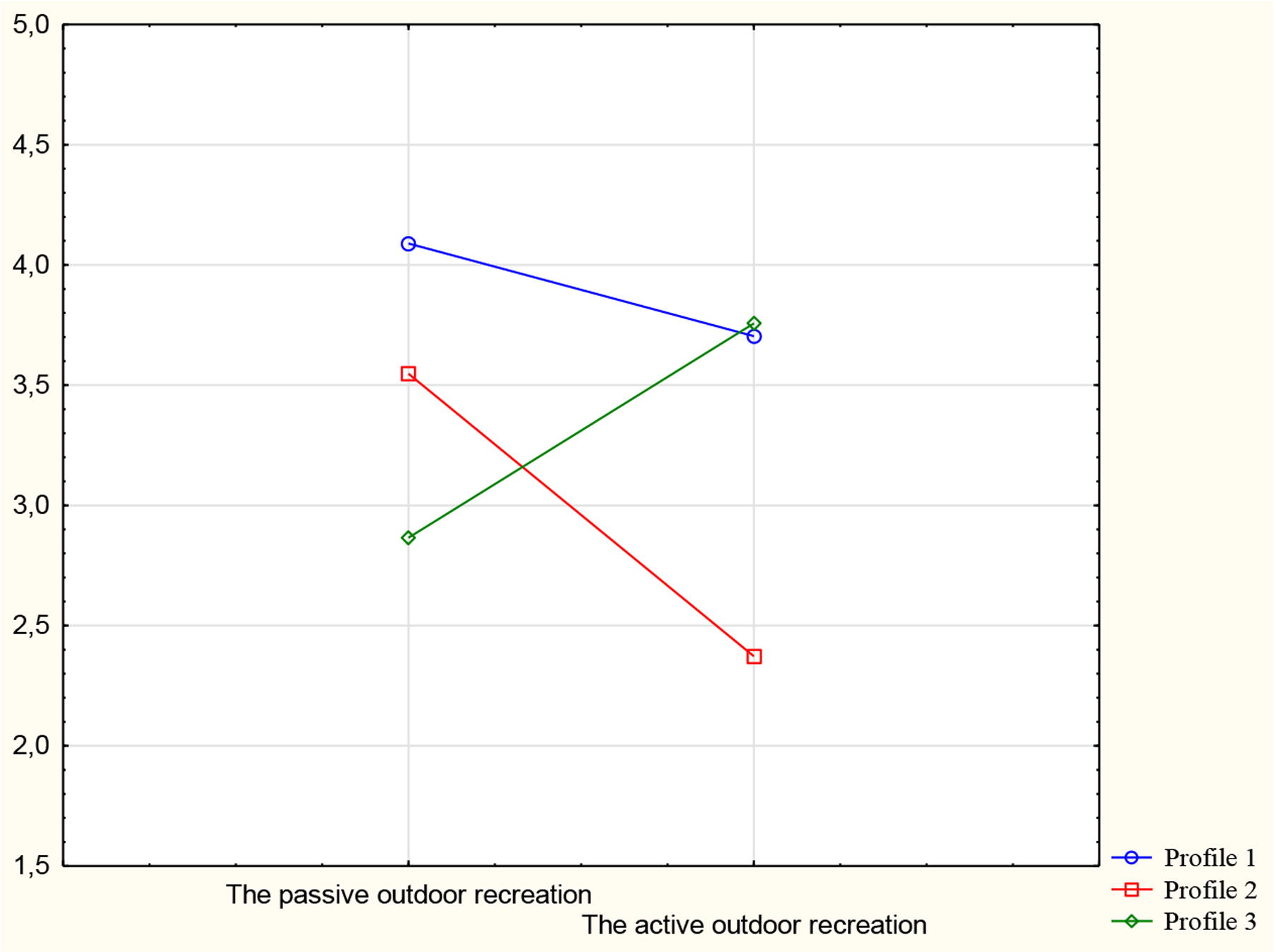
Profiles of active and passive outdoor recreation in the group of respondents (n = 202).
In the final step, scores on the well-being variables in the three clusters of the respondents were compared (see Table 6).
The Well-Being Scales for Three Profiles of Active/Passive Outdoor Recreations. Results One Way Analysis of Variance (n = 202)
p < 0.05; **p < 0.05.
The group who practiced both active and passive outdoor recreation had significantly higher means on PA, positive orientation, and presence of meaning in life than the group of respondents who undertook passive recreation in close contact with nature. Additionally, the group of multiactive recreationists had a significantly higher mean on PA than the group of active recreationists.
Discussion
The aim of this research was to create a new tool for diagnosing active and passive outdoor recreation. The research also aimed to analyze the relationship between active/passive outdoor recreation and some aspects of hedonic and eudaimonistic well-being.
The results presented in the first study indicate that the APORS is a valid and reliable tool. Results of factor analyses show that the APORS is a two-factor instrument. Additional psychometric properties of the APORS were found in the CFA. The CFA results show that the hypothesized model is relatively a good fit to the data, successfully verified the factor structure of the APORS, and provide strong evidence for the validity of the APORS. The scale’s reliability is high.
Current research using APORS suggests that both active and passive outdoor recreation are associated with various aspects of hedonic and eudaimonic well-being. The active outdoor recreation subscale positively predicted PA, positive orientation, and presence of meaning. In turn, the passive outdoor recreation subscale positively predicted PA and positive orientation. However, active recreation in nature has a stronger correlation with well-being than passive outdoor recreation.
A stronger correlation between active recreation and well-being compared with passive recreation can be interpreted by considering the biological basis of physical activity. Several studies suggest that exercising in nature triggers the release of hormones, including endorphins and serotonin (Malm et al., 2019). These hormones have been shown to enhance positive mood or energy levels and to decrease anxiety (Eigenschenk et al., 2019). Exercise in green spaces also increases the blood flow to the brain, improving cognitive skills such as problem solving, attention, and learning (Duncan et al., 2014; Mandolesi et al., 2018). To summarize, physiological processes can affect mental health. In this context, it is understandable that there is a stronger correlation between active leisure-time activities in nature than passive leisure-time activities (those without exercising).
The research findings can be explained not only in terms of physiological processes but also by taking into account the psychological perspective.
Recreation in natural environments can fulfill important needs, such as autonomy, relationships, relaxation, or aesthetic appreciation (Newman et al., 2014). These needs can be met through passive leisure time or through active exploration, which requires physical effort. Meeting these needs can result in positive emotions. Therefore, it is understandable that there is a significant positive relationship between active and passive recreation in the natural environment and PA. The results obtained are consistent with numerous studies that have analyzed the correlation between time spent in nature and well-being (Eigenschenk, 2019). It is important to note, however, that the relationship between outdoor recreation and well-being has a stronger effect when the recreation is active rather than passive, such as for example contemplation of nature. Active recreation in a natural environment is likely to fulfill the aforementioned needs to a greater extent.
Engaging in active recreation in a natural environment is associated with a greater sense of meaning in one’s life, whereas passive recreation lacks this property. Meaning in life refers to the overall satisfaction one experiences from living a life that aligns with important values and goals (Wong, 2011). Active recreation in a natural environment, by definition, involves pursuing specific goals in a natural setting. These goals can be important for individuals not only in a natural environment but also in lifelong activities. Achieving them gives a sense of meaning to one’s life. Passive recreation in natural environments is not associated with achieving goals within a certain time frame, and therefore, lacks a connection to meaning in life.
The importance of goal attainment for well-being is emphasized by Seligman’s model (2011) (achievements as a component of well-being), Ryff’s model (2014) (purpose as a component of well-being), and Newman and Tay’s model (challenge as a component of well-being). In these models, the attainment of goals is a fundamental requirement for life satisfaction. Considering these models, it appears that a correlation between engaging in active outdoor recreation and overall life satisfaction can be interpreted.
Both passive and active outdoor recreation promote a positive orientation. Positive orientation is a synthesis of three latent variables: self-esteem, optimism, and life satisfaction (Caprara et al., 2009). Therefore, it seems that time spent in a natural environment positively supports one’s self-esteem, determines a positive attitude toward the future, and promotes life satisfaction. Passive recreation is less conducive to positive orientation than active recreation in a natural environment. Active recreation in a natural environment allows individuals to use their skills and abilities (self-efficacy) more effectively than passive recreation, leading to an improved self-image, increased confidence in their abilities, and a sense of satisfaction.
Individuals who participate in both passive and active outdoor recreation exhibit a greater degree of positive emotions, a positive orientation, and a sense of purpose in life. Active recreation in a natural environment can fulfill the need for implementing one’s own competences, while passive outdoor recreation can provide rest, relaxation, and aesthetic enjoyment. Therefore, the more needs that are met by the natural environment, the greater the level of positive emotions, self-esteem, optimism, and overall satisfaction with one’s life. In essence, the greater the variety of experiences an individual has in the natural environment, the more it enhances their overall well-being.
Previous research has highlighted the positive impact of spending time in natural environments on mental health (Eigenschenk et al., 2019). It appears that the validity of the frequency of contact with the natural environment is not the only factor to consider. How individuals interact with the natural environment, whether actively or passively, can have a significant impact on their well-being.
Limitations and future directions
The study carried out has certain limitations. First of all, the APORS hasn’t been validated for populations in other regions and countries. This means that this scale is only valid for this specific population in this specific region and country. Future research should include the construction and validation of the APORS, taking into account other regions and countries.
The generalizability of the obtained research results is limited owing to the focus on young participants. To improve the applicability of the findings, future research should investigate the relationship between active/passive outdoor recreation and well-being in other age groups, as the age variable may modify the results.
Additionally, future research should also take into account gender and control for it in the analyses. Sensation-seeking research suggests that gender plays an important role in the active exploration of the natural environment, particularly in relation to adventure and thrill seeking, and there is objective evidence that individuals of different genders may have different levels of interest in active adventure recreation (Zuckerman, 1994).
The relationship between active and passive outdoor recreation and well-being does not mean cause and effect, especially when correlation values are low. Therefore, the idea of linking between variables must be handled with great care. This study analyzed only some of the variables that contribute to well-being. Future research could include elements of well-being that were not part of the study, such as flourishing, vitality, or flows.
Conclusions
Nature is our original and natural home. We are a part of it, and our physical and mental well-being is dependent on it. The benefits of nature on physical health are numerous, including increased life expectancy, faster recovery from illness, lower blood pressure and heart rate, and reduced levels of adrenaline and cortisol in the blood (Eigenschenk, 2019). Nature promotes the reduction of stress, depression, internal tensions, and anger, as along with fostering personal development, increasing self-esteem, and improving social competences (Pomfret et al., 2023).
The results of the research suggest that spending time in nature can predict several aspects of hedonic and eudaimonic well-being. Spending active time in nature has been linked to positive emotions, positive orientation, and a sense of purpose in life. Passive contact with nature may also have some benefits for subjective well-being, but these are weaker than those from the active exploration of nature. These results suggest that not only the presence or absence of contact with nature but also the type of contact should be analyzed when exploring the relationship between humans and nature.
Footnotes
Author Disclosure Statement
The author declares that he has no competing financial interests or personal relationships that can have an impact on this research
Funding Information
This research did not receive any specific grant from funding agencies in the public, commercial, or not-for-profit sectors.

References
Supplementary Material
Please find the following supplemental material available below.
For Open Access articles published under a Creative Commons License, all supplemental material carries the same license as the article it is associated with.
For non-Open Access articles published, all supplemental material carries a non-exclusive license, and permission requests for re-use of supplemental material or any part of supplemental material shall be sent directly to the copyright owner as specified in the copyright notice associated with the article.
