




Abstract
Climate change is a global crisis posing exceptional threats and demands on our younger generations. Our aim was to understand how climate-change worry and hope relate to climate-friendly behaviors, life satisfaction, and negative affect in young people across Qatar and Sweden—countries with different climates and challenges. Data from young people between 16 and 19 years of age from Sweden (n = 277; 61.37% female) and Qatar (n = 134; 49.25% female) were used. Participants completed questionnaires online. Correlational and regression analyses were used to test bivariate and unique associations and moderation effects. Climate worry was positively associated with climate-friendly behaviors in both samples. Climate worry was positively associated with negative affect and negatively associated with life satisfaction in the sample from Qatar, whereas in the Swedish sample it was only positively associated with negative affect. There was a significant interaction between climate hope and worry on climate-friendly behavior (interaction coefficient = 1.44, p = 0.0032) in the sample from Qatar, and on life satisfaction (interaction coefficient = 0.61, p = 0.036) in the sample from Sweden. Climate hope’s positive effects on these outcomes were significant at higher levels of worry. This study shows the importance of considering both the unique effects and the interplay between hope and worry across regions to understand the impacts of the climate crisis on young people.
Climate change is a major global health crisis (Romeu, 2021; Watts et al., 2018; Wu et al., 2020), exacerbating existing health and socioeconomic inequalities globally, particularly for the younger generations who face the threat of worsening climate change with age (Sanson et al., 2018; Ursano et al., 2017; Watts et al., 2018). Even when young people are not directly confronted with extreme climate events, they are exposed to the effects of this problem through media, campaign efforts, and education (Flöttum et al., 2016; Sanson et al., 2019; Sanson & Bellemo, 2021). Young people are particularly vulnerable to the psychological effects of the climate crisis because of the threats and demands that the crisis poses in their lifetime and the developmental demands of their age (Clayton et al., 2014; Clayton et al., 2017; Ojala 2015; Sanson et al., 2018). Many young people are worried and concerned about the climate crisis (Clemens et al. 2022; Hickman et al., 2021; Ingle & Jafry, 2019; Ojala et al., 2021; Vercammen et al., 2023). Although negative emotional experiences are normal reactions in response to the climate crisis (Sanson & Bellemo, 2021), it is important to understand the type and intensity of these psychological reactions and their possible associations with satisfaction with life and general negative affect among young people.
Young people will vary in how they think and feel about climate change and in how they cope with stress-induced reactions (Ojala, 2013). Worry and hope are two important stress-induced cognitive-emotional reactions, playing a critical role in how people feel and react to and cope with uncertainty and potential threats in the environment (Borkovec et al., 1998; Folkman, 2010; Lazarus, 1991; Lazarus & Folkman, 1984; Ojala, 2007; Sweeny & Dooley, 2017). Worry is typically characterized as an unpleasant emotional experience owing to preoccupation with or thinking about possible future negative events (Borkovec et al., 1998; Sweeny & Dooley, 2017). Hope is viewed as a future-oriented positive emotion evoked by appraisals that a desirable goal is possible to reach, although the outcome is uncertain (Lazarus, 1991). Constructive hope does not resort to the denial of a problem, but it is mainly about facing a difficult situation and perceiving possibilities for positive change (Lazarus, 1991; Miceli & Castelfranchi, 2010). Thus, both worry and hope are associated with the future and with uncertainty.
The motivational effects of climate worry and concern have been well documented in the literature. In a recent longitudinal study with young people from Australia, it was reported that increasing climate worry over time was associated with societal engagement (Sciberras & Fernando, 2022). In a study conducted across four countries (Canada, France, United Kingdom, and United States) with young people and young adults, 18 years and older, showed that climate concern was positively associated with climate activism: boycotting and signing petitions (Boulianne & Ohme, 2022). In addition, a recent study with young people from the UK showed that higher climate distress was associated with greater climate activism (Vercammen et al., 2023). A review study also showed that climate-change worry among both adults and young people most often is positively related to various types of climate-change engagement (see Ojala et al., 2021). A recent cross-cultural study with young adults, however, showed that these positive associations seem to be stronger in countries characterized by higher levels of individualism (Ogunbode et al., 2022).
Reports on the association between climate-change worry and different aspects of mental well-being have been inconsistent. Some studies report on a positive association between climate-change worry and general negative affect and others report no relation with measures of life satisfaction (see Ojala et al., 2021 for a review; McBride et al, 2021). There is even a study showing positive relations between climate-change anxiety, on the one hand, and emotional, social, and psychological well-being, on the other, among people living in Poland (see Marczak, 2024). Therefore, there is a need of more studies about the association between climate worry and different aspects of mental well-being.
Regarding hope about climate change and climate engagement, two review studies showed that hope, measured as an emotion, mostly had no or weak positive associations with climate-friendly behaviors (Geiger et al., 2023; Ojala, 2023). There are, however, also studies indicating that hope could have a positive relation to climate engagement, although in these cases hope is often operationalized as a cognitive concept (Stevenson & Peterson; see Ojala, 2023). Studies about climate hope and how it relates to mental well-being are rare, but the few that exist indicate that experiencing hope about this problem could be important for general well-being (Marczak, 2024; Ojala, 2005). Hence, more studies about climate hope among young people and its relation to well-being and climate engagement in different cultural contexts are needed.
In addition, few studies have investigated the interplay among climate-related cognitive-emotional reactions such as hope and worry and their relative impact on climate-friendly behavior and different aspects of mental well-being. Among a sample of middle school students from the USA, climate change concern and hope were independently associated with climate-friendly behavior and there was no interaction between them (Stevenson & Peterson, 2015). In a Swedish study, however, hope and worry about global environmental problems in a group of young adults interacted in predicting one form of pro-environmental behavior, namely recycling (Ojala, 2008). In this study, it was only among those who were highly worried that hope, measured as an emotion, had a positive association with recycling. Regarding mental well-being, one study found that hope had a mitigating effect on the association between worry about global environmental problems and low subjective well-being among adolescents (Ojala, 2005). Considering emotions are key behavioral drivers (Loewenstein & Lerner, 2003) and are vital for mental well-being, it is important to continue to investigate the associations between emotional reactions to climate change and various aspects of mental well-being and climate-friendly behaviors to promote a sustainable and healthy future for young generations. Cross-cultural studies with young people about these matters remain limited in the literature.
Current Study
We set out to examine the possible interaction between climate-change worry and hope as well as their independent association with climate-friendly behavior, life satisfaction, and general negative affect in young people living in Sweden and Qatar. In contrast to Sweden, we were unable to identify any work conducted in Qatar on young people’s emotional reactions to the climate crisis. According to a recent review, the majority of the studies on young people’s climate-related worry, concern, and mental well-being have been conducted in “industrialized countries with largely White populations” (Ramadan et al., 2023). This is an increasingly important topic to understand and address, which may show important regional differences that will need to be considered in community and school programs targeting the issue. Whereas both Sweden and Qatar are coastal countries, they differ in temperature levels, the types of threats posed by climate change, and in cultural, structural, and political aspects. Therefore, it is important to understand young people’s experiences across countries with different climates and challenges. The research questions are:
Do young people in Sweden and Qatar differ in their levels of worry and hope about climate change as well as in their reported climate-friendly behaviors, life satisfaction, and general negative affect? How do climate worry and hope relate to young people’s climate-friendly behaviors, life satisfaction, and general negative affect? Does the effect of climate hope on climate-friendly behaviors, life satisfaction, and negative affect vary across levels of climate worry in young people?
Method
Participants and procedure
Sweden
Emails were sent to secondary schools asking for permission to conduct the study in these schools. Participation was voluntary and sampling was by convenience in different municipalities in the southern and mid part of Sweden. The responses from young people were completely anonymous and no personal data were collected. According to the Swedish Ethics Act, ethics applications are only demanded if sensitive personal data are collected. Data were collected by trained assistants during school hours with the help of an online survey system. The data collection took place during spring 2021–spring 2022. The students were given information about the study and ethics (voluntary participation, anonymity etc.) both in paper format and via oral instructions and thereafter the ones who chose to take part in the study consented to their participation by starting to answer the online questionnaire.
Originally, the sample included 294 participants recruited from secondary schools in Sweden. Data from 5 participants were removed owing to missing information about their age, and data from further 12 participants were discarded because they were outside of the eligible age of 16–19 years (those discarded noted their age as 15, 20, or 27). The remaining sample included 277 participants, with 170 identifying as female and 102 as male, and with 5 having missing information. All participants completed a Swedish version of the questionnaire.
Qatar
Participants eligible for recruitment were between the ages of 16 and 19 years of age attending secondary schools in Qatar. Emails were sent to several secondary schools in Qatar, which included the participant information sheet and survey link to the online study. Data were collected between January and April 2022. Participation was voluntary and sampling was by convenience. Young people of multiple nationalities who were interested in participating accessed the survey through the survey link shared by their school, read the participant information sheet, and completed the online informed consent before proceeding with the study. Participants had to confirm they are residents in Qatar and are between the ages of 16 and 19 years.
In total, 134 participants completed the study, with eighty-four 16-year-old participants, forty-two 17-year-old participants, and eight 18-year-old participants. Of the total sample, 66 identified as female, 66 as male, and 2 chose other. All participants completed an English version of the questionnaires. All procedures for the study with the sample from Qatar was reviewed and approved by the College of Medicine, Veterinary & Life Sciences at the University of Glasgow (project ID: 200220207).
Measures
Worry and hope in relation to the climate crisis
Participants were asked to indicate from not at all = 1 to a very large extent = 6 the level of worry and hope they experience in relation to the climate crisis using single items: “To what extent are you worried about the climate change problem?” and “To what extent do you feel hope about the climate change problem?.”
Climate-friendly behavior
These behaviors were measured with 12 items capturing both behavior in everyday life (e.g., how often one is: “Turn off the lights when leaving an empty room”) and communicating the need to do something about the environment to other people (e.g., how often one is: “trying to influence one’s friends or/and peers to care more for the environment”) (Ojala, 2012). Each item was assessed on a 5-point scale (almost never, seldom, sometimes, often, almost always). The total scale score showed good reliability in both samples (Sweden alpha = 0.86; Qatar alpha = 0.87).
General negative affect
Negative affect was measured with seven items about anxious and depressive feelings felt during the past week, taken from the Child Depression Scale (Radloff, 1977). Example items include: “I have felt down and unhappy.” Each item was rated on a 4-point scale from not at all to often. The total scale score showed acceptable reliability in both samples (Sweden alpha = 0.89; Qatar alpha = 0.91).
Life satisfaction
Life satisfaction was measured using a 7-item scale assessing young people’s thoughts about and satisfaction with their own lives (Huebner, 1991). A 6-point rating scale was used in the Swedish sample with options ranging from 1 = does not apply at all to 6 = apply very well, and a 4-item rating scale was used in the Qatari sample (1 = never, 2 = sometimes, 3 = often, and 4 = almost always). The total scale score showed acceptable reliability in both samples (Sweden alpha = 0.86; Qatar alpha = 0.83).
Data analysis
All analyses were conducted in SPSS version 29.0.1.0. Descriptive statistics were generated for all variables in the study including mean and standard deviation. Mean differences across the two samples were examined using t-tests and welch t-test when there was a violation of the homogeneity of variance assumption. To examine associations, bivariate Pearson correlations were estimated. Multiple regression was used to estimate unique associations between climate change worry and hope and the relevant variables of interest (climate-friendly behavior, negative affect, and life satisfaction), while controlling for sex. To estimate the moderation models, we used regression-based models in PROCESS with bootstrapping methods (Hayes, 2017). Models were estimated with and without sex as a covariate. Sex was used as a covariate as some studies have reported on sex differences in relation to the outcomes of interest in this study. When the interaction was significant, the conditional effects of climate change hope at various levels of climate change worry were examined. The conditioning values of climate change worry used were −1 standard deviation, mean, and +1 standard deviation.
Results
Are there differences in worry, hope, engagement, and well-being in the two samples?
Table 1 shows the descriptive statistics and tests of mean differences across the two samples. The two samples from Sweden and Qatar did not significantly differ on any of the variables. We could not compare the samples in terms of life satisfaction owing to the discrepancy in rating scales used.
Descriptive Statistics and Differences across Groups
welch t-test was used due to violation of homogeneity of variance assumption.
How do worry and hope relate to engagement and well-being?
Table 2 shows the bivariate Pearson correlations among the variables across the two samples. In both the sample of young people from Qatar and the sample of young people from Sweden, climate-change worry was significantly positively associated with climate-friendly behaviors. This means that the more the young people in the two countries worried, the more they were inclined to behave in a climate-friendly manner. In addition, there was a significant positive relation between climate hope and climate-friendly behaviors in the sample from Qatar. However, no significant association between climate hope and climate-friendly behaviors was found in the Swedish sample.
Correlations Among Variables in the Two Groups (Sweden Below the Diagonal and Qatar Above the Diagonal)
p < 0.05.
Climate worry was further significantly positively associated with negative affect and negatively associated with life satisfaction ratings in the sample from Qatar. In the sample from Sweden, climate worry had a significant positive association with negative affect, but in contrast to the result in the Qatari sample, worry had no significant association with life satisfaction. In addition, climate hope had no significant relations to life satisfaction and general negative affect in the sample from Qatar, but it had a significant positive association with life satisfaction and a significant negative relation to general negative affect in the Swedish sample. Finally, climate worry and hope were significantly positively correlated in the sample of young people from Qatar but not associated in the sample from Sweden.
Multiple regressions and moderation analyses
Using multiple regression, we first tested the unique effect of climate worry and hope, while controlling for sex, on climate-friendly behavior, negative affect, and life satisfaction ratings. The standardized regression coefficients (beta) and respective standard errors are reported in Table 3.
Multiple Regression Assessing Unique Associations between Climate Change Worry and Hope and the Three Domains of Interest
p < 0.05.
Female sex was a significant unique correlate of negative affect in both samples, but to a larger degree in the Swedish sample. Climate worry was a unique positive correlate of negative affect and a unique negative correlate of life satisfaction in the sample from Qatar, but not in the Swedish sample. Among both the samples, climate worry was a unique positive correlate of climate-friendly behaviors.
Climate hope had a unique positive association with life satisfaction and a unique negative association with general negative affect in the Swedish sample but did not have a unique association with life satisfaction and negative affect among the sample from Qatar. Regarding climate-friendly behavior, climate hope had a unique positive effect in the sample from Qatar but not in the Swedish sample.
Moderation results
In the sample of young people from Sweden, while controlling for the effect of sex, the moderation effects were not significant in the climate-friendly behavior model (interaction coefficient = 0.005, p = 0.9880), negative affect model (interaction coefficient = −0.15, p = 0.5283), and life satisfaction model (interaction coefficient = 0.48, p = 0.1097). When sex was not included in the moderation models, the results remained similar with no significant interaction terms in the negative affect and climate-friendly behavior models (p > 0.05). However, the interaction was significant in the life satisfaction model (interaction coefficient = 0.61, p = 0.036). The test of highest order unconditional interaction was significant [R2-change = 0.02, F = 4.44 (1,262), p = 0.036]. The conditional effects of climate hope on life satisfaction ratings at three levels of climate worry (−1 standard deviation, mean, and +1 standard deviation) are in Table 4 and shown in Figure 1. There was a significant positive effect of hope at higher levels of worry. Thus, climate hope seems to play a particularly important role for life satisfactions when young people in Sweden feel a high degree of climate-change worry.
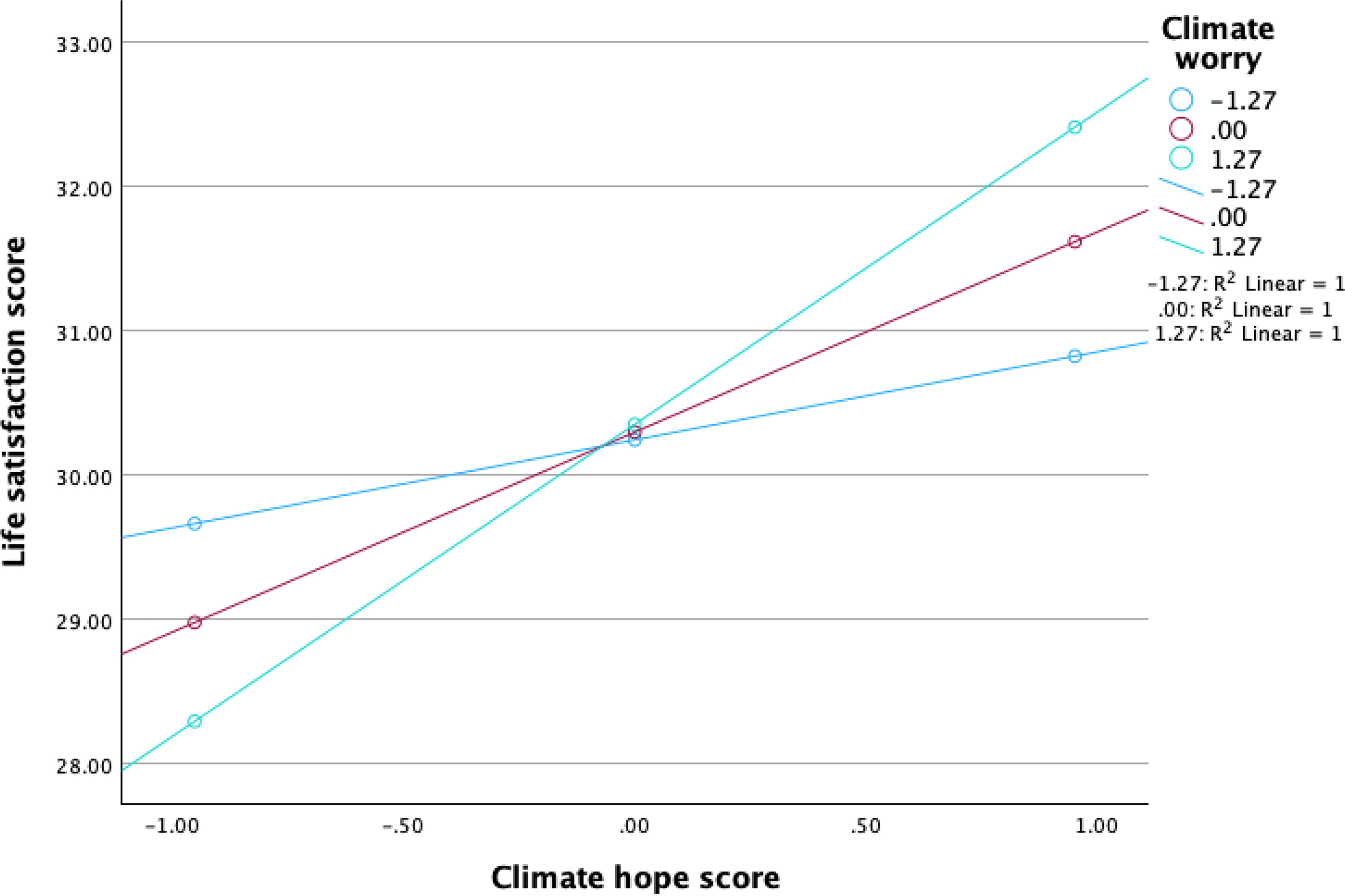
Conditional effects of climate hope on life satisfaction at different levels of worry in the sample of young people from Sweden.
Conditional Effects of Climate Hope at Values of Climate Worry on Life Satisfaction in the Swedish Sample and on Climate-Friendly Behaviors in the Qatari Sample
In the sample of young people from Qatar, while controlling for the effect of sex, the moderation effects were not significant in the negative affect model (interaction coefficient = −0.28, p = 0.3559) or the life satisfaction model (interaction coefficient = 0.15, p = 0.5658). The moderating effect of climate worry on the association between climate hope and climate-friendly behavior, while controlling for the effect of sex, was however significant (interaction coefficient = 1.44, p = 0.0032). The test of highest order unconditional interaction was significant [R2-change = .06, F = 9.00 (1,127), p = 0.0032]. The conditional effects of climate hope on climate-friendly behaviors at the three levels of climate worry are presented in Table 4 and shown in Figure 2. The only significant positive effect of climate hope on climate-friendly behaviors was seen with high levels (+1 standard deviation) of climate worry (b = 2.93, p = 0.0007), whereas the conditional effects at −1 standard deviation on climate change worry and at the mean of climate change worry were nonsignificant. The results remained similar even when sex was not included in the moderation models, whereby the interaction effects were not significant in the negative affect and life satisfaction models (p > 0.05) but significant in the climate-friendly behaviors model (p < 0.05).
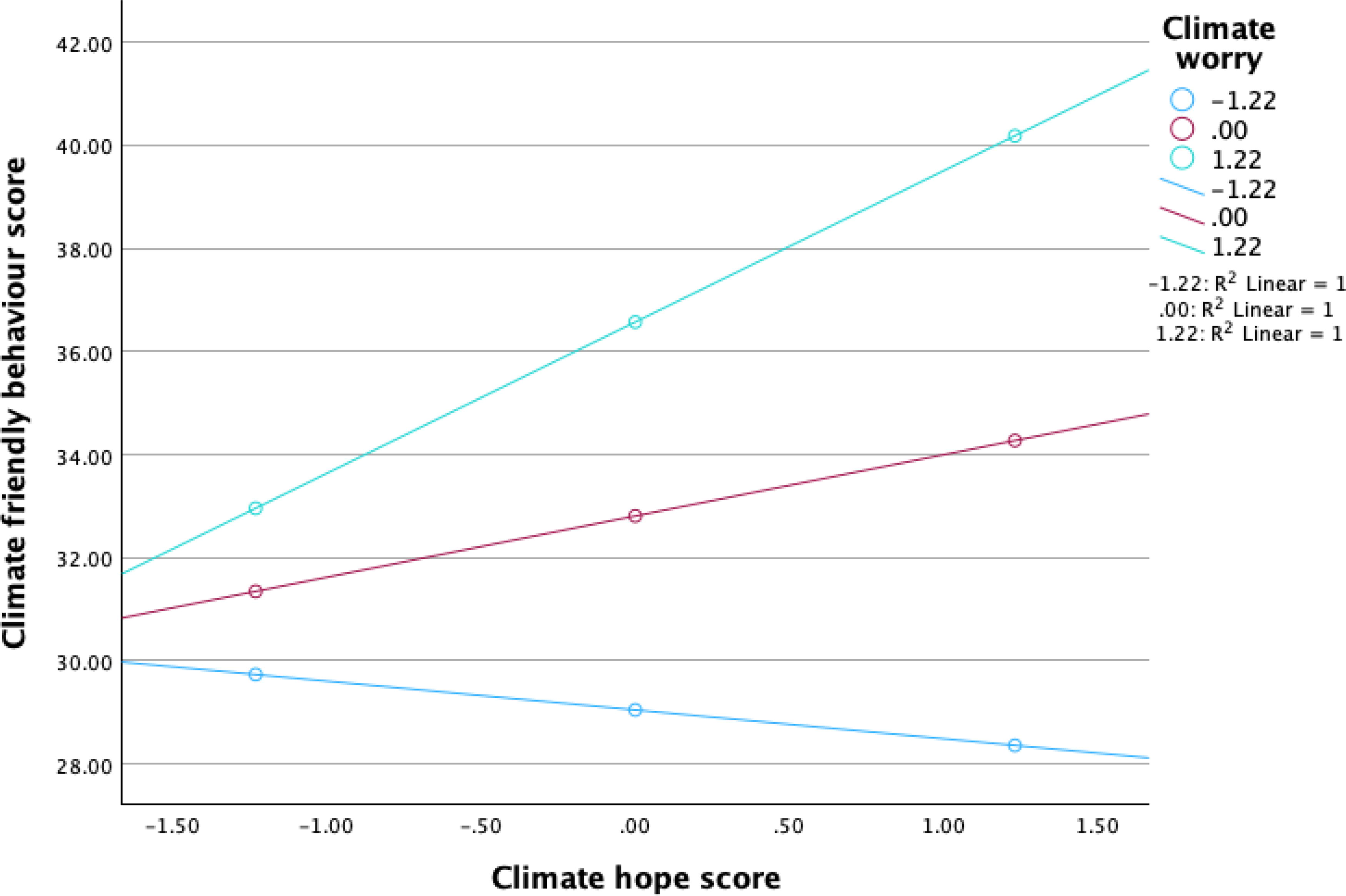
Conditional effects of climate hope on climate-friendly behaviors at different levels of worry in the sample of young people from Qatar.
Discussion
In this study, our aim was to understand how climate-change worry and hope relate to life satisfaction, general negative affect, and climate-friendly behaviors in young people across Qatar and Sweden. Although this is the first study of this kind performed in Qatar, it is notable that young people across the two samples were similar in most respects reporting similar levels of climate worry and hope, negative affect, and climate-friendly behaviors.
The results on climate-change worry are largely consistent with previous research that has shown the motivational impact of climate worry among young people (Ojala et al., 2021; Sciberras & Fernando, 2022; Stevenson & Peterson, 2015). In our study, climate worry was significantly positively associated with climate-friendly behavior in both the Qatari and Swedish samples and had a unique association with engagement when controlling for the effect of climate hope in regression analyses. However, the positive association was stronger in the Swedish sample than in the Qatari sample. This is in line with the results in Ogunbode and colleagues’ study with young adults where the relation between worry and engagement was stronger in countries characterized by higher levels of individualism (2022), with Sweden being one of the most individualized countries in the world (EVS, 2022).
Unsurprisingly, climate worry was independently associated with climate-friendly behavior in both samples. As Dodds puts it, negative emotions can be mobilized for action (2021). It is prefaced that this can be done when the negative emotions associated with climate stress are safely experienced and not debilitating to one’s health. Nonetheless, higher levels of climate worry were also associated with higher reported general negative affect in both samples and with lower life satisfaction among young people from Qatar, highlighting worry’s potential to be negatively implicated in domains related to young people’s general psychological well-being. This is consistent with previously reported negative associations between climate-change worry and different aspects of mental well-being among young people (Ojala et al., 2021; Reyes et al., 2021; Sciberras & Fernando, 2022). This is, however, the first time that this relationship is reported in young people living in Qatar. More longitudinal studies need to be performed to find out if it is climate worry that drives low life satisfaction and high negative affect or if the relationship is in the opposite direction, or indeed bidirectional, whereby one maintains the other in a cyclical manner. Results from Scriberras and Fernandos’ longitudinal study indicate that it is not necessarily climate-change worry that drives depression despite the positive association between the two domains (2022). The findings might suggest that a third factor explains susceptibility to both depression and climate worry, or that initial levels of depression, explain increases in those symptoms overtime. However, the study did not test for these specific alternatives and as such much remains to be explored in future work.
The findings on the associations between climate hope, life satisfaction, general negative affect, and climate-friendly behavior are novel, highlighting that this is an important cognitive-affective reaction to climate change; hope has variable implication for young people’s climate-friendly behaviors, life satisfaction, and negative affect. It is notable that hope seems to be an important positive correlate of climate-friendly behavior in the sample from Qatar. Most importantly, the interaction between climate worry and hope had a significant effect on climate-friendly behavior in the sample from Qatar, whereby hope’s positive effect on climate-friendly behavior was evident foremost with high levels of worry. This finding is consistent with an earlier study in Sweden with younger adolescents (Ojala, 2008). Although the overall association between hope and behavior was also significant, this result indicates that it is foremost a combination of high climate-change worry and hope that is associated with a high degree of engagement.
In the Swedish sample, there was, however, no association between hope and climate-friendly behavior, and we also did not find any interaction between worry and hope. Earlier studies have shown that in Western countries hope measured as an emotion is not always positively related to behavioral engagement (see Ojala, 2023). For some young people, climate hope can be based on denial of the seriousness of climate change, which is negative for engagement, whereas hope for other young people is based on more constructive sources like trust in oneself and others, which are positively associated with engagement (Geiger et al., 2023; Ojala, 2023). This could perhaps be one possible explanation to the nonsignificant correlation between hope and climate-friendly behavior in the Swedish sample. In future studies, sources of hope should be measured, and not only resort to hope as a pure emotion.
Regarding climate hope’s association with negative affect and life satisfaction, in the Swedish sample, higher climate hope was associated with lower general negative affect and higher life satisfaction. In addition, based on the interaction effects, we see that climate hope had a positive effect on life satisfaction at high levels of worry in the Swedish sample. To identify factors that could promote different aspects of mental well-being in the face of the climate threat is important, especially since many young people in this age-group are suffering from low mental well-being in general, not least in Sweden. This study is one of few showing the potential importance of climate hope in this regard (see also Marczak, 2024).
However, somewhat surprisingly, no meaningful associations were found between climate hope, on the one hand, and negative affect and life satisfaction, on the other, in the Qatari sample. At present, there are very few empirical psychological studies with young people residents of Qatar. To understand these results in a better way, it would be interesting to perform qualitative studies about the meaning of hope for young people in both Qatar and Sweden and see if the sources of hope are different for the young people in these two countries. This investigation could help us then advance hope-based initiatives that can promote life satisfaction and well-being in young people while engaging in climate-friendly behavior.
Overall, the results show that climate hope is important for climate-friendly behavior among young people from Qatar and important for life satisfaction and lower general negative affect for Swedish young people. Climate worry is a motivational force in both countries, and yet to a certain degree related to lower life satisfaction and higher general negative affect. Taken together, the findings speak to the importance of communicating both the seriousness (worry) of climate change and possibilities for change for the better (hope) to young people. Community based initiatives that take young people’s negative emotions of worry seriously and mobilize those by offering spaces for proenvironmental engagement can increase a sense of agency and hope in young people and promote well-being (Hart et al., 2014; Hayes et al., 2018; Koger et al., 2011).
Limitations and future directions
The samples of young people were recruited through convenience sampling, which likely limits the generalizability of the findings to the larger young people population in the respective countries. Therefore, the results would benefit from future replication with larger and representative samples. We cannot infer causality about the associations examined in this cross-sectional study, and future replications and extensions of this work would benefit from prospective study designs. As the samples constituted of self-report, there is the limitation with shared method variance that might introduce bias. These limitations can be overcome in future research that uses multi-informant data (e.g., parents, teachers). Nonetheless, it is vital that psychological research considers young people’s perspective when examining issues of relevance to their well-being. Further, due to a lack in gold standard tools measuring climate-change worry and hope, we opted to use one-item measures that are time efficient and to minimize the burden on young people completing the survey. There is much scope for future research to develop these tools further. In addition, beyond age, sex, and country of residence, we did not collect other sociodemographic information such as socioeconomic status. Future research can aim to collect such information, especially from parents, in order to characterize the samples and assess whether such factors are associated with climate change-related variables and outcomes.
Conclusions
Overall, both the unique effects as well as the interplay among hope and worry appear to be relevant for us to properly understand the impacts of the climate crisis on young people across the world. Most important, climate change hope’s effect on life satisfaction in young people in Sweden and proenvironmental behavior in young people in Qatar was dependent on average and above average levels of climate change worry, suggesting that the protective and motivational effect of hope depends on co-occurring worry. Therefore, in addition to targeting efforts at mitigating worry, we need to design proenvironmental and wellbeing initiatives that mobilize young people’s concern about the climate crisis and builds on their hope. The results highlight how these emotions may have different roles across cultures or regions, which should then be taken into account when designing cross-regional programs to deal with climate stress and promote proenvironmental engagement and life satisfaction.
Footnotes
Acknowledgments
The authors thank Malin Rosengren and Grazzia Matamoros at Gothenburg University, Sweden, and Hilda Antilla for their help with the data collection in Sweden. The authors also thank the schools in Qatar who assisted with survey distribution and the students who participated in the study.
Authors’ Contributions
J.R. and M.O.: Conceptualized the study including aims and research questions and collected the data. J.R.: Conducted the data analysis and wrote the original draft of the article. M.O.: Supported the writing of the original draft and contributed to review and editing of latter versions.
Author Disclosure Statement
The authors have no relevant financial or nonfinancial competing interests to report.
Funding Information
The collection of data in Sweden was partly financed by the project Ocean Blues: From anxiety to action (PI: Malin Rosengren) Financed By The Swedish Research Council Formas (2019-01765).