




Abstract
According to the biophilia hypothesis, humans have a fundamental tendency to affiliate with nature. If this hypothesis is true, large majorities of people should express a high level of nature-friendliness (a tendency to affiliate with nature), and this level should have low variability across cultures. We tested this proposition using the interculturally applicable Human and Nature (HaN) scale. We compare the outcomes from 12 previously published studies that applied the HaN scale on four continents and show that a high level of nature-friendliness was indeed detected in all countries. We also demonstrate that the cross-cultural variability of the nature-friendliness levels was as small as their within-culture variability. Jointly then, these 12 studies offer strong support for the biophilia hypothesis. We share implications that are valuable for policymaking as well as further theoretical development of human–nature relationship research, particularly around relational values with nature and ecological virtue ethics.
Introduction
Half a century ago, Fromm (1964) coined the term biophilia, meaning love (“philia”) of life (“bios”). Later, Wilson (1984) used the term “biophilia hypothesis” when pointing at an innate tendency of humans to affiliate with nature. This hypothesis continues to carry direct relevance for biodiversity conservation, because feeling connected to other species and landscapes is a fundamentally important basis for minimizing biodiversity loss and moving toward a better way of living together (e.g., Ives et al., 2018; Zylstra et al., 2014). Moreover, the biophilia hypothesis is important for policy design, because policies developed to activate a propensity that people already possess are different than policies designed to change behavior by forcing something alien upon people (Bouman & Steg, 2019; Golebie & van Riper, 2023). Direct empirical evidence of the biophilia hypothesis is scant, however. This is the focus of the present article.
The biophilia hypothesis
Over decades, there have been multiple conceptualizations of biophilia. For Fromm (1964), for instance, the bios in biophilia referred to human and nonhuman life, while Wilson (1984) discussed “life and life-like processes,” which in practice translated to a focus on nonhuman life (i.e., living nature), with significantly less attention paid to life-like processes or nonliving nature such as geological formations. As for the philia element in the definition, Wilson sometimes also used the term “focus.” Following Wilson and the later biophilia authors, we understand the biophilia concept to be an affiliation (i.e., a positive affect) with nature, including living and nonliving entities. 1
There is also a debate whether biophilia should be defined as innate, that is, hard-wired in our genes, as in Wilson (1984). Such a prefixed position in the debate of genetic determinism versus free will (Sapolsky, 2023) acts as a burden to biophilia research (Kahn, 2011). Yet, there seems to be a broad-felt difference between ephemeral desires and deeper, more stable, and pervasive human needs and propensities. Fiske (2018), for instance, writes about the deep human need to affiliate with other humans (“sociophilia,” we might say) and calls it a “core motive.” We propose to emulate this wisdom and define biophilia as a fundamental human tendency. Possibly innateness then becomes a question of debate and research rather than a definitory struggle.
Strictly speaking, the biophilia concept carries no empirical claim. The biophilia hypothesis, however, does (Kellert and Wilson, 1993). It posits that biophilia is a general human trait, while, of course, allowing for individual differences depending on, for example, genes, early experiences, and contexts of expression. All in all, for the purpose of the present article, we propose that the biophilia hypothesis states that humans have a fundamental tendency to affiliate with nature.
In terms of measurability, the biophilia hypothesis has two different components. One is the “affiliate with nature” component, which is directly measurable with individual-level tools such as observations or questionnaires. Examples are actions to create a more biologically diverse garden and expressing the need for biodiversity conservation. In the present article, this component is called nature-friendliness. The second component is the “fundamental tendency,” as nature-friendliness may be either ephemeral or expressing a fundamental tendency. Nature-friendliness might be identified on the individual level through, for instance, life-story interviews, yet biophilia authors such as Kellert (1993) and Kahn (1999) identify fundamentality at the group level. If nature-friendliness is measured as persistently high and with only slight variation across age or culture, this indicates a fundamental human tendency. We follow this reasoning in the present article.
Although the biophilia hypothesis is widely taken up and studied, there are two main criticisms that warrant consideration. The first one concerns the position of biophilia with respect to its opposite, biophobia (Orr, 1993). First of all, it is clear that biophobia exists: people fear snakes and being on wobbly rocks, and avoid being in freezing rain (Bixler & Floyd, 1997; Shipley & Bixler, 2017). Moreover, these affects may be strong and fundamental, just like biophilia. Should we therefore conceptualize biophobia as deeply separate from biophilia? We follow Kahn (2011) in stressing that people love nature, including the fears and struggles it brings. Fear of nature can coexist with respect and admiration of nature. After this, we position biophobia as an integral part of the overarching concept of biophilia, which is encompassed by our use of the term “affiliation” in our definition.
A second criticism is that the biophilia hypothesis is too broad to be falsified, and therefore not testable (Joye & De Block, 2011; Kahn, 2011). For that reason, Kahn (2011) tends to regard biophilia as a theory-level construct, producing many testable hypotheses on more specific, concrete levels. But why, in fact, could a very broad hypothesis not be open to disconfirmation? Questionnaires can test multiple elements or dimensions of a construct and therefore test hypotheses. Therefore, we synthesized previous research that has used a scale that consists of multiple survey items and dimensions of how people relate to nature, while allowing for agreeing or disagreeing with these ideas; see our Methods section for more details. This way, the present article contributes to empirical testing of the biophilia hypothesis and extends previous evidence for the biophilia hypothesis detailed in the following paragraphs.
Evidence for the biophilia hypothesis
Evidence for the biophilia hypothesis comes in both theoretical and empirical support. Evolutionary biologists, for instance, have pointed to the intimate bonds between humans and nature during the greater part of history, and philosophers have pointed to the nature-friendliness even of hierarchist thinkers (e.g., Aristotle, Kant) who have argued that animals have no soul or reason (Adamson & Edwards, 2018). Fiske’s (2018) assertion that humans have a fundamental need to connect with other people has been mentioned already. If the aforementioned assertion that humans have a fundamental need to connect with other people is true, a fundamental need to also connect with nature, on which humans are also dependent, becomes more plausible.
Another form of evidence has been generated by way of Kahn’s “testable hypotheses,” connected with small-scale empirical research. A mass of medical and psychological studies, for instance, have shown that nature-based experiences promote physical and mental well-being (Kaplan, 1995; Hartig, Mitchell, De Vries, & Frumkin, 2014; Bratman & Olvera-Alvarez, 2022). Whether we walk in nature, do volunteer work in nature, or just see nature on a screen, the effect is always more positive than in artificial, urban, or mixed environments (Schwartz, Dodds, O’Neil-Dunne, Danforth, & Ricketts, 2019; Browning, Mimnaugh, van Riper, Laurent, & LaValle, 2020; Shin, Browning, & Dzhambov, 2022a). The root cause, somehow, must be that an affiliative response to nature is deeply embedded in humans.
Several survey scales have been developed to formulate generalizable conclusions about human–nature relationships based on large samples (Flint, Kunze, Muhar, Yoshida, & Penker, 2013; Muhar et al., 2018; Kleespies & Dierkes, 2020). Examples are the Connectedness-to-Nature Scale (CNS) (Mayer & Frantz, 2004; Navarro et al., 2022), the Nature Relatedness Scale (Nisbet, Zelenski, & Murphy, 2008), the Love and Care for Nature scale (Perkins, 2010), Dispositional Empathy toward Nature (Tam, 2013), and the Human and Nature (HaN) scale (De Groot, Drenthen, & De Groot, 2011). These studies support the biophilia hypothesis in that they tend to show high levels of nature-friendliness in people’s responses. This support is only partial, however, because the survey analyses to date have not addressed the question of whether the measured responses may express a fundamental human tendency. Noteworthy exceptions are found in the work of Kellert (1993) and especially of Kahn (1999). As said already, both authors ground their confirmation of fundamentality, and with that of the biophilia hypothesis, in the invariability of the levels of nature-friendliness across background variables.
In Kahn (1999), the high level of cross-cultural invariability 2 is considered especially important because the interpretation of invariability across other background variables tends to be limited by what we may call the culture argument. If people of different backgrounds express a similar level of nature-friendliness, it could be that rather than expressing a fundamental propensity, they are invariably expressing a learned notion that dominates the culture they are all embedded in. For this reason, we argue that cross-cultural invariability provides strong support for the biophilia hypothesis. A key assumption of the present article is thus that cross-culturally high and invariable levels of nature-friendliness provide particularly strong support for the biophilia hypothesis.
Survey-based work aiming at cross-cultural analysis should be based on a scale that is cross-culturally valid. Such a scale should express an underlying conceptual scheme that links up with cultures of the global South, West, and East. In that respect, the HaN scale stands out from the others, because it measures a broad range of philosophically grounded concepts of relationships between humans and nature, also called “images of relationship” (Van den Born, Lenders, De Groot, & Huijsman, 2001). These images are classified as follows: (1) Mastery over nature: humans are allowed to do with nature as they please; (2) Stewardship of nature: humans stand above nature but with a responsibility to care for it; (3) Partnership with nature: humans and nature are involved in mutual development; and (4) Participation in nature: humans are (modest) parts of nature or a greater spiritual whole. In this way, the HaN scale enables respondents to express their degrees of adherence or rejection toward ideas typically present in dominant Western philosophy (cf. Descartes’ Masters and Possessors of Nature), Christianity and Islam (Haq, 2003; Wijsen and Anshori, 2023; “stewardship”), as well as the more radical ecocentric ideas often found in current ecospirituality, Eastern and indigenous cultures (e.g., Gagliano, 2013). The HaN scale is ideally suited for evaluating the biophilia hypothesis in contrast to other scales that measure nature-friendliness, because it has been applied in a wide array of countries across Europe, Asia, and the Americas, and has been validated used in both qualitative (e.g., Kemp et al., 2017) and quantitative (e.g., Van Riper et al., 2019) studies.
Aim of the present study
The aim of the present article is to investigate the biophilia hypothesis, defined previously, through the outcomes of HaN scale survey research. We examine the tendency to affiliate with nature as part of the biophilia hypothesis through research question 1: to what extent can a high average level of nature-friendliness be found in the HaN survey outcomes? We examine the fundamentality part of the hypothesis through research question 2: what is the cross-cultural variability of the level of nature-friendliness in the HaN survey outcomes, and how does it compare with within-culture variability?
Method of the Present Study
The data set of the present study consisted of the outcomes of all 12 published peer-reviewed survey studies in which the HaN scale was used, with sample sizes greater than 100 respondents. 3 The studies used the same HaN classification, largely the same questionnaire statements and similar methods of analysis, ensuring straightforward comparability. Moreover, because the database comprises all available HaN scale studies rather than representing a sample from some wider population of studies, our conclusions can be drawn by way of direct inspection, without statistical inference being needed.
Some sampling differences did exist between the HaN scale studies. For example, Van den Born (2006) used a representative sample of a national population, De Groot (2012) involved a random sample from rural municipalities, and the sample of Calderón Moya-Méndez, Ganzevoort, Lenders, and van den Born (2022) was fully urban. These differences do not affect the validity of the outcomes of the present article, because the tested prediction of the biophilia hypothesis is that the research outcomes should be largely invariable over any sample. The same holds for the differences between the questionnaire items in which the HaN-scale items were often embedded due to the studies’ wider topics, which could concern, for instance, invasive species, urban environmental management, or river management. Here too, if invariability of HaN-scale outcomes is found, the variation of these contextual topics only strengthens the robustness of HaN-scale outcome invariability.
Methods Applied in HaN Studies
To adequately interpret the outcomes from HaN studies within our data set, as well as key terms such as “outcome classification,” this section describes the typical research methods used. We take De Groot (2012), a survey with 1,811 respondents in France, the Netherlands, and Germany, as an example. The outcomes are presented in Table 1.
The Questionnaire Items That Comprise the Four Images of the Human and Nature Relationship in the Outcome Classification of De Groot (2012), a Human and Nature Scale Survey in France, the Netherlands, and Germany (n = 1,811)
In the right column are the mean levels of adherence to the items and (italicized) the images as a whole.
Levels of adherence were derived from a survey scale that ranged from −2 (fully disagree) and 2 (fully agree); all factor loadings exceeded 0.42 and all Cronbach’s alpha coefficients exceeded 0.68.
Item was originally conceptualized as part of the Stewardship of nature image.
Item was originally conceptualized as part of the Participation in nature image.
Item was originally conceptualized as part of the Partnership with nature image.
Table 1 shows the statements (i.e., survey items) that made up the HaN scale. The statements varied little over the two decades of HaN-scale applications. Respondents indicate their level of agreement with statements, ranging from “fully disagree” (recoded into −2) to “fully agree” (recoded into +2). Therefore, a mean level of adherence to a group of statements of +2 means that all respondents have fully agreed to all statements of that group. Thus, in Table 1, the image of Mastery over nature, due to its negative mean level of adherence, can be said to be rejected overall, while the mean of 1.58 of Stewardship of nature can be interpreted as strong overall adherence to that image.
In the HaN scale, four groups of statements are designed to jointly express the four images of relationships with nature (i.e., Master, Steward, Partner, and Participant). These four images, as formulated in environmental philosophy, form the “mother classification.” In all HaN-scale survey studies, the responses to the statements have been analyzed using a type of factor analysis that identifies underlying concepts (“factors,” often also called “dimensions” in psychological parlance). In the HaN studies, these dimensions and the statements that form them are called the empirically grounded outcome classification, which reproduces the mother classification to a degree that is different in each HaN-scale study. Table 1 presents the outcome classification of the 2012 example study. As can be seen with help of the table’s note, the four dimensions reproduced the mother classification well, justifying labeling the dimensions with the original images’ names. As we will see, in other HaN studies the outcome classification does depart from the mother classification to different degrees, for instance, when three rather than four dimensions emerge from the data. Such a deviance shows that the way respondents view their human–nature relationships may differ from the theoretical mother classification. For instance, in some studies (e.g., Kemp et al., 2017), Partner and Participant statements were grouped together, indicating that the respondents perceive only marginal differences between these underlying philosophies. For all 12 HaN-scale studies, the images of the outcome classification and their mean levels of adherence were taken up to form the data set of the present analysis.
Results
Table 2 represents the constructed data set: the mean levels of adherence to the images in the outcome classifications of all (12) internationally published HaN-scale surveys with more than 100 respondents.
Mean Levels of Adherence to the Images of the Human and Nature Survey Scale Across 12 Case Studies
Levels of adherence were derived from a survey scale that ranged from −2 (fully disagree) to 2 (fully agree).
A three- or two-dimensional structure fitted the data best, resulting in merged cells or “—” in the table.
A level of adherence to the Master dimension was deemed not applicable because its statements differed from the standard HaN scale.
The “Other” category denotes mixed sets of statements that did not conceptually align with the standard HaN images.
Fr = France, De = Germany; “Europe 7” = Finland, Germany, Slovenia, Belgium, the Netherlands, Italy, and the United Kingdom.
This sample included nonactivists for biodiversity conservation because these respondents more closely represented the general population.
HaN, Human and Nature.
Concerning the mean levels of adherence to the images (research question 1), Table 2 shows a clear-cut pattern. The image of Mastery over nature was rejected in all countries on the four continents, whereas the image of Stewardship of nature was strongly adhered to, with mean levels of adherence ranging between 1.27 and 1.58. Less massively but consistently, the two more ecocentric images (i.e., Partnership with nature and Participation in nature) drew positive mean responses in all countries. In cases where the factor analysis indicated that a merged Stewardship/Partnership image better fitted the data (viz. the 2003, 2016, and 2017 studies), the responses fitted fully in the overall pattern.
With respect to the cross-cultural invariability (research question 2), Table 2 provides evidence for these patterns. The degrees of rejection of the Mastery image in the last three studies (United States, Vietnam, and Peru), for instance, all fall within the range set by the preceding European studies. The same holds for the other images evaluated in previous research.
Figure 1 has been designed to highlight the invariability phenomenon. It contrasts the within-country variability against the cross-country variability of the HaN-scale outcomes, enabled by the fact that half of the 12 HaN studies were carried out within a single country (the Netherlands). 4 Within-country variability may be regarded as a baseline variability, caused by chance, different types of samples, different research contexts, slightly different wordings of the questionnaire statements, and so on. Compared with this baseline variability, any added variability between studies carried out in a variety of other countries would indicate a country effect.
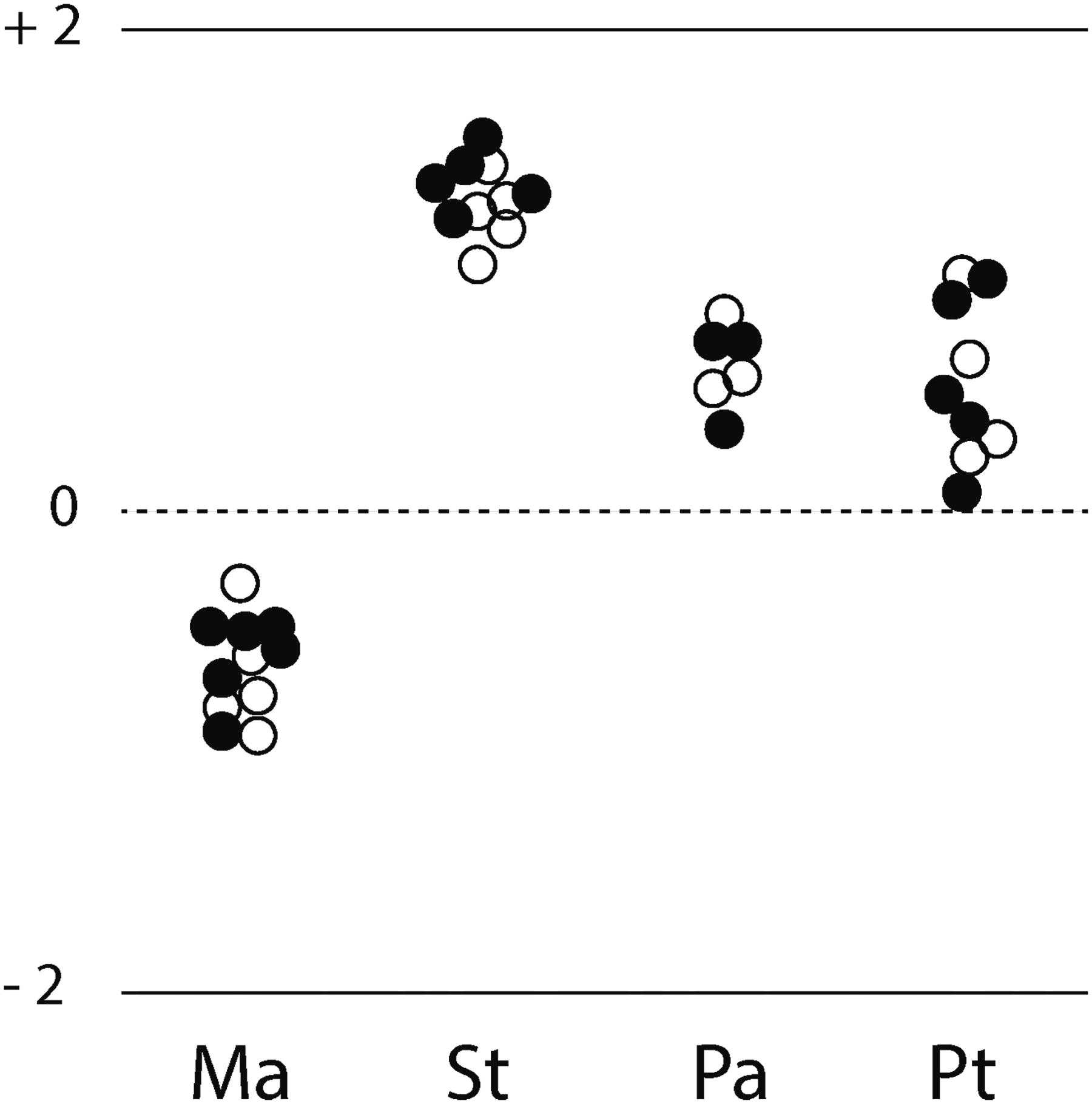
Mean levels of adherence to the four images that comprised the HaN scale, including all single-image outcomes in the outcome classification of the 12 HaN studies. On the vertical dimension, the scores are plotted between the theoretically attainable extremes of −2 and +2. On the horizontal dimension, the scores are plotted across the images of Mastership over nature (Ma). Stewardship of nature (St), Partnership with nature (Pa), and Participation in nature (Pt), with tiny shifts to keep dots individually visible. Open dots are from surveys conducted in the Netherlands, whereas closed dots show results from all other countries. HaN, Human and Nature.
In Figure 1, the open dots represent the mean responses to the four images in the Netherlands, and the closed dots those of all other countries. Comparing the positions of the closed and open dots, it is clear that cross-country variability does not exceed within-country variability. In other words, there is no country effect. This provides support for a fundamental pattern and biophilia being culture independent.
Discussion
By means of 12 studies that applied the same survey scale, we provided empirical support on a global scale for a culture independent, and therefore fundamental, tendency for people to affiliate with nature. This finding advances previous research and conservation initiatives that call for enhanced communication, greater recognition of the multiple values of nature that underlie decision-making, and processes for building meaningful nature-based relationships across contexts (Pascual et al., 2023). In the present section, we first explore the connection of our findings with ecological policies, virtue ethics, and relational values. Subsequently, we reflect on the distinction between the levels and content of nature-friendliness, as well as discuss a number of methodological considerations.
HaN results and ecological policies, virtue ethics, and relational values
Scales such as HaN are important to build theoretical knowledge around human–nature relationships (Flint et al., 2013), and also to support applied outcomes that seek to inform behavior change strategies in support of environmental management (Van Riper et al., 2019). Moreover, empirical support for the biophilia hypothesis as illustrated by the present study constitutes an essential basis for the design of biodiversity policies worldwide, particularly those that depend on public support or stakeholder deliberation. Such policies can and should be built on a shared affection for nature rather than, for example, on a largely utilitarian concept such as ecosystem services. Doing so, however, it should be kept in mind that any fundamental propensity is not necessarily a strong propensity, powerful enough to (co)determine action in people’s daily lives (Holland, Verplanken, & Van Knippenberg, 2002). Biophilia can decrease or increase in strength and articulation, depending on many factors such as people’s experiences in nature, the sociocultural responses to people’s expressions of biophilia, and the institutional freedom people have to act for nature (De Groot, Bonauito, Dedeurwaerdere, & Knippenberg, 2015; Gebhard, 2013). Creating a biophilia-nurturing context is important long-term work for the public foundation of biodiversity policies.
Ethical theories supply much of the background frames of biodiversity and sustainability policies. Specifically in the West, such theories are dominated by the idea that sources of morality are external to humans. We are helped into good behavior by way of duties (“deontological ethics”) or benefits (“utilitarian ethics”) (MacIntyre, 1981). We recognize these easily in injunctions that, for instance, we should [duty] all buy solar cells, which is then also good for our purse or reputation [benefit]. Relatively recently, a third branch of ethical theory that finds its roots in the classical Greek philosophers such as Aristotle—virtue ethics—has been identified as an avenue to strengthen the environmental cause, most often through the concept of “environmental virtues” (Sandler, 2013). Moderation, for instance, can then be said to be an environmental virtue. Other authors such as De Groot and Knippenberg (2023) criticize this approach for representing, in the end, not much more than a merely deontological scheme (i.e., we should all be moderate), and endeavor to articulate a more foundationally ecological “virtue ethic for the earth.” In that context, it is essential that nature can be seen as an integral part of people’s eudaimonia, that is, the happiness that comes with living a good and meaningful life (Van den Born et al., 2018) with the potential to shape environmental behavior (Shin, van Riper, Stedman, & Suski, 2022b). And for that in turn, it is essential that people love nature naturally, so to speak, so that the good life can be conceptualized as nature-inclusive without requiring any external argument. Underpinning the biophilia hypothesis as we did in the present article contributes to this key element of ecological virtue ethics.
“Relational values” are a second element of ethical relevance. The concept of relational values is important because it has been adopted by prominent policy initiatives such as the Intergovernmental Science-Policy Panel on Biodiversity and Ecosystem Services (IPBES, 2022) as a vehicle to open up a richer “value space” for nature conservation, beyond the atomistic dichotomy that nature can only have instrumental (for humans) or intrinsic value (for itself) (Chan, Gould, & Pascual, 2018; Mattijssen et al., 2020). Relational values can be defined as goodness in human–nature relationships (Knippenberg, De Groot, Van den Born, Knights, & Muraca, 2018). How do relational values relate to the concepts of the HaN scale? It has already been shown by Kleespies and Dierkes (2020) that the CNS can be integrated seamlessly in scales that are designed expressly to capture relational values (e.g., Klain, Olmsted, Chan, & Satterfield, 2017; Chapman & Deplazes-Zemp, 2024). And so it is with the HaN scale, which in fact also expresses relational values. HaN-scale images such as Stewardship of nature, Partnership with nature, and Participation in nature all express philosophically grounded categories of relationships with nature. The concepts and outcomes of HaN and allied scale-based survey research therefore show promise to be incorporated in the further development of relational value ethics.
Nature-friendliness level and nature-friendliness content
The approach in the present article has been quantitative, logically because the biophilia hypothesis is a quantitative statement, predicting similarity in the levels of nature-friendliness across cultures. The biophilia hypothesis does not predict that all people love nature in the same way, that is, qualitatively. Indeed, anthropological, cultural, and religious studies show convincingly that great differences exist between the visions of nature in the world’s cultures. One only needs to compare the active Creator of the monotheistic religions with the timeless universe of Buddhism, for instance, or the emphasis on unity in Islam with the emphasis on plurality in Hinduism. We may therefore expect that studies focusing on the qualitative content rather than the quantitative levels of nature-friendliness will reveal a much higher level of cross-cultural variability. Some of this is already encountered in HaN research, such as the study in Vietnam (Duong & Van den Born, 2019). In terms of nature-friendliness levels, its outcome is similar to previous research, as shown in Table 2. Through factor analysis, however, this study also revealed something of what may be a characteristically Vietnamese, culture-dependent aspect of nature-friendliness content. The three images of Stewardship, Partnership, and Participation were not recognized as separate factors by the Vietnamese respondents. The researcher labeled the large, merged factor as “Family with nature.”
At this point, we might wonder how cross-cultural variability in nature-friendliness content may be reconciled with cross-cultural invariability of nature-friendliness levels. In line with Kahn (1999) and Duong and Van den Born (2019), we intuit that the separate and simple statements of the HaN and other scales tap into a layer of basic ideas that tend to be universally human, whereas anthropological, cultural, and religious studies tap into the great variety of constructs that cultures and religions have erected on that universal basis, so to speak, to address contradictions and create larger, coherent stories for people to live in. 5 In a perspective of value pluralism, we may celebrate these qualitative differences. But in a more traditional outlook, we may also celebrate and build on the quantitative universals of what is good in all.
Methodological considerations
Our analysis was based on country-level means of individual responses to the HaN-scale statements. The 12 case studies also showed that underneath these mean values, considerable interindividual variability was present. We did not consider this to be in disagreement with the biophilia hypothesis, because the hypothesis claims the existence of a fundamental tendency, not a fixed or equal ingredient. Any fundamental or even innate tendency will differ within each individual at birth to begin with and may moreover wax or wane in childhood and later life, while for the group as a whole, the level will be much more stable. In other words, the statistical mean as used in the present analysis was a measure well attuned to test the biophilia hypothesis.
The validity of HaN-scale concepts may be of concern, particularly the concept of nature. What do people have in mind when they respond to the term “nature” in the HaN-scale statements? Fortunately, many HaN-scale studies (e.g., Calderón Moya-Méndez et al., 2022) included a “concept of nature” scale in addition to the HaN-scale, all of which showed that respondents viewed the term “nature” in a broad perspective that ranged from one’s own parks or gardens to the local landscape and all the way to the “pure nature” of the rainforest and oceans. This is in line with the broad perception of nature, living and nonliving, in the biophilia hypothesis definition. People’s broad view of nature may also explain the absence of biophobia in our results. Usually, fear of nature focuses on specific elements of nature such as snakes or steep slopes (Patuano, 2020). The broad view of nature invoked by the HaN-scale statements does not associate the concept of nature with such specific elements. 6
Our key assumption was that invariability of outcomes, especially cross-culturally, pointed to a fundamental propensity. Alternative explanations for the cross-cultural invariability of HaN-scale results can be proposed, however. The most interesting of those is to assume (i) that social norms everywhere have become all-pervasively pro-conservation, and (ii) that responses to the HaN-scale statements, rather than grounded in authentic convictions, express social desirability to comply with those social norms. These assumptions cannot be directly disproved but seem implausible. Moreover, some HaN studies have included in-depth interviews about the human–nature relationship (Van den Born, 2008), and the lively content of those discussions was difficult to associate with social desirability.
Conclusion
The biophilia hypothesis, stating that humans have a fundamental propensity to affiliate with nature, is an important basis for policy and theory building around biodiversity conservation. The hypothesis can be assessed through survey research, using, for instance, the HaN scale, in which respondents declare their (dis)agreement with the relational value concepts of Mastery over nature, Stewardship of nature, Partnership with nature, and Participation in nature. Especially because of the fundamentality claim of the biophilia hypothesis, its key test is whether high and invariable cross-cultural mean levels of nature-friendliness are measured in survey research. Being adequate for cross-cultural measurement and having been used in 12 peer-reviewed survey studies on four continents, HaN-scale studies enabled the building of a data set to perform this test unambiguously and without the need for inferential statistics.
Both predictions were shown to be true in the data set, confirming the biophilia hypothesis. This does not imply that we all love nature equally strongly or in the same way. It does mean, however, that love of nature appears to be fundamental and alive in great majorities of people across the globe. For biodiversity policies, the results presented in this article imply that policies should not use only instrumental, economic terms, but rather build on a shared affect for nature, and that people, especially the young, should be given all support and autonomy in the development of a caring and loving relationship with the living world. On a more theoretical level, our findings are important as a foundation for the further development of ecological virtue ethics. A virtue ethic for the earth is a powerful alternative for the currently dominant ethics of environmental duties and utility, building as it does on people’s inner strengths (virtues) and purpose rather than external nudging.
Footnotes
Authors’ Contributions
R.J.G.V.d.B.: Conceptualization (lead), writing (lead), data gathering, and review and editing (lead). C.M.-M.: Conceptualization (supporting), data gathering, and review and editing (supporting). M.d.G.: Conceptualization (supporting), data gathering, and review and editing (supporting). N.T.B.D.: Conceptualization (supporting), data gathering, and review and editing (supporting). W.G.: Conceptualization (supporting), writing (supporting), data gathering, and review and editing (supporting). B.F.v.H.: Conceptualization (supporting), data gathering, and review and editing (lead). A.D.H.: Conceptualization (supporting), data gathering, and review and editing (supporting). R.H.J.L.: Conceptualization (supporting), data gathering, and review and editing (supporting). V.R.: Conceptualization (supporting), writing (supporting), data gathering, and review and editing (supporting). M.S.: Conceptualization (supporting), data gathering, and review and editing (supporting). L.H.N.V.: Conceptualization (supporting), data gathering, and review and editing (supporting). W.T.d.G.: Conceptualization (lead), writing (lead), and review and editing (lead).
Author Disclosure Statement
No competing financial interests exist.
Funding Information
No funding was received for this article.