




Abstract
In the face of rising global concerns regarding emotional distress in the context of rapid urbanization, the need for efficacious and eco-friendly initiatives to address these problems is becoming increasingly relevant. Within the human–nature relationship framework, hands-on participation in tree planting entails activities that enable active interaction with nature. This approach could result in potential mental health benefits while offering a sustainable solution to current environmental challenges. The present study aimed to evaluate the potential effects of hands-on participation in a tree-planting activity on emotional distress parameters in a sample of healthy adults. A pretest–posttest study was conducted, involving 154 participants who engaged in planting containerized saplings through a tree-planting program. The assessment instruments used included the Profile of Mood States for evaluating mood states and the Visual Analog Scale for registering stress and anxiety. Various environmental, activity-related, and personal factors were recorded and analyzed as potential predictive factors of the pretest–posttest outcomes, including connectedness to nature, perceived instorativeness, and physical effort, along with the time spent sleeping, walking, and exercising. The results demonstrated significant reductions in tension, depressed mood, anger, fatigue, stress, and anxiety, as well as an increase in vigor. The predictive factors accounted for 10% of the variability in pretest–posttest changes in depressed mood, 13% in anger, 18% in fatigue, and 22% in vigor. In conclusion, the observed positive changes in mood states, stress, and anxiety following hands-on participation in tree-planting activities could be applied from a preventive perspective on potential emotional distress experienced in urban contexts.
Introduction
The surrounding environment should be considered as thoroughly as the activities that take place within it when aiming to foster better mental health (World Health Organization Regional Office for Europe, 2017). For the majority of human evolution, natural (nonanthropogenic) environments have shaped our physiological and psychological functions through the multisensory stimuli they provide. As such, green spaces are nowadays widely recognized as remarkable settings for a broad spectrum of activities that enhance mental health, as indicated in recent reviews (Beute et al., 2023; Soga, Gaston, & Yamaura, 2017). However, projections indicate that 68.4% of the global population will reside in urban areas by 2050, representing a substantial increase from 29.6% in 1950 (United Nations Department of Economic & Social Affairs Population Division, 2019). Consequently, this rapid urbanization has resulted in a growing disconnection between individuals and natural settings (Steffen, Broadgate, Deutsch, Gaffney, & Ludwig, 2015). Declining contact with nature, in turn, has been associated with mental health problems (Barton & Rogerson, 2017). To address these problems, exploring ways in which urban residents can continue to benefit from natural environments is becoming increasingly important (Nieuwenhuijsen, Khreis, Triguero-Mas, Gascon, & Dadvand, 2017). One potential approach involves encouraging urban residents to interact with such environments, which can strengthen their connection to nature (Furness, 2021).
Human–environment contact can be broadly categorized into passive and active modalities (Brown & Grant, 2005). From an anthropocentric perspective, in passive modalities, the environment can be primarily conceptualized as a source of sensory stimuli, focusing on the reception of these inputs by individuals without actively altering their surroundings. Among such modalities, various forms of exposure to natural environments—including encounters with landscapes or soundscapes—have been associated with positive influences on certain aspects of mental health, such as mood states, stress, and anxiety (Gascon et al., 2015; Kondo, Fluehr, McKeon, & Branas, 2018; Li, Zhang, Bi, Cao, & Zhang, 2022). In contrast, active modalities entail interacting with the environment, wherein, in addition to receiving sensory inputs, individuals induce changes in their surroundings. These changes are understood as the impact generated on the environment as a result of such interaction. This distinctive characteristic of active modalities may offer an advantage over their passive counterparts due to the potential benefits individuals gain from generating these environmental changes. Evidence suggests that such changes are associated with improvements in eudaimonic well-being, the expression of pro-environmental attitudes, and the promotion of bottom-up emotional regulation (Gu, Zheng, & Tse, 2023; Pritchard, Richardson, Sheffield, & McEwan, 2020; Vitale & Bonaiuto, 2024). Within active modalities, a further distinction can be drawn based on the overarching objective(s) of the activity. In the context of natural environments, some endeavors are primarily oriented toward benefiting the individual (e.g., gardening, horticulture, agriculture, grounding techniques), while others are aimed at enhancing the surrounding environment itself (e.g., environmental stewardship or afforestation). Tree-planting activities represent a type of afforestation that is an example of this latter category, serving as an active modality of human–nature contact (Gungormus, Sánchez-Bermejo, & Pérez-Mármol, 2024b).
Emotional distress is understood as a negative emotional response that often persists after stressful situations. This emotional response has become an increasingly prevalent concern with the ongoing urbanization (Daly & Macchia, 2023). According to the “Stress and Coping Model” (Lazarus & Folkman, 1984), emotional distress can arise from the complex interplay of psychological constructs such as mood states, stress, or anxiety (Chun, Knight, & Youn, 2007). Mood states, defined as relatively enduring emotional conditions, influence how individuals perceive and respond to their surroundings (Ekkekakis & Russell, 2013; Terry, Parsons-Smith, & Terry, 2020). Stress, a psychological and physiological reaction to perceived threats or challenges, can trigger or intensify emotional distress when prolonged or intense (O’Connor, Thayer, & Vedhara, 2021). Anxiety, characterized by excessive and persistent worry about everyday and future events (Bandelow & Michaelis, 2015), can also exacerbate emotional distress, potentially creating vicious cycles (Allan et al., 2015). Given the potential impact of mood state imbalances, stress, and anxiety on mental health, developing actions to mitigate their effects has become increasingly important in some contemporary societies (Daly & Macchia, 2023).
Afforestation programs are a promising strategy for improving urban areas by creating green spaces while allowing individuals to interact with natural environments. These can be used as a potential strategy for bottom-up emotional regulation for humans and for improving the surrounding environment by creating green spaces within urban areas (Citaristi, 2022). In terms of environmental restoration, afforestation programs may include various techniques to convert lands into forested areas, such as planting trees, intentional seeding, or encouraging growth from natural seed sources (Food & Agriculture Organization of the United Nations, 2018). Among these techniques, tree planting stands out as particularly beneficial in cities, as it can rapidly transform the urban landscape. The tree species selected for this purpose should be native to the region when prioritizing their ability to thrive in the local soil, weather conditions (Bayón, Godoy, Maurel, van Kleunen, & Vilà, 2021), and available water resources (Singh, Bhattarai, & Vukomanovic, 2022). Beyond the environmental advantages of urban afforestation programs (Oldfield et al., 2014; Pataki et al., 2021), a growing body of research highlights positive mental health benefits associated with tree planting (Jones, 2021; Jones & Goodkind, 2019).
Regarding the evidence to date on the effect of urban afforestation programs, such as urban tree-planting activities, on mental health, two recent systematic reviews are available (Husk, Lovell, Cooper, Stahl-Timmins, & Garside, 2016; Ihle, Jahr, Martens, Muehlan, & Schmidt, 2024). The included studies in these reviews examined the effects on mood states, perceived stress, and state anxiety, providing insight into the potential effect of active interaction with natural spaces on emotional distress. For instance, in a mixed-methods study on active participation in environmental conservation tasks—including tree planting—quantitative results indicated a positive shift in various emotional states of participants, while qualitative interviews suggested reduced stress levels (O’Brien, Townsend, & Ebden, 2010). However, some of these studies did not fully account for the potential confounding effects of social interaction during tree-planting activities.
Conducting research in this area presents several challenges. Previous literature highlights the importance of controlling for potential external and intrapersonal confounders, including perceived instorativeness (Whitburn, Linklater, & Milfont, 2019), connectedness to nature (Nisbet & Zelenski, 2011; Zelenski & Nisbet, 2014), and physical activity (Rosa & Collado, 2020). The instorative potential of environments reflects an environment’s capacity to foster new mental resources. The term “restorativeness”—as widely used in the environmental psychology literature—involves recovery from a previously depleted state, while “instorativeness” does not require an antecedent stressor (Hartig, Korpela, Evans, & Gärling, 1996). Because both concepts share a common theoretical basis, “instorativeness” is used throughout this article as an overarching term, simplifying the terminology by encompassing both restorative and instorative environmental qualities. Connectedness to nature refers to an individual’s affective bond and experiential perception of belonging to the broader natural community, involving a sense of kinship, mutual welfare, and shared identity with the environment (Mayer & Frantz, 2004). By considering the aforementioned aspects, studies could more accurately approach the examination of the potential effects of active engagement with nature—such as tree planting—on emotional distress.
In light of these considerations, the present study aimed to investigate whether hands-on participation in an urban afforestation program would positively influence mood states, perceived stress, and state anxiety in a sample of healthy adults. It is hypothesized that active interaction with nature through a tree-planting activity will enhance positive mood states while reducing negative mood states, perceived stress, and state anxiety in this sample.
Methods
Participants
The present study included 154 participants, 81.8% of whom were female, with a mean age of 20.17 ± 3.08 years. Detailed anthropometric, sociodemographic, and clinical characteristics of the study sample are presented in Table 1. Recruitment strategy involved both direct and indirect outreach methods, including disseminations through institutional email announcements, informational flyers, and brief in-class presentations across various academic programs. This approach was further expanded by leveraging university newsletters, student portals, and internal messaging platforms, complemented by collaborations with student organizations. Before enrollment, participants were informed about the study’s objective and methods, had their questions addressed, and duly provided written informed consent.
Anthropometric, Sociodemographic, and Clinical Characteristics of the Study Participants (N = 154).
M, mean; n, sample size; SD, standard deviation.
The inclusion criteria were as follows: (i) adults aged 18–65 years; and (ii) individuals of all sexes and genders. The study sample selection strategy was refined by applying the following exclusion criteria: (i) current use of any psychotropic medication, to control for confounding effects on study outcomes; (ii) severe cognitive impairment (Mini-Mental State Examination score ≤17 out of 30 points) (Tombaugh & McIntyre, 1992), to minimize the risk of inaccurate self-reports; (iii) serious or unstable health conditions (per participant self-reports or health records), to avoid jeopardizing participant safety; (iv) severe mental disorders in a symptomatic phase, which could confound study outcomes; and (v) behavioral disturbances that could potentially disrupt study procedures (e.g., anger expression), as observed during participant involvement in the study.
An a priori sample size estimation was conducted using statistical power analysis software (G*Power v3.1.9.7 for Windows, Heinrich Heine University, Düsseldorf, Germany). This estimation was based on the effect size (Cohen’s dz = 0.234) reported by Takayama, Fujiwara, Saito, and Horiuchi (2017) for pre–post changes in mood states following a nature-based interaction in healthy adults, as assessed using the Profile of Mood States. For the primary outcome, recruiting 146 participants would achieve 80% power to adequately detect this effect size with a paired t-test at a two-tailed type I error rate of 0.05. To ensure adequate statistical power despite potential dropouts or missing data, this sample size estimate was augmented by 5%, resulting in a final target sample of 154 participants.
Design
A single-group pretest–posttest study was conducted. The study protocol received approval from the Ethics Committee of Provincial Biomedical Research of Granada (reference number 2744-N-21) and was prospectively registered on ClinicalTrials.gov (NCT05384301).
Study setting
The study took place on the University Campus of the Health Technology Park (PTS) at the University of Granada in the city of Granada, Spain. The designated planting area covered 9,711 m2, as shown in the satellite image (see Fig. 1). The site is situated at 671 m above sea level, with a hot-summer Mediterranean climate (Csa) according to the Köppen–Geiger classification. During the recruitment phase, meteorological data from the nearest meteorological station (Estación Meteorológica de la Base Aérea de Armilla) indicated an average temperature of 25.8 °C, humidity of 29.7%, wind speed of 11.7 km/h, and atmospheric pressure of 937.1 hPa. This information was obtained from the Spanish Meteorological Agency (AEMET).
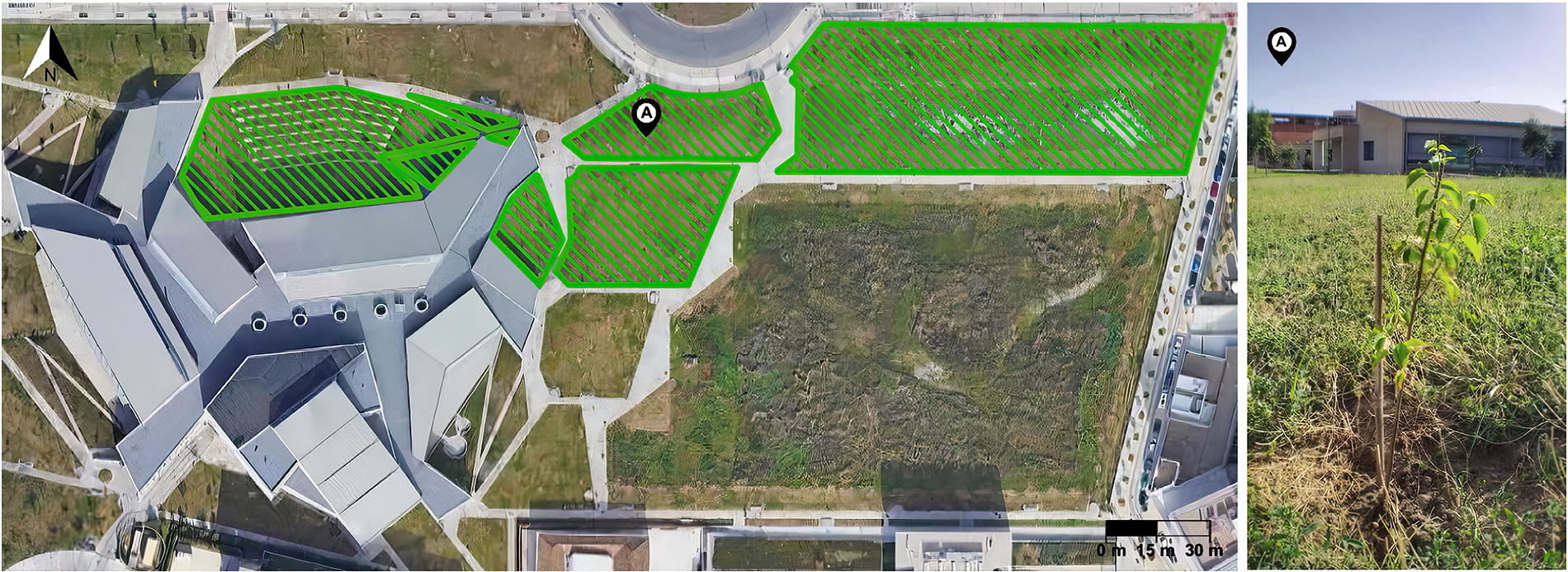
Geospatial arrangement of planted saplings in the remotely sensed imagery of the study site.
Description of participation in urban afforestation
All participants engaged in an urban afforestation program for a single 90-min session (Fig. 2). The program was performed at the same time each day for eight days in total, recruiting 19 participants per day until recruitment was completed. A therapist with 10 years of experience and two biologists (research assistants) with more than 20 years of experience in education and botany monitored each participant throughout their participation in the afforestation.
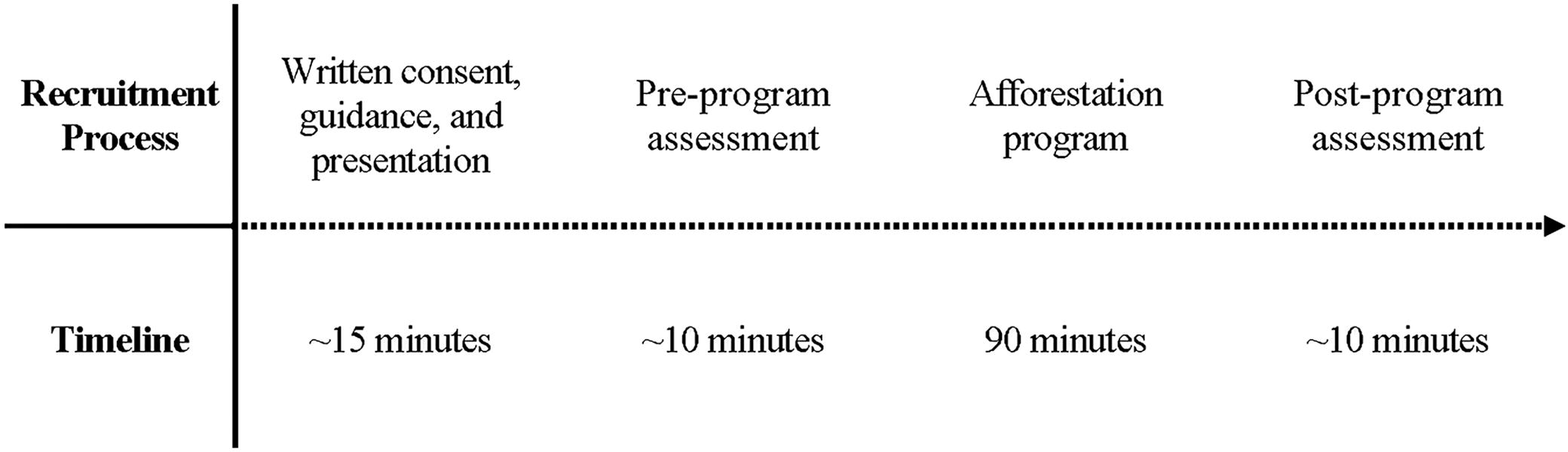
Timeline of the study process depicting the steps followed by each participant recruited under the afforestation program.
Before the initiation of the afforestation, the therapist provided verbal guidance aimed at enhancing participants’ engagement and sensory connection with the environment. This included encouraging attention to external sensory stimuli (i.e., visual, auditory, tactile, and olfactory) and internal sensations (e.g., sensations from muscle activation) arising from their active interaction with the physical environment during the planting process. The biologists gave a standardized presentation on the species to be planted, their ecological roles, and proper planting techniques, ensuring that all participants had the knowledge to effectively perform the activity and understand the environmental significance of their efforts. During the activity, the therapist intermittently reengaged participants as needed, aiming to maintain their focus on the tree-planting task.
The urban afforestation intervention consisted of tilling the soil and planting containerized saplings in designated areas of the campus’s green space. Participants utilized hoes to dig holes of sufficient depth and width to accommodate each plant’s root ball, ensuring that the roots were surrounded by loosened soil both below and on the sides. Each participant planted two saplings, totaling 308 saplings for the entire study sample. The species planted included carob trees (Ceratonia siliqua), holm oaks (Quercus ilex), gall oaks (Quercus faginea), Atlantic pistachio (Pistachia atlantica), wild cherry trees (Prunus avium), and dog rose (Rosa canina). Except for the Atlantic pistachio, these species are native to the region and selected for their resilience to the region’s rising temperatures and prolonged droughts. Placement of the saplings was determined according to site characteristics: the saplings were planted in rows at about 6-m intervals, aligned with preexisting linden trees (Tilia x europaea), while shrubs were planted using “quincunx patterns” with approximately 2-m gaps in sloped areas. Irrigation was provided via either drip or sprinkler systems, depending on the area.
To prevent physical fatigue during the implementation of the urban afforestation program, the participants were allowed to rest as needed. To control a potential confounding effect, social interaction among participants was not permitted during the activity. Although no serious adverse effects or events were anticipated, the participants were carefully observed and questioned by the therapist regarding any potential impact on their physical and mental health (Peryer, Golder, Junqueira, Vohra, & Loke, 2019).
Outcome measures
Sociodemographic, anthropometric, and clinical data were collected using an ad hoc questionnaire developed for this study to ensure a comprehensive description of the study sample. The primary outcome was mood, and the secondary outcomes were perceived stress and state anxiety. Assessments were conducted immediately before and immediately after the implementation of the urban afforestation program. Clear and comprehensible instructions for completing the inventories were provided both in written form—above the printed materials—and verbally by the investigators. The internal consistency (reliability) of each scale used was verified for the current study sample, as shown in Table 2.
Internal Consistency of the Profile of Mood States, Perceived Restorativeness Scale, and Connectedness to Nature Scale for the Study Sample (N = 154)
Mood states
Positive and negative mood states at the moment were evaluated using the Spanish adaptation of the shortened Profile of Mood States (Shacham, 1983), which consists of 30 self-administered items. The instrument encompasses six mood subscales: tension, depressed mood, anger, fatigue, vigor, and friendliness, each assessed by five items rated from zero (“not at all”) to four (“a lot”). Each mood subscale can thus yield a score between zero and 20 points. Higher scores on the vigor and friendliness subscales indicate more positive mood states, while higher scores on the other four subscales indicate more negative mood states. The factor structure of this scale exhibited adequate fit (RMSEA = 0.063) in confirmatory factor analysis (Andrade Fernández, Arce Fernández, de Francisco Palacios, Torrado Quintela, & Garrido, 2013).
Perceived stress
Psychological stress at the moment was measured using a 100-mm Visual Analog Scale. The participants were instructed: “Indicate how stressed you feel at the moment on the following ruler.” The endpoints of the scale were labeled “none” on the left and “as bad as it could be” on the right. The scale yielded a single continuous variable by measuring the distance in millimeters from the leftmost end of the scale to the participant’s mark on the line, recorded as the perceived stress score. Lower scores indicate less perceived stress at the moment. This scale has been demonstrated to be as effective as the Perceived Stress Scale in distinguishing a significant difference in stress levels, requiring less than half the sample size needed by the 10-item Perceived Stress Scale to detect significant differences in stress levels (Lesage, Berjot, & Deschamps, 2012).
State anxiety
State anxiety was measured using a 100-mm Visual Analog Scale for State Anxiety. The participants were instructed: “Please mark the line below with a vertical stroke to show how anxious you feel at the moment.” The left endpoint of the scale read “not at all anxious” and the right endpoint “extremely anxious.” The state anxiety score was determined by measuring the distance in millimeters from the far-left end of the scale to the participant’s mark on the line. Lower scores indicate less anxiety at the moment. This instrument is regarded as a simple and quick tool to measure the level of state anxiety, showing high correlations with the State–Trait Anxiety Inventory (rs = 0.78) and good test–retest reliability (ICC = 0.61) (Davey, Barratt, Butow, & Deeks, 2007; Williams, Morlock, & Feltner, 2010).
Potential predictive factors of study outcomes
Based on theoretical relevance and previous research, six potential factors related to the effects of tree planting on emotional distress were evaluated: (i) the environment’s instorative qualities, assessed using the 5-item version of the Perceived Restorativeness Scale, which includes five subscales—“being-away,” “fascination,” “coherence,” “scope,” and “compatibility” (Hartig et al., 1996; Korpela & Ratcliffe, 2021); (ii) the participants’ attitudes toward nature, evaluated by the 13-item Connectedness to Nature Scale (Mayer & Frantz, 2004); (iii) the physical effort exerted during the activity, evaluated by participants’ self-reports on the 15-point Borg Rating Scale of Perceived Exertion (Chen, Fan, & Moe, 2002); (iv) time spent sleeping per day (recorded in hours); (v) time spent walking per week (recorded in hours); and (vi) time spent exercising per week (recorded in hours). All scales had been validated in Spanish and demonstrated good psychometric properties (Castellanos Fajardo & Pulido Rull, 2009; Negrín, Hernández-Fernaud, Hess, Hernández, et al., 2017; Olivos, Aragonés, & Amérigo, 2011). These factors were recorded prior to the implementation of the urban afforestation program, except for physical effort, which was assessed immediately after the implementation of the urban afforestation program.
Statistical methods
All data collected in the study were managed and analyzed using IBM SPSS Statistics v26.0 for Windows (IBM Corp., Armonk, NY, USA). Descriptive analyses were performed to summarize the data: continuous variables are presented as mean ± standard deviation and categorical variables are presented as absolute frequencies and percentages. Differences between means for dependent samples (pre- and postprogram evaluations) were tested using paired Student’s t-tests. To account for multiple comparisons in the analysis, the Bonferroni correction was applied. For eight measurements, the significance threshold was adjusted by dividing the original alpha level of 0.05 by the number of comparisons, resulting in a corrected level of 0.00625. The magnitude of potential pre–post score differences was estimated by calculating effect sizes and reported as Cohen’s dz, categorized as “small” (≥ 0.2), “medium” (≥ 0.5), and “large” (≥ 0.8) (Lakens, 2013).
To explore the possible relationships between potential predictive factors and changes in each primary and secondary outcome from pre- to postprogram evaluations, multiple linear regression analyses were performed using the stepwise method. The dependent variables were the potential differences between pre- and postmeasures, defined as the delta values. Effect sizes for these analyses were reported as Cohen’s f2, categorized as “small” (≥ 0.02), “medium” (≥ 0.15), and “large” (≥ 0.35) (Cohen, 1988). Statistical significance was set at a two-tailed p-value of <0.05.
Results
Effects of the urban afforestation program on mood states, perceived stress, and state anxiety
Significant decreases were observed in the scores of the subscales for tension [t(153) = 7.258, p < 0.001], depressed mood [t(153) = 11.340, p < 0.001], anger [t(153) = 8.630, p < 0.001], and fatigue [t(153) = 3.395, p = 0.002], whereas a significant increase was observed in the vigor subscale score [t(153) = −6.263, p < 0.001]. Perceived stress [t(153) = 12.287, p < 0.001] and state anxiety [t(153) = 9.457, p < 0.001] also significantly decreased after the implementation of the urban afforestation program. Pre- and postprogram values for each outcome measure are presented in Table 3. No adverse effects were reported.
Pre- to Postintervention Data for Each Outcome Measure (N = 154)
*p < 0.05; **p < 0.01; ***p < 0.001.
Note: M = mean; SD = standard deviation; t = Student’s t-statistic; CI = confidence interval; Cohen’s dz = effect size.
Influence of predictive factors on the effect of the urban afforestation program
Several environmental, activity-related, and personal factors accounted for some of the variance in the pre–post changes in seven dimensions of emotional distress. The regression models were statistically significant for depressed mood [F(2, 142) = 9.293, p < 0.001, adjusted R2 = 0.103], anger [F(2, 142) = 11.799, p < 0.001, adjusted R2 = 0.130], fatigue [F(4, 140) = 8.663, p < 0.001, adjusted R2 = 0.176], vigor [F(4, 140) = 10.935, p < 0.001, adjusted R2 = 0.216], friendliness [F(2, 142) = 4.821, p = 0.009, adjusted R2 = 0.050], perceived stress [F(2, 142) = 5.749, p = 0.004, adjusted R2 = 0.062], and state anxiety [F(1, 143) = 8.229, p = 0.005, adjusted R2 = 0.048]. Specifically, the variance in depressed mood was explained by being-away (t = 3.303, p = 0.001) and compatibility (t = 2.030, p = 0.044); anger by being-away (t = 4.727, p < 0.001) and connectedness to nature (t = −2.114, p = 0.036); fatigue by being-away (t = 3.970, p < 0.001), connectedness to nature (t = −2.972, p = 0.003), time spent sleeping (t = 2.490, p = 0.014), and physical effort exerted during the activity (t = 2.125, p = 0.035); vigor by being-away (t = −4.834, p < 0.001), connectedness to nature (t = 4.582, p < 0.001), time spent sleeping (t = −2.166, p = 0.032), and time spent walking (t = 2.046, p = 0.043); friendliness by coherence (t = −2.969, p = 0.004) and compatibility (t = 1.983, p = 0.049); perceived stress by connectedness to nature (t = −2.965, p = 0.004) and fascination (t = 2.484, p = 0.014); and state anxiety by connectedness to nature (t = −2.869, p = 0.005). No collinearity was observed among the included variables in any regression model. These results are shown in Table 4.
Multiple Regression Models for Predictive Factors Associated with the Outcome Measures (N = 145)
Subscales of the Perceived Restorativeness Scale.
p < 0.05; **p < 0.01; ***p < 0.001.
β, standardized regression coefficient; adj. R2, adjusted regression coefficient of determination; B, unstandardized regression coefficient; CI, confidence interval; Cohen’s f2, effect size; LB, lower bound; SE, standard error; UB, upper bound.
Discussion
The present study aimed to investigate the potential effects of hands-on participation in an urban afforestation program on mood states, perceived stress, and state anxiety in a sample of healthy adults. The results demonstrated moderate increases in positive mood states, small to large reductions in negative mood states, and moderate decreases in the levels of perceived stress and state anxiety. These findings underscore the potential benefits of active engagement in tree-planting activities as a strategy to regulate emotional distress. This study contributes to the growing body of literature by highlighting the health benefits of active interaction with nature and providing valuable insights for promoting urban afforestation initiatives.
The observed effects on emotional distress can be interpreted through psychological and physiological mechanisms related to activity engagement, multisensory stimulation theories, and physical activity models (Kuo, 2015). From a psychological perspective, actively engaging in tree-planting activities might evoke a feeling of accomplishment and environmental contribution (Catanzaro & Ekanem, 2004). Moreover, the hands-on aspect of afforestation programs could foster a more profound sense of connectedness to nature, which has been linked to improved mental health (Mayer, Frantz, Bruehlman-Senecal, & Dolliver, 2009). In line with this, the findings support the Stress Reduction Theory (Ulrich et al., 1991), which posits that natural environments can help alleviate stress. The significant reductions in stress and anxiety observed in this study further corroborate the potential preventive value of urban afforestation programs by modulating emotional distress. Moreover, the biophilia hypothesis (Wilson, 1984) suggests that humans have an innate tendency to seek connections with nature; hands-on participation in tree-planting activities may therefore enhance this innate inclination, providing a sense of belonging and meaningful connection with the environment.
From a physiological standpoint, multisensory stimulation theories posit that encounters with natural environments—such as those encountered during tree planting—can elicit a physiological relaxation conducive to improved mood states and reduced stress (Song, Ikei, & Miyazaki, 2016). For instance, exposure to visual stimuli (e.g., the sight of trees and plants) and auditory stimuli (e.g., the sound of rustling leaves) can positively affect mental health outcomes through the modulation of neural processes by decreasing prefrontal cortex and sympathetic activity while increasing parasympathetic activity (Buxton, Pearson, Allou, Fristrup, & Wittemyer, 2021; Jo, Song, & Miyazaki, 2019; Mygind et al., 2021). In addition, recent meta-analyses suggest another plausible mechanism involving the attenuation of endocrine stress responses, as evidenced by decreased cortisol levels after immersion in natural settings (Antonelli, Barbieri, & Donelli, 2019; Twohig-Bennett & Jones, 2018). Further, the physical activity involved in tree planting could lead to endorphin release, which is known to improve mood (Mandolesi et al., 2018). Finally, engaging in afforestation programs exposes individuals to a diverse array of microbiota present in natural environments. Recent studies suggest that, through the gut–brain axis, exposure to this environmental microbiota can positively influence mood by modulating the gut microbiome (Socała et al., 2021; Stanhope & Weinstein, 2023).
Various environmental, activity-related, and personal factors were associated with the observed changes in emotional distress after active interaction with nature. The perceived instorative properties of the environment were associated with increases in negative mood states. Although this finding might initially appear contradictory to existing literature (Deng et al., 2020), it is important to note that these instorative properties correspond to the ones of the urban area, as this instrument was administrated before its transformation through the afforestation program. Previous literature demonstrated an increased level of perceived instorativeness after participating in environmental activities—such as tree planting—in urban environments (Joung, Park, & Kang, 2022). Thus, one could argue that individuals who perceive the urban areas as less instorative could experience more substantial shifts in mood states after planting trees in them. On the other hand, connectedness to nature was shown to enhance the positive effects of the urban afforestation program on vigor and reduce anger, fatigue, perceived stress, and state anxiety. This finding highlights the potential value of fostering a sense of connectedness to nature as part of therapeutic approaches for clinical populations experiencing emotional distress, such as those with chronic primary pain (Gungormus, Fernández-Martín, Ortigosa-Luque, & Pérez-Mármol, 2024a; Gungormus et al., 2024b). Additionally, the physical effort exerted during the activity, along with personal habits such as time spent sleeping and walking, influenced the effects of tree planting on mood states and stress. Increased physical effort exerted during the activity and time spent sleeping intensified the reduction in mental fatigue, while more time spent sleeping reduced the gain in vigor. These findings suggest that balancing physical activity levels during urban afforestation programs and ensuring adequate rest may optimize the benefits of this nature-based activity.
In terms of the existing literature, to the best of the authors’ knowledge, no experimental study has examined the benefits of active engagement in urban afforestation programs concerning the outcome measures used in this study. Nevertheless, numerous studies on passive exposure to urban green spaces have demonstrated positive changes in mood states, perceived stress, and state anxiety. Regarding mood states, recent meta-analyses have reported enhancements in overall mood (Bray, Reece, Sinnett, Martin, & Hayward, 2022) and reductions in depressive mood (Roberts, van Lissa, Hagedoorn, Kellar, & Helbich, 2019) after short-term multisensory immersion in urban parks. Another recent systematic review has demonstrated that exposure to urban green spaces can positively affect mood states (van den Bosch & Ode Sang, 2017). An experimental study examining the effects of green spaces on pupils’ momentary mood states found a significant positive shift in the momentary mood state after exposure to urban green spaces during class breaks (Wallner et al., 2018). As for perceived stress, a meta-analysis indicated reductions in self-reported stress after exposure to city parks (Yao, Zhang, & Gong, 2021), and two systematic reviews support the notion that minimal greenery can provide these beneficial effects (Gu, Liu, & Lu, 2022; Shuda, Bougoulias, & Kass, 2020). Last, in terms of anxiety, systematic reviews of experimental studies provide evidence that exposure to urban green space results in immediate reductions in anxiety (Bray et al., 2022; Kotera, Lyons, Vione, & Norton, 2021).
Understanding the unique advantages of hands-on participation in afforestation programs may guide urban designers, experts in natural sciences, and healthcare providers in developing innovative, sustainable, and effective interventions to reduce emotional distress and foster environmental conservation. For an in-depth exploration of practical strategies to encourage public engagement in urban afforestation initiatives, along with their co-benefits for mental health and environmental sustainability, readers may consult the ecological model proposed by Moskell and Allred (2013) and the conceptual framework outlined by Barron et al. (2019).
Limitations of the study
When interpreting the findings of this study, the following limitations should be considered: (i) a possible familiarity effect might have influenced the participants’ postintervention responses because the same assessments were administered immediately before and after the intervention. Likewise, participants might have inferred the study’s hypothesis, leading to potential biases in their responses; (ii) the single-group pretest–posttest design limits causal inferences due to the absence of a control group, although this study provides a foundation for future controlled research in this field; and (iii) the lack of follow-up assessments impedes determining whether the observed effects endure over time or are restricted to the immediate term.
Future research
In terms of methodology, conducting experimental studies would provide more robust evidence on the effects of participating in urban afforestation activities on emotional distress and minimize internal validity concerns associated with single-group pretest–posttest designs. The potential maintenance of the observed effects of urban afforestation programs should be investigated in the short, medium, and long terms. Further, replicating this methodology in diverse populations would increase the representativeness of the findings on this topic. Last, incorporating a therapeutic or counseling component alongside the urban afforestation program might have synergistic effects, such as potentially further enhancing the instorative effects of actively participating in tree-planting activities.
Importantly, it would be valuable to explore the specific mechanisms underlying the observed benefits, which may include bottom-up emotional regulation, enhancement of eudaimonic well-being, and the expression of pro-environmental attitudes. Factors that could help identify the most effective ways to implement urban afforestation programs and maximize their benefits on emotional distress parameters should be investigated. These factors may include grading and adapting the tasks of afforestation activity—such as the intensity, duration, frequency, and the different pathways for performing the activity—along with potential differences in outcomes based on the species planted.
Conclusions
In conclusion, this study suggests that hands-on participation in an urban afforestation program for 90 min may lead to potential benefits on mood states, perceived stress, and state anxiety in healthy adults. Factors such as connectedness to nature, perceived instorative properties of the environment, and physical effort exerted during the activity appear to influence these psychological benefits. These findings emphasize the potential significance of promoting urban afforestation programs as a strategy to improve mental health parameters related to emotional distress.
Footnotes
Acknowledgments
The authors are sincerely grateful to the participants of the study and to the association “Árboles contra el Cambio Climático en Granada” (ACCCGranada) for making this study possible and for their efforts against climate change. The authors appreciate the research assistants for their assistance in supervision throughout the activity. Furthermore, the authors wish to acknowledge the gardeners employed by the University of Granada for their dedication during the preparatory training phase and their assistance in providing the necessary components for the intervention. Finally, and above all, the authors extend their gratitude to the anonymous reviewers for their insightful feedback on earlier drafts, which has significantly enhanced the manuscript’s quality. Any remaining mistakes, as always, are our responsibility.
Authors’ Contributions
D.B.G.: Conceptualization, methodology, formal analysis, investigation, data curation, writing—original draft, writing—review and editing, and visualization. J.M.P.-M.: Conceptualization, methodology, formal analysis, investigation, resources, writing—review and editing, supervision, and project administration.
Author Disclosure Statement
No competing financial interests exist.
Funding Information
No funding was received for this article.
Data Availability Statement
The raw data that support the findings of this study are available upon reasonable request from the corresponding author.