




Abstract
While studies have highlighted the psychological benefits of interacting with birds, research exploring, which personality traits influence interest in birdwatching remains limited. This study examined the impact of personality on birdwatching engagement among 85 participants (56.5% male, mean age = 33.0 years) in Isfahan, Iran. Employing the NEO-Five Factor Inventory, we assessed personality traits and measured participants’ immediate and sustained interest in birdwatching, as well as self-identification as a birdwatcher, following a structured intervention comprising three educational sessions and a full-day birdwatching trip. Openness to Experience emerged as the strongest predictor of both immediate (M = 3.45, SD = 1.06) and sustained interest (M = 3.25, SD = 1.07) over 6 months, significantly predicted self-identification as a birdwatcher (β = 0.49). Agreeableness and Conscientiousness also had positive effects, whereas Neuroticism negatively impacted it. These findings indicate how personality profiling can enhance the design of nature-based activities, maximizing engagement and participation.
Nature and Psychological Well-Being
Engaging in nature-related activities has been widely recognized for its critical and multidimensional impact on psychological well-being. Exposure to natural environments has been shown to reduce physiological and psychological stress markers, improve mood, and enhance cognitive functioning The unique role of biodiversity, particularly bird diversity, in fostering these benefits, with bird-rich environments being linked to lower levels of anxiety, depression, and stress(Cox and Gaston, 2016; Douglas and Evans, 2022). These benefits are not only immediate but can also contribute to long-term mental health by sustaining emotional resilience and reducing the prevalence of chronic mental health issues (Bratman, Hamilton, and Daily, 2012; Bratman, Olvera‐Alvarez, and Gross, 2021; Hedin, Hahs, Mata, and Lee, 2022). Additionally, regular interaction with nature fosters a sense of connectedness to the environment, which is associated with increased life satisfaction and a greater sense of purpose (Di Fabio and Kenny, 2021; Ramkissoon and Mavondo, 2017). In an increasingly urbanized world, where individuals are often disconnected from natural settings, participation in biodiversity-focused activities such as birdwatching has become an essential intervention for maintaining mental health(Randler, Rahafar, and Großmann, 2023). These activities offer a proven escape from urban stressors, promoting relaxation and emotional recovery (Cameron et al., 2020; Fuller et al., 2007).
The interaction with birds, whether through watching, feeding, or simply listening to their songs, provides unique mental health benefits. Research suggests that residential areas with richer bird biodiversity are associated with lower levels of depression, anxiety, and stress among inhabitants (Cox and Gaston, 2016; Douglas and Evans, 2022; Randler, Murawiec, and Tryjanowski, 2022). The mere presence of birds can enhance psychological well-being by promoting feelings of relaxation and connection to nature (Fuller et al., 2007). Birdwatching, as a focused activity, extends these benefits by encouraging individuals to engage more deeply with the natural environment. It requires attention to detail and patience, which can be meditative and significantly reduce stress (Andrews, Ammirati, and Andrews, 2024; Clayton, 2007). Further, the active pursuit of birdwatching often leads to increased physical activity, which is itself beneficial for mental health (Ratcliffe, Gatersleben, and Sowden, 2013). Recent studies also highlight birdwatching’s role in fostering social interactions and community building, further amplifying its psychological benefits (Jafarpour and Ramkissoon, 2023; Peterson et al., 2024; Randler et al., 2023). By fostering a closer connection with nature and providing a purposeful activity, birdwatching not only enhances environmental awareness but also serves as a therapeutic exercise, contributing to a sustained improvement in mental and emotional health.
Personality and Engagement with Nature
Personality traits profoundly influence human behaviors and preferences, shaping how individuals engage with and sustain interactions with natural environments. Studies consistently demonstrate that openness and honesty-humility are the strongest predictors of pro-environmental behaviors, driven by curiosity, ethical considerations, and an appreciation for novel and stimulating experiences (Kesenheimer and Greitemeyer, 2021; Nisbet, Zelenski, and Murphy, 2009; Soutter, Bates, and Mõttus, 2020). Agreeableness enhances cooperative and altruistic attitudes essential for environmental collaboration, while conscientiousness supports sustained commitment to conservation actions, including habitat restoration and wildlife protection (Jafarpour and Ramkissoon, 2023; Kesenheimer and Greitemeyer, 2021; Randler et al., 2023). Together, these traits create a personality profile conducive to deep, sustained connections with nature, enhancing both personal well-being and ecological stewardship(Lumber, Richardson, and Sheffield, 2017; Randler et al., 2023).
The Five-Factor Model of Personality provides a comprehensive framework for understanding how different personality dimensions affect engagement with nature-based activities. Recent research emphasizes that this model remains pivotal for predicting diverse environmental behaviors (Kesenheimer and Greitemeyer, 2021; Soutter et al., 2020). Openness to Experience is crucial, as it enhances curiosity and appreciation for diverse experiences, including those provided by natural settings (Hidalgo-Crespo, Velastegui-Montoya, Amaya-Rivas, Soto, and Riel, 2023; McCrae, 2003; Weinstein, Przybylski, and Ryan, 2009). Extraversion supports social and energetic pursuits, often aligning with outdoor group activities. Conversely, Neuroticism may limit such interactions, as higher levels can increase sensitivity to the unpredictability of outdoor settings (Bratman et al., 2021; Weinstein et al., 2009). Agreeableness fosters cooperative and altruistic behaviors, which are vital in collaborative conservation efforts. Recent findings suggest that agreeableness not only supports altruism but also enhances collaborative environmental efforts like habitat restoration(Randler et al., 2023). Lastly, Conscientiousness drives responsible and organized behaviors, leading to sustained commitment to environmental causes, including habitual participation in activities like birdwatching (Schwartz, 2012).
Research Gap and Study Aims
Despite the established benefits of birdwatching for mental health and ecological awareness, the role of personality traits in predicting engagement remains underexplored. While broader links between personality and pro-environmental behaviors have been studied, birdwatching offers a unique blend of physical, cognitive, and emotional engagement that sets it apart from other nature-based activities (Kesenheimer and Greitemeyer, 2021; Randler et al., 2022). Addressing this gap, the present study investigates how specific personality traits influence birdwatching participation, offering practical strategies to enhance nature engagement and conservation awareness
We hypothesize that traits such as openness to experience, agreeableness, and conscientiousness, which align with nature appreciation and pro-environmental behavior, will positively correlate with active birdwatching (Jafarpour and Ramkissoon, 2023; Randler et al., 2023). Conversely, traits like neuroticism are expected to negatively affect engagement. This research aims to quantify these relationships, offering novel insights into how psychological profiles can guide the design of interventions to promote birdwatching and related nature-based activities.
By examining the interplay between personality and birdwatching, this research enhances our understanding of the psychological drivers of nature engagement. For instance, traits like agreeableness and honesty-humility are critical for fostering collaborative conservation efforts, while openness supports curiosity-driven exploration of natural environments (Dean and Wilson, 2023; Gray, Doyle, Doyle, Young, and McMahon, 2024). These insights challenge existing assumptions that nature exposure alone is sufficient for psychological benefits, highlighting the importance of tailoring interventions to personality profiles to maximize the therapeutic and ecological benefits of birdwatching (Peterson et al., 2024). By contributing to frameworks in ecopsychology and conservation psychology, this study offers more personalized strategies to foster environmental stewardship and individual well-being (Andrews et al., 2024).
Methods
Study design
This quasi-experimental study was designed to explore the relationship between personality traits and birdwatching engagement. Participants were recruited through SMS invitations and screened for eligibility before completing the NEO-Five Factor Inventory (NEO-FFI) 1 week before the intervention. The study included three educational sessions over 12 days, followed by a full-day birdwatching trip. Immediate interest in birdwatching was assessed 2 days post-trip, with sustained interest and self-identification as a birdwatcher evaluated 6 months later through phone interviews. To reduce potential biases, the individuals responsible for data collection and analysis were blinded to the participants’ personality scores and their responses during the follow-up assessments. Each participant was assigned a unique identification code to maintain confidentiality and ensure that those analyzing the data had no direct interaction with the participants or knowledge of their specific responses throughout the study.
Participants
Participants were recruited from a pool of 4,500 residents of Isfahan, Iran, via SMS, achieving a 2% response rate. After initial interest from 97 individuals and a subsequent screening process, 12 were excluded due to ineligibility, incomplete data, or personal withdrawals, resulting in a final sample of 85. Participants included 48 males (56.5%) and 37 females (43.5%), aged between 18 and 70 years (M = 33.0, SD = 10.8). They varied in educational background—12% held a high school diploma, 47% a bachelor’s degree, 25% a master’s degree, and 16% a PhD. Most were employed (74%), and a large portion were married (73%). Inclusion criteria required physical capability to attend the birdwatching trip and proficiency in Persian, excluding those with severe mental health disorders, current psychiatric medication, significant physical impairments, or any prior birdwatching experience.
Materials and Measures
Personality assessment
Personality traits were assessed using the NEO-Five Factor Inventory (Costa and McCrae, 2008), a widely validated tool designed to measure the five major domains of personality: Neuroticism, Extraversion, Openness to Experience, Agreeableness, and Conscientiousness. The NEO-FFI consists of 60 items, with participants responding on a 5-point Likert scale ranging from 1 (strongly disagree) to 5 (strongly agree). Higher scores indicate stronger expression of the respective trait. The NEO-FFI has demonstrated strong reliability and validity in various cultural contexts, including Iran (Azkhosh and Asgari, 2014). Participants completed the NEO-FFI 1 week before the start of the birdwatching sessions. The assessment was administered in private rooms at Avaye Dashtyaran Institute, with a psychologist present to address any concerns or questions.
Birdwatching interest assessment
Birdwatching interest was measured through custom-developed Likert-scale questions specifically designed for this study. Immediate interest in birdwatching was assessed 2 days after the birdwatching trip, with participants rating their interest on a scale from 1 (not interested at all) to 5 (extremely interested). Sustained interest was assessed 6 months later using the same scale. These measures allowed for the evaluation of both the short-term and long-term effects of the intervention on participants’ interest in birdwatching.
Birdwatcher identification
Six months after the birdwatching trip, participants were asked whether they considered themselves birdwatchers, with responses recorded as “yes” or “no.” For the purpose of this study, a birdwatcher was defined as someone who regularly engages in the observation of birds in their natural habitat, often as a recreational activity. This definition aligns with common usage, where birdwatchers are individuals who derive pleasure from identifying and watching birds in the wild (Dictionary, 2023).
Intervention
Educational sessions
The intervention consisted of three 90-min educational sessions conducted over a 12-day period. These sessions were designed to introduce participants to birdwatching, emphasizing its ecological importance and practical aspects.
Birdwatching trip
One week after the educational sessions, participants embarked on a full-day birdwatching trip to Choghakhor International Wetland (Fig. 1), approximately 85 min from Isfahan. The wetland is known for its rich biodiversity, providing an ideal setting for the observation of a wide variety of bird species. To ensure personalized guidance, participants were divided into smaller groups of 10 to 15 individuals, with group assignments made randomly to minimize bias related to age, gender, or pre-existing interest in nature.

Participants engaged in birdwatching during the birdwatching trip to Choghakhor International Wetland.
The birdwatching trip was conducted under standardized conditions, with all trips taking place in the spring season, between 7:00 am and 11:00 am, on days with favorable weather conditions (wind speeds of less than 8 km/h and temperatures between 22°C and 26°C). Participants were equipped with 10 × 42 binoculars, Celestron 20-60 × 80 spotting scopes, and the Collins Bird Guide (2nd edition) (Svensson, Mullarney, and Zetterström, 2009). The excursion was led by experienced birding guides, and participants had the opportunity to observe between 45 and 60 bird species. Safety measures were prioritized, with comprehensive insurance coverage, first aid kits, and an emergency response plan in place.
Data analysis
Descriptive statistics were calculated for all demographic variables, personality traits, and birdwatching interest scores. Subgroup analyses were conducted to explore differences in birdwatching interest and birdwatcher identification by gender, age, and education level. Pearson correlation coefficients were calculated to assess relationships between personality traits and birdwatching interest. Paired t-tests were used to compare immediate and sustained interest, while Mann–Whitney U tests were applied to compare personality traits between birdwatchers and non-birdwatchers. A Ridge regression analysis was performed to identify personality traits predictive of birdwatcher identification, using the birdwatcher identification variable as the dependent variable and the five personality traits as independent variables.
Multicollinearity among the predictors (personality traits) was assessed using the variance inflation factor (VIF). VIF values were calculated for Neuroticism, Extraversion, Openness to Experience, Agreeableness, and Conscientiousness. High VIF values were observed for Openness (VIF = 23.69), Agreeableness (VIF = 19.86), and Conscientiousness (VIF = 13.01), indicating significant multicollinearity. To address this, Ridge regression was employed. Ridge regression applies a penalty to the regression coefficients, effectively reducing their magnitude and mitigating the effects of multicollinearity. This method ensures more stable and interpretable estimates, making it an appropriate choice for analyzing the predictors in this study.
Transparency and disclosure of AI use
AI assistance was utilized during the preparation of this article. ChatGPT-4 by OpenAI, accessed on August 9, 2024, was used for language editing, creating a visual representation for the Correlation Matrix of Personality Traits and Birdwatching Interest, and listing suggested limitations for the study. Prompts provided to the AI tool included general requests related to these tasks. Potential biases and limitations introduced using AI have been considered and are discussed in the relevant sections of the article.
Results
Descriptive statistics
The study assessed various personality traits and birdwatching interest levels. The descriptive statistics for these variables are presented in Table 1. On average, participants showed moderate levels across all personality traits. Immediate interest in birdwatching was moderately high (M = 3.45, SD = 1.06), with a slight decrease observed in sustained interest over 6 months (M = 3.25, SD = 1.07).
Descriptive Statistics for Personality Traits and Birdwatching Interest
Subgroup analysis
Gender differences
Subgroup analyses revealed that males exhibited slightly higher levels of both immediate and sustained interest in birdwatching compared to females. Specifically, the mean immediate interest for males was 3.57, while for females it was 3.30. Similarly, sustained interest averaged 3.41 for males and 3.00 for females. Additionally, a higher proportion of males (46.88%) identified as birdwatchers 6 months after the intervention, compared to 30.19% of females. These findings suggest that gender plays a role in both the immediate and long-term engagement with birdwatching activities.
Age differences
The relationship between age and birdwatching interest was assessed using Pearson correlation coefficients. Age was found to be positively correlated with both immediate interest (r = 0.23) and sustained interest (r = 0.19) in birdwatching. However, the correlation between age and identifying as a birdwatcher was weaker (r = 0.14). These findings suggest that while older participants tended to have a slightly higher interest in birdwatching both immediately and over time, age was a less significant factor in determining whether individuals identified as birdwatchers.
Education level differences
Education level was found to be a significant factor in birdwatching interest and identification. Table 2 indicates that participants with higher education levels reported greater immediate and sustained interest in birdwatching. The likelihood of identifying as a birdwatcher was highest among those with a PhD (66.67%), followed by those with a Master’s degree (34.62%).
Birdwatching Interest and Birdwatcher Identification by Education Level
Correlation analysis
The relationships between personality traits and birdwatching interest were explored using Pearson correlation analysis. As shown in Figure 2, Openness to Experience exhibited the strongest positive correlations with both immediate interest (r = 0.87) and sustained interest (r = 0.81). Agreeableness and Conscientiousness also showed positive correlations with both types of interest. In contrast, Neuroticism was negatively correlated with immediate interest (r = −0.32) and sustained interest (r = −0.28). Figure 2 provides a visual summary of these correlations, offering a clear depiction of how personality traits are related to birdwatching interest.

Correlation matrix illustrating relationships between personality traits and birdwatching interest (immediate and sustained).
Comparative analysis
Paired t-tests revealed a statistically significant decrease in birdwatching interest from the immediate post-trip assessment to the 6-month follow-up [t (84) = 3.36, p = 0.001]. This suggests that while initial interest was moderately high, interest levels diminished over time.
Additionally, Mann–Whitney U tests were conducted to compare personality traits between participants who identified as birdwatchers (n = 35) and those who did not (n = 50) at the 6-month follow-up. The analysis showed that birdwatchers had significantly lower scores in Neuroticism (U = 485.5, p < 0.001) and significantly higher scores in Openness (U = 144.5, p < 0.001), Agreeableness (U = 144.5, p < 0.001), and Conscientiousness (U = 292.5, p < 0.001) compared to non-birdwatchers. No significant difference was observed in Extraversion scores between the two groups (U = 1471.5, p = 0.352).
Regression analysis
To identify the personality traits most predictive of identifying as a birdwatcher, a Ridge regression analysis was conducted (Fig. 3). The analysis revealed that Openness to Experience was the strongest positive predictor of birdwatcher identification (β = 0.0119, 95% CI [0.0086, 0.0147]), followed by Agreeableness (β = 0.0088, 95% CI [0.0059, 0.0128]) and Conscientiousness (β = 0.0045, 95% CI [0.0005, 0.0075]). Neuroticism was negatively associated with the likelihood of identifying as a birdwatcher (β = −0.0022, 95% CI [−0.0045, 0.0001]), while Extraversion had a minimal positive effect (β = 0.0017, 95% CI [−0.0013, 0.0049]). These results confirm that personality traits significantly influence birdwatching engagement, with Openness to Experience being the most influential predictor. Prior to conducting the regression analysis, multicollinearity among the personality traits was assessed using VIF. The analysis revealed high VIF values, particularly for Openness to Experience (VIF = 23.69), Agreeableness (VIF = 19.86), and Conscientiousness (VIF = 13.01). These findings confirmed the presence of significant multicollinearity, justifying the use of Ridge regression to stabilize the regression estimates and improve model reliability.
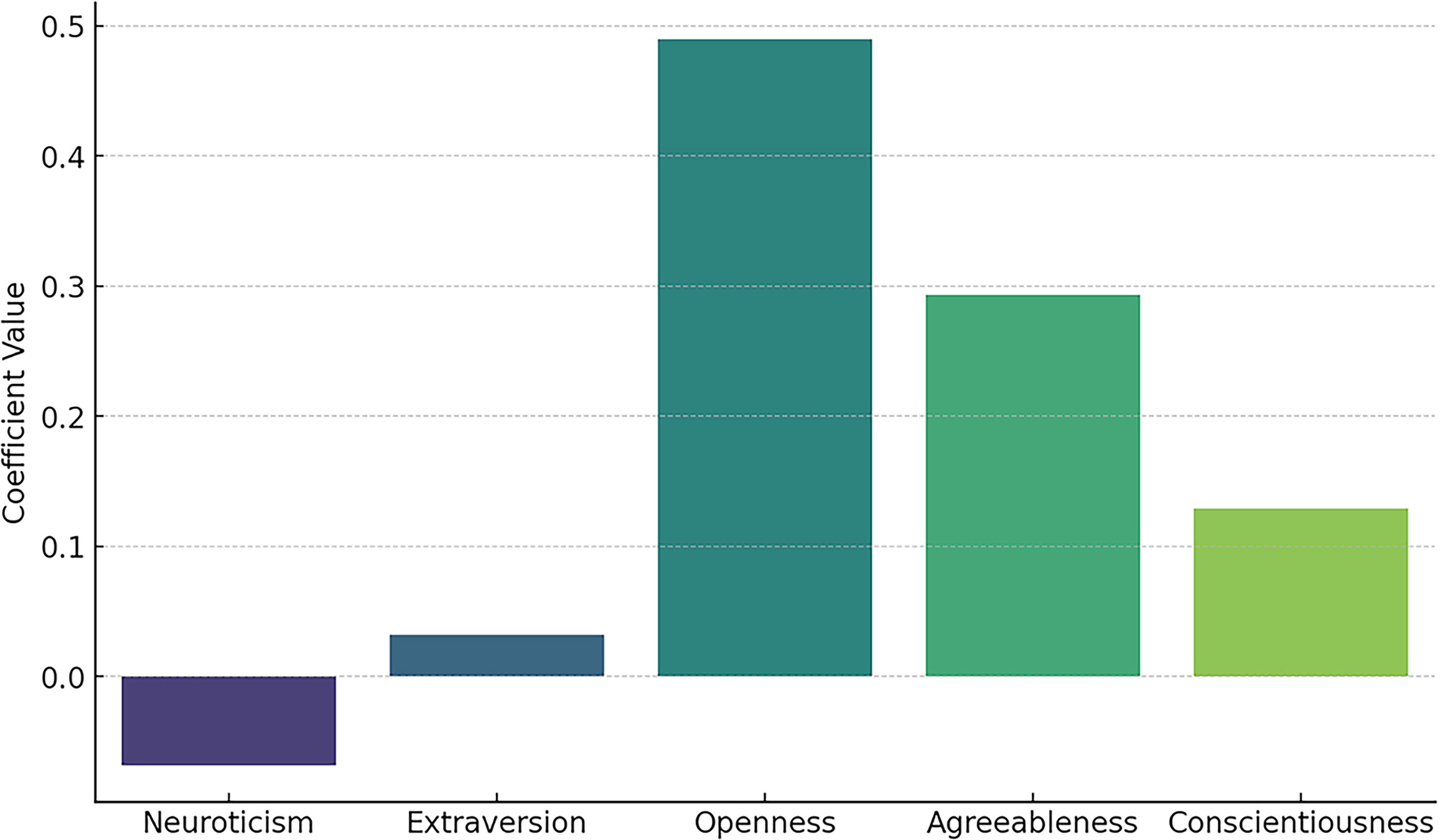
Ridge regression coefficients predicting birdwatcher identification based on personality traits.
Discussion
Our study underscores the significant role of personality traits in predicting engagement with birdwatching across three key domains: immediate interest, sustained interest, and self-identification as a birdwatcher. Openness to Experience consistently emerged as the most robust predictor, emphasizing its well-established link to curiosity and an appreciation for novel and stimulating experiences. This aligns with the study (Soutter et al., 2020) who identified Openness as pivotal in fostering engagement with environmental activities, and Dean and Wilson (2023), who highlighted its relevance to conservation efforts requiring exploratory and creative approaches. Additionally, the progression of birdwatching interest observed in our study aligns with Hidi and Renninger’s four-phase model of interest development (Hidi and Renninger, 2006), which emphasizes the transition from situational to sustained interest through deeper engagement and personal relevance. Agreeableness and Conscientiousness also showed positive associations, with Agreeableness supporting community-oriented and cooperative conservation behaviors, as suggested by Randler et al. (2023), and Conscientiousness driving consistent, organized participation in activities such as long-term monitoring programs (Kesenheimer and Greitemeyer, 2021). These findings reinforce the multidimensional nature of engagement, where distinct traits contribute to varying aspects of participation. Neuroticism was also negatively associated with birdwatching interest and self-identification as a birdwatcher, indicating that individuals with higher levels of this trait are less likely to engage in and maintain interest in birdwatching. This aligns with findings by Weinstein et al. (2009), which highlight emotional stability as critical for consistent engagement with nature.
Our findings build on the existing body of ecopsychology literature by confirming the significant role of Openness to Experience in fostering both immediate and sustained interest in birdwatching, and in predicting long-term identification as a birdwatcher. (Markowitz, Goldberg, Ashton, and Lee, 2012; Nisbet et al., 2009; Soutter et al., 2020). Additionally, we provide new evidence of Agreeableness fostering cooperative and community-oriented conservation efforts, while Conscientiousness supports sustained and organized engagement. This expands prior findings on pro-environmental behavior by illustrating how these traits also sustain long-term engagement in specific activities like birdwatching. Moreover, the negative correlation between Neuroticism and birdwatching interest reinforces the idea that emotional stability is critical for consistent engagement with nature, echoing findings from previous studies (Pickering and Dale, 2023; Weinstein et al., 2009).
Overall, our study not only corroborates existing theories but also extends them by highlighting the nuanced roles of multiple personality traits in predicting sustained engagement with nature-related activities, such as birdwatching. These findings emphasize the value of incorporating personality traits into strategies designed to foster long-term participation in nature-based activities while reflecting the multidimensional contributions of these traits to ecological stewardship.
By confirming and extending prior ecopsychological research, our study demonstrates how personality traits significantly shape how individuals perceive, approach, and maintain their connections with the natural world (Dean and Wilson, 2023; Soutter et al., 2020).
Tailoring conservation programs and nature-based interventions to align with different personality profiles could greatly enhance their effectiveness. For example, individuals high in Openness may benefit from exploratory and knowledge-rich activities, such as guided birdwatching tours focusing on unique species. Those high in Agreeableness could be engaged through group-based or community-driven initiatives, such as citizen science programs or collaborative habitat restoration projects. Meanwhile, individuals with high levels of Conscientiousness might respond better to structured, goal-oriented tasks like long-term monitoring programs.
By integrating personality analysis into program design, practitioners can develop more inclusive and impactful strategies that resonate with diverse audiences. This approach not only enhances participation but also strengthens the connection between individuals and nature, fostering environmental stewardship and psychological well-being. Moreover, these targeted strategies hold promise for addressing global challenges in biodiversity conservation by creating community engagement models that are both sustainable and adaptive to individual differences (Gifford and Nilsson, 2014; Mayer and Frantz, 2004; Peterson et al., 2024; Schultz, 2001).
Ultimately, this study highlights how leveraging personality-based strategies can help conservation practitioners and ecopsychologists design interventions that resonate across diverse cultural and ecological contexts, advancing global biodiversity conservation and environmental stewardship.
Strengths, Limitations, and Future Research
One of the key strengths of this study is its methodological rigor, particularly the use of the NEO-Five Factor Inventory (NEO-FFI), (Costa and McCrae, 2008). The study’s design, which involved a quasi-experimental approach and longitudinal follow-up, allowed for a comprehensive examination of how personality traits influence birdwatching engagement over time. This multi-faceted approach strengthens the reliability of findings by capturing dynamic changes in engagement, an aspect often overlooked in cross-sectional studies (Roberts and DelVecchio, 2000). Additionally, the study’s novel focus on personality and birdwatching bridges gaps between ecopsychology and conservation psychology, offering unique insights into the individual drivers of nature-based behaviors (Gray et al., 2024; Soutter et al., 2020).
Despite its strengths, the study has several limitations. First, the sample size, while sufficient for initial analyses, may limit the generalizability of the findings, particularly as all participants were drawn from a single geographic location—Isfahan, Iran. This geographic concentration restricts the ability to explore cultural and ecological variations that may influence personality-driven engagement (Tam and Milfont, 2020). Second, the measurement of birdwatching interest relied exclusively on a Likert scale, which, while practical, does not fully capture the depth of participants’ experiences or motivations. Incorporating qualitative methods, such as interviews or focus groups, could provide richer, contextual insights into participants’ engagement and sustained interest in future research. Lastly, while self-identification provides an important indicator of engagement, it oversimplifies the multifaceted nature of birdwatching specialization. Future studies could benefit from adopting a multidimensional framework, such as the one proposed by Lee and Scott (2013), which considers skill, behavior, and commitment, to more comprehensively understand birdwatching specialization and its relation to personality traits.
Future research should explore the role of personality traits in birdwatching engagement across different cultural contexts to determine the generalizability of these findings. Cross-cultural studies can illuminate the interplay between cultural norms, personality, and engagement, addressing the underrepresentation of non-Western populations in environmental psychology(Tam and Milfont, 2020). Additionally, studies employing frameworks that capture both quantitative and qualitative dimensions of specialization could enrich the understanding of the nuanced relationships between personality traits and birdwatching behaviors. Expanding investigations to include other nature-based activities, such as gardening or hiking, could reveal whether the predictive power of personality traits extends across diverse forms of environmental interaction(Dean and Wilson, 2023). Employing a longitudinal design with multiple follow-up points could help identify critical junctures where personality-driven interventions are most effective in fostering long-term environmental engagement (Capaldi, Dopko, and Zelenski, 2014; Gosling, Rentfrow, and Swann, 2003; Peterson et al., 2024)
Conclusion
This study highlights the significant role of personality traits, particularly Openness to Experience, in predicting engagement with birdwatching activities. Personality traits influence not only immediate and sustained interest but also self-identification as birdwatchers. However, it is essential to consider inclusive strategies to ensure that all personality types can benefit from birdwatching activities. Diverse excursions tailored to different personality profiles can broaden participation and enhance overall engagement. These insights emphasize the importance of considering personality profiles when designing and implementing nature-based interventions. By aligning activities with personality traits, practitioners can foster deeper and more lasting engagement with nature. Future research should also explore the effectiveness of diverse activity designs in maximizing inclusivity and participation, alongside longitudinal methods to better understand the causal pathways between personality and nature engagement.
Footnotes
Authors’ Contributions
I.E. was responsible for conceptualization, methodology, data collection, writing the original draft, reviewing and editing the article, project administration, and providing resources. F.K. contributed to formal analysis, funding acquisition, and software development. M.A.A.E. worked on visualization and data collection.
Confirmation Statement
All authors confirm that this research was conducted with support from institutions primarily involved in education and research, with no affiliations to government organizations.
Ethical Considerations
The study was conducted in strict accordance with ethical guidelines, with approval obtained from the Iran University of Medical Sciences (approval code: 1398.585 REC.IUMS.IR). Participants were recruited voluntarily and provided with detailed information about the study, including its purpose, procedures, potential risks, and benefits, both verbally and in writing. Written informed consent was obtained from all participants before their inclusion in the study. During the consent process, participants were encouraged to ask questions and were assured that their participation was entirely voluntary, with the right to withdraw from the study at any time without any consequences. To ensure the confidentiality of participant data, all personal information was anonymized by assigning unique identification codes to each participant. Identifiable information was stored separately from the research data, and all data were securely stored in encrypted files accessible only to the principal investigators. Sensitive information, such as mental health status or personal circumstances that could influence participation, was handled with utmost care to protect participants’ privacy. Throughout the study, including during the birdwatching trip, a licensed psychologist was available to provide psychological support to participants who experienced discomfort or anxiety. Participants were informed of this support and how to access it at any time during the study. Additionally, all participants were debriefed at the conclusion of the study, during which they were provided with a summary of the study’s objectives and findings. This debriefing aimed to ensure that participants understood the broader context of their involvement and to address any remaining questions or concerns. Participants were not financially compensated for their participation; however, all expenses related to the birdwatching trip, including transportation, meals, and equipment, were covered by the study. This approach was intended to minimize any financial burden on participants while ensuring full participation in all aspects of the study.
Ethics Approval
The study was conducted with ethical approval from the Iran University of Medical Sciences (code 1398.585 REC.IUMS.IR). Informed consent was obtained from all participants before their inclusion in the study, ensuring their understanding and voluntary participation.
Disclosure Statement
The authors report there are no competing interests to declare.
Funding Information
This work was supported by the AvayeBoom Bird Conservation Society under the project IR-CO17313, which was related to assessing the impact of birdwatching on human health.