




Abstract
The workplace is a critical environment for harnessing nature’s benefits, as organizations directly shape the extent to which employees engage with nature, both at work and at home. Data from two studies (Study 1 N = 545; Study 2 N = 380) were used to test whether nature contact is associated with employee personal well-being (i.e., physical health and mental health) and job well-being (i.e., job burnout, job satisfaction, satisfaction with the physical workspace, and turnover intentions) and whether these associations are stronger for employees with a greater personal connection to nature (i.e., nature relatedness). In both studies, outdoor nature contact at work and at home (e.g., spending breaks outside, eating meals outside) was associated with greater physical health and mental health. In Study 2, indoor nature contact at work (e.g., live plants, sunlight) was associated with greater physical health, mental health, job satisfaction, satisfaction with the physical workspace, and lower job burnout and turnover intentions. Indirect nature contact at work (e.g., nature in artwork) was associated with greater physical health, job satisfaction, and satisfaction with the physical workspace. Nature relatedness was positively correlated with nature contact and employee well-being but generally did not operate as a moderator that strengthened the associations between nature contact and well-being. The results were consistent even after accounting for control variables (i.e., access to public outdoor spaces at work and home, job type). Although most of the effect sizes were small, these findings offer straightforward and potentially low-cost practical implications for organizations interested in improving the health and retention of their employees.
Introduction
There is compelling evidence for the benefits of nature contact on human functioning, health, and well-being (e.g., Bowler et al., 2010; Bratman et al., 2012; Frumkin et al., 2017; Hartig et al., 2014; Maddock & Johnson, 2024; McMahan & Estes, 2015; Twohig-Bennett & Jones, 2018), yet people are increasingly disconnected from nature and spend nearly all their time indoors (Kellert et al., 2017; World Health Organization Regional Office for Europe, 2014). The workplace is a worthwhile context from which to examine the role of nature on well-being because it is where employed adults spend a substantial amount of their time (United States Bureau of Labor Statistics, 2024). This, in turn, contributes to the amount of time spent indoors (e.g., Schweizer et al., 2007; World Health Organization Regional Office for Europe, 2014) and influences the availability of nature in their environment.
Accordingly, scholars are studying ways to enable outdoor office work and bring natural features into the workplace (e.g., Javan Abraham et al., 2023; Klotz & Bolino, 2021; Petersson Troije et al., 2021; Sadick & Kamardeen, 2020), and this area of interest is evident in company practices as well. For example, Microsoft utilizes “tree-house” meeting spaces (Singer-Velush, 2017), Apple’s famous “Apple Park” features 30-acres of landscape with approximately 10,000 trees (Altman, 2017), Amazon has installed three greenhouse “spheres” that are home to over 40,000 different species of plants (Amazon, n.d.), and the Adobe campus has incorporated plants, natural light, and outdoor terraces into their workspace (Engels & Gallivan, 2023). Thus, there appears to be a shared and growing interest in the impact of nature on employees and organizations. The array of beneficial outcomes attributed to nature contact in past research suggests that nature may be advantageous to employees and organizations alike. We test emerging nature-specific organizational theories by examining how nature contact at work and home relate to employee well-being.
Employee well-being is “an integrative concept that characterizes quality of life with respect to an individual’s health and work-related environmental, organizational, and psychosocial factors. Well-being is the experience of positive perceptions and the presence of constructive conditions at work and beyond that enables workers to thrive and achieve their full potential” (Chari et al., 2018, pg. 591). Employee well-being is a multifaceted construct comprised of numerous factors (Chari et al., 2018). In the present study, nature contact at work and home are considered constructive conditions expected to enhance personal well-being and job well-being. In line with past work that has differentiated between personal well-being and job well-being, personal well-being refers to context-free indicators of one’s life in general, whereas job well-being refers to work-specific experiences, feelings, and attitudes (e.g., Fox et al., 2022; Hammer et al., 2021). The quality of one’s physical health and mental health are evaluated as indicators of personal well-being. The way employees feel about their job is also central to their well-being (Chari et al., 2018; Judge & Klinger, 2008); accordingly, job burnout (i.e., feeling emotionally exhausted or worn out due to work), job satisfaction (i.e., contentment with one’s job), satisfaction with the physical workspace (i.e., contentment with the features of one’s physical work environment, including concentration, lighting, aesthetics, and relaxation), and turnover intentions (i.e., inclination to quit one’s job) are assessed as indicators of job well-being. The personal well-being and job well-being variables used in the present studies were selected to capture two key facets of employee well-being and because of their theoretical relevance to nature contact.
Theoretical Background
Biophilia (i.e., the innate affinity for forms of life, including nature; Wilson, 1984) provided the foundation for classic environmental psychology theories and recent theoretical adaptations to work-specific contexts. In stress reduction theory (SRT), nature alleviates psychophysiological reactions to stress and can promote health (Ulrich, 1983, 2023). Attention restoration theory (ART) emphasizes how nature replenishes attentional fatigue (Kaplan & Kaplan, 1989). Work is a common source of stress, and the demands of work can deplete attention, making nature contact relevant to organizational research and practice. This idea was introduced in the context of attention restoration theory (Kaplan, 1993) and is a central feature of recent theoretical models aiming to explain the unique role of nature at work (Klotz & Bolino, 2021) and home (Brossoit & Leslie, 2025) on employee recovery from work stress, energy replenishment, and work-related outcomes. According to the biophilic work design model, nature contact at work should facilitate the restoration of employees’ cognitive, emotional, physical, and prosocial energies (Klotz & Bolino, 2021). The nonwork nature and employee outcomes (NEO) model suggests that nature contact at home may be particularly advantageous for working people because there are more opportunities to recover from work stress and regenerate energies during nonwork time (Brossoit & Leslie, 2025). Drawing from these models, we evaluate the stress-relieving and energizing effects of nature contact at work and home on employee personal well-being and job well-being. In addition to describing how nature enhances well-being, a common thread across these frameworks is that nature’s benefits should be the most pronounced for individuals who prefer it. Thus, to clarify whether contact with nature at work and home is universally beneficial for employee well-being, or if it depends on an individual’s sense connection with the natural world, we examined nature relatedness (Nisbet & Zelenski, 2013) as a moderator. See Figure 1 for the hypothesized model.

Conceptual Model of Hypotheses.
Nature and Personal Well-Being
SRT and ART have garnered empirical support; nature can alleviate stress, improve mood, and enhance physical and mental health (e.g., Hartig et al., 2014; McMahan & Estes, 2015; Twohig-Bennett & Jones, 2018). Extending this research to employee experiences at work, and in line with the biophilic work design model, studies have demonstrated the stress reduction and mental health benefits of walking outside in natural areas during lunch breaks (e.g., Brown et al., 2014; Sianoja et al., 2018). In line with the NEO model, spending more time outside at home should similarly allow employees to recover from work stress, regain energy, and ultimately feel healthier (e.g., Brossoit & Leslie, 2025; Korpela & Kinnunen, 2010; Korpela et al., 2017). There are also health benefits of indoor nature (McSweeney et al., 2015), and studies examining nature within the workplace have found that features like plants, sunlight, and nature in artwork can alleviate stress due to one’s job, as well as enhance physical and mental health (e.g., An et al., 2016; Bergefurt et al., 2022; Bjørnstad et al., 2015; Largo-Wight et al., 2011a; Thompson & Bruk-Lee, 2019; Sadick & Kamardeen, 2020; Silva et al., 2024). Contact with nature across work and home domains should enable stress relief, attention restoration, and the replenishment of energies needed to foster positive health. Therefore, we expect employees who have more contact with nature at work and home will report greater physical health and mental health.
Nature and Job Well-Being
Spending time outside during the workday and at home can provide breaks from the demands of work and restore energies (e.g., attention, mood) that are needed for favorable experiences and attitudes towards one’s job (e.g., Brossoit & Leslie, 2025; Klotz & Bolino, 2021). There is some empirical support for this premise (Hyvönen et al., 2018; Thompson & Bruk-Lee, 2019). In particular, researchers have found that nature inside the workplace is associated with reduced job burnout and favorable job attitudes, with most work examining job satisfaction and satisfaction with the physical workspace (e.g., An et al., 2016; Bergefurt et al., 2022; Dravigne et al., 2008; Hähn et al., 2021; Kaplan, 1993; Lottrup et al., 2015; Shin, 2007; Silva et al., 2024; Thompson & Bruk-Lee, 2019). However, some of these studies focused narrowly on window features (e.g., sunlight, views of nature) rather than comprehensively assessing nature in the workplace. Even less is known about nature at work and turnover intentions; an exception is Leather et al.'s (1998) study, which found that employees with more direct sunlight in their workspace were less likely to quit. We expect that the recovery from work-related stress and energizing features of nature contact will translate to more positive and favorable experiences and attitudes towards one’s work. Taken together, we hypothesize that nature contact at work and home will be positively associated with job satisfaction and satisfaction with the physical workspace and negatively associated with job burnout and turnover intentions.
Nature Relatedness as a Moderator
Over 40 years ago, Ulrich suggested that researchers should investigate “environmentally relevant dimensions of personality” (Ulrich, 1983, pg. 118) when studying the effects of nature. This idea of compatibility with the environment is also a key tenet of ART and has consistently been echoed and recognized by scholars (e.g., Brossoit & Leslie, 2025; Kaplan & Kaplan, 1989; Klotz & Bolino, 2021). Nature relatedness is a construct that captures an individual’s “ecological identity”: the degree to which they feel a sense of personal connection with the natural world and have an appreciation and preference for nature (Nisbet & Zelenski, 2013). Theoretically, those who are more inclined towards nature will experience greater compatibility with natural environments and likely derive the greatest benefits from nature contact (e.g., Brossoit & Leslie, 2025; Kaplan & Kaplan, 1989; Klotz & Bolino, 2021; Ulrich, 1983). Recent empirical findings suggest that the benefits of nature for employees depend on nature-related individual differences. For example, in one study, the positive effects of nature contact in the evening on affect and effort at work the following day was found only for employees who reported high connectedness to nature (Klotz et al., 2023). In another study, the extent to which nature at work satisfied employees’ psychological needs was reduced for those who held greater “speciesism” beliefs that humans are superior to other forms of life (Tang et al., 2023). Drawing from theory and past research, we hypothesize that nature relatedness will moderate the associations between nature contact at work and home and employee personal well-being (i.e., physical health and mental health) and job well-being (i.e., job burnout, job satisfaction, satisfaction with the physical workspace, and turnover intentions), such that the associations will be stronger for employees who are higher in nature relatedness.
Study 1
Study 1 focused on outdoor nature contact at work and home and personal well-being.
Study 1 methods
Study design
Cross-sectional survey data were collected in December 2019–January 2020 on MTurk. To participate in the study, participants were required to be adults in the United States who work at least 20 hours per week on average in a paid job (in addition to their involvement in the crowdsourced research platform, MTurk), to capture both part-time and full-time employees. Given our interest in employee experiences, and because the survey items asked about the previous week, participants who worked less than 10 hours in their primary job last week were excluded. Only participants who work primarily indoors were included because outdoor workers likely have unique experiences of nature contact that are beyond the scope of the present study. The study was approved by IRB and informed consent was obtained. All participants received monetary compensation.
Participants
In Study 1 (N = 545 1 ), 56.9% of participants were women, 42.4% were men, and 0.4% were non-binary. The average age of participants in the sample was 39 years (SD = 11 years). Allowing participants to select all that apply, participants predominantly identified as White (79.3%), Asian (9.7%), Black or African American (7.0%), and Hispanic, Latino, or Spanish (5.0%). Less than 1% of participants, respectively, identified as American Indian or Alaska Native, Middle Eastern or North African, and Native Hawaiian or Other Pacific Islander. Participants worked an average of 38.64 hours per week (SD = 8.22 hours). Some percentages do not sum to 100% because participants had the option to skip demographic questions.
Measures
Nature at work and home
Outdoor nature contact was assessed using four items from the nature contact questionnaire (NCQ; Largo-Wight et al., 2011b). Participants were prompted to think about their contact with the outside environment near their workplace and report the number of times in the last week they spent a work break outside, ate lunch outside, exercised outside, and went outside for a work-related task, such as delivery or errands. Response options were on a 0 (0 times) to 5 (5 or more times) scale and summed, such that higher scores reflect more frequent outdoor nature contact at work. An adapted set of four items was used to capture outdoor nature contact at home in the last week. Participants were prompted to think about their nonwork time for a) days off and b) before and after work and report the number of times in the last week they spent time outside, ate a meal outside, exercised outside, and went outside for a task such as errands. Response options were on a 0 (0 times) to 5 (5 or more times) scale and summed, such that higher scores reflect more frequent outdoor nature contact at home.
Personal well-being
Single-item measures of physical and mental health were used: “In the last week, would you say your physical health is poor, fair, good, very good, or excellent?” and “In the last week, would you say your mental or emotional health is poor, fair, good, very good, or excellent?” (Idler & Benyamini, 1997). Response options aligned with those provided in the items and ranged from 1 (Poor) to 5 (Excellent), with higher scores representing greater physical and mental health.
Nature relatedness
The six-item nature relatedness short-form (i.e., NR-6) was used to assess nature relatedness (Nisbet & Zelenski, 2013). Items in the NR-6 capture the extent to which people feel connected to the natural environment. Participants were instructed to respond as they really feel, rather than how they think “most people” feel (e.g., “My relationship to nature is an important part of who I am”). Response options ranged from 1 (Strongly Disagree) to 5 (Strongly Agree), with higher mean scores reflecting greater nature relatedness.
Study 1 results
Regarding the analytic approach, the GLM function in SPSS Version 29 was used to conduct multivariate regressions, where each model included a single predictor and all outcome variables. The PROCESS macro was used to conduct moderated regression analyses for each predictor and outcome pair (Hayes, 2022). Participants who failed attention checks were excluded from analyses.
Descriptive statistics and correlations are presented in Table 1. Participants reported infrequently going outside at work (M = 4.66, SD = 4.54; 0–20 scale; less than once a day in a five-day workweek) and home, including during days off and before and after work (M = 11.70, SD = 7.68; 0–40 scale) in the last week. On average, participants reported good physical health (M = 3.37, SD = 0.93; 1–5 scale) and good mental health (M = 3.34, SD = 1.06; 1–5 scale). On average, participants reported moderate nature relatedness (M = 3.41, SD = 0.87; 1–5 scale). Analyses were also performed using log transformed versions of the nature contact variables to account for skew, and the findings were consistent, so all reported results reflect untransformed variables.
Descriptive Statistics and Bivariate Correlations for Study 1 and Study 2
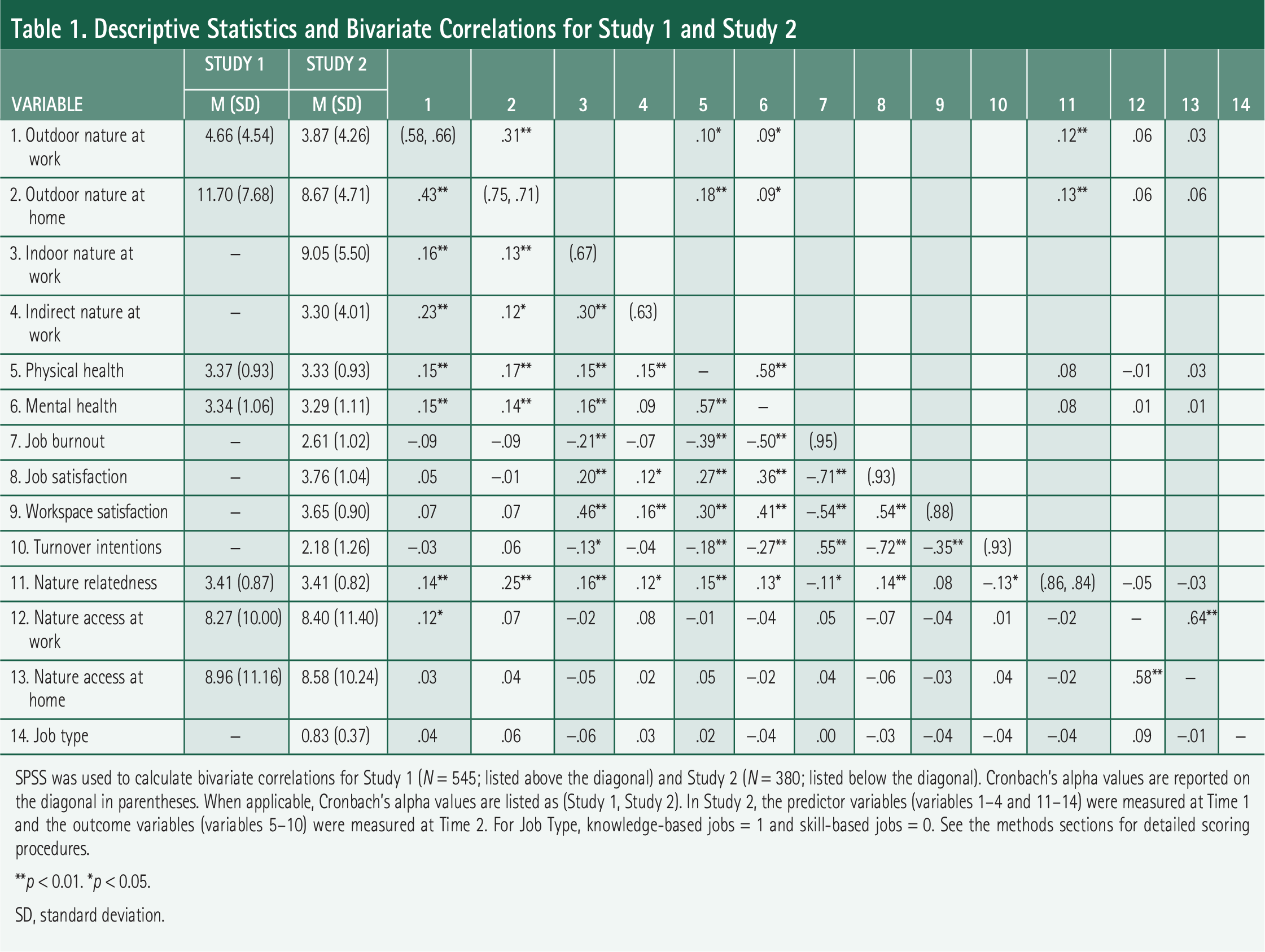
SPSS was used to calculate bivariate correlations for Study 1 (N = 545; listed above the diagonal) and Study 2 (N = 380; listed below the diagonal). Cronbach’s alpha values are reported on the diagonal in parentheses. When applicable, Cronbach’s alpha values are listed as (Study 1, Study 2). In Study 2, the predictor variables (variables 1–4 and 11–14) were measured at Time 1 and the outcome variables (variables 5–10) were measured at Time 2. For Job Type, knowledge-based jobs = 1 and skill-based jobs = 0. See the methods sections for detailed scoring procedures.
**p < 0.01. *p < 0.05.
SD, standard deviation.
Outdoor nature contact at work and home in relation to personal well-being
Outdoor nature contact at work was significantly and positively associated with physical health (b = 0.02, SE = 0.01, p = .016, r2 = .01) and mental health (b = 0.02, SE = 0.01, p = .027, r2 = .01). Similarly, outdoor nature contact at home was significantly and positively associated with physical health (b = 0.02, SE = 0.01, p < .001, r2 = .03) and mental health (b = 0.01, SE = 0.01, p = .034, r2 = .01), see Table 2.
Study 1 Associations Between Nature Contact and Employee Personal Well-Being

The results of two multivariate regressions are reported. Regression coefficients are unstandardized.
*p < .05, **p < .01, ***p < .001.
Nature relatedness as a moderator
Nature relatedness did not moderate any of the associations between outdoor nature contact (at work or at home) and employee personal well-being (i.e., physical health and mental health).
Post Hoc analyses: Surrounding access to public recreation areas
Given that data were collected from participants who live and work in diverse geographic areas across the United States, we had an opportunity to examine the influence of the surrounding environmental context. Access to public outdoor spaces at work and home may relate to usage and employee health. Therefore, supplemental post hoc analyses were performed to include an objective indicator of access to outdoor public recreation areas as a control variable. We used the Parks and Protected Areas Database of the United States to capture land that is accessible to the public for outdoor recreation (PAD-US-AR; Browning et al., 2022). The PAD-US-AR metric is on a 0 (no park cover) to 100 (complete park cover) percentage scale. Participant work and home zip codes were linked to the PAD-US-AR metric to identify the amount of accessible public recreation areas at one’s workplace and home, which were entered as covariates in the relevant models (i.e., PAD-US-AR for the work location was entered into the nature contact at work models; PAD-US-AR for the home location was entered into the nature contact at home models).
Participants had a wide range of accessibility to outdoor public recreation areas, at work and home (minimum = 0, maximum = 76.91), though on average participants’ access to these spaces was low at work (M = 8.27, SD = 10.00) and home (M = 8.96, SD = 11.16). When accounting for access to outdoor recreational spaces at home, the association between outdoor nature contact at home and mental health was only marginally significant (b = 0.01, SE = 0.01, p = .047, r2 = .01). Otherwise, all other results (direct associations and moderations) were consistent with and without the inclusion of the PAD-US-AR control variable. These analyses were also performed using log transformed versions of the PAD-US-AR variables to account for skew, and the findings were consistent.
Study 1 summary
The results from the first study suggest that outdoor nature contact across domains (at work and at home) is associated with greater physical health and mental health, providing support for our hypotheses. Unexpectedly, nature relatedness did not act as a moderator, suggesting that these associations are present even for people who do not feel personally connected to nature. The results were largely consistent even after accounting for the surrounding degree of accessible public recreation areas.
Study 2
Study 2 expanded on the first study by (1) assessing nature contact inside the workplace in addition to outdoor nature contact at work and home, (2) evaluating job well-being in addition to personal well-being, and (3) collecting data across two time points.
Study 2 methods
Study design
Data were collected in April of 2024 on Prolific. The inclusion criteria mirrored Study 1 (i.e., participants were working adults in the United States employed at least 20 hours per week on average in a part-time or full-time paid job, worked at least 10 hours the prior week, and worked primarily indoors). Like the first study, the study was approved by IRB, informed consent was obtained, and all participants received monetary compensation.
Participants
In Study 2 (N = 380), 50% of participants were men, 48.9% were women, and 1.1% were non-binary. The average age of participants was 41 years (SD = 11 years). Allowing participants to select all that apply, participants predominantly identified as White (81.8%), Black or African American (11.6%), Asian (6.3%), and Hispanic, Latino, or Spanish (3.9%). Less than 1% of participants, respectively, identified as American Indian or Alaska Native, Middle Eastern or North African, and Native Hawaiian or Other Pacific Islander. Participants worked an average of 39.86 hours per week (SD = 6.39 hours). Some percentages do not sum to 100% because participants had the option to skip demographic questions.
Measures
Nature contact at work and home
The same measures, response options, and scoring procedures presented in Study 1 were used to assess outdoor nature contact at work in Study 2. To assess outdoor nature contact at home, nonwork time was asked about more generally, rather than with separate questions for days off and before and after work. Otherwise, the approach mirrored Study 1. To assess indoor nature contact in one’s primary workspace, like live plants, animals, or sunlight, six items from the NCQ were used. In addition, six items from the NCQ were used to assess indirect nature contact in one’s primary workspace, such as nature depicted in artwork or on TV monitors. Response options pertaining to the number of natural features were on a 0 to 5 (5 or more) scale. Response options pertaining to frequency were on a 0 (Never) to 4 (Very Often) scale. Due to the different scaling of response options, a linear transformation was applied to frequency items on the 0 to 4 scale to align with a 0 to 5 scale. Items were then summed, such that higher scores reflect greater indoor and indirect nature contact.
Personal well-being
The same measures, response options, and scoring procedures presented in Study 1 were used to assess personal well-being (i.e., physical health and mental health) in Study 2.
Job well-being
Job well-being was assessed with four measures. First, to capture job burnout, six items from the Copenhagen Burnout Inventory that capture work-specific burnout were used (Kristensen et al., 2005; e.g., “Is your work emotionally exhausting?”). One item (“Do you have enough energy for family and friends during leisure time?”) was dropped because it was the only item that was not work-specific and exclusively referred to leisure time. Response options ranged from 1 (Never) to 5 (All of the Time), with higher mean scores reflecting greater job burnout. Next, a three-item measure was used to assess job satisfaction (Cammann et al.,1983; e.g., “In general, I like working here”). Response options ranged from 1 (Strongly Disagree) to 5 (Strongly Agree), in which higher mean scores reflect greater job satisfaction. Satisfaction with the physical workspace was assessed using four items from a larger measure to capture satisfaction with the following aspects of one’s work environment: concentration, lighting, aesthetics, and relaxation (Budie et al., 2018). Response options ranged from 1 (Very Dissatisfied) to 5 (Very Satisfied), such that higher mean scores reflect greater satisfaction with the physical workspace. Last, a two-item measure of turnover intentions was used to capture intentions to quit one’s job (Boroff & Lewin, 1997; e.g., “You are seriously considering quitting your current job for another employer”). Response options ranged from 1 (Strongly Disagree) to 5 (Strongly Agree), in which higher mean scores reflect greater turnover intentions.
Nature relatedness
The same measure, response options, and scoring procedure presented in Study 1 was used to assess nature relatedness in Study 2.
Study 2 results
In Study 2, data were collected across two time points separated by one week to address potential concerns surrounding common method bias (Podsakoff et al., 2012). The nature contact predictor variables and the nature relatedness moderator variable were modeled at Time 1 and the outcome variables were modeled at Time 2. Otherwise, the same analytic approach used in Study 1 was used for the Study 2 analyses.
See Table 1 for descriptive statistics and correlations. Participants reported infrequently going outside at work (M = 3.87, SD = 4.26; 0–20 scale; less than once a day in a five-day workweek) and reported spending more time outside at home (M = 8.67, SD = 4.71; 0–20 scale) in the last week. Participants reported some indoor nature contact at work (M = 9.05, SD = 5.50; 0–30 scale) and sparse indirect nature contact at work (M = 3.30, SD = 4.01; 0–30 scale). On average, participants reported good physical health (M = 3.33, SD = 0.93; 1–5 scale), good mental health (M = 3.29, SD = 1.11; 1–5 scale), experiencing job burnout rarely to some of the time (M = 2.61, SD = 1.02; 1–5 scale), being satisfied with their job (M = 3.76, SD = 1.04; 1–5 scale), being satisfied with their physical workspace (M = 3.65, SD = 0.90; 1–5 scale), and having low intentions to quit their job (M = 2.18, SD = 1.26; 1–5 scale). On average, participants reported moderate nature relatedness (M = 3.41, SD = 0.82; 1–5 scale). Analyses were also performed using log transformed versions of the nature contact variables to account for skew, and the findings were consistent, so all reported results reflect untransformed variables.
Outdoor nature contact at work and home in relation to personal and job well-being
Outdoor nature contact at work was significantly and positively associated with physical health (b = 0.03, SE = 0.01, p = .004, r2 = .02) and mental health (b = 0.04, SE = 0.01, p = .004, r2 = .02), but was not associated with job satisfaction, satisfaction with the physical workspace, job burnout, or turnover intentions. Similarly, outdoor nature contact at home was significantly and positively associated with physical health (b = 0.03, SE = 0.01, p < .001, r2 = .03) and mental health (b = 0.03, SE = 0.01, p = .007, r2 = .02), but was not associated with job satisfaction, satisfaction with the physical workspace, job burnout, or turnover intentions. See Table 3.
Study 2 Associations Between Nature Contact and Employee Personal and Job Well-Being
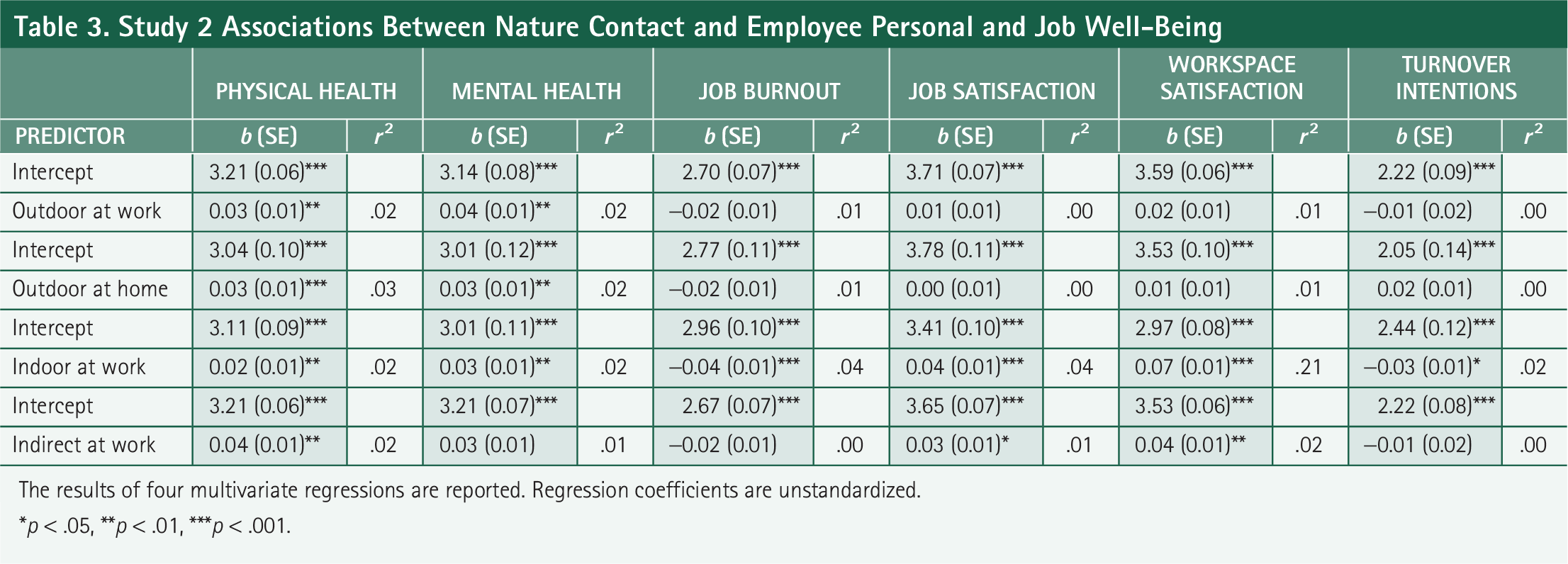
The results of four multivariate regressions are reported. Regression coefficients are unstandardized.
*p < .05, **p < .01, ***p < .001.
Indoor nature contact at work in relation to personal and job well-being
Indoor nature contact at work was significantly associated with physical health (b = 0.02, SE = 0.01, p = .004, r2 = .02), mental health (b = 0.03, SE = 0.01, p = .002, r2 = .02), job satisfaction (b = 0.04, SE = 0.01, p < .001, r2 = .04), satisfaction with the physical workspace (b = 0.07, SE = 0.01, p < .001, r2 = .21), job burnout (b = −0.04, SE = 0.01, p < .001, r2 = .04) and turnover intentions (b = −0.03, SE = 0.01, p = .014, r2 = .02) in the expected directions. See Table 3.
Indirect nature contact at work in relation to personal and job well-being
Indirect nature contact at work was significantly and positively associated with physical health (b = 0.04, SE = 0.01, p = . 002, r2 = .02), job satisfaction (b = 0.03, SE = 0.01, p = .023, r2 = .01) and satisfaction with the physical workspace (b = 0.04, SE = 0.01, p = .002, r2 = .02), but was not associated with mental health, job burnout, or turnover intentions. See Table 3.
Nature relatedness as a moderator
The association between outdoor nature contact at work and satisfaction with the physical workspace was significant only for participants who reported high nature relatedness (b = 0.04, SE = 0.01, p = .003), compared to those who reported average (b = 0.01, SE = 0.01, p = .401) or low nature relatedness (b = −0.02, SE = 0.02, p = .131). Otherwise, nature relatedness did not moderate any other associations between nature contact and well-being. Due to the substantial number of moderation tests performed, we acknowledge that a single significant interaction may reflect a chance finding (i.e., Type I error) and thus refrain from placing substantial weight on its interpretation. For this reason, the interaction graph is omitted from the article and is available upon request. Overall, like Study 1, these findings largely do not provide support for the moderation hypotheses.
Post Hoc analyses: Surrounding access to public recreation areas and job type
The same PAD-US-AR measure that was used in Study 1 was linked to participants’ work and home zip codes. Participants had a wide range of accessibility to outdoor public recreation areas at work (minimum = 0, maximum = 94.66) and home (minimum = 0, maximum = 74.31), though on average participants’ access to these spaces was low at work (M = 8.40, SD = 11.40) and home (M = 8.58, SD = 10.24). When accounting for access to outdoor recreational spaces at work, the association between indirect nature contact at work and satisfaction with the physical workspace was significant for participants who reported average (b = 0.03, SE = 0.01, p = .006) or high nature relatedness (b = 0.06, SE = 0.02, p = .000), compared to those who reported low nature relatedness (b = 0.01, SE = 0.02, p = .633). Otherwise, all other results (direct associations and moderations) were consistent with and without the inclusion of the PAD-US-AR control variable. These analyses were also performed using log transformed versions of the PAD-US-AR variables to account for skew, and the findings were consistent.
Additionally, job type was examined as a control variable, as the availability of outdoor, indoor, and indirect nature contact, as well as employee well-being, may meaningfully vary across jobs. Specific job titles were first categorized into 10 industries 2 specified by the Bureau of Labor Statistics. Most participants worked in Professional and Business Services (56.3%) and Education and Health Services (14.7%). Less than 10% of the sample worked in the remaining eight industries (i.e., Trade, Transportation, and Utilities: 8.9%; Financial Activities: 7.6%; Information: 4.7%; Leisure and Hospitality: 3.2%; Manufacturing: 2.1%; Other Services [except Public Administration]: 1.8%; Construction: 0.3%; Natural Resources and Mining: 0.3%). Given the unbalanced distribution across industry groups, two broader categories were created to capture knowledge-based workers (characterized by intellectual and analytical competencies) and skill-based workers (characterized by manual and technical competencies). Professional and Business Services, Education and Health Services, Financial Activities, and Information reflect knowledge-based work (N = 317) whereas Trade, Transportation, and Utilities, Leisure and Hospitality, Manufacturing, Other Services (except Public Administration), Construction, and Natural Resources and Mining reflect skill-based work (N = 63). The results (direct associations and moderations) were consistent with and without the inclusion of the job type variable.
Study 2 summary
The results from the second study mirrored those found in the first study; outdoor nature contact at work and at home were positively associated with physical health and mental health. Expanding on Study 1, the second study also revealed that indoor nature contact at work was positively associated with each of the personal and job well-being outcomes in the expected directions. Indirect nature contact at work was associated with some aspects of employee well-being. Also aligned with Study 1, nature relatedness did not moderate the associations between nature contact at work and home and employee well-being (with two exceptions that should be interpreted provisionally, as the Type I error rate increases with multiple tests performed). Further, the results were largely consistent even after accounting for the availability of accessible outdoor public spaces at work and home, and after accounting for job type (knowledge or skill-based work).
General Discussion
We evaluated the associations between nature contact across work and home domains and employee personal well-being (i.e., mental health, physical health) and job well-being (i.e., job burnout, job satisfaction, satisfaction with the physical workspace, turnover intentions). Outdoor nature contact, both at work and home, was found to be beneficial for employees’ physical health and mental health. Inside the workplace, nature contact was also associated with favorable employee outcomes. Indoor nature contact (e.g., live plants, sunlight) was associated with greater physical health, mental health, job satisfaction, satisfaction with the physical workspace, as well as lower burnout and lower turnover intentions. Indirect nature contact (e.g., nature in artwork) was associated with greater physical health, job satisfaction, and satisfaction with the physical workspace. Nearly all the findings were consistent when evaluated in two separate samples of working adults and after accounting for potential confounding variables (i.e., access to public recreation areas at work and home, job type). Taken together, these findings suggest that outdoor nature contact is beneficial for employees’ personal well-being, whereas nature contact within the workplace can benefit both personal well-being and job well-being, highlighting the potential for both occupational health and employee retention benefits of nature exposure. These findings provide support for the foundational tenets of biophilia and related environmental and organizational theories regarding the role of nature contact on well-being.
We were also interested in examining whether the associations between nature contact and employee well-being depend on how personally connected individuals feel towards nature. Unexpectedly, across both studies, nature relatedness generally did not moderate the associations between nature contact and well-being. These findings are counter to theory (Brossoit & Leslie, 2025; Kaplan & Kaplan, 1989; Klotz & Bolino, 2021; Ulrich, 1983) and empirical work that has found nature-specific individual differences to strengthen the effects of nature contact on employee outcomes (Klotz et al., 2023; Tang et al., 2023). Our findings suggest that an individual’s sense of interconnectedness with living things and the natural world does not influence whether nature contact at work and home relates to their personal or job well-being; instead, nature contact was positively associated with favorable well-being across the employees in our samples. There were only two significant interactions, both of which suggest that the impact of nature contact at work on employees’ satisfaction with their physical workspace may be strongest for those high in nature relatedness. However, these results should be interpreted cautiously due to the number of moderation tests performed and possibility of Type I errors.
In both studies, the nature relatedness variable was normally distributed, demonstrated good reliability and construct validity, and the sample sizes were large enough to detect small interaction effects. However, the shared variance among the independent variables and the nature relatedness moderator in both studies may have reduced statistical power to detect significant interactive effects. It is also particularly challenging to detect significant moderator effects in nonexperimental field research (McClelland & Judd, 1993), suggesting that future work testing whether the effects of nature contact on well-being depend on nature relatedness would benefit by optimizing internal validity. For example, an intervention aimed at increasing employees’ contact with nature at work (e.g., redesigning workspaces to include more natural light, plants, and nature-themed artwork, or encouraging employees to spend time outside during work breaks) could be tested using an experimental design, with nature relatedness examined as an individual difference moderator. Alternatively, given the large number of scales available to capture individual differences in one’s relatedness, connectedness, and attitudes towards nature, land, and the environment (Keaulana et al., 2021), it is possible that other nature-related individual difference variables may have moderated the effects of nature contact on employee well-being outcomes, providing ample opportunities for future research.
The correlations among nature relatedness and the other study variables are illuminating (see Table 1). Specifically, there are significant correlations between nature relatedness and nearly all the other substantive variables. In both samples, nature relatedness is positively correlated with outdoor nature contact at work and home. In Study 2, nature relatedness is positively correlated with indoor and indirect nature at work. It is possible that people higher in nature relatedness may be more inclined to spend time outside or bring nature into their workspace, or that having greater contact with nature may foster a greater sense of connection to the natural world. Nature relatedness was also positively correlated with physical health, mental health, and job satisfaction, and negatively correlated with job burnout and turnover intentions, aligning with previous research demonstrating that individuals who score high on nature relatedness also tend to report greater well-being (e.g., Nisbet & Zelenski, 2013; Nisbet et al., 2011; Zelenski & Nisbet, 2014). Feeling a sense of personal connection to nature may serve as a protective individual difference for workers, akin to other personal resources (e.g., optimism, resilience; Hobfoll et al., 2018). It is also plausible that nature relatedness may act as a driving predictor, or as a mechanism connecting nature contact with well-being, but not as a moderator that changes the strength of the relationships between nature contact and well-being. We urge researchers to continue examining nature-related individual differences to further clarify the unexpected findings presented in our studies.
It is worth calling attention to indoor nature at work as being particularly advantageous for both personal and job well-being outcomes. Indoor nature contact was significantly associated with each of the outcome variables examined in the present study. Indeed, past work has demonstrated the benefits of the individual components of indoor nature contact (e.g., windows, window views, natural light, animals; An et al., 2016; Leather et al., 1998; Quan et al., 2024; Shin, 2007), so it is reasonable that their combined effect as captured in the indoor nature contact measure would be beneficial to employee well-being. On the other hand, this finding contradicts the assumption that the most direct form of nature exposure — outdoor contact — is the most restorative (Brossoit & Leslie, 2025; Kaplan & Kaplan, 1989; Klotz & Bolino, 2021). Outdoor nature contact was expected to be the most beneficial, but it only influenced physical and mental health — not job well-being. One possible explanation for these surprising results is that both samples included employed adults who work primarily indoors, making indoor forms of nature contact at work more readily available and constant. Indoor employees spend most of their workday inside, constantly surrounded by the indoor and indirect nature features offered by their work environment, whereas outdoor nature exposure presumably occurs during shorter work breaks that account for a small portion of the workday. Thus, the findings may reflect the cumulative effect, or the “dose” of nature contact during the workday. Potential dosage effects, as well as the possibility that indoor nature contact is actually more impactful for employee outcomes, would be worth exploring in future studies. The theorization of how nature impacts people in general may differ from how it impacts people at work, perhaps warranting revisions to nature-specific organizational theories.
Additionally, indirect nature contact at work was also only associated with some well-being outcomes, including physical health, job satisfaction, and satisfaction with the physical workspace, operating more in line with theory (i.e., fewer effects compared to indoor nature contact). However, there was considerably less variability in the indirect nature contact measure, with most participants reporting very little indirect nature contact at work, which may also explain why some hypothesized effects were not detected. In future work, researchers may aim to sample working adults who have high indirect nature contact at work (e.g., people who work in museums) to capture more variability in this measure. Overall, when outdoor and indoor nature contact at work are not feasible, some benefits may still be obtained through indirect forms of nature at work (e.g., nature depicted on computer screens, TV monitors, or artwork).
To better understand the findings in the present study, and more precisely test theory, mediating mechanisms should be explored. For example, stress reduction (SRT; Ulrich, 1983), experiences of recovery from work stress (e.g., psychological detachment, relaxation; NEO model; Brossoit & Leslie, 2025), and the restoration of attention (ART; Kaplan & Kaplan, 1989) and other energies (e.g., emotional energy; biophilic work design model; Klotz & Bolino, 2021) are theorized to explain the effects of nature contact on well-being. Identifying the underlying explanatory mechanisms linking nature contact at work and home to employee personal and job well-being would offer a meaningful theoretical contribution and may also provide insight into our findings (e.g., why some expected associations were not detected, why indoor nature contact was especially beneficial). For instance, outdoor nature contact at work and home (which were not directly associated with job well-being in these studies) may be indirectly linked to job well-being via psychophysiological stress reduction, psychological detachment from work, improved mood, or restored attention. An organization’s investment in natural features within the workplace may also signal to employees that their organization cares about them, so perceived organizational support may also operate as a mediator between nature contact at work and employee well-being (e.g., Bjørnstad et al., 2015). Experiences of spirituality (e.g., Kamitsis & Francis, 2013), mindfulness (e.g., Stewart & Haaga, 2018), and social connectedness (e.g., McNeil et al., 2022) have been found to explain the well-being benefits of nature contact in prior research and may be relevant to employee experiences as well. It is likely that unexplored mediators operate as linking mechanisms between nature contact and employee personal and job well-being outcomes, so it would be worthwhile to test specific indirect effects in future work.
Additional post hoc analyses were performed to account for the surrounding environmental context at work and home (i.e., accessibility of outdoor public areas, using the PAD-US-AR; Browning et al., 2022) as well as job type (i.e., knowledge-based work or skill-based work). Nearly all the results were consistent with and without the inclusion of these covariates, suggesting that the nature contact-well-being associations across two studies were not driven by access to nature or job type, and providing some evidence for the robustness of the findings. Future research investigating nature contact in relation to employee well-being should consider other potential confounds and relevant variables to nature contact and well-being (e.g., socioeconomic status, workplace norms surrounding the use of outdoor greenspaces or bringing nature into the workplace, flexible work schedules, weather; Brossoit & Leslie, 2025; Browning et al., 2022; Klompmaker et al., 2023; Lygum et al., 2023; Petersson Troije et al., 2021).
Limitations and Additional Directions for Future Research
We were interested in examining between-person associations, rather than within-person effects or change over time, considering the presumed stability of nature contact (particularly indoor and indirect nature contact at work). There are exciting opportunities to continue this line of research using more rigorous methodologies. Relationships between nature contact and well-being could be examined over both short time lags (e.g., in an experience sampling design; Fritz et al., 2024) and longer time lags (e.g., in a longitudinal design; Liu et al., 2016), which would provide useful information regarding the degree to which the effects of nature contact are immediate, influence day-to-day experiences, and/or persist over time. Future studies could evaluate changes to indoor nature features (e.g., windows, views, sunlight, plants in one’s workspace), which may be implemented using experimental designs (e.g., Largo-Wight et al., 2024) or quasi-experimental designs (e.g., Raanaas et al., 2012). These study designs are ripe for longitudinal analyses to capture changes in worker experiences. The present findings can build a foundation for future experimental work, particularly organizational interventions, which would reduce self-selection bias (inherent in crowdsourced data) and provide greater confidence in the directionality and causality of effects (e.g., Stone-Romero, 2011). Other avenues for future work may include person-centered techniques, which offer a unique way to explore nature-specific profiles in relation to employee well-being (e.g., Hyvönen et al., 2018). Given our reliance on self-reported outcome measures, the inclusion of objective indicators of stress and health (e.g., physiological indicators of the allostatic load process; Ganster et al., 2018), or company data on actual turnover rates, would advance this area of research.
There are also opportunities for future research to expand on nature contact predictors and employee outcomes. Regarding nature contact, future work could focus more on the home environment. Given our interest in examining nature contact variables that organizations could reasonably influence, we did not consider indoor or indirect nature contact in the home domain. Relatedly, in the wake of the COVID-19 pandemic, there has been a surge of research on remote work arrangements, with studies demonstrating the benefits of nature contact within one’s home office (e.g., Delanoeije & Verbruggen, 2024; Sciulli et al., 2023; Srivastava et al., 2024). Additional outcomes of nature contact at work and home should also be tested in future studies (e.g., job performance, interpersonal outcomes; Brossoit & Leslie, 2025).
One notable limitation is the small size of the effects detected in both studies; for most significant findings, between 1–4% of the variance in the outcome variables were explained by nature contact. Considering the substantial impact physical and mental health-related issues have on individuals, their families, workplaces, and communities (e.g., Hacker, 2024; Kelloway et al., 2023; McGonagle & Barnes‐Farrell, 2014; National Alliance on Mental Illness, 2025; U.S Centers for Disease Control and Prevention, 2024), small effects may still be practically meaningful. Moreover, the costs associated with a dissatisfied workforce and employee turnover are burdensome for organizations to incur (e.g., Hom et al., 2017; Navarra, 2023). Therefore, even moving the needle marginally on these outcomes may be practically useful for workers and organizations. Of note, indoor nature contact at work explained 21% of the variance in satisfaction with the physical workspace, representing a moderate effect. It is possible that satisfaction with the physical workspace may operate as a mediating variable between indoor nature contact at work and experiences of broader job satisfaction and turnover intentions, which we refrained from testing with only two time points of data but could be explored in follow-up research. We urge readers avoid overinterpreting these results considering the trivial effect sizes, while also appreciating the small potential impact of nature contact on employee well-being.
This work contributes to the growing conversation that nature contact is a meaningful health behavior (Maddock & Johnson, 2024; Maddock & Razani, 2024) and informs the larger literature on employee well-being, as it aligns with the
Practical Implications
Findings from the present study offer relatively simple and potentially low-cost practical implications that can be used by organizations interested in holistically improving employee well-being. Organizations interested in employee physical and mental health can provide opportunities for employees to spend time outside during the workday by allocating time for and supporting the use of work breaks, encouraging outdoor meetings, and providing comfortable and accessible outdoor spaces on-site for work and/or breaks. Ensuring that managers, supervisors, and the broader organizational culture supports these approaches is key for ensuring their utility and preventing adverse outcomes, like feelings of guilt or illegitimacy from being outside during the workday (e.g., Lygum et al., 2023; Petersson Troije et al., 2021). Organizations can also influence the extent to which employees can spend time outside at home by providing flexible scheduling options, comprehensive time off and vacation policies, and nature-specific perks like national parks passes or outdoor recreation memberships that could encourage employees to spend their free time outside. Evaluating the impact of these strategies is important for capturing the workplace policies and culture aspect of worker well-being that was missing from the present study (Chari et al., 2018).
In addition to organizational support, companies may consider redesign efforts. The positive correlation between the availability of parks for public recreation near one’s workplace and outdoor nature contact at work (see Table 1) is informative and suggests that organizations and their employees may benefit by investing in the enhancement, protection, and accessibility of local natural areas. Organizations interested in managing employees’ burnout, job satisfaction, satisfaction with the physical workspace, and turnover intentions could also consider bringing natural, biophilic elements into the workplace. Results suggest that increasing indoor nature (e.g., plants, windows, views to the outdoors, sunlight, animals), and, albeit to a lesser extent, indirect nature (e.g., nature depicted in paintings, drawings, photographs, sculptures, or electronics) may benefit employee health, alleviate burnout, improve satisfaction with the physical workspace and with one’s job overall, and reduce the likelihood of quitting. It is worth calling attention to the small effect sizes again, as these practical applications should be carefully evaluated and may be best implemented in combination with other known drivers of employee well-being.
Conclusion
Nature contact is a relatively untapped yet potentially effective, affordable, and feasible way to enhance employee well-being. Results indicate that spending time outside, both at work and at home, is associated with greater physical health and mental health. Additionally, nature contact within the workplace—particularly more direct forms of indoor nature (e.g., plants, sunlight) compared to less direct forms (e.g., nature in artwork)—is associated with greater physical health and mental health, lower job burnout, higher job satisfaction, higher satisfaction with the physical workspace, and lower turnover intentions. Most of these associations do not vary according to participants’ nature relatedness (i.e., feeling personally connected to living things and the natural world), suggesting that even those who do not consider themselves “nature people” still benefit from nature contact at work and home. The results are also not influenced by participants’ access to public recreational parks at work or at home, or by their job type. Collectively, the findings presented in this article add to the growing literature on the benefits of nature contact for employees and organizations.
Authors’ Contributions
R.M.B.: Conceptualization, methodology, investigation, resources, writing—original draft, writing—review and editing, supervision, project administration. H.P.S.: Methodology, formal analysis, data curation, conceptualization, investigation, writing—review and editing, visualization, project administration. A.L.B.: Conceptualization, methodology, formal analysis, investigation, writing—review and editing, project administration. J.J.L.: Conceptualization, writing—review and editing.
Footnotes
Author Disclosure Statement
The authors have no conflicts of interest to disclose.
Funding Information
Funding provided by the Ronald E. McNair Postbaccalaureate Achievement Program, U.S. Department of Education, supported A.L.B.’s work on this article. This research was also supported by a grant from the Centers for Disease Control and Prevention NIOSH Education and Research Center training grant 2T42OH008414.
Data Sharing Statement
Data presented in this article are available upon request.
Ethics Approval Statement
IRB approval was obtained for the data collections presented in this article and informed consent was appropriately obtained from all participants.
1
The sample size from the MTurk data collection differs (by 19 participants) compared to another published paper (Brossoit et al.,  ), which tested different hypotheses and used different variables than those included in this paper. The sample size in the present study is smaller because some participants were excluded to ensure consistent inclusion criteria were used in Studies 1 and 2.
2
Specific job titles were self-reported by participants in an open-response format. All job types were double coded by three research assistants and two of the study’s co-authors. The first round of coding resulted in 65% agreement. The discrepancies were discussed by the coding team and the coding process was repeated, resulting in 92% agreement. The remaining discrepancies were discussed until reaching a consensus.