




Abstract
Abstract
Biological nitrogen removal from municipal wastewater is an important issue. Nitrogen removal by simultaneous nitrification–denitrification (SND) process has drawn much attention in the past few years because of potential reduction in capital and operating costs. Performance of SND process treatment in a continuous flow stirred-tank reactor was examined using Activated Sludge Model No. 1. Individual biomass cells were taken to be suspended with dissolved oxygen (DO) equally available to every cell without considering any floc formation. The combination of operating DO concentration and solids retention time were key factors for effective nitrogen removal. Simulation output predicted significant nitrogen reduction at 0.4 mg/L operating DO and 15-day solids retention time (SRT). The effect of additional operating conditions on nitrogen removal was evaluated. As sufficient electron donor was necessary for sustaining denitrification, the influent biodegradable COD to total kjeldahl nitrogen ratio had significant effect on overall nitrogen reduction and was effective when such ratio was ≥10. Neither hydraulic retention time nor recycle ratio (R) had any notable effect on nitrogen removal. Stochastic simulations considered the natural variability of kinetic and stoichiometric parameters in Activated Sludge Model No. 1 and used Monte Carlo analysis to assess the reliability of SND system operated at optimum conditions. A sensitivity analysis was performed with the stochastic simulation results to identify those model parameters significantly affecting process performance. Predictions from such analysis were found to be in close agreement with previous experimental results and can be used to look into the possibility of converting extended aeration-type activated sludge processes into potential biological nitrogen removal system.
Introduction
Biological nitrification is performed in two steps: at first, NH4+-N is oxidized to NO2−-N (by Nitrosomonous), and in the next step, it is further oxidized to NO3−-N (by Nitrobactor). The nitrifying bacteria are autotrophs and obligate aerobes that use and reduce inorganic carbon in an energy extensive process resulting in low factor of cell synthesis ( fso) and biomass yield factor (Y) values. Their chemolithotrophic nature also translates into a small maximum specific growth rate (μm) value and large minimum solids retention time (θxmin) signifying slow growth of nitrifiers (Rittmann and McCarty, 2001). Rittmann and McCarty (2001) concluded that relatively high value of oxygen half-saturation coefficient (Ko) for nitrifying autotrophs signifies that the nitrifiers are not tolerant of low oxygen concentration, and continuous operation at an operating DO lower than the Ko value will cause an increase in their θxmin value, resulting in washout of biomass from the system and a consequent rise in effluent NH4+-N concentration. Holman and Wareham (2005) suggested that the initial oxidation of NH4+-N is the rate-limiting step of nitrogen removal in SND process. These obligate aerobes are sensitive to DO concentration and the process of nitrification requires an aerobic environment.
Denitrification is the process in which sequential reduction of NO3−-N takes place through intermediates such as nitrite (NO2−), nitric oxide (NO), and nitrous oxide (N2O), and it ultimately produces N2 gas. In contrast to nitrification, increase in DO concentration greater than even by a few tenths of 1 mg O2/L can inhibit the activity of the reductase necessary for catalyzing the reactions (Rittmann and Langeland, 1985; Tiedje, 1988). Also, very low concentration of electron donor (substrate) and too high concentration of DO can lead to accumulation of denitrification intermediates, for example, NO2−, NO, and N2O (Rittmann and McCarty, 2001).
Aerobic heterotrophs responsible for reducing the organic content in wastewater have prolific growth potential. Slower growth rate of nitrifiers can delay onset of denitrification, and denitrifiers can thus eventually encounter a shortage of electron acceptor (NO3−) and also organic electron donor to support their metabolism. In other words, there exists a possibility that aerobic heterotrophs compete for the same substrate and outnumber the denitrifiers, causing disruption in denitrification process. Further, oxygen half-saturation constant for Nitrosomonas is 0.25–0.50 mg/L and that for Nitrobactor is 0.72–2.84 mg/L (Randall et al., 1992), implying that Nitrobactor is more sensitive to low DO concentration, which might lead to inhibition of the second step of nitrification and result in accumulation of NO2−-N (Holman and Wareham, 2005).
In an SND process, these two apparently conflicting environmental conditions are maintained for simultaneous occurrence of nitrification and denitrification in a single reactor. A few important aspects for onset of SND process can be identified as: (1) operating DO level should not be too low failing to support autotrophic nitrification and also not high enough to inhibit denitrification, (2) sufficient solids retention time (SRT) needs to be provided to promote slow-growing nitrifiers, and (3) adequate electron donor has to be available for heterotrophic denitrification. Rittmann and McCarty (2001) concluded that the implementation of SND process required the effective combination of solids retention time (SRT), hydraulic retention time (HRT), and DO concentration. So, it becomes critical to identify the operating conditions at which these two processes, requiring two seemingly different conditions, can occur side by side for efficient nitrogen removal.
Further, Peng and Qi (2007), Zhu et al. (2007), Satoh et al. (2003), Oh and Silverstein (1999), and Pochana and Keller (1999) have discussed the formation of flocs as the possible operational mechanism of SND. Effect of several factors such as size of flocs, level of DO concentration outside the floc (i.e., in the aerobic reactor), extent of oxygen diffusion inside flocs, and so forth, on the degree of nitrogen reduction by SND process have been looked into in some of these research studies and those by other researchers.
Control of operating conditions in an ASP has been implemented with considerable success for improving biological nitrogen removal to upgrade existing plants primarily aimed at biodegradable COD (BCOD) reduction. One of these operating factors in ASP was recognized as DO concentration in aeration tank, which could be adjusted to optimize nitrogen removal and reduce operating cost (Lukasse et al., 1998; Copp et al., 2002; Sin et al., 2004; Insel et al., 2006). The fine tuning of operating DO, particularly at low concentration, was observed to be an effective approach for promoting SND translating into increased nitrogen removal efficiency of the process (Drews et al., 1972; Drews and Greeff, 1973; Applegate et al., 1980; Daigger and Littleton, 2000). However, low DO concentration tends to increase the development of filamentous bacteria, and so this aspect should be further investigated before converting any usual ASP system into SND-ASP.
The objective of this research was to look into the possibility of sustaining SND, provided the operating DO is precisely controlled and if the model can predict the process performance reasonably well without considering either floc formation or existence of any DO concentration gradient across such floc. On finding appropriate operating conditions for SND process for nitrogen removal, a sensitivity analysis was performed by stochastic simulation of the process to account for the natural variability of kinetic and stoichiometric parameters. Operational reliability of this process in achieving nitrogen reduction was indicated by such analysis. The stochastic simulation output was statistically analyzed to identify those parameters significantly impacting nitrogen removal. With the suggested control and operating conditions, existing ASPs can potentially be modified to SND system for nitrogen removal.
Methodology
SND process was simulated using standard GPS-X (2006), version 5.0, which included Activated Sludge Model No. 1 (ASM1). The process units comprised a completely mixed and continuously aerated activated sludge reactor followed by a biomass separator (clarifier).
A primary set of simulations was run taking into account the influent characteristics (Table 1) and the mean values of kinetic and stoichiometric parameters (Appendix A) over a range of solids retention time (SRT) values (Table 2) for any particular operating DO concentration. This process was repeated for a series of operating DO levels varying from 0.1 to 2.0 mg/L. Effective operating parameters (DO concentration and SRT) for occurrence of SND process and significant nitrogen removal were identified from these results. Adopting the same influent, a second set of simulations was run with a selected combination of operating DO and SRT to identify the effects of other parameters (e.g., ratio of BCOD to total kjeldahl nitrogen [TKN] ratio, HRT, and sludge recycle ratio [R]) on total nitrogen (TN) reduction. Each of these parameters was varied in turn over a given range (Table 2) to record its effect on fractional nitrogen removal. The default values of these parameters were influent BCOD-to-TKN ratio of 10 (Table 1), HRT of 12 h, and sludge recycle ratio (R) of 0.5.
Concentrations are expressed in mg/L COD for organic components, mg/L N for nitrogenous species, and mM/L for alkalinity.
Typical proportions taken as per Grady et al. (1999).
ASM1, Activated Sludge Model No. 1.
Process configuration: Complete mix stirred-tank (CSTR) aeration tank with sludge recirculation and wasting followed by secondary clarifier.
Selected ranges typical of a range of simultaneous nitrification–denitrification process configuration (Rittman and McCarty, 2001).
BCOD, biodegradable COD; CSTR, continuous flow stirred-tank reactor; DO, dissolved oxygen concentration in aeration tank; TKN, total kjeldahl nitrogen; θX, solids residence time; θ, hydraulic retention time; R, recycle ratio.
The ASM1 model incorporated seven heterotrophs, five autotrophs, three hydrolyses, and other kinetic and stoichiometric coefficients. Cox (2004) reported that variations in most of these parameter values followed logarithmic probability density function (PDF), and values of some parameters did not vary much and so typical values were recommended. The list of these parameters with statistical distribution parameters and recommended values is given in Appendix A. The simulation performed for SND process with selected operating parameters (i.e., 0.4 mg/L operating DO, 15-day SRT, 12-h HRT, 0.5 recycle ratio, and influent BCOD:TKN ratio of 10) and mean values of kinetic and stoichiometric parameters was termed as discrete simulation.
Stochastic analysis was done for 1,000 Monte Carlo simulations with combinations of values of 15 parameters and operating conditions as above. These simulations were run to obtain the PDFs of steady-state effluent concentrations of various nitrogen species and COD. The sensitivity of SND performance on selected dependent variables (e.g., SS, SNH, and SNO) and nitrogen removal over kinetic and stoichiometric parameters were analyzed. The simulation output was tested by computing the Spearman rank correlation coefficient using Statistical Analysis Software (SAS Institute, Inc.) for each of these 15 parameters to identify those most effectively influencing nitrogen reduction.
The simulations were allowed to run for at least five times the SRT until the state variables converged to obtain the steady-state effluent concentrations. To maintain any stipulated SRT, sludge wasting was done directly from the aeration tank. The secondary clarifier was taken as an ideal biomass separator with 100% particulate removal efficiency in all simulations to focus on process operation.
Results and Discussion
The first set of simulations was aimed at recognizing the optimum combination of operating conditions for simultaneous occurrence of nitrification and denitrification. Simulation results are presented in the form of four contour diagrams to better identify the interacting effect of operating DO and SRT on BCOD (SS), ammonia (SNH), nitrate (SNO), and TN (STN) (Fig. 1a, b, c, and d, respectively). This figure was developed from simulation output obtained by varying SRTs and DO levels.
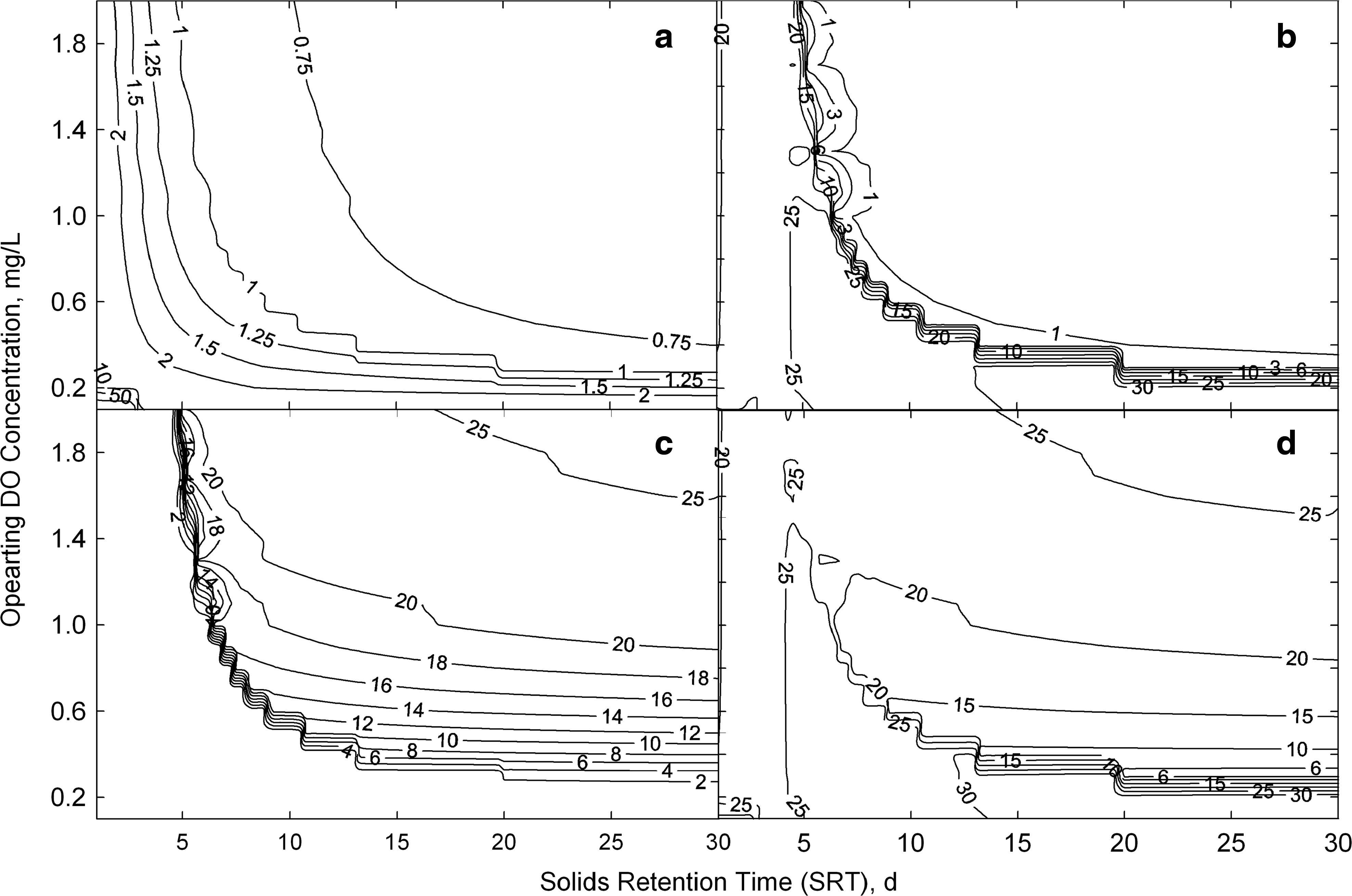
Effect of DO concentration and solids retention time on effluent (
Identification of operating conditions
The organic content of wastewater was predicted to be consumed almost entirely by adopting a 5-day SRT for DO level of ≥ 0.3 mg/L because of prolific heterotrophic growth. Significant TN removal was indicated for an operating DO level of 0.4 mg/L in the aeration tank for ∼13-day SRT (Fig. 1d). Beyond this point, TN removal remained almost unaffected with any further rise in SRT, which was also seen for almost all higher DO levels. Although a better TN reduction was predicted with 0.3 mg/L DO and > 20-day SRT, the combination of 0.4 mg/L DO and 15-day SRT was adopted. Increased DO levels showed inhibition of denitrification process and higher effluent NO3−-N concentration. Although higher DO levels required lesser SRTs for denitrification, overall TN removal suffered as denitrification was suppressed.
A sudden drop in effluent TN with reduced DO levels was noted for > 7-day SRTs. The SND process required retention of enough autotrophic nitrifying biomass by providing higher sludge age for conversion of NH4+-N to NO3−-N. Increased SRT values provided the opportunity of growth of nitrifiers that was reflected in efficient nitrification and subsequent denitrification. This in turn translated into a consequent reduction in effluent TN for corresponding operating DO concentration. Onset of heterotrophic denitrification caused additional consumption of substrate (SS). Selection of 0.4 mg/L DO and 15-day SRT was optimal for efficient nitrogen reduction. Unless stated, simulations were performed adopting this DO and SRT combination for further analysis. The concentration of mixed liquor suspended solids for selected operating condition was around 3,200 mg TSS/L.
Growth rate of nitrifiers
Rittmann and McCarty (2001) indicated that because of small maximum specific growth rate (μm) and large θxmin value, the growth of nitrifier was slow. This implied that sufficient time was needed for their growth in an activated sludge system. The maximum specific autotrophic growth rate (μA) for aerobic nitrifiers in ASM1 model was expressed as (Henze et al., 1987a, 1987b)
For steady state SNH and XB,A concentrations, and given KNH value, the above relationship could be reduced to
where
The limiting minimum value of SRT or
where
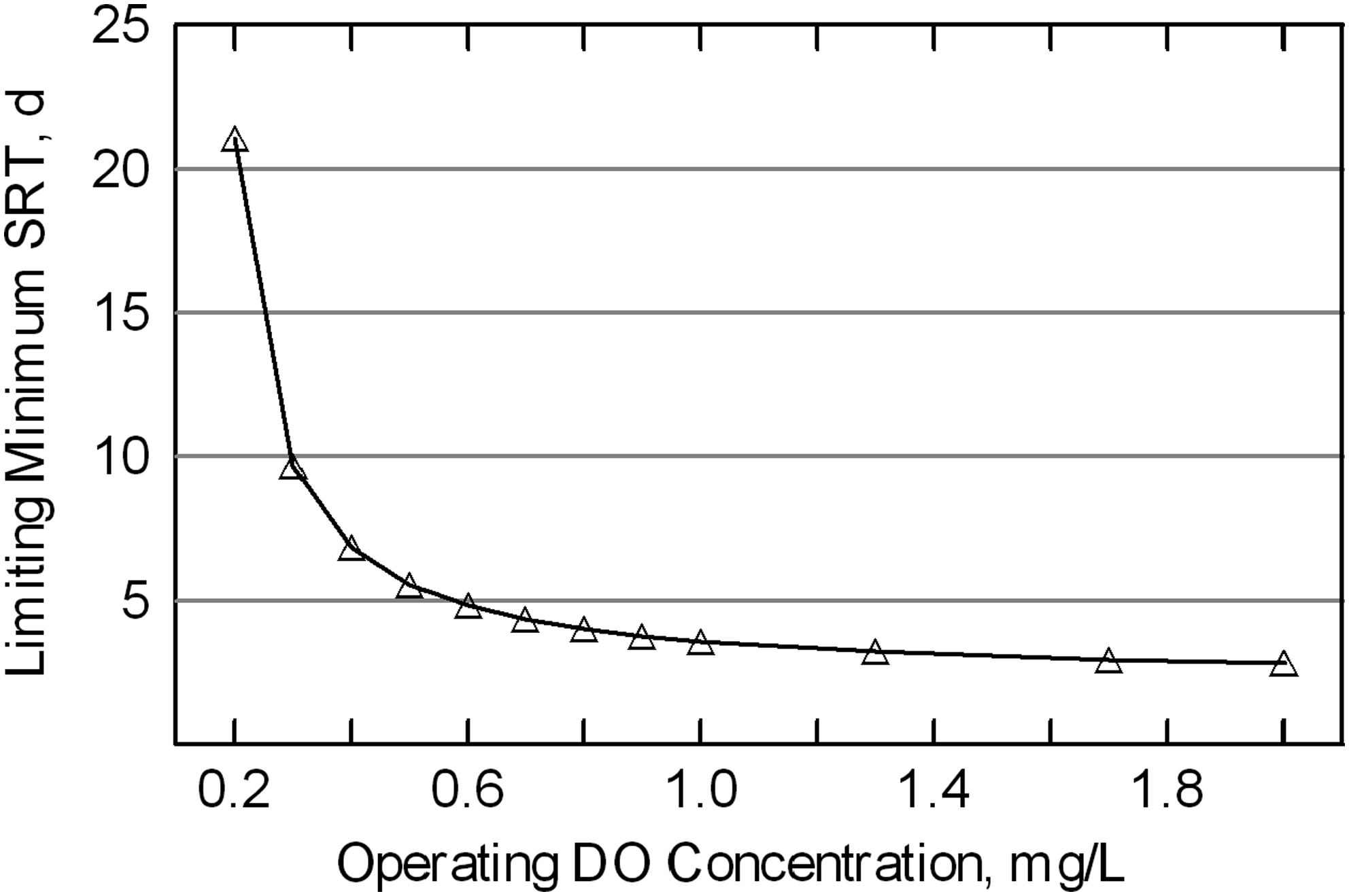
Limiting minimum SRT at various operating DO for growth of autotrophic nitrifiers in continuously aerated system.
Operation of SND system at increased SRT would enhance the reliability of growth of nitrifiers. Also, it could be indicated that adoption of 0.3 mg/L DO and 20-day SRT combination, if operated with this same increased SRT, would have rendered a lower SF for their growth.
Other factors affecting SND process
Once the critical operating parameters (DO and SRT) required for SND process were selected, the effect of other operating factors were studied.
Effect of influent BCOD:TKN ratio
Simulations performed for lower BCOD:TKN ratios (e.g., 4 and 6) indicated a significant drop in alkalinity in the reactor. As the proportion of nitrogen increased in the influent, more nitrogen (in NH4+-N form) was available for oxidation into NO2−/NO3− and only a portion of which eventually underwent denitrification. At the selected DO level (0.4 mg/L), results showed a gradual drop in effluent NO3−-N for increase in BCOD:TKN ratio. TN reduction for such BCOD:TKN ratios ranged from 12% to 56% (Fig. 3a). Increased NO3−-N concentrations in the reactor might have caused acidic condition inflicting a drop in alkalinity. Lower BCOD:TKN ratio in influent wastewater represented lesser carbon source available in comparison to that with higher BCOD:TKN ratios for same amount of nitrogen. Hence, for lower ratios, denitrification was predicted to be subsided because of inadequate carbon source available (i.e., heterotrophs consuming most of the substrate) despite other favorable conditions (e.g., sufficiently low DO, adequate SRT, and sufficient NO3−-N concentration).

Effect of (
For an influent BCOD:TKN ratio of 10, > 75% TN removal was predicted (Fig. 3a). Nitrogen reduction increased almost linearly under the operating conditions as influent BCOD:TKN ratio was raised from 7 to 12. Beyond this point, fractional nitrogen reduction was unaffected by any further increase in this ratio. Over this range, conversion of NH4+-N to NO3−-N by autotrophic oxidation and availability of carbon source for effective denitrification seemed to have reached optimum levels. Over 90% nitrogen removal was predicted for BCOD:TKN of ≥ 12. This ratio proved to be an important determinant of the extent of nitrogen removal that could be achieved.
Effect of HRT
Nitrogen removal when plotted against varying HRTs showed a sudden rise in fractional nitrogen removal from 22% for 5-h to about 80% for 7-h HRT (Fig. 3b). Beyond 8-h HRT, nitrogen removal was unaffected by any further increase. Denitrification suffered for 4-h or less HRT as nominal conversion of NH4+-N into NO3−-N seemed to have occurred. Reduction in both NH4+-N and COD was predicted to increase significantly as the HRT was raised to ≥ 8 h, signifying occurrence of denitrification. This 8-h HRT represented a “threshold” value beyond which performance of SND process remained virtually unchanged by any increase in HRT; yet for HRTs of 6 h or less, denitrification was noted to have been adversely affected.
Effect of sludge recycle ratio (R)
Sludge recycle ratio (R) did not have any appreciable effect on the process, and nitrogen removal was unaffected. The 15-day SRT maintained was shown to be adequate for occurrence of SND process under continuous flow stirred-tank reactor flow regime. Even 25% sludge recycling (i.e., R is 0.25) proved to be sufficient to keep the process running.
Sensitivity analysis of SND process
Stochastic simulations were run adopting the influent characteristics of wastewater and other operating conditions as 0.4 mg/L DO, 12-h HRT, and 0.5 recycle ratio (R). A total number of 1,000 Monte Carlo simulations were done separately with 15-day and 25-day SRT for comparison. The PDFs of steady-state effluent concentrations of BCOD and TN (STN) were plotted (Fig. 4a, b). Stochastic simulation results predicted a process reliability of 22% for 15-day SRT, which was the cumulative probability of the process in meeting the results as predicted by discrete simulation (Fig. 4b). The results with 25-day SRT showed a marginal increase in cumulative probability to 28%. The certainty of obtaining high COD removal in the process was indicated in Fig. 4a.
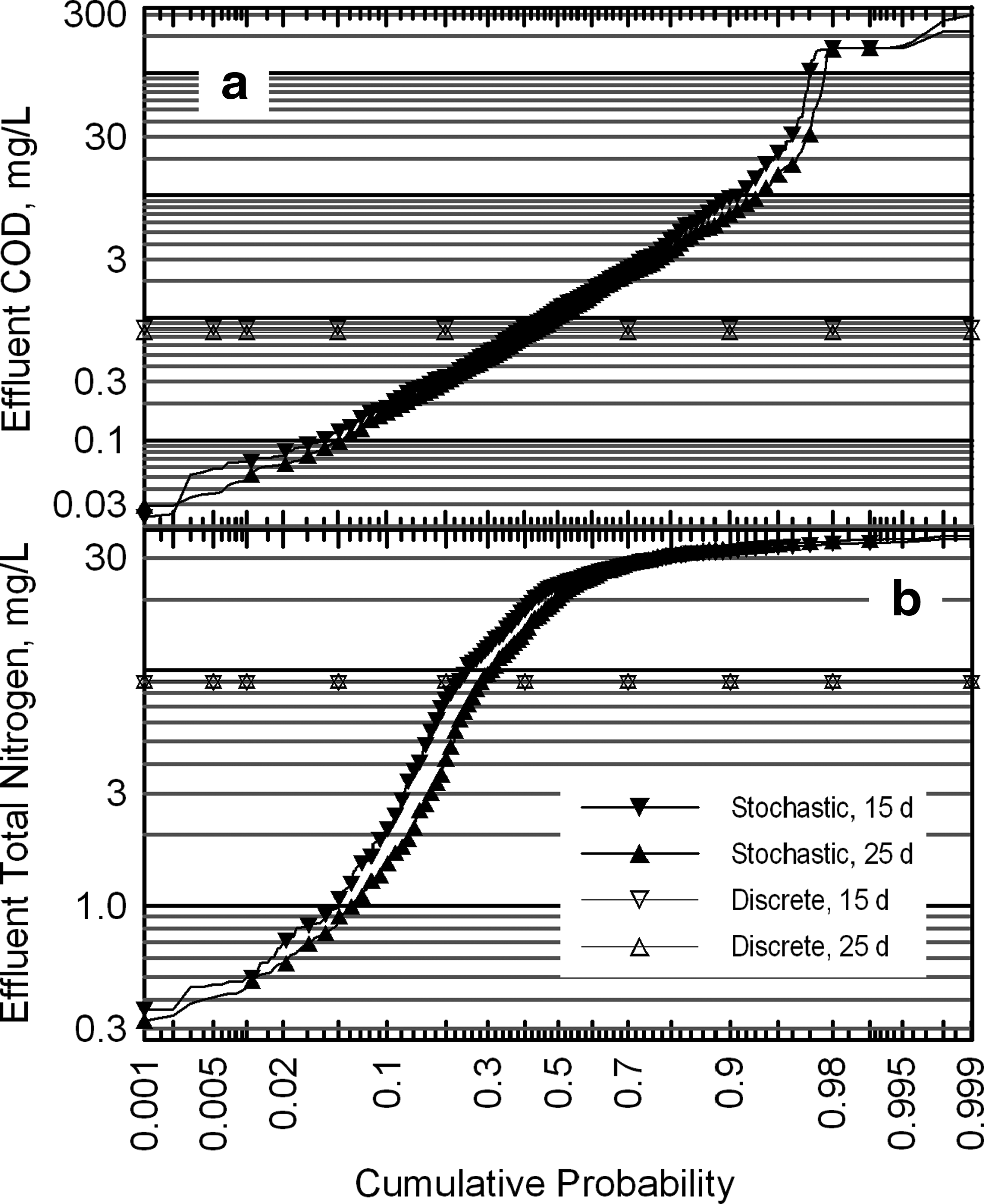
Stochastic simulation results of effluent (
A sensitivity analysis was performed by calculating the Spearman rank correlation matrix using SAS program on stochastic simulation output to identify those kinetic and stoichiometric parameters that notably influenced nitrogen reduction (Appendix B). Strongest positive and negative correlations on overall nitrogen removal was shown by oxygen half-reaction constant for autotrophs (KO,A) and maximum specific autotrophic growth rate (μA).
Comparison with Earlier Studies
The forecasts of this study were in close agreement with the suggestion put forward by Münch et al. (1996) and Insel et al. (2005) that nitrification and denitrification could be achieved simultaneously at a reduced DO level of about 0.5 mg/L. More than 75% of TN removal was predicted by the simulation results for adopting optimum values of operating parameters as 0.4 mg/L DO, 15-day SRT, 12-h HRT, and 0.5 sludge recycle ratio for an influent wastewater with a BCOD:TKN ratio of 10.
In an experimental study, Münch et al. (1996) reported that at an optimum DO of 0.5 mg/L (with 9.4 TCOD:TKN ratio, 18-h HRT, and 15-day SRT), the two reaction rates (nitrification and denitrification) would be similar and this might lead to complete SND. Another laboratory-scale study conducted by Zeng et al. (2003) achieved < 1 mg/L effluent TN at 0.5 mg/L DO and 15-day SRT. Significant nitrogen removal was also reported by Bertanza (1997) in a pilot and real-scale scenario at 0.3–0.5 mg/L operating DO. Available literature was limited on recognizing those kinetic and stoichiometric parameters whose variability might significantly affect nitrogen reduction by SND process.
Simulations performed in the WEST simulation platform (Vanhooren et al., 2003) by Insel (2007) predicted improved TN removal at 0.4 mg/L DO concentration with 20-day SRT for an influent BCOD:TKN ratio of 8. It was identified that a DO set point of KO,A ≥ SOset > KO,H ensured high nitrogen removal with default kinetic and stoichiometric parameters. A study conducted by Lukasse et al. (1998) indicated that in ASM1, both SND and temporally separated nitrification and denitrification processes might be optimal at limiting DO, keeping in view the uncertainty associated with oxygen half-reaction constants of autotrophic (KO,A) and heterotrophic (KO,H) biomass. In a most recent work (Choubert et al., 2009), use of updated ASM1 model parameters for improved prediction of nitrogen removal was suggested, and these parameters were identified as yield factor for heterotrophic biomass (YH), maximum specific growth rate for autotroph (μA), and autotrophic biomass decay rate (bA). Under this study, strong positive and negative correlations were shown by oxygen half-reaction constant for autotrophs (KO,A) and maximum specific autotrophic growth rate (μA), respectively, on nitrogen reduction results obtained with stochastic simulations.
Summary and Conclusions
SND process was simulated using ASM1 to predict optimum operating parameters for its performance and reliability of the process for varying kinetic and stoichiometric parameters and to perform a sensitivity analysis to identify the important process parameters affecting nitrogen removal. The results pointed out some critical aspects of the process: (1) the principle operating conditions to promote SND process for effective nitrogen removal were indicated as 0.4 mg/L operating DO and 15-day SRT; (2) TN removal was found to be dependent on influent BCOD:TKN ratio; and (3) effect of recycle ratio (R) and HRT on nitrogen removal was not appreciable beyond certain minimum values of 0.25 and 6 h, respectively.
Common response of SND process to operating parameters, as predicted by the model, was generally in agreement with the experimental findings. However, certain important observations were made from the stochastic simulations and sensitivity analysis performed and are listed as follows:
For the adopted SRT of 15 days, resulting SF for the growth of nitrifiers was low (∼2.2). As a result, their growth was sensitive to variations in values of other kinetic and stoichiometric parameters, which affected nitrogen removal. Adoption of higher SRT of 25 days, though enhanced the SF for nitrifiers' growth, marginally increased the cumulative probability of the process in meeting the discrete simulation results. This suggested that operating the process at optimum DO concentration was more critical and its operation with increased SRT might not enhance process certainty as effectively as it would for conventional ASP systems primarily aimed at removing organics (Magbanua, 2004). Comparison of model predictions with experimental results indicated that though the structure of ASM1 was suitable for modeling SND process, specific model parameters (e.g., oxygen half-reaction constant for autotrophs [KO,A], maximum specific autotrophic growth rate [μA]) might have to be calibrated. This would more accurately model and simulate the process and reduce the gap between model predictions and experimental findings. It was in line with the suggestions put forward by Choubert et al. (2009) for better prediction of nitrogen removal by ASM1. The PDFs defining the variability of different kinetic and stoichiometric parameters were considered to be separate, but some of these might have joint or connected PDFs.
On tallying the suggested operating conditions and level of nitrogen removal with other experimental results, it was noted that the model predictions were in line with these experimental observations. Hence, according to these model forecasts, the issue of trying to grow biological flocs while maintaining optimum DO to make SND process work could be eliminated. Consequently, the structure of ASM1 was found suitable for simulating SND, and further analysis showed that specific model parameters might have to be calibrated to more accurately model and simulate the process and reduce the gap between model predictions and experimental findings. An organized set of simulations were run for SND process to evaluate the effect of various external conditions and the operational sensitivity of the process to variations in process parameters. The extent of nitrogen removal, indicated to be optimally achieved in a single reactor, seems prospective for capital and operational cost savings. With these simple additions of equipment and controls, extended aeration-type ASPs can be modified into SND system for nitrogen removal. However, the process needs to be suitably calibrated and validated prior to such application.
Nomenclature
Footnotes
Acknowledgments
The author gratefully acknowledges the help and input received from Dr. Benjamin S. Magbanua Jr. and Dr. Dennis D. Truax of Department of Civil & Environmental Engineering, Mississippi State University.
Author Disclosure Statement
No competing financial interests exist.