




Abstract
Abstract
Lack of legal limits for heavy metal content in compost in China necessitates studying effects of heavy metal distribution on resulting toxicity to soil microbes, after the application of heavy metal–contaminated compost. A sequential extraction procedure was used to study the dynamic speciation of cadmium (Cd), and polymerase chain reaction–denaturing gradient gel electrophoresis (DGGE) analysis was applied to observe the changes in bacterial communities in red soil that were stressed by Cd-polluted compost. Results showed that the Cd fractions of exchangeable, carbonate, and Fe-Mn oxides increased (range: 0.88–10.12, 0.19–2.58, and 0.47–1.9 mg/kg, respectively), organic fraction of Cd decreased (0.05–0.34 mg/kg), and residual fraction of Cd did not regularly change with increased Cd content in compost during simultaneous incubation. DGGE profiles indicated that bacterial communities were affected by Cd-polluted compost to some extent. New bands emerged in the early incubation stage, and some bands disappeared in the late incubation stage. Similarity coefficients of DGGE profiles showed that genetic similarity increased at 14 days before incubation (highest, 93.8%) and decreased after 28 days (lowest, 74.6%). High Shannon's diversity index (H) revealed an activation effect of Cd on bacterial communities, which was mainly attributed to the increase in the carbonate fraction with 12.8 mg/kg Cd treatment. Low H values implied an inhibition of bacterial communities by 107.8 mg/kg Cd compost, which was possibly owing to the increases in exchangeable and carbonate fractions.
Introduction
The contamination of agricultural soils by heavy metals accompanied with MSW compost application has become an urgent problem in recent years (Jordao et al., 2006). Heavy metals discharged from MSW together with the soil biogeochemical cycle can contribute to variability in metal content and distribution in soil. Because metallic elements in amended soils are influenced by several factors, including pH, redox potential, the type and quality of soil, the concentration and species of ions competing for adsorption, and particularly by the presence of organic or inorganic ligands (Illera et al., 2000; Kabala and Singh, 2001), the mobilities and availabilities of heavy metal vary with time and location. The determination of total heavy metal concentrations alone provides little information. It is necessary to determine the fraction distribution of heavy metals when assessing heavy metals mobility and availability in soil (Cornu and Clozel, 2000). The use of sequential extraction techniques provides essential information for a better understanding of heavy metal behavior in soils, including potential mobilities, availabilities, and assimilation by plants (Kabala and Singh, 2001). Transformation of heavy metals includes five major forms, namely, (1) exchangeable fraction, (2) carbonate fraction, (3) Fe-Mn oxides fraction, (4) organic fraction, and (5) residual fraction. Among the five major forms, the exchangeable and carbonate fractions have been considered bioavailable or toxic to soil microbes, whereas others are not considered bioavailable to microbes.
Pollution with heavy metal may influence microbial community composition (Smit et al., 1997; Turpeinen et al., 2004) and cause changes in microbial biomass and activities (Hu et al., 2007; Liao and Xie, 2007; Wang et al., 2007). Several methods have been proposed for evaluating the responses of soil bacterial community structures to heavy metal pollution, for example, community-level physiological profiling (Classen et al., 2003), fatty acid methyl ester analysis (Zelles, 1999), and nucleic acid profiling techniques (Eriksson et al., 2003; Cardinale et al., 2004). Nucleic acid-based techniques, such as polymerase chain reaction–denaturing gradient gel electrophoresis (PCR-DGGE) (Li et al., 2006; Malik et al., 2008), provide exciting opportunities for bypassing traditional culture methods and have consequently greatly increased the understanding of microbial diversity in natural ecosystems.
In China, there is no legal limit for heavy metal content in compost because of the lack of scientifically based supporting information. Using reference limits from other municipalities is risky because heavy metal effects have different mobilities or bioavailabilities in different media such as compost or sludge. For example, the Control Standards for Pollutants in Sludge for Agricultural Use (GB 4284-84) in China suggests limits <20 mg/kg for cadmium (Cd), <1,000 mg/kg for Pb, <15 mg/kg for Hg, and <1,000 mg/kg for Cr for materials used in agriculture.
To date, very few reports have focused on the relationship between metal fractions and bacterial communities after the application of heavy metal–contaminated compost to soils. However, red soil is widely distributed in southern China, and it supports an important grain production base. It is essential to clarify the biological effects of heavy metal in compost on this soil microenvironment. Red soil in southern China was selected for this study. Referring to the limit for Cd (<20 mg/kg) in the Control Standards for Pollutants in Sludge for Agricultural Use (GB 4284-84) in China, three levels of Cd content, 7.8 mg/kg (background value), 12.8 mg/kg (lower than the 20 mg/kg limit and 5 mg/kg higher than the control), and 107.8 mg/kg (higher than the 20 mg/kg limit and 100 mg/kg higher than the control) were used to assess the effects of Cd-contaminated compost on (1) relative contents of Cd fractions in red soil determined by a sequential extraction procedure and (2) bacterial communities estimated by PCR-DGGE analysis after total bacterial DNA extraction from soil.
Materials and Methods
Samples of compost and soil
Compost was purchased from the Biological Engineering Company of Hunan, China, with an organic matter content of 30%, pH of 6.3, moisture content of 7.6% (w/w), inorganic materials (N + K2O + P2O5, 6%), and 7.8 mg/kg Cd. The compost sample was sieved through a plastic screen (1 mm pore size). The Cd-containing solution was sprayed on the compost sample to obtain two treatments with final Cd concentrations of 12.8 and 107.8 mg/kg. The Cd-contaminated composts were then incubated for 7 days at 28°C (±1°C). During the incubation period, distilled deionized water was added to the samples every second day to maintain the moisture content at 40%. After incubation, the samples were air-dried and ground.
Red soil samples were collected from the surface layer (0–20 cm depth) in an old citrus orchard in Hunan Province, South China. The soil used is termed “Ferralsol” in the Chinese soil classification system and “Ultisol” in the American soil classification system. Fundamental soil characteristics were analyzed according to the method of Lu (2000). The composition was 36.50% clay, 44.87% silt, and 18.63% sand. The soil pH was 4.8, with 11.1 cmol/kg cation exchange capacity, 9.1 g/kg organic matter, 129.5 mg/kg alkaline hydrolysis nitrogen, 3.2 mg/kg rapidly available phosphorus, 54.3 mg/kg rapidly available potassium, and 8.15 mg/kg Cd. The soil used for the experiment was sieved with a 2.5-mm-diameter mesh.
Experimental design
A laboratory incubation experiment was designed to analyze changes in Cd fractions and bacterial communities after application of Cd-polluted compost to red soil. In each treatment, 1,500 g of fresh soil sample was mixed thoroughly with 100 g of compost containing 7.8, 12.8, or 107.8 mg/kg Cd (Cd0, Cd1, and Cd2). Mixtures were added to polyethylene cylindrical containers (with a height of 20 cm and a diameter of 15 cm) and incubated at room temperature for 50 days. Each treatment was performed in triplicate. During the incubation period, the soil moisture content was maintained at 40% of water-holding capacity with deionized water. Soil (100 g) was sampled on days 0, 3, 7, 14, 28, and 50 from the start of incubation. Portions of soil samples were dried and sieved through 1-mm pores and used to determine the Cd fractions. Other samples were preserved at −21°C for later application of PCR-DGGE to detect shifts in bacterial communities.
Cd analysis
Cd speciation (exchangeable fraction, carbonate fraction, Fe-Mn oxides fraction, organic fraction, and residual fraction) in the soil was determined by a modified sequential extraction procedure (Tessier et al., 1979; Li et al., 1995). After each extraction, sediment/water separation was performed by centrifugation at 3,000 rpm for 30 min. Subsequently, liquid samples were filtered through 0.45-μm cellulose nitrate membranes and measured for metal concentrations by flame atomic absorption spectrometry (AA700; Perkin-Elmer).
PCR-DGGE analyses of bacterial communities
Total DNA of each soil sample was extracted with proteinase K and cetyl trimethyl ammonium bromide as described by Zhou et al. (1996) and Moffett et al. (2003). Purification of total DNA was performed with a silver bead DNA gel extraction kit (Sangon: SK111) according to the manufacturer's instructions, followed by suspension of the DNA in 30 μL of TE buffer. The DNA solution was assessed by agarose gel electrophoresis.
Total DNA from the 18 samples was used as a template to amplify the V3 variable region of the bacterial 16S rDNA gene with PCR using the universal primers GC338F (5′-CGC CCG CCG CGC GCG GCG GGC GGG GCG GGG GCA CGG GGG G CCT ACG GGA GGC AGC AG-3′) and 518R (5′-ATT ACC GCG GCT GCT-3′) (Ana and Baltasar, 2006).
Each 50 μL PCR mixture contained 2 μL of template DNA, 5 μL of 10× buffer with MgCl2 (TianGen), 1 μL of 10 mM dNTP mixture (TianGen), 1 μL of 10 μmol/mL of each primer (Sangon), 0.6 μL of 2.5 U/μL Taq DNA polymerase (TianGen), 2 μL of 10 mg/mL bovine serum albumin V (Sangon), and 37.4 μL of sterilized Milli-Q water. PCR amplification was performed with the following cycling conditions: 4 min at 94°C, 35 cycles consisting of 30 s at 94°C, 40 s at 56°C, and 40 s at 72°C, and a final 7 min extension at 72°C. Products were stored at −20°C before analyzing. The PCR products (5 μL) were visualized by 1.5% agarose gel electrophoresis at 100 V/cm for 25 min after mixing with 0.5 μL of 100× SYBRTM Green I and visualized with the Gel Doc XR System (Bio-Rad).
The expected size of the amplified fragment was 240 bp. DGGE analysis was performed in a DCodeTM Universal Detection System instrument and gradient former Model 475 according to the manufacturer's instructions (Bio-Rad). The denaturant solution was prepared according to the protocol of Muyzer et al. (1993). The acrylamide concentration in the gel was 8% and the denaturing gradient was 30%–65%. Electrophoresis was performed in 1× TAE buffer at 60°C for 12 h at 130 V. Gels were stained with 1× SYBRTM Green I and visualized in ultraviolet light with the Gel Doc XR System.
Statistical analyses
Data of Cd fractions in the soil were analyzed with Excel software. Banding patterns of the DGGE profile were processed using Quantity One gel analysis software (Bio-Rad). This software identifies the bands occupying the same position and the intensities among different lanes of the gel. The Shannon index (H) was used to estimate red soil bacterial communities on the basis of the intensity and band numbers using equation (1) (Zak et al., 1994). The phylotype profiles of the samples from paired samples were compared by Sorenson's index (Cs), a pairwise similarity coefficient that was calculated by equation (2), (Murray et al., 1996; Gillian et al., 1998). Cs values range from 0 to 100.
where ni is the peak height of the band i, N is the sum of peak heights in a given DGGE gel profile, Ljk is the number of bands common to lanes j and k, Lj is the number of bands in lane j, and Lk is the number of bands in lane k.
Results and Discussion
Cd formation distribution with sequential extraction process
The forms of heavy metals in soil greatly influence both heavy metal availabilities to plants and microbial community diversities. Sequential extractions allowed for the assessment of the distribution of bound heavy metals in soil and were used to predict phyto-available amounts of metals. To determine Cd transformation and phyto-availability in red soil treated with Cd-contaminated compost, a sequential extraction procedure was used to analyze the changes in the distributions of Cd fractions after treatments.
Cd fractions transformed in response to metal amendment over the experiment duration (Fig. 1). After 3 days of incubation, Cd content in the exchangeable, carbonate, organic, and Fe-Mn oxides fractions increased Cd content in compost during the same incubation time. The exchangeable fraction of Cd did not transform significantly with time in the control, whereas it decreased in the first 3 days of incubation and then increased with 12.8 mg/kg Cd treatment. The exchangeable fraction of Cd increased with time with 107.8 mg/kg Cd treatment, with 5.5- and 2.3-fold increases compared with those for control and 12.8 mg/kg Cd treatment, respectively. The carbonate fraction of Cd increased during the first 3 days of incubation, decreased from day 3 to 7, and then gradually increased in the control and 12.8 mg/kg Cd treatment. With 107.8 mg/kg Cd treatment, the carbonate fraction of Cd increased in the first 7 days of incubation, decreased from day 7 to 14, and gradually increased thereafter. The organic fraction of Cd had no regular changes with control treatment. This fraction gradually declined from 0.35 mg/kg to nearly 0 on day 28 of incubation with 12.8 mg/kg Cd, whereas it fell rapidly to nearly 0 on the same day with 100 mg/kg treatment. The Fe-Mn oxides fraction of Cd increased during the early incubation stages and decreased thereafter in the control and during 12.8 mg/kg and 107.8 mg/kg Cd treatments. The residual fraction of Cd had no regular changes over time in the control, whereas it increased and reached a high value of 3.48 mg/kg on day 28 of 12.8 mg/kg Cd treatment. This fraction decreased and reached a low value on day 7 of 107.8 mg/kg Cd treatment.
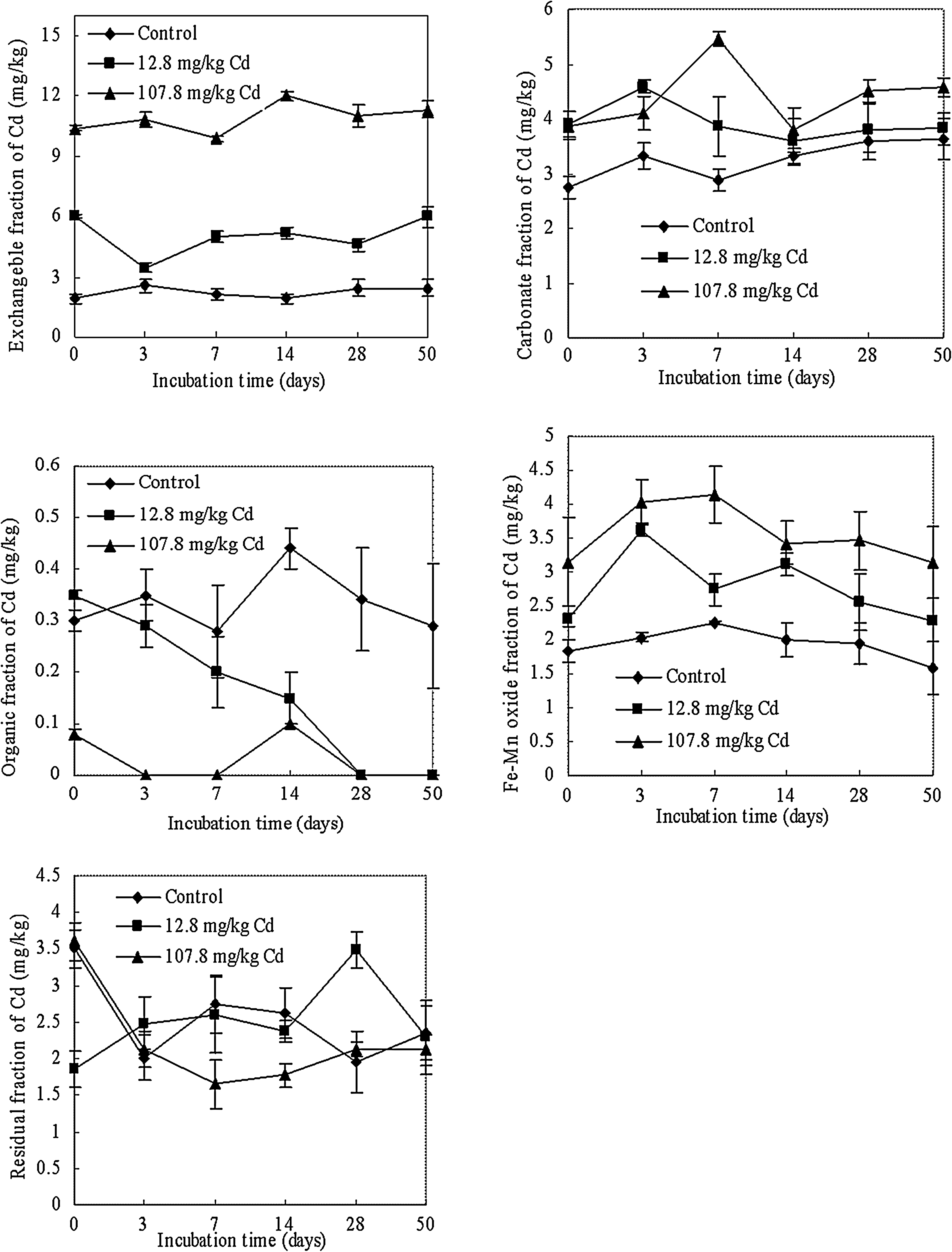
Cd fractions in control and 12.8 and 107.8 mg/kg Cd compost treatments. Cd, cadmium.
Addition of organic amendments to soil can contribute to metal immobilization through the formation of stable complexes with -OH or -COOH groups on solid surfaces of the organic polymers (Madrid et al., 2007). Udom et al. (2004) showed that increased organic matter content contributes to heavy metal fixation in soil through the formation of organometallic complexes, thus decreasing heavy metal mobility and phytotoxicity. However, when compost contaminated with heavy metals was added to red soil, the organic amendments had different effects on metal availability. The results showed that Cd transformation and phytotoxicity increased with increased Cd content in compost. The increase in phytotoxicity was due to the increase in the exchangeable fraction content with increasing Cd content in compost. In the control, Cd did not transform significantly among the five fractions. However, there was obvious transformation of organic and Fe-Mn oxides fractions to exchangeable and carbonate fractions in the treatments amended with Cd. Similar results were found by Perez et al. (2007), who showed that composted municipal wastes underwent significant increases in the Cd concentrations of carbonate and exchangeable fractions. The acid condition (pH 4.8) of red soil may be the main reason that led to the increase in Cd mobility.
Relative proportion of Cd fractions
The relative proportions of individual Cd fractions among treatments are displayed in Fig. 2. Over the course of incubation, increasing Cd concentrations in compost led to an increase in the exchangeable fraction and proportional decreases in the organic and residual fractions, whereas proportions of carbonate and Fe-Mn oxides of Cd had no obvious changes during treatment.

Distribution of Cd fractions in control (
Among different fractions, the exchangeable fraction has the highest mobility and bioavailability and is therefore the most potentially toxic fraction in soils (Petruzzelli et al., 1994). The exchangeable fraction of Cd content increased with increasing Cd content in compost. Therefore, the application of contaminated compost to soil increased Cd bioavailability. The results showed that all five fractions of Cd had increased transformation with higher Cd content in compost.
Bacterial community analysis using PCR-DGGE
The diversity of the bacterial community in each sample was analyzed by PCR-DGGE of amplified V3 region 16S rDNA genes. DGGE analysis was performed with the total DNA directly extracted from soil samples. DGGE banding patterns indicated that numerous common bands existed among treatments, such as bands a, e, g, i, k, l, m, and n. However, there were changes in band presence and relative intensity in response to Cd content (Fig. 3). As incubation time progressed, some faint bands disappeared, including bands b, o, and p, while some bands (including bands A, B, and C) in DGGE profiles decreased in intensity after 50 days. Additionally, the intensity of some DGGE bands increased (including bands e, g, l, and n) over time, which suggested that some soil microorganisms may use compost as an energy source and cause a shift in the relative abundances of soil bacterial groups. This effect may be enhanced by tolerance to Cd in some microbe species. Those without this metal tolerance would disappear over time, such as bands b, o, and p. However, new bands r, h, A, B, C, and D appeared in DGGE profiles during the first 14 days of incubation. There may be new microbial species with tolerance to Cd contamination in red soil.
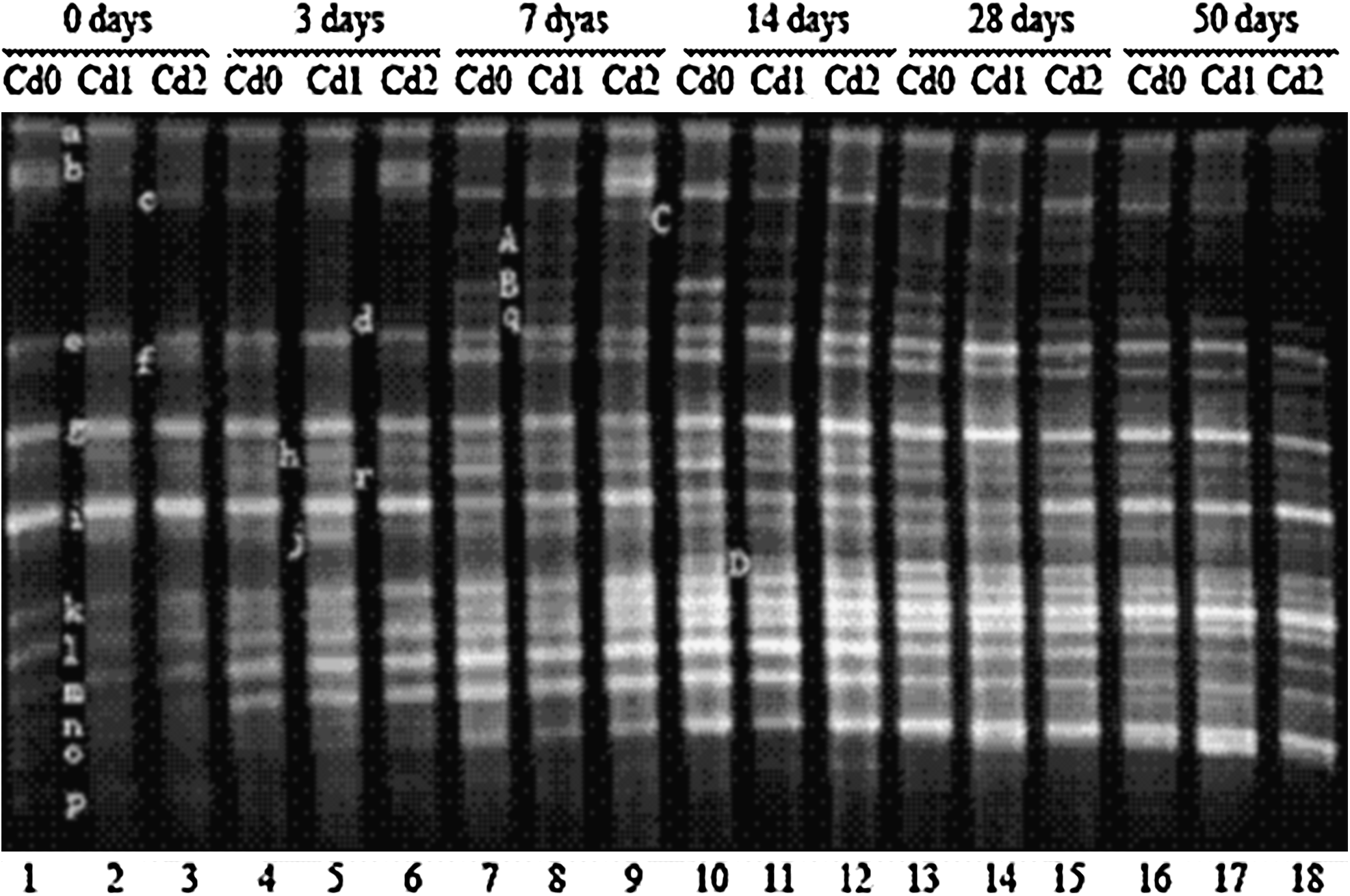
Denaturing gradient gel electrophoresis profiles of the 240-bp polymerase chain reaction fragment of 16S rDNA genes (V3 region) amplified after different soil treatments. The gradient of the urea and formamide ranged from 35% to 70%. Cd0, controls; Cd1, soil treated with compost contaminated with 12.8 mg/kg Cd; Cd2, soil treated with compost contaminated with 107.8 mg/kg Cd. Lanes labeled 1–18, respectively. Bands marked with uppercase letters (A–D) and lowercase letters (a–r) showed different bacterial communities in different treatments.
Previous findings showed that heavy metals in soil not only affected the number of dominant bacterial types but also changed the community structure. Those results suggested that heavy metals caused a decrease in bacterial species richness, a relative increase in soil actinomycetes or even decreases in both the biomass and diversity of the bacterial communities in contaminated soils (Fritze et al., 2000; Akmal et al., 2005; Renella et al., 2005; Hu et al., 2007).
To clarify the differences in bacterial community diversity, H values were calculated by analyzing 16S rDNA gene fragments of DGGE (Table 1). The results showed that the bacterial community structure increased in the early incubation stage (28 days) and decreased in the late incubation period (after 50 days) in response to Cd content in compost. During the incubation period, diversity was high with 12.8 mg/kg Cd compost treatment compared with the other treatments. The highest H values for 12.8 mg/kg content among the three treatments revealed that 12.8 mg/kg Cd in compost had an activation effect on bacterial communities. The lowest H value was noted with 107.8 mg/kg Cd treatment until the culture terminal.
Cluster analysis of genetic diversity
To clarify genetic diversity differences of bacteria in red soil, the method of unweighted pair-groups using arithmetic averages (UPGMA) was used to detect the phylogenetic similarity of DGGE fingerprints (Fig. 4). The results showed that the genetic similarity of all samples was 56%. The greatest difference was found between the profiles of lane 1 and all other profiles. Lane 1 was the only member of the cluster. With increasing incubation time, genetic similarity of DGGE profiles gradually increased from 62% to 93.8% compared with lane 1 during the first 14 days of incubation and gradually decreased after 28 days from 92.7% to 76.4%. These results implied that the differences in the genetic diversity of soil bacteria increased during the first 14 days of incubation and decreased after 28 days.
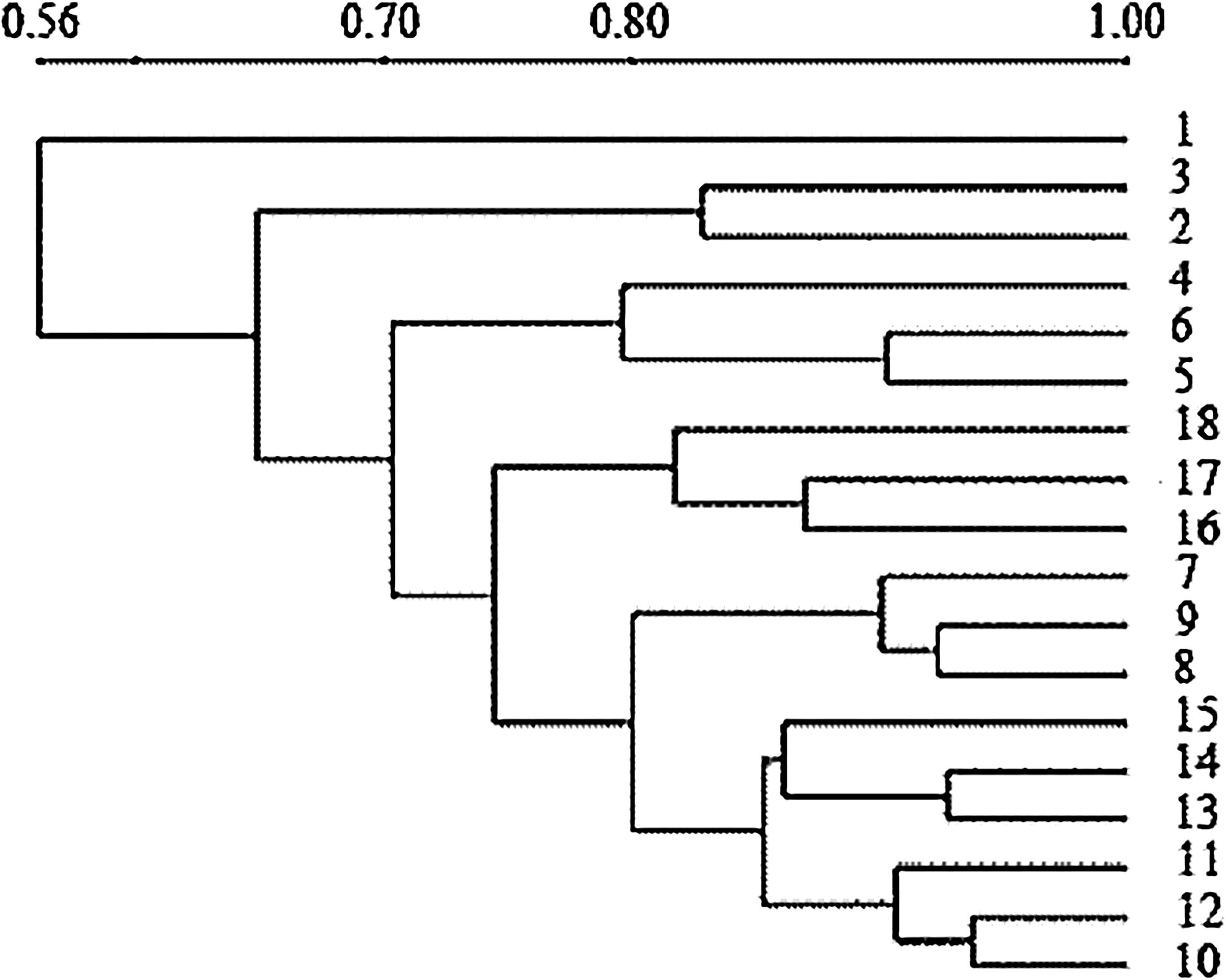
Unweighted pair-groups using arithmetic averages cluster analysis of banding patterns generated by polymerase chain reaction–denaturing gradient gel electrophoresis of 16S rDNA fragments from different soil treatments. The horizontal axis is a scaling of sample similarity. Numbers 1–18 refer to electrophoretic lanes in Fig. 3.
Profiles of 12.8 and 107.8 mg/kg Cd treatments were quite similar (83%–92%) and distinct from that of the control over the first 7 days of incubation. Hence, effects of Cd on bacterial communities were evident in the early incubation stage. At day 14, profiles of lanes 10 and 12 were 94% similar, which was the highest genetic similarity observed in the experiment. After 28 days, similarity profiles ranged from 83% to 92% between control and 12.8 mg/kg Cd treatment, and they were more similar to one another than to the 107.8 mg/kg Cd treatment profile, indicating that the exchangeable fraction of Cd had inhibitory effects on bacterial communities in the late incubation period.
Relationship of bacterial communities and Cd fractions
Cd fractions in soil affected the mobility and bioavailability of microbes, further influencing bacterial communities. The correlation coefficients among Cd fractions are shown in Table 2. The statistical analysis according to five fractions of Cd content is shown in Fig. 1. The variability in bacterial communities indicated the possibility that different fractions of Cd may result in communities that are more variable and less stable. In the control, the exchangeable fraction of Cd had a positive correlation (0.67) with the carbonate fraction and had a negative correlation with the others. From previous results (Fig. 3), bacterial communities increased during the first 28 days of incubation and had a small decrease after 50 days, which indicated that Cd fractions had little toxicity on bacterial communities in the control. In 12.8 mg/kg Cd samples, the carbonate fraction of Cd had a positive correlation with the organic fraction (0.49) and a negative relationship with the exchangeable fraction (−0.71). Bioavailability of heavy metals could commonly be expressed with the proportion of carbonate and exchangeable fractions in the total heavy metal content (Adriano, 2001). Activation of bacterial communities with 12.8 mg/kg Cd treatment was mainly attributed to the increase in the carbonate fraction (Fig. 1). In 107.8 mg/kg Cd samples, the exchangeable fraction had a positive correlation with the organic fraction (0.41), and the carbonate fraction had a positive correlation with the Fe-Mn oxides fraction (0.51). Bacterial communities decreased with the increase in exchangeable and carbonate fractions during incubation. In compost with high Cd content, inhibition of bacterial communities was possibly due to the increases in exchangeable and carbonate fractions.
Conclusions
Results from this study suggested that Cd fractions exhibited transformation behavior and mobility in soil. During incubation, Cd fractions of exchangeable, carbonate, and Fe-Mn oxides increased, the organic fraction decreased, and the residual fraction did not regularly change with increased Cd content in compost. Genetic similarity was increased in the early incubation stage and decreased in the late incubation period. Bacterial communities were activated by the carbonate fraction in 12.8 mg/kg Cd-contaminated compost and inhibited by exchangeable and carbonate fractions in 107.8 mg/kg Cd-contaminated compost. To obtain more information about the influence of heavy metal–contaminated compost on the soil environment, further studies should focus on the effects of Cd accumulation following repeated compost application on the distribution of Cd fractions and long-term potential biomass toxicity.
Footnotes
Acknowledgments
This study was financially supported by the National Natural Science Foundation of China (50908078), Special Foundation of China Postdoctoral Science (200902467), China Postdoctoral Science Foundation (20080430153), Xiangjiang Water Environmental Pollution Control Project subjected to the National Key Science and Technology Project for Water Environmental Pollution Control (2009ZX07212-001-02 and 2009ZX07212-001-06), and Program for Changjiang Scholars and Innovative Research Team in University (IRT0719).
Author Disclosure Statement
No competing financial interests exist.